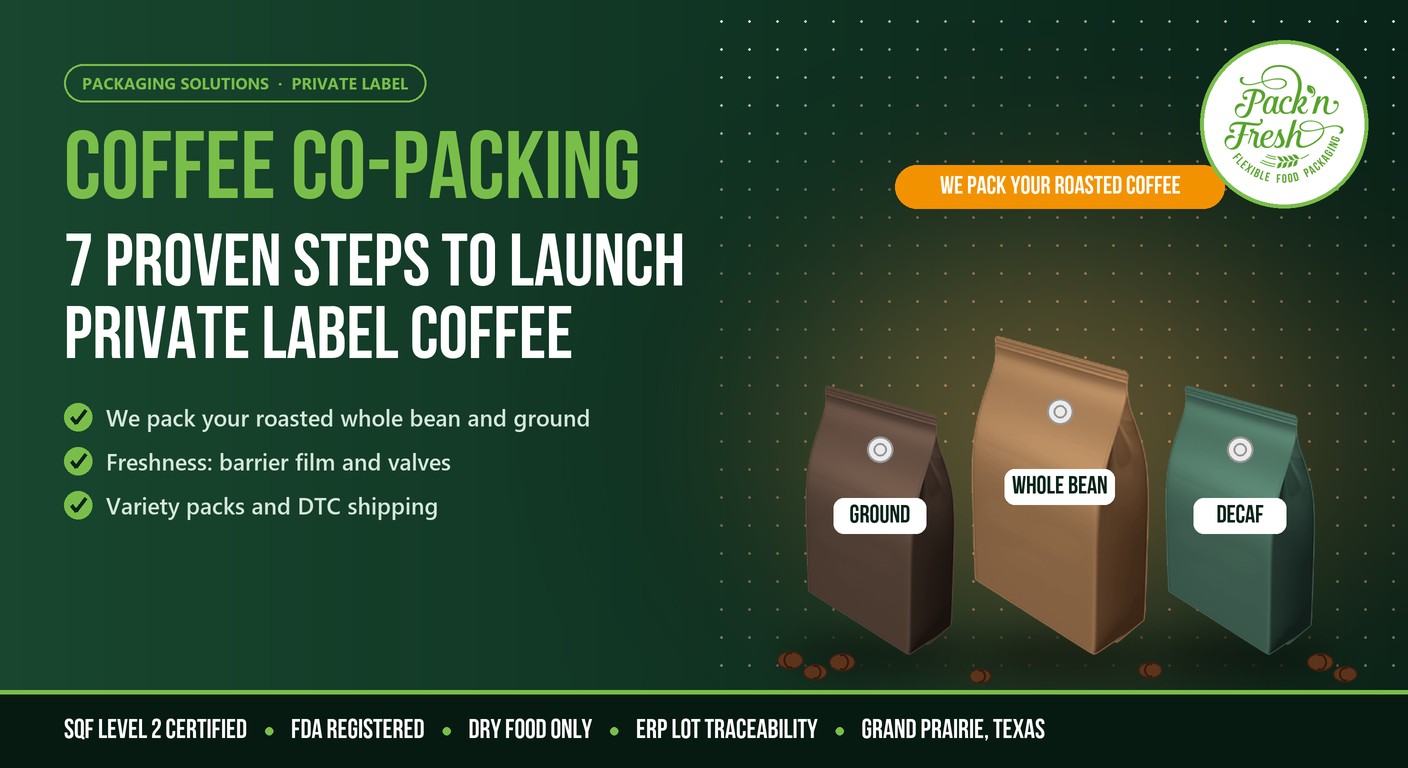
Coffee Co-Packing: 7 Proven Steps to Launch Private Label Coffee
Coffee co-packing lets a brand put roasted coffee on shelves and doorsteps without building its own packaging line. The demand is there: the National Coffee Association reports that 66% of American adults drank coffee in the past day in its Spring 2026 National Coffee Data Trends study, more than any other beverage.
At the same time, shoppers are warming to store brands. According to PLMA and Circana data reported by Food Processing, U.S. store brand sales reached a record $282.8 billion in 2025. Retailers, specialty brands and subscription startups all see coffee as a natural place to grow a private label range.
But roasted coffee is one of the most freshness-sensitive dry products a brand can pack. Oxygen, moisture and trapped carbon dioxide all work against flavor from the moment the beans leave the roaster. This guide walks through seven decisions that shape a successful coffee co-packing program, from whole bean versus ground to valves, formats, labels, certifications and partner selection.
Table of Contents
- Why Private Label Brands Use Coffee Co-Packing
- Whole Bean vs. Ground: How Packaging Needs Differ
- Protecting Freshness: Oxygen, CO2 and Barrier Films
- Choosing Coffee Packaging Formats
- Labeling Rules for Private Label Coffee
- Certifications, Variety Packs and DTC Kitting
- How to Choose a Coffee Co-Packing Partner
1. Why Private Label Brands Use Coffee Co-Packing
Most coffee brands are built around sourcing, roasting profiles and storytelling, not packaging machinery. Filling, sealing, coding and kitting require equipment, trained staff and a food safety system that take years to build. Coffee co-packing separates those jobs, so the brand focuses on the coffee and the co-packer focuses on getting it into packs consistently.
Who Is Launching Private Label Coffee
- Grocery and specialty retailers adding store-brand whole bean and ground coffee next to national brands.
- Emerging coffee brands that work with a toll roaster and need a separate packing partner.
- DTC and subscription brands that ship monthly bags, sampler boxes and gift sets.
- Hospitality, office and corporate gifting programs that want branded coffee without a roastery.
Store Brands Keep Gaining Ground
The same report notes that store brand dollar share rose from 19.1% in 2021 to 21.3% in 2025, with unit share a record 23.5%. Coffee is a high-frequency, repeat purchase, which makes it an attractive category for retailers building loyalty with their own labels. For a broader view of how store brands come to life, see our guide to private label food manufacturing.
Where the Co-Packer Fits
In a typical program, the brand or its roaster supplies already-roasted coffee, or the co-packer sources it to the brand’s specification. The co-packer then handles filling, sealing, coding, labeling, secondary packaging and shipping. Being clear on this handoff early prevents gaps in responsibility for freshness, specs and quality records.
2. Whole Bean vs. Ground: How Packaging Needs Differ
The first product decision in any coffee co-packing project is whether you are selling whole bean, ground, or both. The two forms look similar on a spec sheet but behave very differently on a packaging line and on the shelf.
Whole Bean Coffee
Whole beans protect their aroma better because less surface area is exposed to air. However, they keep releasing carbon dioxide for weeks after roasting. A peer-reviewed study by Smrke et al. in Food Packaging and Shelf Life (2022) notes that whole bean coffee degasses for about one month. That gas must go somewhere, which is why valve decisions matter most for whole bean SKUs.
Ground Coffee
Grinding releases much of the trapped gas quickly but exposes far more surface area to oxygen. Ground coffee therefore tends to stale faster once a pack is opened. It is also dustier, which can affect seal quality during filling, and its bulk density differs from whole bean, so fill volumes and pack sizes need separate testing.
3. Protecting Freshness: Oxygen, CO2 and Barrier Films
The Smrke study explains that barrier packaging materials and removing oxygen during packing help slow oxidative degradation. It also notes that even the best packaging cannot stop freshness loss entirely, so planning the whole timeline matters.
One-Way Degassing Valves
A one-way valve lets carbon dioxide escape from inside the bag without letting outside air in. Without one, freshly roasted whole beans can puff up a sealed bag. Ask whether your packaging supplier offers pre-installed valves on premade bags or valves on roll stock, and confirm that the valve suits your roast and degassing time.
Nitrogen Flushing
Nitrogen flushing replaces the air in the pack with inert gas before sealing to lower residual oxygen. It is a common option for coffee and other oxygen-sensitive dry foods. Whether it makes sense depends on your shelf-life target, your format and your budget. Confirm with any co-packer whether gas flushing is available for your format; our modified atmosphere packaging guide explains how it works.
Barrier Film Choices
Film structure balances barrier, look, sealability and cost. Brands should decide with their film supplier and co-packer which structure fits their coffee and channel.
- Foil laminates: very high oxygen and moisture barrier, popular for premium whole bean.
- Metallized films: a middle ground in barrier and cost for many everyday blends.
- Recyclable mono-material films: growing in demand, but they should be validated with shelf-life testing.
- Kraft-look laminates: a natural appearance, usually with a barrier layer inside.
Shelf-Life Testing Is Your Proof
Set your best-by date from real data, not guesses. Pack sample runs in your chosen film, store them under realistic conditions and cup them at planned intervals. That evidence supports your date code and helps answer retailer questions.
4. Choosing Coffee Packaging Formats
Format drives shelf impact, shipping cost and how customers use your coffee. Many brands launch one hero format and add others once demand is proven.
Stand-Up Pouches
Stand-up pouches are a leading retail format for specialty and private label coffee. They stand on shelf, offer a large print panel and often carry a reclosable zipper. Many come premade with a valve already installed. See our guide to snack and spice pouch packaging for more on pouch styles and closures.
Pillow and Fin-Seal Bags
Pillow and fin-seal bags are economical for foodservice, office and bulk channels, and are usually packed into cases rather than displayed alone.
Sachets and Sample Packs
Small sachets of ground coffee make excellent samplers, hotel amenities and add-ons for subscription boxes. They help shoppers try a new roast before committing to a full bag. At small fill weights, precise portioning becomes critical to stay within your labeled net weight.
Cans and Tubs
Plastic or metal cans and tubs suit large ground coffee SKUs, club store packs and gift presentations. They feel substantial and protect the product from crushing. Discuss lid seals and liners, since a rigid container still needs a good barrier to protect freshness.
Planning a Private Label Coffee Line?
Pack’n Fresh packs roasted whole bean and ground coffee into pouches, sachets, cans and kits in an SQF Level 2 certified facility. Share your coffee, formats and channels, and we will help you plan the right setup.
5. Labeling Rules for Private Label Coffee
Coffee labels look simple, but they must still meet federal food labeling rules. Mistakes on net weight, organic claims or origin statements can force costly relabeling. Plan your label with your co-packer before artwork is final.
Net Weight
FDA’s labeling regulations in 21 CFR Part 101, including section 101.7, require a net quantity of contents statement on the principal display panel. For coffee, that means net weight in both U.S. customary and metric units. Accurate fill weights on the line keep that statement honest on every bag.
Roast Date and Best-By Date
Many specialty buyers look for a roast date, while retailers usually expect a best-by date and lot code. Decide which dates you will show and where they print. Clear lot codes link each finished bag back to the coffee lot used, which supports traceability and any product hold.
Organic Claims
The USDA National Organic Program sets the labeling tiers. Products labeled “organic” must contain at least 95% organic ingredients, excluding salt and water, while “made with organic” products require at least 70%. Only products in the top tiers may display the USDA organic seal. Organic coffee also needs a certified chain of custody, including at the packing facility.
6. Certifications, Variety Packs and DTC Kitting
Retail buyers increasingly ask about the packing facility as well as the coffee itself. A certified facility makes audits smoother and opens doors to organic, kosher and specialty channels. Strong coffee co-packing partners also help with the secondary packaging that DTC and gifting depend on.
Certifications Buyers Ask About
- GFSI-benchmarked food safety such as SQF, often required by major retailers.
- USDA Organic certification of the handler, so organic claims stay valid through packing.
- Kosher certification for brands selling to kosher consumers and specialty grocers.
- FDA registration and FSMA-compliant food safety practices.
Variety Packs and Gift Sets
Sampler boxes with several roasts or origins drive trial and make great seasonal gifts. Kitting combines different bags, sachets or cans into one display box or shipper, sometimes with inserts or tasting cards. A co-packer that fills and kits under one roof removes a handoff and the risk that comes with it.
DTC and Subscription Shipping
Coffee subscriptions depend on on-time shipments. Ask whether your partner can support drop-shipping or DTC orders alongside retail pallets.
7. How to Choose a Coffee Co-Packing Partner
Compare candidates on documented procedures rather than promises, and treat any early cost estimate as a range until formats, film and volumes are confirmed.
Main Cost Drivers
- Packaging materials: premade valve bags, foil films and printed cans raise material cost.
- Format and size: small sachets and gift kits involve more labor per pound than larger bags.
- Run length and SKU count: many roasts and sizes mean more changeovers.
- Gas flushing and testing: nitrogen flushing and shelf-life studies add time and cost.
- Sourcing model: whether you supply roasted coffee and packaging or the co-packer sources them.
Questions to Ask Every Candidate
- Which food safety certification do you hold, and at what level?
- Are you certified organic and kosher for the coffee you plan to pack?
- How do you verify fill weights and record them per lot?
- How quickly can you trace a finished bag back to the incoming coffee lot?
- Can you handle filling, labeling, kitting and shipping in one facility?
Start With a Pilot Run
A short pilot confirms fill weights, seal quality, valve bag performance and print registration before a full launch. It also gives you packed samples for shelf-life testing and retailer review. Treat it as part of your launch budget, not an optional extra.
How Pack’n Fresh Supports Coffee Co-Packing for Private Label Brands
Pack’n Fresh is an SQF-certified contract packaging company in Grand Prairie, Texas, focused on dry food. Since 2017 we have helped brands move from sourcing to shelf with one partner. For coffee co-packing, we pack already-roasted whole bean and ground coffee supplied by your roaster, or we can help source coffee and packaging materials to your specification.
Capabilities That Matter for Coffee Brands
- Pouch filling in stand-up, pillow/fin-seal, 3/4-side seal, VFFS and premade pouches, plus sachets and stick packs down to 2 g.
- Cans, jars, cartons and cups in plastic or metal, from single-serve up to 5 lb.
- SQF Level 2 certified facility, FDA-registered and FSMA-compliant, with Organic, Kosher, Non-GMO and Gluten-Free certifications.
- ERP traceability on Microsoft Dynamics 365 for full lot tracking and fast mock recalls.
- Digital Ingredient Locking, which halts production if a wrong material is scanned.
- Kitting and assembly, variety packs, display boxes, shrink-wrap, labeling and insert placement.
- Drop-shipping and DTC shipping support from our Grand Prairie facility near DFW.
Our owners bring food science and QA backgrounds, and we work with both startups and scaling brands. Siloed production scheduling and ATP swab sanitation verification support clean changeovers between products.
Conclusion
Private label coffee is a strong opportunity for retailers and emerging brands, but it rewards careful planning. Decide early between whole bean and ground, choose barrier films and valve options that fit your degassing timeline, and match each format to a channel.
From there, get labels right, line up certifications buyers expect and plan your kits and DTC shipments. Finally, choose a partner with certified food safety, documented weight control and real lot traceability. With those pieces in place, coffee co-packing becomes a reliable path from roasted beans to loyal customers.
Frequently Asked Questions About Coffee Co-Packing
What is coffee co-packing?
Coffee co-packing is when a contract packager fills your already-roasted whole bean or ground coffee into retail or DTC packaging on your behalf. The co-packer handles filling, sealing, coding, labeling, kitting and often shipping. Brands use it to launch or scale coffee lines without buying packaging equipment or building an in-house food safety system.
Does Pack’n Fresh roast coffee?
No. Pack’n Fresh is a dry food contract packer, not a roaster. Your roaster supplies roasted whole bean or ground coffee, or we can help source coffee to your specification. We then pack it into pouches, sachets, cans or kits in our SQF Level 2 certified facility in Grand Prairie, Texas, with full lot traceability.
Do coffee bags need a one-way degassing valve?
Whole bean coffee keeps releasing carbon dioxide for weeks after roasting, so many brands use a one-way valve to let gas out without letting oxygen in. Ground coffee releases more gas quickly but still benefits from strong barrier film. The right choice depends on your roast, time from roasting to packing and shelf-life goals.
Which packaging formats work best for private label coffee?
Stand-up pouches with zippers are a popular retail format. Pillow and fin-seal bags suit foodservice and office channels, while small sachets work well for samples and subscription add-ons. Plastic or metal cans and tubs fit larger ground SKUs and gifts. Many brands start with one hero format and expand later.
Can organic coffee be packed by a co-packer?
Yes, as long as the packing facility holds USDA Organic certification, so the organic chain of custody stays intact. Under the National Organic Program, products labeled organic need at least 95% organic ingredients. Pack’n Fresh is a certified Organic facility, which helps brands keep organic claims valid through packing.
Launch Your Private Label Coffee with Pack’n Fresh
Pack’n Fresh is an SQF Level 2 certified dry food co-packer in Grand Prairie, Texas. We pack roasted whole bean and ground coffee into pouches, sachets, cans and gift kits, backed by ERP traceability, Digital Ingredient Locking and DTC shipping support. Tell us about your coffee and channels, and we will help you plan your launch.