
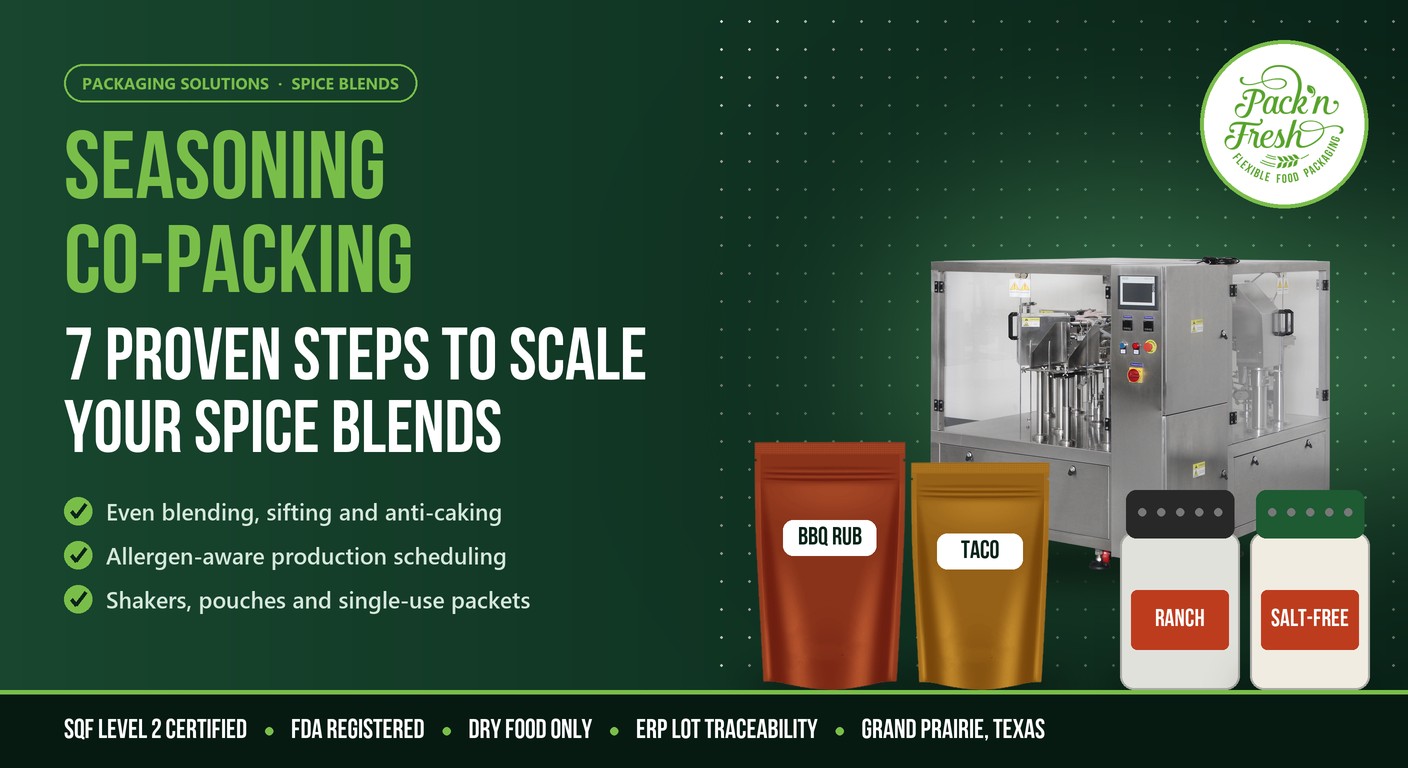
Seasoning Co-Packing: 7 Proven Steps to Scale Your Spice Blends
Seasoning co-packing is how most rub, taco mix and ranch blend brands grow past the commercial-kitchen stage without building their own plant. The category is large and still expanding: TechSci Research valued the global spices and seasoning market at USD 19.85 billion in 2024 and projects USD 27.17 billion by 2030, a 5.37% CAGR.
Growth does not make blends easy to produce. A single-origin ground pepper is one ingredient in one bag. A competition BBQ rub can hold a dozen ingredients with very different particle sizes, densities and moisture behaviors, and every jar must taste the same as the last one.
Blends also carry regulatory traps that single spices do not, from hidden allergens like milk powder and sesame to naming rules for “spices” and “flavorings” on the label. This guide covers the seven decisions that make seasoning co-packing work for founders and private-label retailers, from formulation handoff to choosing a partner.
Table of Contents
- Why Blend Brands Are Turning to Seasoning Co-Packing
- Blend Uniformity: Particle Size, Density and Mixing
- Sifting, Anti-Caking and Moisture Control
- Allergens Hiding in Seasoning Blends
- Labeling Rules for Spices, Flavorings and Blends
- Choosing Formats: Shakers, Pouches, Sachets and Meal-Kit Portions
- Supply Risk, Tariffs and Choosing a Seasoning Co-Packing Partner
1. Why Blend Brands Are Turning to Seasoning Co-Packing
Most seasoning brands start small. A founder mixes a rub in a shared kitchen, sells it at markets or online, and then lands a regional grocery account. At that point, hand-mixing and hand-filling become the bottleneck, and quality starts to drift from batch to batch.
What Changes When Volume Grows
- Consistency: retailers and repeat buyers expect identical flavor, color and heat in every unit.
- Documentation: buyers ask for a GFSI-benchmarked audit, allergen controls and lot traceability.
- Formats: one blend may need a shaker for retail, a pouch for refills and a portion pack for meal kits.
- Sourcing: larger runs need reliable, tested ingredient supply instead of retail-sized purchases.
Private-Label Retailers Have Different Needs
Retailers building store-brand seasoning lines usually want many SKUs with matched packaging and tight specifications. They need a partner who can source ingredients to spec, blend to the brand’s formula and deliver shelf-ready product. Our guide to private label food manufacturing explains how that model works in more detail.
For both groups, seasoning co-packing turns a recipe into a repeatable, auditable product.
2. Blend Uniformity: Particle Size, Density and Mixing
Uniformity is the core quality issue in any multi-ingredient seasoning. If salt settles to the bottom of a batch while dried herbs float to the top, the first shaker of a run will taste different from the last.
Why Ingredients Separate
Segregation happens when ingredients differ in particle size, shape or density. Coarse salt crystals, flaky parsley, fine garlic powder and granulated sugar all move differently when the blend is mixed, conveyed or vibrated during filling. Even a well-mixed batch can un-mix on the way to the filler.
How a Co-Packer Controls It
- Particle size matching: specifying mesh sizes for each ingredient so they behave more alike.
- Correct order of addition: adding minor ingredients, such as color or heat, in a pre-blend so they disperse evenly.
- Validated mix times: confirming the blend is uniform without over-mixing fragile herbs into dust.
- Gentle transfer: limiting drops and vibration between blender and filler.
- In-process checks: sampling from the start, middle and end of each run.
Salt and Sugar Content
Salt and sugar are often the largest and densest ingredients in a rub. Because they drive both taste and the Nutrition Facts panel, uneven distribution can push sodium or sugar values away from what the label declares. Salt-free blends have their own challenge: without salt as a carrier, flavor depends entirely on herb and spice dispersion.
3. Sifting, Anti-Caking and Moisture Control
Dry blends attract moisture. Garlic and onion powders, sugars, buttermilk or cheese powders and some salts pull water from humid air, which leads to clumps, hard cakes and shakers that stop pouring. Controlling moisture is just as important as getting the recipe right.
Sifting and Screening
Sifting removes lumps, foreign material and oversized particles before blending or filling. It is also a basic food safety step, because it catches debris that may arrive with raw agricultural ingredients. Ask how screens are inspected and what happens when a screen shows damage.
Anti-Caking Agents
Many blends use flow agents such as silicon dioxide or calcium silicate. Under 21 CFR 172.480, silicon dioxide may be used only in foods where an anticaking effect has been shown, and only in amounts reasonably required for that effect. Some clean-label brands avoid synthetic flow agents and instead use rice concentrate or better barrier packaging.
Moisture-Smart Production
- Controlled staging: keeping opened ingredient bags closed and limiting exposure time.
- Hygroscopic ingredients last: adding moisture-hungry powders late in the process where possible.
- Barrier packaging: matching the container or film to the blend’s sensitivity.
- Shelf-life checks: watching for caking and color loss over time before you set a best-by date.
4. Allergens Hiding in Seasoning Blends
Single spices rarely contain major allergens, but blends often do. Ranch and cheese seasonings use milk powder. Many rubs and gravy-style mixes use wheat flour or soy sauce powder as a carrier or flavor. Everything-bagel and furikake-style blends use sesame seeds.
Sesame Changed the Rules
The FDA confirms that under the FASTER Act, sesame became the ninth major food allergen, and as of January 1, 2023 it must be labeled as an allergen on packaged foods. For seasoning brands, this matters because sesame used as a spice or flavoring can no longer hide inside a generic term on the label.
Cross-Contact Is the Bigger Risk
Fine powders travel. Milk powder from a ranch run can settle on equipment, hoppers and surfaces, then end up in a “dairy-free” taco blend scheduled next. A strong co-packer controls this with allergen-aware scheduling, validated cleaning between runs and verification before the next product starts.
- Run order: allergen-free blends first, allergen-containing blends last.
- Dedicated tools: scoops, screens and bins assigned by allergen where practical.
- Verified cleaning: documented cleanups confirmed before changeover is signed off.
- Label review: every allergen in the formula reflected in the “Contains” statement.
For a deeper look at controls and traceability, read our guide to allergen management in food packaging.
Ready to Move Your Blend Out of the Kitchen?
Pack’n Fresh blends, sifts and fills dry seasonings in an SQF Level 2 facility with siloed allergen scheduling and full lot traceability. Share your formula and target formats to get started.
5. Labeling Rules for Spices, Flavorings and Blends
Seasoning labels look simple, but the ingredient statement follows specific FDA rules. Getting them wrong can mean relabeling costs, retailer rejections or worse. Your co-packer should flag label issues during onboarding, while the brand owner keeps final responsibility for the label.
What Counts as a “Spice”
Under 21 CFR 101.22, a spice is an aromatic vegetable substance, whole, broken or ground, whose main function is seasoning rather than nutrition. Ingredients traditionally regarded as foods, such as onion, garlic and celery, are excluded. That means onion powder and garlic powder must be named individually rather than grouped under “spices.”
Spices, Colors and Flavorings
- Collective terms: qualifying spices may be declared as “spices,” and flavorings as “natural flavor” or “artificial flavor.”
- Color spices: paprika, turmeric and saffron must appear as “spice and coloring” unless named individually.
- Non-spice ingredients: salt, sugar, dehydrated vegetables, milk powder and flow agents are listed by common name.
Claims to Watch
Claims like “salt-free,” “low sodium,” “organic,” “gluten-free” or “kosher” each need support, whether through nutrient values or certification. Make sure your production facility holds the certifications your label claims. Net weight must also be accurate, which ties back to precise filling.
6. Choosing Formats: Shakers, Pouches, Sachets and Meal-Kit Portions
The same blend can live in several formats, each serving a different channel. Choosing formats early lets you plan artwork, filling equipment and secondary packaging together. Many seasoning brands launch with two formats and add more as channels grow.
Shakers and Jars
Plastic shakers and jars with sifter caps remain the retail standard for everyday use. They display well on shelf and suit repeat cooking.
Stand-Up and Refill Pouches
Stand-up pouches work well for larger rubs, bulk sizes and refills. They use less material, ship flat before filling and offer a large print panel for storytelling. A high-barrier film protects moisture-sensitive blends. See our overview of snack and spice pouch packaging for film and pouch style options.
Sachets and Single-Use Packets
Single-use packets fit sampling programs, foodservice, subscription boxes and single-recipe taco or chili mixes. Accurate small-dose filling is essential here, because a small error is a large percentage of a tiny fill.
Meal-Kit and Kitting Portions
Meal kits and gift boxes need pre-portioned seasonings that match a recipe card. These portions are often packed and then kitted with other dry components, inserts or multipacks. Handling filling and kitting under one roof removes a handoff and simplifies traceability.
7. Supply Risk, Tariffs and Choosing a Seasoning Co-Packing Partner
Seasoning brands depend on global agriculture. Many core spices cannot be grown at scale in the United States, so raw material quality, safety and cost are shaped by imports. Your partner’s sourcing and testing approach matters as much as its filling line.
Pathogen and Filth Risk in Raw Spices
FDA’s 2013 draft risk profile on spices found that about 12% of sampled imported spice shipments were tainted with filth or pathogens and about 6.6% carried Salmonella, as reported by CIDRAP. FDA later added retail data showing lower Salmonella prevalence in retail spices, which FDA said is consistent with pathogen-reduction treatment after import. The lesson is to buy treated, tested ingredients with a Certificate of Analysis and approved suppliers.
Tariffs and the Case for Domestic Blending
Trade policy has added uncertainty. Food Dive reported that McCormick estimated tariffs could cost it as much as $90 million a year. The American Spice Trade Association later welcomed a November 2025 executive order removing many spices from reciprocal tariffs. Exemptions can change, so brands benefit from keeping sourcing flexible, holding approved backup suppliers and treating any landed-cost estimate as subject to change.
Questions to Ask a Seasoning Co-Packing Partner
- Which GFSI-benchmarked certification do you hold, such as SQF, and at what level?
- How do you verify blend uniformity and sodium consistency from batch to batch?
- How do you sift, screen and handle foreign-material risk?
- How do you schedule and verify cleaning between allergen and non-allergen blends?
- Can you source and test ingredients, or must we supply them?
- Which formats can you fill, and can you kit portions for meal kits or gift boxes?
- How quickly can you trace a finished lot back to every ingredient lot?
A capable seasoning co-packing partner will show you documented records, not verbal promises, and will be candid about which blends may need adjustments from the brand before scale-up.
How Pack’n Fresh Supports Seasoning and Spice Blend Brands
Pack’n Fresh is an SQF-certified contract packaging company in Grand Prairie, Texas, focused exclusively on dry food. Since 2017 we have helped brands go from source to shelf with one partner. For seasoning blends, that means dry blending, sifting, precision portioning, filling and secondary packaging in one facility.
Capabilities That Matter for Seasoning Blends
- Dry blending, seasoning and sifting with precision ingredient portioning.
- Formats from 2 g to 5 lb: stand-up and pillow pouches, plastic jars, cans, cups, cartons, sachets and stick packs.
- SQF Level 2 certified facility, FDA-registered and FSMA-compliant, with Organic, Kosher, Non-GMO and Gluten-Free certifications.
- ERP traceability on Microsoft Dynamics 365 for full lot tracking and fast mock recalls.
- Digital Ingredient Locking, which halts production if a wrong material is scanned.
- Siloed production scheduling for allergen control, with ATP swab sanitation verification.
- Ingredient and packaging sourcing, kitting, multipacks, display boxes, labeling and drop-shipping support.
Our owners bring food science and quality assurance backgrounds, and we work with both startups and scaling brands. Our Grand Prairie location near DFW supports efficient shipping across the United States.
Conclusion
A great seasoning starts with a great recipe, but it scales through process. Uniform blending, careful sifting, moisture control, allergen discipline and accurate labels are what keep the hundredth batch tasting like the first.
The right partner brings those controls, plus format flexibility and reliable sourcing, so you can focus on flavors, customers and growth. Treat seasoning co-packing as a long-term quality partnership rather than a simple filling job, and your blends will be ready for any shelf.
Frequently Asked Questions About Seasoning Co-Packing
What is seasoning co-packing?
Seasoning co-packing is when a contract packager blends, sifts and fills your dry seasoning formula into retail or foodservice packaging on your behalf. The co-packer manages ingredient handling, mixing, filling, coding and quality records. Brands keep ownership of their recipe and customers while avoiding the cost of building and certifying their own production facility.
How do co-packers keep seasoning blends consistent?
Consistency comes from matching ingredient particle sizes, adding minor ingredients in a pre-blend, validating mix times and limiting vibration between the blender and filler. Good co-packers also sample from the beginning, middle and end of each run. These steps keep salt, sugar, heat and color evenly distributed so every unit tastes the same.
Do seasoning blends need allergen labeling?
Yes, whenever the blend contains a major allergen. Common examples include milk powder in ranch or cheese blends, wheat flour used as a carrier, soy sauce powder and sesame seeds. Since January 1, 2023, sesame is the ninth major allergen. Each allergen must appear on the label, and the facility should control cross-contact between runs.
Can I list my ingredients simply as “spices”?
Partly. FDA rules allow true spices to be declared collectively as “spices.” However, ingredients traditionally regarded as foods, such as onion, garlic and celery, must be named individually. Color spices like paprika and turmeric must read “spice and coloring” unless named. Salt, sugar, milk powder and flow agents are always listed by common name.
Which packaging formats work best for seasonings?
Plastic shakers and jars suit everyday retail use, while stand-up pouches work well for larger rubs and refill sizes. Sachets and single-use packets fit sampling, foodservice and recipe mixes, and pre-portioned packs serve meal kits. Choose formats by channel before artwork is final.
Scale Your Seasoning Line with Pack’n Fresh
Pack’n Fresh is an SQF Level 2 certified dry food co-packer in Grand Prairie, Texas. We blend, sift and fill seasonings from 2 g sachets to 5 lb pouches, backed by ERP traceability, Digital Ingredient Locking and siloed allergen scheduling. Tell us about your blends and channels, and we will help you plan production.