The Meal Kit Executive’s Packaging Solutions: How to Control Costs & Drive Profitability
You lead an established meal kit business that has successfully scaled beyond the startup phase. You have a loyal customer base and a respected brand.
However, growth has introduced massive, complex problems—and they all center on one critical area: Packaging and Logistics.
Your success is no longer about the recipes; it’s about supply chain execution. It’s about how you efficiently and profitably get specialized, shelf-stable components—like high-value spice blends, specialty grains, or finishing sauces—into a single customer box, 1,000 miles away.
If your system is built on outdated, manual, or fragmented logistics, your growth is being capped by runaway costs. This is the definitive guide for operations managers and executives who are ready to transition their current supply chain to a more scalable, professional, and profitable model. We’ll cover the massive drain of the fragmented vendor model, the materials that guarantee margin, and the strategic partnership that unlocks the next phase of profitable growth: Turnkey Meal Kit Co-Packing.
Chapter 1: The Fragmented Supply Chain: Why Juggling Vendors Is Draining Profitability
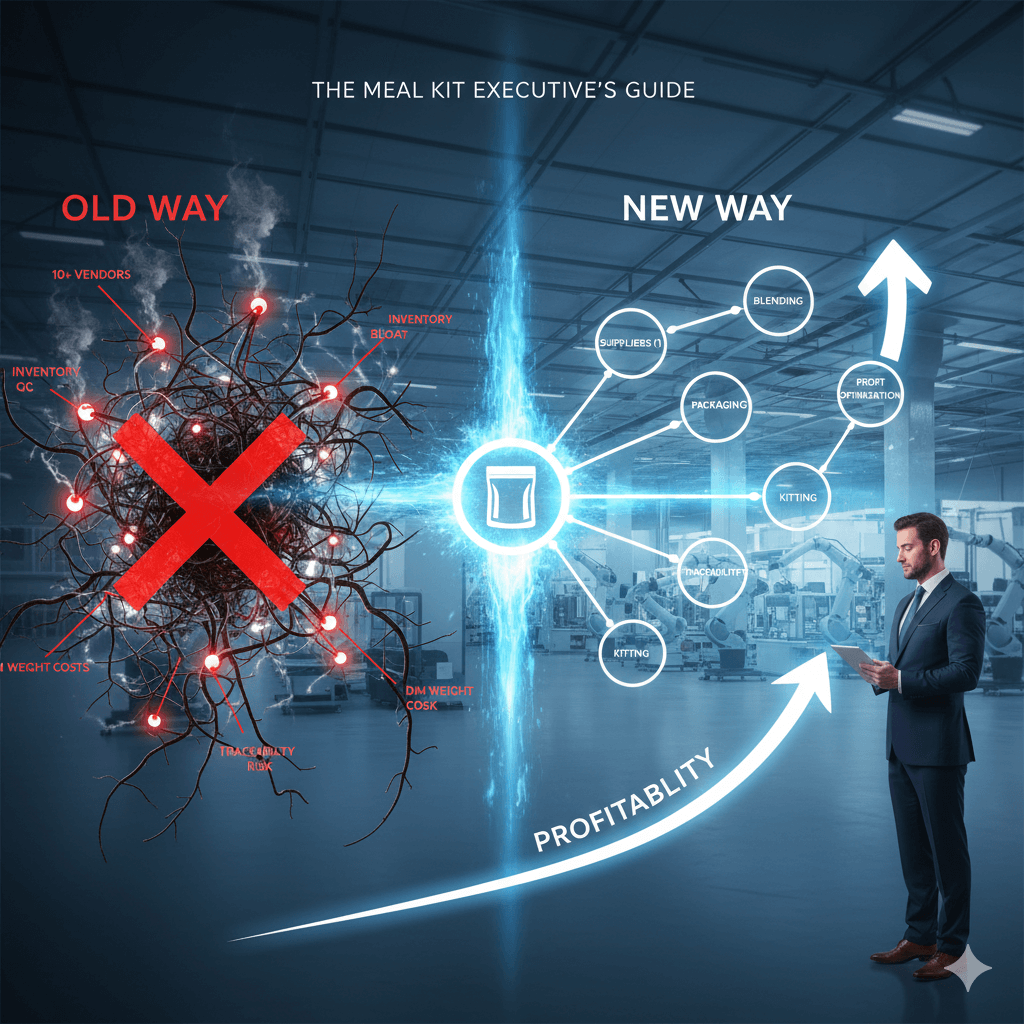
The current system of sourcing components from 10+ different vendors (blending, packaging, labeling, shipping) is a financial and operational liability. This complexity is not a sign of efficiency; it’s a sign of a fragmented supply chain built on risk.
For an established enterprise, the true cost of this “Vendor Juggle” is immense:
- Massive Inventory Bloat: Forcing an established company to purchase massive Minimum Order Quantities (MOQs) of raw packaging materials (boxes, film, jars) that tie up critical working capital and require vast, expensive warehouse space.
- Operational Risk: Relying on multiple handoffs means one delay, one quality control failure, or one miscommunication can halt production across your entire enterprise.
- No Volume Consolidation: The sheer inefficiency of buying 10 small quantities from 10 different people ensures you never achieve the true economy of scale that your enterprise volume should command.
- Traceability Liability: An outdated, non-integrated system makes lot-level traceability a manual, complex, and potentially company-ending legal risk during an audit or recall.
Chapter 2: The Strategic Solution: How Turnkey Co-Packing Unlocks True Scalability
A turnkey co-packer is a single partner that manages the entire packaging and kitting process for you—from sourcing raw ingredients to blending your proprietary mixes, to packaging them into pouches, and handing them off to your final fulfillment house.
This transition is the most impactful decision an established business can make to simplify its operations and immediately improve its margin.
| Operational Function | The Old, Fragmented Way | The New Turnkey Way |
|---|---|---|
| Vendor Management | 10+ partners (Blender, Pouch Supplier, Kitter, Shipper) | 1 Strategic Partner (Your Co-Packer) |
| Inventory Risk | High. Capital tied up in packaging MOQs and storage. | Low. Co-packer manages material sourcing and just-in-time delivery. |
| Traceability | Messy paper trails, high legal/audit risk. | Digital, lot-level tracking (ERP) in a single system. |
| Executive Focus | Managing Logistics and QC Headaches | Driving Brand Growth and Marketing Strategy |
Chapter 3: The Ultimate Packaging Format: Why Pouches Won
Your packaging is your customer’s first physical experience with your brand. The reliance on rigid plastic tubs and heavy jars is now a significant cost center.
The clear winner for stable, non-perishable ingredients—especially your high-value spice blends, specialty grains, coffee, and finishing sauces—is the flexible, small-format pouch (stand-up, pillow, and stick packs).
The Pouch Advantage for Established Enterprises:
- It Slashes Your Shipping Costs (DIM Weight):
- Pouches are lightweight and form-fitting. They allow you to use a significantly smaller final shipping box.
- This directly and immediately reduces your “Dimensional Weight (DIM)” freight charges—a cost that can make or break the profitability of high-volume shipments.
- It Elevates Your Premium Brand:
- The modern, flat, custom-printed pouch is a vibrant, full-color “mini-billboard” that wins at the point of sale (or in the unboxing experience). A small label on an opaque tub cannot compete with the brand presence of a full-surface printed pouch.
- It Simplifies Kitting:
- Pouches are easy to handle, stack efficiently, and reduce breakage compared to rigid containers, leading to faster, more accurate kitting and a better customer experience.
Chapter 4: The Professional Edge: Integrated Systems and Compliance
Scaling successfully means adopting best-in-class operational professionalism. This relies on an integrated, modern approach to food safety and logistics.
The ERP System: Your Traceability Insurance
An Enterprise Resource Planning (ERP) system digitally tracks every single ingredient from the moment it enters the facility to the moment it leaves in a customer’s kit.
- Compliance: This is your best and fastest defense against an FDA audit or a product recall.
- Efficiency: It ensures accurate, real-time inventory management, which is essential for managing your complex supply chain and preventing out-of-stocks.
A professional co-packer doesn’t just use an ERP system; they integrate their lot codes and inventory reporting directly with your systems, providing a single source of truth for your entire operation.
Chapter 5: How to Choose Your Strategic Meal Kit Co-Packer
When you are already an established brand, the decision is not if you need a co-packer, but which partner is sophisticated enough to handle your scale and complexity.
- Ask About Specialization: Does their facility match your needs? They should specialize in high-SKU meal kit kitting, small-format (< 2lb) pouches and kits of shelf-stable components.
- Ask About Blending: If you have proprietary spice or powder blends, your co-packer should have in-house blending capabilities. Managing two separate partners (a blender and a packager) re-creates the “DIY Trap.”
- Ask About Food Science: Are they just machine operators, or are they food scientists and quality control experts? Their team should be able to consult on material integrity and shelf life.
- Ask About Equipment Flexibility: Do they have a range of equipment that allows them to scale with you, or are they limited to one machine that requires massive MOQs?
Your Next Step: From Complex Operations to Streamlined Profitability
The right turnkey co-packing partner provides the integrated systems, expertise, and operational structure that frees your enterprise from the inefficiencies of the fragmented supply chain. It’s the moment your logistics stop being a bottleneck and start being a competitive advantage.
About Pack’n Fresh, Pack’n Fresh is the expert turnkey co-packing partner for scaling food brands. We specialize in the exact needs of the established meal kit industry: high-SKU, small-format (< 2lb) pouches, in-house blending, and complex kitting, all backed by a food-science-led team and a state-of-the-art ERP system.
Stop managing logistics. Start driving profitability. Contact us today for a strategic consultation.