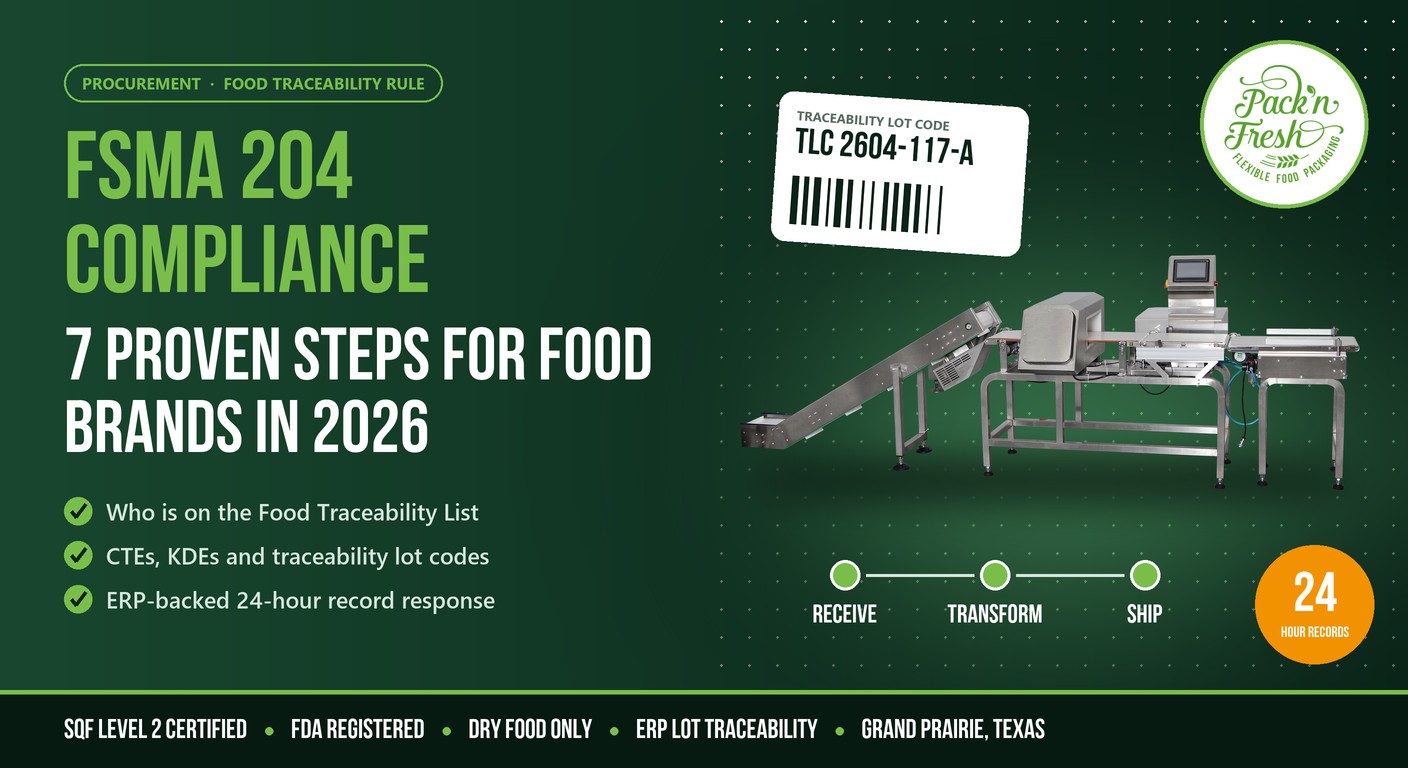
FSMA 204 compliance explained for food brands: what the FDA Food Traceability Rule requires, the 2028 deadline, and what to ask your dry-food co-packer.
FSMA 204 compliance explained for food brands: what the FDA Food Traceability Rule requires, the 2028 deadline, and what to ask your dry-food co-packer.
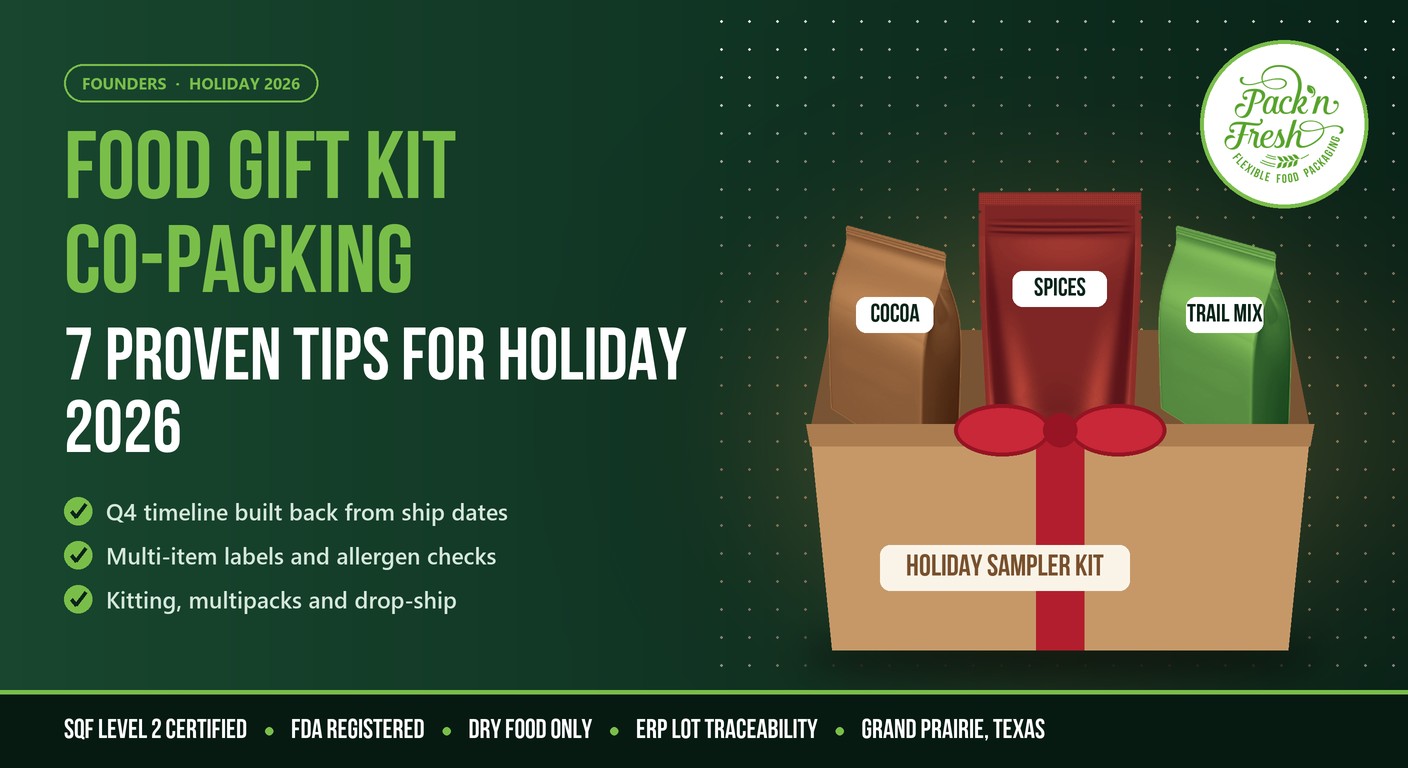
Food gift kit co-packing guide for holiday 2026: plan Q4 lead times, design dry sampler kits, label multi-item allergens and choose a kitting partner.
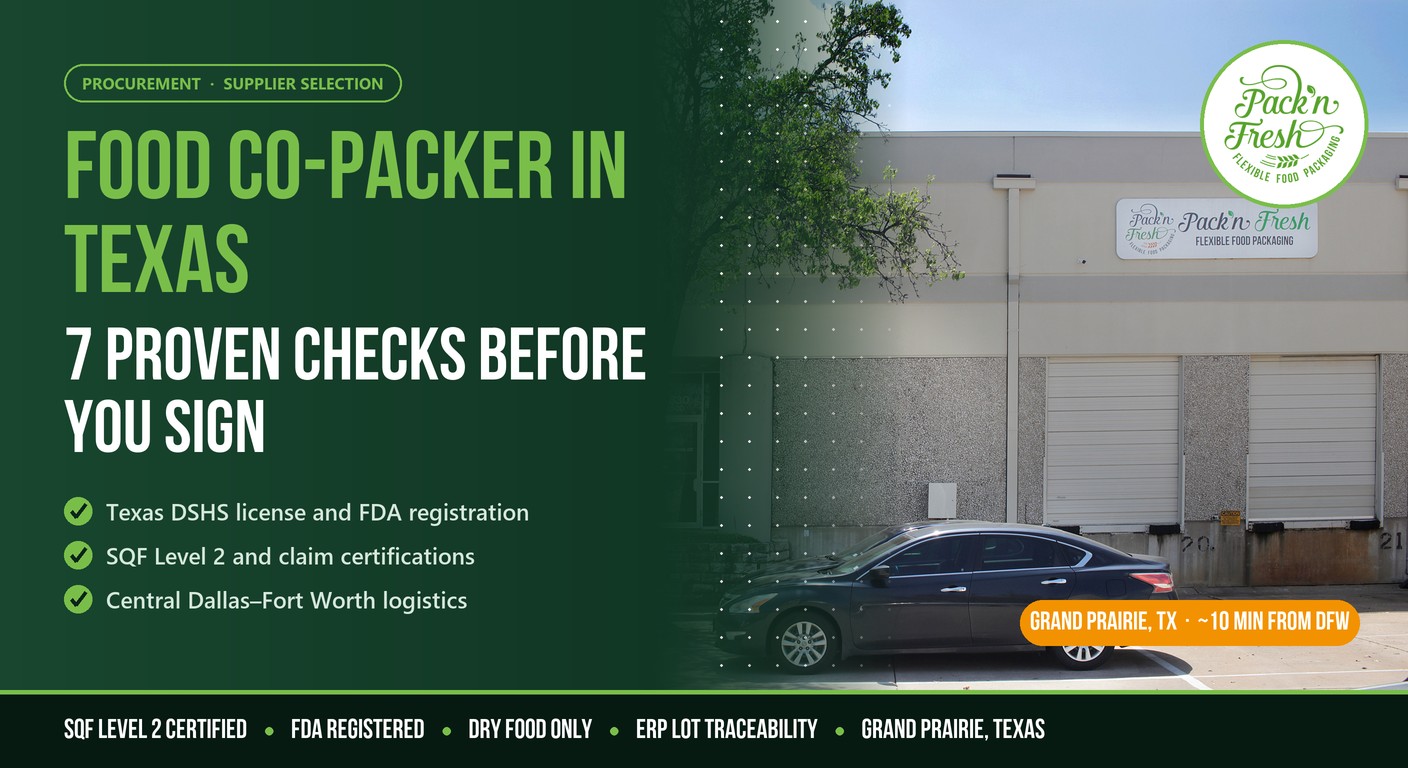
Need a food co-packer in Texas? Use 7 proven checks on DSHS licensing, SQF certification, dry packing capabilities, DFW logistics and contracts.
The functional food industry is experiencing one of its most sustained growth cycles in a generation, and collagen is at the center of it. The global collagen market reached USD 13.02 billion in 2026 and is projected to climb to USD 30.43 billion by 2034 at a compound annual growth rate of 11.19% — driven by a consumer base that increasingly views nutrition as a proactive health investment rather than a reactive intervention. Powder formats are capturing the majority of that growth, holding 58.4% of the collagen product type segment in 2026, and for brands competing in this space, collagen powder co-packing has become one of the most consequential operational decisions a founder or product manager will make.
Collagen powder sits at a powerful intersection of consumer demand: the beauty-from-within movement, which has introduced collagen supplementation to millions of consumers who previously sought skin and joint support through topical products, and the active lifestyle nutrition segment, which embraces collagen peptides for their distinctive amino acid profile — rich in glycine, proline, and hydroxyproline — associated with connective tissue support and post-exercise recovery. These two forces are simultaneously expanding the addressable market for collagen powder and raising consumer expectations for product quality, mixability, flavor, and label transparency.
The manufacturing complexity behind a great collagen powder product is often invisible to the consumer but deeply felt by the brand team. Collagen peptides are hygroscopic — they actively absorb moisture from surrounding air — meaning blending must occur in controlled humidity environments. Molecular weight of the peptides varies by degree of hydrolysis, directly affecting how the powder disperses in liquid and how it feels in the mouth. Serving sizes ranging from 5 to 20 grams make filling accuracy a label compliance issue, not a secondary quality concern. Every one of these variables is shaped by the collagen powder co-packing relationship, which is why choosing the right manufacturing partner matters as much as the formulation itself.
This guide covers seven proven strategies for collagen powder co-packing in 2026: understanding collagen peptide science and blending requirements; managing allergen risk for marine and bovine sources; selecting the right packaging format for your channel strategy; achieving FDA label compliance; planning for multi-channel scale; evaluating co-packing partners on technical merit and certification; and building the kind of manufacturing partnership that grows with a brand rather than constraining it. Each strategy draws on production realities, regulatory requirements, and market dynamics that are shaping the collagen category right now.
The market data supporting collagen powder investment is unusually compelling. According to Grand View Research, the global collagen market reached USD 13.02 billion in 2026 and is projected to reach USD 30.43 billion by 2034 at an 11.19% CAGR — one of the strongest sustained growth trajectories in the functional food and supplement industry. Narrowing to food-grade collagen applications specifically — the segment most relevant to dry blending and powder formats — the market stands at USD 5.64 billion in 2026, with projections reaching USD 9.95 billion by 2035. For co-packers and the brands that partner with them, collagen powder co-packing represents one of the clearest growth opportunities in contract manufacturing today.
Powder form commands a dominant position in the collagen product landscape, holding 58.4% of the collagen product type segment in 2026. That dominance reflects the practical versatility that dry powder formats offer across the full spectrum of collagen applications. Consumers stir collagen powder into morning coffee, blend it into smoothies, fold it into baking mixes, combine it with other functional ingredients in meal replacement formulas, and incorporate it into protein bar bases. Every one of these is a dry application that rewards the precision, consistency, and quality control that professional co-packing facilities provide — and none of them can be served by liquid filling operations.
Bovine collagen remains the market’s dominant source, accounting for 41.9% of market share and delivering Types I and III collagen peptides used broadly in skin health, joint support, and general wellness applications. Marine collagen — primarily derived from fish skin and scales, rich in Type I peptides — is growing rapidly and attracting brands seeking to serve pescatarian consumers and premium positioning that emphasizes sustainably sourced marine ingredients. Each source category carries different production requirements and allergen management obligations that directly affect the collagen powder co-packing relationship. The brands capturing share in this expanding market are those with the most reliable production infrastructure — consistent fill weights, batch-to-batch uniformity, accurate allergen declarations, and label-compliant serving sizes are the operational requirements that define competitive advantage in collagen powder retail.
A co-packer that does not understand collagen peptide science cannot reliably produce a collagen powder product that meets label specifications or consumer expectations. Collagen powder co-packing demands more than the ability to weigh and fill — it requires an operational understanding of how collagen peptides behave during blending, filling, and storage, and how those behaviors affect finished product quality. Brands that partner with technically informed co-packers avoid the costly formulation failures and batch rejections that come with manufacturing partners who treat collagen like any other bulk protein powder.
Collagen peptides — also known as hydrolyzed collagen — are produced by enzymatic or acid hydrolysis of native collagen protein, breaking long collagen chains into shorter amino acid fragments. The degree of hydrolysis determines the molecular weight distribution of the resulting peptides, typically expressed in Daltons (Da) or kiloDaltons (kDa). Low-molecular-weight peptides in the range of 2,000 to 5,000 Da disperse rapidly in cold water with minimal clumping, making them ideal for stick pack applications where fast dissolution is a consumer expectation. Higher-molecular-weight fractions may require warmer water to dissolve fully and can produce a slightly thicker mouthfeel — a texture characteristic that some brands use as a differentiator in functional creamer and mixing bowl formats.
Hygroscopicity is the physical property that most directly affects collagen powder production quality. Because collagen peptides readily absorb atmospheric moisture, powder that is blended, transferred, or packaged in environments with inadequate humidity control will begin to clump and aggregate — reducing flowability, compromising fill weight accuracy, shortening shelf life, and producing a finished product that performs poorly in the consumer’s hands. Professional collagen powder co-packing requires controlled relative humidity during blending operations, during transfer to hoppers and fill funnels, and in all staging areas where open product is present. Facilities without humidity monitoring and active humidity control infrastructure are categorically unsuitable for collagen powder production, regardless of their other credentials.
Precision dosing is the operational capability that closes the gap between formula design and label compliance. Pack’n Fresh’s precision micro-dosing capability addresses the inherent challenge of collagen powder serving sizes: at a 10-gram serving size, a ±5% fill weight variation means a consumer could receive as little as 9.5 or as much as 10.5 grams per serving. For brands making specific collagen peptide quantity claims on their labels — “10g collagen peptides per serving” — filling accuracy is not a quality preference. It is a compliance requirement under FDA current good manufacturing practice regulations for dietary supplements under 21 CFR Part 111, and label inaccuracy at scale represents both a consumer protection failure and a regulatory enforcement risk.
Allergen management is one of the most technically and legally consequential areas of collagen powder co-packing — and one that is frequently underestimated by brands in the early stages of product development. The Food Allergen Labeling and Consumer Protection Act (FALCPA) designates nine major allergens in the United States, including fish and shellfish. Because marine collagen is derived from fish — most commonly tilapia, cod, snapper, or salmon skin and scales — any product containing marine collagen peptides must carry mandatory allergen declarations, and the co-packing facility must manage those allergens with systems capable of preventing cross-contact with allergen-free product lines.
Cross-contact — the unintentional transfer of an allergenic protein from one product or surface to another — is the primary allergen risk in dry powder manufacturing environments. Unlike liquid production lines where surfaces can be purged and rinsed between runs, dry powder residue adheres to equipment surfaces, accumulates in crevices, and can become airborne during blending operations. A single fish allergen cross-contact event affecting an allergen-free product can render an entire production batch unsafe for consumers with fish allergies, trigger an FDA voluntary recall notice, expose the brand and co-packer to regulatory enforcement action, and cause permanent reputational damage that is disproportionately costly to reverse.
Siloed allergen scheduling is the production management standard that professional co-packers implement to control cross-contact risk in shared manufacturing environments. Under a siloed scheduling protocol, fish-containing collagen runs are assigned to dedicated production windows with explicit schedule buffers before and after. Equipment used during those runs — blenders, transfer augers, hoppers, form-fill-seal machines, and conveyors — undergoes full disassembly, cleaning, and verified sanitation before any allergen-free production resumes. This requires documented scheduling procedures, validated cleaning methods calibrated specifically for protein residue removal, and systematic verification that cleaning was effective before the next run begins.
ATP swab testing provides the objective, documented verification that professional allergen management systems require after sanitation events. ATP — adenosine triphosphate — is present in all organic matter, including collagen peptide protein residue, and can be measured on equipment surfaces using handheld bioluminescence meters. By swabbing critical contact surfaces after cleaning and comparing measured ATP levels against validated acceptance thresholds, Pack’n Fresh sanitation teams confirm that surfaces have been cleaned to a defined biological cleanliness standard — providing objective, documented evidence of sanitation effectiveness rather than relying on visual inspection alone. This verification step is especially important in collagen powder co-packing for marine sources, because fish allergen protein can be present in quantities invisible to the human eye yet sufficient to trigger a reaction in a sensitized consumer. The allergen management traceability framework at Pack’n Fresh links every finished production batch to the specific ingredient lots used, supporting accurate allergen declarations and rapid response capability in the event of a supplier-initiated ingredient recall.
Packaging format selection in collagen powder co-packing is a strategic decision that cascades across production requirements, channel strategy, consumer experience, and unit economics. Each major format for collagen powder — stick packs, stand-up pouches, canisters, and sachets — carries distinct manufacturing demands, cost profiles, and market positioning implications. Brands that make informed packaging decisions early in the product development process set themselves up for smoother production launches and stronger retail positioning; those that treat packaging as an afterthought often discover costly incompatibilities between their chosen format and their product’s physical powder characteristics.
Stick packs are the highest-growth packaging format for collagen powder in the premium functional food segment in 2026. Their single-serve convenience, on-the-go portability, and premium shelf aesthetic align with exactly the beauty-from-within and active lifestyle consumer profiles that drive collagen adoption. A stick pack product — whether a 5-gram marine collagen beauty powder or a 15-gram bovine collagen sport recovery blend — communicates portion control, precision, and premium brand positioning at a glance. However, stick packs place the most demanding requirements on powder characteristics: the collagen blend must flow freely through narrow form-fill-seal funnels, maintain consistent fill weights across high-speed production runs, and seal reliably in a narrow laminate tube that provides the necessary moisture and oxygen barrier for target shelf life.
Stand-up pouches (SUPs) offer versatile positioning for collagen brands launching multi-serve retail SKUs in the 100-gram to 500-gram range. The format provides ample label real estate for ingredient storytelling, clinical reference language, and QR codes linking to brand education content — all of which matter on a natural grocery shelf where educated consumers read labels carefully before purchasing. From a production standpoint, stand-up pouches are somewhat more forgiving of powder flow characteristics than stick packs, because VFFS (vertical form-fill-seal) equipment uses larger fill openings, though consistent headspace management remains important for oxidation prevention and shelf life protection.
Canisters remain the dominant format for premium collagen powders targeting health and wellness retail planograms. Rigid containers — whether polypropylene with a snap lid or composite paperboard with a metal base — communicate stability, premium positioning, and daily-use convenience in a way that flexible pouches cannot entirely replicate. A 30-serving or 60-serving canister of 10-gram bovine collagen peptides commands a retail price point that covers premium ingredient cost and supports meaningful margin — and it presents in a format that retail supplement buyers expect from brands seeking planogram placement. Canister filling requires accurate auger or net-weight filling equipment capable of handling the larger total fill weights — 300 to 600 grams per canister — that multi-serving collagen SKUs demand.
Is Your Collagen Formula Ready to Scale? Let’s Build the Right Production Plan.
Pack’n Fresh delivers SQF Level 2 certified collagen powder co-packing from our Grand Prairie, Texas facility — with precision micro-dosing, Digital Ingredient Locking, siloed allergen scheduling, and full-service dry blending, pouching, labeling, kitting, and warehousing. Whether you are launching your first SKU or scaling to national retail, our team can review your formulation and packaging requirements in a free consultation.
FDA regulatory compliance for collagen powder products is more nuanced than brands sometimes expect — and the consequences of getting it wrong extend from label corrections and retailer delistings to formal enforcement actions. Whether a collagen product is classified as a dietary supplement or a conventional food ingredient shapes the entire regulatory framework that applies to its labeling, manufacturing, and marketing. A technically capable collagen powder co-packing partner is not a substitute for qualified regulatory counsel, but it is a critical operational checkpoint for catching compliance gaps before they become costly production problems.
The FDA does not recognize collagen as having any pre-established, FDA-endorsed structure/function claims. Unlike certain probiotics or vitamins where regulatory guidance is established, collagen’s relationship to skin elasticity, joint health, and connective tissue support has not been the subject of FDA endorsement or pre-market approval. Brands making structure/function claims on collagen products — for example, “supports healthy joints and cartilage” or “promotes skin hydration and elasticity” — are exercising rights granted under the Dietary Supplement Health and Education Act (DSHEA), but they are required to notify the FDA within 30 days of first marketing the product bearing that specific claim. This notification requirement is frequently overlooked by early-stage brands and creates regulatory exposure that even a technically excellent product cannot protect against.
Protein content claims for collagen powder products carry a specific technical complexity that distinguishes collagen from whey, casein, or plant protein sources. Collagen peptides are approximately 98 to 99 percent protein by dry weight — but they are not a complete protein, as they lack sufficient tryptophan. Nutrient content claims for protein — “high in protein” (20% or more of the Daily Value per RACC) or “good source of protein” (10 to 19% of the DV) — must be based on a PDCAAS (protein digestibility-corrected amino acid score) or DIAAS calculation, not raw gram weight. Because the PDCAAS for collagen peptides is essentially zero due to limiting tryptophan, a collagen product cannot technically make a “high in protein” claim based on collagen peptides alone, regardless of total gram content. Brands that include a complete protein co-ingredient — such as whey or pea protein — may be able to support a protein claim on the combined formula, but this requires careful PDCAAS calculation and allergen declaration updating.
For FDA labeling purposes, allergen declarations for marine collagen products must meet FALCPA requirements in full. The specific fish species used must be identified — either within the ingredient list in parenthetical form (“hydrolyzed collagen peptides [tilapia]”) or in a separate “Contains: Fish (Tilapia)” statement on the principal display panel or information panel. Brands transitioning between collagen sources — from bovine to marine, or between fish species — must update their label allergen declarations before marketing the reformulated product. ERP-backed traceability at the co-packer level provides the ingredient source documentation that supports accurate and current allergen declarations at every production run.
The growth trajectory for successful collagen brands in 2026 moves through recognizable stages — direct-to-consumer launch, Amazon marketplace expansion, specialty and natural retail placement, and ultimately broader conventional channel distribution. Each stage places different demands on the collagen powder co-packing relationship, and brands that anticipate those demands before they become urgent will scale more efficiently and with fewer operational disruptions than those that treat co-packing as a static vendor arrangement. The co-packing partner that fits a 5,000-unit DTC launch is not automatically the right partner for a 200,000-unit national retail program — and discovering that mismatch at a critical growth inflection point is costly in both time and brand momentum.
Amazon marketplace success for collagen powder products depends heavily on packaging and labeling compliance with Amazon’s fulfillment requirements. FBA standards require scannable barcodes on all six sides of retail units and case cartons, specific suffocation warning labels on flexible packaging above a defined opening size threshold, and FNSKU labeling for accurate inventory tracking in Amazon fulfillment centers. Brands launching collagen products via FBA without co-packing partner input on these requirements often discover non-compliance at the inbound shipment inspection stage — resulting in repackaging fees, inventory holds, and lost sales velocity during peak demand periods. A co-packer with Amazon FBA program experience can ensure that collagen powder products arrive at fulfillment centers in fully compliant condition from the first shipment.
Retail channel entry introduces purchase order management complexity that most DTC-first brands underestimate significantly. Retailer-issued purchase orders carry specific ship window requirements — often plus or minus three to five business days from the target ship date — that require production scheduling aligned to retailer calendars. Case pack configurations, floor-ready merchandise requirements, and GS1-compliant UPC standards are baseline expectations from virtually every retail buyer. A co-packer with ERP-backed production planning — like Pack’n Fresh’s integrated ERP system — can align production runs to retailer ship windows, generate compliant batch documentation, and maintain the lot traceability records that retail buyer audits and third-party food safety qualification programs increasingly demand as conditions of continued listing.
Building a long-term collagen powder co-packing relationship requires more than executing individual purchase orders well. It involves shared production planning visibility, proactive communication on ingredient lead times and supply chain disruptions, capacity reservation for seasonal demand peaks, and a co-packer quality team that understands a brand’s product specifications with the same depth that the brand’s own product development team does. The supplement co-packing relationship that supports a brand through DTC launch, Amazon scale-up, and retail expansion is built on operational trust and documented systems — not just competitive pricing. Establishing that relationship before growth urgency creates pressure to compromise on partner quality is one of the most consequential strategic decisions a collagen brand leader will make.
Selecting the right collagen powder co-packing partner is a decision that will shape the brand’s operational foundation for years. The wrong choice — made on the basis of lowest minimum order quantities, geographic proximity, or a persuasive sales conversation — creates production bottlenecks, compliance exposure, allergen risk, and brand reputation damage that are expensive to reverse. The right choice provides the quality infrastructure, technical capability, and documented systems that allow a collagen brand to compete confidently in retail, food service, and DTC channels simultaneously. Evaluating candidates against a structured set of technical and operational criteria is the only way to make this decision with the rigor it deserves.
Food safety certification is the non-negotiable first filter in any collagen powder co-packing partner evaluation. SQF Level 2 certification, awarded and maintained through the Safe Quality Food Institute, signals that an independent, accredited auditor has reviewed the facility’s food safety plan, quality management system, allergen management procedures, and production documentation — and found them to meet an internationally recognized HACCP-based standard. Co-packers with active SQF Level 2 certification have demonstrated to a third party that their systems exist and are implemented consistently; those offering only self-certification or informal quality assurances have not made that demonstration. For collagen brands selling through retailers who conduct supplier facility audits, SQF Level 2 certification is increasingly a listing prerequisite rather than a differentiator.
Precision dosing capability evaluation requires specific, quantitative inquiry rather than general capability assertions. Ask potential co-packers for fill weight accuracy data from recent production runs on collagen or comparable protein powder products at your target serving size. Request the coefficient of variation (CV) for fill weights — a professional facility will have this data readily available from its quality monitoring program. Understand what equipment the co-packer uses for stick pack or canister filling, what the validated fill weight accuracy tolerance is, and how out-of-tolerance fills are detected and managed in real time during production. A co-packer that cannot answer these questions with specificity is not equipped for professional-grade collagen powder co-packing at label-compliant accuracy levels.
Digital Ingredient Locking capability addresses a risk that many collagen brands do not identify until they experience it firsthand: formula drift during production. Without a system that anchors production batches to approved ingredient specifications, co-packing operations can drift — through informal substitutions, supplier changes, or ratio adjustments made without brand authorization — in ways that compromise product integrity, label accuracy, and potentially intellectual property. Pack’n Fresh’s Digital Ingredient Locking system prevents this by tying each production batch to a locked set of approved specifications, including collagen peptide source, molecular weight parameters, co-ingredient identities and ratios, and raw material lot approvals. No production occurs against a formula that differs from the brand’s approved specification without explicit, documented authorization from the brand owner.
Pack’n Fresh delivers the full spectrum of capabilities that professional collagen powder co-packing demands — SQF Level 2 certified food safety infrastructure, ERP-backed traceability, Digital Ingredient Locking, siloed allergen scheduling, ATP swab sanitation verification, and precision micro-dosing — all from a single full-service facility in Grand Prairie, Texas. The facility handles dry products exclusively: dry blending, pouching, labeling, kitting, and warehousing, with no liquid filling operations that could introduce cross-contamination complexity into powder manufacturing environments. For collagen brands that need a co-packer who understands the production requirements as thoroughly as the formulation requirements, Pack’n Fresh provides that technical depth alongside the quality systems that retail and food service channels increasingly require as conditions of entry.
The Digital Ingredient Locking system is the capability that most directly protects collagen brands with proprietary formulations or precise peptide ratio specifications. When a brand has invested in developing a distinctive collagen blend — a specific ratio of low-molecular-weight marine peptides with vitamin C and hyaluronic acid, for example, or a bovine collagen formula with a proprietary co-ingredient matrix — that investment deserves protection at the manufacturing level. Pack’n Fresh’s Digital Ingredient Locking ensures that every production batch is manufactured against the brand’s approved specification, with ingredient identities, sources, ratios, and lot approvals locked into the batch record before production begins. Formula drift, unauthorized substitutions, and ratio deviations that could compromise product integrity or label accuracy are prevented by system design rather than detected retrospectively.
For collagen brands ready to explore what a professional collagen powder co-packing relationship looks like in practice — from pilot batch formulation review through retail-scale production planning — Pack’n Fresh offers a structured consultation process. The team reviews formulation requirements, packaging format specifications, volume projections, channel strategy, and regulatory context to develop a co-packing proposal that is aligned with the brand’s specific growth roadmap. Whether the conversation starts at concept formulation, active DTC launch, or preparation for a retail buyer’s qualification audit, Pack’n Fresh is equipped to meet brands where they are and build a manufacturing partnership designed to scale with them through every stage of growth.
The collagen powder market in 2026 offers one of the clearest sustained growth opportunities in functional food — but capturing that opportunity requires more than a compelling brand story or a well-formulated product. With powder formats holding 58.4% of the collagen product segment and the food collagen market projected to reach USD 9.95 billion by 2035, the competitive landscape rewards brands that build manufacturing precision into their products from the first production run. Collagen powder co-packing done with technical rigor — precision dosing, controlled humidity blending, validated allergen management, ERP-backed traceability, and SQF-certified quality systems — is not an operational detail. It is the foundation on which consumer trust, retailer confidence, and long-term brand equity are built batch by batch.
The seven strategies covered in this guide provide a framework for approaching collagen powder co-packing decisions with the rigor the category demands: understanding peptide science and hygroscopic blending requirements; managing allergen risk for marine and bovine sources with documented, verified protocols; selecting the right packaging format for each target channel; achieving FDA label compliance including structure/function claim notifications and FALCPA allergen declarations; planning for multi-channel scale from DTC through retail and food service; evaluating co-packing partners on documented technical merit rather than self-assessment claims; and choosing a full-service facility with the certifications, systems, and central US geographic positioning to support national distribution ambitions from day one.
Collagen powder co-packing is the contract manufacturing process where a specialized facility dry blends, fills, packages, and labels collagen peptide powder products on behalf of brand owners. It requires specialized capabilities because collagen peptides are hygroscopic — clumping in uncontrolled environments — and marine-sourced collagen is a FALCPA-designated fish allergen requiring documented allergen controls. Precise 5-to-20-gram serving sizes demand calibrated filling equipment, humidity-controlled blending environments, and ongoing statistical quality monitoring to meet retail-grade standards.
No. Pack’n Fresh is a dry products co-packer exclusively — no liquid filling, RTD beverages, or liquid collagen formats of any kind. All capabilities are optimized for dry powder production: dry blending, pouching, labeling, kitting, and warehousing for collagen powders, stick packs, sachets, and canister fills. This dry-only focus ensures every system — production environment, allergen management, quality protocols — is fully optimized for powder excellence without cross-contamination risk.
Under FALCPA, products containing marine collagen peptides derived from fish must identify the species — either parenthetically in the ingredient list (“hydrolyzed collagen peptides [tilapia]”) or in a separate “Contains: Fish (Tilapia)” statement. Brands switching from bovine to marine collagen must update allergen declarations before marketing the reformulated product. A co-packer with documented lot-level ingredient traceability makes allergen declaration accuracy a managed, verifiable process at every production run.
SQF Level 2 certification means an independent, accredited auditor has verified a co-packing facility’s food safety plan, allergen management, and quality documentation against an internationally recognized HACCP-based standard. For collagen brands pursuing retail distribution, it satisfies the third-party audit requirements many retailers impose for new vendor approval, demonstrates documented allergen management to buyers, and provides the credibility that self-certified quality assurances cannot replicate. SQF Level 2 certified collagen powder co-packing is increasingly a baseline retail expectation.
Collagen powder serving sizes of 5 to 20 grams are specified precisely on product labels, and fill accuracy determines whether each serving delivers the stated peptide amount. At a 10-gram serving, a ±5% variation means consumers may receive 9.5 to 10.5 grams — a label compliance issue under FDA CGMP regulations (21 CFR Part 111). Co-packers with validated precision dosing equipment and documented statistical process control provide the accuracy that label-compliant, retail-ready collagen powder products require at every volume.
Ready to Launch or Scale Your Collagen Powder Line? Pack’n Fresh Is Ready.
Pack’n Fresh offers SQF Level 2 certified collagen powder co-packing from our Grand Prairie, Texas facility — with precision micro-dosing, Digital Ingredient Locking, siloed allergen scheduling, and full-service dry blending, pouching, labeling, kitting, and warehousing. Let’s build a co-packing plan that fits your formula, your format, and your growth timeline.
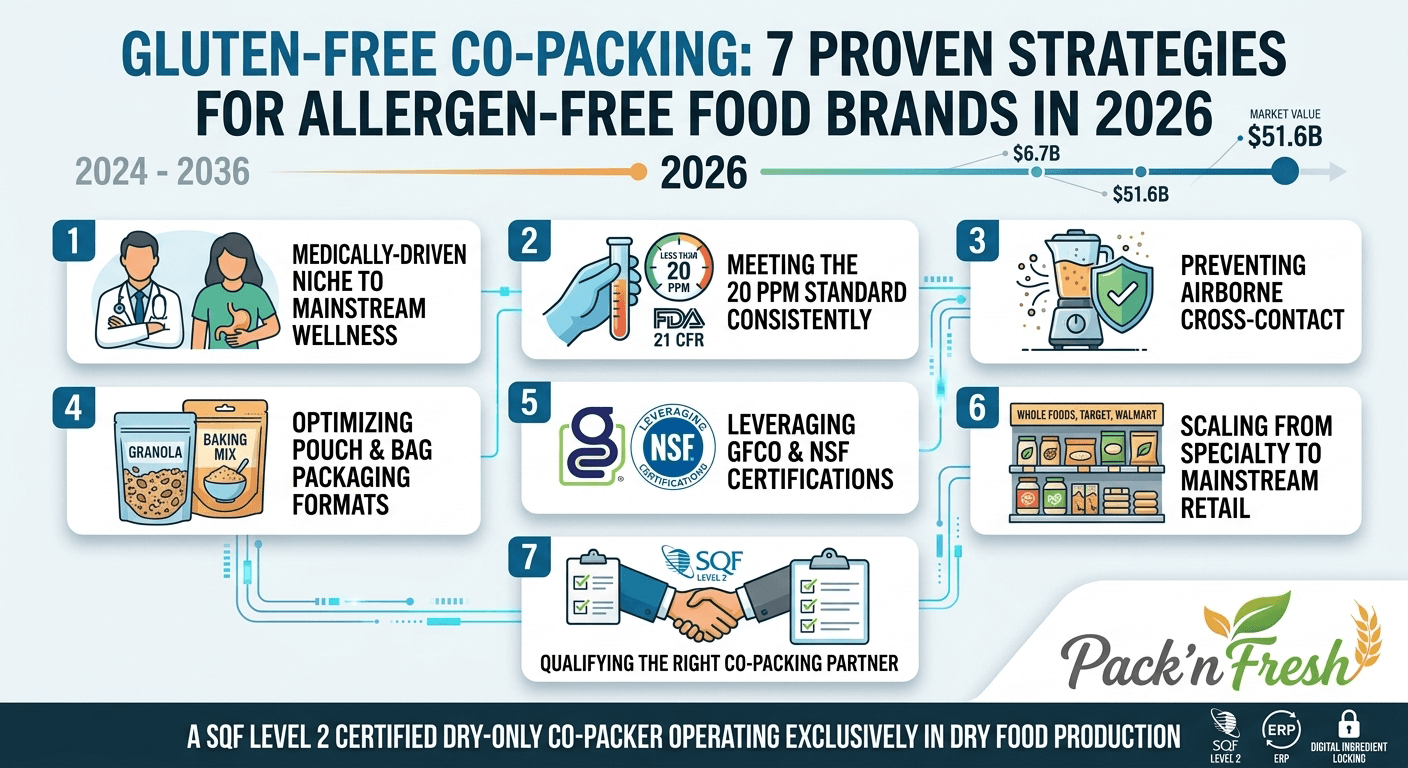
The gluten-free food market has moved decisively into the mainstream of the American grocery store. The global gluten-free food market is valued at USD 6.7 billion in 2026, growing at a 7.0% CAGR through 2036 — driven by rising celiac disease diagnosis rates, expanding non-celiac gluten sensitivity awareness, and broad consumer preference for allergen-transparent food products. The allergen-free food market as a whole reached USD 51.6 billion in 2026, projected to nearly double to USD 103.5 billion by 2036. Bakery and snacks alone account for 28% of allergen-free product demand in 2026, representing an enormous opportunity specifically for dry food brands — baking mixes, flours, granola, cereals, crackers, and snack mixes.
Behind every gluten-free product on a retail shelf is a manufacturing decision that determines whether that label claim is credible, defensible, and safe for the consumers who depend on it. Celiac disease affects approximately 1% of the global population, and for those individuals, even trace gluten exposure can trigger a serious autoimmune response. The FDA established its gluten-free labeling standard at less than 20 parts per million (21 CFR Part 101.91) because that threshold represents the level below which most celiac patients can tolerate without triggering a clinical response. A brand that places a “gluten-free” label on a product produced in a facility where cross-contact is not rigorously controlled is putting medically vulnerable consumers at risk — making the co-packing partnership decision categorically more consequential than it is for conventional food brands.
The regulatory environment around gluten cross-contact is also tightening. In January 2026, FDA opened a formal Request for Information on gluten cross-contact labeling, signaling intent to develop more specific guidance on precautionary allergen labeling for gluten. In July 2026, the Codex Alimentarius Commission adopted new precautionary allergen labeling (PAL) guidance setting global benchmarks for when “may contain” statements are scientifically justified. Together, these developments signal that the standards governing gluten-free co-packing will become more specific, more enforceable, and more auditable — making the choice of a rigorously qualified co-packing partner a forward-looking compliance decision, not merely a current-state quality preference.
Pack’n Fresh is a SQF Level 2 certified full-service co-packer based in Grand Prairie, Texas, operating exclusively in dry product categories — baking mixes, flours, spice blends, granola, cereal, snack mixes, and nutritional powders. We handle no liquid filling and no beverage production. Our entire facility and quality management system is purpose-engineered for dry food production, with every allergen control protocol calibrated specifically for the cross-contact risks that matter most in dry blending environments. Our gluten-free co-packing capabilities include siloed allergen scheduling, ATP swab sanitation verification, Digital Ingredient Locking, and ERP-backed lot-level traceability — a complete operational stack for brands that cannot afford a label claim that fails.
The gluten-free category has undergone a fundamental transformation, shifting from a medically driven niche to a mainstream consumer preference embraced by a far broader population. Today, gluten-free purchasing is driven by three distinct groups: diagnosed celiacs managing an autoimmune condition, individuals with non-celiac gluten sensitivity who report meaningful symptom improvement on gluten-free diets, and lifestyle-motivated consumers who associate gluten-free eating with general wellness and cleaner ingredient profiles. That triple demand structure is what has sustained the category’s growth well past the initial trend wave and positioned it as a durable, structurally supported market segment.
Market entry economics strongly favor the co-packing model for gluten-free brand founders. Building a gluten-free compliant in-house facility requires capital investment in allergen-segregated equipment, dedicated production areas, validated sanitation infrastructure, and certification costs — in addition to standard manufacturing infrastructure. A co-packing partnership converts all of that fixed capital into a variable production cost, allowing brand founders to direct capital toward product development, marketing, and retail placement. Gluten-free co-packing brands consistently report that this capital efficiency allowed them to test market reception and refine their product positioning before committing to manufacturing infrastructure.
The competitive landscape in gluten-free dry food is becoming more quality-stratified in ways that favor brands with certified, documented production credentials. Major retail buyers — Whole Foods Market, Sprouts Farmers Market, Natural Grocers, Thrive Market, and the natural-food buying teams at Target and Walmart — scrutinize supplier food safety certifications and facility audits with increasing rigor. A brand that can demonstrate SQF Level 2 certification at its co-packing facility, documented allergen controls, and third-party gluten testing on finished product is in a meaningfully stronger retail conversation than a brand whose only quality credential is a self-declaration. That documentation advantage is what experienced gluten-free co-packing operations provide — not just production capacity, but the audit-ready quality infrastructure that retail buyers now expect as a baseline.
The FDA gluten-free labeling rule — codified at 21 CFR Part 101.91 and final since August 2013 — establishes that a food bearing any “gluten-free” claim must contain less than 20 parts per million of gluten in the finished product. The 20 ppm threshold was selected based on a comprehensive scientific review concluding that the vast majority of individuals with celiac disease can tolerate gluten at or below this level without a measurable clinical response. The rule applies to voluntary “gluten-free” claims; FDA does not currently require such a claim on products that do not make one, but holds all labeled food products to a truthful and non-misleading standard.
For a co-packing facility to credibly support a brand’s gluten-free label claim, it must have systems that reliably prevent finished product gluten from exceeding 20 ppm — not just on average, but consistently across every production run. A facility that achieves compliance most of the time but experiences occasional exceedances due to inconsistent sanitation or undocumented ingredient substitutions cannot credibly support a gluten-free label claim. The 20 ppm standard is a maximum threshold, not an average — every unit of product must meet it. This makes the quality management system and process controls at a gluten-free co-packing facility as commercially important as any other selection criterion.
Ingredient-level gluten control is as important as finished product testing for maintaining a compliant program. Many ingredients used in gluten-free formulas carry a natural contamination risk because they are grown or processed in proximity to wheat. Oats are the most commercially significant example: conventional oats are frequently co-mingled with wheat during harvesting and processing, making them a major risk unless specifically sourced as certified gluten-free oats grown and processed under documented controls. Similar risks exist for some rice flour sources, certain legume flours, and seed products processed on shared equipment. A rigorous gluten-free co-packing operation requires ingredient-level certifications or testing documentation for all inputs with meaningful cross-contact risk.
The FDA’s January 2026 Request for Information on gluten cross-contact labeling is the most significant regulatory development in this space in over a decade. The RFI signals that FDA is considering whether to develop more specific labeling guidance for precautionary “may contain gluten” statements — potentially aligning voluntary advisory language with quantitative risk thresholds, similar to the Codex Alimentarius Commission’s July 2026 precautionary allergen labeling guidance. For brands and their co-packing partners, this means documentation infrastructure supporting gluten risk management — facility risk assessments, cross-contact probability analyses, testing protocols — will increasingly need to be audit-ready for potential FDA review, not just retailer audits. For a broader view of how GFSI certifications provide this foundation, see Pack’n Fresh’s guide to GFSI food safety standards.
Gluten cross-contact is the central operational challenge of gluten-free co-packing in a shared dry blending environment — and it is fundamentally more difficult to manage than most other allergen cross-contact scenarios because of the physical properties of wheat flour. Wheat flour particles are fine — typically 50 to 150 microns in diameter — and light enough to remain suspended in facility air for extended periods following a wheat-containing production run. This airborne dispersal capacity means that conventional separation strategies — running gluten-free products on dedicated equipment in a shared production floor — may not fully eliminate cross-contact risk if wheat-containing products have been run in the same airspace during the same production shift. Controlling airborne wheat cross-contact distinguishes truly qualified co-packing facilities from those that approach the problem through equipment-level sanitation alone.
Siloed allergen scheduling is the most defensible architectural control for wheat cross-contact management. At Pack’n Fresh, our allergen scheduling system assigns specific production windows — not just specific equipment — to allergen-defined product families. Wheat-containing production runs are completed during designated windows, followed by a documented settling interval before gluten-free production begins. Post-sanitation ATP swab verification — measuring adenosine triphosphate levels on contact surfaces as an indicator of biological and food residue — must meet pre-specified cleanliness benchmarks before any gluten-free production run may begin. This scheduling architecture is documented in our ERP production management system, creating a verifiable, auditable record of the temporal separation between wheat-containing and gluten-free production runs.
Ingredient staging and receiving are cross-contact risk points that receive less operational attention than in-process blending but are equally important for a complete prevention program. When wheat-containing and gluten-free ingredients are received and staged without physical or procedural separation, the risk of ingredient-level cross-contact through incidental contact during staging is real. A rigorous allergen management program addresses this through designated allergen zones, closed container policies for all ingredients awaiting use, and documented receiving inspection procedures that verify supplier allergen declarations against the production specification for each ingredient lot. Pack’n Fresh’s Digital Ingredient Locking system adds a technology layer: ingredients are verified at the system level against the approved specification for each formula before they can be released for production, preventing unauthorized ingredient substitutions that could introduce unexpected allergens into a gluten-free production run. For a complete framework, review Pack’n Fresh’s resource on allergen management and traceability in food packaging.
Packaging format selection for gluten-free dry food brands is a strategic decision with implications for retail shelf performance, e-commerce logistics economics, consumer usability, and regulatory label compliance — all of which intersect with the production capabilities of your gluten-free co-packing partner. The formats that dominate gluten-free dry food in 2026 include resealable stand-up pouches, lay-flat bags for smaller portion sizes, multi-layer barrier flat-bottom bags for flour and grain products, and retail-ready display-ready cases for club and natural channel retailers. Each format has a distinct performance profile and production requirements that must be matched to your co-packer’s filling and packaging capabilities.
Stand-up resealable pouches have become the dominant retail format for gluten-free baking mixes, granola, and snack mixes in the 10 oz to 32 oz net weight range. Pouches stand on shelf without a secondary display fixture, accommodate large label panels carrying full regulatory information alongside brand design, and the resealable zipper closure addresses a genuine consumer usability need for products used in portions across multiple occasions. For e-commerce fulfillment, pouches are significantly lighter than rigid boxes or canisters, reducing dimensional weight shipping costs — a meaningful COGS advantage for DTC brands. Pack’n Fresh’s pouching capabilities are matched to the fill weight ranges and product flow characteristics typical in the gluten-free dry food category.
Label compliance for gluten-free products requires careful attention to allergen declaration format, net weight accuracy, and FDA label placement requirements. For products making an affirmative “gluten-free” claim, the claim must be truthful and supported by the 20 ppm compliance framework described in Section 2. Brands using certified gluten-free oats should identify them as “gluten-free oats” or “certified gluten-free oats” in the ingredient list to address the specific consumer knowledge gap around oat cross-contact. A gluten-free product produced in a facility that also processes other major allergens must evaluate whether precautionary advisory statements are warranted based on the facility’s documented risk assessment. See Pack’n Fresh’s post on 5 common food packaging mistakes for the label compliance errors that most frequently create recall and compliance risk for dry food brands.
Is Your Gluten-Free Brand Ready for a Certified Co-Packing Partner?
Pack’n Fresh is a SQF Level 2 certified dry-only co-packer in Grand Prairie, Texas with siloed allergen scheduling, ATP swab sanitation verification, Digital Ingredient Locking, and ERP-backed traceability — everything a gluten-free brand needs to protect its label claim and scale with confidence. We handle dry blending, pouching, labeling, kitting, and warehousing for dry food brands at every growth stage. Gluten-free co-packing is one of our core capabilities, and we are ready to talk about your production needs.
Third-party gluten-free certification is how a brand communicates to consumers, retailers, and regulatory bodies that its gluten-free claim has been independently verified against a defined standard — not simply self-declared. In the gluten-free dry food category, certification marks carry substantial commercial value because they provide the credibility signal that informed consumers — particularly celiac patients who face the most serious medical risk from label claim failures — use to make purchase decisions. The two most commercially significant certification programs in the United States are GFCO (administered by the Gluten-Free Certification Organization, a program of the Gluten Intolerance Group) and NSF/ANSI 306.
GFCO certification uses a 10 ppm threshold — more stringent than FDA’s 20 ppm requirement — as its benchmark for finished product gluten content. The GFCO mark is the most widely recognized gluten-free certification mark in US retail and has established the strongest consumer trust equity in the celiac and gluten-sensitive community. GFCO certification requires an application covering the product formula and production facility, a facility inspection conducted by a GFCO-accredited inspector, and ongoing finished product testing at accredited laboratories. For gluten-free co-packing arrangements, GFCO’s facility inspection scope includes the co-packing facility itself — meaning the facility must demonstrate compliance with GFCO’s production and allergen control requirements. Brands pursuing GFCO certification should select co-packing partners with prior experience supporting GFCO inspections.
FDA compliance is the baseline requirement that operates independently of and in parallel with voluntary third-party certification. Regardless of whether a brand holds GFCO or NSF certification, it is always subject to FDA’s gluten-free labeling rule at 21 CFR Part 101.91. FDA may test labeled gluten-free products at any time — through retail sampling, consumer complaint investigation, or systematic surveillance programs — and a finished product result above 20 ppm triggers FDA enforcement authority, regardless of what any voluntary certification mark represents. Certification demonstrates consumer-facing credibility; FDA compliance is the legal baseline that cannot be satisfied by a voluntary program alone. Working with an SQF Level 2 certified gluten-free co-packing partner provides the documented process controls that support both FDA compliance and voluntary certification simultaneously. For context on how SQF and GFSI frameworks function as the foundation for food safety compliance, see Pack’n Fresh’s overview of GFSI food safety standards.
The transition from specialty retail placement to mainstream retail distribution is the defining growth challenge for gluten-free dry food brands, and co-packing infrastructure decisions made at launch either enable or constrain that transition. Specialty channel retailers typically operate with flexible supplier qualification processes and work with brands building their quality documentation and certification infrastructure. Mainstream retail buyers — national grocery chains, big-box stores, club retailers — operate with formal supplier qualification programs that include facility audits, food safety certification requirements, insurance thresholds, traceability documentation, and supply volume guarantees that many early-stage brands cannot satisfy without the right co-packing partner already in place.
Volume scalability is the most obvious requirement for mainstream retail transition, and it is where many gluten-free brands encounter their first critical constraint. A brand that has been producing with a small-batch co-packer faces a fundamental question when a national grocery buyer requests a test market rollout across 400 stores: does the current co-packing partner have the scheduling capacity, equipment capacity, and raw material procurement relationships to triple production volume within the buyer’s lead time requirement? Co-packers in the allergen-free space note that this is the single most common transition failure point for emerging brands — not quality failures, not certification gaps, but simple production capacity limitations that prevent brands from accepting the retail opportunities their marketing efforts have created. Selecting a full-service gluten-free co-packing partner with demonstrated scale capacity from the beginning eliminates this ceiling.
Documentation scalability is the less visible but equally important dimension of the specialty-to-mainstream transition. Mainstream retail buyers request documentation packages during supplier qualification that include SQF certification certificates, product-specific allergen declarations, finished product ELISA test certificates of analysis, ingredient supplier qualification documentation, and production traceability records demonstrating lot-level tracking from raw material receipt through finished product shipment. A gluten-free co-packing partner operating on paper-based or informal documentation systems cannot generate these packages on the timescales that retail supplier qualification processes require. Pack’n Fresh’s ERP-backed production management system creates this documentation infrastructure as a byproduct of normal production operations — every lot is tracked, every test result is linked to the corresponding production record, and documentation requests from retail buyer qualification teams can be fulfilled accurately and promptly.
Selecting a gluten-free co-packing partner is a due diligence process that should be as rigorous as any major supplier qualification decision a food brand makes — and in the gluten-free category, more rigorous than the equivalent process for conventional categories, because the consequences of a poor selection are both a regulatory compliance failure and a consumer safety failure. The selection framework below organizes the evaluation across four dimensions: food safety certification, allergen management systems, testing protocols, and traceability infrastructure. A co-packer that cannot provide clear, documented evidence of competency in all four areas is not a credible partner for a brand with a gluten-free label claim it needs to stand behind.
Food safety certification is the starting point and the minimum qualification threshold. SQF Level 2 — a GFSI-recognized food safety management certification — is the baseline that major retail buyers in the natural, specialty, and mainstream grocery channel now require of their suppliers’ co-packing facilities. SQF Level 2 demonstrates that the facility has implemented a comprehensive food safety management system encompassing hazard analysis, allergen management, sanitation, traceability, and management commitment to continuous improvement — verified by an independent third-party auditor against the SQF Code standard. A co-packer operating without SQF Level 2 or an equivalent GFSI certification (BRC, FSSC 22000, or IFS) is operationally excluded from the supplier qualification programs of every major retailer requiring certified suppliers. The FDA Food Safety Modernization Act (FSMA) establishes the statutory framework that SQF-certified facilities are built to satisfy — including the Preventive Controls for Human Food rule that mandates documented allergen controls for facilities handling major allergens.
Allergen management system evaluation should go deeper than asking whether the facility has an allergen management program. The questions that reveal actual capability: Does the facility use siloed scheduling that separates wheat-containing production from gluten-free production in time — not just in equipment? What is the post-sanitation verification protocol, and what quantitative metric must be achieved before gluten-free production may begin? Are there dedicated equipment components for gluten-free production, and how are those components identified, stored, and protected between runs? What is the protocol when the scheduled gluten-free production run is requested earlier than planned? The answers to these questions — and the documentation available to support them — separate genuinely capable gluten-free co-packing operations from those that have allergen programs on paper but inadequate controls in practice.
Traceability infrastructure is the most underweighted evaluation dimension. In the event of a gluten-related quality event — a consumer complaint, a retailer test finding an exceedance, or an FDA inquiry — the brand’s ability to rapidly scope the affected product population and execute a targeted recall depends entirely on the completeness and accessibility of production traceability records maintained by the co-packer. Full, bidirectional lot-level traceability — tracing from a finished product lot back to every ingredient lot used in its production, and conversely from a raw material lot to every finished product unit incorporating it — is the standard that major retail buyers and FDA expect in the event of a quality investigation. Co-packers operating without ERP-backed production management typically cannot provide this level of documentation with the speed and accuracy that quality event investigations require. Pack’n Fresh’s ERP-connected production management system provides this bidirectional traceability as a standard feature of every production run — not a premium service or a custom documentation request.
Pack’n Fresh: Your Certified Gluten-Free Co-Packing Partner in Grand Prairie, Texas
Pack’n Fresh is a SQF Level 2 certified, dry-product-only co-packer built for allergen-sensitive brands that cannot afford a label claim that fails. Our gluten-free co-packing capabilities include siloed allergen scheduling, ATP swab sanitation verification, Digital Ingredient Locking, ERP-backed lot-level traceability, and full-service production — dry blending, pouching, labeling, kitting, and warehousing under one roof. We are dry only: no liquid filling, no beverages, no shared liquid lines. If you are scaling a gluten-free baking mix, granola, flour blend, snack mix, or nutritional powder brand, we want to hear about your production needs.
Pack’n Fresh was designed from the ground up as a dry-product-only co-packing operation — which means every system, protocol, and piece of equipment at our Grand Prairie, Texas facility is purpose-built for the dry blending and packaging categories where gluten-free brands operate. We do not divide our facility management, allergen scheduling system, or sanitation infrastructure between dry and liquid production lines. Dry blending is what we do, and our operational expertise reflects the depth that comes from doing one thing exceptionally well rather than many things acceptably.
Our SQF Level 2 certification — verified annually by an independent third-party auditor against the Safe Quality Food Institute’s code — provides our brand partners with the documented food safety management foundation that major retail buyers require. Our SQF certification covers every aspect of our production operation: hazard analysis, allergen control, sanitation, traceability, supplier qualification, and management system documentation. When a retail buyer’s quality team requests our food safety certification documentation, we can provide it immediately — because it is current, audited, and maintained as a living operational standard. Our Digital Ingredient Locking system verifies every ingredient in every formula against its approved specification at the point of production, preventing any unapproved ingredient from entering the production workflow without documented authorization from the quality team.
Our ERP-backed production management and traceability system provides the lot-level documentation that retail buyers, certification auditors, and FDA expect — and that quality events require. Every production run at Pack’n Fresh generates a complete digital record linking raw material lots, blend documentation, fill weight records, sanitation verification data, and finished product lot assignments in a single accessible production history. Pack’n Fresh serves brands producing gluten-free baking mixes, all-purpose and specialty gluten-free flours, granola and cereal, snack mixes, nutritional powders, spice and seasoning blends, and specialty dry food products. If your product is dry and your label claim is gluten-free, our operation is built for your brand.
Gluten-free co-packing is not a niche production category — it is one of the fastest-growing segments in the entire dry food co-packing industry, driven by a market worth USD 6.7 billion in 2026 and growing at 7.0% CAGR through the next decade. The brands building durable competitive positions in this space are doing so by combining compelling product formulas with rigorous production infrastructure — certified facilities, validated allergen controls, documented traceability, and third-party verification of their gluten-free claims. The seven strategies in this guide represent the operational frameworks that distinguish brands with credible, defensible gluten-free credentials from those relying on self-declaration as their quality management system.
The FDA’s January 2026 RFI on gluten cross-contact labeling and the Codex Alimentarius Commission’s July 2026 precautionary allergen labeling guidance both signal a tightening regulatory environment in which the operational quality of your co-packing partner will become more, not less, consequential. Selecting a SQF Level 2 certified, allergen-management-sophisticated, ERP-connected gluten-free co-packing partner is not just a current-state quality decision — it is a forward-looking investment in compliance preparedness for the regulatory framework being built around you. The brands that make that investment now will be better positioned to navigate the evolving regulatory landscape, satisfy increasingly rigorous retail buyer requirements, and maintain the consumer trust that a gluten-free label claim is intended to communicate.
The FDA gluten-free labeling rule (21 CFR Part 101.91) requires any food labeled “gluten-free” to contain less than 20 ppm of gluten in the finished product. Your co-packing partner plays a critical role by controlling cross-contact through allergen scheduling, validated sanitation, and finished product ELISA testing documentation that verifies compliance for each production lot. A co-packer without documented allergen controls and testing capability cannot credibly support your label claim. See the FDA’s gluten-free labeling guidance page.
GFCO (Gluten-Free Certification Organization) uses a 10 ppm threshold — more stringent than FDA’s 20 ppm standard — and is the most widely recognized gluten-free certification mark in US specialty and natural retail. NSF/ANSI 306 applies the 20 ppm threshold that aligns with FDA. Both require third-party facility inspections and ongoing finished product testing at accredited laboratories. GFCO is generally preferred for brands targeting the natural and specialty channel, where celiac-community trust equity carries the most commercial weight.
Siloed allergen scheduling assigns specific production time windows — not just equipment — exclusively to allergen-defined product families. In a gluten-free co-packing context, wheat-containing production runs are scheduled during designated windows separated from gluten-free runs by a documented settling interval, followed by validated sanitation and verification testing before gluten-free production begins. This scheduling architecture is documented in the co-packer’s ERP system, creating an auditable record of temporal separation that equipment-level sanitation alone cannot achieve in a shared dry blending environment.
ATP (adenosine triphosphate) swab testing measures the presence of organic material — including food residues — on production contact surfaces after cleaning. Elevated ATP readings following a sanitation cycle indicate incomplete removal of potential allergen-containing residue. For gluten-free co-packing, ATP swab results collected after cleaning wheat-containing equipment provide quantitative, documented evidence that sanitation was effective before gluten-free production begins — replacing visual inspection with a measurable, recordable cleanliness standard relevant to gluten cross-contact risk.
Pack’n Fresh handles dry products only — gluten-free baking mixes, all-purpose and specialty gluten-free flours (rice flour, almond flour, coconut flour, and tapioca starch blends), granola and breakfast cereal, dry snack mixes, nutritional and protein powders, spice and seasoning blends, and kitted dry food products. Pack’n Fresh does not handle liquid filling, beverages, or liquid sauces. Our allergen management systems and scheduling protocols are calibrated specifically for the dry blending environments where gluten cross-contact is managed through scheduling, sanitation, and testing.
Ready to Scale Your Gluten-Free Brand with a Certified Co-Packing Partner?
Pack’n Fresh offers SQF Level 2 certified gluten-free co-packing for dry food brands in Grand Prairie, Texas — dry blending, pouching, labeling, kitting, and warehousing with the allergen management protocols, testing documentation, and ERP-backed traceability that retail buyers expect. Dry products only. No liquid filling. Start with a free consultation to discuss your formula, volume, and production timeline.
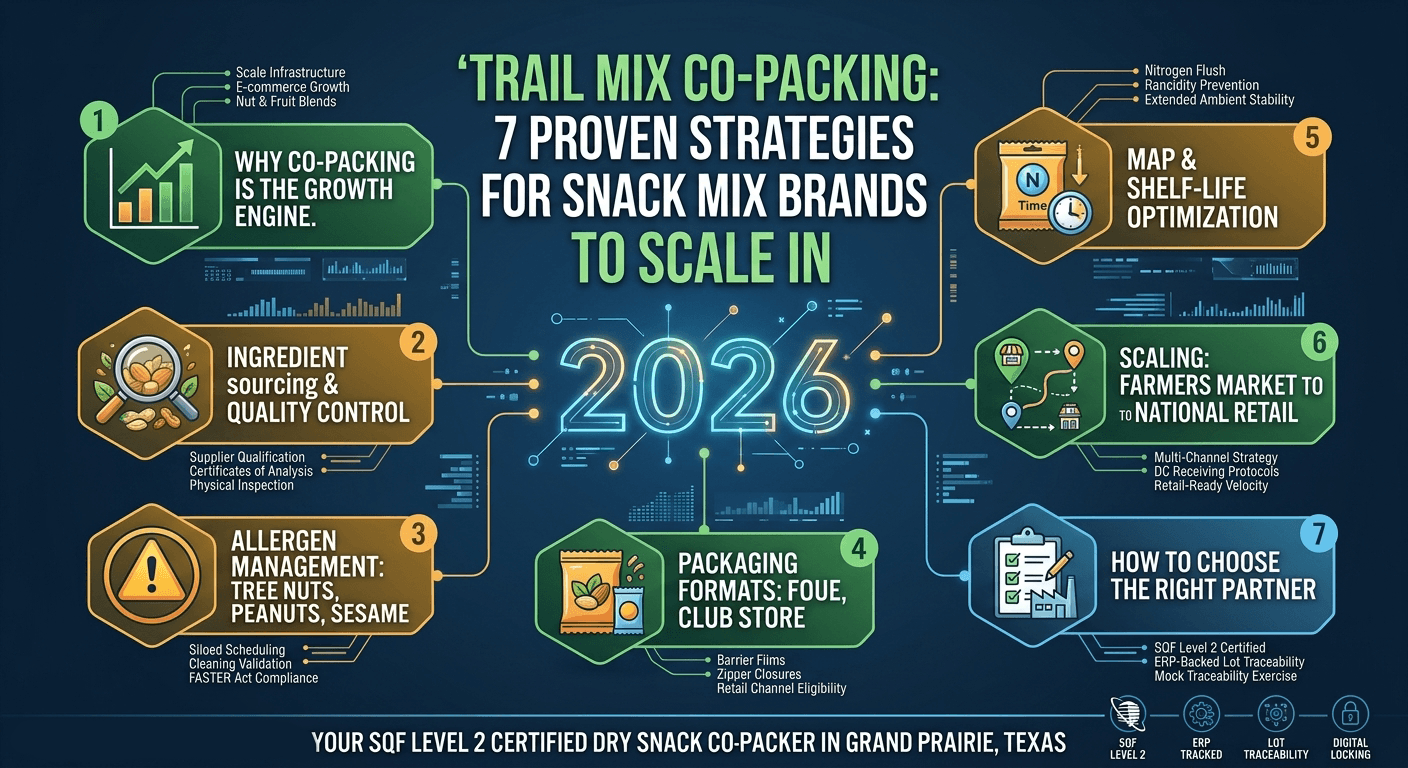
The global trail mix market is on a sustained growth trajectory that creates real commercial opportunity for snack brands at every development stage. Industry research values the market at USD 10.91 billion in 2026 and projects it will reach USD 14.77 billion by 2031 at a 6.24% compound annual growth rate. Verified Market Reports attributes this growth to a structural consumer shift toward nutrient-dense, portable, whole-food snack formats that serve both active-lifestyle and everyday-convenience occasions.
Capturing that opportunity demands far more than a differentiated formula and compelling brand identity. A trail mix product is an orchestrated assembly of dry components — tree nuts, peanuts, seeds, dried fruits, granola clusters, and increasingly, functional inclusions such as collagen peptides and fortified fiber powders — each with its own moisture activity profile, allergen classification, and particle density. Blending these components in precise ratios, portioning accurately, and packaging them in barrier formats that maintain shelf stability at commercial volumes while meeting certified food safety standards is a manufacturing challenge most brands cannot handle without an experienced production partner.
This is precisely where trail mix co-packing becomes the defining strategic lever for brands ready to scale. A professional co-packer brings not only the blending, portioning, and packaging equipment required at commercial volumes, but also the certified food safety infrastructure — SQF Level 2 certification, HACCP-based allergen controls, ERP-backed lot traceability, and documented cleaning validation records — that major grocery retailers and food service distributors require before they will approve a supplier. Understanding what separates a genuinely capable partner from one that is willing but operationally underprepared is the foundation of this guide.
The seven strategies that follow address every critical dimension of trail mix manufacturing: ingredient quality controls, allergen management, modified atmosphere packaging, retail compliance documentation, and co-packing partner evaluation criteria. Each strategy reflects the operational realities of commercial dry snack manufacturing and provides actionable frameworks for brand founders and procurement managers evaluating co-manufacturing partnerships. Whether you are sourcing your first commercial production run or assessing whether your current arrangement can support a national retail launch, these strategies apply directly.
The market data behind the trail mix category in 2026 reflects a durable structural shift in consumer snacking, not a short-cycle trend. The global trail mix market, valued at USD 10.91 billion this year and projected at USD 14.77 billion by 2031, is advancing at a 6.24% CAGR that outpaces the broader snack food category average. Growth spans active-lifestyle shoppers, health-and-wellness buyers, and workday snackers replacing processed options with nut-and-fruit blends delivering sustained energy without refined sugar spikes.
Online retail is emerging as the single fastest-growing distribution channel in the category, with e-commerce projected to expand at 7.15% CAGR through 2031. Trail mix co-packing with a certified production partner is the operational foundation that makes consistent online fulfillment possible at scale. Brands that produce reliably, maintain shelf stability through parcel supply chains, and carry third-party food safety certifications are positioned to capture a disproportionate share of this digital commerce growth.
Ingredient innovation is reshaping trail mix formulations and opening premium segment opportunities at two to three times the price point of conventional nut-and-fruit blends. Functional inclusions — collagen peptides for protein density, fortified dietary fibers for gut-health marketing, adaptogenic mushroom powders for wellness branding — create new technical requirements at the co-packing level: homogeneous distribution of fine-particle powders across coarser matrices, moisture activity management across components with different hygroscopic properties, and lot-level documentation supporting functional ingredient label claims.
Retail channel dynamics are raising the production quality and compliance bar at every distribution tier simultaneously. Club stores continue expanding trail mix floor and shelf space, natural grocers are tightening supplier qualification requirements, and mass retailers are building premium snack sets with trail mix as a high-margin centerpiece. Across all of these channels, the common denominator for supplier approval is a certified, audit-ready manufacturing partner — precisely what a qualified trail mix co-packing facility provides to its brand clients.
Trail mix brands consistently find that production capacity, not marketing effectiveness, becomes the binding growth constraint as consumer demand accelerates. A brand that secures a regional Sprouts or Whole Foods placement but cannot reliably produce 25,000 units monthly at consistent quality will lose that placement to a competing brand that can. Engaging a professional trail mix co-packing partner is fundamentally a decision to remove manufacturing capacity as the limiting factor and replace it with scalable infrastructure designed to grow with your retail footprint.
The quality ceiling for any trail mix product is set at the ingredient intake stage, and a professional trail mix co-packing operation must maintain documented ingredient qualification processes for every raw material your formula requires. This means reviewing supplier food safety certifications — SQF, FSSC 22000, BRC, or equivalent GFSI credentials — along with Certificate of Analysis documentation for each incoming lot, allergen status verification, and physical inspection upon receipt. Ingredient qualification is a continuous program ensuring every lot of almonds, cashews, dried cranberries, granola clusters, or functional dry inclusions meets your formula’s quality specification before blending begins.
Moisture activity (aw) management is one of the most technically critical and frequently underestimated quality parameters in dry snack mix production. Each component carries a different equilibrium moisture activity: almonds typically stabilize around 0.55–0.65 aw, while dried cranberries can range from 0.60 to 0.75 aw depending on processing method. When components with different aw values are blended, moisture migration occurs as the system moves toward equilibrium — progressively softening nuts, hardening dried fruits, promoting clumping, and compromising both sensory quality and microbial stability over the product’s shelf life.
ATP swab sanitation verification provides rapid, quantified evidence of equipment hygiene that visual inspection alone cannot deliver. Pack’n Fresh uses ATP swab testing between production runs, testing blending chambers, fill heads, weigh systems, and sealing surfaces to confirm equipment is hygienically clean before your trail mix production begins. These swab results are logged as part of the sanitation record, creating documentation that supports food safety audits and customer quality assurance reviews — a meaningful differentiator between trail mix co-packing facilities that operate with verified sanitation systems and those that rely solely on operator judgment.
ERP-backed traceability converts ingredient management from a paper-intensive exercise into a real-time digital system with full audit capability. Pack’n Fresh’s ERP-integrated production platform assigns lot identifiers to every incoming ingredient, links those lots to specific production orders, tracks component consumption through blending and portioning, and traces finished goods to shipment records. In a supplier recall or internal quality deviation, this system identifies exactly which production runs and finished lot codes incorporated the affected ingredient within minutes — enabling targeted product holds rather than broad market withdrawals.
Digital Ingredient Locking addresses one of the most persistent root causes of quality and safety incidents in multi-ingredient dry snack manufacturing: human error in formula assembly. Pack’n Fresh’s Digital Ingredient Locking system requires each ingredient to be digitally verified against the approved formula specification before it enters the blending process, cross-referencing scanned ingredient identity against the production order and flagging any discrepancy. For trail mix formulas with ten to fifteen components — many sharing similar visual characteristics — this systematic verification layer provides protection that relying solely on employee attentiveness cannot replicate.
Trail mix is inherently one of the highest-allergen food categories in the snack industry, and the regulatory framework governing its production is comprehensive. A single trail mix formula can simultaneously contain tree nuts — almonds, cashews, walnuts, pecans — peanuts, sesame seeds, and wheat-containing granola components, covering four of the nine major allergens recognized under FALCPA and the FASTER Act of 2021, which added sesame as a major allergen effective January 1, 2023. For any brand in this category, allergen management is the central operational discipline that must be embedded in every stage of the trail mix co-packing process.
Siloed allergen scheduling is Pack’n Fresh’s structural approach to allergen conflict prevention at the production planning level, operating upstream of equipment cleaning entirely. Rather than relying solely on cleaning procedures to manage allergen transitions, Pack’n Fresh organizes its production schedule to segregate allergen classes by dedicated time blocks — scheduling peanut-containing formulas in production windows physically and temporally separated from tree-nut-containing and sesame-containing formulas. This architecture reduces allergen changeover frequency, minimizes cross-contact risk at the most fundamental operational level, and provides a documented scheduling framework that supports FSMA Preventive Controls compliance and retailer allergen questionnaires.
Cleaning validation for allergen changeovers is a documented, systematic process that any GFSI-certified trail mix co-packing facility must maintain with verifiable records. Following a production run containing a defined allergen, the line undergoes a structured cleaning sequence — dry cleaning to remove gross residue, wet cleaning with food-grade detergents, rinse, and drying — followed by ATP swab verification of all product-contact surfaces, and for high-risk transitions, allergen-specific swab testing using ELISA-based kits to confirm removal below the action threshold. Pack’n Fresh documents all changeover cleaning records as part of its sanitation program, creating an auditable data trail for customer allergen management questionnaires and retail supplier audits.
Ingredient storage segregation is the physical infrastructure dimension of allergen management — and it is where many smaller co-packing operations fall short. In a facility handling peanuts, tree nuts, and sesame as concurrent raw materials, physical storage must enforce complete separation with designated allergen-specific zones, clear identification, physical barriers between allergen classes, and documented receiving and staging procedures that maintain allergen integrity from the dock through the production floor. Pack’n Fresh maintains allergen-designated storage areas with access controls preventing co-mingling of allergen-class ingredients at the warehouse level, where cross-contact is operationally simplest to prevent and most damaging when it occurs undetected.
For a comprehensive examination of allergen risk management within a broader food safety management system, Pack’n Fresh’s in-depth resource on allergen management in food packaging and traceability risk mitigation covers supplier allergen documentation, facility allergen zoning, FALCPA label compliance, and FSMA Preventive Controls requirements in practical detail. Trail mix brands entering the category for the first time will find this guide essential for evaluating whether a prospective co-packing partner’s allergen program is adequate for their specific formula risk profile.
Packaging format selection is one of the most commercially consequential decisions a trail mix brand makes, simultaneously determining retail channel eligibility, consumer occasion fit, shelf presentation, unit economics, and the specific production capabilities your trail mix co-packing partner must provide. The category spans a wide range of formats — from 1-ounce single-serve sachets for vending and convenience to 48-ounce resealable stand-up pouches engineered for club store velocity — and the production requirements for each format differ substantially in film material selection, fill system configuration, and sealing technology. Matching your packaging format to your target retail channel is a strategic decision that must precede co-packing partner selection.
The pouch and sachet segment is the fastest-growing format in the trail mix category, advancing at 6.5% CAGR driven by e-commerce growth, on-the-go consumption occasions, and retailer demand for shelf-ready pouch presentations. Stand-up pouches with reclosable zipper closures have become the dominant branded format in natural and specialty grocery, providing superior graphic space for brand differentiation, consumer-valued resealability, and the barrier film properties needed to protect nut oils and dried fruit quality through extended ambient shelf life. Pack’n Fresh’s pouching capabilities span the stand-up pouch dimensions and closure configurations the trail mix co-packing category requires, from small-format single-serve to large-format club and e-commerce SKUs.
Club store and mass retail formats introduce the most demanding specification set in trail mix packaging, with tight fill-weight tolerances — often ±3 grams on large fills — retail-ready label requirements, defined case-pack configurations, and consistent visual presentation that survives weeks of open-display shelf time. Pack’n Fresh’s ERP-backed production management system coordinates formula specifications, fill-weight parameters, label version requirements, and case-pack configurations for each customer SKU and retail destination, ensuring the correct product ships with the documentation the retailer’s compliance team requires at receiving.
For a detailed examination of film materials, barrier specifications, zipper formats, and print considerations for snack pouch applications, Pack’n Fresh’s guide to snack and spice pouch packaging is a practical resource for trail mix brands evaluating their packaging strategy. Selecting the right film barrier for your trail mix formula — balancing moisture vapor transmission rate against oxygen transmission rate based on your specific ingredient mix, moisture activity profile, and target shelf life — is a technical decision your co-packing partner should actively support with documented material recommendations and comparable formula shelf-life validation data.
Ready to Scale Your Trail Mix Brand? Talk to Pack’n Fresh.
Pack’n Fresh is a SQF Level 2 certified dry product co-packer in Grand Prairie, Texas, specializing in trail mix co-packing for snack brands ready to move from small-batch to retail-ready scale. Our full-service capabilities include dry blending, stand-up pouching, MAP nitrogen flush, kitting, labeling, warehousing, Digital Ingredient Locking, and siloed allergen scheduling for nut-intensive formulas.
Shelf life is not simply a technical specification printed on the package — it is a commercial threshold that determines whether your trail mix reaches consumers in optimal condition through a retail supply chain. Major retail distribution center receiving protocols require trail mix SKUs to arrive with 60% to 80% of remaining shelf life to accommodate DC storage, store delivery cycles, and consumer purchase time. For trail mix products targeting 12 to 18 months of ambient shelf stability, ingredient aw management, packaging material barrier selection, and gas atmosphere technology must all be optimized together — and trail mix co-packing with a partner who integrates these variables into a coherent shelf-life management system is the practical route to meeting retail requirements consistently.
Modified Atmosphere Packaging (MAP) is the industry-standard technology for extending shelf life in nut-containing trail mix formulations. Nuts and seeds contain significant concentrations of polyunsaturated and monounsaturated fatty acids — oleic acid in almonds, linoleic acid in walnuts and sunflower seeds — that oxidize readily when exposed to atmospheric oxygen, producing the aldehyde and ketone compounds responsible for rancid off-flavors and off-aromas. MAP directly addresses this mechanism by displacing or replacing oxygen in the package headspace with inert gas before sealing, dramatically slowing the lipid oxidation that degrades both sensory quality and the nutritional value of fat-soluble vitamins in fortified formulas.
Nitrogen flush is the most widely applied MAP technique in trail mix co-packing and dry snack production. In a nitrogen flush system, the package is filled with product, flooded with food-grade nitrogen gas displacing the oxygen-laden headspace air, and sealed in rapid sequence, maintaining internal headspace oxygen concentration typically below 1 to 2% compared to approximately 21% in ambient air. At this reduced oxygen level, the rate of lipid oxidation in nut-containing formulas slows by an order of magnitude, extending sensory shelf life by weeks to months depending on the formula’s total oil content and the initial quality of incoming nut ingredients.
Carbon dioxide is sometimes incorporated into the MAP gas blend for trail mix formulas that include granola clusters or oat-based components where yeast-and-mold suppression is a secondary shelf-life concern alongside oxidation control. CO₂ exhibits antimicrobial properties at headspace concentrations above approximately 20%, and a nitrogen/CO₂ blend — typically 70 to 80% N₂ and 20 to 30% CO₂ — simultaneously addresses lipid oxidation in nut-containing components and microbial stability in cereal-based ones. Pack’n Fresh documents MAP parameters for each customer formula as a permanent element of the production specification record, ensuring gas blend ratios are consistently applied across every production run.
For a comprehensive technical guide to MAP applications in dry snack manufacturing — covering gas selection rationale, aw considerations, film barrier specifications, and shelf-life validation approaches — Pack’n Fresh’s resource on modified atmosphere packaging and shelf life optimization covers the full technical picture in one place. Shelf-life validation — storing finished product under defined conditions and conducting sensory, microbiological, and physicochemical testing at defined intervals — is both a regulatory expectation under FSMA and a commercial expectation from retail buyers who require documented evidence that your product maintains declared quality through their distribution supply chain.
The transition from small-batch trail mix to commercially manufactured product positioned for national retail is not a single step — it is a sequence of production capability thresholds, each requiring different co-packing arrangements, documentation standards, and volume commitments. What works for a 500-unit farmers market run does not work for a 40,000-unit natural grocery regional launch, and regional natural channel production does not meet the specification depth required for a national club store program. Understanding the scale milestones and the trail mix co-packing capabilities required at each stage prepares brand teams to structure co-manufacturing partnerships that support, rather than constrain, their growth trajectory.
Minimum order quantity negotiation is the first practical production conversation a growing trail mix brand has with a commercial co-packer, and understanding the drivers helps brands negotiate effectively. Co-packer MOQs are determined by equipment changeover costs, packaging material minimums from film and label suppliers, and production scheduling efficiency — factors that vary by facility and formula complexity. Regional brands in the 5,000 to 15,000 unit per run range need co-packers willing to accommodate shorter runs with efficient changeovers, and Pack’n Fresh discusses MOQ structures directly with brand partners during onboarding, establishing run sizes that reflect actual production economics and scale as retail velocity supports larger volumes.
Retail compliance documentation is the scaling requirement that consistently surprises trail mix brand founders who underestimate the bureaucratic depth of major retail supplier approval. Before Whole Foods Market, Sprouts Farmers Market, Target, or Costco will process a purchase order, their supplier compliance teams typically require: a current SQF or GFSI certification certificate, documented lot traceability records and a written mock-recall procedure, allergen management documentation, nutrition facts panel validation against laboratory analysis, and in some programs a third-party facility audit report. A trail mix co-packing partner holding SQF Level 2 certification substantially reduces the time required to assemble this package because the most demanding elements are already in place and audited annually.
E-commerce scaling introduces fulfillment requirements fundamentally different from retail store replenishment, and trail mix brands building both channels simultaneously must confirm their co-packing partner supports both without operational compromise. Online channels — Amazon, direct-to-consumer Shopify storefronts, Thrive Market — require unit labeling formatted for warehouse pick-and-pack, platform-specific labeling for marketplace fulfillment programs, and packaging robust enough to protect product integrity through parcel shipping variability. Pack’n Fresh’s kitting and warehousing capabilities allow trail mix brands to consolidate production and e-commerce-ready fulfillment at a single co-packing location, reducing the logistics complexity of managing a separate third-party logistics relationship.
The decision to entrust your trail mix brand’s manufacturing to a co-packing partner is a commitment that affects every downstream element of your business — product quality, food safety compliance, retail eligibility, cost structure, and growth velocity. It deserves the same rigor and structured evaluation you apply to selecting a major retail customer or a strategic investor, because a co-packing partner lacking the right certifications, allergen management infrastructure, or production documentation systems creates not just operational friction but regulatory and reputational risk. Evaluating candidates against a consistent, criteria-based framework identifies the facilities genuinely capable of supporting your brand.
SQF Level 2 certification is the non-negotiable baseline credential for any trail mix co-packing facility worthy of serious consideration. SQF is recognized by the Global Food Safety Initiative (GFSI) and audited annually by independent, SQFI-accredited certification bodies. The Safe Quality Food Institute maintains a searchable database of certified facilities, allowing you to verify a co-packer’s SQF status and certification scope before requesting a facility visit. SQF Level 2 certification confirms the facility has implemented a documented food safety management system including HACCP-based hazard analysis, prerequisite programs covering allergen management, sanitation, pest control, and supplier qualification — all verified annually by a third party.
FSMA Preventive Controls compliance is the regulatory foundation that every commercial trail mix co-packing operation in the United States must satisfy. The FDA’s Food Safety Modernization Act requires food manufacturing facilities to maintain documented Preventive Controls Plans addressing allergen controls, sanitation controls, and supply chain program controls, along with monitoring procedures, corrective action protocols, and verification activities. When evaluating a co-packing partner, request a summary of their Preventive Controls Plan and ask specifically about their allergen Preventive Controls — the documented controls for tree nuts, peanuts, and sesame are the most critical elements for a trail mix co-packer to have correctly designed and consistently executed.
ERP-backed traceability capability separates professional trail mix co-packing operations from facilities managing production on spreadsheets and paper lot cards, and the simplest evaluation method is a mock traceability exercise. Provide a hypothetical ingredient lot number and ask the facility to demonstrate how quickly and completely they can trace that ingredient through all associated production runs and finished lot codes. A facility operating on a robust ERP system should complete this exercise in under four hours with fully documented records; a facility requiring multiple days represents a traceability risk that is incompatible with retail supplier agreements where four-hour recall response is increasingly a contractual requirement.
Pack’n Fresh is a full-service, SQF Level 2 certified co-packer in Grand Prairie, Texas, specializing exclusively in dry product manufacturing for snack, spice, and specialty food brands. As a dedicated dry-only facility, Pack’n Fresh produces trail mix formulas — tree nuts, peanuts, seeds, dried fruits, granola clusters, and functional dry inclusions — without any liquid filling, beverage production, or liquid sauce operations on site. This dry-product-only focus means every system in the facility is calibrated for the precision demands of complex dry snack formulas, undiluted by competing operational requirements from wet-process or liquid product lines.
Pack’n Fresh’s core capabilities for trail mix co-packing include precision dry blending with documented weigh-to-blend accuracy; stand-up pouch filling and sealing across single-serve, multi-serve, and club store formats; modified atmosphere packaging with nitrogen flush for nut-containing formulas requiring extended shelf life; kitting and variety pack assembly for e-commerce and retail display applications; custom labeling with ERP-managed label version control; and finished goods warehousing with lot-level inventory management. Every production run is executed within a SQF Level 2 certified food safety management system audited annually by an independent third-party certifier.
The Digital Ingredient Locking system at Pack’n Fresh provides systematic, documented verification that every ingredient entering a production blend matches the approved formula specification before blending begins — particularly valuable for trail mix formulas with complex component lists and critical allergen implications. Combined with siloed allergen scheduling that segregates peanut-class, tree-nut-class, and sesame-class production windows at the planning stage, and ATP swab verification confirming equipment hygiene between every run, Pack’n Fresh’s allergen management infrastructure is designed to meet the documentation expectations of the most rigorous retail compliance programs in natural, specialty, and mass grocery markets.
The trail mix category in 2026 represents a genuine and growing commercial opportunity — a USD 10.91 billion global market advancing at 6.24% CAGR, with e-commerce outpacing that rate and premium functional formulations commanding price points that reward quality investment. Capturing that opportunity at scale requires a production infrastructure capable of delivering consistent quality, certified food safety compliance, allergen management discipline, and the packaging technology that maintains product integrity from the production line through the consumer’s hands. Trail mix co-packing with the right certified partner is the strategic foundation that transforms a differentiated formula into a retail-ready, audit-compliant, scalable brand.
The seven strategies in this guide — ingredient quality control through ATP swab verification and Digital Ingredient Locking, allergen management through siloed scheduling and cleaning validation, MAP-based shelf-life optimization, retail compliance documentation, and structured co-packing partner evaluation using SQF certification and ERP traceability as core criteria — address the operational checkpoints that separate trail mix brands built for sustainable national scale from those that plateau at regional or artisan production. Each strategy provides both a technical framework and the evaluation questions that reveal whether a prospective co-packing partner has genuinely implemented the system or merely represents that they have.
At minimum, require SQF Level 2 or equivalent GFSI certification — FSSC 22000 or BRC are also accepted by major retailers. SQF Level 2 means the facility has been independently audited against food safety management standards covering HACCP, allergen controls, sanitation programs, and supplier qualification. For brands targeting Whole Foods, Target, Sprouts, or club stores, SQF certification is a formal supplier prerequisite. Verify a facility’s current certification status directly through the SQFI database before initiating any co-packing discussions.
Qualified trail mix co-packing facilities manage allergens through siloed production scheduling that segregates allergen classes by dedicated time blocks, physical ingredient storage segregation, allergen changeover cleaning validation with ATP swab verification, and allergen-specific swab testing for high-risk transitions. The FASTER Act, effective January 1, 2023, added sesame as a major allergen under FALCPA — making sesame controls as rigorous as peanut and tree-nut controls. Ask any prospective co-packer to describe their allergen changeover procedure step by step; the specificity of the answer reveals program maturity.
Modified Atmosphere Packaging (MAP) displaces oxygen in the sealed package headspace with inert gas — most commonly nitrogen, or a nitrogen/CO₂ blend — to dramatically slow the lipid oxidation that causes nuts and seeds to develop rancid off-flavors. Nuts contain polyunsaturated fatty acids that oxidize rapidly under ambient oxygen, degrading quality within weeks to months. MAP extends trail mix sensory shelf life to support the 12 to 18 month windows that major grocery retailers and club stores require from any professional trail mix co-packing operation.
Digital Ingredient Locking digitally verifies each ingredient against the approved formula specification before it enters the blending process. For trail mix formulas with ten or more components — many sharing similar visual characteristics, such as raw almonds and cashews, or sesame and hemp seeds — this system prevents formula assembly errors including wrong ingredient selection, allergen-class substitution, and incorrect lot usage. Without it, multi-ingredient blending relies solely on employee attentiveness to prevent errors that can result in allergen incidents, label violations, or product non-conformance.
ERP-backed traceability in a professional trail mix co-packing operation links every ingredient lot at receipt to every production run that consumed it, and every production run to every finished lot code shipped. In a recall scenario, this system identifies exactly which finished lot codes contain the affected ingredient within hours — enabling a targeted product hold rather than a broad market withdrawal. Most major retail supplier agreements now include a contractual four-hour mock recall response requirement, making ERP traceability infrastructure a commercial necessity for brands in national retail distribution.
Minimum order quantities vary by facility, formula complexity, and packaging format, but regional and emerging brands typically encounter MOQs in the range of 5,000 to 20,000 units per SKU for standard stand-up pouch formats. MOQs are driven by equipment changeover costs, packaging material minimums from film and label suppliers, and production scheduling efficiency. As retail velocity grows and run sizes increase, per-unit costs improve as setup costs are amortized across larger volumes, making MOQ an evolving conversation as your brand scales.
Schedule Your Trail Mix Co-Packing Consultation with Pack’n Fresh
Pack’n Fresh is a SQF Level 2 certified dry product co-packer in Grand Prairie, Texas, ready to support your trail mix brand from first commercial production run through national retail scale. Our full-service trail mix co-packing capabilities — dry blending, stand-up pouching, MAP nitrogen flush, kitting, ERP traceability, Digital Ingredient Locking, and siloed allergen scheduling — are available for snack brands at every stage of growth. Reach out today to discuss your formula, your volume targets, and your retail timeline.
Every year, thousands of food entrepreneurs ask themselves the same foundational question: what does it actually take to turn a great recipe into a commercially manufactured product that reaches retail shelves and generates consistent, scalable revenue? The journey from a home kitchen idea to a product that consumers can buy at their local grocery store is longer, more technically complex, and more capital-intensive than most first-time founders anticipate — but it is absolutely achievable with the right roadmap and the right partners. Understanding how to launch a food brand in today’s competitive market means building competency across multiple disciplines simultaneously: food science, regulatory compliance, brand strategy, manufacturing logistics, and multi-channel distribution — all before your product ever reaches a store shelf.
The food brands that reach meaningful commercial scale are rarely those with the best recipes. They are the ones whose founders understood how to launch a food brand as a complete business system — not simply a culinary passion project. That distinction matters enormously: it is the difference between a product that sells out at one farmers market weekend and a brand that earns a purchase order from a regional grocery chain with 200 locations. This guide was written specifically to help you make that transition with clarity and confidence, so you can move from concept to retail shelf in 2026 without wasting capital on avoidable mistakes that derail far too many promising food startups before they reach their potential.
What follows is a practical, step-by-step framework covering everything a first-time or early-stage food founder needs to know about how to launch a food brand in the current market: from validating your concept before spending a dollar on manufacturing, to navigating FDA compliance under FSMA, selecting and vetting the right co-packer, designing retail-ready packaging, and executing a multi-channel go-to-market strategy that generates real, sustainable revenue. Whether you are launching a clean-label sauce, a functional snack, a specialty beverage, a premium pantry staple, or a private-label retail product, the seven steps in this article apply directly to your product, your market, and your launch timeline.
This guide walks you through all seven of those steps in sequence: concept validation, brand identity and trademark protection, FDA compliance under FSMA, co-packer selection and vetting, retail-ready packaging design, go-to-market channel strategy, and long-term growth through a strategic co-packing partnership. Each step builds directly on the one before it, and understanding how to launch a food brand through this complete framework is what separates founders who reach the retail shelf from those who stall at the product development stage.
At Pack’n Fresh, a SQF Level 2 certified full-service co-packer based in Grand Prairie, Texas, we have partnered with food entrepreneurs at the earliest stages of their brands — from first product development conversation to first retail purchase order. Our fully integrated production capabilities — including dry blending, pouching, labeling, kitting, and ERP-backed lot traceability — give brand founders the operational foundation they need when they are learning how to launch a food brand without the coordination complexity of managing multiple independent vendors. For the emerging food brands we work with, that end-to-end operational support at launch is not a convenience — it is a competitive advantage that shapes the entire trajectory of their first year in market.
The single most expensive mistake founders make when learning how to launch a food brand is falling in love with their product before the market has validated demand for it. Product development costs, custom packaging design fees, regulatory consulting, co-packer minimum order quantities, and initial inventory can easily total tens of thousands of dollars before you have sold a single unit at retail — and every dollar of that investment carries real financial risk if you have not first confirmed that real consumers actually want what you are making at the price you need to charge. The best founders in the food industry treat concept validation like a scientific hypothesis test: they design small, low-cost experiments specifically designed to confirm or challenge their core assumptions before committing capital to commercial-scale production.
Begin by building a thorough, objective picture of your target product category and its competitive landscape. Professional industry tools like SPINS and Mintel offer detailed category analysis and purchase data, but low-cost alternatives — walking your target retail section and photographing every competitor on shelf, reading consumer reviews on Amazon for competing products, monitoring category conversations in food-focused online communities — can reveal significant insight without a subscription fee. Your goal at this stage is to identify a defensible gap that your product authentically fills and that your target consumer actually cares about — not simply to find confirmation for assumptions you already hold. If five competitors are already competing effectively at your exact positioning and price point, that is critical market intelligence you need before you commit to manufacturing, not after.
Sell before you manufacture — this is one of the most important principles in how to launch a food brand without catastrophic early losses. Before booking co-packer production time or ordering custom packaging components, produce small cottage-law-compliant batches where your state’s regulations permit, and sell at local farmers markets, community pop-up events, or through a small DTC pre-order campaign to test real consumer purchasing behavior. Farmers market sales conversations are among the highest-quality market research available to an early-stage food brand: consumers will tell you directly which flavors move fastest, which label descriptions create confusion, what price point feels right for your product, and how your brand compares in their minds to competing products they already buy. Set yourself a concrete validation target: aim to sell at least 500 units at local events and direct channels before you schedule a co-packer discovery call.
Analyze your pricing and margin structure rigorously before you commit to a manufacturing partner or a packaging format. Calculate your estimated cost of goods sold (COGS) at realistic co-packer scale and work backward from a realistic retail selling price — taking into account the typical retail margin (30–50%), distributor margin (15–25%), freight costs, and promotional allowances — to confirm that your unit economics actually work at your target price point. Our detailed guide on food business COGS calculation walks through exactly how to structure this math before you commit capital to a production run. Founders consistently report that discovering at this stage that their target retail price is insufficient to support their actual cost structure is far less painful than discovering it after 5,000 units of finished goods are sitting in a warehouse.
Distill your product’s core differentiation into a single, clear sentence before you take your concept any further. This is sometimes called your shelf pitch — the one claim that makes a buyer or a first-time consumer choose your product over a direct competitor sitting immediately beside it. Knowing how to launch a food brand with genuine retail traction almost always traces back to founders who could articulate this sentence with precision and confidence from the earliest stage of their planning. If you cannot state your differentiation that concisely and convincingly right now, treat it as a signal that your concept needs additional refinement before you invest in co-packing, packaging design, or distribution outreach.
Document everything systematically during your validation phase — disciplined founders who understand how to launch a food brand with lasting co-packer credibility treat this step as non-negotiable. Keep organized records of your sales volumes by event and channel, your consumer feedback conversations, your price sensitivity testing results, and the questions that buyers and consumers ask most frequently about your product. This documentation becomes the raw material for your brand story, your investor narrative, your retail sell sheet, and your buyer conversations later in the launch process. A co-packer with genuine experience working with early-stage food brands will want to understand your validation story before they invest time in a discovery conversation — it demonstrates that you are a disciplined brand founder, not someone exploring a manufacturing hobby.
Every strategic decision in how to launch a food brand with lasting recognition flows from the strength of your brand identity. Brand identity is not simply a logo and a color palette — it is the complete, integrated system of visual and verbal signals that communicate your product’s value, personality, and promise to a consumer in the three to five seconds they spend evaluating your product at shelf. Before you invest substantially in packaging design, website development, or social media content, you need to make the foundational brand decisions that will govern every downstream design and communication choice for years: your brand name, your complete visual identity system, your brand voice and tone, and your core founding story. Brand operators note that these foundational decisions become exponentially more expensive to revise once commercial packaging has been printed and distributed to retail accounts, so investing the time to make them strategically right from the beginning creates significant compounding returns.
Conduct a thorough trademark search before committing to any brand name or logo system — and do it before you fall in love with a name that may already be legally protected. The USPTO (United States Patent and Trademark Office) maintains a publicly searchable database called TESS (Trademark Electronic Search System) where you can check for existing federal trademark registrations in your product category before you invest in naming, design, or brand registration. Filing a federal trademark with the USPTO is the standard mechanism for protecting food brand names, logos, and slogans in U.S. commerce; the application process requires submitting your mark, its classification under the appropriate International Class of goods, and a specimen demonstrating the mark in active commercial use. Working with a qualified trademark attorney is strongly advisable throughout this process, because incorrect goods classification, likelihood-of-confusion conflicts with existing marks, and procedural errors are among the most common reasons USPTO applications are rejected or significantly delayed.
Protect your formula and proprietary processes before you share them with any external party — this is one of the highest-leverage legal steps in how to launch a food brand without surrendering your core intellectual property to a competitor. When you begin working with co-packers, ingredient suppliers, flavor development houses, or any third-party involved in your production process, you will necessarily be sharing formulation information that represents a core competitive asset — the precise combination of ingredients, ratios, and processes that makes your product distinctive. Always execute a Non-Disclosure Agreement (NDA) before sharing any formulation details, process specifications, ingredient sourcing information, or proprietary flavor profiles with any external organization. Most reputable co-packers are fully accustomed to executing NDAs as a standard element of their client onboarding process — but review every NDA carefully with qualified legal counsel to confirm it adequately covers the specific intellectual property you are disclosing and provides meaningful enforcement rights.
Your brand voice and complete visual identity system should be built precisely around your specific target consumer, not a generalized food-purchasing audience. A functional electrolyte drink targeting competitive endurance athletes communicates very differently from a premium artisan hot sauce targeting adventurous home chefs — even if both products are packaged in similar-sized bottles occupying adjacent positions on the same retail shelf. Define your target consumer persona with operational specificity: demographic profile, household income bracket, purchase motivations, dietary philosophy, shopping channel preferences, and media consumption patterns. Let that persona drive every brand decision you make, from the copy hierarchy on your front label to your Instagram content strategy to the trade events you choose to invest booth space at. This discipline in consumer focus is one of the most consistent predictors of early launch success that co-packers experienced in new product launches observe across their growing client roster.
Understanding how to launch a food brand with lasting market position also means recognizing that brand equity is actively constructed before your product ships — not passively accumulated after it does. Begin building your email subscriber list, your social media following, and your brand narrative during the product development phase, not after your first commercial production run arrives. Document your development journey authentically, share the story of why you are building this brand and what gap in the market motivated you, and start capturing genuine consumer testimonials and feedback even from your earliest cottage-production batches. By the time your co-packer delivers your first commercial run, you should already have a warm, engaged audience that has followed your journey and is ready and eager to make a purchase.
FDA compliance is non-negotiable for any food brand selling products to U.S. consumers, and the regulatory requirements are more specific, more technical, and more actively enforced than most first-time founders realize when they begin their launch planning. The Food Safety Modernization Act (FSMA) fundamentally reoriented FDA’s regulatory posture from responding to foodborne illness outbreaks after they occur to actively preventing them before they can happen — placing significant new preventive control obligations on food facilities and manufacturers at every stage of the supply chain. Understanding your specific obligations under FSMA, and building a manufacturing relationship with a co-packer who already operates in full documented compliance with those requirements, is one of the most critical components of knowing how to launch a food brand that survives its first regulatory review or retail buyer compliance audit.
Founders who understand how to launch a food brand in full FDA compliance know that facility registration is a mandatory pre-production step, not a post-launch formality. Food facilities that manufacture, process, pack, or hold food intended for consumption in the United States are required to register with the FDA before producing food for U.S. commerce — this is a FSMA requirement, not simply a best practice. FDA food facility registration is completed online through the FDA’s Unified Registration and Listing System (FURLS) at fda.gov/food and must be renewed biennially during the October through December registration window. If you are working with a co-packer — which most emerging food brands should be — that co-packer’s facility is the registered food facility for regulatory purposes. Confirm this arrangement explicitly in your co-packing agreement, request a copy of your co-packer’s current FDA registration number and registration status documentation, and retain those records as part of your compliance file.
FDA food labeling requirements are detailed, technically specific, and enforced by both FDA and state-level regulatory agencies. Federal law requires that any packaged food product sold in U.S. commerce include the following mandatory elements: a Nutrition Facts panel formatted precisely to current FDA specifications (including the updated panel format that has been mandatory since 2020 for most manufacturers), a complete ingredient list declared in descending order of predominance by weight using standardized ingredient names, a major food allergen declaration compliant with both FALCPA and the FASTER Act of 2021, the net quantity of contents expressed in both metric and U.S. customary units, and the name and place of business of the manufacturer, packer, or distributor. The full technical requirements for each of these mandatory label elements — including type size requirements, panel placement rules, and permitted format variations — are available at FDA’s food labeling and nutrition resource page.
For any founder mapping out how to launch a food brand with allergen-containing ingredients, allergen labeling deserves particular attention from both a regulatory compliance and consumer safety standpoint. The FASTER Act of 2021 added sesame as the ninth major food allergen in the United States, effective January 1, 2023 — joining the previously established eight: milk, eggs, fish, shellfish, tree nuts, peanuts, wheat, and soybeans. Your ingredient list and any applicable may-contain or processed-in-the-same-facility statements must accurately reflect every major allergen present in your formulation. Where cross-contact in the manufacturing environment is a realistic operational possibility, that risk should be disclosed to consumers through appropriate precautionary labeling. A qualified co-packer will have documented, audited allergen control procedures that protect your specific product and their other client products simultaneously — including allergen scheduling protocols and verified sanitation standards designed specifically to manage cross-contact risk between production runs.
FSMA also requires that facilities producing food subject to the Preventive Controls for Human Food rule maintain comprehensive written food safety plans, conduct documented hazard analyses for each product they manufacture, and implement preventive controls with monitoring, corrective action, and verification procedures that are documented and available for regulatory review. Founders consistently report that partnering with an SQF-certified co-packer dramatically simplifies their own compliance burden, because a certified co-packer’s food safety management system already meets or exceeds FSMA’s preventive controls requirements at the facility level. Knowing how to launch a food brand without becoming entangled in costly regulatory non-compliance issues frequently comes down to choosing a manufacturing partner whose existing certifications and documented food safety systems effectively carry a substantial portion of your compliance responsibility on your behalf.
Founders who know how to launch a food brand that scales without operational crisis will tell you that choosing the right co-packer is the single most consequential decision of the entire launch process, and the stakes justify treating it as a multi-week strategic evaluation rather than a casual vendor comparison. A strong co-packing partner is far more than a contract manufacturer — they are an operational partner who protects your proprietary formula, delivers consistent product quality across every production run regardless of volume, scales their service capacity alongside your brand’s growth trajectory, and actively helps you navigate the technical and regulatory challenges of commercial food production. A poor co-packer choice, by contrast, can derail your launch timeline by months, generate quality inconsistencies that cost you early retail placements, and expose your brand to significant regulatory liability you may not discover until a buyer audit reveals the problem.
Begin your co-packer evaluation by clearly defining the complete scope of production services your brand requires, then systematically match those requirements to co-packer capabilities. How to launch a food brand efficiently almost always involves working with a full-service co-packer rather than piecing together a supply chain from multiple independent vendors. Full-service co-packers — like Pack’n Fresh in Grand Prairie, Texas — provide end-to-end manufacturing solutions that include sourcing and managing inbound raw materials, filling, sealing, labeling, kitting, and warehousing under a single, integrated operational roof. This integrated capability means you as the brand owner do not need to coordinate multiple independent vendors, manage inbound ingredient shipment logistics, or troubleshoot handoffs between separate suppliers and manufacturers. Specialty co-packers may focus on specific product formats (liquid-only, dry blends, flexible pouches) or specific product categories — match your product’s format and category to the co-packer’s demonstrated operational expertise before you invest time scheduling a facility visit.
Third-party food safety certification is the absolute minimum qualification bar for any co-packer you seriously evaluate. A co-packer operating without a recognized independent certification — such as SQF (Safe Quality Food) certification from the Safe Quality Food Institute — represents an unnecessary and potentially brand-threatening risk to your product’s integrity and your consumers’ safety. Pack’n Fresh holds SQF Level 2 certification, meaning an independent auditor from a SQFI-approved certification body has comprehensively evaluated our food safety management system against the SQF Code standards and formally confirmed compliance. For brand founders, this certification provides documented, third-party-verified evidence of your manufacturing partner’s food safety practices — the kind of documentation that retail buyers, grocery chain compliance teams, national distributors, and institutional purchasers may require before approving your brand for their program.
Ask every co-packer candidate to explain their allergen management system in specific operational detail — not just in general terms or with reference to a written policy document. Brands whose products contain any of the nine major food allergens, or whose products must be kept free of cross-contact with allergens present elsewhere in the facility, need a co-packer who can demonstrate documented allergen control with real operational specificity about how cross-contact risk is managed run-to-run. Pack’n Fresh uses siloed allergen scheduling, which means allergen-containing production runs are methodically sequenced and scheduled to prevent cross-contact exposure with non-allergen or allergen-sensitive products. We combine this scheduling system with ATP swab sanitation verification — an objective, measurement-based microbiological test that provides documented confirmation that all equipment contact surfaces are free of biological residue following every cleaning event between production runs. Request ATP testing records and allergen scheduling documentation from every co-packer candidate before making a selection commitment.
Founders learning how to launch a food brand at a retail-ready level quickly discover that traceability infrastructure has become operationally non-negotiable for food brands seeking placement with retail chains, regional and national distributors, and institutional buyers — and the regulatory trend toward mandatory supply chain traceability under FSMA’s Food Traceability Rule makes this a forward-looking investment regardless of your current channel profile. In the event of a product recall — whether voluntary or FDA-mandated — your ability to trace every ingredient from its origin through your co-packer’s production process to the specific lot of finished goods currently in the distribution channel determines how quickly and precisely you can limit consumer exposure and protect your brand’s long-term reputation. Pack’n Fresh’s ERP-backed production management system maintains comprehensive production records linking every lot of finished product to its source ingredients, production batch parameters, in-process quality control data, and finished goods disposition. Our Digital Ingredient Locking system provides an additional safeguard by ensuring that production runs cannot deviate from an approved, brand-owner-authorized formulation without documented authorization — protecting your formula integrity, your label compliance, and your product consistency simultaneously.
For a more comprehensive operational framework covering the full co-packer vetting process, read our detailed guide on choosing a food co-packer: 5 critical questions every brand should ask, which covers minimum order quantity negotiation, lead time management, contract term structures, and ongoing quality control requirement setting. If you are earlier in the process and want to understand what co-packing actually involves before beginning vetting conversations, our foundational overview of what food co-packing is and how it can benefit your business is the right starting point. How to launch a food brand the right way means treating co-packer selection as a multi-week strategic investment, not a two-hour vendor comparison.
Ready to Work With a Co-Packer Purpose-Built for New Food Brand Launches?
Pack’n Fresh is a SQF Level 2 certified full-service co-packer in Grand Prairie, Texas. We offer ERP-backed traceability, Digital Ingredient Locking, siloed allergen scheduling, and fully integrated production services — from inbound materials through labeling, kitting, and warehousing. Whether you are planning your first production run or scaling an established SKU, we would love to discuss your product and timeline.
Your packaging is your product’s most powerful sales tool at the retail shelf level — and it performs that function entirely without you present to explain, demonstrate, or advocate. The design decisions you make about label layout, color palette, typography, front-panel visual hierarchy, and back-panel copy will determine whether your product attracts consumer attention and earns a purchase or disappears behind a more visually compelling competitor. Brand operators note that packaging design is consistently one of the highest-leverage investments an early-stage food brand can make, yet it is also one of the most frequently rushed steps in how to launch a food brand at retail scale, with founders cutting corners that later cost them placements, reorder opportunities, and the kind of brand recognition that drives long-term consumer loyalty.
Structure your front panel around a deliberate visual hierarchy that communicates your product’s core value proposition within one second of shelf exposure — because that is realistically all the time you will have. Your brand name should function as the dominant visual element that creates recognition and recall. Directly adjacent to it, your product name or flavor descriptor should immediately answer the consumer’s first question: what is this? The hero claim — your single most compelling benefit, whether “No Added Sugar,” “USDA Organic,” “Gluten-Free,” “20g Protein,” “Non-GMO,” or another category-relevant attribute — should be the third element the consumer’s eye encounters, reinforcing the primary purchase motivation. Consumers making purchase decisions in a retail aisle spend very limited time reading label copy; your packaging must communicate its entire value proposition without requiring careful reading.
Understanding how to launch a food brand through the right packaging format requires an early co-packer conversation, because your physical packaging format has direct structural implications for your production relationship that must be resolved before your label design is finalized — not after packaging components have been ordered. Different fill formats — glass jars, flexible stand-up pouches, rigid plastic containers, aseptic cartons, aluminum cans, foil-sealed cups, metal tins — require fundamentally different filling equipment, sealing systems, and labeling approaches. Discuss your preferred format with your co-packer before committing to a design, because equipment tolerances, minimum fill volumes, and label application specifications vary significantly across formats and must be fully compatible with your co-packer’s existing production capabilities. Pack’n Fresh’s precision micro-dosing capability enables accurate, consistent filling of small-volume servings that require tight fill-weight control — a differentiating operational asset for brands producing hot sauces, concentrated flavor drops, premium oils, or high-value supplement-grade functional ingredients where fill accuracy directly affects both product quality and regulatory compliance.
Your mandatory FDA labeling elements — Nutrition Facts panel, complete ingredient list, allergen declarations, net quantity statement, and manufacturer contact information — must be integrated into your label design from the very beginning of the design process. It is a common and costly mistake for first-time founders to invest substantially in label artwork only to discover during the prepress review that mandatory FDA label elements cannot be accommodated within the available panel space at the required minimum type sizes. Work with a label designer who has specific, demonstrated experience with FDA food labeling requirements, or use FDA’s published label format templates as structural constraints from your first design draft. Regulatory compliance is not a design afterthought you address before sending files to the printer — it is a fundamental design constraint that must govern your label layout from the first concept sketch.
Knowing how to launch a food brand that earns repeat retail placement also means approaching your packaging from the buyer’s operational perspective, not just from the consumer’s visual perspective. Retail buyers evaluate packaging submissions for shelf-fit (does the package fit within the standard shelf depth and height allowed by their planogram?), planogram compatibility (does it stack, hang, or stand in a format their shelving system supports?), and case efficiency (what are the case pack quantity and master case dimensions?). Request standard case pack configurations and pallet layout specifications from your co-packer during initial production planning, and confirm that your packaging format is fully compatible with their case sealing, pallet building, and warehouse storage systems before you finalize component procurement.
Your go-to-market strategy determines not just where your product will be sold, but in what sequence, at what investment level, and through what channel architecture — and channel sequencing is one of the most consistently misunderstood dimensions of how to launch a food brand effectively. The industry-validated channel progression for most emerging food brands follows a deliberate escalation of both opportunity and barrier-to-entry: farmers markets and local community events → direct-to-consumer (DTC) e-commerce → regional specialty retail → natural and organic grocery chains → national mass retail. Each channel in this sequence builds the specific proof points — documented sales velocity, verified consumer reviews, retailer references, and brand story depth — that the next, higher-barrier channel requires before their buyers will take your call.
For founders learning how to launch a food brand with real consumer validation baked in from day one, farmers markets are dramatically undervalued as a launch vehicle and deserve far more strategic investment than most founders give them. A farmers market booth puts you in direct, unmediated contact with your target consumers — no distributor margin, no retail listing fee, no slotting allowance, and no buyer gatekeeper standing between you and your customer. More importantly, the live sales environment at a farmers market creates real-time consumer feedback loops that no focus group can replicate: you will learn which flavors move fastest, which label language generates the most confusion or the most enthusiasm, what price point your specific target consumer considers genuinely reasonable, and how your product compares in their experience to competing products they already purchase regularly. Founders consistently report that their first season of farmers market sales was the most valuable market research investment they made across their entire launch — and they generated real revenue while conducting it.
Launch your DTC e-commerce channel concurrently with your farmers market presence, and use your early farmers market customers as your first online buyers, reviewers, and brand advocates. Shopify is the most widely used e-commerce platform among early-stage food brands because of its native inventory management, payment processing, and subscription app integrations. Subscription purchase models work particularly well for consumable food products — hot sauces, coffee blends, snack bars, supplements, shelf-stable meal components — because they generate predictable recurring revenue that enables more accurate production volume forecasting and eventually provides the leverage to negotiate improved minimum order quantities and longer planning horizons with your co-packer. Understanding how to launch a food brand with operational efficiency means building the revenue predictability that allows your manufacturing relationships to mature alongside your volume.
For founders who understand how to launch a food brand through a disciplined channel sequence, regional specialty retail is typically the first brick-and-mortar channel where early-stage brands find meaningful velocity, and it is the channel most worth prioritizing aggressively before you approach larger regional or national chains. Independent natural food retailers, regional specialty grocery chains, local food co-ops, and premium specialty markets are significantly more open to emerging brands than national chains, feature meaningfully shorter buyer decision timelines, and are genuinely motivated to carry compelling local and regional brand stories that their core customer base actively responds to. To secure initial placement with regional specialty retailers, you typically need: a professionally designed sell sheet with verifiable sales history, retail-ready packaging that fully complies with FDA labeling requirements, a reliable ability to service accounts on their required replenishment schedule, and a promotional support plan that demonstrates to the buyer that you are personally invested in making their shelf placement commercially successful.
National retail is a long-term objective that requires a substantial, documented foundation of channel velocity before it becomes a realistic near-term conversation. The category buyers at Whole Foods Market, Target, Kroger, Albertsons, Wegmans, and comparable national chains are evaluating tens of thousands of product submissions simultaneously and making placement decisions based on verifiable consumer velocity data, promotional budget commitment levels, proven retail execution capability, and precise category fit with their existing planogram architecture. Brand operators note that most food brands that ultimately achieve meaningful national retail placement spent two to four years building their velocity foundation in smaller, more accessible channels before earning that shelf space. Knowing how to launch a food brand for long-term national retail success means being strategically patient about the national opportunity while executing with real urgency in the direct and regional channels where you can build verifiable momentum right now.
Industry trade events — Natural Products Expo West, the Specialty Food Association’s Summer and Winter Fancy Food Shows, and category-specific industry conferences — are important relationship-building venues for food brands that are genuinely ready to begin accelerating the retail conversation at a broader level. These events provide direct, concentrated access to national and regional distributors, food brokers, category buyers, and industry trade media who can meaningfully accelerate your retail expansion if the relationship is established at the right stage of your brand’s development. Most experienced food industry advisors consistently recommend that you should arrive at trade shows fully equipped — confirmed co-packing partnership, retail-compliant packaging, verified sales history, and a compelling data-backed sell sheet — before investing in booth space. Trade events are most effective as acceleration tools for brands that already have proven channel momentum, not as substitutes for building that momentum through direct sales channel execution first.
Your first commercial production run is a milestone worth celebrating — and then immediately treating as the baseline from which you will systematically improve. The food brands that achieve lasting market presence are those whose founders approached their initial launch not as the finish line of their launch process, but as the starting point of a disciplined operational learning cycle: measuring consumer response across channels, tracking sell-through velocity at each retail account, testing new SKU variants and product formats as data supports, and continuously improving product and brand execution based on real market feedback. How to launch a food brand that compounds value over time means building operational systems and co-packing relationships capable of scaling with genuine consistency — not just executing a single successful launch event and hoping the momentum carries.
Founders who truly understand how to launch a food brand with operational discipline use co-packer production documentation as an active management tool from the very first run — not as archival paperwork. Request complete batch records, production yield data, fill-weight audit results, and quality control testing documentation from every production run and review them carefully. Understand your standard production yield percentage — the ratio of saleable finished product to total raw material input — because this number is the bedrock foundation of your COGS model and drives your pricing architecture at every future volume tier. A co-packing partner genuinely committed to your brand’s long-term success will provide complete, transparent production documentation and proactively communicate any process deviations, raw material substitutions, or out-of-specification events that could affect your product’s consistency, label compliance, or shelf life performance.
As your production volume grows over time, your relationship with your co-packer should evolve from a transactional vendor arrangement to a genuine strategic manufacturing partnership. Pack’n Fresh works with emerging food brands at every stage of their growth trajectory, from initial first-run production commitments to high-volume recurring commercial production at full retail scale. Our ERP-backed production management system ensures that every production run — whether your first 500-unit introductory batch or your hundredth 50,000-unit recurring order — is tracked with the same rigorous level of documented traceability, quality control verification, and production data integrity. This operational consistency is what enables growing food brands to maintain the product quality standards that earned their retail placements as they scale to volumes that would strain a less systematized manufacturing partner.
As experienced founders who know how to launch a food brand at scale will confirm, new product development is one of the most powerful commercial growth levers available once a loyal consumer base is established — and your co-packing partner should be actively engaged in that process as a capabilities consultant, not just a passive executor. When you are ready to extend your product line with a new flavor variant, a new packaging format, a new serving size tier, or an entirely new product category, engage your co-packer early in the planning process to evaluate whether your proposed new SKU is compatible with their existing filling equipment, allergen scheduling protocols, and labeling systems before you invest in new packaging component artwork or procurement. Pack’n Fresh’s precision micro-dosing capability and fully integrated full-service production infrastructure give growing food brands the operational flexibility to explore multiple formats, serving sizes, and product configurations without requiring the significant capital investment in dedicated proprietary equipment that in-house production would demand.
Distribution partnerships represent a major commercial growth inflection point for food brands that have established solid, documented velocity in their direct and regional retail channels. National food distributors like UNFI and KeHE serve as the logistics backbone for natural, specialty, and conventional grocery retail — managing the warehousing, order fulfillment, invoicing, and last-mile delivery to individual retail accounts that independently servicing hundreds of store locations would otherwise require you to execute yourself. Founders consistently report that securing a meaningful distributor partnership requires demonstrated retail velocity with verifiable sell-through data, a retail-ready product with complete regulatory compliance documentation, and a manufacturing partner who can reliably meet the distributor’s required delivery timelines, lot coding standards, and inbound shipment documentation requirements. Confirm with your co-packer early that they are operationally configured to ship directly to distributor warehouse receiving facilities and to provide the case labels, lot codes, Certificates of Analysis, and shipping documentation that major distributors require before accepting inbound product.
Ultimately, how to launch a food brand that achieves its full commercial potential requires thinking in multi-year horizons, not in monthly sprint cycles driven by launch-week excitement. Plan your first 24 months as a structured sequence of concrete, achievable milestones: market validation and brand development → first co-packer production run → DTC channel launch → farmers market season → first regional retail placement → first retail reorder → first line extension → first distributor partnership. Each milestone creates the operational and commercial foundation that makes the next milestone achievable. The discipline to complete each milestone thoroughly before aggressively pursuing the next is what consistently distinguishes food brands with durable, compounding growth from brands that generate promising early momentum but stall before reaching meaningful scale. Co-packers experienced in working with early-stage food brands regularly observe that the founders most likely to build lasting market presence are the ones who maintain rigorous strategic discipline at each stage rather than attempting to compress timelines or skip the foundational steps that experienced brands have learned are non-negotiable.
For food entrepreneurs navigating the real-world complexity of how to launch a food brand from scratch, Pack’n Fresh offers the specific combination of verified food safety certification, comprehensive full-service manufacturing capabilities, and production infrastructure that early-stage food brands need — without the coordination complexity of managing multiple independent vendors or the regulatory burden of facility registration and food safety plan development from a standing start. Located in Grand Prairie, Texas — a strategically central U.S. hub with cost-efficient shipping access to both major coastal markets and key regional distribution centers throughout the Sunbelt — Pack’n Fresh serves emerging and growth-stage food brands across a wide range of product categories and packaging formats.
Our SQF Level 2 certification means that your brand’s products are manufactured in a facility independently evaluated and formally verified by an accredited SQFI certification body against the rigorous food safety management standards of the Safe Quality Food Institute. For food brand founders, this certification is not simply a compliance checkbox to present during a buyer audit — it is a documented operational credential you can actively leverage in conversations with retail buyers, regional grocery chain compliance departments, and national distributors who are increasingly requiring verified, third-party-audited food safety practices from the brands they commit shelf space to. Our Digital Ingredient Locking system ensures your proprietary formula is protected across every production run, and our ERP-backed traceability infrastructure maintains comprehensive production records from your first batch through every subsequent commercial run as your volume scales.
Pack’n Fresh is a true full-service co-packer in the most operationally meaningful sense of the term: we manage inbound raw material sourcing and receiving verification, filling and sealing operations, labeling and date coding, kitting and retail assembly, and warehousing and outbound logistics under a single integrated production facility. For founders navigating how to launch a food brand while simultaneously managing brand development, regulatory compliance, sales channel outreach, and financial relationships, this integrated production capability dramatically reduces the coordination complexity and execution risk associated with your first commercial production run. Our siloed allergen scheduling protocols and ATP swab sanitation verification system provide the scientifically documented, objectively measured allergen control that brand founders with allergen-containing or allergen-sensitive products require — and can demonstrate with confidence to retail buyers who request your manufacturing documentation as part of their vendor approval process.
When you are ready to begin the co-packer evaluation conversation in earnest, the Pack’n Fresh team is available for a no-commitment free consultation to discuss your product category, production volume requirements, target launch timeline, and packaging format needs. We have supported many emerging food brands through exactly the steps outlined in this guide — from initial discovery conversations through first commercial production runs and into growing retail distribution relationships — and we would welcome the opportunity to discuss how to launch a food brand with the right co-packing partner — starting with your specific product, target timeline, and production requirements.
Knowing how to launch a food brand in 2026 means understanding that you are not launching a product in isolation — you are building a complete, integrated business system with a manufacturing supply chain, a regulatory compliance infrastructure, a carefully developed brand identity, and a deliberate multi-channel distribution architecture. Each of the seven steps in this framework represents a distinct operational and strategic discipline that successful food founders have had to develop and execute before they reached meaningful commercial scale. The encouraging, well-documented reality is that the framework itself is proven: thousands of food brands have navigated this exact sequence of decisions, found strong co-packing partners, built retail-ready brands, and are now generating consistent revenue on retail shelves across the country.
The most consistent differentiator between food brands that build lasting market presence and those that stall after a promising early launch is the quality of the foundational decisions made in the first 12 to 18 months — particularly the co-packer selection and the go-to-market channel sequencing. A manufacturing partner who delivers consistent product quality, documented regulatory compliance, scalable production capacity, and genuine operational transparency gives you a foundation that actively supports every growth decision you make downstream. If you are genuinely serious about how to launch a food brand that builds durable commercial value, treat those foundational decisions with the time, rigor, and strategic discipline they deserve — because every major milestone that follows depends on getting them right.
Whether you are still in the concept validation stage, actively evaluating co-packing partners, finalizing your retail-ready packaging design, or preparing your first formal buyer pitch, the seven steps in this guide — and the full-service team at Pack’n Fresh in Grand Prairie, Texas — are available to support your progress. How to launch a food brand is ultimately a question that gets answered one well-executed, strategically disciplined step at a time. The food founders who reach the retail shelf — and build thriving brands that stay there — are the ones who commit to moving decisively and methodically toward the next milestone on their roadmap, every single day.
The realistic timeline for how to launch a food brand from initial concept through your first retail placement typically ranges from 12 to 24 months, with most founders reaching their first co-packer commercial production run within six to nine months of beginning the process in earnest. The most time-intensive phases are typically concept validation and market testing (two to four months), FDA compliance review and label development (one to three months), co-packer vetting and contract negotiation (four to eight weeks), and retail-ready packaging design and component production (six to twelve weeks). Founders who attempt to rush any of these phases — particularly the co-packer vetting process and the FDA label compliance review — consistently report rework costs, compliance corrections, and launch delays that a more methodical, sequenced approach would have avoided entirely.
The total capital required for how to launch a food brand varies significantly by product category, packaging format, and target distribution channel, but brand operators note that a realistic initial launch budget — covering packaging design and first print run, co-packer first-production-run minimum order quantity, FDA registration and compliance review, initial inventory carrying costs, and basic digital marketing and sales assets — typically ranges from $25,000 to $75,000 for most emerging food brand categories. Products requiring custom packaging components, specialty or imported ingredients, or co-packers with higher minimum order requirements may require substantially more launch capital. Our guide on food business COGS calculation provides a structured financial framework for building an accurate cost model before you commit your launch capital.
Yes — food facilities that manufacture, process, pack, or hold food intended for human consumption in the United States are legally required to register with the FDA under the Food Safety Modernization Act before producing food for U.S. commerce. If you are working with a co-packer, the co-packer’s facility typically fulfills the FDA facility registration requirement for your production runs — but confirm this explicitly in your co-packing agreement and retain your co-packer’s registration documentation. Brand founders also need to be aware of their labeling compliance obligations, their allergen declaration requirements, and — depending on their product category and facility type — the FSMA Preventive Controls for Human Food requirements. Consulting with a qualified food regulatory attorney early in your planning is advisable for any founder who wants a complete understanding of how to launch a food brand in full regulatory compliance before committing to a co-packer and production schedule.
Minimum order quantities (MOQs) vary considerably across co-packers depending on product format, facility operational scale, and production complexity. When evaluating co-packing partners as part of how to launch a food brand at your current development stage, ask directly about the minimum commitment for a first production run, the minimum for ongoing recurring runs, and whether the co-packer offers staged scaling arrangements that allow your volume commitments to grow proportionally as your verified retail sales grow. Understanding MOQ terms before you select a co-packing partner is essential because MOQ requirements directly determine your initial capital commitment, your inventory carrying costs, and your cash flow profile in the months following your first production run. Early-stage founders consistently find that full-service co-packers with genuine experience in emerging brand launches are more flexible on initial MOQ terms than large-scale commodity manufacturers whose primary client base consists of established national brands with high-volume recurring programs.
At a minimum, any co-packer you seriously evaluate for how to launch a food brand should hold a recognized, independently audited third-party food safety certification — with SQF (Safe Quality Food) certification from the Safe Quality Food Institute being among the most widely recognized and respected in the industry. SQF certification at Level 2 or higher means an independent auditor from an SQFI-accredited certification body has evaluated the facility’s food safety management system against the comprehensive SQF Code standards. Additional certifications to evaluate depending on your product category and target market include USDA Organic facility certification, Kosher or Halal certification, Non-GMO Project verification capability, and allergen-free facility certification for products making allergen-free label claims. Always request current certification documents directly from the co-packer, and consider verifying active certification status directly with the certifying body before making a significant production commitment.
Protecting your proprietary formulation is one of the most important practical steps in how to launch a food brand through an external co-packing relationship. The primary legal mechanism is a Non-Disclosure Agreement (NDA) executed with every external party — co-packer, ingredient supplier, flavor development house, contract laboratory, or third-party consultant — before you share any formulation details, ingredient specifications, process parameters, or proprietary flavor profiles. Most established, reputable co-packers are fully accustomed to executing NDAs as a standard element of their client onboarding process and will have a standard form available; however, always have any NDA reviewed by a qualified attorney before signing to confirm it adequately covers the specific intellectual property you are disclosing and provides meaningful, enforceable legal protection. Additionally, maintain your proprietary formulas and ingredient ratios in secure internal systems with strict access controls, file federal trademark protections with the USPTO for your brand name and logo, and consider trade secret protections for your most commercially sensitive formulation elements.
Ready to Take the Next Step in Launching Your Food Brand?
Pack’n Fresh is a SQF Level 2 certified full-service co-packer based in Grand Prairie, Texas, offering ERP-backed traceability, Digital Ingredient Locking, siloed allergen scheduling, ATP swab sanitation verification, precision micro-dosing, and complete production management from inbound materials through labeling, kitting, and warehousing. Our team has helped emerging food brands navigate every step of the commercial launch process — and we are ready to support yours.
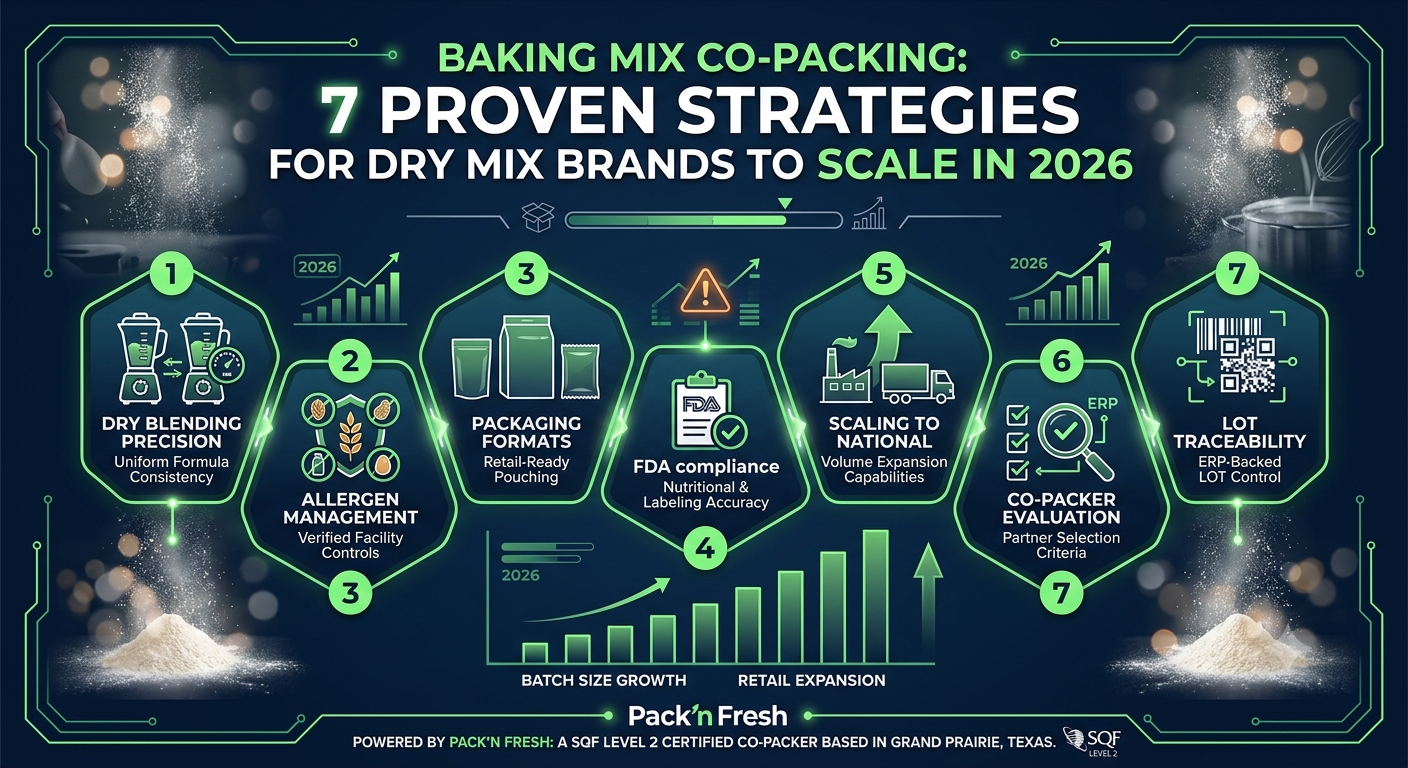
The home baking movement that surged during 2020 never fully reversed — instead, it permanently elevated consumer demand for premium baking mixes, gluten-free alternatives, artisan bread blends, and specialty flour bases across retail, e-commerce, and foodservice channels. For dry mix brand founders working to capitalize on that sustained momentum, baking mix co-packing has emerged as the most efficient path from kitchen-tested recipe to retail-ready product at commercial scale. Outsourcing production to a certified, full-service co-packer gives brand owners immediate access to industrial-grade dry blending equipment, allergen-controlled manufacturing environments, and regulatory expertise that would take years and significant capital investment to replicate independently.
At the same time, scaling a dry baking mix brand is not as straightforward as it might appear on the surface. Precision matters at every stage of production — from the particle-size compatibility and distribution uniformity of your dry blend, to the accuracy of your leavening agent ratios, from the integrity of your allergen declarations to the retail-shelf appeal of your packaging format. Brands that approach baking mix co-packing as a commodity procurement decision — rather than as a strategic manufacturing partnership — frequently encounter batch-to-batch formula inconsistency, compliance vulnerabilities that surface during retail audits, or packaging that fails to compete effectively at the shelf level. Choosing the right production partner is the single operational decision that most directly shapes a brand’s capacity to grow.
This comprehensive guide covers seven proven strategies that dry mix brands are using in 2026 to scale successfully through baking mix co-packing. Whether you are launching your first SKU, transitioning from self-manufacturing to outsourced production, or expanding to a national retail footprint, these strategies will help you evaluate co-packers with greater precision, tighten your production quality controls, and move from concept to consumer-ready product with the consistency and regulatory compliance that serious retail buyers demand.
The seven strategies covered here span the full production lifecycle of a commercial baking mix operation: dry blending precision and formula consistency controls, allergen management for wheat, nuts, dairy, and egg across shared-facility production environments, retail-ready packaging formats suited to each distribution channel, FDA labeling compliance for branded dry mix products, the operational mechanics of scaling from small-batch to national distribution volume, and the evaluation criteria brands should apply when selecting a baking mix co-packing partner capable of supporting long-term growth. Each section is written for brand operators making real production decisions — not for academic interest.
At Pack’n Fresh, a SQF Level 2 certified full-service co-packer based in Grand Prairie, Texas, we partner with baking mix brands at every production scale — from first commercial run through national retail distribution. Our Digital Ingredient Locking system programs exact ingredient ratios directly into the production workflow to ensure formula accuracy across every batch, siloed allergen scheduling creates verified separation between allergen-containing and allergen-sensitive production runs, and precision micro-dosing delivers the leavening agent accuracy that baking mix formulas demand at commercial volume. ERP-backed lot traceability connects every incoming ingredient lot to its finished product batch, supporting the supplier qualification documentation that retail buyers require from serious baking mix co-packing partners.
The baking mix category is one of the largest dry goods segments in retail grocery, with consistent year-over-year consumer demand driven by home baking trends that accelerated during and after 2020. From pancake and waffle mixes to artisan bread blends, grain-free baking bases, and protein-enriched muffin mixes, the segment is expanding across price points and retail channels. Brands gaining the most shelf space are those with production systems capable of simultaneously meeting volume requirements, formula consistency standards, and food safety compliance — and baking mix co-packing provides the infrastructure to accomplish all three without the burden of owning and operating a dedicated manufacturing facility.
For early-stage brands, the economics of self-manufacturing are prohibitive. Industrial ribbon blenders, allergen-controlled production lines, food-grade pouching equipment, SQF-certified facility buildout, and the personnel to operate and maintain them each represent substantial capital commitments that few emerging food brands can absorb before generating significant revenue. Baking mix co-packing replaces that fixed-cost investment with variable production expense — meaning brands pay for manufacturing as they sell product, not before a single purchase order is confirmed. That capital efficiency allows founders to direct resources toward recipe development, marketing, retail sales, and distribution channel relationships rather than facility compliance and equipment lifecycle management.
Established brands face a different but equally compelling set of pressures at scale. When a regional specialty food company receives its first purchase order from a national grocery chain or club store buyer, the required production volume, turnaround timeline, and documentation standards often exceed what an in-house facility can deliver without major capital reinvestment. Outsourcing to a full-service baking mix co-packing partner allows brands to absorb large orders without building dedicated production capacity — the co-packer’s existing certified infrastructure handles the surge while the brand maintains its focus on the customer relationship and sales growth.
There is also the compliance dimension, which is increasingly decisive for brands competing in the modern retail landscape. FDA labeling standards, FALCPA allergen declaration requirements, and food safety certification thresholds expected by major retail buyers have all grown more rigorous in recent years. A certified co-packing partner maintains these compliance standards as a core operational competency, built into every production run, rather than as an afterthought bolted onto a primarily production-focused operation. When regulatory requirements evolve — and they consistently do — a well-resourced co-packer adapts proactively, shielding brands from the disruption of navigating changes independently and under time pressure.
Finally, the 2026 baking mix market rewards brands capable of serving multiple distribution channels simultaneously. Direct-to-consumer e-commerce, natural food retail, club store formats, specialty grocery, and subscription box services each carry distinct packaging specifications, labeling conventions, and fulfillment requirements. A full-service baking mix co-packing partner with diversified capabilities — including dry blending, flexible pouching, labeling, kitting, and on-site warehousing — can support all of these channels from a single production relationship, giving brands the operational flexibility to pursue growth wherever consumer demand is strongest without managing a fragmented multi-vendor supply chain.
Consistency is the foundation of every commercially successful baking mix brand. A consumer who bakes a perfect loaf of banana bread or a dozen flawless blueberry muffins using your mix will return to purchase again — but only if the next bag and the bag after that produce the same reliable result. That consistency depends entirely on the precision of the dry blending process, which is where the technical depth of a baking mix co-packing partner becomes the decisive factor in brand performance. Producing repeatable results at scale requires controlling particle size compatibility, bulk density ratios, ingredient loading sequence, moisture content, and distribution uniformity across every production run — not just when equipment is freshly calibrated.
The dry blending equipment used in commercial baking mix production — including ribbon blenders, paddle mixers, and rotary drum blenders — each have specific operating parameters that directly affect blend homogeneity. Ribbon blenders, the most commonly used equipment type for flour-based dry mixes, employ counter-rotating helical ribbons to achieve thorough ingredient distribution throughout the batch. However, achieving a truly homogeneous finished blend requires careful attention to ingredient loading sequence, blend time calibration, and fill volume optimization relative to blender capacity. Over-blending can cause particle separation by density — a phenomenon where heavier particles migrate to the bottom of the batch — while under-blending leaves pockets of concentrated individual ingredients, producing measurable inconsistency from bag to bag within a single production run.
Particle size compatibility is a less-discussed but critically important variable in baking mix co-packing. When fine powders — cake flour, powdered sugar, cocoa powder, confectioners’ sugar — are combined with coarser inclusions like rolled oats, dried fruit pieces, or chocolate chips, the differing particle sizes and bulk densities create a natural tendency toward segregation during blending, transport, and handling. A skilled co-packing operation manages this tendency through blend sequence optimization, equipment speed calibration, and in some formulations, pre-blending of fine ingredient components before the introduction of coarser inclusions. The objective is a finished blend that remains uniform from the first unit filled on the packaging line to the very last unit of the run.
Moisture content control is equally critical in baking mix production and is an area where facility environment management has direct impact on finished product quality and shelf life. Elevated ambient moisture promotes ingredient clumping, accelerates starch degradation, and reduces the effective shelf life of the finished mix — all of which create consumer quality complaints and retail returns. Professional co-packers monitor and control ambient humidity in both production and storage environments, use anti-caking agents such as silicon dioxide or tricalcium phosphate in flour-based mixes to prevent clumping during storage and distribution, and specify moisture-barrier packaging film structures aligned to each product’s shelf life requirements. These controls are not optional add-ons; they are what separates consistent, retail-ready product from product that degrades before it reaches the consumer.
Leavening agents represent the highest-precision blending challenge in baking mix formulation and require co-packing capabilities that go beyond standard blending equipment and operator vigilance. Baking powder, baking soda, cream of tartar, and instant yeast must each be incorporated at exact ratios relative to the flour base to deliver predictable rise, crumb structure, and texture in the finished baked product. Even a 0.5% variation in leavening agent concentration can produce measurable performance differences — flatter cookies, dense quick breads, or muffins that fail to rise to specification — which translate directly into consumer dissatisfaction and negative reviews. Precision micro-dosing capability, such as the system employed at Pack’n Fresh, ensures that these critical minor ingredients are weighed and incorporated with the formula accuracy that consumer-facing baking mix products require at every production volume. For a detailed overview of how micro-dosing systems function in dry food production, see our precision micro-dosing packaging guide.
A Digital Ingredient Locking system takes production precision a decisive step further by programming exact ingredient ratios and quantities directly into the production workflow, preventing formula deviations at the system level rather than relying solely on operator verification as the primary error-prevention mechanism. Rather than depending on a single manual check at weigh-in, ingredient locking embeds formula accuracy into each blending step — detecting potential discrepancies and triggering alerts before a non-conforming batch reaches the packaging line and becomes finished goods inventory. For baking mix brands whose formula performance is a core brand promise and a competitive differentiator, this level of process control is not a premium feature; it is a baseline production requirement that a qualified baking mix co-packing partner should be able to deliver.
Baking mixes are among the most allergen-intensive product categories in the dry goods segment, presenting co-packing challenges that require specialized facility protocols, rigorous scheduling discipline, and documented verification systems at every stage. Wheat is simultaneously the primary structural ingredient in most conventional baking mixes and one of the nine major allergens recognized under federal law — making it unique among food ingredients in that it is both ubiquitous in the category and a serious health risk for the significant consumer population with wheat allergy or celiac disease. Tree nuts — including pecans, walnuts, almonds, and macadamia nuts — are common inclusions in specialty, artisan, and regional baking mixes. Dairy-derived dry ingredients, including powdered milk, nonfat dry milk, and butter powder, appear in pancake mixes, biscuit blends, and cake mixes. Egg powder, a functional binding and leavening ingredient, is incorporated into many baking bases. Any co-packing facility handling products containing these ingredients must have robust, documented allergen controls in place — or brands face serious recall risk, regulatory exposure, and potentially irreversible reputational damage in the market.
Baking mix co-packing facilities that handle multiple allergen-containing products must implement what food safety professionals refer to as allergen scheduling — the strategic sequencing of production runs designed to create verified separation between allergen-containing and allergen-free production. Effective allergen scheduling goes substantially beyond simple equipment wiping between runs. It involves dedicated production blocks for allergen-free products, physical separation of allergen-containing raw materials in ingredient storage areas, clearly defined cleaning and sanitation protocols specific to each allergen type present in the facility, and documented verification that each cleaning step was executed correctly before allergen-sensitive production resumes. Siloed allergen scheduling — in which allergen-containing products are produced in physically or temporally isolated production environments with no overlap — represents the gold standard for multi-allergen co-packing facilities and provides the clearest evidence of allergen risk management for brand quality audits.
ATP (adenosine triphosphate) swab testing is the verification tool that closes the loop on allergen cleaning protocols with quantitative, objective evidence of sanitation effectiveness. After each cleaning event, ATP swabs measure the biological residue remaining on contact surfaces and equipment — producing a numerical result that confirms whether cleaning achieved the required standard or requires re-cleaning before production resumes. Facilities using ATP swab sanitation verification can document cleaning effectiveness with data rather than relying solely on visual inspection, which has well-documented limitations in detecting residual allergen contamination at levels that matter for sensitive consumers. This documentation is material for SQF certification compliance, retail buyer supplier qualification, and due diligence in the event of a consumer complaint. For brands leveraging baking mix co-packing to produce allergen-free variants alongside conventional allergen-containing formulas, requesting ATP swab verification data from your co-packer is sound supply chain quality management, not excessive scrutiny. Our resource on allergen management in food packaging covers these protocols in greater depth.
Gluten-free baking mixes require a distinct, additional layer of allergen protocol beyond what standard wheat management controls provide. The FDA standard for a “gluten-free” label claim requires that the finished product contain less than 20 parts per million (ppm) of gluten — a threshold that must be reliably achieved and documented, not merely approximated. Meeting this standard in a shared co-packing facility requires either a physically separated, dedicated production environment reserved exclusively for gluten-free runs, or a validated cleaning and sanitation protocol accompanied by laboratory testing confirming that residual gluten has been eliminated below the 20 ppm threshold before gluten-free production begins. Brands producing gluten-free baking mixes should ask any prospective co-packer directly how they achieve and verify sub-20 ppm gluten levels across production runs, and should request documentation of testing results from recent production as part of their qualification process.
The federal regulatory framework governing allergen labeling for baking mix brands is the Food Allergen Labeling and Consumer Protection Act (FALCPA), which mandates clear label declaration of the nine major allergens: milk, eggs, fish, shellfish, tree nuts, peanuts, wheat, soybeans, and sesame. FALCPA-compliant labeling must use the common English name of each allergen and can be declared either within the ingredient list — using the allergen’s common name in parentheses — or in a separate “Contains” statement positioned immediately after the ingredient list. A knowledgeable co-packing partner with experience in baking mix production can review label copy for FALCPA compliance before final print approval, catching potential declaration errors or missing allergen disclosures before they create legal exposure or consumer safety risks in the market.
Packaging format is not merely an aesthetic decision for baking mix brands — it is a functional and strategic choice that affects shelf life, retail shelf space requirements, per-unit production economics, and consumer usability in the kitchen context. The format selected must protect the dry blend from moisture ingress and oxidation throughout the full distribution chain, communicate brand identity and product quality signals at the retail shelf, meet retailer-specific packaging specifications, and be operationally compatible with the co-packer’s pouching and filling equipment. Baking mix co-packing partners with diversified flexible packaging capabilities can typically support multiple formats, giving brands the ability to serve different retail channels and consumer segments without maintaining separate manufacturing relationships for each product line or channel.
Stand-up pouches have become the dominant packaging format in the premium and specialty baking mix segment, and their growth trajectory continues in 2026. Their advantages are significant: multi-layer laminate film structures provide superior moisture and oxygen barrier properties relative to single-layer alternatives; the broad front panel offers premium billboard real estate for brand graphics, ingredient callouts, and certifications; and the resealable zipper closure delivers a consumer-friendly pantry experience that keeps the unused portion of a mix fresh between baking sessions. From a production standpoint, stand-up pouches run efficiently on vertical form-fill-seal (VFFS) equipment and accommodate a wide range of fill weights — from compact single-serve formats to multi-pound retail bags. For brands entering the natural food retail, specialty grocery, or direct-to-consumer channel, stand-up pouches project the premium brand positioning that resonates with quality-conscious consumers and commands higher retail price points.
Box formats remain the dominant packaging structure in the conventional grocery segment, particularly for pancake and waffle mixes, yellow cake mixes, cornbread blends, and brownie mixes where consumer familiarity with the rectangular box drives comfort and purchase confidence. Boxes offer practical advantages for conventional retail distribution: excellent structural rigidity for shelf stacking and display stability; generous printing surface for nutritional information, preparation instructions, and promotional messaging; and the ability to incorporate an inner liner bag that provides moisture protection for the dry blend independent of the outer box’s structural integrity. Box assembly and labeling can be integrated into a co-packing operation that also handles kitting, allowing brands to include recipe cards, promotional inserts, or branded accessories within each unit at scale and without separate fulfillment operations.
Canisters — rigid containers with resealable, consumer-friendly lids — are gaining meaningful traction in the all-purpose flour blend, artisan baking mix, and protein baking base categories, where consumers associate the canister format with quality ingredients and extended storage utility that justifies a higher retail price point. Canisters are compatible with dry blend filling operations and can be decorated with shrink sleeve labels or direct-print graphics that support premium positioning and retail differentiation. The practical trade-offs with canisters include higher per-unit packaging material cost and more complex retail shelf space requirements — factors that make the format best suited to specialty retail channels and premium price points where elevated packaging cost is absorbed into a higher margin structure.
Single-serve sachets represent the fastest-growing packaging format in the baking mix category in 2026, driven by the expansion of DTC subscription box services, meal kit programs, and experiential gifting products that prize convenience, portion precision, and novelty. A standard single-serve sachet contains a pre-portioned dry mix quantity calibrated to produce a defined output — a dozen muffins, one standard loaf of quick bread, or a specific number of pancakes — eliminating the measuring step for the consumer and delivering a highly controlled, reproducible baking experience. Co-packers with sachet-filling and kitting capabilities can assemble multi-flavor variety packs, branded recipe kit bundles, or multi-week subscription box assortments that command significant price premiums in DTC and specialty gifting channels. Baking mix co-packing partners who offer both pouching and kitting services under a single roof eliminate the coordination friction and extended lead times associated with managing separate manufacturing and assembly vendors for each channel.
Ready to Scale Your Baking Mix Brand with a Certified Co-Packing Partner?
Pack’n Fresh is a SQF Level 2 certified co-packer based in Grand Prairie, Texas, specializing in dry product manufacturing — including dry blending, flexible pouching, labeling, kitting, and warehousing. Our Digital Ingredient Locking system, siloed allergen scheduling, ATP swab sanitation verification, and ERP-backed lot traceability give your baking mix brand the production foundation it needs to grow from initial launch through national distribution.
Every baking mix sold in the United States must meet FDA food labeling requirements, and compliance is non-negotiable regardless of production volume, distribution channel, or brand stage. The mandatory label elements for packaged baking mix products include a properly formatted Nutrition Facts panel, a complete ingredient list in descending order of predominance by weight, a FALCPA-compliant allergen declaration, an accurate net weight statement, and manufacturer or distributor contact information. For brands using a co-packing partner, the co-packer’s name and address may appear on the label — or brands may use a “manufactured for” or “distributed by” designation to maintain brand identity without disclosing the co-packer directly. Baking mix co-packing relationships operate most smoothly when all label copy is finalized and reviewed for compliance before production begins, not revised during an active production run where changes create documentation complications and potential rework costs.
The Nutrition Facts panel for baking mix products requires specific formatting under FDA regulations, including standardized serving size declaration, calorie and macronutrient disclosure, and mandatory declaration of specified nutrients in the required order and format. Serving size for dry baking mixes is typically expressed as the amount of dry mix per serving, with associated notation regarding the yield from a standard preparation recipe. Brands offering multiple preparation options — a standard recipe and a reduced-fat or reduced-sugar alternative, for example — must ensure their Nutrition Facts panel accurately reflects the declared serving preparation. Experienced co-packing partners who specialize in dry food products can often identify label formatting or numerical calculation errors that operators with less category-specific experience may not catch, providing an informal compliance check before product goes to market.
The ingredient list on a baking mix label must declare all ingredients in descending order of predominance by weight, including the sub-ingredients of any compound ingredient used in the formulation. This means that if your baking mix includes a compound flavor system, a commercial leavening blend with multiple components, or a proprietary enzyme system, each component within those compounds must be individually declared in the ingredient list — not just the compound’s trade name or descriptor. FALCPA allergen declarations must appear either within the ingredient list using each allergen’s common English name in parentheses, or in a clearly formatted “Contains” statement immediately following the ingredient list without any intervening copy. The FDA’s food labeling and nutrition resource center provides the authoritative regulatory guidance that every baking mix brand should review and reference before finalizing packaging copy for any production run.
Label claims on baking mix packaging — including “gluten-free,” “certified organic,” “non-GMO,” “no artificial ingredients,” and “made with whole grains” — each carry specific regulatory or third-party certification requirements that must be met and substantiated before the claim can appear on a retail label. The “gluten-free” claim requires documented laboratory testing confirming the finished product contains less than 20 ppm gluten, with the production protocol used to achieve that standard validated and consistently applied. “Organic” claims require USDA National Organic Program certification covering both the specified ingredients and the production facility where blending occurs. “Non-GMO” is not a federally standardized claim and is typically supported by third-party verification programs such as the Non-GMO Project. A SQF Level 2 certified co-packing facility like Pack’n Fresh provides a documented food safety foundation, but brands retain full responsibility for substantiating all specific marketing claims that appear on their finished product labels.
Net weight declarations for baking mix products must express product weight in both metric (grams or kilograms) and US customary (ounces or pounds) units, positioned in the lower 30% of the principal display panel in a type size proportional to the package dimensions as specified in FDA regulations. For variable-weight products — where fill weight fluctuates within an acceptable specification range across a production run — professional baking mix co-packing operations maintain calibrated filling equipment, conduct regular in-line weight checks throughout each run, and maintain records confirming that all finished units consistently meet or exceed the minimum net weight declared on the label. These weight verification records are maintained as part of the production documentation supporting SQF compliance and can be provided to retail buyers during supplier qualification audits. For a deeper overview of food safety certification standards and their relationship to retail compliance, our GFSI food safety standards guide provides useful context.
The transition from small-batch or self-manufactured production to national retail distribution is the most operationally complex phase in any baking mix brand’s commercial development — and it is precisely the stage where the right baking mix co-packing partnership delivers its most tangible and measurable value. The challenges at this stage are multi-dimensional: production volume requirements increase by orders of magnitude, formula consistency standards tighten as retail buyers conduct their own quality audits, packaging must comply with retailer-specific specifications that vary by channel and account, and lead times compress as the brand transitions from reactive order-filling to proactive inventory management. Brands that attempt to navigate this transition through self-manufacturing frequently encounter a capacity ceiling that stalls growth momentum; those with the right co-packing infrastructure already in place move through it with operational continuity.
The first scaling challenge to address is minimum order quantity (MOQ) alignment between your brand’s growth trajectory and your co-packer’s production economics. Many specialty food brands build their initial customer base through small-batch production that is feasible at artisan volumes but economically inefficient — or unavailable — at commercial scale. A co-packaging partner can model the production economics of progressively larger batch sizes, helping brands understand how ingredient purchasing leverage, setup time amortization, and operational efficiency combine to reduce per-unit cost as volume grows. Understanding the co-packer’s MOQ thresholds and aligning production planning and purchase order strategy accordingly is foundational to the scaling process — and directly affects the contribution margin the brand can sustain at retail price points.
Retail buyer qualification requirements escalate substantially as brands pursue placement with larger grocery accounts. Major grocery chains, natural food retailers, club store buyers, and specialty food distributors each conduct supplier qualification processes that evaluate food safety systems, labeling accuracy, production documentation practices, and lot-level traceability capability. A co-packer holding SQF Level 2 certification meets the food safety audit threshold required by most major retail buyers — meaning that baking mix co-packing with a certified partner positions brands to enter qualification conversations from a position of credibility rather than remediation. Pack’n Fresh’s ERP-backed production management system generates the traceability documentation that retailer quality teams require, eliminating one of the most common and time-consuming barriers to retail entry that emerging baking mix brands encounter.
ERP (Enterprise Resource Planning) systems in co-packing environments provide capabilities that extend well beyond standard inventory tracking. They connect incoming ingredient lot numbers to the specific finished product batches produced from those ingredients, record production parameters and in-line weight verification data for every run, and enable complete forward and backward lot traceability in the event of a quality concern, consumer complaint, or regulatory inquiry requiring rapid response. For baking mix brands, this infrastructure matters most in two high-stakes scenarios: an ingredient supplier recall that requires same-day identification of all finished goods potentially affected, and a consumer complaint that requires documented root-cause investigation for retailer response. Without ERP-backed traceability, both scenarios become reactive crises requiring manual record reconstruction; with it, they become rapidly documentable events that demonstrate supply chain control. Baking mix co-packing with an ERP-enabled partner transforms lot traceability from a compliance burden into a competitive asset in retail qualification.
Warehousing and fulfillment integration becomes an increasingly strategic component of a mature baking mix co-packing relationship as brands expand from regional accounts to national distribution across multiple retail channels. A co-packer that offers on-site finished goods warehousing can hold inventory and stage shipments to distribution centers on a schedule aligned with retail replenishment cycles — reducing the logistics complexity of coordinating between a separate manufacturing location and an independent third-party logistics provider. This is particularly valuable for brands managing multiple active SKUs across DTC, retail, and foodservice channels simultaneously, where a subscription fulfillment batch might ship out in the first week of the month and a palletized retail replenishment order goes to a regional distribution center the following week. A centrally located co-packer, such as Pack’n Fresh in Grand Prairie, Texas within the Dallas-Fort Worth metro, offers natural inbound and outbound freight economics that compound in economic impact as distribution volume scales to national coverage.
Selecting a co-packing partner is one of the most consequential operational decisions a dry mix brand makes — and unlike most business decisions, it is not easily or quickly reversed once production is underway and commercial relationships have been built on the co-packer’s production capacity. The wrong partner can produce formula inconsistency across batches, create allergen cross-contact incidents, generate labeling documentation errors, or introduce supply disruptions that damage retail relationships and cost the brand hard-won shelf placement. The right partner provides a manufacturing foundation that scales with the brand’s growth, maintains quality without constant brand-side oversight, and opens retail qualification doors that an uncertified facility simply cannot access. When evaluating baking mix co-packing candidates, the following framework identifies the criteria that matter most for dry mix brands with serious retail distribution ambitions.
Food safety certification is the non-negotiable starting point in any co-packer evaluation process. SQF (Safe Quality Food) certification, administered by the Safe Quality Food Institute (SQFI) and recognized by the Global Food Safety Initiative (GFSI), is accepted by virtually all major US retailers as independent evidence that a manufacturing facility has been audited against comprehensive quality and food safety standards. SQF Level 2 certification — the level maintained by Pack’n Fresh — covers both food safety program fundamentals and quality management systems, meaning the facility has been independently evaluated against standards for facility design, personnel hygiene, pest control, allergen management, sanitation protocols, equipment maintenance, and production documentation requirements. Brands evaluating co-packers should verify current SQF certification status directly through the SQFI certification database before entering any production agreement, and should treat a lapsed or absent certification as a significant disqualifying factor for any retail-oriented baking mix production relationship.
Allergen control capability is the second critical evaluation dimension for any baking mix brand, given the significant allergen complexity inherent to the product category. During the co-packer evaluation and qualification process, ask specifically and document the answers: What allergens does the facility currently handle in production? How is allergen scheduling implemented — by production shift, by calendar day, or by physical production zone separation? What are the specific written cleaning protocols between allergen-containing and allergen-free production runs, and how is cleaning effectiveness verified? Is ATP swab testing conducted after each allergen cleaning event, and are quantitative results documented and retained? Is siloed allergen scheduling available, and does it create verifiable physical or temporal separation between allergen categories? The specificity and depth of the answers to these questions will quickly differentiate facilities that treat allergen management as a fully integrated operational system from those that treat it as an ad-hoc procedural step between runs.
ERP system capability is a third evaluation dimension that meaningfully separates co-packing facilities positioned to support growing retail brands from those better suited to simpler production arrangements without retail qualification requirements. During prospect conversations, ask: What production management and traceability system do you operate, and how long has it been in use? Can you provide lot-level traceability documentation connecting incoming ingredient lots to finished product batches? In a recall simulation, how quickly could your team identify and document all production lots potentially affected by a single ingredient lot? What production records are generated per run, what specific data do they capture, and how long are records retained? A co-packer who cannot answer these questions with specificity — providing system names, documentation examples, and realistic timeline estimates — likely does not have the traceability infrastructure that major retail buyers will expect during qualification audits of your brand as a supplier.
Digital Ingredient Locking capability deserves focused attention from any baking mix brand whose formulas involve precise ratios of multiple dry ingredients — particularly leavening agents, flavor systems, color components, or functional ingredients at minor inclusion rates. In dry blending operations without a locking mechanism, the accuracy of every production batch depends on operator attention, manual weight verification steps, and adherence to written procedures — all of which are necessary but inherently fallible process controls. Baking mix co-packing partners who have implemented digital ingredient locking have programmed required formula parameters directly into the production system, so any deviation from specification is detected and flagged in real time rather than identified after a non-conforming batch has been produced and packaged as finished goods. For specialty baking mixes where formula performance is the primary brand differentiator, this embedded system-level process control is a meaningful and measurable investment in production quality.
Location and logistics should factor into the co-packer selection decision, particularly for brands building toward national distribution with freight cost sensitivity. A co-packer positioned in the central United States — such as Grand Prairie, Texas, situated within the Dallas-Fort Worth metropolitan corridor — offers favorable inbound freight economics from major ingredient suppliers across the Texas Gulf Coast and Midwest growing regions, and competitive outbound freight costs to both coastal and interior retail distribution centers nationally. As distribution volumes grow and freight costs become a progressively larger component of total landed product cost, the cumulative freight advantage of a centrally located co-packing partner delivers a measurable and compounding contribution to brand profitability at scale.
Pack’n Fresh is a SQF Level 2 certified full-service co-packer based in Grand Prairie, Texas, purpose-built to support dry goods brands — including baking mixes, spice blends, dry seasoning bases, and specialty dry food products — from initial production run through retail-ready distribution. The facility’s end-to-end capabilities cover dry blending, flexible pouching, label application, kitting, and on-site warehousing, providing brands with a single integrated manufacturing partner rather than a fragmented network of separate vendors to coordinate across. For brands considering baking mix co-packing for the first time or evaluating a transition from an existing production partner, Pack’n Fresh offers the operational depth, certified quality systems, and proven infrastructure to support brands from launch through national scale without requiring a vendor change as volume grows.
Pack’n Fresh’s Digital Ingredient Locking system directly addresses one of the most formula-critical challenges in baking mix production: ensuring that leavening agents, flavor systems, color components, and functional minor ingredients are incorporated at precisely programmed ratios on every production run — reliably, run after run, without depending solely on operator verification as the primary error-prevention mechanism. Combined with precision micro-dosing capability for minor ingredient additions, which enables accurate incorporation of small-percentage inclusions such as vanilla powder, enzyme systems, or specialty flavor compounds, Pack’n Fresh’s dry blending systems are specifically configured for the ingredient accuracy that baking mix formulas demand at commercial scale. Brands that have experienced batch-to-batch formula inconsistency at previous co-packing partners frequently identify ingredient ratio variation as the root cause — a failure mode that ingredient locking eliminates at the system level rather than relying on procedural controls alone.
Allergen management at Pack’n Fresh is built around siloed allergen scheduling, which sequences production to create verified separation between allergen-containing products and allergen-sensitive or allergen-free production runs. ATP swab sanitation verification closes the loop on each cleaning event with objective, quantitative data — providing documentation that satisfies SQF compliance requirements, satisfies retailer supplier qualification reviewers, and supports brand quality agreements with co-manufacturing customers. For baking mix brands producing wheat-based conventional formulas alongside specialty allergen-sensitive variants, Pack’n Fresh’s allergen management protocols provide the documented controls necessary to produce both product types safely and compliantly within a single SQF-certified facility, without requiring separate manufacturing relationships for each allergen profile.
Pack’n Fresh’s ERP-backed production management system generates complete lot-level traceability records for every production run — connecting incoming ingredient lot numbers to finished goods batches and enabling rapid, documented identification of affected product in the event of an ingredient supplier recall or a consumer-reported quality concern requiring investigation. This traceability infrastructure is standard practice at Pack’n Fresh, not a premium add-on available only for select accounts or high-volume customers. The documentation it produces meets the retailer supplier qualification requirements that growing baking mix brands encounter as they pursue distribution expansion, and Pack’n Fresh’s team can provide traceability documentation to retail buyers during qualification processes without requiring custom report generation. Located in Grand Prairie, Texas, Pack’n Fresh offers strong inbound logistics economics from major ingredient and packaging suppliers, and competitive outbound freight for brands building national distribution reach across both eastern and western US markets.
Scaling a baking mix brand successfully in 2026 requires more than a compelling recipe and effective marketing — it requires a production infrastructure capable of maintaining formula precision across increasing volume, managing allergen complexity without error, meeting evolving FDA labeling requirements without disruption, and supporting the packaging, fulfillment, and documentation needs of multiple distribution channels simultaneously. Baking mix co-packing with the right certified partner compresses the time and capital required to build that infrastructure, replacing years of facility development and retail qualification work with an immediate relationship with a manufacturing team whose production competency is established, independently audited, and already accepted by the retail buyers your brand wants to reach.
The seven strategies covered in this guide — from understanding dry blending precision controls and allergen management protocols, to selecting the right packaging format for each channel, navigating FDA compliance requirements, planning for scale economics, and rigorously evaluating co-packer quality systems — provide a practical, integrated framework for making the co-packing partnership decision well. The brands that extract the most sustainable value from the co-packing model are those that approach the relationship with clear quality requirements, a well-documented and tested formula, realistic volume projections, and a clear understanding of the compliance standards their target retail channels require from their supplier base. The right co-packing partner translates those inputs into consistent, retail-ready, compliant product at scale — reliably, run after run.
If your baking mix brand is ready to move beyond self-manufacturing, or if you are searching for a baking mix co-packing partner that combines SQF Level 2 certification, Digital Ingredient Locking, siloed allergen scheduling, ATP swab sanitation verification, ERP-backed lot traceability, and full-service production capabilities from dry blending through warehousing, Pack’n Fresh is ready to support your growth. Contact our team to discuss your formula specifications, packaging requirements, volume trajectory, and distribution timeline — and let us show you how our Grand Prairie, Texas facility can serve as the certified production foundation your baking mix brand needs to compete effectively and scale with confidence in 2026 and beyond.
Baking mix co-packing is the process of outsourcing the manufacturing of dry baking products — including pancake mixes, bread mixes, cake mixes, gluten-free flour blends, protein baking bases, and specialty baking mixes — to a third-party certified production facility. The co-packer handles all aspects of manufacturing on behalf of the brand owner: dry ingredient blending to formula specification, packaging into the specified format (stand-up pouches, boxes, sachets, or canisters), label application, production documentation, and in many cases warehousing and logistics staging for outbound shipments. The brand owner retains ownership of the product formula, brand identity, and the commercial relationship with retail buyers — while the co-packer provides the certified production infrastructure, blending equipment, allergen controls, and qualified personnel needed to manufacture the product to specification at commercial production volumes.
For baking mix brands, essential allergen controls to require from a co-packer include siloed allergen scheduling that creates verified temporal or physical separation between allergen-containing and allergen-free production runs; documented cleaning and sanitation protocols specific to each allergen type present in the facility; ATP swab verification testing that confirms sanitation effectiveness with quantitative data rather than visual inspection alone; and complete lot-level traceability documentation connecting ingredient lots to finished product batches. If your brand produces a gluten-free variant, ask specifically how the co-packer achieves and documents sub-20 ppm gluten levels — the FDA threshold required for a “gluten-free” label claim — and request recent laboratory testing results as part of your co-packer qualification process. Verify that these controls are operational and documented, not merely described in written procedures.
SQF (Safe Quality Food) certification, recognized by the Global Food Safety Initiative (GFSI), is the most broadly accepted food safety certification in the US retail grocery supply chain and is required or strongly preferred by most major grocery chains, natural food retailers, and club stores during new supplier qualification. SQF Level 2 certification covers both food safety program fundamentals and quality management systems — providing assurance that the facility has been independently audited against comprehensive standards covering allergen management, sanitation, traceability documentation, and production record requirements. Brands evaluating baking mix co-packing partners should verify current certification status directly through the SQFI database and treat a lapsed or absent SQF certification as a significant disqualifying factor for any co-packing relationship intended to support retail distribution ambitions.
Precision micro-dosing is the capability to accurately measure and incorporate minor ingredients — those present at small percentage inclusion rates — into a dry blend with the formula consistency that commercial production volumes demand. In baking mix production, the most formula-critical micro-dosed ingredients are leavening agents: baking powder, baking soda, cream of tartar, and instant yeast. These ingredients typically appear at inclusion rates well below 5% by weight, but their functional impact on the finished baked product — rise height, crumb texture, color, and flavor — is disproportionately large relative to their concentration. Even variations as small as 0.5% in leavening agent dosage can produce measurable differences in finished product performance across batches. Precision micro-dosing capability, combined with a Digital Ingredient Locking system, ensures that every production run delivers the formula accuracy that consumer expectations and brand consistency require across hundreds of thousands of units.
Yes — but only if the facility has implemented and can document the specific allergen management protocols required to prevent gluten cross-contact during gluten-free production runs. This requires more than standard cleaning between runs; it demands either a dedicated production environment reserved exclusively for gluten-free production, or a validated clean-in-place protocol with laboratory testing confirming sub-20 ppm residual gluten before each gluten-free run begins. When evaluating co-packers for gluten-free baking mix co-packing alongside conventional products, request the specific documentation of the cleaning validation protocol used, the testing methodology applied to verify sub-20 ppm results, and recent test data from actual production runs. Facilities that employ siloed allergen scheduling and ATP swab sanitation verification are best positioned to produce both product types compliantly within a single certified facility environment.
Full-service baking mix co-packing facilities with flexible packaging capabilities can typically support a range of formats: stand-up pouches with resealable zipper closures (the preferred format for premium, specialty, and DTC channels); pillow bag formats for conventional retail and bulk distribution contexts; box formats with inner liner bags (the traditional format for the conventional grocery segment); rigid canisters with resealable lids for premium and all-purpose blend categories; and single-serve sachets for subscription box services, meal kit programs, and experiential gifting products. The optimal format depends on your distribution channel, target retail price point, consumer use pattern, and the pouching equipment your co-packer operates. Co-packers that also offer kitting services alongside pouching can assemble multi-flavor variety packs, recipe bundles, and subscription assortments that support premium DTC price positioning and increase average order value for e-commerce brands.
Partner with a SQF Level 2 Certified Baking Mix Co-Packing Facility
Pack’n Fresh provides end-to-end dry product co-packing services from our certified Grand Prairie, Texas facility — including dry blending with Digital Ingredient Locking, allergen-controlled pouching and packaging, ERP-backed lot traceability, kitting, and warehousing. Whether you are launching your first SKU or scaling an established brand to national retail, our team is ready to support your production goals with the quality systems and traceability documentation your retail buyers require.
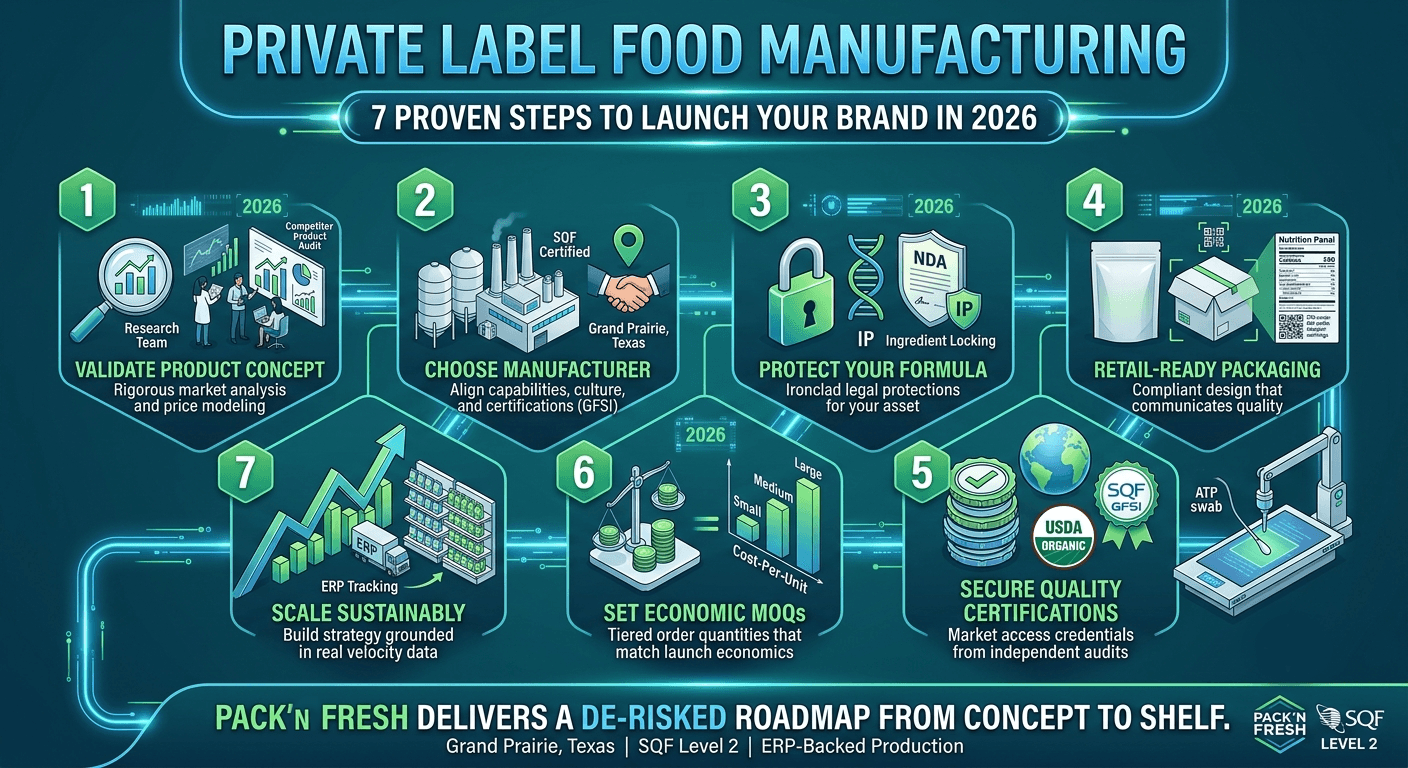
The retail shelf has never been more competitive, yet brand operators entering private label food manufacturing are finding a surprisingly direct path from concept to shelf. Private label sales rose 4.4% across all outlets in H1 2025 while national brands grew only 1.1%, signaling a structural shift in how consumers and retailers think about brand value. Whether you are an entrepreneur launching a specialty sauce brand or a regional grocery chain building a store-brand portfolio, the fundamentals of private label food manufacturing follow a repeatable, de-risked playbook. This guide walks you through all seven steps.
What makes private label food manufacturing uniquely powerful in 2026 is the convergence of consumer trust, retailer investment, and manufacturing sophistication. A reported 95% of consumers now buy private label products, and 69% say they purchase them on most or every shopping trip — figures that would have been unthinkable a decade ago. The co-packing infrastructure supporting private label food manufacturing today has never been more capable, with SQF-certified facilities, ERP-backed production management, and precision filling technologies that rival what national brands achieve at far greater volume. The result is a genuinely level playing field for emerging brand operators.
Private label food manufacturing is not a simple one-step operation — it requires formula validation, manufacturer selection, IP protection, packaging compliance, quality certification, and a launch strategy built for scale. Seven distinct steps separate a product idea from a product on a retailer’s shelf, and each step carries its own set of decisions, costs, and risk factors. This guide provides an actionable framework for every phase, with practical guidance on where brand founders consistently save money, avoid costly mistakes, and accelerate time to market. By the end, you will know exactly what to ask, what to verify, and what to expect from your manufacturing partner.
This guide walks you through the complete private label food manufacturing process in seven practical steps: validating your product concept and market opportunity, choosing a manufacturer aligned with your category and certifications, locking down your formula with ironclad IP protections, designing retail-ready packaging that meets FDA and retailer requirements, securing the quality certifications your target channels demand, setting minimum order quantities that match your launch economics, and building a scale strategy grounded in real velocity data. Each step builds on the last, giving you a de-risked roadmap from first concept through sustained retail growth.
At Pack’n Fresh, a SQF Level 2 certified full-service co-packer based in Grand Prairie, Texas, we partner with food entrepreneurs and retail brands at every stage of the private label food manufacturing process. Our ERP-backed production environment delivers real-time traceability from ingredient receipt to outbound shipment, and our Digital Ingredient Locking system ensures your formula stays exactly as you approved it — across every batch, every season. From precision filling and allergen-siloed scheduling to labeling, kitting, and warehousing, Pack’n Fresh provides the full-service infrastructure that serious private label food manufacturing programs require.
Private label food manufacturing is the process by which a third-party manufacturer produces a food or beverage product to a brand owner’s specifications, which the brand owner then sells under its own label. Unlike national brands that own their manufacturing assets outright, private label brand owners leverage a co-packer’s equipment, certifications, labor, and supply chain infrastructure to bring products to market. This arrangement lets brand operators reach retail-quality production without the capital required to build or lease a dedicated facility. The model has been the backbone of grocery retail for decades — but it has evolved dramatically in sophistication, accessibility, and scale.
The distinction between private label and contract manufacturing deserves clarification before you begin planning. In private label food manufacturing, the brand owner either develops an original formula — often collaborating with the co-packer’s food scientists — or adapts an existing base formulation to meet specific market requirements. In either case, the finished product bears the brand owner’s label, not the manufacturer’s. Contract manufacturing sometimes implies the co-packer develops and owns the base formula, while the brand owner controls only packaging and positioning. Understanding this distinction matters deeply for intellectual property planning, which Step 3 covers in full detail.
Who benefits most from private label food manufacturing? The model serves several distinct operator profiles exceptionally well. Regional grocery chains and club retailers are the most recognized players, building store-brand programs that compete directly with national SKUs at better margin. But the model works equally well for e-commerce brand builders, food entrepreneurs validating a niche product concept, specialty distributors monetizing a loyal customer base, and health and wellness brands seeking to own formulations tied to a specific dietary protocol. Notably, private label health and wellness lines are seeing a 25% higher repeat purchase rate versus standard offerings — a signal that consumers in these categories are building genuine brand loyalty around private label products.
The Food Contract Manufacturing Market was valued at $235.6 billion in 2026 and is projected to reach $463.17 billion by 2035, growing at a 7.80% CAGR. This trajectory reflects not just increased private label volume but the increasing sophistication of outsourced production across every food category — from ambient grocery to refrigerated deli to frozen entrees. Brand operators entering private label food manufacturing today are doing so in the most favorable cost-structure environment the category has ever offered, with co-packers providing tiered minimum orders, flexible run sizes, and end-to-end services that once required three or four separate vendors to coordinate.
One emerging trend reshaping private label food manufacturing in 2026 is what industry analysts are calling “Co-Manufacturing Consolidation.” Major retailers — including Walmart and Sam’s Club, which have made public commitments to removing 30 to 40 key ingredients from their own-brand products — are moving toward Exclusive Production Agreements that lock in preferred manufacturers for multi-year windows. For emerging brands and growing chains, this trend creates both urgency and opportunity: urgency to secure capable manufacturing partners before quality capacity tightens, and opportunity to differentiate on formulation attributes that align with the clean-label commitments retailers are now codifying into vendor contracts.
The defining risk to understand before entering private label food manufacturing is that your brand’s success is structurally linked to your manufacturer’s performance. A co-packer’s food safety record, supply chain reliability, capacity headroom, and regulatory standing become the operational foundation your brand rests on. The due diligence required before signing a manufacturing agreement is therefore not a procedural formality — it is the most consequential business decision a brand founder makes in the early stages. The six steps that follow provide a systematic framework for navigating every phase of this process, from concept validation through scale.
Before a single ingredient is sourced or a label designed, successful brand operators in private label food manufacturing complete a rigorous concept validation phase. This phase answers three fundamental questions: Is there a documented consumer need for this product in this category? Is the target price point achievable at the required margin? And is there a co-packer capable of producing it at the quality and volume your retail target demands? Skipping this phase is the single most common reason early-stage private label projects stall after the first production run, often when inventory fails to move at the price originally modeled.
Retail buyer research is the most underutilized validation tool available to brand founders entering private label food manufacturing. Before investing in formula development or packaging design, request a category review meeting with buyers at your target retail channel — whether that is a regional grocery chain, a specialty natural foods retailer, or a club store buyer. Category buyers will tell you directly what gaps exist in their current planogram, what price architecture they are building toward, and what certification or clean-label attributes their vendor selection criteria currently prioritize. This intelligence shapes every downstream formulation and positioning decision your brand will make.
Consumer panel testing does not need to be expensive at the validation stage. Brand operators consistently find that small-format sensory panels — groups of 20 to 30 target consumers evaluating blind taste tests against category benchmarks — produce actionable preference data at a fraction of the cost of formal market research. The key metrics to capture at this stage are: overall preference score versus the category leader, purchase intent at your target retail price, and open-ended feedback on texture, flavor profile, and packaging concept. These data points become the formulation brief you hand your co-packer when you are ready to move into development.
Competitive shelf analysis is the third pillar of concept validation and one of the most direct research methods available. Walk your target category across five to ten retail locations — or conduct a systematic online shelf audit for e-commerce — and document the current price ladder, ingredient positioning, certifications on pack, and package format range. private label food manufacturing succeeds when it either undercuts national brand pricing at comparable quality or offers a meaningfully differentiated formulation — organic, allergen-free, or functional ingredient — that justifies a premium position. The shelf audit reveals which position is realistically available to a new entrant in your specific category and geography.
Financial validation runs parallel to market validation and should never be deferred until after formula development. Model the unit economics at the minimum order quantity your prospective co-packer requires, working backward from the retail price to your target margin. Build in landed cost, co-packer margin, label and packaging cost, freight, slotting fees for traditional retail, and a 10 to 15 percent buffer for initial waste and rework. The Pack’n Fresh resource on COGS calculation for food businesses provides a practical framework for this modeling work. Brand operators who enter private label food manufacturing with a detailed cost model before the first production run consistently outperform those who reverse-engineer the economics after the fact.
Timing is a validation variable that brand founders frequently underestimate in early-stage planning. Private label food manufacturing timelines — from initial formula brief to first retail-ready pallet — typically span twelve to twenty-four weeks depending on formula complexity, packaging development lead times, and the co-packer’s current production schedule. Building a launch calendar backward from your target in-store date, with buffer built in for regulatory review and retailer onboarding, is not optional project management discipline. It is the difference between launching on time and losing a seasonal selling window that will not return for twelve months.
Selecting a co-packer is not a procurement exercise — it is a partnership decision that shapes your brand’s quality ceiling, cost structure, and scale trajectory for years. The private label food manufacturing industry contains hundreds of contract facilities ranging from small artisan co-packers handling a few SKUs at low volume to large multi-line facilities with automated filling capacity capable of millions of units per month. Finding the right fit requires understanding not just what a co-packer can produce, but how their operational capabilities and culture align with your brand’s quality standards, category requirements, and growth roadmap.
The first filter in manufacturer selection is category specialization. Private label food manufacturing is not technically one-size-fits-all across the product landscape. A facility optimized for ambient dry goods may lack the humidity controls required for confectionery production. A co-packer with deep expertise in sauces and dressings may not have the allergen-management protocols required for a nut butter or trail mix product. Confirm that your prospective manufacturer has active production experience in your specific food category — not adjacent categories — and can provide references from active customers in that space before you invest further time in evaluation.
Certifications are the second filter, and they are non-negotiable for most retail channels. The major grocery and club store buyers require at minimum a GFSI-recognized food safety certification before onboarding a new private label vendor. SQF (Safe Quality Food) certification is one of the most widely recognized standards in the North American market, with SQF Level 2 confirming that a facility has implemented and passed an independent audit against a comprehensive food safety management system. BRC Global Standards, FSSC 22000, and IFS are other recognized GFSI schemes you may encounter depending on your retailer’s specific requirements. Confirm active certification status — not just claimed status — before engaging beyond an initial inquiry.
Geographic location affects landed cost more than most brand founders anticipate in early-stage planning. A co-packer located in the geographic center of the continental United States offers meaningful freight advantages for private label food manufacturing programs distributing to multiple regions simultaneously. Location also influences ingredient sourcing costs, labor market dynamics, and a facility’s ability to recruit qualified food science and production management talent. For national distribution programs, freight symmetry — roughly equivalent outbound costs to the East and West coasts — can represent a meaningful per-unit cost advantage when aggregated across annual production volume.
Evaluate the co-packer’s technology infrastructure as rigorously as its physical production capabilities. An ERP system that manages production scheduling, batch documentation, and inventory in real time is no longer a premium feature — it is a baseline expectation for any private label food manufacturing partner operating at professional scale. Ask prospective manufacturers whether they offer digital traceability from ingredient receipt to finished goods shipment, how they generate and retain batch records, and whether their systems can produce the documentation your retail accounts will require during an audit or quality inquiry. Facilities operating on paper-based systems introduce documentation risk that is difficult to manage after a production issue surfaces.
A facility audit — conducted in person or via a credentialed third-party auditor — is the only reliable method for verifying that a co-packer’s stated capabilities match its actual operational reality. Request a walkthrough before signing any agreement. Observe the production environment, sanitation protocols, allergen segregation practices, and the condition and calibration status of filling and sealing equipment. Ask to see a recent third-party audit report and the facility’s corrective action log. Private label food manufacturing partnerships produce the best long-term outcomes when the brand operator enters the relationship with a clear-eyed view of both the manufacturer’s strengths and the areas where ongoing management attention will be required.
Intellectual property protection is the least glamorous element of private label food manufacturing and consistently the most underestimated source of long-term business risk. When a brand operator invests in original formula development — through internal food scientists, an independent flavor house, or collaborative development with a co-packer — that formulation represents a proprietary asset that must be legally protected before any production agreement is executed. Entering a co-packing arrangement without clearly documented IP protections is not a calculated risk; it is an avoidable oversight with potentially permanent consequences for your brand’s competitive position.
The non-disclosure agreement is the first line of protection in any private label food manufacturing relationship. A well-drafted NDA should cover the formula itself, the identity of your ingredient suppliers, your intended retail target accounts, your pricing structure, and any proprietary production processes that differentiate your product from category competitors. Have the NDA reviewed by an attorney with food and beverage industry experience — not a general commercial attorney. Standard NDA templates commonly offered by co-packers are typically written to protect the manufacturer’s interests first, and negotiating brand-protective provisions into the agreement is a normal, expected part of the contracting process.
Formula ownership documentation goes beyond the NDA and is frequently overlooked entirely by first-time brand operators. If your co-packer’s food scientists contributed to formula development, your manufacturing agreement must explicitly state that all intellectual property created during the development process is owned by the brand operator — not the manufacturer. This work-for-hire provision should be unambiguous, covering the base formula, any subsequent iterations developed during production optimization, and the proprietary ingredient ratios that define your product’s sensory profile. Brand operators consistently discover the importance of this clause after a manufacturer relationship ends and ownership of the formulation becomes contested.
Ingredient locking is a concept that experienced private label brand operators prioritize from day one. An ingredient-locked formula specifies not just the category of each ingredient — such as “apple cider vinegar” — but the specific supplier, grade, and specification of that ingredient. When an ingredient is locked at the contract level, your co-packer cannot substitute a lower-cost or lower-quality alternative without your explicit written approval. Some co-packers offer digital ingredient locking systems that automatically flag any proposed substitution for brand owner review, providing the kind of production control that serious private label brands require at every stage of the manufacturing relationship.
Regulatory documentation ownership is a separate but related IP consideration that deserves explicit attention in every manufacturing agreement. Your formulations are documented with the FDA under specific product parameters. Your nutrition facts panels are calculated from your specific ingredient specifications. Your allergen declarations are generated from your specific formula composition. If you change co-packers, you need to be able to take these regulatory documents with you — not reconstruct them from scratch at significant cost and delay. Ensure your manufacturing agreement specifies that all regulatory submissions, nutrition facts calculations, and allergen assessments produced during your relationship with the co-packer belong to you.
Confidentiality obligations should extend beyond the primary co-packer to their ingredient suppliers and subcontractors. In large private label food manufacturing programs, the co-packer may source specific proprietary ingredients through a broker or distributor who gains incidental knowledge of your formula composition. Ensure your agreement requires your co-packer to impose equivalent confidentiality obligations on any third party that gains access to your formulation data. This requirement is particularly important for highly differentiated products where the ingredient combination itself is the core competitive advantage that justifies your brand’s premium positioning in the market.
Ready to Explore Private Label Food Manufacturing for Your Brand?
Pack’n Fresh is a SQF Level 2 certified co-packer based in Grand Prairie, Texas, offering full-service private label food manufacturing — from Digital Ingredient Locking and allergen-siloed scheduling to precision filling, labeling, and warehousing. We work with emerging brands and established retailers who need a manufacturing partner they can trust with their most valuable product assets.
Packaging in private label food manufacturing is simultaneously a regulatory compliance exercise and a brand-building investment. Your product’s label must satisfy FDA food labeling requirements — including accurate nutrition facts panels, allergen declarations, net weight statements, and manufacturer address disclosures — before it can legally enter retail commerce. Compliance is the floor, not the ceiling. Brands that succeed in this space consistently invest in packaging that communicates quality, clarity, and differentiation at a distance of three feet on a crowded retail shelf.
The nutrition facts panel is the single most regulated element of any food package, and errors here carry the highest compliance risk. Nutrition facts must be calculated from your specific production formula — not from a similar product or a generic database estimate — and must be reviewed against FDA’s current guidance on serving size standardization, rounding rules, and the required declaration of vitamins and minerals. For brands targeting specific retail channels, additional labeling requirements may apply: club stores frequently require specific net weight formats, natural food retailers may require third-party certification logos, and international distribution requires country-specific labeling compliance beyond the baseline FDA standard.
Allergen declaration errors are the most common trigger for food product recalls in the North American market. The Food Allergen Labeling and Consumer Protection Act requires clear declaration of the nine major allergens — milk, eggs, fish, shellfish, tree nuts, peanuts, wheat, soybeans, and sesame — and FDA enforcement in this area has become increasingly rigorous. When choosing a private label food manufacturing partner, confirm that your allergen declarations are validated against both your specific formula and the facility’s allergen control program. A co-packer with siloed allergen scheduling — where allergen-containing products run on dedicated days or lines, with full changeover sanitation between — provides the manufacturing assurance that backs up your on-package allergen declaration.
Retailer-specific packaging requirements add a layer of complexity that extends well beyond FDA compliance. Many major retailers impose their own additional standards: minimum font sizes for ingredient lists, sustainability certification requirements on packaging materials, QR code placement specifications, and format restrictions on package dimensions to optimize shelf space utilization. Work with your co-packer to understand which retailers you are targeting before finalizing package dimensions and structural design, because a format that fits perfectly in one retailer’s planogram may not qualify for another’s shelf program without costly modification.
The Private Label Manufacturers Association (PLMA) publishes annual guidelines and convenes industry events that surface current retailer packaging requirements and category design trends. Brand operators in private label food manufacturing consistently find PLMA resources valuable for understanding how major retail accounts are evolving their packaging standards — particularly for sustainability attributes like recyclability, post-consumer recycled content, and reduced packaging weight. These attributes are increasingly becoming retailer requirements rather than optional brand differentiators, and packaging structures that do not anticipate this evolution will require expensive redesigns in the near term.
Full-service co-packers reduce the operational complexity of a launch by managing coordination between packaging component procurement, label printing, and labeling line integration. Getting all three in sync — packaging components arriving on time, labels printed to specification, and the line configured for your format — is consistently the most operationally complex element of a private label launch. Co-packers who manage this coordination directly reduce the brand operator’s project management burden significantly and eliminate the timeline risk that accumulates when multiple independent vendors must synchronize with each other across parallel workstreams.
Quality certifications function as market access credentials in modern private label food manufacturing. Retailers use certification requirements to pre-qualify manufacturing partners before vendor approval, consumers use certification logos to make trust-based purchase decisions at the shelf, and brand operators use certifications to differentiate their supply chain story in category pitches to retail buyers. Understanding which certifications your target channel requires — and which your prospective co-packer currently holds — is a prerequisite for building a viable manufacturing strategy in any major retail channel.
GFSI — the Global Food Safety Initiative — is the umbrella framework under which most major food safety certification schemes operate. GFSI does not issue certifications directly; instead, it benchmarks and recognizes schemes that meet its standards for comprehensive food safety management systems. The major GFSI-recognized schemes include SQF, BRC Global Standards, FSSC 22000, and IFS Food. Most major North American grocery chains and club retailers require GFSI certification from their manufacturing vendors as a non-negotiable condition of vendor approval. Understanding which specific scheme your target retailer accepts is an important early-stage qualification step in any private label food manufacturing partner evaluation process.
SQF Level 2 certification represents a meaningful operational commitment in private label food manufacturing. At Level 2, a manufacturing facility has implemented and been independently audited against a comprehensive food safety management system covering raw material controls, sanitation verification, allergen management, equipment calibration, and corrective action protocols. Partnering with an SQF Level 2 certified co-packer like Pack’n Fresh means the baseline food safety infrastructure supporting your brand has been verified by an independent third-party auditor against one of the most rigorous standards in the North American food industry. For a detailed breakdown of the certification landscape, the Pack’n Fresh guide to GFSI food safety standards covers each scheme’s scope and requirements in depth.
Sanitation verification at modern co-packing facilities has evolved significantly beyond visual inspection protocols. ATP (adenosine triphosphate) swab testing is now the industry standard for confirming that production surfaces have been cleaned to a microbial load threshold that meets food safety requirements. Facilities that use ATP swab testing as a documented, systematic part of their sanitation protocol — rather than relying solely on visual checks or scheduled cleaning logs — provide brand operators with an evidence-based sanitation record that holds up under third-party audit scrutiny. Ask any prospective co-packer whether ATP testing is standard in their program and whether results are logged and retained in their production management system.
Organic certification is a separate credential from food safety certification and requires its own distinct compliance infrastructure. USDA Organic certification requires that every ingredient in a certified organic product is sourced from USDA Organic certified suppliers, that the production facility meets organic handling requirements, and that the co-packer itself holds USDA Organic certification to handle certified organic ingredients legally. Not all co-packers hold organic certification, and those that do typically operate organic production runs on a specific dedicated schedule to prevent co-mingling with conventional ingredients. If your private label brand is targeting the organic segment, confirm your co-packer’s organic certification status before formula development begins.
Allergen management deserves a focused discussion beyond what GFSI schemes require at baseline in the context of private label food manufacturing. Some brand operators — particularly those producing products for consumers with severe allergies — seek additional third-party allergen certifications or operational validation documentation. A co-packer with a documented siloed allergen scheduling program, where allergen-containing products run on dedicated days or lines with full changeover sanitation and ATP verification between, provides the operational foundation that supports both internal safety objectives and the documentation requirements that third-party allergen certification bodies and retail audit teams will request.
Minimum order quantities are the most practically significant contractual variable in any private label food manufacturing agreement, yet they are frequently treated as a fixed constraint rather than a negotiated outcome. Co-packers set MOQs based on the economics of their production runs — setup time, line changeover costs, ingredient procurement minimums, and the fixed overhead that must be amortized across a batch. Understanding the economic logic behind the MOQ number gives brand operators the leverage to negotiate arrangements that fit their launch volume without requiring the manufacturer to absorb economics that do not support their operating model.
For brand founders launching their first private label product, the goal is typically to negotiate the smallest viable initial run that enables real-world market testing without overcommitting capital to inventory. Brand operators consistently report that initial MOQs can often be negotiated downward when the brand operator is willing to accept higher per-unit costs on the first run, commit to a follow-on production schedule, or reduce packaging format complexity. The economic trade-off — higher unit cost on a smaller initial run versus the inventory risk of a full standard MOQ — typically favors the smaller run when market validation data is limited. Test before you commit, not the reverse.
Smart launch sequencing reduces risk in private label food manufacturing by staging market exposure to match available inventory and demonstrated sell-through rates. Rather than launching simultaneously across all channels, successful brand operators typically begin with a single retail partner or e-commerce channel, gather velocity data and consumer feedback over a 60 to 90 day window, and use that data to refine messaging, pricing, and format before expanding distribution. This staged approach allows inventory levels to match demonstrated demand — the most reliable way to avoid the costly combination of stockout at launch followed by long-dated inventory as initial excitement subsides.
Scale economics in private label food manufacturing improve meaningfully at key production volume thresholds. Most co-packers structure their pricing across three to five volume tiers, with meaningful per-unit cost reductions at each step up. Understanding where those pricing inflection points are — typically expressed in cases or unit quantities rather than dollar values — allows brand operators to plan procurement and production scheduling to capture tier improvements as volume grows. This planning work should happen before launch, not after, so that the pricing roadmap is visible and achievable within the brand’s financial model from the beginning.
The 2026 trend of Co-Manufacturing Consolidation — where major retailers are moving toward Exclusive Production Agreements with preferred vendors — creates a strategic imperative for growing private label brands to secure manufacturing partnerships before quality capacity tightens. Pack’n Fresh operates from Grand Prairie, Texas — a central US location that provides freight-efficient access to distribution networks across the continental United States. Brands that establish manufacturing relationships and demonstrate reliable velocity data before the next wave of retailer consolidation are best positioned to negotiate favorable production agreements from a position of demonstrated market performance rather than a standing start.
Scaling sustainably in private label food manufacturing requires proactive capacity planning conversations with your co-packer — conversations that most brand operators initiate far too late. Most production facilities operate at 60 to 80 percent of rated capacity during normal periods, with headroom available for growth. But the best production windows at quality co-packers are allocated months in advance to established customers with performance track records. Beginning capacity planning conversations at 60 to 70 percent of your current production volume — rather than waiting until you are capacity-constrained and scrambling — ensures that your scale path is mapped before you need it and that your growth seasons stay fully stocked.
Pack’n Fresh is a private label food manufacturing partner purpose-built for brand operators who require institutional-grade food safety infrastructure at a scale that serves growing brands. As an SQF Level 2 certified full-service co-packer based in Grand Prairie, Texas, our end-to-end capabilities include materials sourcing, precision filling and sealing across multiple formats, digital labeling, kitting and bundling, and full-pallet warehousing — all managed within a single ERP-backed production environment that provides real-time traceability from ingredient receipt to outbound shipment. Our central US location ensures freight-efficient access to distribution networks coast to coast.
Our Digital Ingredient Locking system ensures that every raw material in your formula is locked to your specification before production begins. If a supplier substitution is proposed — whether due to availability, cost, or a specification change — the system flags it for brand owner review before any deviation from your approved formula occurs. In private label food manufacturing, ingredient consistency is brand consistency. A product that tastes or performs differently in month six than it did at launch is both a customer retention problem and a quality control failure, and our ingredient control infrastructure is specifically designed to prevent that outcome across every production run.
Allergen management at Pack’n Fresh operates through siloed allergen scheduling combined with ATP swab sanitation verification at every changeover. Allergen-containing production runs are scheduled on designated days, with full sanitation protocols and ATP confirmation before any non-allergen product runs on the same line. For private label brands making allergen-free claims or producing for consumers with severe allergies, this operational discipline provides both the manufacturing confidence and the audit documentation that third-party certification bodies require. Our precision micro-dosing capability also extends our private label food manufacturing program to products requiring exact functional ingredient delivery — nutraceutical additions, flavor compounds, or concentrated natural extracts where deviation at the microgram level affects both product efficacy and regulatory compliance.
For brand operators who want to understand how co-packing works before engaging in a full program evaluation, our introductory guide to what food co-packing is and how it benefits your business covers the co-packing model, how manufacturer relationships are structured, and what questions to ask during your initial outreach. Private label food manufacturing succeeds when the brand operator and the manufacturing partner are genuinely aligned on quality standards, growth expectations, and operational values — and we built Pack’n Fresh to be exactly that kind of partner.
Private label food manufacturing in 2026 represents one of the most compelling brand-building opportunities in the consumer goods landscape. With private label sales outpacing national brand growth by a factor of four to one, consumer trust in private label at record levels, and the Food Contract Manufacturing Market expanding at nearly 8 percent annually, the infrastructure, consumer demand, and retail appetite for high-quality private label brands are all accelerating simultaneously. The seven steps in this guide — from concept validation through scale planning — provide a framework for navigating this opportunity systematically rather than opportunistically.
The quality of your co-packer determines the quality ceiling of your brand. No marketing investment, no packaging redesign, and no retail relationship can compensate for inconsistent production, unreliable traceability, or a food safety record that puts your retail accounts at risk. The selection process outlined in this guide — evaluating certifications, technology infrastructure, category specialization, geographic fit, and IP protections — is the single highest-leverage work a brand operator undertakes in the private label food manufacturing journey. Invest in it accordingly, and the returns will compound across every season you operate.
The brand operators who succeed in private label food manufacturing in 2026 and beyond will be those who combine consumer-first thinking with operational precision. They will know their formula inside out, control their ingredient supply chain, build retail relationships grounded in velocity data, and partner with manufacturers whose capabilities and values align with where their brand is going — not just where it is today. If you are ready to start that journey, the conversation begins with a consultation. Let’s build it together.
Private label food manufacturing is when a third-party co-packer produces a product to your brand’s specifications and you sell it under your own label, controlling the brand identity and retail relationship. Contract manufacturing is a broader term that sometimes implies the co-packer owns or developed the base formulation, while the brand owner primarily controls packaging and positioning. The key distinction is intellectual property ownership — in true private label food manufacturing, the brand operator owns the formula, the label, and the retail relationship from day one. Establishing that ownership clearly before production begins is the most important protective step a brand operator can take.
Most private label food manufacturing programs take twelve to twenty-four weeks from initial formula brief to first retail-ready pallet, depending on formula complexity, packaging development lead times, and the co-packer’s current production schedule. More complex products with custom flavor development or specialized regulatory review may extend beyond this range. Brand operators who complete formula validation and retail buyer conversations before engaging a co-packer can compress this timeline by eight to twelve weeks by eliminating iteration cycles that typically occur when these steps run sequentially rather than in parallel from the outset.
For most retail channels, a GFSI-recognized food safety certification — such as SQF Level 2, BRC Global Standards, or FSSC 22000 — is the minimum requirement for vendor approval in a private label food manufacturing partnership. SQF Level 2 is the most widely accepted standard among North American grocery and club retailers. If your product line targets the organic segment, confirm your co-packer holds USDA Organic certification. For allergen-sensitive products, look for documented siloed allergen scheduling and ATP swab sanitation verification as evidence of operational allergen control discipline that goes beyond basic GFSI compliance requirements.
Minimum order quantities in private label food manufacturing vary significantly by product category, packaging format, and the co-packer’s production scale and overhead structure. Brand operators consistently find MOQs ranging from a few hundred cases for specialized niche products to several thousand cases for high-speed automated filling lines. MOQs are negotiable in many cases — particularly on initial runs — when the brand operator is willing to accept higher per-unit costs or commit to a follow-on production schedule. Always request a detailed cost breakdown at multiple volume tiers from any prospective co-packer before making a final sourcing decision.
Formula protection in private label food manufacturing requires a multi-layered approach: a robust NDA signed before any formula data is shared, a manufacturing agreement with explicit work-for-hire provisions assigning all development IP to the brand operator, ingredient locking provisions that prevent unauthorized substitutions, and documentation ownership clauses covering regulatory submissions and nutrition facts calculations. Have all provisions reviewed by an attorney with food and beverage industry experience. The co-packer’s standard agreement template is typically structured to protect the manufacturer — negotiating brand-protective provisions is a normal, expected part of the contracting process.
Yes — the co-packing model is increasingly accessible to early-stage brands and startups, particularly as manufacturers have developed tiered service models and flexible MOQ structures to serve smaller accounts alongside established retail programs. The key is selecting a co-packer whose operational scale and service model aligns with your launch volume and the level of hands-on coordination you need. A small emerging brand should look for a co-packer with experience serving similar-sized accounts, flexible initial run sizes, and end-to-end capabilities that reduce the number of vendors and coordination touchpoints required in the early stages of a brand build.
Start Your Private Label Food Manufacturing Journey with Pack’n Fresh
Pack’n Fresh is Grand Prairie, Texas’s SQF Level 2 certified full-service co-packer. From formula development and Digital Ingredient Locking to precision filling, labeling, kitting, and warehousing, we provide everything your private label brand needs to launch and scale with confidence. Request a free quote today and speak directly with our production team about your project.
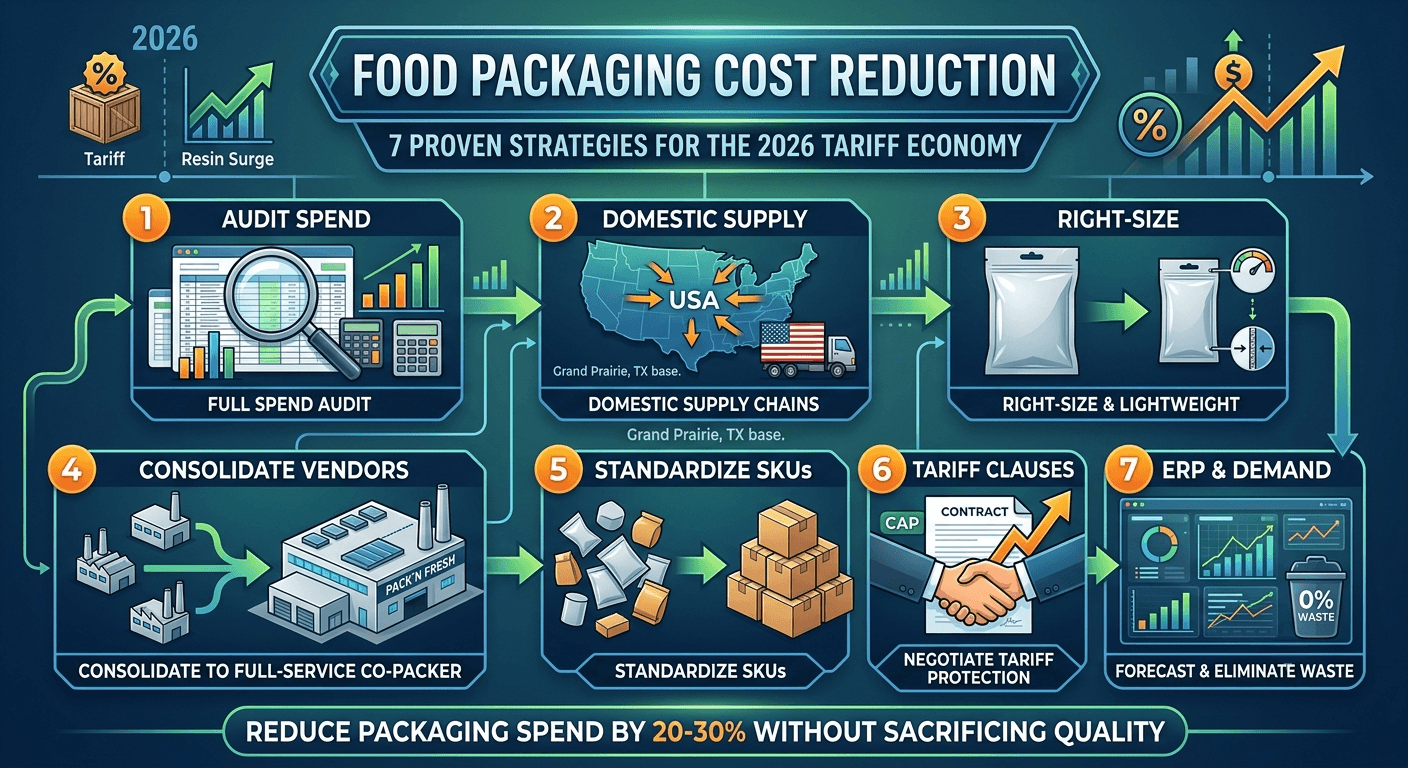
Food brands in 2026 are absorbing packaging cost shocks unlike anything the industry has seen in years. Polyethylene and polypropylene resin prices have surged more than 30 percent since late February, Section 232 tariffs on imported steel and aluminum are now enforced at 50 percent of full customs value, and packaging machinery import costs have jumped an average of 21 percent. Every co-packer, every packaging buyer, and every brand manager is being asked the same question: where can we cut without cutting quality? This guide lays out a proven roadmap for food packaging cost reduction that works in this specific environment — not theoretical savings, but actionable strategies grounded in how packaging supply chains actually operate today.
The good news is that real food packaging cost reduction is achievable without sacrificing compliance, shelf appeal, or consumer experience. Most brands have never done a rigorous line-by-line audit of what packaging actually costs them across the full value chain. When you break down materials, converting, storage, changeover, waste, and vendor coordination fees separately, the opportunities become visible. Industry operators consistently report that holistic packaging optimization across material selection, supplier consolidation, and format standardization can reduce total packaging spend by 20 to 30 percent without touching a single product recipe.
At Pack’n Fresh, a SQF Level 2 certified full-service co-packer based in Grand Prairie, Texas, we partner with food brands at exactly this inflection point. We help brands reconfigure their packaging strategy so that food packaging cost reduction becomes a structural advantage rather than a one-time fix. The seven strategies below reflect what actually works for growing CPG brands navigating the 2026 tariff environment.
The seven strategies covered in this guide move from diagnostic to structural. We start with a full packaging spend audit — because you cannot cut what you have not measured — and work through domestic sourcing, format right-sizing, vendor consolidation, SKU standardization, contract renegotiation, and ERP-driven demand alignment. Each strategy stands on its own, but the compounding effect of implementing them together is where the most significant food packaging cost reduction opportunities live.
At Pack’n Fresh, a SQF Level 2 certified full-service co-packer based in Grand Prairie, Texas, we work with food brands across the CPG spectrum — from emerging regional brands to established national labels — that are navigating exactly these cost pressures. Our domestic supply relationships, ERP-integrated production environment, and full-service capabilities make food packaging cost reduction a built-in feature of how we co-pack, not an afterthought applied at the end of a project.
The most common mistake brands make when trying to achieve food packaging cost reduction is going straight to the material cost line and trying to negotiate a cheaper pouch or a thinner film. That approach often leads to compliance failures, quality complaints, or shelf-life problems that cost far more than the savings they generated. Effective food packaging cost reduction starts with knowing exactly where your packaging dollars are going before you change anything.
A complete packaging spend audit has three layers. The first is direct material costs: the price per unit of every substrate, closure, label, insert, and outer carton across every SKU. The second is converting and production costs: what you pay for filling, sealing, labeling, kitting, and inspection per case. The third — and most overlooked — is indirect costs: minimum order quantity penalties from small-volume SKUs, waste from overruns, expediting fees when lead times slip, and the hidden overhead of managing five or six separate packaging suppliers.
Most brands find that indirect costs account for 15 to 25 percent of total packaging spend and are the easiest target for immediate food packaging cost reduction. These costs rarely appear on a packaging invoice — they hide in freight charges, storage fees, changeover downtime, and the labor hours your team spends chasing vendor quotes and coordinating deliveries. A proper audit surfaces them so you can attack them systematically.
When conducting the audit, pull 12 months of purchase orders across every packaging supplier. Calculate your actual cost-per-unit for each SKU including inbound freight, storage, and waste. Compare that fully-loaded cost to your theoretical standard cost. The gap between the two is your food packaging cost reduction opportunity. If you need a deeper framework for mapping packaging into your total COGS picture, our guide on food business COGS calculation walks through how to build that model from scratch.
Brands that complete this audit for the first time typically find their results cluster into three categories. The first is materials that are over-specified relative to their actual channel requirements — a high-barrier film protecting a product that does not need that level of oxygen exclusion, or a premium carton used for a product sold primarily in e-commerce where the outer carton is never seen by the consumer. The second category is suppliers that are underperforming on lead time, quality consistency, or minimum order flexibility, driving hidden costs through expediting fees and inventory write-offs. The third is internal complexity — too many SKUs, too many formats, or too many changeovers per week — that inflate per-unit cost even when individual supplier pricing is reasonable.
Prioritizing which category to attack first depends on your current constraint. If cash flow is tight, reducing inventory carrying cost through MOQ renegotiation delivers results fastest. If margin is the primary pressure, material right-sizing and format consolidation typically offer the largest structural food packaging cost reduction. If operations are the bottleneck, SKU rationalization to reduce changeover frequency will improve throughput and cost simultaneously. In most cases, the audit reveals all three categories of opportunity, and a sequenced roadmap that addresses each in turn delivers compounding improvement over four to six quarters.
The single most structurally impactful move for food packaging cost reduction in 2026 is reducing your exposure to imported packaging materials. According to packaging industry analysts, the combination of Section 232 steel and aluminum tariffs at 50 percent, broad reciprocal tariff structures on finished packaging goods, and resin prices driven up by Middle East supply disruptions has made the landed cost of imported packaging both higher and nearly impossible to forecast. Brands still sourcing film, foil, metal closures, or corrugated materials from offshore suppliers are absorbing all of that unpredictability into their COGS.
Domestic material sourcing eliminates the tariff layer entirely. It also removes the currency risk, the 6- to 12-week ocean transit lead time, and the inventory carrying costs that come with needing to buffer against import delays. For brands that have been sourcing packaging from China, Southeast Asia, or Europe, the math in 2026 often shows that domestic materials — even at a nominally higher unit cost — deliver a lower total landed cost once tariffs, freight, and inventory financing are factored in.
The same principle applies to your co-packer. A co-packer operating in the U.S. with domestic material supply chains gives you a tariff-sheltered production environment. This is a meaningful component of food packaging cost reduction that brands often overlook when they focus only on unit-level material pricing. Pack’n Fresh operates from Grand Prairie, Texas, with domestic supplier relationships across film, foil, and flexible packaging substrates. That location in the center of the country also reduces inbound ingredient freight and outbound distribution costs for brands shipping nationally.
Domestic co-packing also delivers lead time advantages that translate into real cost savings. Shorter lead times mean lower safety stock requirements, smaller working capital tied up in packaging inventory, and faster response when demand patterns shift. Every week of safety stock you can take out of your packaging pipeline is a direct contribution to food packaging cost reduction.
The transition from imported to domestic material sourcing does not need to happen all at once. A practical approach is to start with the packaging components that have the highest tariff exposure — typically metal closures, foil laminates, and rigid trays where Section 232 tariffs add the most cost — and substitute those with domestic equivalents first. Flexible film substrates can follow in a second phase as you validate domestic alternatives against your existing barrier and shelf-life requirements. Most co-packers with domestic supplier relationships can facilitate this transition without a production stoppage if migration is planned 60 to 90 days in advance.
Domestic sourcing also improves your quality audit program. When your packaging material supplier is three states away rather than twelve time zones away, a raw material quality issue identified in receiving can be escalated and resolved in days rather than weeks. Faster quality feedback loops reduce the risk of producing a full batch against out-of-spec materials — an event that typically results in complete product write-off and emergency re-sourcing at premium cost. Reducing that risk is an indirect but real component of food packaging cost reduction that does not appear on a material price comparison but shows up clearly in annual waste and write-off totals.
Packaging that is heavier, larger, or more structurally complex than the product actually requires is one of the most persistent sources of unnecessary cost in food manufacturing. Food packaging cost reduction through right-sizing means systematically matching your packaging format — its gauge, dimensions, closure type, and barrier specification — to the actual protection requirements of the product inside it.
Many brands inherit packaging specifications that were set during product development and never revisited. A pouch gauge specified for a 24-month shelf life product may be unnecessarily thick if the product is actually turning in 90 days. A rigid box used because it looked premium at launch may be delivering no functional value over a stand-up pouch that costs 40 to 60 percent less per unit. Revisiting these specifications with your co-packer — specifically looking at whether current formats are over-engineered relative to actual channel requirements — is one of the fastest paths to meaningful food packaging cost reduction.
Lightweighting is the complementary tactic: reducing the weight of the packaging material itself without changing the format. Converting from a thicker polyethylene film to a thinner high-barrier alternative, or moving from a full-gauge aluminum foil laminate to a thinner foil/film combination, can reduce material cost per unit by 15 to 25 percent while maintaining or improving oxygen transmission rates. The key is that any lightweighting decision must be validated against shelf-life testing and distribution stress testing before full rollout.
Right-sizing also delivers downstream savings in freight. A product that ships in a package 20 percent smaller in cubic volume pays 20 percent less in dimensional weight freight charges. For brands with significant DTC or national retail distribution, the freight impact of food packaging cost reduction through right-sizing can rival the material cost savings themselves. Analyze your freight spend alongside material cost when evaluating format changes — the full picture is almost always more compelling than the material line alone.
Brands moving from rigid packaging to flexible pouches often find that this single format change delivers the most concentrated food packaging cost reduction available to them. Stand-up pouches require less material per unit, ship flat before filling, and take up less shelf space in retail — which matters for category resets. Our guide on stand-up pouch packaging covers the format decision framework in detail.
One consideration brands sometimes overlook in right-sizing is the retailer approval process. Major retail channels — club stores, natural grocery, mass market — each have packaging dimension and structural requirements that must be met before a product can be ranged in their planograms. Before committing to a new format or gauge specification, confirm that the proposed change meets the requirements of every retail channel the product currently sells through or is targeting. A format change that delivers 20 percent material cost savings but requires a 90-day retail re-approval process may be the right decision — but the timing needs to align with your category reset calendar, not just your cost reduction timeline.
Shelf-life validation is the other gate that right-sizing must pass through. Modified atmosphere packaging, barrier film selection, and seal integrity specifications exist to maintain product safety and quality over the intended shelf life. Any reduction in packaging specification — thinner gauge, lower barrier, narrower seal width — requires accelerated shelf-life testing under the same conditions the product will experience in distribution and storage. Running these tests in parallel with the format change design process, rather than sequentially, is the most time-efficient path to capturing the food packaging cost reduction that right-sizing delivers without slowing the rollout schedule.
One of the most underappreciated levers for food packaging cost reduction is the elimination of multi-vendor overhead. A brand working with separate suppliers for film, labels, filling, kitting, and labeling is not just paying each vendor separately — it is absorbing coordination costs, quality control gaps, freight between facilities, and minimum order penalties from each vendor operating on its own schedule and volume tier.
When a brand consolidates to a full-service co-packer that handles materials, filling, labeling, kitting, and warehousing under one roof, those coordination layers disappear. There is one purchase order, one quality audit, one inbound freight lane, and one point of accountability for everything that goes out the door. Industry operators consistently note that this consolidation alone can reduce total packaging operations cost by 18 to 25 percent, even before any material substitution is considered. The food packaging cost reduction comes from elimination of overhead, not from cutting material quality.
Full-service co-packers also offer economies of scale that fragmented multi-vendor relationships cannot match. A full-service operation buying film in volume for multiple customers has supplier negotiating leverage that a small brand buying on its own will never achieve. When that purchasing power translates into material cost, the brand benefits from food packaging cost reduction without doing anything differently on its end. The co-packer’s scale becomes the brand’s cost advantage.
There is also a quality dimension to consolidation. When multiple vendors each handle part of the packaging process, accountability for quality failures fragments. A seal failure, a label misregister, or an off-spec fill weight gets attributed to whoever happens to be the last vendor to touch the product. A full-service co-packer owns the outcome end-to-end — which means problems get identified and fixed earlier, reducing waste-driven cost. Our detailed breakdown of full-service packaging solutions covers each of these advantages in depth.
For brands currently working with three or more packaging vendors, the consolidation analysis almost always shows net positive food packaging cost reduction. The exercise is straightforward: total up what you pay each vendor including freight, minimum order fees, coordination labor, and quality-related rework. Compare that to a fully-loaded quote from a single full-service co-packer. The gap is typically larger than brands expect.
The transition to a full-service co-packer is typically structured in three phases. The first phase — validation and onboarding — involves running trial production to confirm that the co-packer’s equipment, materials, and processes can reproduce the product to spec. This phase typically takes four to eight weeks and should be completed before any existing vendor agreements are terminated. The second phase is parallel production: running a defined volume through both the old vendor network and the new co-packer simultaneously to validate quality consistency and operational cadence. The third phase is full transition: shutting down the fragmented vendor relationships and consolidating all production to the full-service partner.
Brands that try to skip the validation and parallel production phases in order to capture food packaging cost reduction faster often pay a higher price when quality issues surface in full-scale production with no fallback option. A structured transition that adds six to ten weeks to the timeline is consistently the lower-risk path, and the cost savings from consolidation are permanent once the transition is complete. The initial investment in a careful transition pays itself back within the first production cycle at the new consolidated rate.
Ready to cut your packaging costs without cutting corners?
Pack’n Fresh helps food brands achieve measurable food packaging cost reduction through full-service co-packing, domestic material sourcing, and ERP-backed production management. Let’s build your cost reduction roadmap together.
Format proliferation is a silent killer of packaging economics. Every unique SKU — different pouch size, different label layout, different fill weight, different closure type — requires its own setup, its own minimum order quantity, its own tooling amortization, and its own changeover time on the production line. Brands that have grown quickly and added SKUs to capture market segments often end up with portfolios where the packaging complexity cost exceeds the revenue contribution of the marginal SKUs driving it.
Food packaging cost reduction through SKU rationalization starts with a volume-weighted analysis of your portfolio. Rank every SKU by annual units sold and by fully-loaded packaging cost per unit. The SKUs in the bottom quartile by volume and the top quartile by cost-per-unit are your primary targets. The question for each is whether the revenue it generates justifies its disproportionate contribution to packaging complexity — and the answer is often no.
The goal of rationalization is not to eliminate product variety — it is to deliver that variety within a standardized packaging architecture. Standardizing on two or three core format configurations (for example, a 4 oz stand-up pouch, an 8 oz stand-up pouch, and a 1 lb flat-bottom bag) lets your co-packer run longer, more efficient production campaigns. Fewer changeovers mean lower per-unit setup cost and better utilization of line time. That efficiency is a direct driver of food packaging cost reduction at the production level.
Standardization also improves your purchasing leverage. Buying larger consolidated volumes of two or three film SKUs instead of small quantities of six or eight different substrates puts you in a better tier with material suppliers. Volume pricing improvements of 8 to 15 percent are common when a brand moves from fragmented small-lot purchasing to consolidated volume purchasing within a standardized format architecture.
Once you have identified your target standard formats, work with your co-packer to build product line extensions within those formats rather than outside them. Flavor variants, seasonal products, and limited editions can almost always be accommodated within an existing format configuration through label changes alone. This approach gives consumers the variety they want while delivering the food packaging cost reduction your margins require.
The SKU rationalization decision is easier when you have a clear framework for what constitutes a non-viable SKU. A useful starting threshold: any SKU that generates less than two production runs per year is a candidate for review. Running a SKU once or twice annually means setup and changeover costs represent a disproportionate share of its fully-loaded unit cost — often exceeding what the margin contribution from that SKU actually delivers. For those products, the choice is either to discontinue the SKU, absorb it into a larger format under the same brand architecture, or accept that it will always carry a cost premium and price it accordingly.
Rationalization does not mean eliminating your lowest-volume products entirely. For some brands, a premium low-volume SKU serves a strategic purpose beyond its direct margin contribution — it demonstrates range, supports a premium price positioning, or qualifies the brand for a retailer category that benefits the whole portfolio. The goal of food packaging cost reduction through SKU management is not to build the smallest possible portfolio, but to ensure that every SKU in the portfolio is either carrying its own packaging cost weight or serving a clear strategic function that justifies the cost it imposes on the rest of the production schedule.
The contract between a food brand and its co-packer determines who absorbs the cost of packaging material volatility — and in 2026, that is not a question to leave to ambiguity. Many brands are currently operating under contracts written in 2023 or 2024 that contain material pass-through clauses with no caps, meaning that every resin price increase or tariff surcharge flows directly into their per-case rate with no protection. Renegotiating these contract terms is a structural lever for food packaging cost reduction that requires no operational changes at all.
The most important clause to add or revise is the material cost adjustment provision. A well-structured version of this clause defines a baseline material cost index (typically a published resin price index or commodity reference), specifies how often adjustments can be made, and caps the maximum year-over-year increase that can be passed through. A cap of 5 to 8 percent per year gives your co-packer reasonable protection against genuine market moves while protecting your brand from absorbing extraordinary spikes caused by tariff policy decisions entirely outside your co-packer’s control.
Volume tier pricing is the second lever. If your co-packer offers per-case pricing that decreases at defined volume thresholds, committing to an annual minimum volume in exchange for a locked rate can deliver 6 to 12 percent food packaging cost reduction relative to spot pricing. The risk is that you commit to volume you need to hit — so this works best for brands with predictable, growing demand where the volume commitment is conservative relative to actual trajectory.
Annual review clauses protect both parties in a volatile material environment. Rather than waiting for contract renewal to discuss pricing, schedule a formal semi-annual review that looks at material index changes, volume actuals versus commitments, and any operational efficiency gains the co-packer has realized. Co-packers who are genuinely partnered with their customers — rather than just transacting with them — will share efficiency gains as they occur. That partnership dynamic is itself a source of sustained food packaging cost reduction over time.
Minimum order quantity terms deserve scrutiny as well. MOQs that were set when material costs were lower may no longer make sense — a brand forced to order 20,000 units of a pouch it sells 8,000 units per quarter is financing 12,000 units of inventory carrying cost per cycle. Revisiting MOQ terms as part of a broader contract negotiation can free up working capital that is effectively a hidden packaging cost.
When renegotiating, come prepared with data rather than requests. Pull your material cost index history for the past 24 months, calculate the cumulative percentage change in your major packaging inputs, and quantify in dollar terms what those changes have cost your business at current volumes. Co-packers negotiate more constructively when presented with a factual cost impact analysis than when approached with a general request for lower pricing. Showing that a 30 percent resin increase has added $X per case to your production cost, and proposing a specific tariff protection clause that limits future exposure to Y percent annually, is a far more productive starting point than asking for a better rate without context.
The goal of contract renegotiation for food packaging cost reduction is not to transfer all cost risk to your co-packer — it is to establish a risk-sharing framework that both parties can plan around. Co-packers face the same material volatility you do, and contracts that leave them fully exposed to cost spikes tend to produce either co-packer relationships that deteriorate under margin pressure or sudden rate increase requests mid-contract that are harder to plan around than a structured annual adjustment mechanism. A fair contract produces a stable, sustainable co-packing relationship that delivers consistent packaging cost performance over time.
Overproduction is one of the least visible but most significant sources of packaging cost in food manufacturing. When demand forecasts are inaccurate and production runs are set too high, the result is excess finished goods inventory, obsolescence write-offs when products expire, and — critically — packaging material that was purchased, converted, and wasted without generating any revenue. Systematic food packaging cost reduction through demand alignment is only possible when your co-packer is operating from the same real-time data you are.
An ERP-backed co-packer gives brands visibility into production schedules, material inventory levels, and consumption actuals in real time. When a demand signal shifts — a retail order changes, a DTC subscription cohort churns, a seasonal product moves faster or slower than forecast — an ERP-integrated production environment can recalibrate the production schedule before the wrong volume runs. That recalibration prevents the packaging waste that accumulates when production is driven by static schedules rather than live demand data.
The cost impact of demand-aligned production is material. Every case that is produced and then written off as expired or obsolete carries 100 percent of its packaging cost with zero revenue recovery. Reducing overproduction by 10 percent in a brand doing $5 million in annual COGS can represent $400,000 to $600,000 in recovered packaging cost — a scale of food packaging cost reduction that no material substitution or vendor consolidation exercise is likely to match. Our full analysis of why ERP implementation matters in a co-packer covers this in detail.
Demand forecasting integration also enables better purchasing timing. When your co-packer can see your demand plan 8 to 12 weeks forward, it can time material purchases to avoid price spikes, consolidate material buys across customers for volume pricing, and carry less buffer inventory without risking stockouts. That purchasing intelligence is a compounding source of food packaging cost reduction that improves over time as the forecast model becomes more accurate.
Pack’n Fresh’s ERP system connects production scheduling, material inventory, and traceability into a single platform. Brands working with us have real-time visibility into their production status, material consumption, and inventory position — enabling the kind of demand-aligned decision-making that turns overproduction waste from an accepted cost of doing business into an eliminated cost center.
When evaluating a co-packer’s ERP maturity, ask specifically about demand signal integration. A co-packer with a good ERP system can still produce at the wrong volume if it is operating from a demand plan that is 60 days old. The facilities that deliver the best food packaging cost reduction through production accuracy are those that have established a direct connection between the brand’s sales data or DTC subscription platform and the co-packer’s production scheduling system. This integration does not need to be technically complex — a shared planning document refreshed weekly can achieve most of the benefit. But it does need to be a deliberate, structured process rather than an informal conversation at the start of each production month.
Emergency production runs are another cost that ERP-driven demand management eliminates. When forecasts are inaccurate and safety stock runs out unexpectedly, brands often resort to expedited production runs that carry setup premiums, expedited material sourcing fees, and expedited freight costs. These emergency costs can easily exceed 30 to 50 percent above standard run rates for the same production volume. Eliminating even two or three emergency runs per year through better demand visibility is a meaningful contribution to food packaging cost reduction that does not require any change to material specifications, formats, or supplier relationships.
Every strategy in this guide maps to a specific operational capability. At Pack’n Fresh, we have built our co-packing model around the capabilities that make food packaging cost reduction achievable at scale — not as a one-time project, but as a structural feature of how we produce for every brand we partner with.
Our SQF Level 2 certification means that quality control is built into the production process, not inspected at the end. Preventing packaging failures — seal defects, fill weight variances, label misregisters — at the point of occurrence eliminates the rework cost and product write-off cost that inflate packaging spend in facilities without robust quality management systems. Quality-driven food packaging cost reduction is the kind that compounds: fewer defects mean less waste, less waste means better line utilization, and better line utilization means lower per-unit cost for every brand on the floor.
Our Digital Ingredient Locking system provides an additional layer of allergen and cross-contamination protection that eliminates the risk of costly product recalls. A single recall event can generate packaging cost exposure that erases years of cost reduction progress. Brands co-packing at a facility with robust allergen management and traceability are protecting their packaging economics from low-probability but high-consequence events that unmanaged facilities leave as an open risk.
Our full-service model — covering material procurement, filling, sealing, labeling, kitting, and warehousing — allows brands to realize the vendor consolidation savings described in Strategy 4 immediately, without a complex transition project. When you move to Pack’n Fresh, you are not managing six supplier relationships down to five; you are moving from fragmented to unified in a single step. That is the fastest path to structural food packaging cost reduction for brands currently operating a multi-vendor model.
Grand Prairie, Texas gives brands a domestic production base that is sheltered from the tariff exposure affecting imported packaging materials and finished goods. Our domestic material supply relationships mean that the resin price volatility described at the top of this guide — PE/PP up 30 percent, PET trending at $1,100 to $1,250 per metric ton — is something we navigate on your behalf rather than something you absorb blindly through import invoices.
The 2026 tariff environment has made food packaging cost reduction an urgent priority for brands that were still operating on pre-tariff cost assumptions. Resin prices at four-year highs, steel and aluminum tariffs restructured to apply at full customs value, and packaging machinery import costs up 21 percent have created a structural cost increase that cannot be managed by simply asking existing suppliers for a better price. The brands that will protect their margins in this environment are the ones that take a systematic approach — auditing actual spend, restructuring supplier relationships, optimizing formats, and building contract terms that provide real tariff protection.
The seven strategies in this guide are not sequential — they work in parallel, and the order in which you pursue them should reflect where your audit identifies the largest opportunities. For most brands, vendor consolidation and domestic sourcing will deliver the fastest and largest impact. Format right-sizing and SKU standardization will deliver sustained compounding savings over subsequent quarters. Contract renegotiation and ERP-driven demand alignment will build the structural foundation that makes those savings permanent rather than temporary.
Effective food packaging cost reduction is not about cutting quality — it is about eliminating waste, consolidating complexity, and building supplier relationships that are structured for shared efficiency rather than one-sided cost pass-through. Pack’n Fresh partners with food brands to make that kind of structural improvement achievable. If you are ready to build a packaging cost reduction roadmap that fits your specific product mix and channel strategy, we are here to help.
For most brands, consolidating from a multi-vendor packaging model to a single full-service co-packer delivers the fastest measurable food packaging cost reduction. Vendor consolidation eliminates coordination overhead, minimum order penalties from multiple suppliers, and inter-facility freight costs without requiring any product formula or format changes. Brands with three or more packaging vendors typically see 18 to 25 percent reduction in total packaging operations cost within the first production cycle after consolidation.
The 2026 tariff environment affects packaging costs through three channels. Section 232 tariffs on imported steel and aluminum at 50 percent of full customs value increase the cost of metal closures, canned packaging, and foil laminates. Reciprocal tariffs on finished packaging goods imported from affected countries add cost to sourcing film, pouches, and boxes from offshore suppliers. And plastic resin prices — driven by both import tariffs on petrochemical feedstocks and Strait of Hormuz supply disruptions — have pushed polyethylene and polypropylene to four-year highs. Domestic sourcing is the most direct path to food packaging cost reduction under these conditions.
Lightweighting is the process of reducing the gauge or weight of packaging material while maintaining its protective performance. For flexible packaging, this typically means switching to a thinner film with equivalent or superior barrier properties — for example, moving from a 3.5 mil polyethylene film to a 2.8 mil high-barrier alternative. Industry operators consistently report that well-executed lightweighting delivers food packaging cost reduction of 15 to 25 percent on direct material cost per unit. Additional freight savings from reduced dimensional weight typically add another 5 to 10 percent to the total benefit. Any lightweighting change must be validated through shelf-life testing and distribution stress testing before deployment at scale.
The ERP capabilities most relevant to food packaging cost reduction are real-time inventory visibility, demand-driven production scheduling, and automated material consumption tracking. Real-time inventory visibility lets you and your co-packer see packaging material levels without manual counts, enabling tighter purchasing cycles and less safety stock. Demand-driven scheduling prevents overproduction by aligning run quantities to actual demand signals rather than static forecasts. And automated material consumption tracking identifies waste points in the production process — fill weight variance, seal rejection rates, label waste — before they accumulate into significant cost. A co-packer with a fully implemented ERP will be able to share this data with you directly, not just report it retrospectively.
In a stable material cost environment, annual contract reviews are typically sufficient. In 2026’s volatile tariff environment, semi-annual reviews are a stronger approach to sustained food packaging cost reduction. The review should examine actual material cost index changes against the baseline written into your contract, volume actuals versus commitments, and any efficiency improvements your co-packer has realized that should flow back to your per-case rate. Co-packers who are genuinely partnered with their customers will welcome semi-annual reviews as an opportunity to demonstrate value and strengthen the relationship. Those who resist them are typically absorbing margin on material volatility at your expense.
Yes — and for brands where format changes require retail buyer approval or significant tooling investment, format-neutral food packaging cost reduction strategies should be prioritized first. Switching to domestic material suppliers, consolidating to a full-service co-packer, renegotiating contract terms, and implementing ERP-driven demand alignment all deliver meaningful cost reduction without touching the packaging format the consumer sees on shelf. Once those structural changes are in place, format optimization through right-sizing and lightweighting can be pursued as a second phase with the savings from phase one funding the validation and transition costs of phase two.
Stop absorbing tariff costs. Start building a smarter packaging model.
Pack’n Fresh offers food brands a domestic, full-service co-packing partnership built for food packaging cost reduction in today’s environment — SQF Level 2 certified, ERP-backed, and located in Grand Prairie, Texas for central U.S. distribution. Tell us about your current packaging model and we will identify your biggest cost reduction opportunities at no charge.