The Hidden Costs of Food business: How to Calculate True COGS for Your Brand
For the founder of a scaling meal-kit or supplement brand, the math often starts simply:
Cost of Ingredients + Cost of Packaging = Cost of Goods Sold (COGS).
However, as you scale from your first 1,000 units to 50,000, that simple equation often fails. You may notice your bank balance isn’t reflecting your projected food profit margins. You’re selling more, but your overhead is swallowing the growth.
The culprit? A narrow definition of food business COGS calculation. In the high-stakes world of food packaging—particularly for businesses focused on pouches smaller than 2 lbs—the “hidden” costs of packaging often outweigh the cost of the raw ingredients themselves.
1. Beyond the Ingredient: The True Anatomy of COGS
In a professional food business, Food business COGS calculation isn’t just the protein and the produce. It is the total cost required to bring a “shippable” unit into existence. If you are currently managing production in-house, you must account for the DIY food packaging hidden costs that often go unrecorded.
True COGS includes:
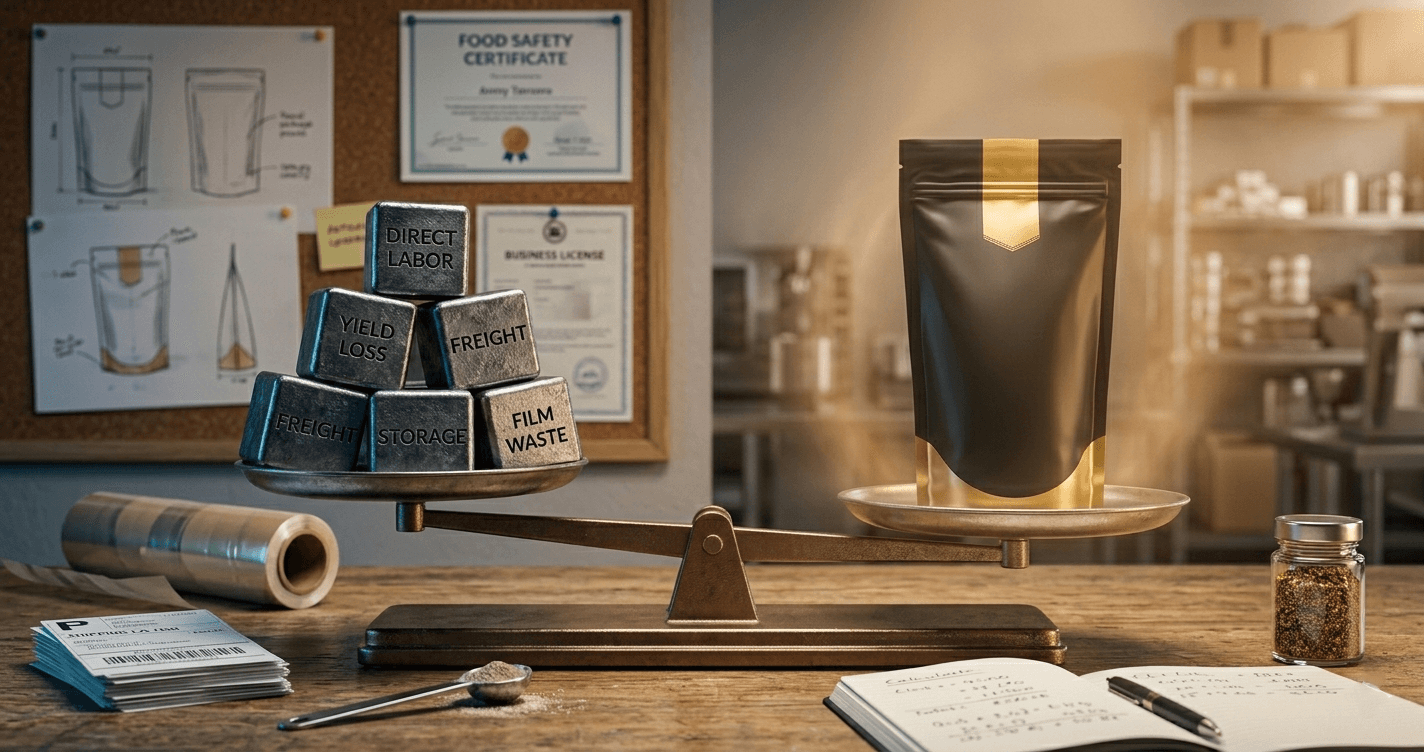
- Direct Labor: The minutes spent by staff blending, packing, and kitting.
- Yield Loss: Ingredients lost during the transition from bulk to pouch.
- Quality Control (QC): The cost of ensuring every unit meets strict food safety and regulatory transparency standards.
- Packaging Materials: Not just the pouch, but the film waste and labels.
Turning Variable Costs into Fixed Success
The most common food packaging mistake is treating production as a variable experiment. At Pack’n Fresh, we solve this through our Full-Service Packaging Solution. By utilizing a turn-key model, we help founders move away from the “hidden cost” trap.
Instead of juggling five different vendors and losing track of your food business overhead, our integrated approach provides a single, transparent per-unit price. This allows you to forecast your contract packaging ROI with 100% accuracy, ensuring that as you scale, your margins remain protected.
2. The 5 Hidden Margin Killers
To protect your food profit margins, you must account for these five variables that rarely show up on a standard invoice.
I. The Labor of Manual Packing
Scaling brands often start with manual labor because it requires less upfront capital. However, the labor cost per unit is astronomical compared to automated solutions. Manual packing leads to inconsistent portioning—which either ruins a recipe or “gives away” your profit in overfilled pouches.
II. Packaging Film Waste
When using high-speed machinery, the first few feet of packaging film are often wasted during calibration. If your production runs are small and inefficient, your “film scrap” percentage can eat 5–8% of your material budget. A partner with an extensive equipment portfolio can minimize this waste through precision engineering.
III. Machine Downtime and Maintenance
If you own your equipment, every hour that machine isn’t running is a drain on your food business overhead. This includes cleaning, sanitation between different recipes, and mechanical repairs. For a deep dive into how specialized equipment affects your bottom line, see our ultimate guide on supplement co-packing.
IV. Warehouse Storage for “Empty” Space
Storage is a massive hidden cost. Large minimum order quantities (MOQs) on custom-printed pouches mean you are paying to store “air” (empty packaging) for months. Transitioning to stand-up pouch packaging can optimize shelf space, but managing that inventory still carries a carrying cost.
V. Freight: The Inbound/Outbound Gap
Many founders calculate the cost of shipping the finished product but forget the cost of shipping bulk ingredients and empty packaging to the production facility. For brands trying to scale, these logistics can be a major food packaging mistake that destroys margins.
3. The ‘Dimensional Weight’ Trap
Shipping costs are no longer determined strictly by weight; they are determined by “Dim Weight.” According to the FedEx Dimensional Weight Guide, shipping rates are calculated based on the volume of the package relative to its actual weight.
If your packaging is bulky or poorly designed, you might be paying the shipping rate for a 5 lb package even if your product only weighs 1 lb. This is why meal kit packaging costs are heavily influenced by the choice between rigid boxes and flexible pouches.
4. The Solution: How Turnkey Co-packing Stabilizes COGS
The most effective way to gain a competitive advantage is to shift from a “variable cost” model to a “fixed cost” model. This is the primary contract packaging ROI benefit.
Companies like Pack’n Fresh offer a turn-key solution that simplifies this entire headache into a single, predictable per-unit price. By outsourcing the sourcing, blending, packing, and kitting, you gain:
- Predictable Pricing: One flat fee covers everything from ingredients to the final kit.
- Customization without Complexity: Tailoring portion sizes and ingredients to specific client needs.
- Reduced Overhead: You no longer need to invest in a wide range of machinery; you leverage the co-packer’s extensive equipment portfolio instead.
- Expert Oversight: Tapping into co-owners’ backgrounds in food science and quality control.
For a full breakdown of the advantages, read our 7 reasons why full-service packaging is a powerful solution.
The Ultimate COGS Checklist
Before you sign your next production contract, use this contract packaging checklist to ensure your food business COGS calculation is accurate.
- Ingredient Yield: Have you factored in a 3-5% loss during the blending process?
- Labor Load: Does your per-unit cost include payroll taxes and insurance for packing staff?
- Waste Factor: Are you accounting for packaging materials lost during machine setup?
- Regulatory Compliance: Does your cost include the safety checks required by the FDA’s Food Safety Modernization Act (FSMA)?
- Opportunity Cost: What is the value of the time you spend managing production instead of growing the brand?
Summary: Focus on Growth, Not Logistics
As a founder, your value is in brand building and recipe innovation. You shouldn’t have to be an expert in machine maintenance or film tension. By partnering with an innovative partner that understands the specific needs of the meal-kit and supplement industry, you can turn your packaging from a hidden cost center into a transparent, scalable engine for growth. Understanding what food co-packing is and its benefits is the first step toward reclaiming your margins.
Schedule your Food business COGS calculation Audit with Pack’n Fresh today