
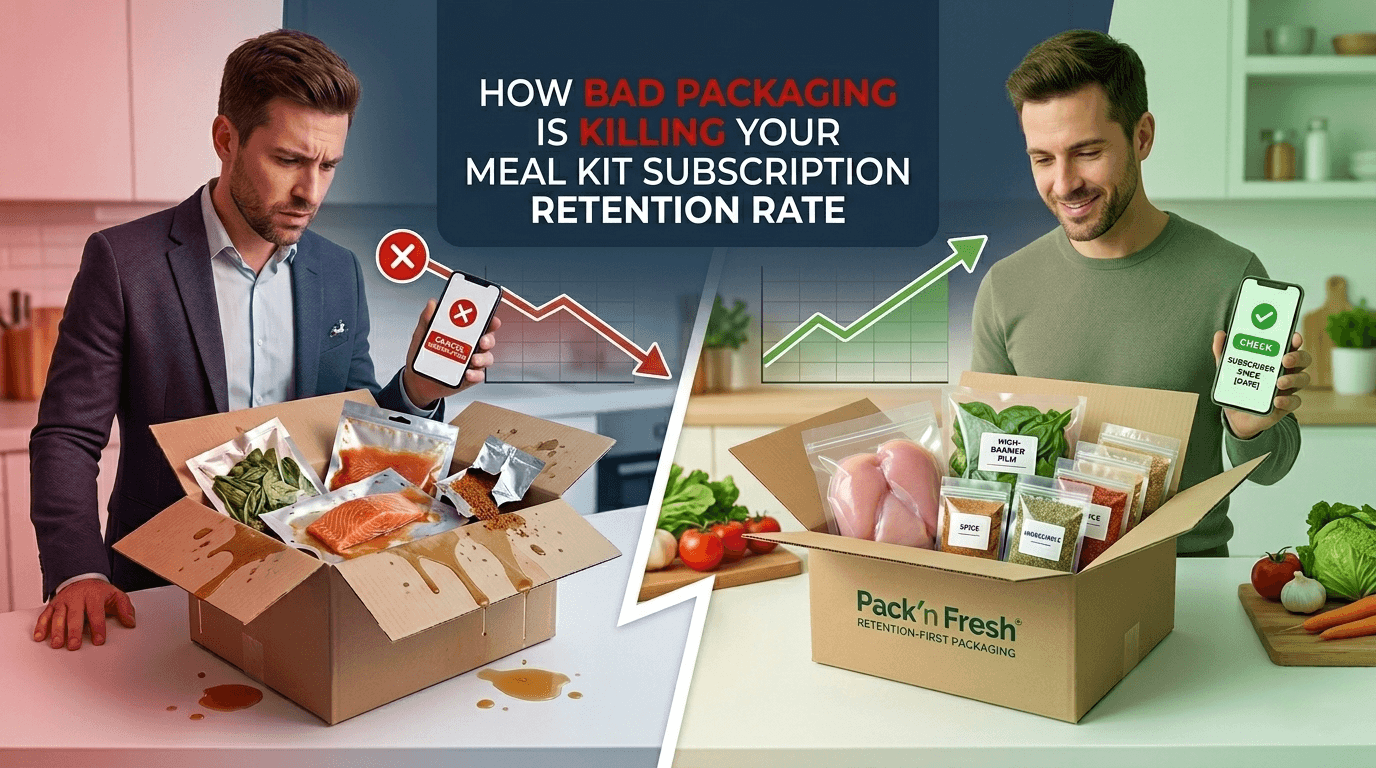
Meal Kit Subscription Retention: 5 Ways Your Packaging Is Silently Driving Churn
Your recipes are excellent. Your ingredients are fresh. Your branding is sharp. Yet month after month, your meal kit subscription retention rate keeps declining — and the cause may be sitting right in your customer’s recycling bin.
Poor packaging is one of the most silent, most damaging forces behind meal kit churn, and the majority of founders don’t see it until they’ve already lost hundreds of subscribers. According to McKinsey & Company, meal kit services face an average annual churn rate of 45–60%. While pricing and recipe fatigue are often blamed, a significant but underreported driver of poor meal kit subscription retention is the unboxing experience itself — specifically, how packaging performs on freshness, convenience, and perceived quality.
At Pack’n Fresh, we partner with meal kit brands at every stage of growth, and we’ve seen firsthand how a packaging overhaul directly translates into improved meal kit subscription retention. In this post, we break down exactly how packaging drives churn — and the 5 proven fixes that stop it.
Table of Contents
- The Real Reason Customers Cancel Meal Kit Subscriptions
- 5 Packaging Failures That Destroy Meal Kit Subscription Retention
- How Packaging Directly Affects Customer Lifetime Value (LTV)
- The Pack’n Fresh Retention-First Packaging Model
- Real-World Impact: What Better Packaging Looks Like
- How to Audit Your Packaging for Meal Kit Subscription Retention Risk
- Conclusion
- FAQs
1. The Real Reason Customers Cancel — And Why It Starts With Packaging
When a subscriber cancels, your cancellation survey might say “too expensive” or “not enough variety.” But dig deeper into behavioral data, and a different story emerges. Research from the Food Marketing Institute shows that 35% of food subscription cancellations are linked to a negative product experience — wilted greens, leaking sauces, clumped spice pouches, or a box that arrives looking like it survived a shipping war.
Your packaging is not just a box. It is the physical manifestation of your brand promise. Every time a customer opens a delivery, they are subconsciously asking: “Do I trust this brand with my family’s dinner?” A warm protein pack, a broken spice sachet, or damp cardboard answers that question with a hard no — and kills meal kit subscription retention on the spot.
This is why meal kit subscription retention must be viewed through a packaging lens — not just a marketing or pricing lens. The moment of unboxing is the single most critical quality touchpoint your brand owns. Understanding the true hidden costs behind your food business COGS — including packaging-related credits and returns — is the first step to fixing this.
2. 5 Packaging Failures That Destroy Meal Kit Subscription Retention
Failure #1: Inadequate Thermal Protection Breaks Subscriber Trust
If your temperature-sensitive proteins or dairy components arrive above safe holding temperatures (above 40°F / 4°C), you are not just risking a bad review — you are risking a food safety incident. A single spoiled delivery can permanently end a customer’s trust in your brand. According to Nielsen, one negative experience reaches an average of 9–15 people through word of mouth and social media — turning one packaging failure into a compounding meal kit subscription retention problem.
Failure #2: Non-Resealable or Difficult-to-Open Pouches Create Friction
Convenience is the entire value proposition of a meal kit. If a subscriber struggles to open a spice sachet, tears a pouch incorrectly and loses half the contents, or cannot reseal an ingredient bag for next-day use, they experience friction at the one moment your brand should be creating delight. Poorly designed pouches signal a lack of care — and subscribers notice. This friction is one of the most underrated drivers of poor meal kit subscription retention.
Failure #3: Low-Barrier Films Cause Premature Spoilage
Using generic, low-barrier packaging film for dry ingredients like spice blends, seasoning packets, or grain pouches accelerates oxidation and moisture ingress. The result: clumped powders, stale aromas, and off-flavors by the time the kit reaches the kitchen. This is why the science of modified atmosphere packaging for food shelf life is critical — a compromised seal destroys the entire freshness strategy your meal kit subscription retention model depends on.
Failure #4: Over-Packaging Triggers Sustainability-Driven Churn
Today’s subscriber is environmentally conscious. A box stuffed with excessive plastic, non-recyclable ice packs, and layers of foam inserts communicates environmental irresponsibility — a value mismatch that quietly erodes loyalty and destroys meal kit subscription retention among eco-aware demographics. In a 2023 IBM survey, 62% of consumers said they would change purchasing habits to reduce environmental impact. Over-packaging accelerates guilt-driven churn, particularly among subscribers aged 25–40.
Failure #5: Inconsistent Portioning Destroys Brand Trust
If a meal kit promises “2 servings” but packaging inconsistency means one delivery has noticeably more or less food than the last, subscribers lose trust in the brand’s precision. This is a co-packing and packaging operations issue, not just a recipe issue. Without precision portioning equipment and an ERP system to monitor fill weights, portion consistency becomes a manual — and therefore unreliable — process that silently erodes meal kit subscription retention. See how automated food kitting eliminates manual scaling problems killing your Q2 margins.
3. How Packaging Directly Affects Meal Kit Subscription Retention and LTV
Meal kit subscription retention is ultimately a financial equation. The cost of acquiring a new subscriber (CAC) in the meal kit industry averages $94–$145 per customer (Statista, 2024). If that customer churns after two deliveries because of a bad packaging experience, you have not only lost revenue — you have lost the entire CAC investment with zero return.
Consider this: a subscriber retained for 12 months at $60/week generates $3,120 in annual revenue. A subscriber who cancels after 6 weeks generates just $360. The LTV gap is nearly $2,760 — per customer. Multiply this across hundreds of churned subscribers per quarter, and poor packaging is quite literally destroying your company’s financial health and long-term meal kit subscription retention curve.
The inverse is equally powerful. Brands that invest in retention-focused packaging — proper thermal barriers, clean pouch formats, precise portioning — report 20–30% improvements in 6-month meal kit subscription retention rates. This translates directly to lower effective CAC, higher LTV, and a more predictable revenue model that investors and retail partners respond to with confidence.
4. The Pack’n Fresh Retention-First Packaging Model
At Pack’n Fresh, we design every packaging solution with one goal: making sure your customer’s unboxing experience earns their next order and supports long-term meal kit subscription retention. Our retention-first approach includes:
- High-barrier film selection for spice pouches, protein powders, and seasoning blends — protecting against moisture, oxygen, and UV degradation throughout the entire last-mile journey
- Precision fill-weight portioning using automated equipment calibrated to ±0.5g accuracy — so every “1 tbsp of seasoning” is exactly that, every single time
- ERP-driven traceability that ensures lot-level consistency — if a film supplier changes spec, we catch it before it reaches your subscriber’s kitchen
- Right-sized packaging design consultation — eliminating unnecessary void fill and over-packaging that drives sustainability-related churn
- Reseal-friendly pouch formats that maintain freshness between meal prep sessions, adding perceived value that reinforces subscription renewal decisions
We also work closely with brands on their DTC food packaging solutions to ensure the outer shipping format protects every inner component across a 3–5 day transit window. Our on-the-go meal kit packaging optimization guide is a strong companion resource for the full design philosophy behind meal kit subscription retention-focused packaging.
5. Real-World Impact: What Packaging-Driven Meal Kit Subscription Retention Looks Like
Consider a meal kit brand scaling from 5,000 to 20,000 weekly subscribers. At 5,000 subscribers, informal quality checks and manual kitting may be sufficient. But as volume scales, manual processes introduce inconsistency — and meal kit subscription retention begins to suffer. When this brand transitions to Pack’n Fresh’s automated kitting line with precision portioning and high-barrier spice pouches, the results are measurable: complaint tickets related to “bad smell,” “leaking sachets,” or “warm proteins” drop significantly. Customer support costs decrease. And 6-month meal kit subscription retention metrics improve because the physical product consistently meets the promise made at the point of sale.
Better packaging doesn’t just prevent cancellations — it generates referrals. When subscribers consistently experience clean, precise, beautifully presented meal components, they share. That organic word-of-mouth reduces your effective CAC and compounds your meal kit subscription retention growth.
6. How to Audit Your Packaging for Meal Kit Subscription Retention Risk
Before your next delivery cycle, run this quick packaging audit specifically designed to identify meal kit subscription retention threats:
- Temperature integrity: Are all cold components arriving below 40°F? Are you testing with thermochromic indicators or temperature loggers?
- Seal integrity: Pull a random sample from each production run. Are all pouches sealed with zero micro-leaks? Even a 0.5% failure rate at 10,000 units/week = 50 bad deliveries per week.
- Portioning accuracy: Weigh 20 random spice/ingredient pouches from each production run. Is variance within ±2g? If not, investigate your filling equipment calibration.
- Recyclability audit: What percentage of your packaging components are curbside recyclable? If below 60%, you are at risk with sustainability-conscious subscribers.
- Open-and-use friction test: Have someone unfamiliar with your kits open and use every pouch format cold. Count friction points — every single one is a meal kit subscription retention risk.
- Supplier consistency check: Have your film or sachet specs changed in the last 90 days? Supplier changes without QA verification introduce invisible freshness risks.
If you identify two or more failure points in this audit, it is time to have a packaging operations review with your co-packing partner. Learn more about the 5 most common food packaging mistakes that brands make when scaling.
7. Conclusion: Packaging Is Your #1 Meal Kit Subscription Retention Strategy
Meal kit subscription retention is not solved by discounts, loyalty programs, or more recipe variety alone. The physical experience your packaging creates at the moment of unboxing is a foundational meal kit subscription retention driver — one that most brands dramatically underinvest in.
Every dollar invested in better barrier films, tighter portioning tolerances, and smarter thermal protection is a dollar invested in lower churn, higher LTV, and a more defensible brand. Packaging is not a cost center. It is your most consistent customer touchpoint — and it should be engineered specifically to protect meal kit subscription retention.
At Pack’n Fresh, we help scaling meal kit brands build packaging systems that protect product quality from our production line to your subscriber’s kitchen. We are an SQF-certified, ERP-integrated contract packaging facility — built specifically to help brands like yours scale without sacrificing the quality your subscribers subscribed for.
FAQs — Meal Kit Subscription Retention & Packaging
Q. How does packaging affect meal kit subscription retention?
Packaging directly impacts the unboxing experience — the primary quality touchpoint between your brand and subscribers. Poor thermal protection, leaking pouches, and inconsistent portioning destroy meal kit subscription retention by creating negative product experiences that erode customer trust and trigger cancellations.
Q. What is the average churn rate for meal kit companies?
According to McKinsey & Company, meal kit services face an average annual churn rate of 45–60%. A significant contributor to poor meal kit subscription retention is negative product experience at delivery, which is directly influenced by packaging quality and consistency.
Q. How can a co-packer help improve meal kit subscription retention?
A qualified co-packer like Pack’n Fresh offers precision portioning (±0.5g), high-barrier pouch films, ERP-based lot-level traceability, and automated kitting — all of which eliminate the inconsistencies that drive packaging-related cancellations and support stronger meal kit subscription retention over time.
Q. What packaging improvements most directly improve meal kit subscription retention?
The highest-impact improvements are: (1) upgrading to high-barrier film for spice and ingredient pouches, (2) implementing precision fill-weight automation, (3) right-sizing thermal packaging for your transit window, and (4) switching to resealable, frustration-free pouch formats. Together, these 4 changes are the most proven drivers of improved meal kit subscription retention.
Q. Is sustainable packaging important for meal kit subscription retention?
Yes. Over 62% of consumers actively consider environmental impact in purchasing decisions (IBM, 2023). Excessive or non-recyclable packaging is a measurable churn driver, especially among subscribers aged 25–40 — the core meal kit demographic — making eco-friendly packaging design a direct meal kit subscription retention investment.