Clean Label Food Packaging: 7 Ways to Survive the Ultra-Processed Food Backlash in 2026
Something significant has shifted in the American food market. Consumers are reading ingredient labels more carefully than ever before. They are photographing ingredient lists and posting them on social media. They are downloading apps that score their food products on “processing level.” And increasingly, they are abandoning brands whose ingredient lists fail the “grandmother test” — if your grandmother wouldn’t recognize it as food, it does not belong in the product.
The ultra-processed food backlash is real, it is data-backed, and it is accelerating. For food brand founders and co-packing clients, the strategic response is not a complete product reformulation overnight — it starts with how your clean label food packaging communicates ingredient integrity and manufacturing transparency to a consumer base that is more skeptical than ever before.
At Pack’n Fresh, we co-pack for food brands navigating this exact shift. This post breaks down what the ultra-processed food backlash actually means, why clean label food packaging is now a front-line brand defense strategy, and the 7 specific ways your brand can adapt its packaging approach to win consumer trust in 2026.
Table of Contents
- What the Ultra-Processed Food Backlash Actually Is — And Why It’s Not Going Away
- What “Clean Label” Means in 2026 (And What It Doesn’t)
- 7 Clean Label Food Packaging Strategies That Protect Your Brand
- How Certifications Support Your Clean Label Food Packaging Story
- The Role of Your Co-Packer in Clean Label Compliance
- Common Clean Label Mistakes That Backfire
- Conclusion
- FAQs
1. What the Ultra-Processed Food Backlash Actually Is — And Why It Is Not Going Away
The term “ultra-processed food” comes from the NOVA food classification system, developed by researchers at the University of São Paulo, which categorizes foods into 4 groups based on the extent of industrial processing. NOVA Group 4 — ultra-processed foods — includes products containing ingredients not typically found in home kitchens: emulsifiers, artificial colorings, flavor enhancers, modified starches, hydrogenated oils, and high-fructose corn syrup.
In 2024, a series of high-profile peer-reviewed studies linked ultra-processed food consumption to increased risk of cardiovascular disease, type 2 diabetes, depression, and even certain cancers. These studies were covered in mainstream media with a frequency and prominence that previous nutrition research rarely achieved. The result: a significant portion of the American consumer base — particularly the health-conscious, educated demographic that drives premium food brand growth — actively began avoiding products they perceived as ultra-processed.
The data is compelling. According to the 2025 IFIC Food & Health Survey, 80% of American consumers now say they consider whether a food was processed before buying it — up from 76% in 2023 — and 40% report being familiar with the specific term “ultra-processed food,” a 12-percentage-point jump from just two years prior. Awareness is translating into behavior: a separate IFIC analysis found consumer confusion and concern about ultra-processed foods growing faster than any other food-safety issue tracked in 2025. For food brands, this is not a niche concern. It is a mainstream market force that requires a proactive clean label food packaging response.
2. What “Clean Label” Means in 2026 — And What It Doesn’t
“Clean label” is not an FDA-defined term. There is no legal standard, no certification authority, and no universal definition. This ambiguity creates both an opportunity and a risk for food brands. The opportunity: brands can authentically define and communicate what “clean” means for their specific product category. The risk: vague or unsubstantiated “clean” claims invite consumer and regulatory backlash.
In practice, clean label food packaging in 2026 is defined by what consumers expect to see — and not see — on your ingredient list and package:
What clean label consumers expect TO SEE:
- Short ingredient lists — typically 8 ingredients or fewer for snacks and simple products, 12–15 for meal kit components
- Ingredients they recognize and can pronounce — whole food names, not chemical-sounding derivatives
- Real food descriptors — “sea salt” not “sodium chloride,” “cane sugar” not “sucrose,” “dried tomatoes” not “tomato powder”
- Transparent sourcing claims — “domestic ingredients,” “family farm,” “non-GMO corn”
- Third-party certifications — Organic, Non-GMO, Gluten-Free, Kosher — as independent verification
What clean label consumers expect NOT TO SEE:
- Artificial colors, flavors, or preservatives (Red 40, Yellow 5, sodium benzoate)
- High-fructose corn syrup in any form
- Partially hydrogenated oils
- Carrageenan, carboxymethylcellulose, or other industrial emulsifiers
- Ingredient names that require a chemistry degree to interpret
- Very long ingredient lists regardless of the individual ingredients’ natural status
Effective clean label food packaging does not just remove problematic ingredients — it actively communicates their absence and celebrates the ingredients that remain.
3. The 7 Clean Label Food Packaging Strategies That Protect Your Brand in 2026
Strategy 1 — Lead with Your Ingredient List as a Marketing Asset
The most powerful clean label food packaging strategy is also the simplest: make your ingredient list a headline feature, not a footnote. Brands like RxBar built entire identities on ingredient-forward packaging (“3 Egg Whites. 6 Almonds. 4 Cashews. 2 Dates. No B.S.”). This approach works precisely because it demonstrates confidence in the product’s ingredient integrity.
If your product has a short, recognizable ingredient list, your packaging should showcase it prominently on the front of pack. This transforms what is typically a compliance requirement (ingredient disclosure) into a purchase driver — the embodiment of effective clean label food packaging.
Strategy 2 — Replace Ambiguous Claims with Specific, Verifiable Statements
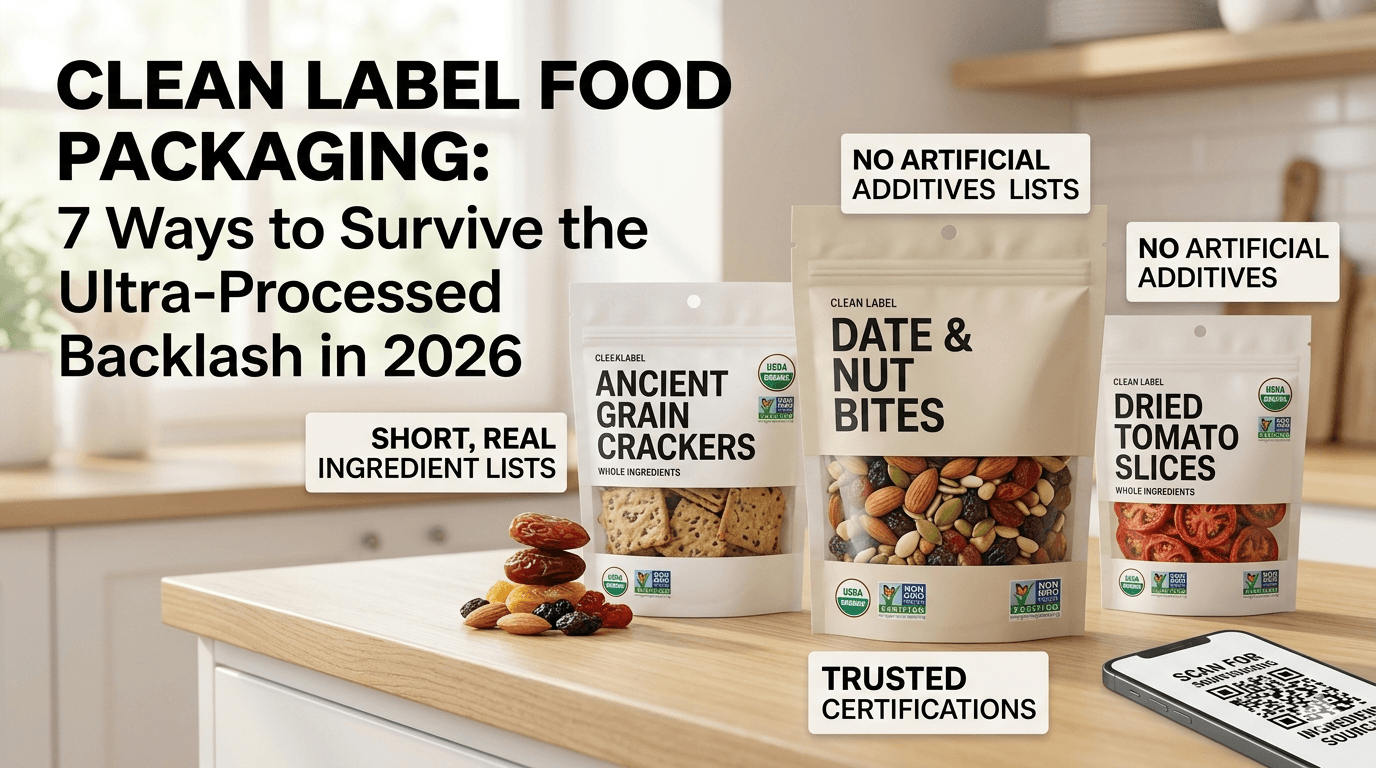
Generic claims like “natural,” “wholesome,” or “real ingredients” have lost consumer credibility through overuse and misuse. Effective clean label food packaging replaces vague language with specific, verifiable statements: “No artificial preservatives,” “Made with 100% whole grain oats,” “Sweetened only with dates,” “Contains 5 ingredients you can see in the photo.”
Specificity builds trust. Vagueness invites skepticism. In 2026’s environment of heightened ingredient scrutiny, every generic “natural” claim is a missed opportunity to make a specific, credible statement that resonates with clean label consumers.
Strategy 3 — Use Transparency Windows and Visible Ingredient Photography
Physical packaging transparency — literal windows that let consumers see the actual product inside — is one of the most powerful clean label food packaging tools available. A transparent window in a pouch that shows whole spices, real nuts, or visible grain pieces communicates ingredient quality more convincingly than any text claim.
Where a physical window is not practical (for light-sensitive or humidity-sensitive ingredients), high-quality ingredient photography on pack that accurately represents the actual contents performs the same trust-building function. The key is authenticity — stylized photography that bears no resemblance to the actual product contents actively backfires with clean label consumers.
Strategy 4 — Audit and Simplify Your Ingredient List Before Redesigning Your Packaging
The most effective clean label food packaging strategy starts before the design table — it starts in the formulation kitchen and the ingredient sourcing process. Work through every ingredient in your current formulation and ask: can this be replaced with a recognizable whole food equivalent without compromising product performance?
Common clean label substitutions include: replacing modified food starch with arrowroot powder or tapioca starch, replacing sodium benzoate with rosemary extract, replacing artificial flavor with real spice concentrates, and replacing refined sugars with dates, honey, or coconut sugar. Many of these substitutions are possible without significant cost increases when managed through a co-packer with strong ingredient sourcing relationships.
At Pack’n Fresh, our hybrid sourcing model gives brands access to domestic and global clean ingredient suppliers at competitive pricing — making the reformulation process economically viable for brands at every scale.
Strategy 5 — Leverage Third-Party Certifications as Clean Label Proof Points
In the absence of a legal “clean label” standard, third-party certifications serve as the most credible clean label signal on your packaging. For clean label consumers, certifications like Non-GMO Project Verified, USDA Organic, and Gluten-Free (GFCO) function as independent confirmation that your “clean” claims are externally audited, not self-declared.
We explore the revenue impact of these certifications in depth in our post on food brand certifications ROI — Organic, Kosher, and Non-GMO. From a clean label food packaging perspective, the key is not to collect certifications indiscriminately, but to display the specific certifications that are most meaningful to your target consumer’s clean label definition.
Strategy 6 — Address Allergens with Proactive Transparency, Not Just Compliance
Clean label consumers view allergen labeling not just as a safety requirement but as a transparency signal. Brands that clearly, prominently, and proactively communicate allergen information — beyond the minimum FDA requirement — signal that they have “nothing to hide” in their production process. This is an underutilized element of clean label food packaging that builds specific trust with the growing population of consumers managing food sensitivities.
This is also an area where your co-packer’s allergen management capabilities directly impact your ability to make credible claims. Our guide on allergen management in food packaging explains the operational systems — siloed production scheduling, validated sanitation protocols, ATP swab testing — that make “free-from” claims defensible.
Strategy 7 — Build a “Behind the Label” Digital Experience
QR codes on packaging have evolved from novelty to expectation. Clean label food packaging in 2026 uses QR codes to extend the ingredient story beyond what fits on the physical package — linking to ingredient sourcing videos, facility tours, third-party lab test results, and farmer profiles. This “behind the label” transparency is especially powerful for brands whose ingredients have compelling sourcing stories (single-origin spices, small-farm proteins, regeneratively grown grains).
Under FSMA Section 204 traceability requirements, your supply chain must maintain digital lot-level records anyway — repurposing that traceability data into consumer-facing transparency content is a no-cost upgrade to your clean label food packaging strategy.
4. How Certifications Support Your Clean Label Food Packaging Story
Clean label food packaging claims are most credible when they are independently verified. The certification landscape in 2026 offers several meaningful options for brands building a clean label identity:
- USDA Organic: The gold standard for ingredient integrity — verifies no synthetic pesticides, GMOs, or artificial additives were used in production. The strongest clean label signal for natural channel brands.
- Non-GMO Project Verified: Specifically addresses the GMO concern that is one of the top clean label triggers for consumers. Highly visible, instantly recognized.
- Gluten-Free (GFCO): For naturally gluten-free products, this certification serves double duty — allergen safety signal and production process transparency signal.
- No Artificial Ingredients (self-declared with ingredient list support): While not a third-party certification, a clearly supported “no artificial flavors, colors, or preservatives” callout backed by a clean ingredient list is a high-performing clean label food packaging element.
Pack’n Fresh holds Organic, Non-GMO, Kosher, and Gluten-Free facility certifications — giving brands we co-pack a credible certification foundation for their clean label food packaging strategy from day one.
5. The Role of Your Co-Packer in Clean Label Compliance
Your co-packer is the physical environment where your clean label promise is either kept or broken. A co-packer that uses shared equipment without validated sanitation protocols, cannot provide ingredient lot-level traceability, or sources packaging materials that contain BPA or other chemical migrants directly undermines your clean label food packaging claims — regardless of how excellent your package design is.
The questions to ask your co-packer about clean label compliance:
- Can you provide Certificate of Analysis documentation for every ingredient lot used in my production run?
- What is your validated cleaning procedure between runs — specifically for allergen residue and cross-contact risk?
- Are your packaging films food-contact safe per FDA 21 CFR regulations, and are migration test results available?
- Do you hold Organic or Non-GMO facility certification that would support my product-level certification?
- What is your FSMA 204 digital traceability system, and can you provide lot-level ingredient traceability on demand?
At Pack’n Fresh, all of these questions have affirmative answers — built into our standard operating procedures, not available only as premium add-ons. This is the operational foundation that makes credible clean label food packaging possible for every brand we serve. Explore our full-service capabilities in our guide on 7 powerful reasons to choose a full-service packaging solution.
6. Common Clean Label Packaging Mistakes That Backfire
Not all clean label food packaging attempts succeed. Here are the most common mistakes that damage rather than build consumer trust:
- Greenwashing ingredient names: Renaming “high-fructose corn syrup” as “corn sugar” or “maltodextrin” as “tapioca fiber” fools no one in 2026. Informed consumers and food journalists will identify and publicize these rebranding attempts immediately.
- “Natural” without specificity: Claiming “all natural ingredients” while including carrageenan, maltodextrin, or natural flavor (which can contain hundreds of chemical components) invites well-deserved skepticism.
- Front-of-pack clean claims contradicted by the ingredient list: Leading with “No Preservatives” while the ingredient list contains citric acid as a preservative is a consistency failure that destroys trust.
- Certifications that don’t match your claims: Displaying a “Certified Gluten-Free” seal on a product that also contains wheat starch is both a regulatory violation and a clean label food packaging integrity failure.
- Over-claiming on behalf of your co-packer’s certifications: Your product is only as certified as your specific production run — co-packer facility certifications must be verified as current and applicable to your specific product to be legitimately displayed.
7. Conclusion: Clean Label Food Packaging Is Your Brand’s Most Durable Defense
The ultra-processed food backlash is not a trend that will peak and subside. The scientific evidence base is growing, the media coverage is intensifying, and consumer behavior is shifting in ways that compound over time as new information reaches new demographics. For food brand founders, the question is not whether to develop a clean label food packaging strategy — it is how quickly and how authentically.
The most durable clean label food packaging strategy is not one built on marketing language. It is one built on genuine ingredient integrity, production transparency, and third-party verification — all of which begin with choosing a co-packing partner whose facility certifications, traceability systems, and allergen management protocols make clean label claims defensible.
At Pack’n Fresh, our Organic, Non-GMO, Kosher, and Gluten-Free certifications, combined with our ERP-driven traceability and rigorous sanitation standards, make us the co-packing partner of choice for brands that are serious about clean label integrity. If you are ready to build a clean label food packaging strategy that consumers will trust and competitors will struggle to match, reach out to our team today.
FAQs — Clean Label Food Packaging
What is clean label food packaging?
Clean label food packaging refers to packaging that communicates ingredient transparency, minimal processing, and recognizable ingredients to health-conscious consumers. It includes short ingredient lists, absence of artificial additives, prominent display of third-party certifications, and design elements that actively signal ingredient integrity rather than obscuring it.
Is “clean label” an FDA-regulated term?
No. “Clean label” has no official FDA definition or regulatory standard. This means brands have flexibility in how they define and communicate their clean label positioning — but it also means unsubstantiated or misleading clean label claims can attract FTC scrutiny and consumer backlash. The safest clean label food packaging approach is to anchor claims in specific, verifiable facts supported by third-party certifications.
How many ingredients should a clean label product have?
There is no universal rule, but consumer research consistently shows that products with 8 or fewer ingredients score highest on clean label perception tests. For more complex meal kit components, 12–15 recognizable ingredients can still qualify as clean label if every ingredient is familiar and functional. Effective clean label food packaging makes the ingredient count a visible feature rather than hiding it.
How does my co-packer affect my clean label claims?
Significantly. Your co-packer’s ingredient sourcing practices, allergen management protocols, facility certifications, and packaging material standards all directly affect whether your clean label food packaging claims are operationally defensible. A co-packer who cannot provide ingredient lot-level traceability or whose facility lacks Organic/Non-GMO certification cannot support many clean label claims regardless of your product formulation.
What certifications best support a clean label food packaging strategy?
The most valuable certifications for clean label food packaging are: USDA Organic (strongest overall signal), Non-GMO Project Verified (most recognized consumer-facing seal), and Gluten-Free GFCO (for naturally gluten-free products). Together, these three certifications address the top clean label concerns of the health-conscious consumer segment that drives premium food brand growth.
What is the difference between “natural” and “clean label” on food packaging?
“Natural” is an FDA-recognized but loosely defined claim that has been significantly devalued through misuse. “Clean label” is a broader consumer-defined concept that goes beyond the natural claim to include minimal processing, recognizable ingredients, supply chain transparency, and production integrity. Effective clean label food packaging goes far beyond simply claiming “natural” — it substantiates ingredient quality through specific claims, certifications, and design elements that make the product’s integrity immediately visible.