Private Label Food Manufacturing: 7 Proven Steps to Launch Your Brand in 2026
The retail shelf has never been more competitive, yet brand operators entering private label food manufacturing are finding a surprisingly direct path from concept to shelf. Private label sales rose 4.4% across all outlets in H1 2025 while national brands grew only 1.1%, signaling a structural shift in how consumers and retailers think about brand value. Whether you are an entrepreneur launching a specialty sauce brand or a regional grocery chain building a store-brand portfolio, the fundamentals of private label food manufacturing follow a repeatable, de-risked playbook. This guide walks you through all seven steps.
What makes private label food manufacturing uniquely powerful in 2026 is the convergence of consumer trust, retailer investment, and manufacturing sophistication. A reported 95% of consumers now buy private label products, and 69% say they purchase them on most or every shopping trip — figures that would have been unthinkable a decade ago. The co-packing infrastructure supporting private label food manufacturing today has never been more capable, with SQF-certified facilities, ERP-backed production management, and precision filling technologies that rival what national brands achieve at far greater volume. The result is a genuinely level playing field for emerging brand operators.
Private label food manufacturing is not a simple one-step operation — it requires formula validation, manufacturer selection, IP protection, packaging compliance, quality certification, and a launch strategy built for scale. Seven distinct steps separate a product idea from a product on a retailer’s shelf, and each step carries its own set of decisions, costs, and risk factors. This guide provides an actionable framework for every phase, with practical guidance on where brand founders consistently save money, avoid costly mistakes, and accelerate time to market. By the end, you will know exactly what to ask, what to verify, and what to expect from your manufacturing partner.
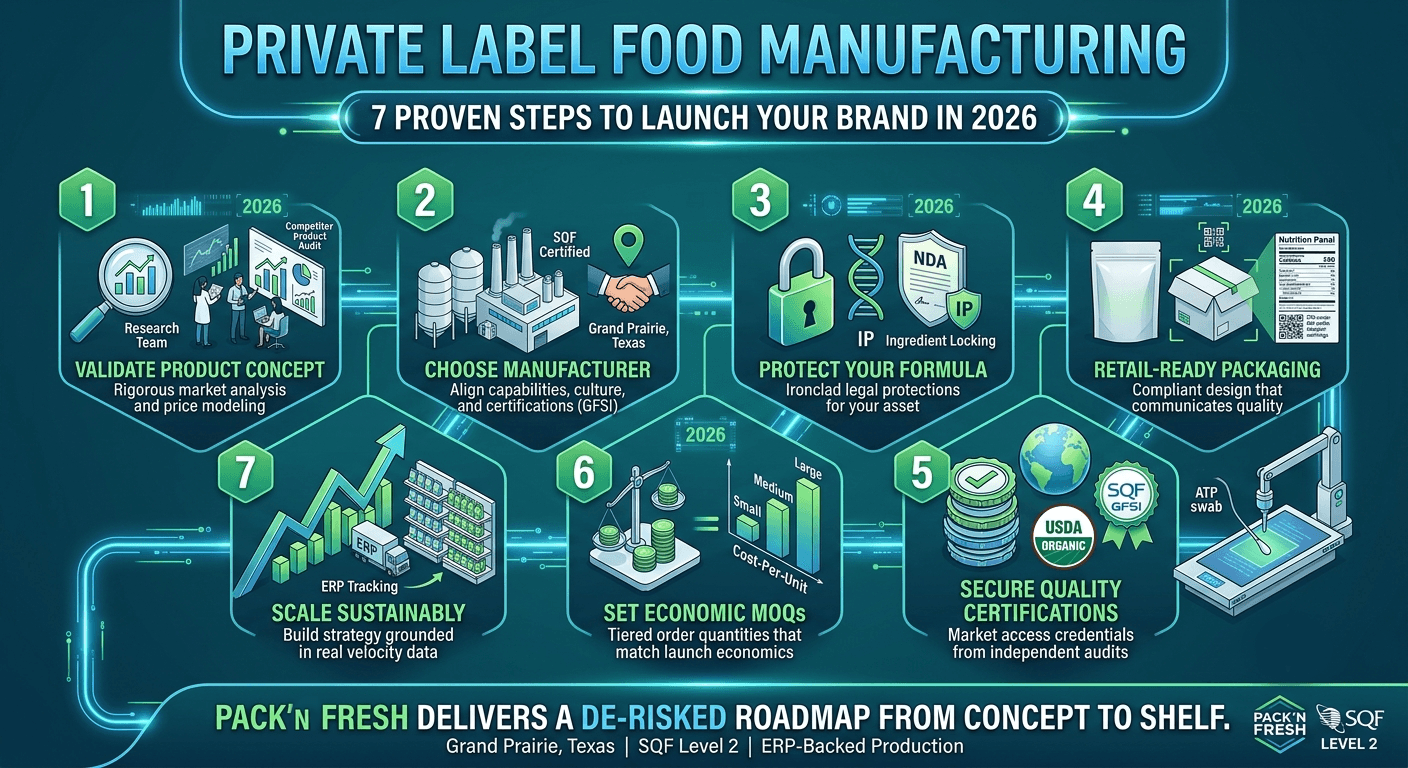
This guide walks you through the complete private label food manufacturing process in seven practical steps: validating your product concept and market opportunity, choosing a manufacturer aligned with your category and certifications, locking down your formula with ironclad IP protections, designing retail-ready packaging that meets FDA and retailer requirements, securing the quality certifications your target channels demand, setting minimum order quantities that match your launch economics, and building a scale strategy grounded in real velocity data. Each step builds on the last, giving you a de-risked roadmap from first concept through sustained retail growth.
At Pack’n Fresh, a SQF Level 2 certified full-service co-packer based in Grand Prairie, Texas, we partner with food entrepreneurs and retail brands at every stage of the private label food manufacturing process. Our ERP-backed production environment delivers real-time traceability from ingredient receipt to outbound shipment, and our Digital Ingredient Locking system ensures your formula stays exactly as you approved it — across every batch, every season. From precision filling and allergen-siloed scheduling to labeling, kitting, and warehousing, Pack’n Fresh provides the full-service infrastructure that serious private label food manufacturing programs require.
Table of Contents
- What Is Private Label Food Manufacturing and Who Is It Right For?
- Step 1 — Validate Your Product Concept and Market Opportunity
- Step 2 — Choose a Private Label Food Manufacturer Who Fits Your Category
- Step 3 — Protect Your Formula: IP, NDAs, and Ingredient Ownership
- Step 4 — Design Retail-Ready Packaging That Meets FDA and Retailer Requirements
- Step 5 — Navigate Quality Certifications: SQF, GFSI, and Organic
- Step 6 & 7 — Set Minimum Orders, Launch Smart, and Scale Sustainably
What Is Private Label Food Manufacturing and Who Is It Right For?
Private label food manufacturing is the process by which a third-party manufacturer produces a food or beverage product to a brand owner’s specifications, which the brand owner then sells under its own label. Unlike national brands that own their manufacturing assets outright, private label brand owners leverage a co-packer’s equipment, certifications, labor, and supply chain infrastructure to bring products to market. This arrangement lets brand operators reach retail-quality production without the capital required to build or lease a dedicated facility. The model has been the backbone of grocery retail for decades — but it has evolved dramatically in sophistication, accessibility, and scale.
The distinction between private label and contract manufacturing deserves clarification before you begin planning. In private label food manufacturing, the brand owner either develops an original formula — often collaborating with the co-packer’s food scientists — or adapts an existing base formulation to meet specific market requirements. In either case, the finished product bears the brand owner’s label, not the manufacturer’s. Contract manufacturing sometimes implies the co-packer develops and owns the base formula, while the brand owner controls only packaging and positioning. Understanding this distinction matters deeply for intellectual property planning, which Step 3 covers in full detail.
Who benefits most from private label food manufacturing? The model serves several distinct operator profiles exceptionally well. Regional grocery chains and club retailers are the most recognized players, building store-brand programs that compete directly with national SKUs at better margin. But the model works equally well for e-commerce brand builders, food entrepreneurs validating a niche product concept, specialty distributors monetizing a loyal customer base, and health and wellness brands seeking to own formulations tied to a specific dietary protocol. Notably, private label health and wellness lines are seeing a 25% higher repeat purchase rate versus standard offerings — a signal that consumers in these categories are building genuine brand loyalty around private label products.
The Food Contract Manufacturing Market was valued at $235.6 billion in 2026 and is projected to reach $463.17 billion by 2035, growing at a 7.80% CAGR. This trajectory reflects not just increased private label volume but the increasing sophistication of outsourced production across every food category — from ambient grocery to refrigerated deli to frozen entrees. Brand operators entering private label food manufacturing today are doing so in the most favorable cost-structure environment the category has ever offered, with co-packers providing tiered minimum orders, flexible run sizes, and end-to-end services that once required three or four separate vendors to coordinate.
One emerging trend reshaping private label food manufacturing in 2026 is what industry analysts are calling “Co-Manufacturing Consolidation.” Major retailers — including Walmart and Sam’s Club, which have made public commitments to removing 30 to 40 key ingredients from their own-brand products — are moving toward Exclusive Production Agreements that lock in preferred manufacturers for multi-year windows. For emerging brands and growing chains, this trend creates both urgency and opportunity: urgency to secure capable manufacturing partners before quality capacity tightens, and opportunity to differentiate on formulation attributes that align with the clean-label commitments retailers are now codifying into vendor contracts.
The defining risk to understand before entering private label food manufacturing is that your brand’s success is structurally linked to your manufacturer’s performance. A co-packer’s food safety record, supply chain reliability, capacity headroom, and regulatory standing become the operational foundation your brand rests on. The due diligence required before signing a manufacturing agreement is therefore not a procedural formality — it is the most consequential business decision a brand founder makes in the early stages. The six steps that follow provide a systematic framework for navigating every phase of this process, from concept validation through scale.
Step 1 — Validate Your Product Concept and Market Opportunity
Before a single ingredient is sourced or a label designed, successful brand operators in private label food manufacturing complete a rigorous concept validation phase. This phase answers three fundamental questions: Is there a documented consumer need for this product in this category? Is the target price point achievable at the required margin? And is there a co-packer capable of producing it at the quality and volume your retail target demands? Skipping this phase is the single most common reason early-stage private label projects stall after the first production run, often when inventory fails to move at the price originally modeled.
Retail buyer research is the most underutilized validation tool available to brand founders entering private label food manufacturing. Before investing in formula development or packaging design, request a category review meeting with buyers at your target retail channel — whether that is a regional grocery chain, a specialty natural foods retailer, or a club store buyer. Category buyers will tell you directly what gaps exist in their current planogram, what price architecture they are building toward, and what certification or clean-label attributes their vendor selection criteria currently prioritize. This intelligence shapes every downstream formulation and positioning decision your brand will make.
Consumer panel testing does not need to be expensive at the validation stage. Brand operators consistently find that small-format sensory panels — groups of 20 to 30 target consumers evaluating blind taste tests against category benchmarks — produce actionable preference data at a fraction of the cost of formal market research. The key metrics to capture at this stage are: overall preference score versus the category leader, purchase intent at your target retail price, and open-ended feedback on texture, flavor profile, and packaging concept. These data points become the formulation brief you hand your co-packer when you are ready to move into development.
Competitive shelf analysis is the third pillar of concept validation and one of the most direct research methods available. Walk your target category across five to ten retail locations — or conduct a systematic online shelf audit for e-commerce — and document the current price ladder, ingredient positioning, certifications on pack, and package format range. private label food manufacturing succeeds when it either undercuts national brand pricing at comparable quality or offers a meaningfully differentiated formulation — organic, allergen-free, or functional ingredient — that justifies a premium position. The shelf audit reveals which position is realistically available to a new entrant in your specific category and geography.
Financial validation runs parallel to market validation and should never be deferred until after formula development. Model the unit economics at the minimum order quantity your prospective co-packer requires, working backward from the retail price to your target margin. Build in landed cost, co-packer margin, label and packaging cost, freight, slotting fees for traditional retail, and a 10 to 15 percent buffer for initial waste and rework. The Pack’n Fresh resource on COGS calculation for food businesses provides a practical framework for this modeling work. Brand operators who enter private label food manufacturing with a detailed cost model before the first production run consistently outperform those who reverse-engineer the economics after the fact.
Timing is a validation variable that brand founders frequently underestimate in early-stage planning. Private label food manufacturing timelines — from initial formula brief to first retail-ready pallet — typically span twelve to twenty-four weeks depending on formula complexity, packaging development lead times, and the co-packer’s current production schedule. Building a launch calendar backward from your target in-store date, with buffer built in for regulatory review and retailer onboarding, is not optional project management discipline. It is the difference between launching on time and losing a seasonal selling window that will not return for twelve months.
Step 2 — Choose a Private Label Food Manufacturer Who Fits Your Category
Selecting a co-packer is not a procurement exercise — it is a partnership decision that shapes your brand’s quality ceiling, cost structure, and scale trajectory for years. The private label food manufacturing industry contains hundreds of contract facilities ranging from small artisan co-packers handling a few SKUs at low volume to large multi-line facilities with automated filling capacity capable of millions of units per month. Finding the right fit requires understanding not just what a co-packer can produce, but how their operational capabilities and culture align with your brand’s quality standards, category requirements, and growth roadmap.
The first filter in manufacturer selection is category specialization. Private label food manufacturing is not technically one-size-fits-all across the product landscape. A facility optimized for ambient dry goods may lack the humidity controls required for confectionery production. A co-packer with deep expertise in sauces and dressings may not have the allergen-management protocols required for a nut butter or trail mix product. Confirm that your prospective manufacturer has active production experience in your specific food category — not adjacent categories — and can provide references from active customers in that space before you invest further time in evaluation.
Certifications are the second filter, and they are non-negotiable for most retail channels. The major grocery and club store buyers require at minimum a GFSI-recognized food safety certification before onboarding a new private label vendor. SQF (Safe Quality Food) certification is one of the most widely recognized standards in the North American market, with SQF Level 2 confirming that a facility has implemented and passed an independent audit against a comprehensive food safety management system. BRC Global Standards, FSSC 22000, and IFS are other recognized GFSI schemes you may encounter depending on your retailer’s specific requirements. Confirm active certification status — not just claimed status — before engaging beyond an initial inquiry.
Geographic location affects landed cost more than most brand founders anticipate in early-stage planning. A co-packer located in the geographic center of the continental United States offers meaningful freight advantages for private label food manufacturing programs distributing to multiple regions simultaneously. Location also influences ingredient sourcing costs, labor market dynamics, and a facility’s ability to recruit qualified food science and production management talent. For national distribution programs, freight symmetry — roughly equivalent outbound costs to the East and West coasts — can represent a meaningful per-unit cost advantage when aggregated across annual production volume.
Evaluate the co-packer’s technology infrastructure as rigorously as its physical production capabilities. An ERP system that manages production scheduling, batch documentation, and inventory in real time is no longer a premium feature — it is a baseline expectation for any private label food manufacturing partner operating at professional scale. Ask prospective manufacturers whether they offer digital traceability from ingredient receipt to finished goods shipment, how they generate and retain batch records, and whether their systems can produce the documentation your retail accounts will require during an audit or quality inquiry. Facilities operating on paper-based systems introduce documentation risk that is difficult to manage after a production issue surfaces.
A facility audit — conducted in person or via a credentialed third-party auditor — is the only reliable method for verifying that a co-packer’s stated capabilities match its actual operational reality. Request a walkthrough before signing any agreement. Observe the production environment, sanitation protocols, allergen segregation practices, and the condition and calibration status of filling and sealing equipment. Ask to see a recent third-party audit report and the facility’s corrective action log. Private label food manufacturing partnerships produce the best long-term outcomes when the brand operator enters the relationship with a clear-eyed view of both the manufacturer’s strengths and the areas where ongoing management attention will be required.
Step 3 — Protect Your Formula: IP, NDAs, and Ingredient Ownership
Intellectual property protection is the least glamorous element of private label food manufacturing and consistently the most underestimated source of long-term business risk. When a brand operator invests in original formula development — through internal food scientists, an independent flavor house, or collaborative development with a co-packer — that formulation represents a proprietary asset that must be legally protected before any production agreement is executed. Entering a co-packing arrangement without clearly documented IP protections is not a calculated risk; it is an avoidable oversight with potentially permanent consequences for your brand’s competitive position.
The non-disclosure agreement is the first line of protection in any private label food manufacturing relationship. A well-drafted NDA should cover the formula itself, the identity of your ingredient suppliers, your intended retail target accounts, your pricing structure, and any proprietary production processes that differentiate your product from category competitors. Have the NDA reviewed by an attorney with food and beverage industry experience — not a general commercial attorney. Standard NDA templates commonly offered by co-packers are typically written to protect the manufacturer’s interests first, and negotiating brand-protective provisions into the agreement is a normal, expected part of the contracting process.
Formula ownership documentation goes beyond the NDA and is frequently overlooked entirely by first-time brand operators. If your co-packer’s food scientists contributed to formula development, your manufacturing agreement must explicitly state that all intellectual property created during the development process is owned by the brand operator — not the manufacturer. This work-for-hire provision should be unambiguous, covering the base formula, any subsequent iterations developed during production optimization, and the proprietary ingredient ratios that define your product’s sensory profile. Brand operators consistently discover the importance of this clause after a manufacturer relationship ends and ownership of the formulation becomes contested.
Ingredient locking is a concept that experienced private label brand operators prioritize from day one. An ingredient-locked formula specifies not just the category of each ingredient — such as “apple cider vinegar” — but the specific supplier, grade, and specification of that ingredient. When an ingredient is locked at the contract level, your co-packer cannot substitute a lower-cost or lower-quality alternative without your explicit written approval. Some co-packers offer digital ingredient locking systems that automatically flag any proposed substitution for brand owner review, providing the kind of production control that serious private label brands require at every stage of the manufacturing relationship.
Regulatory documentation ownership is a separate but related IP consideration that deserves explicit attention in every manufacturing agreement. Your formulations are documented with the FDA under specific product parameters. Your nutrition facts panels are calculated from your specific ingredient specifications. Your allergen declarations are generated from your specific formula composition. If you change co-packers, you need to be able to take these regulatory documents with you — not reconstruct them from scratch at significant cost and delay. Ensure your manufacturing agreement specifies that all regulatory submissions, nutrition facts calculations, and allergen assessments produced during your relationship with the co-packer belong to you.
Confidentiality obligations should extend beyond the primary co-packer to their ingredient suppliers and subcontractors. In large private label food manufacturing programs, the co-packer may source specific proprietary ingredients through a broker or distributor who gains incidental knowledge of your formula composition. Ensure your agreement requires your co-packer to impose equivalent confidentiality obligations on any third party that gains access to your formulation data. This requirement is particularly important for highly differentiated products where the ingredient combination itself is the core competitive advantage that justifies your brand’s premium positioning in the market.
Ready to Explore Private Label Food Manufacturing for Your Brand?
Pack’n Fresh is a SQF Level 2 certified co-packer based in Grand Prairie, Texas, offering full-service private label food manufacturing — from Digital Ingredient Locking and allergen-siloed scheduling to precision filling, labeling, and warehousing. We work with emerging brands and established retailers who need a manufacturing partner they can trust with their most valuable product assets.
Step 4 — Design Retail-Ready Packaging That Meets FDA and Retailer Requirements
Packaging in private label food manufacturing is simultaneously a regulatory compliance exercise and a brand-building investment. Your product’s label must satisfy FDA food labeling requirements — including accurate nutrition facts panels, allergen declarations, net weight statements, and manufacturer address disclosures — before it can legally enter retail commerce. Compliance is the floor, not the ceiling. Brands that succeed in this space consistently invest in packaging that communicates quality, clarity, and differentiation at a distance of three feet on a crowded retail shelf.
The nutrition facts panel is the single most regulated element of any food package, and errors here carry the highest compliance risk. Nutrition facts must be calculated from your specific production formula — not from a similar product or a generic database estimate — and must be reviewed against FDA’s current guidance on serving size standardization, rounding rules, and the required declaration of vitamins and minerals. For brands targeting specific retail channels, additional labeling requirements may apply: club stores frequently require specific net weight formats, natural food retailers may require third-party certification logos, and international distribution requires country-specific labeling compliance beyond the baseline FDA standard.
Allergen declaration errors are the most common trigger for food product recalls in the North American market. The Food Allergen Labeling and Consumer Protection Act requires clear declaration of the nine major allergens — milk, eggs, fish, shellfish, tree nuts, peanuts, wheat, soybeans, and sesame — and FDA enforcement in this area has become increasingly rigorous. When choosing a private label food manufacturing partner, confirm that your allergen declarations are validated against both your specific formula and the facility’s allergen control program. A co-packer with siloed allergen scheduling — where allergen-containing products run on dedicated days or lines, with full changeover sanitation between — provides the manufacturing assurance that backs up your on-package allergen declaration.
Retailer-specific packaging requirements add a layer of complexity that extends well beyond FDA compliance. Many major retailers impose their own additional standards: minimum font sizes for ingredient lists, sustainability certification requirements on packaging materials, QR code placement specifications, and format restrictions on package dimensions to optimize shelf space utilization. Work with your co-packer to understand which retailers you are targeting before finalizing package dimensions and structural design, because a format that fits perfectly in one retailer’s planogram may not qualify for another’s shelf program without costly modification.
The Private Label Manufacturers Association (PLMA) publishes annual guidelines and convenes industry events that surface current retailer packaging requirements and category design trends. Brand operators in private label food manufacturing consistently find PLMA resources valuable for understanding how major retail accounts are evolving their packaging standards — particularly for sustainability attributes like recyclability, post-consumer recycled content, and reduced packaging weight. These attributes are increasingly becoming retailer requirements rather than optional brand differentiators, and packaging structures that do not anticipate this evolution will require expensive redesigns in the near term.
Full-service co-packers reduce the operational complexity of a launch by managing coordination between packaging component procurement, label printing, and labeling line integration. Getting all three in sync — packaging components arriving on time, labels printed to specification, and the line configured for your format — is consistently the most operationally complex element of a private label launch. Co-packers who manage this coordination directly reduce the brand operator’s project management burden significantly and eliminate the timeline risk that accumulates when multiple independent vendors must synchronize with each other across parallel workstreams.
Step 5 — Navigate Quality Certifications: SQF, GFSI, and Organic
Quality certifications function as market access credentials in modern private label food manufacturing. Retailers use certification requirements to pre-qualify manufacturing partners before vendor approval, consumers use certification logos to make trust-based purchase decisions at the shelf, and brand operators use certifications to differentiate their supply chain story in category pitches to retail buyers. Understanding which certifications your target channel requires — and which your prospective co-packer currently holds — is a prerequisite for building a viable manufacturing strategy in any major retail channel.
GFSI — the Global Food Safety Initiative — is the umbrella framework under which most major food safety certification schemes operate. GFSI does not issue certifications directly; instead, it benchmarks and recognizes schemes that meet its standards for comprehensive food safety management systems. The major GFSI-recognized schemes include SQF, BRC Global Standards, FSSC 22000, and IFS Food. Most major North American grocery chains and club retailers require GFSI certification from their manufacturing vendors as a non-negotiable condition of vendor approval. Understanding which specific scheme your target retailer accepts is an important early-stage qualification step in any private label food manufacturing partner evaluation process.
SQF Level 2 certification represents a meaningful operational commitment in private label food manufacturing. At Level 2, a manufacturing facility has implemented and been independently audited against a comprehensive food safety management system covering raw material controls, sanitation verification, allergen management, equipment calibration, and corrective action protocols. Partnering with an SQF Level 2 certified co-packer like Pack’n Fresh means the baseline food safety infrastructure supporting your brand has been verified by an independent third-party auditor against one of the most rigorous standards in the North American food industry. For a detailed breakdown of the certification landscape, the Pack’n Fresh guide to GFSI food safety standards covers each scheme’s scope and requirements in depth.
Sanitation verification at modern co-packing facilities has evolved significantly beyond visual inspection protocols. ATP (adenosine triphosphate) swab testing is now the industry standard for confirming that production surfaces have been cleaned to a microbial load threshold that meets food safety requirements. Facilities that use ATP swab testing as a documented, systematic part of their sanitation protocol — rather than relying solely on visual checks or scheduled cleaning logs — provide brand operators with an evidence-based sanitation record that holds up under third-party audit scrutiny. Ask any prospective co-packer whether ATP testing is standard in their program and whether results are logged and retained in their production management system.
Organic certification is a separate credential from food safety certification and requires its own distinct compliance infrastructure. USDA Organic certification requires that every ingredient in a certified organic product is sourced from USDA Organic certified suppliers, that the production facility meets organic handling requirements, and that the co-packer itself holds USDA Organic certification to handle certified organic ingredients legally. Not all co-packers hold organic certification, and those that do typically operate organic production runs on a specific dedicated schedule to prevent co-mingling with conventional ingredients. If your private label brand is targeting the organic segment, confirm your co-packer’s organic certification status before formula development begins.
Allergen management deserves a focused discussion beyond what GFSI schemes require at baseline in the context of private label food manufacturing. Some brand operators — particularly those producing products for consumers with severe allergies — seek additional third-party allergen certifications or operational validation documentation. A co-packer with a documented siloed allergen scheduling program, where allergen-containing products run on dedicated days or lines with full changeover sanitation and ATP verification between, provides the operational foundation that supports both internal safety objectives and the documentation requirements that third-party allergen certification bodies and retail audit teams will request.
Step 6 & 7 — Set Minimum Orders, Launch Smart, and Scale Sustainably
Minimum order quantities are the most practically significant contractual variable in any private label food manufacturing agreement, yet they are frequently treated as a fixed constraint rather than a negotiated outcome. Co-packers set MOQs based on the economics of their production runs — setup time, line changeover costs, ingredient procurement minimums, and the fixed overhead that must be amortized across a batch. Understanding the economic logic behind the MOQ number gives brand operators the leverage to negotiate arrangements that fit their launch volume without requiring the manufacturer to absorb economics that do not support their operating model.
For brand founders launching their first private label product, the goal is typically to negotiate the smallest viable initial run that enables real-world market testing without overcommitting capital to inventory. Brand operators consistently report that initial MOQs can often be negotiated downward when the brand operator is willing to accept higher per-unit costs on the first run, commit to a follow-on production schedule, or reduce packaging format complexity. The economic trade-off — higher unit cost on a smaller initial run versus the inventory risk of a full standard MOQ — typically favors the smaller run when market validation data is limited. Test before you commit, not the reverse.
Smart launch sequencing reduces risk in private label food manufacturing by staging market exposure to match available inventory and demonstrated sell-through rates. Rather than launching simultaneously across all channels, successful brand operators typically begin with a single retail partner or e-commerce channel, gather velocity data and consumer feedback over a 60 to 90 day window, and use that data to refine messaging, pricing, and format before expanding distribution. This staged approach allows inventory levels to match demonstrated demand — the most reliable way to avoid the costly combination of stockout at launch followed by long-dated inventory as initial excitement subsides.
Scale economics in private label food manufacturing improve meaningfully at key production volume thresholds. Most co-packers structure their pricing across three to five volume tiers, with meaningful per-unit cost reductions at each step up. Understanding where those pricing inflection points are — typically expressed in cases or unit quantities rather than dollar values — allows brand operators to plan procurement and production scheduling to capture tier improvements as volume grows. This planning work should happen before launch, not after, so that the pricing roadmap is visible and achievable within the brand’s financial model from the beginning.
The 2026 trend of Co-Manufacturing Consolidation — where major retailers are moving toward Exclusive Production Agreements with preferred vendors — creates a strategic imperative for growing private label brands to secure manufacturing partnerships before quality capacity tightens. Pack’n Fresh operates from Grand Prairie, Texas — a central US location that provides freight-efficient access to distribution networks across the continental United States. Brands that establish manufacturing relationships and demonstrate reliable velocity data before the next wave of retailer consolidation are best positioned to negotiate favorable production agreements from a position of demonstrated market performance rather than a standing start.
Scaling sustainably in private label food manufacturing requires proactive capacity planning conversations with your co-packer — conversations that most brand operators initiate far too late. Most production facilities operate at 60 to 80 percent of rated capacity during normal periods, with headroom available for growth. But the best production windows at quality co-packers are allocated months in advance to established customers with performance track records. Beginning capacity planning conversations at 60 to 70 percent of your current production volume — rather than waiting until you are capacity-constrained and scrambling — ensures that your scale path is mapped before you need it and that your growth seasons stay fully stocked.
How Pack’n Fresh Powers Private Label Food Manufacturing
Pack’n Fresh is a private label food manufacturing partner purpose-built for brand operators who require institutional-grade food safety infrastructure at a scale that serves growing brands. As an SQF Level 2 certified full-service co-packer based in Grand Prairie, Texas, our end-to-end capabilities include materials sourcing, precision filling and sealing across multiple formats, digital labeling, kitting and bundling, and full-pallet warehousing — all managed within a single ERP-backed production environment that provides real-time traceability from ingredient receipt to outbound shipment. Our central US location ensures freight-efficient access to distribution networks coast to coast.
Our Digital Ingredient Locking system ensures that every raw material in your formula is locked to your specification before production begins. If a supplier substitution is proposed — whether due to availability, cost, or a specification change — the system flags it for brand owner review before any deviation from your approved formula occurs. In private label food manufacturing, ingredient consistency is brand consistency. A product that tastes or performs differently in month six than it did at launch is both a customer retention problem and a quality control failure, and our ingredient control infrastructure is specifically designed to prevent that outcome across every production run.
Allergen management at Pack’n Fresh operates through siloed allergen scheduling combined with ATP swab sanitation verification at every changeover. Allergen-containing production runs are scheduled on designated days, with full sanitation protocols and ATP confirmation before any non-allergen product runs on the same line. For private label brands making allergen-free claims or producing for consumers with severe allergies, this operational discipline provides both the manufacturing confidence and the audit documentation that third-party certification bodies require. Our precision micro-dosing capability also extends our private label food manufacturing program to products requiring exact functional ingredient delivery — nutraceutical additions, flavor compounds, or concentrated natural extracts where deviation at the microgram level affects both product efficacy and regulatory compliance.
For brand operators who want to understand how co-packing works before engaging in a full program evaluation, our introductory guide to what food co-packing is and how it benefits your business covers the co-packing model, how manufacturer relationships are structured, and what questions to ask during your initial outreach. Private label food manufacturing succeeds when the brand operator and the manufacturing partner are genuinely aligned on quality standards, growth expectations, and operational values — and we built Pack’n Fresh to be exactly that kind of partner.
Conclusion
Private label food manufacturing in 2026 represents one of the most compelling brand-building opportunities in the consumer goods landscape. With private label sales outpacing national brand growth by a factor of four to one, consumer trust in private label at record levels, and the Food Contract Manufacturing Market expanding at nearly 8 percent annually, the infrastructure, consumer demand, and retail appetite for high-quality private label brands are all accelerating simultaneously. The seven steps in this guide — from concept validation through scale planning — provide a framework for navigating this opportunity systematically rather than opportunistically.
The quality of your co-packer determines the quality ceiling of your brand. No marketing investment, no packaging redesign, and no retail relationship can compensate for inconsistent production, unreliable traceability, or a food safety record that puts your retail accounts at risk. The selection process outlined in this guide — evaluating certifications, technology infrastructure, category specialization, geographic fit, and IP protections — is the single highest-leverage work a brand operator undertakes in the private label food manufacturing journey. Invest in it accordingly, and the returns will compound across every season you operate.
The brand operators who succeed in private label food manufacturing in 2026 and beyond will be those who combine consumer-first thinking with operational precision. They will know their formula inside out, control their ingredient supply chain, build retail relationships grounded in velocity data, and partner with manufacturers whose capabilities and values align with where their brand is going — not just where it is today. If you are ready to start that journey, the conversation begins with a consultation. Let’s build it together.
Frequently Asked Questions About Private Label Food Manufacturing
What is private label food manufacturing and how does it differ from contract manufacturing?
Private label food manufacturing is when a third-party co-packer produces a product to your brand’s specifications and you sell it under your own label, controlling the brand identity and retail relationship. Contract manufacturing is a broader term that sometimes implies the co-packer owns or developed the base formulation, while the brand owner primarily controls packaging and positioning. The key distinction is intellectual property ownership — in true private label food manufacturing, the brand operator owns the formula, the label, and the retail relationship from day one. Establishing that ownership clearly before production begins is the most important protective step a brand operator can take.
How long does private label food manufacturing typically take from concept to shelf?
Most private label food manufacturing programs take twelve to twenty-four weeks from initial formula brief to first retail-ready pallet, depending on formula complexity, packaging development lead times, and the co-packer’s current production schedule. More complex products with custom flavor development or specialized regulatory review may extend beyond this range. Brand operators who complete formula validation and retail buyer conversations before engaging a co-packer can compress this timeline by eight to twelve weeks by eliminating iteration cycles that typically occur when these steps run sequentially rather than in parallel from the outset.
What certifications should I look for in a private label food manufacturer?
For most retail channels, a GFSI-recognized food safety certification — such as SQF Level 2, BRC Global Standards, or FSSC 22000 — is the minimum requirement for vendor approval in a private label food manufacturing partnership. SQF Level 2 is the most widely accepted standard among North American grocery and club retailers. If your product line targets the organic segment, confirm your co-packer holds USDA Organic certification. For allergen-sensitive products, look for documented siloed allergen scheduling and ATP swab sanitation verification as evidence of operational allergen control discipline that goes beyond basic GFSI compliance requirements.
What minimum order quantity should I expect in private label food manufacturing?
Minimum order quantities in private label food manufacturing vary significantly by product category, packaging format, and the co-packer’s production scale and overhead structure. Brand operators consistently find MOQs ranging from a few hundred cases for specialized niche products to several thousand cases for high-speed automated filling lines. MOQs are negotiable in many cases — particularly on initial runs — when the brand operator is willing to accept higher per-unit costs or commit to a follow-on production schedule. Always request a detailed cost breakdown at multiple volume tiers from any prospective co-packer before making a final sourcing decision.
How do I protect my formula in a private label food manufacturing agreement?
Formula protection in private label food manufacturing requires a multi-layered approach: a robust NDA signed before any formula data is shared, a manufacturing agreement with explicit work-for-hire provisions assigning all development IP to the brand operator, ingredient locking provisions that prevent unauthorized substitutions, and documentation ownership clauses covering regulatory submissions and nutrition facts calculations. Have all provisions reviewed by an attorney with food and beverage industry experience. The co-packer’s standard agreement template is typically structured to protect the manufacturer — negotiating brand-protective provisions is a normal, expected part of the contracting process.
Can private label food manufacturing work for small brands and startups?
Yes — the co-packing model is increasingly accessible to early-stage brands and startups, particularly as manufacturers have developed tiered service models and flexible MOQ structures to serve smaller accounts alongside established retail programs. The key is selecting a co-packer whose operational scale and service model aligns with your launch volume and the level of hands-on coordination you need. A small emerging brand should look for a co-packer with experience serving similar-sized accounts, flexible initial run sizes, and end-to-end capabilities that reduce the number of vendors and coordination touchpoints required in the early stages of a brand build.
Start Your Private Label Food Manufacturing Journey with Pack’n Fresh
Pack’n Fresh is Grand Prairie, Texas’s SQF Level 2 certified full-service co-packer. From formula development and Digital Ingredient Locking to precision filling, labeling, kitting, and warehousing, we provide everything your private label brand needs to launch and scale with confidence. Request a free quote today and speak directly with our production team about your project.