Baking Mix Co-Packing: 7 Proven Strategies for Dry Mix Brands to Scale in 2026
The home baking movement that surged during 2020 never fully reversed — instead, it permanently elevated consumer demand for premium baking mixes, gluten-free alternatives, artisan bread blends, and specialty flour bases across retail, e-commerce, and foodservice channels. For dry mix brand founders working to capitalize on that sustained momentum, baking mix co-packing has emerged as the most efficient path from kitchen-tested recipe to retail-ready product at commercial scale. Outsourcing production to a certified, full-service co-packer gives brand owners immediate access to industrial-grade dry blending equipment, allergen-controlled manufacturing environments, and regulatory expertise that would take years and significant capital investment to replicate independently.
At the same time, scaling a dry baking mix brand is not as straightforward as it might appear on the surface. Precision matters at every stage of production — from the particle-size compatibility and distribution uniformity of your dry blend, to the accuracy of your leavening agent ratios, from the integrity of your allergen declarations to the retail-shelf appeal of your packaging format. Brands that approach baking mix co-packing as a commodity procurement decision — rather than as a strategic manufacturing partnership — frequently encounter batch-to-batch formula inconsistency, compliance vulnerabilities that surface during retail audits, or packaging that fails to compete effectively at the shelf level. Choosing the right production partner is the single operational decision that most directly shapes a brand’s capacity to grow.
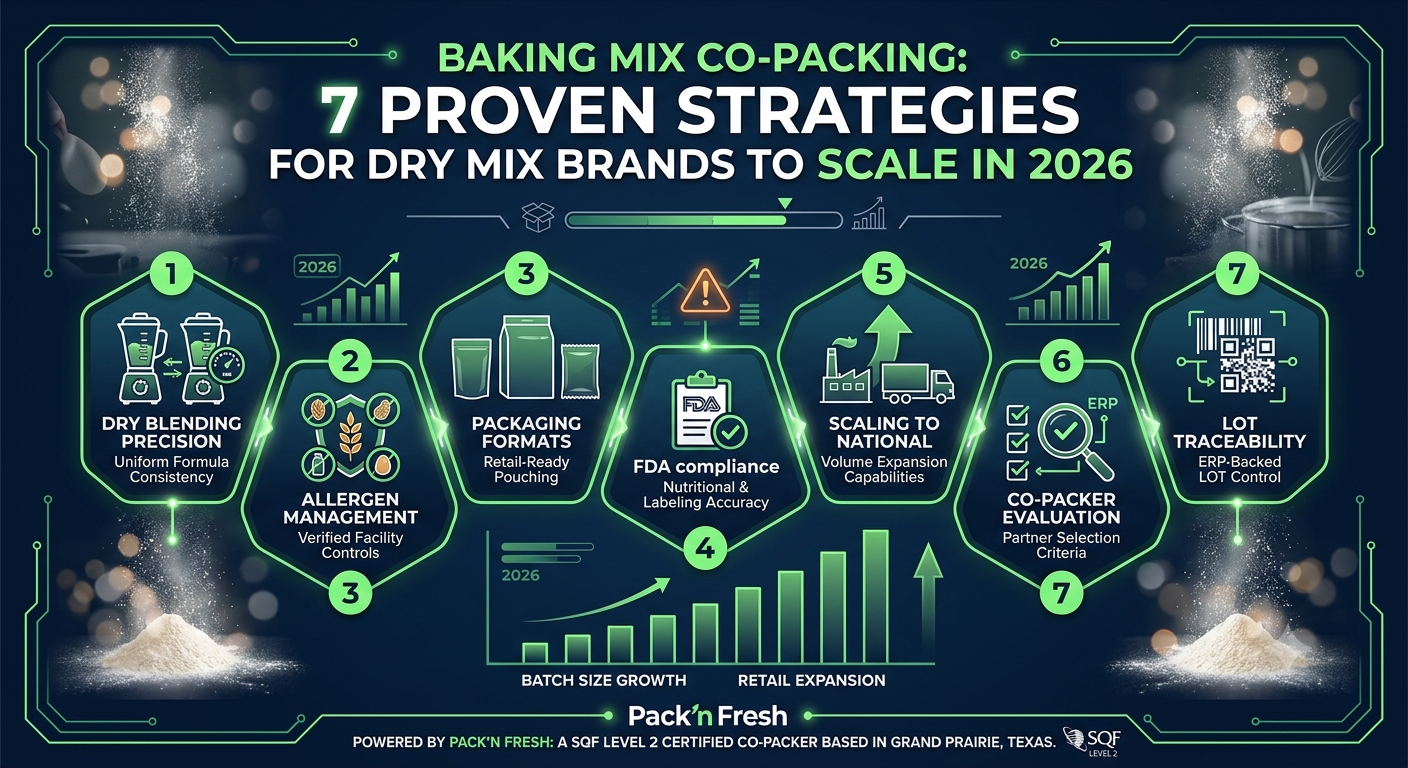
This comprehensive guide covers seven proven strategies that dry mix brands are using in 2026 to scale successfully through baking mix co-packing. Whether you are launching your first SKU, transitioning from self-manufacturing to outsourced production, or expanding to a national retail footprint, these strategies will help you evaluate co-packers with greater precision, tighten your production quality controls, and move from concept to consumer-ready product with the consistency and regulatory compliance that serious retail buyers demand.
The seven strategies covered here span the full production lifecycle of a commercial baking mix operation: dry blending precision and formula consistency controls, allergen management for wheat, nuts, dairy, and egg across shared-facility production environments, retail-ready packaging formats suited to each distribution channel, FDA labeling compliance for branded dry mix products, the operational mechanics of scaling from small-batch to national distribution volume, and the evaluation criteria brands should apply when selecting a baking mix co-packing partner capable of supporting long-term growth. Each section is written for brand operators making real production decisions — not for academic interest.
At Pack’n Fresh, a SQF Level 2 certified full-service co-packer based in Grand Prairie, Texas, we partner with baking mix brands at every production scale — from first commercial run through national retail distribution. Our Digital Ingredient Locking system programs exact ingredient ratios directly into the production workflow to ensure formula accuracy across every batch, siloed allergen scheduling creates verified separation between allergen-containing and allergen-sensitive production runs, and precision micro-dosing delivers the leavening agent accuracy that baking mix formulas demand at commercial volume. ERP-backed lot traceability connects every incoming ingredient lot to its finished product batch, supporting the supplier qualification documentation that retail buyers require from serious baking mix co-packing partners.
Table of Contents
- Why Baking Mix Co-Packing Is the Smartest Move for Dry Mix Brands in 2026
- Dry Blending Precision: How Baking Mix Co-Packers Maintain Formula Consistency at Scale
- Allergen Management in Baking Mix Co-Packing: Wheat, Nuts, Dairy, and Egg Controls
- Packaging Formats for Baking Mixes: Stand-Up Pouches, Boxes, Canisters, and Single-Serve Sachets
- FDA Compliance and Labeling Requirements for Baking Mix Brands
- Scaling Your Baking Mix Brand from Small Batch to National Distribution
- How to Choose the Right Baking Mix Co-Packer: Quality Standards, ERP, and Traceability
Why Baking Mix Co-Packing Is the Smartest Move for Dry Mix Brands in 2026
The baking mix category is one of the largest dry goods segments in retail grocery, with consistent year-over-year consumer demand driven by home baking trends that accelerated during and after 2020. From pancake and waffle mixes to artisan bread blends, grain-free baking bases, and protein-enriched muffin mixes, the segment is expanding across price points and retail channels. Brands gaining the most shelf space are those with production systems capable of simultaneously meeting volume requirements, formula consistency standards, and food safety compliance — and baking mix co-packing provides the infrastructure to accomplish all three without the burden of owning and operating a dedicated manufacturing facility.
For early-stage brands, the economics of self-manufacturing are prohibitive. Industrial ribbon blenders, allergen-controlled production lines, food-grade pouching equipment, SQF-certified facility buildout, and the personnel to operate and maintain them each represent substantial capital commitments that few emerging food brands can absorb before generating significant revenue. Baking mix co-packing replaces that fixed-cost investment with variable production expense — meaning brands pay for manufacturing as they sell product, not before a single purchase order is confirmed. That capital efficiency allows founders to direct resources toward recipe development, marketing, retail sales, and distribution channel relationships rather than facility compliance and equipment lifecycle management.
Established brands face a different but equally compelling set of pressures at scale. When a regional specialty food company receives its first purchase order from a national grocery chain or club store buyer, the required production volume, turnaround timeline, and documentation standards often exceed what an in-house facility can deliver without major capital reinvestment. Outsourcing to a full-service baking mix co-packing partner allows brands to absorb large orders without building dedicated production capacity — the co-packer’s existing certified infrastructure handles the surge while the brand maintains its focus on the customer relationship and sales growth.
There is also the compliance dimension, which is increasingly decisive for brands competing in the modern retail landscape. FDA labeling standards, FALCPA allergen declaration requirements, and food safety certification thresholds expected by major retail buyers have all grown more rigorous in recent years. A certified co-packing partner maintains these compliance standards as a core operational competency, built into every production run, rather than as an afterthought bolted onto a primarily production-focused operation. When regulatory requirements evolve — and they consistently do — a well-resourced co-packer adapts proactively, shielding brands from the disruption of navigating changes independently and under time pressure.
Finally, the 2026 baking mix market rewards brands capable of serving multiple distribution channels simultaneously. Direct-to-consumer e-commerce, natural food retail, club store formats, specialty grocery, and subscription box services each carry distinct packaging specifications, labeling conventions, and fulfillment requirements. A full-service baking mix co-packing partner with diversified capabilities — including dry blending, flexible pouching, labeling, kitting, and on-site warehousing — can support all of these channels from a single production relationship, giving brands the operational flexibility to pursue growth wherever consumer demand is strongest without managing a fragmented multi-vendor supply chain.
Dry Blending Precision: How Baking Mix Co-Packers Maintain Formula Consistency at Scale
Consistency is the foundation of every commercially successful baking mix brand. A consumer who bakes a perfect loaf of banana bread or a dozen flawless blueberry muffins using your mix will return to purchase again — but only if the next bag and the bag after that produce the same reliable result. That consistency depends entirely on the precision of the dry blending process, which is where the technical depth of a baking mix co-packing partner becomes the decisive factor in brand performance. Producing repeatable results at scale requires controlling particle size compatibility, bulk density ratios, ingredient loading sequence, moisture content, and distribution uniformity across every production run — not just when equipment is freshly calibrated.
The dry blending equipment used in commercial baking mix production — including ribbon blenders, paddle mixers, and rotary drum blenders — each have specific operating parameters that directly affect blend homogeneity. Ribbon blenders, the most commonly used equipment type for flour-based dry mixes, employ counter-rotating helical ribbons to achieve thorough ingredient distribution throughout the batch. However, achieving a truly homogeneous finished blend requires careful attention to ingredient loading sequence, blend time calibration, and fill volume optimization relative to blender capacity. Over-blending can cause particle separation by density — a phenomenon where heavier particles migrate to the bottom of the batch — while under-blending leaves pockets of concentrated individual ingredients, producing measurable inconsistency from bag to bag within a single production run.
Particle size compatibility is a less-discussed but critically important variable in baking mix co-packing. When fine powders — cake flour, powdered sugar, cocoa powder, confectioners’ sugar — are combined with coarser inclusions like rolled oats, dried fruit pieces, or chocolate chips, the differing particle sizes and bulk densities create a natural tendency toward segregation during blending, transport, and handling. A skilled co-packing operation manages this tendency through blend sequence optimization, equipment speed calibration, and in some formulations, pre-blending of fine ingredient components before the introduction of coarser inclusions. The objective is a finished blend that remains uniform from the first unit filled on the packaging line to the very last unit of the run.
Moisture content control is equally critical in baking mix production and is an area where facility environment management has direct impact on finished product quality and shelf life. Elevated ambient moisture promotes ingredient clumping, accelerates starch degradation, and reduces the effective shelf life of the finished mix — all of which create consumer quality complaints and retail returns. Professional co-packers monitor and control ambient humidity in both production and storage environments, use anti-caking agents such as silicon dioxide or tricalcium phosphate in flour-based mixes to prevent clumping during storage and distribution, and specify moisture-barrier packaging film structures aligned to each product’s shelf life requirements. These controls are not optional add-ons; they are what separates consistent, retail-ready product from product that degrades before it reaches the consumer.
Leavening agents represent the highest-precision blending challenge in baking mix formulation and require co-packing capabilities that go beyond standard blending equipment and operator vigilance. Baking powder, baking soda, cream of tartar, and instant yeast must each be incorporated at exact ratios relative to the flour base to deliver predictable rise, crumb structure, and texture in the finished baked product. Even a 0.5% variation in leavening agent concentration can produce measurable performance differences — flatter cookies, dense quick breads, or muffins that fail to rise to specification — which translate directly into consumer dissatisfaction and negative reviews. Precision micro-dosing capability, such as the system employed at Pack’n Fresh, ensures that these critical minor ingredients are weighed and incorporated with the formula accuracy that consumer-facing baking mix products require at every production volume. For a detailed overview of how micro-dosing systems function in dry food production, see our precision micro-dosing packaging guide.
A Digital Ingredient Locking system takes production precision a decisive step further by programming exact ingredient ratios and quantities directly into the production workflow, preventing formula deviations at the system level rather than relying solely on operator verification as the primary error-prevention mechanism. Rather than depending on a single manual check at weigh-in, ingredient locking embeds formula accuracy into each blending step — detecting potential discrepancies and triggering alerts before a non-conforming batch reaches the packaging line and becomes finished goods inventory. For baking mix brands whose formula performance is a core brand promise and a competitive differentiator, this level of process control is not a premium feature; it is a baseline production requirement that a qualified baking mix co-packing partner should be able to deliver.
Allergen Management in Baking Mix Co-Packing: Wheat, Nuts, Dairy, and Egg Controls
Baking mixes are among the most allergen-intensive product categories in the dry goods segment, presenting co-packing challenges that require specialized facility protocols, rigorous scheduling discipline, and documented verification systems at every stage. Wheat is simultaneously the primary structural ingredient in most conventional baking mixes and one of the nine major allergens recognized under federal law — making it unique among food ingredients in that it is both ubiquitous in the category and a serious health risk for the significant consumer population with wheat allergy or celiac disease. Tree nuts — including pecans, walnuts, almonds, and macadamia nuts — are common inclusions in specialty, artisan, and regional baking mixes. Dairy-derived dry ingredients, including powdered milk, nonfat dry milk, and butter powder, appear in pancake mixes, biscuit blends, and cake mixes. Egg powder, a functional binding and leavening ingredient, is incorporated into many baking bases. Any co-packing facility handling products containing these ingredients must have robust, documented allergen controls in place — or brands face serious recall risk, regulatory exposure, and potentially irreversible reputational damage in the market.
Baking mix co-packing facilities that handle multiple allergen-containing products must implement what food safety professionals refer to as allergen scheduling — the strategic sequencing of production runs designed to create verified separation between allergen-containing and allergen-free production. Effective allergen scheduling goes substantially beyond simple equipment wiping between runs. It involves dedicated production blocks for allergen-free products, physical separation of allergen-containing raw materials in ingredient storage areas, clearly defined cleaning and sanitation protocols specific to each allergen type present in the facility, and documented verification that each cleaning step was executed correctly before allergen-sensitive production resumes. Siloed allergen scheduling — in which allergen-containing products are produced in physically or temporally isolated production environments with no overlap — represents the gold standard for multi-allergen co-packing facilities and provides the clearest evidence of allergen risk management for brand quality audits.
ATP (adenosine triphosphate) swab testing is the verification tool that closes the loop on allergen cleaning protocols with quantitative, objective evidence of sanitation effectiveness. After each cleaning event, ATP swabs measure the biological residue remaining on contact surfaces and equipment — producing a numerical result that confirms whether cleaning achieved the required standard or requires re-cleaning before production resumes. Facilities using ATP swab sanitation verification can document cleaning effectiveness with data rather than relying solely on visual inspection, which has well-documented limitations in detecting residual allergen contamination at levels that matter for sensitive consumers. This documentation is material for SQF certification compliance, retail buyer supplier qualification, and due diligence in the event of a consumer complaint. For brands leveraging baking mix co-packing to produce allergen-free variants alongside conventional allergen-containing formulas, requesting ATP swab verification data from your co-packer is sound supply chain quality management, not excessive scrutiny. Our resource on allergen management in food packaging covers these protocols in greater depth.
Gluten-free baking mixes require a distinct, additional layer of allergen protocol beyond what standard wheat management controls provide. The FDA standard for a “gluten-free” label claim requires that the finished product contain less than 20 parts per million (ppm) of gluten — a threshold that must be reliably achieved and documented, not merely approximated. Meeting this standard in a shared co-packing facility requires either a physically separated, dedicated production environment reserved exclusively for gluten-free runs, or a validated cleaning and sanitation protocol accompanied by laboratory testing confirming that residual gluten has been eliminated below the 20 ppm threshold before gluten-free production begins. Brands producing gluten-free baking mixes should ask any prospective co-packer directly how they achieve and verify sub-20 ppm gluten levels across production runs, and should request documentation of testing results from recent production as part of their qualification process.
The federal regulatory framework governing allergen labeling for baking mix brands is the Food Allergen Labeling and Consumer Protection Act (FALCPA), which mandates clear label declaration of the nine major allergens: milk, eggs, fish, shellfish, tree nuts, peanuts, wheat, soybeans, and sesame. FALCPA-compliant labeling must use the common English name of each allergen and can be declared either within the ingredient list — using the allergen’s common name in parentheses — or in a separate “Contains” statement positioned immediately after the ingredient list. A knowledgeable co-packing partner with experience in baking mix production can review label copy for FALCPA compliance before final print approval, catching potential declaration errors or missing allergen disclosures before they create legal exposure or consumer safety risks in the market.
Packaging Formats for Baking Mixes: Stand-Up Pouches, Boxes, Canisters, and Single-Serve Sachets
Packaging format is not merely an aesthetic decision for baking mix brands — it is a functional and strategic choice that affects shelf life, retail shelf space requirements, per-unit production economics, and consumer usability in the kitchen context. The format selected must protect the dry blend from moisture ingress and oxidation throughout the full distribution chain, communicate brand identity and product quality signals at the retail shelf, meet retailer-specific packaging specifications, and be operationally compatible with the co-packer’s pouching and filling equipment. Baking mix co-packing partners with diversified flexible packaging capabilities can typically support multiple formats, giving brands the ability to serve different retail channels and consumer segments without maintaining separate manufacturing relationships for each product line or channel.
Stand-up pouches have become the dominant packaging format in the premium and specialty baking mix segment, and their growth trajectory continues in 2026. Their advantages are significant: multi-layer laminate film structures provide superior moisture and oxygen barrier properties relative to single-layer alternatives; the broad front panel offers premium billboard real estate for brand graphics, ingredient callouts, and certifications; and the resealable zipper closure delivers a consumer-friendly pantry experience that keeps the unused portion of a mix fresh between baking sessions. From a production standpoint, stand-up pouches run efficiently on vertical form-fill-seal (VFFS) equipment and accommodate a wide range of fill weights — from compact single-serve formats to multi-pound retail bags. For brands entering the natural food retail, specialty grocery, or direct-to-consumer channel, stand-up pouches project the premium brand positioning that resonates with quality-conscious consumers and commands higher retail price points.
Box formats remain the dominant packaging structure in the conventional grocery segment, particularly for pancake and waffle mixes, yellow cake mixes, cornbread blends, and brownie mixes where consumer familiarity with the rectangular box drives comfort and purchase confidence. Boxes offer practical advantages for conventional retail distribution: excellent structural rigidity for shelf stacking and display stability; generous printing surface for nutritional information, preparation instructions, and promotional messaging; and the ability to incorporate an inner liner bag that provides moisture protection for the dry blend independent of the outer box’s structural integrity. Box assembly and labeling can be integrated into a co-packing operation that also handles kitting, allowing brands to include recipe cards, promotional inserts, or branded accessories within each unit at scale and without separate fulfillment operations.
Canisters — rigid containers with resealable, consumer-friendly lids — are gaining meaningful traction in the all-purpose flour blend, artisan baking mix, and protein baking base categories, where consumers associate the canister format with quality ingredients and extended storage utility that justifies a higher retail price point. Canisters are compatible with dry blend filling operations and can be decorated with shrink sleeve labels or direct-print graphics that support premium positioning and retail differentiation. The practical trade-offs with canisters include higher per-unit packaging material cost and more complex retail shelf space requirements — factors that make the format best suited to specialty retail channels and premium price points where elevated packaging cost is absorbed into a higher margin structure.
Single-serve sachets represent the fastest-growing packaging format in the baking mix category in 2026, driven by the expansion of DTC subscription box services, meal kit programs, and experiential gifting products that prize convenience, portion precision, and novelty. A standard single-serve sachet contains a pre-portioned dry mix quantity calibrated to produce a defined output — a dozen muffins, one standard loaf of quick bread, or a specific number of pancakes — eliminating the measuring step for the consumer and delivering a highly controlled, reproducible baking experience. Co-packers with sachet-filling and kitting capabilities can assemble multi-flavor variety packs, branded recipe kit bundles, or multi-week subscription box assortments that command significant price premiums in DTC and specialty gifting channels. Baking mix co-packing partners who offer both pouching and kitting services under a single roof eliminate the coordination friction and extended lead times associated with managing separate manufacturing and assembly vendors for each channel.
Ready to Scale Your Baking Mix Brand with a Certified Co-Packing Partner?
Pack’n Fresh is a SQF Level 2 certified co-packer based in Grand Prairie, Texas, specializing in dry product manufacturing — including dry blending, flexible pouching, labeling, kitting, and warehousing. Our Digital Ingredient Locking system, siloed allergen scheduling, ATP swab sanitation verification, and ERP-backed lot traceability give your baking mix brand the production foundation it needs to grow from initial launch through national distribution.
FDA Compliance and Labeling Requirements for Baking Mix Brands
Every baking mix sold in the United States must meet FDA food labeling requirements, and compliance is non-negotiable regardless of production volume, distribution channel, or brand stage. The mandatory label elements for packaged baking mix products include a properly formatted Nutrition Facts panel, a complete ingredient list in descending order of predominance by weight, a FALCPA-compliant allergen declaration, an accurate net weight statement, and manufacturer or distributor contact information. For brands using a co-packing partner, the co-packer’s name and address may appear on the label — or brands may use a “manufactured for” or “distributed by” designation to maintain brand identity without disclosing the co-packer directly. Baking mix co-packing relationships operate most smoothly when all label copy is finalized and reviewed for compliance before production begins, not revised during an active production run where changes create documentation complications and potential rework costs.
The Nutrition Facts panel for baking mix products requires specific formatting under FDA regulations, including standardized serving size declaration, calorie and macronutrient disclosure, and mandatory declaration of specified nutrients in the required order and format. Serving size for dry baking mixes is typically expressed as the amount of dry mix per serving, with associated notation regarding the yield from a standard preparation recipe. Brands offering multiple preparation options — a standard recipe and a reduced-fat or reduced-sugar alternative, for example — must ensure their Nutrition Facts panel accurately reflects the declared serving preparation. Experienced co-packing partners who specialize in dry food products can often identify label formatting or numerical calculation errors that operators with less category-specific experience may not catch, providing an informal compliance check before product goes to market.
The ingredient list on a baking mix label must declare all ingredients in descending order of predominance by weight, including the sub-ingredients of any compound ingredient used in the formulation. This means that if your baking mix includes a compound flavor system, a commercial leavening blend with multiple components, or a proprietary enzyme system, each component within those compounds must be individually declared in the ingredient list — not just the compound’s trade name or descriptor. FALCPA allergen declarations must appear either within the ingredient list using each allergen’s common English name in parentheses, or in a clearly formatted “Contains” statement immediately following the ingredient list without any intervening copy. The FDA’s food labeling and nutrition resource center provides the authoritative regulatory guidance that every baking mix brand should review and reference before finalizing packaging copy for any production run.
Label claims on baking mix packaging — including “gluten-free,” “certified organic,” “non-GMO,” “no artificial ingredients,” and “made with whole grains” — each carry specific regulatory or third-party certification requirements that must be met and substantiated before the claim can appear on a retail label. The “gluten-free” claim requires documented laboratory testing confirming the finished product contains less than 20 ppm gluten, with the production protocol used to achieve that standard validated and consistently applied. “Organic” claims require USDA National Organic Program certification covering both the specified ingredients and the production facility where blending occurs. “Non-GMO” is not a federally standardized claim and is typically supported by third-party verification programs such as the Non-GMO Project. A SQF Level 2 certified co-packing facility like Pack’n Fresh provides a documented food safety foundation, but brands retain full responsibility for substantiating all specific marketing claims that appear on their finished product labels.
Net weight declarations for baking mix products must express product weight in both metric (grams or kilograms) and US customary (ounces or pounds) units, positioned in the lower 30% of the principal display panel in a type size proportional to the package dimensions as specified in FDA regulations. For variable-weight products — where fill weight fluctuates within an acceptable specification range across a production run — professional baking mix co-packing operations maintain calibrated filling equipment, conduct regular in-line weight checks throughout each run, and maintain records confirming that all finished units consistently meet or exceed the minimum net weight declared on the label. These weight verification records are maintained as part of the production documentation supporting SQF compliance and can be provided to retail buyers during supplier qualification audits. For a deeper overview of food safety certification standards and their relationship to retail compliance, our GFSI food safety standards guide provides useful context.
Scaling Your Baking Mix Brand from Small Batch to National Distribution
The transition from small-batch or self-manufactured production to national retail distribution is the most operationally complex phase in any baking mix brand’s commercial development — and it is precisely the stage where the right baking mix co-packing partnership delivers its most tangible and measurable value. The challenges at this stage are multi-dimensional: production volume requirements increase by orders of magnitude, formula consistency standards tighten as retail buyers conduct their own quality audits, packaging must comply with retailer-specific specifications that vary by channel and account, and lead times compress as the brand transitions from reactive order-filling to proactive inventory management. Brands that attempt to navigate this transition through self-manufacturing frequently encounter a capacity ceiling that stalls growth momentum; those with the right co-packing infrastructure already in place move through it with operational continuity.
The first scaling challenge to address is minimum order quantity (MOQ) alignment between your brand’s growth trajectory and your co-packer’s production economics. Many specialty food brands build their initial customer base through small-batch production that is feasible at artisan volumes but economically inefficient — or unavailable — at commercial scale. A co-packaging partner can model the production economics of progressively larger batch sizes, helping brands understand how ingredient purchasing leverage, setup time amortization, and operational efficiency combine to reduce per-unit cost as volume grows. Understanding the co-packer’s MOQ thresholds and aligning production planning and purchase order strategy accordingly is foundational to the scaling process — and directly affects the contribution margin the brand can sustain at retail price points.
Retail buyer qualification requirements escalate substantially as brands pursue placement with larger grocery accounts. Major grocery chains, natural food retailers, club store buyers, and specialty food distributors each conduct supplier qualification processes that evaluate food safety systems, labeling accuracy, production documentation practices, and lot-level traceability capability. A co-packer holding SQF Level 2 certification meets the food safety audit threshold required by most major retail buyers — meaning that baking mix co-packing with a certified partner positions brands to enter qualification conversations from a position of credibility rather than remediation. Pack’n Fresh’s ERP-backed production management system generates the traceability documentation that retailer quality teams require, eliminating one of the most common and time-consuming barriers to retail entry that emerging baking mix brands encounter.
ERP (Enterprise Resource Planning) systems in co-packing environments provide capabilities that extend well beyond standard inventory tracking. They connect incoming ingredient lot numbers to the specific finished product batches produced from those ingredients, record production parameters and in-line weight verification data for every run, and enable complete forward and backward lot traceability in the event of a quality concern, consumer complaint, or regulatory inquiry requiring rapid response. For baking mix brands, this infrastructure matters most in two high-stakes scenarios: an ingredient supplier recall that requires same-day identification of all finished goods potentially affected, and a consumer complaint that requires documented root-cause investigation for retailer response. Without ERP-backed traceability, both scenarios become reactive crises requiring manual record reconstruction; with it, they become rapidly documentable events that demonstrate supply chain control. Baking mix co-packing with an ERP-enabled partner transforms lot traceability from a compliance burden into a competitive asset in retail qualification.
Warehousing and fulfillment integration becomes an increasingly strategic component of a mature baking mix co-packing relationship as brands expand from regional accounts to national distribution across multiple retail channels. A co-packer that offers on-site finished goods warehousing can hold inventory and stage shipments to distribution centers on a schedule aligned with retail replenishment cycles — reducing the logistics complexity of coordinating between a separate manufacturing location and an independent third-party logistics provider. This is particularly valuable for brands managing multiple active SKUs across DTC, retail, and foodservice channels simultaneously, where a subscription fulfillment batch might ship out in the first week of the month and a palletized retail replenishment order goes to a regional distribution center the following week. A centrally located co-packer, such as Pack’n Fresh in Grand Prairie, Texas within the Dallas-Fort Worth metro, offers natural inbound and outbound freight economics that compound in economic impact as distribution volume scales to national coverage.
How to Choose the Right Baking Mix Co-Packer: Quality Standards, ERP, and Traceability
Selecting a co-packing partner is one of the most consequential operational decisions a dry mix brand makes — and unlike most business decisions, it is not easily or quickly reversed once production is underway and commercial relationships have been built on the co-packer’s production capacity. The wrong partner can produce formula inconsistency across batches, create allergen cross-contact incidents, generate labeling documentation errors, or introduce supply disruptions that damage retail relationships and cost the brand hard-won shelf placement. The right partner provides a manufacturing foundation that scales with the brand’s growth, maintains quality without constant brand-side oversight, and opens retail qualification doors that an uncertified facility simply cannot access. When evaluating baking mix co-packing candidates, the following framework identifies the criteria that matter most for dry mix brands with serious retail distribution ambitions.
Food safety certification is the non-negotiable starting point in any co-packer evaluation process. SQF (Safe Quality Food) certification, administered by the Safe Quality Food Institute (SQFI) and recognized by the Global Food Safety Initiative (GFSI), is accepted by virtually all major US retailers as independent evidence that a manufacturing facility has been audited against comprehensive quality and food safety standards. SQF Level 2 certification — the level maintained by Pack’n Fresh — covers both food safety program fundamentals and quality management systems, meaning the facility has been independently evaluated against standards for facility design, personnel hygiene, pest control, allergen management, sanitation protocols, equipment maintenance, and production documentation requirements. Brands evaluating co-packers should verify current SQF certification status directly through the SQFI certification database before entering any production agreement, and should treat a lapsed or absent certification as a significant disqualifying factor for any retail-oriented baking mix production relationship.
Allergen control capability is the second critical evaluation dimension for any baking mix brand, given the significant allergen complexity inherent to the product category. During the co-packer evaluation and qualification process, ask specifically and document the answers: What allergens does the facility currently handle in production? How is allergen scheduling implemented — by production shift, by calendar day, or by physical production zone separation? What are the specific written cleaning protocols between allergen-containing and allergen-free production runs, and how is cleaning effectiveness verified? Is ATP swab testing conducted after each allergen cleaning event, and are quantitative results documented and retained? Is siloed allergen scheduling available, and does it create verifiable physical or temporal separation between allergen categories? The specificity and depth of the answers to these questions will quickly differentiate facilities that treat allergen management as a fully integrated operational system from those that treat it as an ad-hoc procedural step between runs.
ERP system capability is a third evaluation dimension that meaningfully separates co-packing facilities positioned to support growing retail brands from those better suited to simpler production arrangements without retail qualification requirements. During prospect conversations, ask: What production management and traceability system do you operate, and how long has it been in use? Can you provide lot-level traceability documentation connecting incoming ingredient lots to finished product batches? In a recall simulation, how quickly could your team identify and document all production lots potentially affected by a single ingredient lot? What production records are generated per run, what specific data do they capture, and how long are records retained? A co-packer who cannot answer these questions with specificity — providing system names, documentation examples, and realistic timeline estimates — likely does not have the traceability infrastructure that major retail buyers will expect during qualification audits of your brand as a supplier.
Digital Ingredient Locking capability deserves focused attention from any baking mix brand whose formulas involve precise ratios of multiple dry ingredients — particularly leavening agents, flavor systems, color components, or functional ingredients at minor inclusion rates. In dry blending operations without a locking mechanism, the accuracy of every production batch depends on operator attention, manual weight verification steps, and adherence to written procedures — all of which are necessary but inherently fallible process controls. Baking mix co-packing partners who have implemented digital ingredient locking have programmed required formula parameters directly into the production system, so any deviation from specification is detected and flagged in real time rather than identified after a non-conforming batch has been produced and packaged as finished goods. For specialty baking mixes where formula performance is the primary brand differentiator, this embedded system-level process control is a meaningful and measurable investment in production quality.
Location and logistics should factor into the co-packer selection decision, particularly for brands building toward national distribution with freight cost sensitivity. A co-packer positioned in the central United States — such as Grand Prairie, Texas, situated within the Dallas-Fort Worth metropolitan corridor — offers favorable inbound freight economics from major ingredient suppliers across the Texas Gulf Coast and Midwest growing regions, and competitive outbound freight costs to both coastal and interior retail distribution centers nationally. As distribution volumes grow and freight costs become a progressively larger component of total landed product cost, the cumulative freight advantage of a centrally located co-packing partner delivers a measurable and compounding contribution to brand profitability at scale.
How Pack’n Fresh Supports Your Baking Mix Co-Packing Operation
Pack’n Fresh is a SQF Level 2 certified full-service co-packer based in Grand Prairie, Texas, purpose-built to support dry goods brands — including baking mixes, spice blends, dry seasoning bases, and specialty dry food products — from initial production run through retail-ready distribution. The facility’s end-to-end capabilities cover dry blending, flexible pouching, label application, kitting, and on-site warehousing, providing brands with a single integrated manufacturing partner rather than a fragmented network of separate vendors to coordinate across. For brands considering baking mix co-packing for the first time or evaluating a transition from an existing production partner, Pack’n Fresh offers the operational depth, certified quality systems, and proven infrastructure to support brands from launch through national scale without requiring a vendor change as volume grows.
Pack’n Fresh’s Digital Ingredient Locking system directly addresses one of the most formula-critical challenges in baking mix production: ensuring that leavening agents, flavor systems, color components, and functional minor ingredients are incorporated at precisely programmed ratios on every production run — reliably, run after run, without depending solely on operator verification as the primary error-prevention mechanism. Combined with precision micro-dosing capability for minor ingredient additions, which enables accurate incorporation of small-percentage inclusions such as vanilla powder, enzyme systems, or specialty flavor compounds, Pack’n Fresh’s dry blending systems are specifically configured for the ingredient accuracy that baking mix formulas demand at commercial scale. Brands that have experienced batch-to-batch formula inconsistency at previous co-packing partners frequently identify ingredient ratio variation as the root cause — a failure mode that ingredient locking eliminates at the system level rather than relying on procedural controls alone.
Allergen management at Pack’n Fresh is built around siloed allergen scheduling, which sequences production to create verified separation between allergen-containing products and allergen-sensitive or allergen-free production runs. ATP swab sanitation verification closes the loop on each cleaning event with objective, quantitative data — providing documentation that satisfies SQF compliance requirements, satisfies retailer supplier qualification reviewers, and supports brand quality agreements with co-manufacturing customers. For baking mix brands producing wheat-based conventional formulas alongside specialty allergen-sensitive variants, Pack’n Fresh’s allergen management protocols provide the documented controls necessary to produce both product types safely and compliantly within a single SQF-certified facility, without requiring separate manufacturing relationships for each allergen profile.
Pack’n Fresh’s ERP-backed production management system generates complete lot-level traceability records for every production run — connecting incoming ingredient lot numbers to finished goods batches and enabling rapid, documented identification of affected product in the event of an ingredient supplier recall or a consumer-reported quality concern requiring investigation. This traceability infrastructure is standard practice at Pack’n Fresh, not a premium add-on available only for select accounts or high-volume customers. The documentation it produces meets the retailer supplier qualification requirements that growing baking mix brands encounter as they pursue distribution expansion, and Pack’n Fresh’s team can provide traceability documentation to retail buyers during qualification processes without requiring custom report generation. Located in Grand Prairie, Texas, Pack’n Fresh offers strong inbound logistics economics from major ingredient and packaging suppliers, and competitive outbound freight for brands building national distribution reach across both eastern and western US markets.
Conclusion
Scaling a baking mix brand successfully in 2026 requires more than a compelling recipe and effective marketing — it requires a production infrastructure capable of maintaining formula precision across increasing volume, managing allergen complexity without error, meeting evolving FDA labeling requirements without disruption, and supporting the packaging, fulfillment, and documentation needs of multiple distribution channels simultaneously. Baking mix co-packing with the right certified partner compresses the time and capital required to build that infrastructure, replacing years of facility development and retail qualification work with an immediate relationship with a manufacturing team whose production competency is established, independently audited, and already accepted by the retail buyers your brand wants to reach.
The seven strategies covered in this guide — from understanding dry blending precision controls and allergen management protocols, to selecting the right packaging format for each channel, navigating FDA compliance requirements, planning for scale economics, and rigorously evaluating co-packer quality systems — provide a practical, integrated framework for making the co-packing partnership decision well. The brands that extract the most sustainable value from the co-packing model are those that approach the relationship with clear quality requirements, a well-documented and tested formula, realistic volume projections, and a clear understanding of the compliance standards their target retail channels require from their supplier base. The right co-packing partner translates those inputs into consistent, retail-ready, compliant product at scale — reliably, run after run.
If your baking mix brand is ready to move beyond self-manufacturing, or if you are searching for a baking mix co-packing partner that combines SQF Level 2 certification, Digital Ingredient Locking, siloed allergen scheduling, ATP swab sanitation verification, ERP-backed lot traceability, and full-service production capabilities from dry blending through warehousing, Pack’n Fresh is ready to support your growth. Contact our team to discuss your formula specifications, packaging requirements, volume trajectory, and distribution timeline — and let us show you how our Grand Prairie, Texas facility can serve as the certified production foundation your baking mix brand needs to compete effectively and scale with confidence in 2026 and beyond.
Frequently Asked Questions About Baking Mix Co-Packing
What is baking mix co-packing and how does it work?
Baking mix co-packing is the process of outsourcing the manufacturing of dry baking products — including pancake mixes, bread mixes, cake mixes, gluten-free flour blends, protein baking bases, and specialty baking mixes — to a third-party certified production facility. The co-packer handles all aspects of manufacturing on behalf of the brand owner: dry ingredient blending to formula specification, packaging into the specified format (stand-up pouches, boxes, sachets, or canisters), label application, production documentation, and in many cases warehousing and logistics staging for outbound shipments. The brand owner retains ownership of the product formula, brand identity, and the commercial relationship with retail buyers — while the co-packer provides the certified production infrastructure, blending equipment, allergen controls, and qualified personnel needed to manufacture the product to specification at commercial production volumes.
What allergen controls should I require from a baking mix co-packer?
For baking mix brands, essential allergen controls to require from a co-packer include siloed allergen scheduling that creates verified temporal or physical separation between allergen-containing and allergen-free production runs; documented cleaning and sanitation protocols specific to each allergen type present in the facility; ATP swab verification testing that confirms sanitation effectiveness with quantitative data rather than visual inspection alone; and complete lot-level traceability documentation connecting ingredient lots to finished product batches. If your brand produces a gluten-free variant, ask specifically how the co-packer achieves and documents sub-20 ppm gluten levels — the FDA threshold required for a “gluten-free” label claim — and request recent laboratory testing results as part of your co-packer qualification process. Verify that these controls are operational and documented, not merely described in written procedures.
What food safety certifications should a baking mix co-packer hold?
SQF (Safe Quality Food) certification, recognized by the Global Food Safety Initiative (GFSI), is the most broadly accepted food safety certification in the US retail grocery supply chain and is required or strongly preferred by most major grocery chains, natural food retailers, and club stores during new supplier qualification. SQF Level 2 certification covers both food safety program fundamentals and quality management systems — providing assurance that the facility has been independently audited against comprehensive standards covering allergen management, sanitation, traceability documentation, and production record requirements. Brands evaluating baking mix co-packing partners should verify current certification status directly through the SQFI database and treat a lapsed or absent SQF certification as a significant disqualifying factor for any co-packing relationship intended to support retail distribution ambitions.
How does precision micro-dosing affect baking mix quality at commercial scale?
Precision micro-dosing is the capability to accurately measure and incorporate minor ingredients — those present at small percentage inclusion rates — into a dry blend with the formula consistency that commercial production volumes demand. In baking mix production, the most formula-critical micro-dosed ingredients are leavening agents: baking powder, baking soda, cream of tartar, and instant yeast. These ingredients typically appear at inclusion rates well below 5% by weight, but their functional impact on the finished baked product — rise height, crumb texture, color, and flavor — is disproportionately large relative to their concentration. Even variations as small as 0.5% in leavening agent dosage can produce measurable differences in finished product performance across batches. Precision micro-dosing capability, combined with a Digital Ingredient Locking system, ensures that every production run delivers the formula accuracy that consumer expectations and brand consistency require across hundreds of thousands of units.
Can a single co-packing facility handle both gluten-free and conventional baking mixes?
Yes — but only if the facility has implemented and can document the specific allergen management protocols required to prevent gluten cross-contact during gluten-free production runs. This requires more than standard cleaning between runs; it demands either a dedicated production environment reserved exclusively for gluten-free production, or a validated clean-in-place protocol with laboratory testing confirming sub-20 ppm residual gluten before each gluten-free run begins. When evaluating co-packers for gluten-free baking mix co-packing alongside conventional products, request the specific documentation of the cleaning validation protocol used, the testing methodology applied to verify sub-20 ppm results, and recent test data from actual production runs. Facilities that employ siloed allergen scheduling and ATP swab sanitation verification are best positioned to produce both product types compliantly within a single certified facility environment.
What packaging formats are available for baking mixes through a full-service co-packer?
Full-service baking mix co-packing facilities with flexible packaging capabilities can typically support a range of formats: stand-up pouches with resealable zipper closures (the preferred format for premium, specialty, and DTC channels); pillow bag formats for conventional retail and bulk distribution contexts; box formats with inner liner bags (the traditional format for the conventional grocery segment); rigid canisters with resealable lids for premium and all-purpose blend categories; and single-serve sachets for subscription box services, meal kit programs, and experiential gifting products. The optimal format depends on your distribution channel, target retail price point, consumer use pattern, and the pouching equipment your co-packer operates. Co-packers that also offer kitting services alongside pouching can assemble multi-flavor variety packs, recipe bundles, and subscription assortments that support premium DTC price positioning and increase average order value for e-commerce brands.
Partner with a SQF Level 2 Certified Baking Mix Co-Packing Facility
Pack’n Fresh provides end-to-end dry product co-packing services from our certified Grand Prairie, Texas facility — including dry blending with Digital Ingredient Locking, allergen-controlled pouching and packaging, ERP-backed lot traceability, kitting, and warehousing. Whether you are launching your first SKU or scaling an established brand to national retail, our team is ready to support your production goals with the quality systems and traceability documentation your retail buyers require.