Gluten-Free Co-Packing: 7 Proven Strategies for Allergen-Free Food Brands in 2026
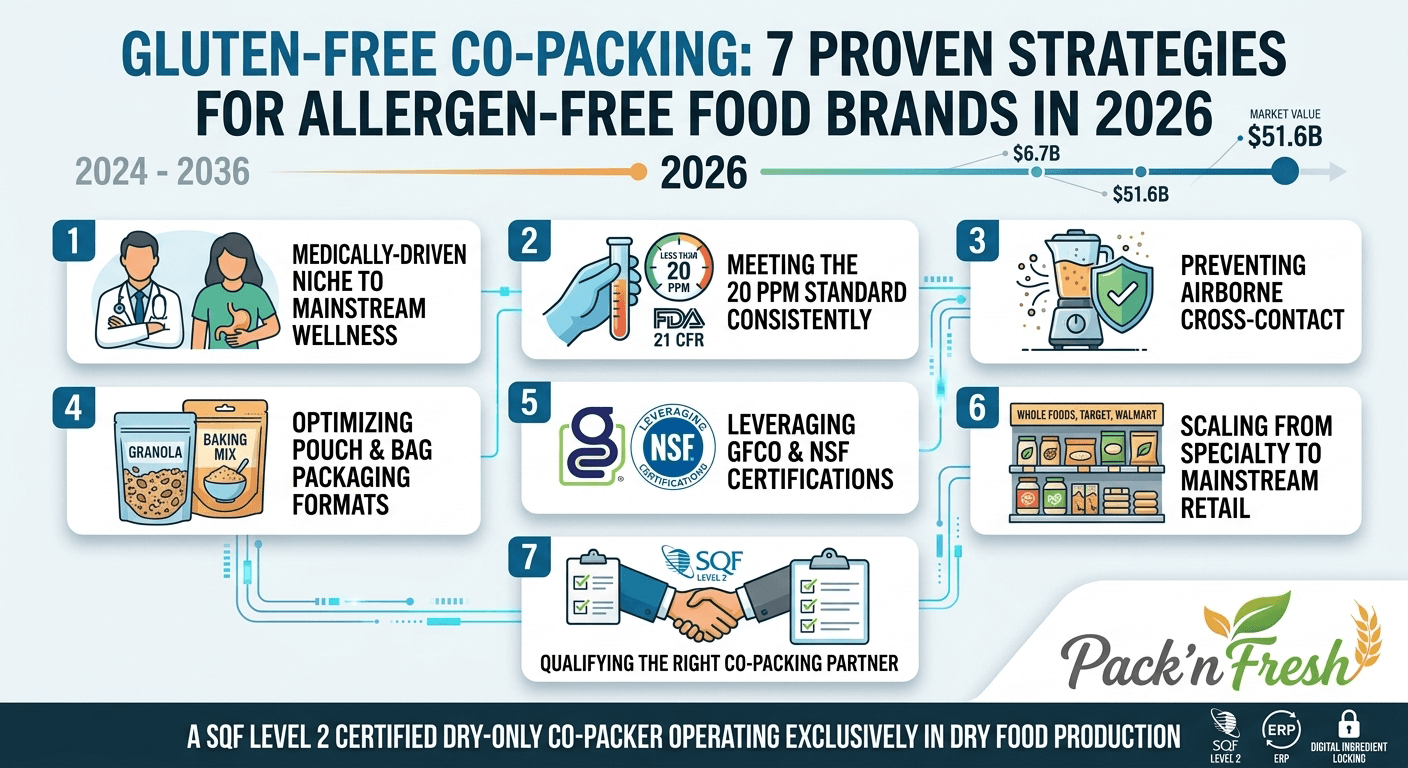
The gluten-free food market has moved decisively into the mainstream of the American grocery store. The global gluten-free food market is valued at USD 6.7 billion in 2026, growing at a 7.0% CAGR through 2036 — driven by rising celiac disease diagnosis rates, expanding non-celiac gluten sensitivity awareness, and broad consumer preference for allergen-transparent food products. The allergen-free food market as a whole reached USD 51.6 billion in 2026, projected to nearly double to USD 103.5 billion by 2036. Bakery and snacks alone account for 28% of allergen-free product demand in 2026, representing an enormous opportunity specifically for dry food brands — baking mixes, flours, granola, cereals, crackers, and snack mixes.
Behind every gluten-free product on a retail shelf is a manufacturing decision that determines whether that label claim is credible, defensible, and safe for the consumers who depend on it. Celiac disease affects approximately 1% of the global population, and for those individuals, even trace gluten exposure can trigger a serious autoimmune response. The FDA established its gluten-free labeling standard at less than 20 parts per million (21 CFR Part 101.91) because that threshold represents the level below which most celiac patients can tolerate without triggering a clinical response. A brand that places a “gluten-free” label on a product produced in a facility where cross-contact is not rigorously controlled is putting medically vulnerable consumers at risk — making the co-packing partnership decision categorically more consequential than it is for conventional food brands.
The regulatory environment around gluten cross-contact is also tightening. In January 2026, FDA opened a formal Request for Information on gluten cross-contact labeling, signaling intent to develop more specific guidance on precautionary allergen labeling for gluten. In July 2026, the Codex Alimentarius Commission adopted new precautionary allergen labeling (PAL) guidance setting global benchmarks for when “may contain” statements are scientifically justified. Together, these developments signal that the standards governing gluten-free co-packing will become more specific, more enforceable, and more auditable — making the choice of a rigorously qualified co-packing partner a forward-looking compliance decision, not merely a current-state quality preference.
Pack’n Fresh is a SQF Level 2 certified full-service co-packer based in Grand Prairie, Texas, operating exclusively in dry product categories — baking mixes, flours, spice blends, granola, cereal, snack mixes, and nutritional powders. We handle no liquid filling and no beverage production. Our entire facility and quality management system is purpose-engineered for dry food production, with every allergen control protocol calibrated specifically for the cross-contact risks that matter most in dry blending environments. Our gluten-free co-packing capabilities include siloed allergen scheduling, ATP swab sanitation verification, Digital Ingredient Locking, and ERP-backed lot-level traceability — a complete operational stack for brands that cannot afford a label claim that fails.
Table of Contents
- Why Gluten-Free Co-Packing Is One of the Fastest-Growing Opportunities in Dry Food Production
- The FDA Gluten-Free Standard: What Your Co-Packer Must Guarantee (Less Than 20 ppm)
- Preventing Gluten Cross-Contact in a Shared Dry Blending Facility
- Packaging Formats for Gluten-Free Brands: Pouches, Bags, and Retail-Ready Solutions
- Third-Party Certification for Gluten-Free Products: GFCO, NSF, and FDA Compliance
- Scaling Your Gluten-Free Brand from Specialty to Mainstream Retail
- How to Choose a Gluten-Free Co-Packer: Protocols, Testing, and Traceability
1. Why Gluten-Free Co-Packing Is One of the Fastest-Growing Opportunities in Dry Food Production
The gluten-free category has undergone a fundamental transformation, shifting from a medically driven niche to a mainstream consumer preference embraced by a far broader population. Today, gluten-free purchasing is driven by three distinct groups: diagnosed celiacs managing an autoimmune condition, individuals with non-celiac gluten sensitivity who report meaningful symptom improvement on gluten-free diets, and lifestyle-motivated consumers who associate gluten-free eating with general wellness and cleaner ingredient profiles. That triple demand structure is what has sustained the category’s growth well past the initial trend wave and positioned it as a durable, structurally supported market segment.
Market entry economics strongly favor the co-packing model for gluten-free brand founders. Building a gluten-free compliant in-house facility requires capital investment in allergen-segregated equipment, dedicated production areas, validated sanitation infrastructure, and certification costs — in addition to standard manufacturing infrastructure. A co-packing partnership converts all of that fixed capital into a variable production cost, allowing brand founders to direct capital toward product development, marketing, and retail placement. Gluten-free co-packing brands consistently report that this capital efficiency allowed them to test market reception and refine their product positioning before committing to manufacturing infrastructure.
The competitive landscape in gluten-free dry food is becoming more quality-stratified in ways that favor brands with certified, documented production credentials. Major retail buyers — Whole Foods Market, Sprouts Farmers Market, Natural Grocers, Thrive Market, and the natural-food buying teams at Target and Walmart — scrutinize supplier food safety certifications and facility audits with increasing rigor. A brand that can demonstrate SQF Level 2 certification at its co-packing facility, documented allergen controls, and third-party gluten testing on finished product is in a meaningfully stronger retail conversation than a brand whose only quality credential is a self-declaration. That documentation advantage is what experienced gluten-free co-packing operations provide — not just production capacity, but the audit-ready quality infrastructure that retail buyers now expect as a baseline.
2. The FDA Gluten-Free Standard: What Your Co-Packer Must Guarantee (Less Than 20 ppm)
The FDA gluten-free labeling rule — codified at 21 CFR Part 101.91 and final since August 2013 — establishes that a food bearing any “gluten-free” claim must contain less than 20 parts per million of gluten in the finished product. The 20 ppm threshold was selected based on a comprehensive scientific review concluding that the vast majority of individuals with celiac disease can tolerate gluten at or below this level without a measurable clinical response. The rule applies to voluntary “gluten-free” claims; FDA does not currently require such a claim on products that do not make one, but holds all labeled food products to a truthful and non-misleading standard.
For a co-packing facility to credibly support a brand’s gluten-free label claim, it must have systems that reliably prevent finished product gluten from exceeding 20 ppm — not just on average, but consistently across every production run. A facility that achieves compliance most of the time but experiences occasional exceedances due to inconsistent sanitation or undocumented ingredient substitutions cannot credibly support a gluten-free label claim. The 20 ppm standard is a maximum threshold, not an average — every unit of product must meet it. This makes the quality management system and process controls at a gluten-free co-packing facility as commercially important as any other selection criterion.
Ingredient-level gluten control is as important as finished product testing for maintaining a compliant program. Many ingredients used in gluten-free formulas carry a natural contamination risk because they are grown or processed in proximity to wheat. Oats are the most commercially significant example: conventional oats are frequently co-mingled with wheat during harvesting and processing, making them a major risk unless specifically sourced as certified gluten-free oats grown and processed under documented controls. Similar risks exist for some rice flour sources, certain legume flours, and seed products processed on shared equipment. A rigorous gluten-free co-packing operation requires ingredient-level certifications or testing documentation for all inputs with meaningful cross-contact risk.
The FDA’s January 2026 Request for Information on gluten cross-contact labeling is the most significant regulatory development in this space in over a decade. The RFI signals that FDA is considering whether to develop more specific labeling guidance for precautionary “may contain gluten” statements — potentially aligning voluntary advisory language with quantitative risk thresholds, similar to the Codex Alimentarius Commission’s July 2026 precautionary allergen labeling guidance. For brands and their co-packing partners, this means documentation infrastructure supporting gluten risk management — facility risk assessments, cross-contact probability analyses, testing protocols — will increasingly need to be audit-ready for potential FDA review, not just retailer audits. For a broader view of how GFSI certifications provide this foundation, see Pack’n Fresh’s guide to GFSI food safety standards.
3. Preventing Gluten Cross-Contact in a Shared Dry Blending Facility
Gluten cross-contact is the central operational challenge of gluten-free co-packing in a shared dry blending environment — and it is fundamentally more difficult to manage than most other allergen cross-contact scenarios because of the physical properties of wheat flour. Wheat flour particles are fine — typically 50 to 150 microns in diameter — and light enough to remain suspended in facility air for extended periods following a wheat-containing production run. This airborne dispersal capacity means that conventional separation strategies — running gluten-free products on dedicated equipment in a shared production floor — may not fully eliminate cross-contact risk if wheat-containing products have been run in the same airspace during the same production shift. Controlling airborne wheat cross-contact distinguishes truly qualified co-packing facilities from those that approach the problem through equipment-level sanitation alone.
Siloed allergen scheduling is the most defensible architectural control for wheat cross-contact management. At Pack’n Fresh, our allergen scheduling system assigns specific production windows — not just specific equipment — to allergen-defined product families. Wheat-containing production runs are completed during designated windows, followed by a documented settling interval before gluten-free production begins. Post-sanitation ATP swab verification — measuring adenosine triphosphate levels on contact surfaces as an indicator of biological and food residue — must meet pre-specified cleanliness benchmarks before any gluten-free production run may begin. This scheduling architecture is documented in our ERP production management system, creating a verifiable, auditable record of the temporal separation between wheat-containing and gluten-free production runs.
Ingredient staging and receiving are cross-contact risk points that receive less operational attention than in-process blending but are equally important for a complete prevention program. When wheat-containing and gluten-free ingredients are received and staged without physical or procedural separation, the risk of ingredient-level cross-contact through incidental contact during staging is real. A rigorous allergen management program addresses this through designated allergen zones, closed container policies for all ingredients awaiting use, and documented receiving inspection procedures that verify supplier allergen declarations against the production specification for each ingredient lot. Pack’n Fresh’s Digital Ingredient Locking system adds a technology layer: ingredients are verified at the system level against the approved specification for each formula before they can be released for production, preventing unauthorized ingredient substitutions that could introduce unexpected allergens into a gluten-free production run. For a complete framework, review Pack’n Fresh’s resource on allergen management and traceability in food packaging.
4. Packaging Formats for Gluten-Free Brands: Pouches, Bags, and Retail-Ready Solutions
Packaging format selection for gluten-free dry food brands is a strategic decision with implications for retail shelf performance, e-commerce logistics economics, consumer usability, and regulatory label compliance — all of which intersect with the production capabilities of your gluten-free co-packing partner. The formats that dominate gluten-free dry food in 2026 include resealable stand-up pouches, lay-flat bags for smaller portion sizes, multi-layer barrier flat-bottom bags for flour and grain products, and retail-ready display-ready cases for club and natural channel retailers. Each format has a distinct performance profile and production requirements that must be matched to your co-packer’s filling and packaging capabilities.
Stand-up resealable pouches have become the dominant retail format for gluten-free baking mixes, granola, and snack mixes in the 10 oz to 32 oz net weight range. Pouches stand on shelf without a secondary display fixture, accommodate large label panels carrying full regulatory information alongside brand design, and the resealable zipper closure addresses a genuine consumer usability need for products used in portions across multiple occasions. For e-commerce fulfillment, pouches are significantly lighter than rigid boxes or canisters, reducing dimensional weight shipping costs — a meaningful COGS advantage for DTC brands. Pack’n Fresh’s pouching capabilities are matched to the fill weight ranges and product flow characteristics typical in the gluten-free dry food category.
Label compliance for gluten-free products requires careful attention to allergen declaration format, net weight accuracy, and FDA label placement requirements. For products making an affirmative “gluten-free” claim, the claim must be truthful and supported by the 20 ppm compliance framework described in Section 2. Brands using certified gluten-free oats should identify them as “gluten-free oats” or “certified gluten-free oats” in the ingredient list to address the specific consumer knowledge gap around oat cross-contact. A gluten-free product produced in a facility that also processes other major allergens must evaluate whether precautionary advisory statements are warranted based on the facility’s documented risk assessment. See Pack’n Fresh’s post on 5 common food packaging mistakes for the label compliance errors that most frequently create recall and compliance risk for dry food brands.
Is Your Gluten-Free Brand Ready for a Certified Co-Packing Partner?
Pack’n Fresh is a SQF Level 2 certified dry-only co-packer in Grand Prairie, Texas with siloed allergen scheduling, ATP swab sanitation verification, Digital Ingredient Locking, and ERP-backed traceability — everything a gluten-free brand needs to protect its label claim and scale with confidence. We handle dry blending, pouching, labeling, kitting, and warehousing for dry food brands at every growth stage. Gluten-free co-packing is one of our core capabilities, and we are ready to talk about your production needs.
5. Third-Party Certification for Gluten-Free Products: GFCO, NSF, and FDA Compliance
Third-party gluten-free certification is how a brand communicates to consumers, retailers, and regulatory bodies that its gluten-free claim has been independently verified against a defined standard — not simply self-declared. In the gluten-free dry food category, certification marks carry substantial commercial value because they provide the credibility signal that informed consumers — particularly celiac patients who face the most serious medical risk from label claim failures — use to make purchase decisions. The two most commercially significant certification programs in the United States are GFCO (administered by the Gluten-Free Certification Organization, a program of the Gluten Intolerance Group) and NSF/ANSI 306.
GFCO certification uses a 10 ppm threshold — more stringent than FDA’s 20 ppm requirement — as its benchmark for finished product gluten content. The GFCO mark is the most widely recognized gluten-free certification mark in US retail and has established the strongest consumer trust equity in the celiac and gluten-sensitive community. GFCO certification requires an application covering the product formula and production facility, a facility inspection conducted by a GFCO-accredited inspector, and ongoing finished product testing at accredited laboratories. For gluten-free co-packing arrangements, GFCO’s facility inspection scope includes the co-packing facility itself — meaning the facility must demonstrate compliance with GFCO’s production and allergen control requirements. Brands pursuing GFCO certification should select co-packing partners with prior experience supporting GFCO inspections.
FDA compliance is the baseline requirement that operates independently of and in parallel with voluntary third-party certification. Regardless of whether a brand holds GFCO or NSF certification, it is always subject to FDA’s gluten-free labeling rule at 21 CFR Part 101.91. FDA may test labeled gluten-free products at any time — through retail sampling, consumer complaint investigation, or systematic surveillance programs — and a finished product result above 20 ppm triggers FDA enforcement authority, regardless of what any voluntary certification mark represents. Certification demonstrates consumer-facing credibility; FDA compliance is the legal baseline that cannot be satisfied by a voluntary program alone. Working with an SQF Level 2 certified gluten-free co-packing partner provides the documented process controls that support both FDA compliance and voluntary certification simultaneously. For context on how SQF and GFSI frameworks function as the foundation for food safety compliance, see Pack’n Fresh’s overview of GFSI food safety standards.
6. Scaling Your Gluten-Free Brand from Specialty to Mainstream Retail
The transition from specialty retail placement to mainstream retail distribution is the defining growth challenge for gluten-free dry food brands, and co-packing infrastructure decisions made at launch either enable or constrain that transition. Specialty channel retailers typically operate with flexible supplier qualification processes and work with brands building their quality documentation and certification infrastructure. Mainstream retail buyers — national grocery chains, big-box stores, club retailers — operate with formal supplier qualification programs that include facility audits, food safety certification requirements, insurance thresholds, traceability documentation, and supply volume guarantees that many early-stage brands cannot satisfy without the right co-packing partner already in place.
Volume scalability is the most obvious requirement for mainstream retail transition, and it is where many gluten-free brands encounter their first critical constraint. A brand that has been producing with a small-batch co-packer faces a fundamental question when a national grocery buyer requests a test market rollout across 400 stores: does the current co-packing partner have the scheduling capacity, equipment capacity, and raw material procurement relationships to triple production volume within the buyer’s lead time requirement? Co-packers in the allergen-free space note that this is the single most common transition failure point for emerging brands — not quality failures, not certification gaps, but simple production capacity limitations that prevent brands from accepting the retail opportunities their marketing efforts have created. Selecting a full-service gluten-free co-packing partner with demonstrated scale capacity from the beginning eliminates this ceiling.
Documentation scalability is the less visible but equally important dimension of the specialty-to-mainstream transition. Mainstream retail buyers request documentation packages during supplier qualification that include SQF certification certificates, product-specific allergen declarations, finished product ELISA test certificates of analysis, ingredient supplier qualification documentation, and production traceability records demonstrating lot-level tracking from raw material receipt through finished product shipment. A gluten-free co-packing partner operating on paper-based or informal documentation systems cannot generate these packages on the timescales that retail supplier qualification processes require. Pack’n Fresh’s ERP-backed production management system creates this documentation infrastructure as a byproduct of normal production operations — every lot is tracked, every test result is linked to the corresponding production record, and documentation requests from retail buyer qualification teams can be fulfilled accurately and promptly.
7. How to Choose a Gluten-Free Co-Packer: Protocols, Testing, and Traceability
Selecting a gluten-free co-packing partner is a due diligence process that should be as rigorous as any major supplier qualification decision a food brand makes — and in the gluten-free category, more rigorous than the equivalent process for conventional categories, because the consequences of a poor selection are both a regulatory compliance failure and a consumer safety failure. The selection framework below organizes the evaluation across four dimensions: food safety certification, allergen management systems, testing protocols, and traceability infrastructure. A co-packer that cannot provide clear, documented evidence of competency in all four areas is not a credible partner for a brand with a gluten-free label claim it needs to stand behind.
Food safety certification is the starting point and the minimum qualification threshold. SQF Level 2 — a GFSI-recognized food safety management certification — is the baseline that major retail buyers in the natural, specialty, and mainstream grocery channel now require of their suppliers’ co-packing facilities. SQF Level 2 demonstrates that the facility has implemented a comprehensive food safety management system encompassing hazard analysis, allergen management, sanitation, traceability, and management commitment to continuous improvement — verified by an independent third-party auditor against the SQF Code standard. A co-packer operating without SQF Level 2 or an equivalent GFSI certification (BRC, FSSC 22000, or IFS) is operationally excluded from the supplier qualification programs of every major retailer requiring certified suppliers. The FDA Food Safety Modernization Act (FSMA) establishes the statutory framework that SQF-certified facilities are built to satisfy — including the Preventive Controls for Human Food rule that mandates documented allergen controls for facilities handling major allergens.
Allergen management system evaluation should go deeper than asking whether the facility has an allergen management program. The questions that reveal actual capability: Does the facility use siloed scheduling that separates wheat-containing production from gluten-free production in time — not just in equipment? What is the post-sanitation verification protocol, and what quantitative metric must be achieved before gluten-free production may begin? Are there dedicated equipment components for gluten-free production, and how are those components identified, stored, and protected between runs? What is the protocol when the scheduled gluten-free production run is requested earlier than planned? The answers to these questions — and the documentation available to support them — separate genuinely capable gluten-free co-packing operations from those that have allergen programs on paper but inadequate controls in practice.
Traceability infrastructure is the most underweighted evaluation dimension. In the event of a gluten-related quality event — a consumer complaint, a retailer test finding an exceedance, or an FDA inquiry — the brand’s ability to rapidly scope the affected product population and execute a targeted recall depends entirely on the completeness and accessibility of production traceability records maintained by the co-packer. Full, bidirectional lot-level traceability — tracing from a finished product lot back to every ingredient lot used in its production, and conversely from a raw material lot to every finished product unit incorporating it — is the standard that major retail buyers and FDA expect in the event of a quality investigation. Co-packers operating without ERP-backed production management typically cannot provide this level of documentation with the speed and accuracy that quality event investigations require. Pack’n Fresh’s ERP-connected production management system provides this bidirectional traceability as a standard feature of every production run — not a premium service or a custom documentation request.
Pack’n Fresh: Your Certified Gluten-Free Co-Packing Partner in Grand Prairie, Texas
Pack’n Fresh is a SQF Level 2 certified, dry-product-only co-packer built for allergen-sensitive brands that cannot afford a label claim that fails. Our gluten-free co-packing capabilities include siloed allergen scheduling, ATP swab sanitation verification, Digital Ingredient Locking, ERP-backed lot-level traceability, and full-service production — dry blending, pouching, labeling, kitting, and warehousing under one roof. We are dry only: no liquid filling, no beverages, no shared liquid lines. If you are scaling a gluten-free baking mix, granola, flour blend, snack mix, or nutritional powder brand, we want to hear about your production needs.
Pack’n Fresh: Built for Gluten-Free Dry Food Production
Pack’n Fresh was designed from the ground up as a dry-product-only co-packing operation — which means every system, protocol, and piece of equipment at our Grand Prairie, Texas facility is purpose-built for the dry blending and packaging categories where gluten-free brands operate. We do not divide our facility management, allergen scheduling system, or sanitation infrastructure between dry and liquid production lines. Dry blending is what we do, and our operational expertise reflects the depth that comes from doing one thing exceptionally well rather than many things acceptably.
Our SQF Level 2 certification — verified annually by an independent third-party auditor against the Safe Quality Food Institute’s code — provides our brand partners with the documented food safety management foundation that major retail buyers require. Our SQF certification covers every aspect of our production operation: hazard analysis, allergen control, sanitation, traceability, supplier qualification, and management system documentation. When a retail buyer’s quality team requests our food safety certification documentation, we can provide it immediately — because it is current, audited, and maintained as a living operational standard. Our Digital Ingredient Locking system verifies every ingredient in every formula against its approved specification at the point of production, preventing any unapproved ingredient from entering the production workflow without documented authorization from the quality team.
Our ERP-backed production management and traceability system provides the lot-level documentation that retail buyers, certification auditors, and FDA expect — and that quality events require. Every production run at Pack’n Fresh generates a complete digital record linking raw material lots, blend documentation, fill weight records, sanitation verification data, and finished product lot assignments in a single accessible production history. Pack’n Fresh serves brands producing gluten-free baking mixes, all-purpose and specialty gluten-free flours, granola and cereal, snack mixes, nutritional powders, spice and seasoning blends, and specialty dry food products. If your product is dry and your label claim is gluten-free, our operation is built for your brand.
Conclusion
Gluten-free co-packing is not a niche production category — it is one of the fastest-growing segments in the entire dry food co-packing industry, driven by a market worth USD 6.7 billion in 2026 and growing at 7.0% CAGR through the next decade. The brands building durable competitive positions in this space are doing so by combining compelling product formulas with rigorous production infrastructure — certified facilities, validated allergen controls, documented traceability, and third-party verification of their gluten-free claims. The seven strategies in this guide represent the operational frameworks that distinguish brands with credible, defensible gluten-free credentials from those relying on self-declaration as their quality management system.
The FDA’s January 2026 RFI on gluten cross-contact labeling and the Codex Alimentarius Commission’s July 2026 precautionary allergen labeling guidance both signal a tightening regulatory environment in which the operational quality of your co-packing partner will become more, not less, consequential. Selecting a SQF Level 2 certified, allergen-management-sophisticated, ERP-connected gluten-free co-packing partner is not just a current-state quality decision — it is a forward-looking investment in compliance preparedness for the regulatory framework being built around you. The brands that make that investment now will be better positioned to navigate the evolving regulatory landscape, satisfy increasingly rigorous retail buyer requirements, and maintain the consumer trust that a gluten-free label claim is intended to communicate.
Frequently Asked Questions
What is the FDA standard for gluten-free labeling, and how does my co-packer help me meet it?
The FDA gluten-free labeling rule (21 CFR Part 101.91) requires any food labeled “gluten-free” to contain less than 20 ppm of gluten in the finished product. Your co-packing partner plays a critical role by controlling cross-contact through allergen scheduling, validated sanitation, and finished product ELISA testing documentation that verifies compliance for each production lot. A co-packer without documented allergen controls and testing capability cannot credibly support your label claim. See the FDA’s gluten-free labeling guidance page.
What is the difference between GFCO certification and NSF/ANSI 306 for gluten-free products?
GFCO (Gluten-Free Certification Organization) uses a 10 ppm threshold — more stringent than FDA’s 20 ppm standard — and is the most widely recognized gluten-free certification mark in US specialty and natural retail. NSF/ANSI 306 applies the 20 ppm threshold that aligns with FDA. Both require third-party facility inspections and ongoing finished product testing at accredited laboratories. GFCO is generally preferred for brands targeting the natural and specialty channel, where celiac-community trust equity carries the most commercial weight.
How does siloed allergen scheduling work in a shared dry blending facility?
Siloed allergen scheduling assigns specific production time windows — not just equipment — exclusively to allergen-defined product families. In a gluten-free co-packing context, wheat-containing production runs are scheduled during designated windows separated from gluten-free runs by a documented settling interval, followed by validated sanitation and verification testing before gluten-free production begins. This scheduling architecture is documented in the co-packer’s ERP system, creating an auditable record of temporal separation that equipment-level sanitation alone cannot achieve in a shared dry blending environment.
What does ATP swab testing verify, and why does it matter for gluten-free production?
ATP (adenosine triphosphate) swab testing measures the presence of organic material — including food residues — on production contact surfaces after cleaning. Elevated ATP readings following a sanitation cycle indicate incomplete removal of potential allergen-containing residue. For gluten-free co-packing, ATP swab results collected after cleaning wheat-containing equipment provide quantitative, documented evidence that sanitation was effective before gluten-free production begins — replacing visual inspection with a measurable, recordable cleanliness standard relevant to gluten cross-contact risk.
What dry food categories does Pack’n Fresh support for gluten-free co-packing?
Pack’n Fresh handles dry products only — gluten-free baking mixes, all-purpose and specialty gluten-free flours (rice flour, almond flour, coconut flour, and tapioca starch blends), granola and breakfast cereal, dry snack mixes, nutritional and protein powders, spice and seasoning blends, and kitted dry food products. Pack’n Fresh does not handle liquid filling, beverages, or liquid sauces. Our allergen management systems and scheduling protocols are calibrated specifically for the dry blending environments where gluten cross-contact is managed through scheduling, sanitation, and testing.
Ready to Scale Your Gluten-Free Brand with a Certified Co-Packing Partner?
Pack’n Fresh offers SQF Level 2 certified gluten-free co-packing for dry food brands in Grand Prairie, Texas — dry blending, pouching, labeling, kitting, and warehousing with the allergen management protocols, testing documentation, and ERP-backed traceability that retail buyers expect. Dry products only. No liquid filling. Start with a free consultation to discuss your formula, volume, and production timeline.