
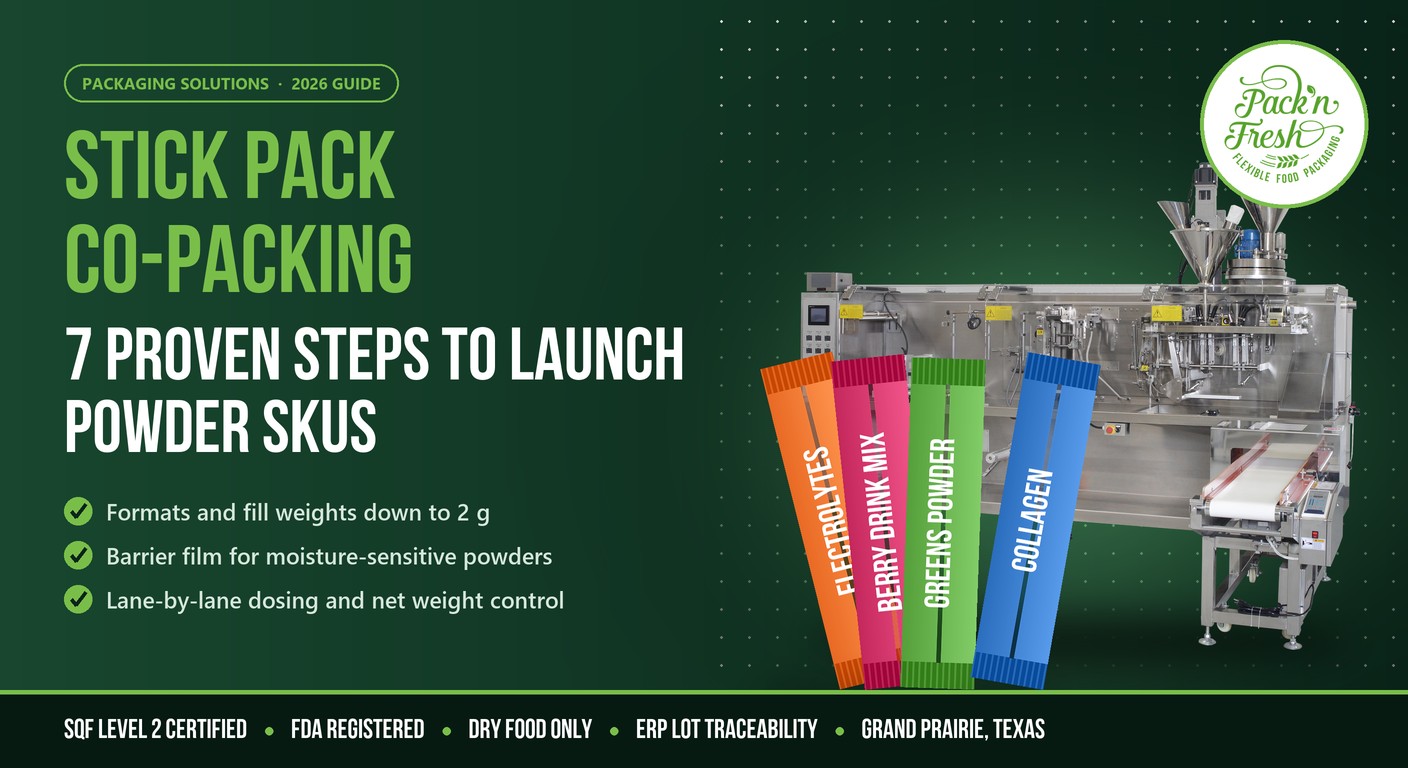
Stick Pack Co-Packing: 7 Proven Steps to Launch Powder SKUs
Stick pack co-packing has become the fastest route for dry powder brands to put a single serving in a consumer’s pocket. Mordor Intelligence values the global stick packaging market at USD 1.58 billion in 2026 and projects USD 2.07 billion by 2031, a 5.54% CAGR. Powders held the largest product-form share, at 42.34% of 2025 revenue.
Demand is coming from exactly the categories founders are building today: electrolyte and hydration mixes, powdered drink mixes, protein, collagen, sweeteners and seasonings. A stick pack turns a tub-sized product into a trial-friendly, gym-bag-ready serving that fits subscription boxes, sampling programs and checkout displays.
But a stick pack is not just a smaller pouch. Narrow seals, tiny fill weights, hygroscopic powders and multi-lane machines create technical risks that rarely show up in a tub or bag. This guide walks through the seven decisions that shape a successful stick pack co-packing program, from format and film to dosing, cartoning, cost and partner selection.
Table of Contents
- Why Powder Brands Are Moving to Stick Pack Co-Packing
- Choosing Stick Pack Formats, Widths and Fill Weights
- Powder Flow, Moisture and Barrier Film Selection
- Dosing Accuracy and Net Weight Compliance
- Multi-Lane VFFS: What Changes at Scale
- Cartoning, Display Boxes and Kitting
- Cost Drivers and Choosing a Stick Pack Co-Packing Partner
1. Why Powder Brands Are Moving to Stick Pack Co-Packing
The single-serve shift is structural, not seasonal. Mordor Intelligence reports that food and beverages captured 37.81% of stick packaging revenue in 2025, and that nutraceutical powders within that group are advancing at a 6.41% CAGR through 2031. Functional powder brands are leading the charge because their products are dosed by the serving.
Hydration and Drink Mixes Lead the Category
Electrolyte mixes are a clear example. Allied Market Research sized the electrolyte mixes market at $17.7 billion in 2022 and estimates it will reach $30.1 billion by 2031, growing at a 5.2% CAGR. Much of that volume moves in single-serve formats that consumers tear open and pour into a water bottle.
What a Stick Pack Does for Your Brand
- Lower trial barrier: shoppers can test a flavor without committing to a full tub.
- Exact serving: no scoop, no guesswork, consistent results every time.
- Channel flexibility: one SKU feeds retail cartons, DTC variety packs, gyms and corporate wellness boxes.
- Lower material use: a slim flexible format uses less packaging than rigid containers per serving.
For a deeper look at the consumer side of this trend, see our breakdown of single-serve food packaging trends. The rest of this guide focuses on the production decisions behind the pack.
2. Choosing Stick Pack Formats, Widths and Fill Weights
Every stick pack decision starts with the serving size. The fill weight determines the pack width and length, which in turn determines film consumption, machine setup and how many packs fit in a carton. Lock the serving size with your formulator before you request quotes.
Typical Fill Ranges by Product
- Sweeteners and seasonings: very small doses, often just a few grams, where precision matters most.
- Electrolyte and hydration mixes: compact single servings designed to dissolve in one bottle.
- Collagen and greens powders: mid-size servings that need a slightly wider stick.
- Protein powders: the largest servings, which push the upper limit of stick format and sometimes suit a sachet better.
Stick Pack vs. Sachet
A stick pack is a narrow tube sealed with a center fin seal and two end seals. A sachet is a flatter, wider three- or four-side-seal pouch. Sticks look premium and pour cleanly into bottles, while sachets accept bulkier fills and larger print panels. Many brands run both formats for different channels.
Design Details That Affect Production
Ask early about tear notches, easy-open features, and where your lot code and best-by date will print. Graphics need a registration mark so the artwork lands in the same spot on every pack. Small decisions here prevent costly film reprints after your first stick pack co-packing run.
3. Powder Flow, Moisture and Barrier Film Selection
Powder behavior is the single biggest variable in stick pack quality. A powder that flows well in a tub filler can bridge, rathole or dust inside a narrow stick pack tube. Before any trial, your co-packer should understand particle size, bulk density and how the blend responds to humidity.
Hygroscopic Ingredients Need Extra Care
Electrolyte salts, sugars, collagen peptides and many sweeteners readily absorb moisture. Left exposed, they clump, cake or lose flowability mid-run. Controlled room conditions, sealed hoppers and sensible staging times keep the powder consistent from the first stick to the last.
Dust and Seal Integrity
Fine powders tend to dust into the seal area during filling. Powder trapped in a seal weakens it and can cause leakers in transit. Proper auger tooling, settling time and seal jaw settings all help, and seal strength should be verified during line trials.
Matching Film to the Formula
Film structure is a balance of barrier, sealability and cost. Common laminates pair a printable outer layer with a foil or metallized barrier and a sealant inner layer. Mordor Intelligence notes that regulatory pressure is pushing brands toward mono-material, recyclable structures, so discuss sustainability goals before you commit to a laminate.
- High-barrier foil laminates: best for moisture-sensitive or oxygen-sensitive blends.
- Metallized films: a middle ground for many drink mixes and seasonings.
- Recyclable mono-material films: growing option that should be validated with shelf-life testing.
4. Dosing Accuracy and Net Weight Compliance
When a serving weighs only a few grams, a small fill error is a large percentage error. Overfilling gives product away on every stick, while underfilling exposes the brand to compliance risk and unhappy customers. Accurate dosing is the foundation of profitable stick pack co-packing.
Know the Rules
FDA’s labeling regulations in 21 CFR Part 101, including section 101.105, require a net quantity of contents declaration on the principal display panel, stated by weight for dry foods. NIST Handbook 133 explains how inspectors test lots, where the average net quantity must at least equal the labeled amount.
How Precision Is Achieved
- Servo-driven augers tuned to the specific powder density.
- Check weighing at defined intervals, with results recorded per lot.
- Statistical process control so drift is corrected before it becomes a reject.
- Lane-by-lane verification on multi-lane equipment, since each lane can drift independently.
Supplement brands also need label claims per serving to match what is actually in the stick. Our guide to precision micro-dosing packaging covers the technical side of small-dose accuracy in more detail.
Planning Your First Stick Pack SKU?
Pack’n Fresh fills dry powders into stick packs and sachets down to 2 g with precision micro-dosing in an SQF Level 2 facility. Share your formula and serving size, and we will map out the right format.
5. Multi-Lane VFFS: What Changes at Scale
Most stick packs are made on vertical form-fill-seal (VFFS) equipment that slits a wide roll of film into several lanes, forms each lane into a tube, fills it and seals it. Mordor Intelligence reports that 4-10 lane systems held 44.47% of the stick packaging machinery base in 2025. More lanes mean more output per cycle, but also more variables to control.
What Multi-Lane Means for Your Brand
- Film planning: roll width, print repeat and lane count must match the machine exactly.
- Consistency across lanes: each lane needs its own dosing check and seal inspection.
- Changeover time: switching flavors means cleaning every lane, hopper and auger.
- Run length: longer runs per flavor generally spread setup time across more units.
Flavor Rotations and Allergen Sequencing
Brands with many flavors should plan production sequences carefully. Running lighter flavors before darker ones, and allergen-free blends before allergen-containing ones, reduces cleaning risk. Ask your co-packer how they schedule flavors and validate cleanups between them.
Start With a Line Trial
A short trial run confirms flow, fill accuracy, seal strength and print registration before full production. It is the cheapest way to catch problems like powder bridging or weak end seals. Treat the trial as part of your launch budget, not an optional extra.
6. Cartoning, Display Boxes and Kitting
A stick pack rarely ships alone. It usually goes into a retail carton, a counter display or a variety kit, and those secondary packaging choices shape your shelf presence. Plan the secondary pack alongside the primary pack, not after it.
Retail Cartons and Counter Displays
Count-based cartons, such as 10, 14, 20 or 30 sticks, are common for hydration and supplement brands because they align with daily routines. Shelf-ready display boxes with tear-away fronts work well at checkout and in convenience channels. Confirm carton dimensions with the retailer before printing.
Variety Packs and Kitting
Mixed-flavor packs drive trial and are popular in DTC and subscription models. Kitting combines different flavors or products into one shipper, sometimes with inserts, coupons or literature. A co-packer that handles filling and kitting under one roof removes a handoff and the risk that comes with it.
Labeling and Coding
Every stick and every carton should carry traceable lot codes. Clear coding links finished goods back to the ingredient lots used, which matters for retailer audits and for any product hold. Ask how codes are printed, verified and recorded in the co-packer’s system.
7. Cost Drivers and Choosing a Stick Pack Co-Packing Partner
Cost per unit in stick pack co-packing depends on far more than the powder. Brands that understand the drivers can make design choices that protect margin without hurting quality. Treat any early cost estimate as a range until film, formula and run size are finalized.
The Main Cost Drivers
- Film structure and print: foil laminates and many print colors raise material cost.
- Fill weight and width: larger sticks use more film and run fewer per minute.
- Run length and flavor count: frequent changeovers add labor and downtime.
- Powder behavior: difficult, dusty or sticky blends run slower.
- Secondary packaging: cartons, displays and kitting add labor and materials.
- Sourcing: whether the co-packer buys ingredients and film or you supply them.
Questions to Ask Every Candidate
- Which GFSI-benchmarked certification do you hold, such as SQF, and at what level?
- How do you verify fill weights on each lane, and how are records kept?
- How do you control allergens and validate cleaning between flavors?
- Can you trace a finished lot back to every ingredient lot quickly?
- Can you handle blending, filling, cartoning and kitting in one facility?
A strong partner will answer with documented procedures, not promises. If your brand also sells tubs or bulk bags, our guides to protein powder co-packing and supplement production can help you align formats across your range.
How Pack’n Fresh Supports Stick Pack Co-Packing for Powder Brands
Pack’n Fresh is an SQF-certified contract packaging company in Grand Prairie, Texas, focused on dry food. Since 2017 we have helped brands move from sourcing to shelf with one partner. For stick pack co-packing, that means dry blending, precision filling, secondary packaging and shipping handled under one roof.
Capabilities That Matter for Stick Packs
- Stick packs and sachets down to 2 g with precision micro-dosing for small-serving powders.
- SQF Level 2 certified facility, FDA-registered and FSMA-compliant, with Organic, Kosher, Non-GMO and Gluten-Free certifications.
- ERP traceability on Microsoft Dynamics 365 for full lot tracking and fast mock recalls.
- Digital Ingredient Locking, which halts production if a wrong material is scanned.
- Siloed production scheduling for allergen control, plus ATP swab sanitation verification.
- Kitting and assembly, display boxes, multipacks, shrink-wrap, labeling and inserts.
Our owners bring food science and QA backgrounds, and we work with both startups and scaling brands. Our central Texas location also supports efficient shipping across the United States.
Conclusion
Stick packs give powder brands a powerful way to win trial, enter new channels and deliver an exact serving every time. The format rewards careful planning: the right fill weight, the right barrier film, verified dosing on every lane and secondary packaging designed for the shelf.
The partner you choose determines whether those plans hold up at production speed. Look for certified food safety, documented weight control, real traceability and the ability to handle blending through kitting. With those in place, stick pack co-packing becomes a growth engine rather than a production headache.
Frequently Asked Questions About Stick Pack Co-Packing
What is stick pack co-packing?
Stick pack co-packing is when a contract packager fills your dry powder into narrow single-serve stick packs on your behalf. The co-packer manages film handling, dosing, sealing, coding and often cartoning or kitting. Brands use it to launch single-serve SKUs without buying specialized multi-lane equipment or building an in-house quality system for small-dose filling.
What products work best in stick packs?
Free-flowing dry powders work best, including electrolyte and hydration mixes, powdered drink mixes, collagen, greens, sweeteners and seasonings. Protein powders can work when the serving fits the stick format, though larger servings sometimes suit a sachet better. Very sticky or highly hygroscopic blends may need formula or environment adjustments before running reliably.
How small can a stick pack fill weight be?
Fill weight depends on the powder and the equipment, but precision micro-dosing allows very small servings. Pack’n Fresh fills stick packs and sachets down to 2 g. At these weights, check weighing and lane-by-lane verification are essential, because even a small fill variation represents a large percentage of the labeled net weight.
Which film should I choose for a moisture-sensitive powder?
Moisture-sensitive powders such as electrolyte salts, sugars and collagen usually need a high-barrier structure, often a foil or metallized laminate with a reliable sealant layer. If you want a recyclable mono-material film, validate it with shelf-life testing first. Your co-packer and film supplier should review the formula together before any film is printed.
What affects the cost per stick pack?
Key drivers include film structure and print colors, fill weight and pack size, run length per flavor, the number of changeovers, powder flow behavior and secondary packaging such as cartons, displays or kits. Who sources ingredients and film also matters. Treat early estimates as ranges until your formula, film and order volumes are confirmed.
Launch Your Stick Pack Line with Pack’n Fresh
Pack’n Fresh is an SQF Level 2 certified dry food co-packer in Grand Prairie, Texas. We fill powders into stick packs and sachets down to 2 g, backed by ERP traceability, Digital Ingredient Locking and siloed allergen scheduling. Tell us about your formula, servings and channels, and we will help you plan your launch.