
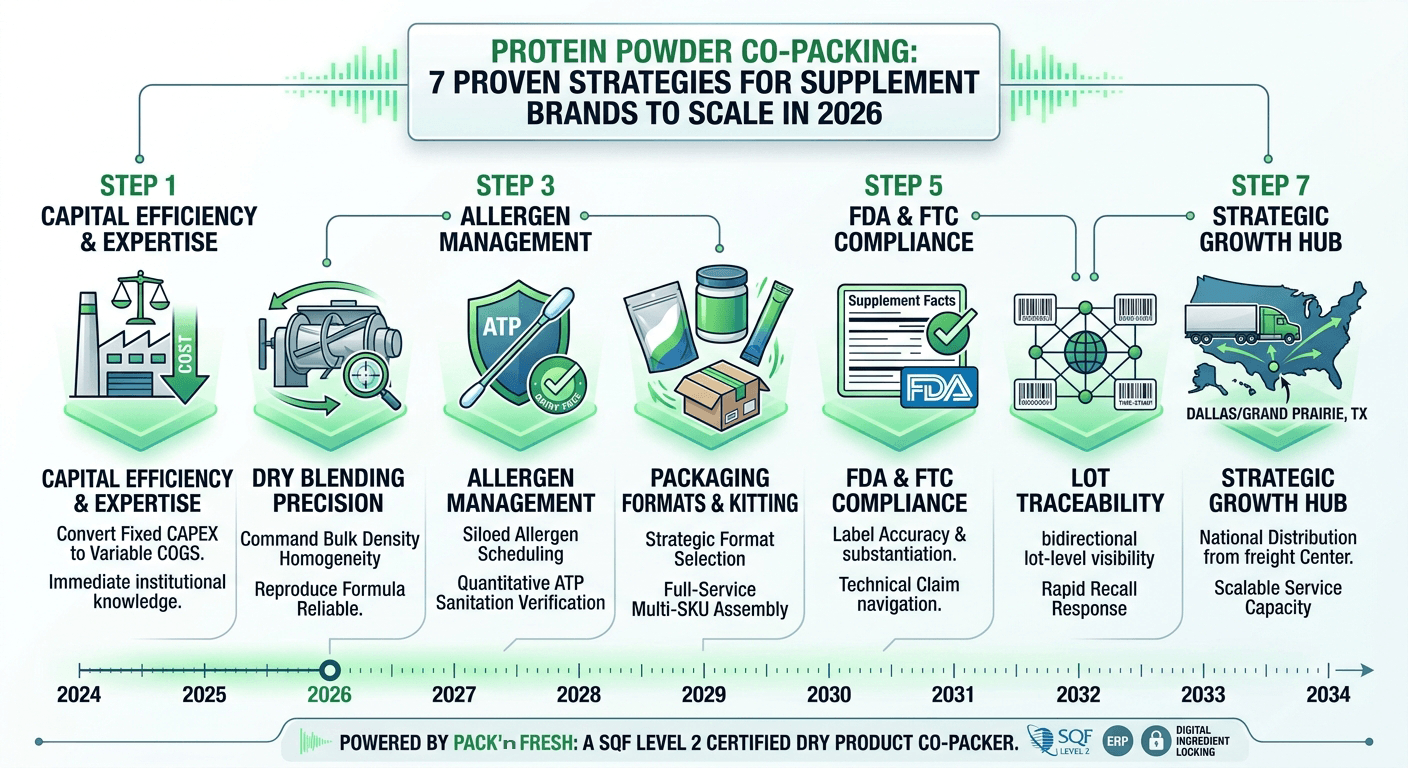
Protein Powder Co-Packing: 7 Proven Strategies for Supplement Brands to Scale in 2026
The protein supplement market is one of the fastest-evolving segments in the entire food and beverage industry, and the brands winning shelf space and consumer loyalty in 2026 are not necessarily those with the best formulas. They are the ones with the best operational infrastructure behind those formulas. Protein powder co-packing — partnering with a certified contract manufacturer to handle dry blending, pouching, labeling, and fulfillment — has become the strategic foundation that allows supplement brands to move fast, maintain quality, and scale without the capital burden of in-house manufacturing.
The market opportunity is substantial and still expanding. The protein packaging market was valued at USD 26.00 billion in 2024 and is projected to reach USD 42.39 billion by 2034, growing at a 5.01% CAGR. Powder form remains the dominant segment in the protein supplement market, driven by consumer preference for serving-size flexibility, strong value per unit, and compatibility with a wide range of use occasions — from morning shakes to baked-good recipes to post-workout recovery. For brands operating in this category, speed and consistency are defining competitive variables.
The category is also growing more technically complex. Plant-based proteins — pea, rice, and hemp — are gaining ground strongly as consumers prioritize sustainability, digestibility, and ingredient transparency alongside performance. Functional add-ins including collagen peptides, probiotics, adaptogens, and nootropic compounds are increasingly being layered into formulas that once contained a single protein source and a flavor system. Each new ingredient introduces a new blending challenge, a new allergen consideration, and a new label compliance requirement. That complexity is exactly why protein powder co-packing with a technically qualified, certified partner has never been more strategically important for supplement brands at any stage of growth.
Technical capability is where co-packing partnerships are made or broken in the dry supplement segment. Dry blending at production scale is not a simple mixing operation — it requires rigorous command of bulk density homogeneity across ingredients with different particle geometries, an understanding of how protein concentrates and isolates behave differently during blending, anti-caking strategies for hygroscopic proteins that absorb moisture from ambient air, and precision distribution of minor flavor and functional components throughout large-format batch runs. Supplement brands that work with co-packers who have mastered these dynamics ship a more consistent, higher-quality product.
This guide covers seven proven strategies for supplement brand founders and operations managers evaluating or scaling their protein powder co-packing operation in 2026. Whether you are outgrowing a shared-use facility, transitioning away from a co-packer who cannot meet your quality standards, or launching a new plant-based or performance protein line, these frameworks apply. At Pack’n Fresh — a SQF Level 2 certified full-service co-packer based in Grand Prairie, Texas — we partner with supplement brands at every growth stage, providing dry blending, pouching, labeling, kitting, and warehousing under a single ERP-connected operation.
Pack’n Fresh handles dry products only. Every piece of equipment, every sanitation protocol, every scheduling system, and every compliance program at our facility is purpose-built for dry blending and packaging — not divided between powder and liquid lines. If you are building a protein powder brand and need a co-packing partner with the technical depth, food safety certification, and production systems to scale alongside your growth, this guide is written for you.
Table of Contents
- Why Protein Powder Co-Packing Is the Smartest Move for Supplement Brands in 2026
- Dry Blending Precision: How Protein Powder Co-Packers Maintain Formula Consistency at Scale
- Allergen Management in Protein Powder Co-Packing: Dairy, Soy, Tree Nuts, and Cross-Contact
- Packaging Formats for Protein Brands: Pouches, Canisters, Stick Packs, and Single-Serve Sachets
- FDA and FTC Compliance for Protein Powder Brands: Labels, Claims, and Third-Party Testing
- Scaling Your Protein Brand: From Small-Batch to National Distribution
- How to Choose the Right Protein Powder Co-Packing Partner: ERP, Certifications, and Micro-Dosing
1. Why Protein Powder Co-Packing Is the Smartest Move for Supplement Brands in 2026
Building and operating an in-house manufacturing facility capable of producing a compliant, retail-ready protein powder is a capital-intensive commitment that most supplement brand founders are strategically better positioned to avoid. The equipment alone — industrial ribbon blenders, pneumatic conveying systems, automated filling lines, allergen-segregated equipment sets, and certified sanitation infrastructure — represents an investment that can reach seven figures before accounting for staffing, process validation, and ongoing facility compliance. Protein powder co-packing converts that fixed capital expenditure into a variable operating cost that scales directly with your production volume, preserving capital for brand development, marketing, and distribution growth.
Beyond the capital efficiency argument, there is a deep expertise argument. A co-packer that runs protein dry blending operations every day has already solved the process problems that most brand owners will not encounter until they are in a production crisis — a batch with uneven flavor distribution across the fill weight, a whey isolate that bridges in the hopper under high humidity, a hydrolyzed protein blend that clumps during the filling cycle because of insufficient anti-caking agent loading. These are not theoretical edge cases; they are common process challenges that experienced co-packing operations have systematic, documented solutions for. Partnering with a protein powder co-packing operation that runs this type of production daily means buying into that institutional process knowledge immediately.
Regulatory complexity is a third and growing driver. FDA labeling requirements for protein supplements, FTC guidelines governing structure/function advertising claims, and the rising retailer expectation for third-party food safety certifications have made compliance a full-time discipline. A co-packer operating under SQF Level 2 or an equivalent GFSI-recognized certification already has the documentation systems, allergen controls, traceability infrastructure, and audit-ready quality management built into its daily operations. When a major retail buyer requests a Certificate of Conformance, a complete production record, or a full allergen management program description, an SQF-certified co-packer can respond with documentation immediately. That capability matters enormously for brands pursuing national retail placement.
Speed to market is a fourth advantage that protein supplement brands consistently find decisive. A brand that has formulated its product and approved its label can move from formula sign-off to finished, retail-ready inventory in a fraction of the time it would require to establish in-house production. In a category where new products move quickly and consumer attention is competitive, the time saved through co-packing translates directly into market positioning advantages. Protein powder co-packing compresses the development-to-shelf timeline in a way that in-house manufacturing simply cannot match at an equivalent capital commitment.
Co-packing also offers meaningful flexibility for portfolio expansion that brand owners frequently undervalue. A brand that starts with a single whey concentrate formula can add a plant-based pea and rice blend, a mass gainer with complex carbohydrate layering, a hydrolyzed collagen peptide recovery formula, or a peri-workout performance blend without investing in additional equipment or facility space. The co-packer absorbs the operational complexity of those additions. That structural flexibility — available on a production-volume-driven cost basis — is one of the strongest arguments for protein powder co-packing as a long-term business model rather than simply a launch-phase solution.
Geography is also a meaningful operational advantage that brands often underweight in co-packer selection decisions. Grand Prairie, Texas — where Pack’n Fresh operates — sits at the geographic center of continental US freight lanes. That central position reduces shipping times and outbound freight costs to distribution points on both coasts compared to coastal manufacturing locations, and provides a natural hub for brands distributing nationally through multiple DCs. A centrally located co-packer is not just a production partner; it is a logistics advantage embedded in your cost structure from the first production run.
2. Dry Blending Precision: How Protein Powder Co-Packers Maintain Formula Consistency at Scale
Dry blending for protein powder looks deceptively simple from the outside. Combine a protein source, a sweetener, a flavoring system, and perhaps a vitamin premix or functional add-in, run the blender, and fill into pouches. In practice, achieving statistical homogeneity across a production batch that may weigh thousands of pounds — with each ingredient contributing its own particle size distribution, bulk density, flow behavior, and electrostatic charge — is a rigorous process engineering discipline that separates quality-focused protein powder co-packing operations from simple contract blenders. Getting it right determines whether every scoop a consumer measures out delivers the protein content, flavor intensity, and functional ingredient load the label promises.
Bulk density homogeneity is the foundational performance metric in high-quality dry protein blending. Whey protein concentrate — which retains more residual fat and moisture than isolate forms — has a lower bulk density and a more irregular, granular particle shape that behaves differently in the blending vessel than the finer, higher-density particles of a whey protein isolate. When a formula calls for both concentrate and isolate — as many commercial whey formulas do for cost and amino acid profile optimization — the blending sequence, vessel fill ratio, agitation speed, and blend duration must be engineered to account for those density and particle size differences. A skilled protein powder co-packing team does not apply a generic blend profile to every formula; they engineer the process parameters for each specific formula to achieve the homogeneity targets the brand owner specifies.
Hygroscopic behavior is a major process challenge for several commercially important protein types. Hydrolyzed whey — enzymatically broken into shorter peptide chains for faster absorption and faster sensory dissolution — is particularly prone to moisture uptake from ambient air. This hygroscopic behavior causes clumping at the filling head, bridging in the hopper, and caking in finished pouches during storage and transit. Anti-caking agents — typically silicon dioxide (SiO₂) or tricalcium phosphate — are incorporated into formulas specifically to address this behavior by coating protein particles and reducing their tendency to bond under humidity. Protein powder co-packing operations with deep blending experience validate anti-caking agent loading rates not just at production time but across accelerated shelf-life testing conditions that simulate the humidity and temperature extremes of real-world supply chain and consumer storage environments.
Flavor system distribution is where many co-packers fall short, and where formula consistency is most visibly compromised for end consumers. Flavor compounds are typically added at inclusion rates below one percent of total formula weight — sometimes significantly below that threshold for high-intensity flavor systems. At those low loading levels, achieving uniform distribution of the flavor throughout a multi-hundred-pound batch requires a precision micro-dosing system capable of weighing and introducing these minor components with tight accuracy at the correct point in the blending sequence. The same precision requirement applies to functional add-ins — probiotic cultures, adaptogenic plant extracts, nootropic compounds — that are biologically active at very low concentrations. At Pack’n Fresh, our precision micro-dosing capability is specifically engineered to deliver the exact ingredient ratios that functionally complex protein powder formulas demand, from flavor systems to active supplement compounds.
ERP-backed production management converts process design into repeatable, documented execution. When every step of the blending process — ingredient receipt, lot number capture, in-process weigh-up, addition sequence, blend time, quality hold status, and release approval — is tracked in a connected enterprise resource planning system, the co-packer can reproduce the same formula reliably across production runs, across different operators, and across shifts without relying on individual institutional memory. Co-packers in the dry blending space note that ERP-connected production management is increasingly expected by sophisticated supplement brand clients as a baseline operational requirement, not an optional premium feature.
Digital Ingredient Locking takes ERP-backed traceability one step further. At Pack’n Fresh, our Digital Ingredient Locking system prevents any unapproved ingredient substitution or formula deviation at the point of production. If an ingredient lot fails incoming quality inspection, the system flags it and prevents its use in any production run without explicit authorization from the quality team. If a raw material specification changes at the supplier level — a particle size shift, a moisture specification adjustment — the system catches the deviation before it reaches the blending floor. This system-level control is what distinguishes a genuine quality-focused protein powder co-packing partner from a contract blender operating on paper records and informal communication.
3. Allergen Management in Protein Powder Co-Packing: Dairy, Soy, Tree Nuts, and Cross-Contact
Allergen management is the highest-stakes operational challenge in protein powder co-packing, because the protein supplement category sits at the intersection of two realities: the most commercially important protein sources — whey (dairy), casein (dairy), and soy protein isolate — are also major food allergens under FDA regulations, and a meaningful portion of protein supplement consumers have documented food allergies for which they are relying on label declarations and facility allergen controls to protect their health. Getting allergen management wrong is not only a regulatory compliance failure; it is a direct consumer safety risk that can trigger recalls, FDA warning letters, class-action litigation, and brand damage that takes years to recover from.
The most important architectural decision in a protein powder co-packing operation’s allergen management system is scheduling. Many co-packing facilities rely primarily on sanitation — cleaning equipment after allergen-containing production runs before switching to allergen-sensitive products — as their principal allergen control strategy. Sanitation is necessary but insufficient as a standalone control for high-risk allergen scenarios. The more defensible approach is siloed allergen scheduling: dedicating specific production days, production windows, or dedicated production lines exclusively to allergen-defined product families — dairy-containing, soy-containing, tree-nut-containing, or allergen-free — and separating them in time with documented scheduling logic that eliminates the opportunity for cross-contact through equipment residue or airborne particulate. At Pack’n Fresh, our siloed allergen scheduling system ensures that production windows are clearly defined, documented in our ERP production schedule, and available to brand clients as evidence of our allergen risk management architecture.
Sanitation verification is the evidence layer that gives allergen scheduling its regulatory and commercial credibility. After any allergen-containing production run and before resuming allergen-sensitive production, a validated sanitation process must be completed and confirmed effective by objective measurement — not just visual inspection. Pack’n Fresh uses ATP swab sanitation verification: a rapid, quantitative test that measures adenosine triphosphate (ATP) levels on contact surfaces following cleaning. ATP is present in all living cells and food residues, so elevated ATP readings after cleaning indicate incomplete removal of food contact material. ATP swab results are captured in our production records as quantitative sanitation verification data, providing clients with documented evidence of effective sanitation that goes well beyond a visual cleanliness check. This data is part of the traceability package available to every Pack’n Fresh brand client. To understand how this fits into a complete allergen risk framework, see our deep-dive on allergen management and traceability risks in food packaging.
Label declaration is the consumer-facing component of allergen management and must accurately reflect both intentionally added allergens and the facility’s realistic cross-contact risk profile. Under FDA regulations, the nine major food allergens — milk, eggs, fish, shellfish, tree nuts, peanuts, wheat, soybeans, and sesame — must be declared on labels either within the ingredient list using common names or in a clearly identified “Contains” statement. For brands producing in a facility where cross-contact with other allergens cannot be fully eliminated through scheduling and sanitation controls alone, “May Contain” precautionary advisory statements may be appropriate based on a formal allergen risk assessment for each product. A technically experienced protein powder co-packing partner will help brands navigate these declarations with precision, based on actual facility risk data — not generic language copied from a template.
Traceability is the operational backbone of effective allergen control when things go wrong. In the event of an undeclared allergen discovery — through third-party finished product testing, a retail buyer audit, or a consumer complaint — the ability to rapidly identify every ingredient lot present in the affected production run and every unit of finished product in the distribution channel determines whether a recall can be executed in hours rather than days. Pack’n Fresh’s ERP-backed traceability provides complete, bidirectional lot-level visibility: every ingredient lot is linked to every production run in which it appears, and every production run is linked to every finished product lot and outbound shipment. Supplement brands consistently find that this level of traceability documentation is expected — not optional — by the major retail buyers and distributors they target for growth.
Brands producing plant-based protein lines alongside dairy-based lines face a particularly layered allergen management challenge that experienced co-packers are equipped to address systematically. Pea protein is not currently classified as a major allergen under FDA regulations, but it is a legume and warrants consideration for brands with legume-sensitive consumers in their target market. Rice protein is generally hypoallergenic but may be processed in proximity to gluten-containing grains depending on the facility. Hemp protein introduces considerations for certain retail and marketplace channel policies that restrict hemp-derived ingredients regardless of THC content. A protein powder co-packing partner with multi-allergen portfolio experience will have documented, individualized risk assessments for each of these scenarios — not a single generic allergen management policy applied uniformly across a diverse production schedule.
4. Packaging Formats for Protein Brands: Pouches, Canisters, Stick Packs, and Single-Serve Sachets
Packaging format for protein powder brands is not an aesthetic decision — it is a strategic choice that directly affects cost of goods, consumer experience, retail shelf mechanics, e-commerce logistics economics, and the operational requirements of your protein powder co-packing partner. The formats growing fastest in the protein supplement market include resealable stand-up pouches, rigid canisters, single-serve stick packs, and flat-bottom sachets. Each appeals to distinct consumer use cases and distribution channels, and each carries specific production, materials sourcing, and regulatory labeling implications that must be resolved during partner selection, not after packaging components have been ordered.
Stand-up resealable pouches have emerged as the dominant format in the direct-to-consumer protein powder channel, particularly for brands operating through their own e-commerce platforms or online marketplaces. Pouches are significantly lighter than rigid canisters, reducing dimensional weight freight costs in DTC fulfillment — a meaningful COGS advantage at scale. They can be printed in short digital runs at relatively accessible minimum order quantities, making them accessible to emerging brands that are not yet ready to commit to the MOQs of custom-molded rigid containers. From a co-packing production perspective, pouch filling for dry protein powder requires a vertical form-fill-seal system or premade pouch filling line capable of handling the free-flow characteristics of the specific blend — blend particle size, bulk density, and flow angle all affect filling speed and fill-weight accuracy.
Rigid canisters — typically HDPE or PET — remain the preferred format for club-channel brands, gym retail, and brands pursuing premium market positioning. Canisters provide a stable footprint for retail shelf display, a resealable lid that consumers associate with product quality and premium value, and generous label surface area for regulatory compliance information and brand storytelling. The trade-off is unit weight and cube efficiency, both of which drive higher freight costs in e-commerce fulfillment relative to pouches of equivalent net weight. For brands pursuing hybrid DTC and retail strategies, canisters frequently become the right format choice at volume thresholds where brand equity positioning and retail compliance requirements justify the incremental freight cost.
Stick packs and single-serve sachets are the fastest-growing format segment in functional supplement packaging, driven by consumer demand for portability, portion control, and convenience-channel placement. For protein powder brands, stick packs are particularly well-suited to formulas that layer functional add-ins — a protein plus probiotic blend, a protein plus adaptogen formula, or a single-serve collagen peptide and amino acid product — where the per-serving active ingredient load makes single-serve dosing clinically and experientially meaningful. Producing stick packs requires specialized filling equipment, tight powder flow specification compliance, and seal integrity verification that is distinct from pouch or canister production. Not every protein powder co-packing partner is equipped for stick pack production — verify equipment capability explicitly during the partner evaluation process.
Kitting and multi-SKU assembly is a frequently overlooked packaging capability that has become strategically important for protein brands pursuing subscription DTC models, retail sampling programs, or bundled product launches. A subscription shipment containing a full-size protein pouch, a sample stick pack of a complementary functional formula, and a branded measuring scoop requires not just blending and filling capability, but a kitting operation capable of assembling those components into a compliant, retail-ready outbound unit efficiently and accurately. Pack’n Fresh’s full-service capability includes kitting and product assembly, allowing supplement brands to consolidate their co-packing and fulfillment operations with a single SQF-certified partner rather than coordinating between separate manufacturers, fillers, and 3PLs.
Label compliance is the final packaging dimension that protein powder brands must complete before any product enters commerce. Supplement labels require a Supplement Facts panel with accurate per-serving protein content, a complete ingredient list with allergen declarations, a net weight statement, and a manufacturer or distributor name and address at minimum. Brands making structure/function claims on their labels — “supports muscle recovery,” “promotes lean muscle growth” — must also include the required FDA disclaimer: “This statement has not been evaluated by the Food and Drug Administration. This product is not intended to diagnose, treat, cure, or prevent any disease.” A protein powder co-packing partner with label review experience in the supplement category can help identify compliance issues before production, not after retail placement has been secured.
Need a Dry Blending Co-Packer Built for Protein Supplement Brands?
Pack’n Fresh is a SQF Level 2 certified, full-service protein powder co-packing partner in Grand Prairie, Texas. We offer ERP-backed traceability, Digital Ingredient Locking, siloed allergen scheduling, ATP swab sanitation verification, and precision micro-dosing — all under one dry-product-only roof. Whether you are launching your first SKU or scaling an established line, we are ready to discuss your formula and production timeline.
5. FDA and FTC Compliance for Protein Powder Brands: Labels, Claims, and Third-Party Testing
Regulatory compliance for protein powder brands in 2026 runs across two primary federal frameworks: FDA’s dietary supplement labeling requirements and the FTC’s advertising and marketing standards. These frameworks overlap in meaningful ways, and the compliance risks are higher for supplement brands than for conventional food brands because of the performance claims that supplement marketing depends on. A technically capable protein powder co-packing partner will be familiar with both frameworks and will flag compliance issues during the production planning phase — before they become costly corrections to printed labels or legal exposure from live advertising claims.
On the FDA side, protein content claims on dietary supplement labels are governed by 21 CFR Part 101. A product labeled as “high protein” must contain 20% or more of the Daily Value for protein per serving — based on the Daily Value of 50 grams for a 2,000-calorie reference diet. A product labeled as “good source of protein” must contain between 10% and 19% of the Daily Value per serving. These thresholds are regulatory requirements, not aspirational guidelines — they must be supported by the protein content declared in the Supplement Facts panel, which must in turn be validated by laboratory testing from a qualified analytical laboratory. Brands that launch with protein content claims that are not substantiated by testing expose themselves to FDA warning letters, FTC enforcement actions, and the class-action litigation that has been increasingly targeting supplement label accuracy in recent years.
The protein content declaration itself carries a technical complexity that many emerging supplement brands underestimate. Supplement Facts protein content must reflect actual protein content as determined by appropriate analytical methodology — not simply the sum of protein ingredient weights in the formula. Certain plant-based proteins, when tested by total nitrogen content alone, can appear higher in protein than their actual amino acid content supports, a phenomenon sometimes called nitrogen spiking. Reputable brands and quality-focused co-packers use third-party finished product testing that quantifies actual amino acid content — not just total nitrogen — to validate that the protein declaration reflects the nutritionally meaningful protein content consumers are actually receiving. Protein powder co-packing partners with mature quality systems will have established relationships with accredited analytical laboratories and can help brands establish validated testing protocols for their specific formulas.
Structure/function claims — the marketing claims that supplement brands make about what their products do for the body — are governed by both FDA regulations and FTC advertising standards simultaneously. Under FDA rules, structure/function claims must be truthful and not misleading, must be substantiated by competent and reliable scientific evidence, and must be accompanied by the required disclaimer. The FTC applies its own substantiation standards to the same claims when they appear in advertising — including digital advertising, influencer content, and email marketing — with a general requirement that claims be supported by competent and reliable scientific evidence. Supplement brands making performance-oriented claims like “clinically proven to build muscle” or “pharmaceutical-grade protein” without adequate scientific substantiation are operating in a high-risk regulatory and litigation environment. You can review FDA’s labeling requirements in full at FDA’s food labeling and nutrition resource center.
Third-party certifications — NSF Certified for Sport, Informed Sport, Banned Substances Control Group (BSCG) — have moved from a differentiating attribute to a baseline expectation in the athletic performance and sports nutrition market. These programs require lot-by-lot testing of finished product for banned substances as well as a facility audit of the manufacturing quality system. A SQF Level 2 certified co-packing facility provides the quality management infrastructure that these certification bodies audit — making it significantly more efficient for brands to pursue and maintain third-party sports certifications when they are produced at a certified facility. Protein supplement brands consistently find that the requirement for these certifications is expanding from the professional athlete market into the general fitness consumer market, driven by retail buyer compliance requirements and consumer demand for testing-backed transparency. For additional context on co-packing quality standards, see our complete guide to supplement co-packing.
International market compliance is an additional regulatory layer for protein powder co-packing brands with global distribution ambitions. Canada’s Natural Health Products regulations require separate product licensing and facility site licensing for dietary supplements sold in Canada. The EU’s Novel Food Regulation governs certain functional ingredients — including some adaptogenic plants and novel proteins — that may require pre-market authorization before they can legally be sold in EU member states. Australia’s Therapeutic Goods Administration maintains its own registration requirements for products positioned as therapeutic goods. Working with a co-packer that produces documentation in a format compatible with international regulatory submissions — and that can support the production records required for international compliance dossiers — is a meaningful advantage for brands building global distribution from the outset.
6. Scaling Your Protein Brand: From Small-Batch to National Distribution
Scaling a protein powder brand from an initial small-batch DTC launch to national retail distribution is a multi-stage operational journey that places very different demands on your protein powder co-packing partner at each stage of growth. In the early launch phase, small minimum order quantities, formula flexibility, and rapid production turnaround are the most operationally important attributes. As the brand grows toward regional and national retail placement, production consistency, volume capacity, comprehensive compliance documentation, and traceability infrastructure become the dominant requirements. The co-packer who helped you execute a 500-unit DTC launch run may not have the capacity, the systems, or the quality documentation infrastructure to support a 50,000-unit per month retail program.
The transition from DTC to retail distribution is where many protein powder brands encounter their first serious operational stress test. National retail buyers — and their compliance teams — typically require a Certificate of Analysis (COA) for every incoming lot, strict adherence to label specifications and UPC/barcode formatting, and in some categories evidence of specific third-party certifications or manufacturing audits. They require packaging formats, label layouts, and pallet configurations that conform to the retailer’s own planogram specifications and receiving requirements. A protein powder co-packing partner that has successfully supported brands through the retail onboarding process — and whose quality systems and production documentation can satisfy retail buyer compliance requirements — significantly de-risks the transition from DTC to shelf.
Volume forecasting and capacity planning become critical operational disciplines as a supplement brand scales beyond its initial launch volumes. A co-packer operating under an ERP-based production management system can provide brands with real-time visibility into production scheduling, inventory status, raw material lead times, and available capacity windows — which makes meaningful demand forecasting and production planning possible. Brands that cannot forecast accurately end up either over-committing to production runs that tie up working capital in unsold finished goods inventory, or under-producing and missing sales opportunities that took months of brand-building investment to generate. Co-packers in the dry blending space note that ERP-connected planning visibility is consistently one of the most impactful operational advantages that scaling brands cite when comparing their co-packing relationships.
Multi-SKU complexity is another scaling challenge that benefits decisively from a systems-capable co-packing partner. A brand that launches with two protein flavors in a single format may find itself within 18 months managing eight flavors across three protein sources — whey, plant-based, and collagen — in two packaging formats and four size options. Each SKU introduces its own formula specification, its own label artwork version, its own allergen profile, and its own production scheduling and material sourcing requirements. Managing that complexity in-house is a full-time operational function. Managing it through a protein powder co-packing partner whose ERP system tracks all of that complexity systematically is a fundamentally more scalable model that preserves the brand team’s focus for growth activities rather than production coordination.
Warehousing and logistics integration is the final piece of the scaling infrastructure that supplement brands often overlook until they are already operationally overwhelmed. A co-packer that offers on-site warehousing — holding finished goods inventory and coordinating outbound shipping — eliminates the need for a separate third-party logistics provider and the coordination overhead that comes with managing two vendor relationships simultaneously. For brands running both DTC and retail distribution, a co-packing partner that can manage pick-and-pack fulfillment for DTC orders, palletize and label for retail distribution center receiving, and maintain safety stock inventory under a single ERP-connected roof dramatically simplifies the operational model. Pack’n Fresh’s warehousing capability is designed specifically to support this kind of integrated supply chain model for growing supplement brands.
The strategic goal of every scaling decision is to build a supply chain capable of absorbing demand growth without compromising the quality, consistency, and compliance that generated that demand in the first place. Protein powder co-packing with a partner who has the capacity, quality systems, food safety certifications, and operational infrastructure to grow alongside your brand is not simply a production decision — it is a foundational investment in the long-term competitive defensibility of your brand. The supplement brands that scale most successfully are those that make this partner selection decision strategically and deliberately at the beginning of the relationship, not reactively under the operational pressure of a capacity or compliance crisis.
7. How to Choose the Right Protein Powder Co-Packing Partner: ERP, Certifications, and Micro-Dosing
Selecting a protein powder co-packing partner is one of the most consequential operational decisions a supplement brand makes across its entire lifecycle. The wrong choice — a facility with inadequate allergen controls, no meaningful traceability, or filling equipment that cannot handle the precision demanded by a functionally complex formula — can result in product recalls, regulatory action, brand reputation damage, and the significant operational disruption of transitioning to a new co-packing partner mid-growth. The right choice accelerates your market timeline, protects your product’s quality integrity, and gives you the operational platform to execute your growth strategy with consistent results and documented compliance.
Food safety certification is the first and most fundamental evaluation filter. Any protein powder co-packing partner you seriously evaluate should hold a recognized third-party food safety certification — SQF Level 2, BRC Global Standard, FSSC 22000, or equivalent. These certifications are not marketing credentials; they represent formal, structured audits conducted by accredited third-party bodies that verify the facility’s food safety management system, allergen controls, sanitation procedures, pest management, supplier verification program, and traceability documentation against internationally recognized food safety standards. SQF Level 2 specifically certifies that a facility operates under a food safety management system meeting the rigorous requirements of the Safe Quality Food Institute, which is recognized by the Global Food Safety Initiative. You can review SQF certification standards and scope in full at SQFI.com.
ERP-backed traceability is the second non-negotiable evaluation criterion for any protein supplement brand with retail or national distribution ambitions. A co-packer running production on paper batch records and manual lot tracking systems is an operational liability. Manual systems make mock recall execution slow and imprecise; they create opportunities for transcription errors that compromise the accuracy of ingredient lot linkages; and they do not scale efficiently with growing production volumes or SKU complexity. An ERP-connected facility can generate a complete, bidirectional trace on any finished product lot in minutes — linking every ingredient lot consumed, every production step completed, every QC test result, and every outbound shipment to a specific finished product lot code. Request a mock recall demonstration from every prospective protein powder co-packing partner during your evaluation process. The response you get will tell you more about their actual traceability capability than any quality document they provide.
Precision micro-dosing capability is a non-negotiable facility requirement for protein powder brands with functionally complex formulas containing ingredients at sub-one-percent inclusion rates. Probiotic cultures, vitamin and mineral premixes, adaptogenic plant extracts, nootropic compounds, and enzyme blends are each present in a finished protein formula at inclusion levels where a small absolute weighing error creates a significant relative deviation from the declared label amount. A co-packer without precision micro-dosing equipment — gravimetric micro-dosing systems with validated accuracy tolerances — cannot reliably hit the inclusion targets for these ingredients at production scale, which means your product will not consistently match its declared formulation. This is not an assumption-safe capability: verify that your prospective co-packer has the specific micro-dosing equipment and the process validation data to support your formula’s most demanding minor ingredients. Our detailed guide to precision micro-dosing for functional ingredients explains what to look for and what questions to ask.
Allergen management architecture is the fourth critical evaluation dimension. Do not accept a general description of an allergen management program — ask specifically how the co-packer schedules allergen-containing and allergen-free production, what their documented tolerance thresholds are for allergen cross-contact, and how they verify the effectiveness of sanitation between allergen-sensitive production runs. A co-packer that can respond with specific, documented protocols — ATP swab testing procedures with data records, allergen scheduling logic in their ERP, lot-level allergen risk assessment documentation — has a mature and defensible allergen management program. A co-packer that answers these questions in generalities is revealing something important about the actual rigor of their quality and food safety system.
Evaluate capacity fit, minimum order quantities, lead time structure, and account management model alongside technical capabilities. Protein powder co-packing is a partnership, not a transaction. The operational dynamics of the relationship — how quickly the team responds to formula change requests, how proactively they communicate about raw material lead time issues or scheduling constraints, how they manage the production quality documentation that your retail buyers require — matter as much as the technical capabilities of the facility itself. Reference checks with existing brand clients, in-person facility visits, and a well-structured pilot production run are all worth the evaluation investment before committing to a long-term co-packing agreement.
Protein powder co-packing partner selection is one of the few early-stage decisions in a supplement brand’s lifecycle that is genuinely difficult to reverse without significant cost and operational disruption. Transitioning between co-packers mid-growth requires formula re-validation, new production documentation, potential label updates, and the retraining of a new team on your specific product requirements. Invest the time to make the right choice at the beginning of the partnership and structure your co-packing agreement with the growth trajectory of your brand in mind — including volume tiering provisions, formula change protocols, and term length that gives both parties a stable foundation for a productive long-term relationship. For a market data perspective on the functional ingredient trends shaping protein formula development, Grand View Research’s collagen market analysis provides directional context on one of the fastest-growing protein add-in categories.
How Pack’n Fresh Supports Your Protein Powder Co-Packing Operation
Pack’n Fresh is a SQF Level 2 certified full-service co-packer headquartered in Grand Prairie, Texas, specializing exclusively in dry product manufacturing. We do not do liquid filling, beverage production, or liquid sauce co-packing — every piece of equipment, every protocol, and every team member at our facility is focused on one discipline: dry blending and packaging done at the highest quality and compliance standard. That singular focus is not a limitation; it is an operational commitment that allows us to build genuine depth of expertise in the specific domain where protein powder brands need a world-class partner.
Our ERP-backed production management system provides complete, bidirectional lot-level traceability from raw ingredient receipt through finished goods shipment. Our Digital Ingredient Locking system prevents any unapproved formula deviation at the point of production — no ingredient substitution, no addition-sequence change, no specification deviation without documented quality authorization. For brands with functionally complex protein formulas — those incorporating probiotics, collagen peptides, adaptogens, nootropic compounds, or vitamin premixes at precise inclusion rates — our precision micro-dosing capability delivers the exact ingredient ratios your approved formula demands at every production run, at every volume level.
Allergen management at Pack’n Fresh is built on a siloed scheduling architecture that separates allergen-containing and allergen-sensitive production in time, supported by ATP swab sanitation verification that provides quantitative, documented confirmation of effective cleaning between production runs. Our allergen management documentation — scheduling records, sanitation verification logs, ATP swab results, and finished product Certificates of Analysis — is available to brand clients as part of our standard production traceability package. For brands navigating the label declaration decisions and cross-contact advisory statement requirements that come with managing multi-allergen protein portfolios, our quality team provides guidance grounded in current FDA regulatory requirements.
Our Grand Prairie, Texas location provides a freight logistics advantage that integrates directly into your supply chain cost structure: competitive transit times to distribution points on both coasts, favorable LTL and FTL freight rates from a central US hub, and proximity to the Dallas-Fort Worth logistics infrastructure that supports national distribution programs. Whether you are fulfilling DTC orders from a single warehouse or building a multi-DC retail distribution network, our central location lowers your per-unit delivered cost on every shipment. To learn how Pack’n Fresh can support your protein powder co-packing operation — from formula discussion to first retail-ready production run — contact our team for a free consultation.
Conclusion
The protein supplement market’s continued expansion — driven by consumer demand for functional protein, the rise of plant-based and hybrid protein formulas, growing mainstream adoption of functional add-ins, and the proliferation of premium packaging formats — makes this one of the most dynamic and opportunity-rich categories in the nutraceutical industry. Navigating that opportunity successfully requires more than a differentiated formula and a compelling brand story. It requires a protein powder co-packing partner with the technical precision, food safety infrastructure, ERP-connected traceability, and operational systems to convert that formula into a consistent, compliant, retail-ready product across every production run at every volume level.
The seven strategies covered in this guide — from dry blending precision and allergen management architecture to packaging format selection, FDA and FTC compliance navigation, scaling frameworks, and co-packing partner evaluation criteria — are the operational foundations of a protein powder brand built to compete and grow. Each strategy reinforces the others: precision blending only delivers its full value when combined with verified allergen controls, which generate retail buyer confidence only when backed by SQF-certified food safety documentation and ERP-level traceability. The most durable supplement brands integrate all of these elements into their co-packing partnership from day one, not retroactively under the pressure of a quality event or retail buyer audit.
If your brand is ready to move from concept to commercial production, ready to upgrade from a co-packer who has stopped meeting your quality and compliance standards, or ready to add a new protein formula to an existing SKU portfolio, Pack’n Fresh is ready to talk. Our team specializes in the technically demanding, compliance-intensive protein powder co-packing work that emerging and scaling supplement brands need — backed by SQF Level 2 certification, ERP-connected production management, Digital Ingredient Locking, precision micro-dosing, and siloed allergen scheduling. Reach out today to schedule a free consultation and learn how a purpose-built dry products co-packer in Grand Prairie, Texas can help your protein brand scale with confidence in 2026 and beyond.
Frequently Asked Questions About Protein Powder Co-Packing
What is protein powder co-packing and how does it work for supplement brands?
Protein powder co-packing is the practice of contracting a certified dry blending manufacturer — a co-packer — to produce your protein supplement formula rather than building in-house manufacturing capability. The brand owner provides the approved formula specification and label artwork; the co-packer handles ingredient procurement verification, dry blending, filling, sealing, labeling, and in some cases warehousing and fulfillment. A full-service protein powder co-packing partner like Pack’n Fresh provides complete production documentation — lot records, Certificates of Analysis, allergen management records, and traceability data — that supports the brand’s compliance and retail buyer requirements. The arrangement allows supplement brands to launch and scale without the capital expenditure and operational complexity of owning and operating a certified manufacturing facility.
What dry blending capabilities should I verify before choosing a protein powder co-packer?
Verify that the co-packer has demonstrated experience with the specific protein types in your formula — whey concentrate, whey isolate, hydrolyzed whey, casein, pea, rice, or hemp — and understands the particle size differences, bulk density considerations, and hygroscopic behavior that affect blending performance for each. Confirm that they have precision micro-dosing capability for minor ingredients like probiotics, adaptogens, vitamin premixes, or flavor systems that are present at sub-one-percent inclusion rates. Ask specifically how they validate batch homogeneity and what their fill-weight accuracy tolerances are. Co-packers in the dry blending space note that ERP-backed production management and Digital Ingredient Locking are the strongest operational indicators of a facility that can deliver consistent formula integrity across every production run.
How do co-packers manage allergen cross-contact in protein powder production?
Effective allergen management in protein powder co-packing combines scheduling controls, validated sanitation, and traceability documentation. The most rigorous approach is siloed allergen scheduling — dedicating specific production windows or production lines to allergen-defined product families, rather than relying solely on sanitation to manage cross-contact risk between runs. Sanitation effectiveness should be verified with an objective quantitative method such as ATP swab testing, not just visual inspection. Complete, lot-linked ERP traceability ensures that every finished product batch can be traced to every ingredient and every production step, enabling rapid and precise response to any allergen event. Label declarations must accurately reflect both intentional allergens and the facility’s cross-contact risk profile for all nine FDA major food allergens.
What certifications should a protein powder co-packing facility hold?
At minimum, a protein powder co-packing facility should hold a GFSI-recognized food safety certification — SQF Level 2, BRC Global Standard, or FSSC 22000. SQF Level 2 certification, maintained by Pack’n Fresh, demonstrates that the facility operates under a formally audited food safety management system covering allergen controls, sanitation, traceability, supplier verification, and preventive controls — verified by an accredited independent audit body, not self-declared. For supplement brands targeting the sports nutrition and athletic performance market, the facility’s quality infrastructure should also support pursuit of third-party finished-product certifications like NSF Certified for Sport or Informed Sport. Compliance with FDA’s dietary supplement Current Good Manufacturing Practices (cGMPs) under 21 CFR Part 111 is a baseline regulatory requirement for any facility producing dietary supplements for U.S. commerce.
What is precision micro-dosing and why does it matter for protein powder formulas?
Precision micro-dosing refers to the accurate weighing and introduction of minor formula ingredients — those present at inclusion rates typically below one percent of total formula weight — at the correct point in the dry blending sequence. In functionally complex protein powder formulas, micro-dosed ingredients include probiotic cultures, adaptogenic plant extracts, nootropic compounds, digestive enzyme blends, and vitamin-mineral premixes that are biologically active at very low concentrations. A small absolute weighing error on a micro-dosed ingredient creates a large relative deviation from the declared label amount, which can compromise both product efficacy and label compliance. Protein supplement brands consistently find that precision micro-dosing capability is the technical differentiator that separates co-packers equipped to handle advanced functional formulas from those limited to simpler single-source protein blends.
Can a protein powder co-packing partner help with FDA supplement label compliance?
Experienced protein powder co-packing partners regularly provide practical label review support — identifying common compliance issues with Supplement Facts panel formatting, protein content claim thresholds under 21 CFR Part 101, allergen declaration accuracy, and structure/function claim disclaimer requirements. While the co-packer is not a regulatory consultant and brands should always obtain qualified regulatory counsel for final label approval, a co-packer with substantial supplement production experience adds meaningful early-stage value by catching common label compliance problems before they delay a launch or trigger an FDA comment. Accurate protein content declaration, correct allergen callouts, and compliant claim language are the three label elements where co-packer experience in the supplement space most consistently helps brands avoid costly corrections at the pre-launch stage.
Ready to Scale Your Protein Powder Brand With a Certified Co-Packing Partner?
Pack’n Fresh is a SQF Level 2 certified, dry-products-only co-packer in Grand Prairie, Texas. We bring ERP-backed traceability, Digital Ingredient Locking, siloed allergen scheduling, ATP swab verification, and precision micro-dosing to every protein powder co-packing engagement — from your first commercial run to national retail scale. Let us show you what a purpose-built dry blending partner can do for your supplement brand.