
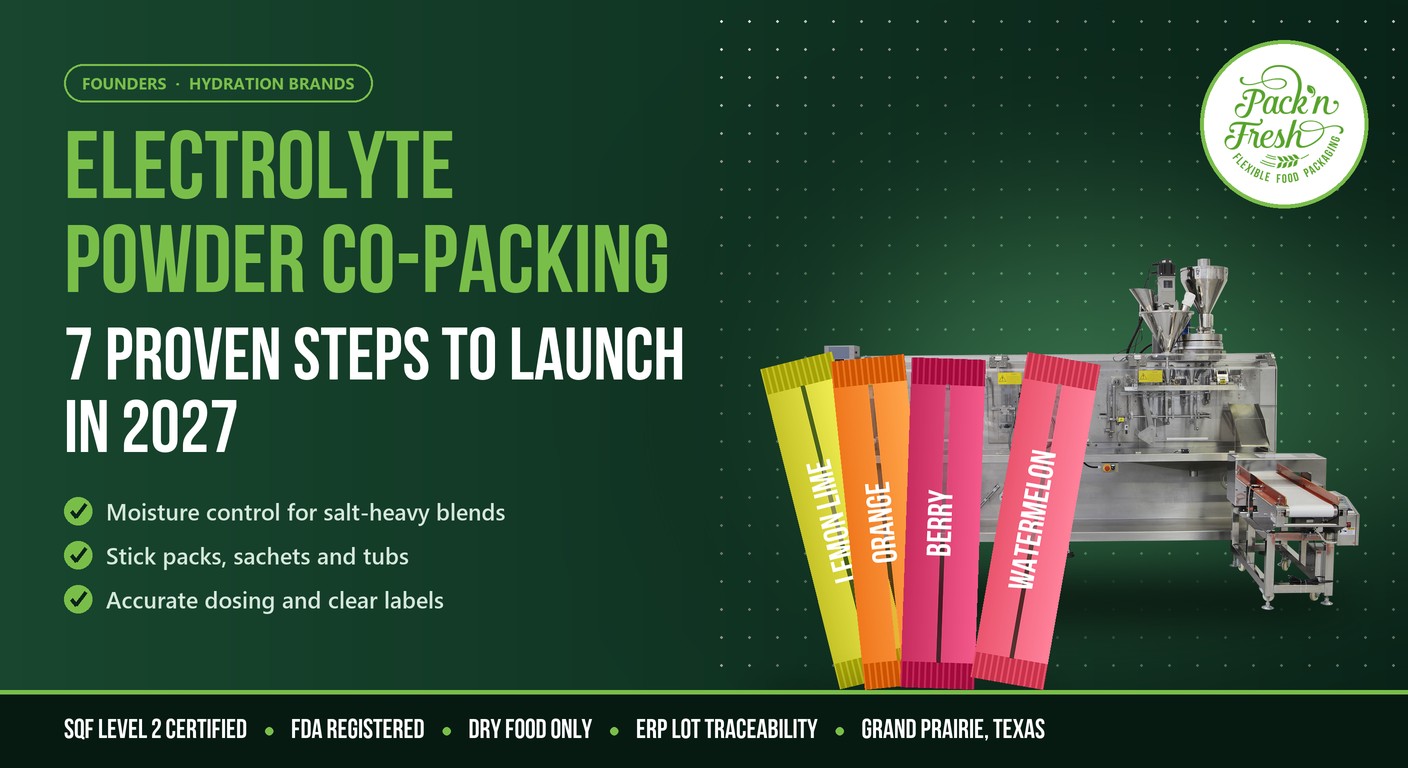
Electrolyte Powder Co-Packing: 7 Proven Steps to Launch in 2027
Electrolyte powder co-packing is how most new hydration brands get from a promising formula to a shelf-ready product without building their own plant. The category is large and still growing. Market.us estimates the global electrolyte powders market at about USD 8.4 billion in 2024 and forecasts roughly USD 18.3 billion by 2034, an 8.1% CAGR.
The same Market.us analysis places North America at about 48% of global value, making it the largest regional market for many founders. Athletes, travelers and wellness shoppers buy hydration in powder form because it is light, portable and easy to dose.
Yet electrolyte blends are among the more demanding dry powders to pack. Mineral salts pull moisture from the air, servings are small, and label claims are made per serving. This guide walks founders through the seven steps that shape a successful electrolyte powder co-packing program, from formula handling and format choice to labeling, allergen control and partner selection.
Table of Contents
- Why Hydration Brands Are Turning to Electrolyte Powder Co-Packing
- Handling Hygroscopic Salts, Caking and Powder Flow
- Choosing Your Format: Stick Packs, Sachets, Tubs and Canisters
- Dosing Accuracy, Net Weight and Per-Serving Claims
- Labeling: Supplement Facts or Nutrition Facts?
- Allergen Control, Shelf Life and Moisture Barrier
- Variety Packs, Kitting and Choosing a Partner
1. Why Hydration Brands Are Turning to Electrolyte Powder Co-Packing
Hydration has moved well beyond the sports sideline. Electrolyte mixes now sit in gym bags, carry-on luggage, office drawers and morning wellness routines. For a founder, that broad audience means competing on taste, convenience and trust from the first production run.
Flavor is a major driver of the category. Market.us reports that flavored products held more than 68% of the electrolyte powders market in 2024. That usually means multiple flavors per brand, and every flavor becomes its own production run, label and inventory line.
Why Founders Outsource Instead of Building a Line
- Capital: filling, sealing and checkweighing equipment is costly, and electrolyte formats often need more than one machine type.
- Compliance: a certified facility, cGMP practices and documented food safety programs take years to build.
- Speed: a co-packer with existing equipment and procedures shortens the path to a first production run.
- Focus: founders can spend their time on retail, DTC growth and community instead of plant maintenance.
What a Co-Packer Actually Handles
Depending on the partner, electrolyte powder co-packing can cover ingredient and film sourcing, dry blending, filling, sealing, coding, cartoning, kitting and shipping. Fewer handoffs generally mean fewer chances for moisture exposure, mix-ups and delays.
2. Handling Hygroscopic Salts, Caking and Powder Flow
Electrolyte formulas are built on mineral salts such as sodium, potassium and magnesium sources, often combined with sugars, sweeteners, acids and flavors. Many of these ingredients are hygroscopic, which means they attract and absorb water from the surrounding air. That single property drives most of the technical challenges in production.
Why Caking Happens
Food science research describes caking as the result of water being absorbed or redistributed in a powder during processing and storage. A widely cited 2007 review in Food Science and Biotechnology, “Caking in Food Powders”, explains how water makes particle surfaces sticky, causing them to bind together into lumps. For a consumer, that shows up as a clumped stick pack or a brick inside a tub.
Controls That Protect Flow
- Humidity awareness: blending and filling should happen in controlled conditions, with sensible limits on how long open powder is exposed.
- Sealed staging: bulk blend should stay closed between blending and filling.
- Formula support: your formulator may consider flow aids or anti-caking ingredients where appropriate.
- Pre-run testing: a short trial reveals bridging, dusting or sticking before a full production run.
Blend Uniformity Matters
An electrolyte blend mixes ingredients with very different particle sizes and densities. Fine minerals can separate from coarser particles during transfer. Good dry blending and careful handling keep each serving true to the label’s sodium and potassium amounts.
3. Choosing Your Format: Stick Packs, Sachets, Tubs and Canisters
Format is both a marketing and a production decision. Single-serve formats win trial and portability, while multi-serve containers lower the cost per serving for loyal customers. Many hydration brands launch with both.
Single-Serve: Stick Packs and Sachets
Stick packs are slim, premium-looking and pour cleanly into a water bottle, which is why they are so common in hydration. Sachets offer a wider print area and can hold slightly bulkier servings. Our guide to stick pack co-packing covers film widths, multi-lane equipment and fill weights in depth, so here we focus on how the format fits the electrolyte category.
- Best for: trial, travel, sampling, subscription boxes and retail checkout displays.
- Watch out for: small fills where tiny weight errors become large percentage errors.
- Pairs with: count cartons and mixed-flavor variety packs.
Multi-Serve: Tubs, Canisters and Pouches
Tubs, canisters and stand-up pouches with a scoop suit daily users who mix hydration at home or the gym. They reduce packaging per serving and let you offer a value price point. Rigid containers in plastic or metal travel well; stand-up pouches ship flat and use less storage space before filling.
- Best for: repeat buyers, club packs and DTC subscriptions.
- Watch out for: repeated opening, which exposes the powder to humidity every day.
- Pairs with: resealable closures, liners and clear scoop instructions.
4. Dosing Accuracy, Net Weight and Per-Serving Claims
Electrolyte products are bought for what is in each serving. If a stick pack is underfilled, the customer receives less sodium or potassium than the label states. If it is overfilled, the brand gives product away on every unit. Accurate dosing protects both compliance and margin.
Net Weight Rules
Packaged goods sold in the U.S. are subject to net quantity checks by weights and measures officials. NIST Handbook 133 (2026 edition) is the procedural guide inspectors use to test whether packages meet their declared net contents. Your co-packer should understand how those checks work and set fill targets accordingly.
How Precision Is Maintained
- Calibrated fillers tuned to the bulk density of each flavor, since densities can differ between flavors.
- Checkweighing at defined intervals, with records kept per lot.
- Drift correction before a trend turns into out-of-spec product.
- Documented release so each lot ships with weight data you can review.
Small servings make this harder. Our precision micro-dosing packaging guide explains the techniques behind accurate fills at very low weights, which is especially relevant for concentrated electrolyte formulas.
Launching an Electrolyte or Hydration Powder?
Pack’n Fresh blends and fills dry powders into stick packs and sachets down to 2 g, plus pouches, cups, cans and jars up to 5 lb, in an SQF Level 2 facility. Share your formula and target formats, and we will help you plan the run.
5. Labeling: Supplement Facts or Nutrition Facts?
One of the first questions founders face is whether their electrolyte mix is a dietary supplement or a conventional food. The answer shapes the label panel, the claims you can make and the regulations that apply. It depends on how the product is formulated, labeled and marketed, not simply on the fact that it is a powder.
What FDA Says About Powders
FDA’s guidance Distinguishing Liquid Dietary Supplements from Beverages notes that powdered premixes can be marketed as dietary supplements when they are labeled as such and not represented as beverages. It also lists factors, such as product name, packaging and marketing language, that can make a product a conventional food instead. Positioning and wording matter.
The Two Label Paths
- Dietary supplement: uses a Supplement Facts panel. FDA’s Dietary Supplement Labeling Guide explains serving size, dietary ingredient amounts and the “Other Ingredients” list.
- Conventional food: uses a Nutrition Facts panel and follows the general food labeling rules.
Work With a Regulatory Expert
Your co-packer prints and applies what you approve, but the classification and claims decision belongs to the brand. Engage a regulatory consultant or food attorney before finalizing artwork. A good partner will still flag practical issues, such as where lot codes and best-by dates will print on a narrow stick pack.
6. Allergen Control, Shelf Life and Moisture Barrier
Many electrolyte formulas are free of common allergens, and brands often market them that way. That promise only holds if the production environment protects it. Shared equipment, shared rooms and shared staging areas can all introduce cross-contact if they are not managed.
Know the Major Allergens
FDA’s Food Allergies page lists nine major food allergens: milk, eggs, fish, crustacean shellfish, tree nuts, peanuts, wheat, soybeans and sesame. Sesame was added by the FASTER Act, effective January 1, 2023. Even an allergen-free hydration mix may be produced in a facility that handles some of these, so ask how cross-contact is prevented.
Moisture Barrier and Shelf Life
Because electrolyte salts are hygroscopic, packaging is your main defense after the product leaves the plant. Foil or metallized laminates provide strong moisture barriers for stick packs and sachets. For tubs and canisters, a tight closure and an induction seal or liner help, though the barrier weakens once the consumer opens the container.
Shelf-life claims should come from real testing of your formula in your chosen package, not assumptions. Plan stability testing early, and repeat it if you change film, container or formula. Strong barrier choices are a core part of electrolyte powder co-packing quality.
7. Variety Packs, Kitting and Choosing a Partner
Variety packs are a natural fit for hydration brands. A box with several flavors lets new customers find a favorite and gives subscribers something to look forward to.
Secondary Packaging Options
- Count cartons: common for daily-routine products, such as 10, 15 or 30 sticks.
- Display boxes: shelf-ready trays for checkout, gyms and convenience channels.
- Multipacks and club packs: larger bundles for warehouse clubs and value buyers.
- Inserts and coupons: literature that drives reorders or subscription sign-ups.
Hygroscopic, small-dose powders share many of the same challenges. If you also sell a beauty or wellness powder, our guide to collagen powder co-packing shows how similar hygroscopic and dosing challenges apply.
How to Evaluate Candidates
Choosing the right partner is the single biggest factor in electrolyte powder co-packing success. Look for documented systems rather than verbal promises. A certification benchmarked by the Global Food Safety Initiative, such as SQF, signals that food safety programs have been independently audited.
- Which certifications do you hold, and at what level?
- How do you control humidity exposure for hygroscopic powders?
- How do you schedule and validate cleaning between allergen and allergen-free runs?
- How do you verify fill weights, and can I see lot records?
- How quickly can you trace a finished lot back to every ingredient lot?
- Can you handle blending, filling, cartoning and kitting in one facility?
How Pack’n Fresh Supports Electrolyte and Hydration Powder Brands
Pack’n Fresh is an SQF-certified contract packaging company in Grand Prairie, Texas, focused exclusively on dry food. Since 2017 we have helped brands go from source to shelf with one partner. For electrolyte powder co-packing, that means dry blending, precision filling, secondary packaging and shipping support under one roof.
Capabilities That Matter for Hydration Powders
- Stick packs and sachets down to 2 g with precision micro-dosing, plus pouches, cups, cans and jars up to 5 lb (plastic and metal).
- Dry blending, sifting and precision ingredient portioning for multi-ingredient formulas.
- SQF Level 2 certified facility, FDA-registered and FSMA-compliant, with USDA Organic, Kosher, Non-GMO and Gluten-Free certifications.
- ERP traceability on Microsoft Dynamics 365 for full lot tracking and fast mock recalls.
- Digital Ingredient Locking, which halts production if a wrong material is scanned.
- Siloed production scheduling for allergen control, verified with ATP swab sanitation checks.
- Kitting and assembly, variety packs, display boxes, multipacks, shrink-wrap, labeling and inserts.
Our owners bring food science and quality assurance backgrounds, and we work with startups as well as scaling brands. We can also source ingredients and packaging materials, and our Dallas–Fort Worth location in the central U.S. supports efficient shipping nationwide.
Conclusion
Electrolyte powders are a strong category for founders, but they reward careful planning. Hygroscopic salts need humidity control, small servings need precise dosing, and every label claim depends on what actually goes into each pack. Format, labeling path and barrier choices should be locked before production begins.
The right partner turns those requirements into a repeatable process. Look for certified food safety, documented weight control, real allergen management and full traceability. With those in place, electrolyte powder co-packing becomes a dependable foundation for growth rather than a recurring risk.
Frequently Asked Questions About Electrolyte Powder Co-Packing
What is electrolyte powder co-packing?
Electrolyte powder co-packing is when a contract packager blends and fills your hydration formula into finished packaging on your behalf. Services can include ingredient sourcing, dry blending, stick pack or sachet filling, tubs and pouches, coding, cartoning and kitting. Brands use it to launch quickly without buying equipment or building a certified facility of their own.
Why do electrolyte powders clump, and how is it prevented?
Many electrolyte salts, acids and sugars are hygroscopic, so they absorb moisture from the air and can cake into lumps. Prevention combines controlled production conditions, sealed staging of bulk blend, short exposure times and strong moisture-barrier packaging. Your formulator may also consider flow aids. A line trial helps confirm that the blend runs and stays free-flowing.
Should my electrolyte mix use Supplement Facts or Nutrition Facts?
It depends on how the product is formulated, labeled and marketed. FDA guidance says powdered premixes can be dietary supplements, which use a Supplement Facts panel, while products presented as conventional foods use Nutrition Facts. Because wording and positioning affect classification, confirm your labeling path with a regulatory consultant before you finalize artwork.
Which packaging format is best for electrolyte powders?
Stick packs and sachets suit trial, travel, sampling and retail displays, while tubs, canisters and stand-up pouches suit daily users and subscriptions. Many hydration brands offer both. Choose high-barrier films for single-serve packs and tight closures or liners for multi-serve containers, because electrolyte salts are sensitive to moisture once exposed.
How small can an electrolyte stick pack serving be?
Minimum fill depends on the powder and the equipment, but precision micro-dosing allows very small servings. Pack’n Fresh fills stick packs and sachets down to 2 g. At low weights, regular checkweighing and documented lot records are essential, because a small variation can represent a large share of the labeled net weight.
Bring Your Hydration Brand to Market with Pack’n Fresh
Pack’n Fresh is an SQF Level 2 certified dry food co-packer in Grand Prairie, Texas. We can blend and fill electrolyte powders into stick packs, sachets, pouches and containers, backed by ERP traceability, Digital Ingredient Locking and siloed allergen scheduling. Tell us about your formula, flavors and channels, and we will help you plan your launch.