
The Ultimate DTC Food Packaging Solutions: Navigating Shipping Costs and Freshness
In the hyper-competitive landscape of Direct-to-Consumer (DTC) food, your packaging is more than just a container—it is a logistics tool, a brand ambassador, and a thermal barrier. For founders of scaling meal-kit and supplement brands, moving from local delivery to national shipping often hits a “financial wall.” To scale successfully, you must implement DTC food packaging solutions specifically engineered for the rigors of the “last mile.”
Pack’n Fresh positions itself as a reliable partner, offering advanced DTC food packaging solutions that help brands navigate escalating shipping costs and the struggle to maintain ingredient freshness during shipping meal kits.
1. The DTC Challenge: Why Last-Mile Delivery is Different
Shipping food directly to a consumer’s doorstep is fundamentally harder than stocking a retail shelf. In retail, products move in temperature-controlled pallets; in DTC, every parcel is an island. According to the U.S. Food Safety Portal, temperature fluctuations are the primary cause of product failure in the supply chain.
- Temperature Control: Direct shipping exposes products to thermal spikes. High-quality DTC food packaging solutions ensure your brand maintains a strict commitment to food safety and regulatory standards.
- Shipping Meal Kits Costs: Unlike palletized freight, DTC parcels face high-velocity sorting. Brands must prioritize portable snack packaging formats that protect the product without adding unnecessary bulk or weight.
Pillar Strategy: The Turnkey DTC Engine
The biggest drain on a brand’s margin is managing fragmented vendors. At Pack’n Fresh, our Full-Service Packaging Solution acts as a turn-key model for growth. We manage the ingredient sourcing, precision blending, and final meal kit fulfillment under one roof. This integrated approach ensures your DTC food packaging solutions are perfectly matched to your shipping box size, preventing the “oversized box” error that spikes shipping costs.
2. Pouch vs. Box: Mastering Dimensional (DIM) Weight
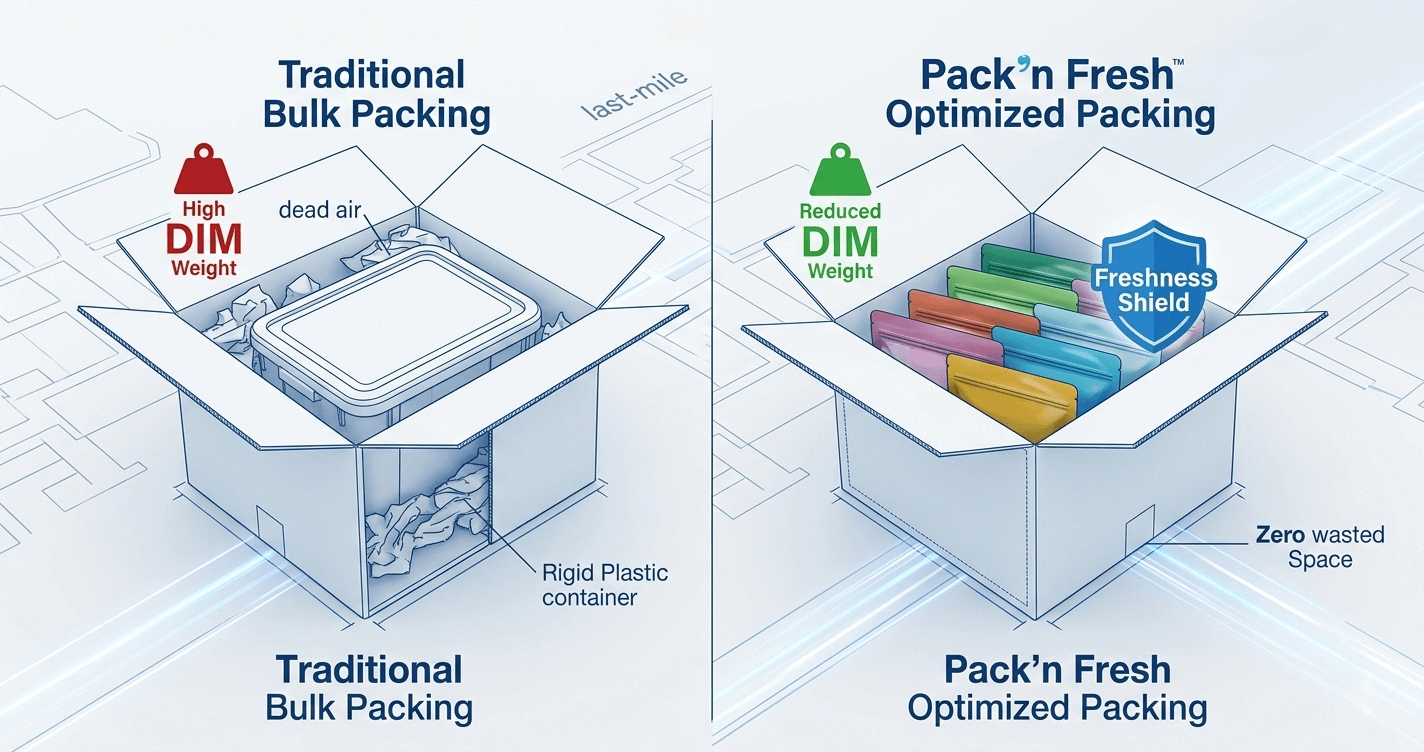
The most significant factor in meal kit fulfillment is “ghost weight.” Carriers use a calculation called Dimensional (DIM) Weight to charge for the space a package occupies.
The Strategic Advantage of Flexible Pouches
Using rigid containers for light products often leads to paying for “dead air.” Pack’n Fresh specializes in DTC food packaging solutions for pouches smaller than 2 lbs, which offers a major advantage in dimensional weight for food brands. By optimizing your DTC food packaging solutions, you can significantly reduce the volume and tare weight of your shipments.
Refer to the UPS Daily Rates Guide to see how even a 1-inch reduction in box dimensions can save your brand thousands in shipping meal kits surcharges.
3. Beating the Heat: Active Packaging and MAP
Maintaining freshness traditionally meant adding heavy gel packs, which spikes your total weight. Modern DTC food packaging solutions now allow for “active” freshness that doesn’t add bulk.
Modified Atmosphere Packaging (MAP): Our MAP solutions replace oxygen with a protective gas mix. This is essential for shipping meal kits that contain perishables, as it extends shelf life by several days without the need for excessive insulation. Learn more about the science of gas flushing at The Institute of Food Technologists.
4. Scalability: Why a Turnkey Co-packer is Essential
As your brand grows, the complexity of meal kit fulfillment and meal kit logistics becomes overwhelming. Transitioning to a turn-key solution simplifies the process by providing a one-stop shop for all your DTC food packaging solutions.
By partnering with a specialist in snack and spice packaging, you gain access to an extensive equipment portfolio designed for high-resolution branding and precision kitting. This ensures your DTC food packaging solutions remain professional as you scale from 1,000 to 100,000 units.
The DTC Packaging Checklist
- DIM Weight Optimization: Are you using DTC food packaging solutions that minimize “dead air”?
- Portion Precision: Are you using automated weighers to minimize product giveaway?
- Safety Compliance: Does your production meet FSMA 204 traceability requirements?
- Thermal Validation: Have you tested your DTC food packaging solutions against summer temperature spikes?
Summary: Designing for the Last Mile
In the world of DTC food, your margins are won or lost in the shipping box. By embracing flexible packaging and mastering dimensional weight for food brands, you can protect your product while slashing logistics costs.