
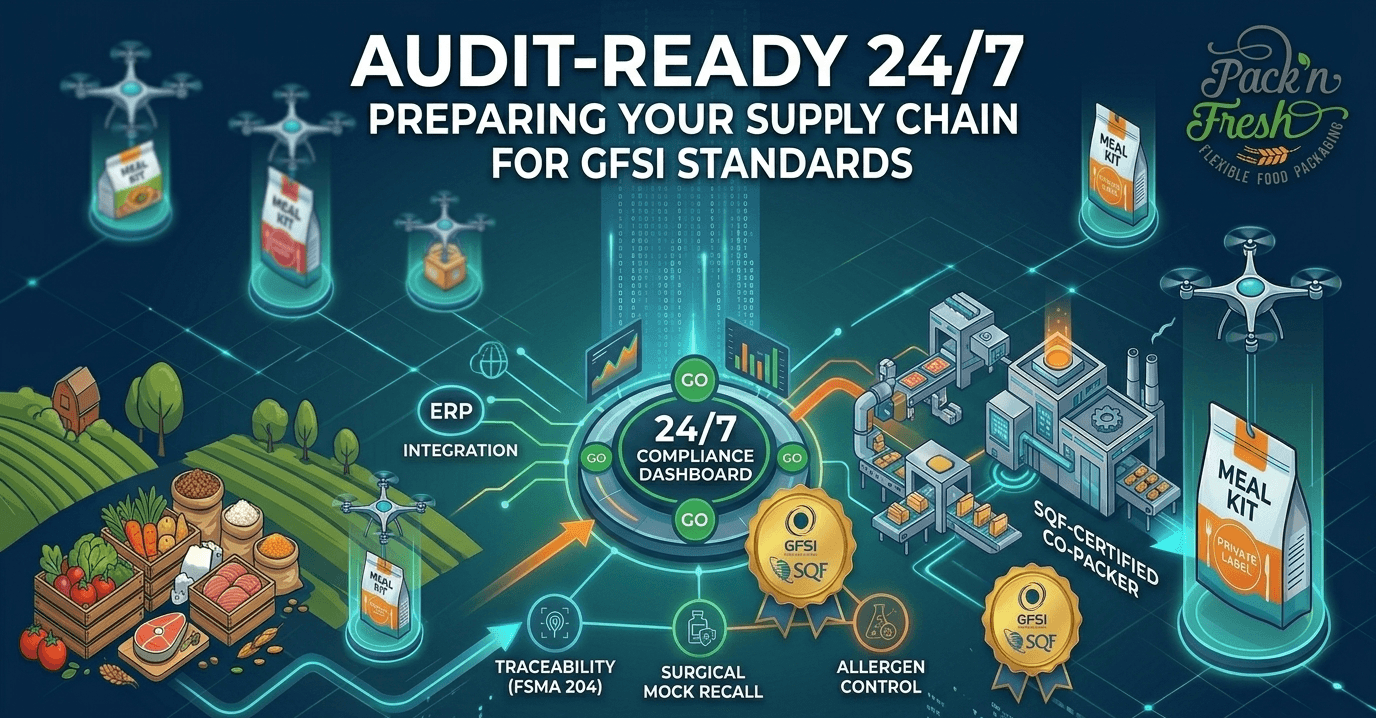
Audit-Ready 24/7: Preparing Your Supply Chain for GFSI Standards
Adhering to GFSI food safety standards is now a 24/7 requirement for modern brands. As a Food Safety and Regulatory Compliance Officer, I often see companies navigate shifting thresholds while still viewing audits as a localized, annual stress test. However, as we approach the regulatory thresholds, that mindset is no longer viable. Today, food safety is not a singular event; it is a continuous, verifiable state of operations.
If you are scaling a meal kit or private label brand, your supply chain must be audit-ready 24/7. Achieving this level of continuous compliance requires moving beyond spreadsheets and partnering with an SQF-certified co-packer that embeds regulatory rigor into its daily operations.
1. The Current Regulatory Landscape: Evolving GFSI & SQF Standards
The demands of GFSI food safety standards and SQF certifications are evolving rapidly. A major driver is the FDA’s Food Safety Modernization Act (FSMA) Section 204, which mandates enhanced traceability recordkeeping. While the full deadline is 2028, leading retailers are demanding strong Key Data Elements (KDEs) today. Without a fully integrated partner, meeting emerging trends in food packaging contracts is nearly impossible.
Pack’n Fresh’s experienced team and commitment to food packaging safety and regulatory standards ensure high-quality products that meet these rigorous requirements.
Evolving GFSI Food Safety Standards & SQF Compliance
To navigate this complex environment, an Enterprise Resource Planning (ERP) system is no longer a luxury. When Pack’n Fresh handles the entire process—from sourcing to kitting—our system tracks every single touchpoint. This is why it is important to choose a copacker with an ERP implemented; it eliminates the “blind spots” that occur during production.
The “Surgical” Mock Recall: The ultimate test of traceability is the mock recall. With a fully implemented ERP, we execute “surgical” recalls. We identify exactly which lot of raw ingredients went into which specific final pouch. This digital precision protects your brand from widespread market panic and the 5 common food packaging mistakes that lead to financial loss.
Adhering to GFSI food safety standards provides a universal gold standard that builds immediate trust with national retailers. For meal kit founders, this certification is the ‘passport’ required to enter premium markets. It ensures that every step of the manufacturing process—from raw material intake to final kitting—is scrutinized under a globally recognized framework of safety and quality
2. Allergen Management Best Practices
Undeclared allergens remain a leading cause of recalls, which is why strict adherence to GFSI food safety standards is central to our allergen control protocols. To mitigate allergen and traceability risks, we implement strict operational controls:
- Siloed Production Scheduling: Running allergen-free products prior to allergen-containing products, monitored by the ERP.
- Validated Sanitation SOPs: Utilizing state-of-the-art equipment designed for deep sanitation, coupled with ATP swab testing.
- Expert Oversight: Our co-owners’ backgrounds in food science ensure that allergen control plans are strictly enforced.
- Digital Ingredient Locking: The ERP automatically halts the production line if an incorrect raw material is scanned.
Summary: Secure Your Supply Chain Today
The transition to a digital-first compliance model is the most significant shift in modern manufacturing. By aligning your brand with GFSI food safety standards through a technology-enabled partner, you are not just passing an audit; you are building a resilient brand. This proactive approach to safety reduces the ‘risk premium’ associated with scaling, allowing you to focus on marketing and product development while we handle the technical rigors of compliance
Your brand’s reputation takes years to build, but it can be dismantled by a single safety incident. Do not wait for a compliance deadline to upgrade your infrastructure. Partner with an expert who can help you get your food co-packing partner based on actual data and safety protocols.