
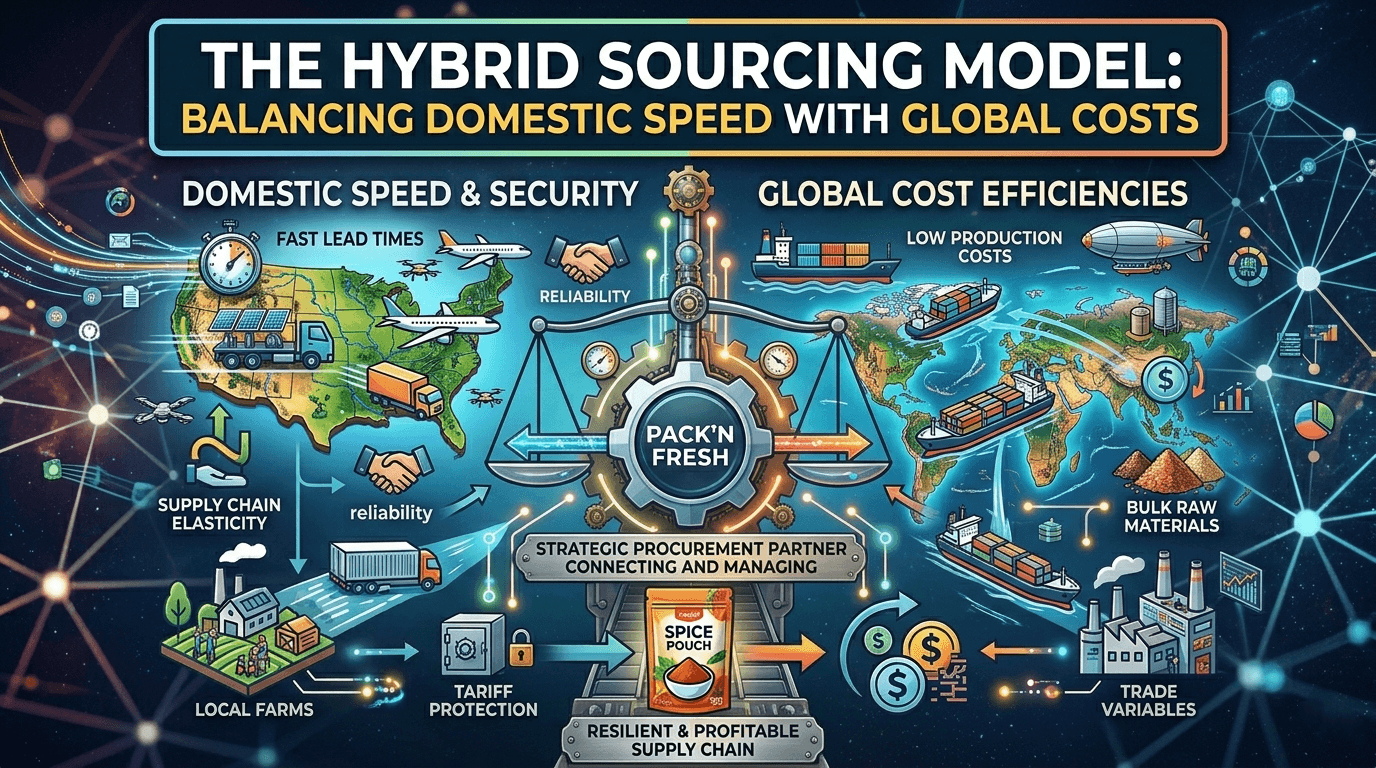
The Hybrid Sourcing Model: Balancing Domestic Speed with Global Costs
In today’s volatile trade environment, the traditional “lowest-cost-at-all-costs” sourcing model has officially retired. For meal kit founders and food brand executives, the challenge is no longer just finding the cheapest ingredient—it is ensuring that the ingredient actually arrives at the production line on time, within spec, and without a surprise tariff invoice.
To survive the current economic climate, brands must transition to a hybrid food sourcing strategy. This model balances the cost efficiencies of global trade with the unmatched speed and security of domestic supply chains. At Pack’n Fresh, we provide the infrastructure to manage this balance, acting as a strategic procurement partner. Understanding what is food co-packing and how can it benefit your business is the first step in mastering this hybrid approach.
1. Navigating the 2026 Tariff-Focused Economy
The shift toward a more protectionist global trade environment has fundamentally altered the domestic vs. global food supply chain debate. According to U.S. Customs and Border Protection, trade remedies and duties can fluctuate significantly based on current policy, making long-term forecasting difficult for international-only brands.
For many brands, the perceived savings of overseas sourcing are being erased by:
- Increased Duties: Surprise tariffs that can swing margins by 10–25% overnight.
- Port Congestion: Administrative hurdles and customs inspections that add weeks to lead times.
- Inventory Carrying Costs: The need to sit on six months of safety stock to hedge against shipping delays.
In this environment, local food sourcing wins in a tariff-focused economy. By shifting a portion of your raw material procurement to domestic partners, you gain “supply chain elasticity”—the ability to react to market trends without waiting for an ocean freighter. This elasticity is a core benefit for any brand adopting a hybrid sourcing model.
Pillar Strategy: Eliminating Vendor Finger-Pointing
One of the greatest “hidden costs” in the food industry is the fragmented supply chain. When a brand uses a broker for spices, a separate blender for dry mixes, and a third-party co-packer, they create a “responsibility gap.” When a quality issue arises, the result is inevitable: vendor finger-pointing.
Pack’n Fresh eliminates this friction through a turn-key blending and packing model. There are 7 full-service packaging solution powerful reasons to consolidate your supply chain, but the most important is control.
This integration provides:
- Single-Point Accountability: We own the quality and the timeline from the raw seed to the sealed pouch.
- Resource Management: We ensure ingredients meet strict food packaging safety and regulatory standards before they ever enter our equipment.
- Simplified Logistics: No more paying for freight to move semi-finished goods between facilities.
2. Significantly Reducing Lead Times
In the meal kit industry, speed to market is a competitive advantage. By utilizing our turn-key solutions, brands can effectively reduce lead times in food production by 15% or more, which is a critical advantage of the hybrid sourcing model. This efficiency is driven by our efficient packaging solutions design and our specialization in snack and spice pouch packaging (under 2 lbs).
Summary: Future-Proof Your Procurement
The “Growth Wall” of 2026 is built from logistical delays and rising trade costs. To scale, you need a partner that doesn’t just pack bags, but understands the strategic math of procurement. This is why many brands are choosing a copacker with an ERP implemented to manage these complex data points.
At Pack’n Fresh, our co-owners’ backgrounds in food science and quality control ensure that your hybrid sourcing model is built on a foundation of safety and excellence. Stop managing a dozen vendors and start managing one result.
By choosing a partner that integrates these complex global and domestic variables, your brand can maintain a hybrid sourcing model that is both resilient and highly profitable. This strategic shift ensures long-term sustainability in an ever-changing international trade landscape