
Mastering Modified Atmosphere Packaging for Food: The Science of Shelf Life
In the meal kit and specialized snack industry, the “moment of truth” doesn’t happen at the checkout page—it happens in the customer’s kitchen 10 to 14 days later. When a subscriber opens a spice pouch packaging only to find clumped powder or an off-aroma, the brand doesn’t just lose a sale; it loses a lifetime value (LTV) customer.
As brands scale beyond the “startup kitchen” phase, basic packaging is no longer sufficient. To compete in 2026, brands must move from simply containing food to engineering its environment. This is where Modified Atmosphere Packaging for Food—often referred to as protective gas flushing—becomes a non-negotiable asset for quality preservation.
According to research published by ScienceDirect, Modified Atmosphere Packaging for Food technology is one of the most effective ways to inhibit the growth of spoilage-causing organisms and maintain organoleptic properties (taste, smell, color).
The Science: How MAP Controls the Biological Clock
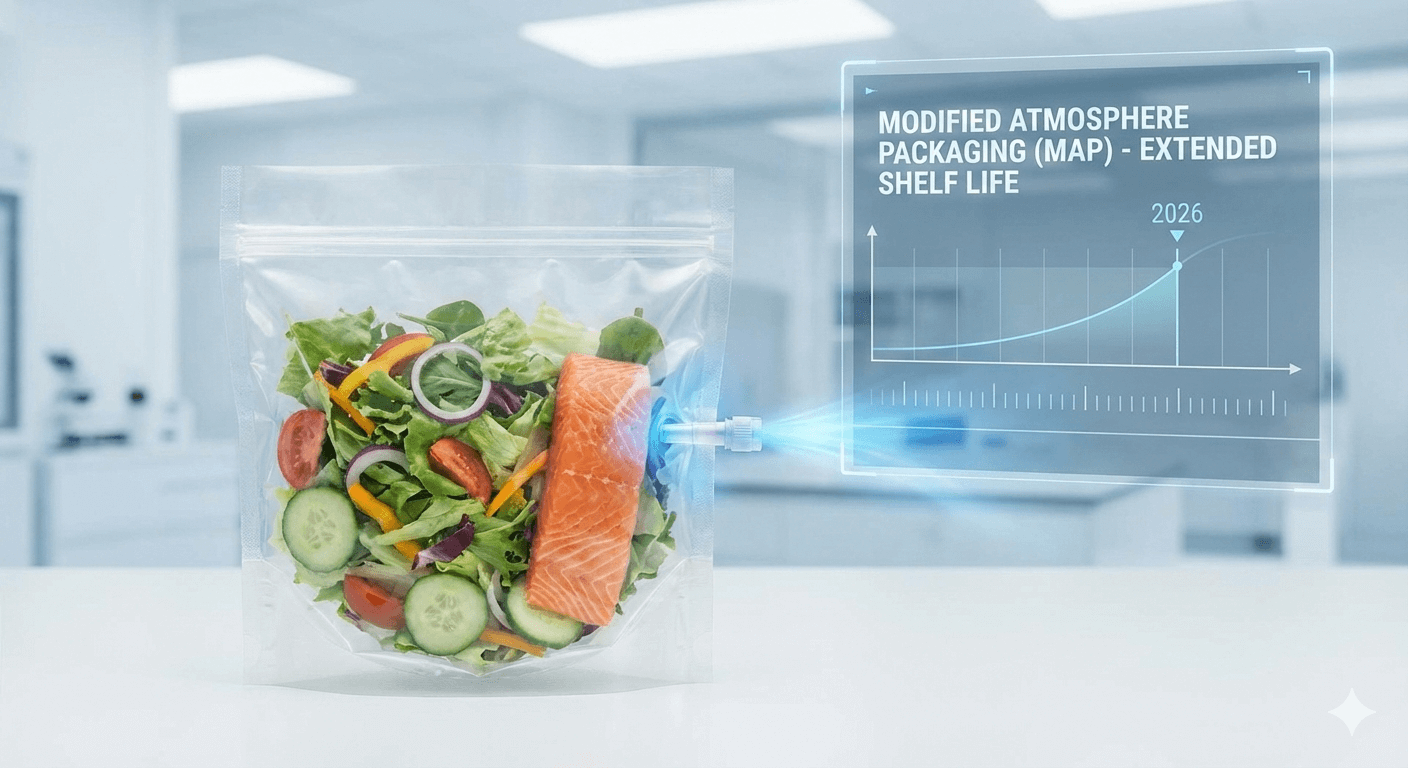
Modified Atmosphere Packaging for Food involves displacing the ambient air inside a pouch with a specific, food-grade gas mixture.
-
- Oxygen Displacement: Ambient air contains ~21% oxygen, the primary catalyst for oxidation and aerobic microbial growth. By utilizing high-purity nitrogen (N₂) as an inert filler, we can reduce residual oxygen levels to below 1%.
- Microbial Inhibition: For certain products, a blend including Carbon Dioxide (CO₂) is used to actively inhibit the growth of spoilage-causing bacteria and molds.
- Maintaining Structure: Nitrogen flushing for small pouches also serves as a “buffer” gas, preventing delicate components from being crushed during shipping—a critical benefit for bold, high-protein snacks and fragile meal kit inclusions.
Technical Execution: VFFS and Barrier Material Selection
At Pack’n Fresh, we specialize in integrating Modified Atmosphere Packaging for Food into VFFS packaging (Vertical Form Fill Seal) lines for pouches under 2 lbs. However, the gas flush is only half of the equation.
The most frequent failure in small-format MAP is neglecting the OTR barrier films (Oxygen Transmission Rate) of the packaging material. A high-purity gas flush is useless if the film allows oxygen to migrate back into the pouch over time. We work with our clients to select multi-layer barrier films that match the specific respiration and sensitivity of the ingredient, ensuring the modified atmosphere remains stable from our facility to the customer’s doorstep.
Technical Spotlight: Precision in Small-Format Headspace
In pouches under 2 lbs, the ratio of gas to product—known as “headspace”—is much tighter than in bulk bags. Even a 0.5% deviation in nitrogen purity can lead to localized oxidation. At Pack’n Fresh, we utilize high-precision sensors on our VFFS lines to ensure every small pouch maintains a perfect “atmospheric thumbprint” for maximum shelf-life stability.
Economic Impact: Beyond the Freshness Claim
By extending shelf life by 200% to 400%, Modified Atmosphere Packaging for Food allows brands to expand their distribution radius and reduce “shrink” (inventory spoilage). For executives looking to optimize their supply chain, food shelf-life extension technology is the key to transitioning from local delivery to national fulfillment.
2026 Technical Spotlight: Precision Gas Monitoring
In 2026, real-time gas analysis is becoming a standard. When utilizing Modified Atmosphere Packaging for Food, it is vital to perform destructive and non-destructive testing at the machine level to verify that nitrogen levels remain consistent throughout the production run. This level of technical oversight ensures that your 100th pouch has the same protective atmosphere as your 10,000th.
Ready to Scale Your Shelf Life?
Ready to triple your product’s shelf life without chemicals? Don’t leave your brand’s freshness to chance. Consult with our expert team today to audit your MAP compatibility and explore our Modified Atmosphere Packaging for Food solutions.