
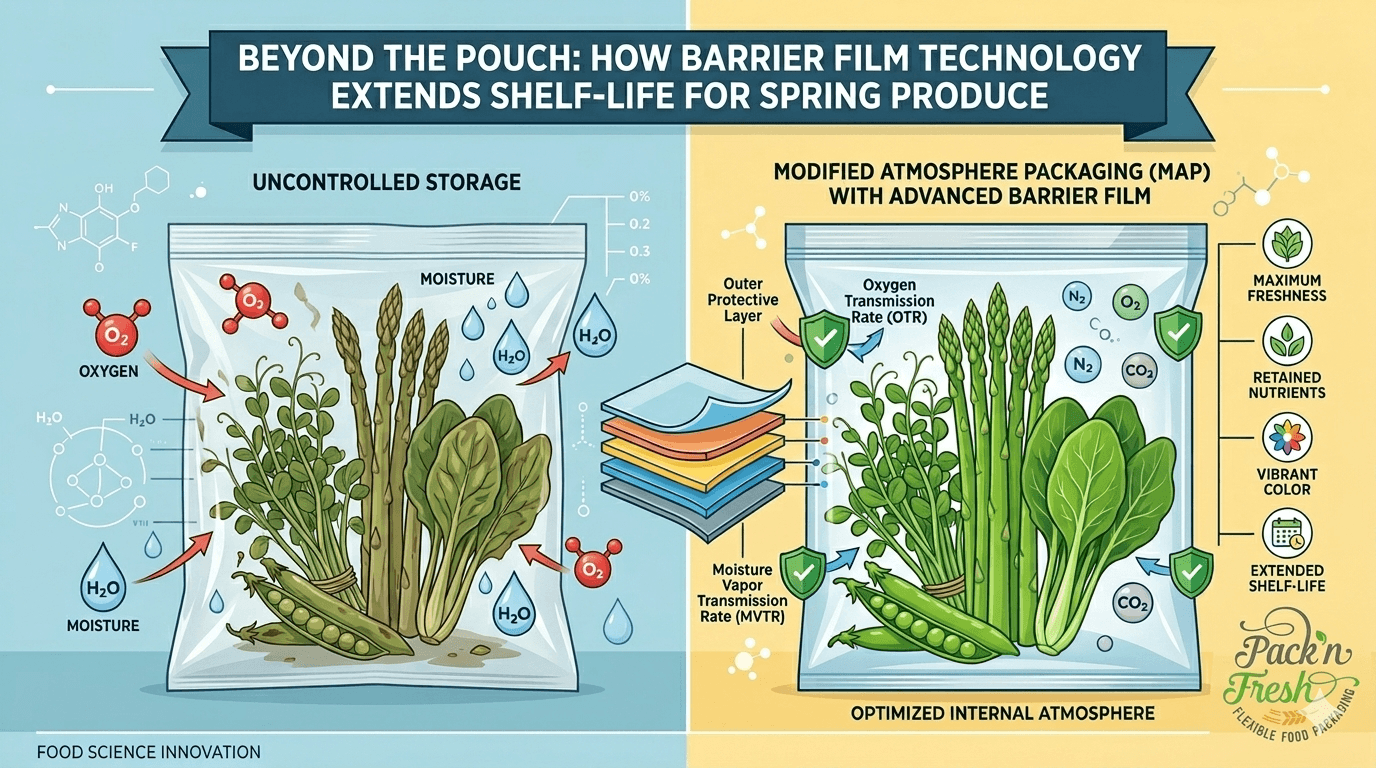
Beyond the Pouch: How Barrier Film Technology Extends Shelf-Life for Spring Produce
Modified atmosphere packaging is the definitive solution for meal kit founders and food brands as they transition into the spring season and face the recurring biological challenge of produce respiration. Fresh spring produce—from delicate pea shoots to crisp asparagus—remains biologically active after harvest. Without the right technical intervention, these ingredients can lose their nutritional value, texture, and flavor within days.
For the modern food brand, “packaging” can no longer be a passive envelope. It must be a high-performance atmospheric shield. Achieving true food shelf life extension requires a sophisticated marriage of material science and gas dynamics.
1. The Science of Barrier Films: Your First Line of Defense
At the heart of any high-quality food pouch is the barrier film. Unlike standard plastics, food-safe barrier films are engineered with multiple layers of specialized polymers (such as EVOH or Nylon) designed to control the migration of molecules.
Moisture and Oxygen Transmission Rates (MVTR & OTR): In food science, we measure the efficacy of a film by its transmission rates. If your film has a high Oxygen Transmission Rate (OTR), your ingredients will oxidize, leading to browning and “off” flavors. If the Moisture Vapor Transmission Rate (MVTR) is poorly calibrated, your ingredients may dehydrate or clump. By selecting the correct gauge, we create a micro-environment that effectively “slows down” the aging process—a core component of efficient packaging solutions design.
Why Modified Atmosphere Packaging (MAP) is a Growth Game-Changer
While the film acts as the shield, Modified Atmosphere Packaging (MAP) is the active strategy. MAP involves flushing the package with a precise mixture of gases—typically Nitrogen ($N_2$) and Carbon Dioxide ($CO_2$)—to displace Oxygen ($O_2$).
The “Spring” Challenge: Spring brings unpredictable logistics. A delivery truck might be 50°F in the morning and 80°F by the afternoon. According to the USDA Food Safety and Inspection Service, maintaining control during these temperature shifts is vital for safety.
MAP acts as a stabilizer during these transitions. By significantly reducing oxygen levels (common targets are $<1\%–2\%$), we inhibit the growth of aerobic spoilage organisms. This is essential for DTC food packaging solutions, where consumers expect a “farm-to-table” experience despite the product spending 48 hours in transit.
The role of modified atmosphere packaging extends beyond mere protection; it is about active preservation. By utilizing multi-layer films with specific OTR and MVTR ratings, we can manipulate the internal environment to match the biological needs of each ingredient. This precision ensures that even the most volatile organic compounds—those responsible for the ‘fresh’ scent of spring greens—remain trapped within the pouch until the consumer opens it.
2. Quality Control Standards at Pack’n Fresh
At Pack’n Fresh, we apply rigorous food science to every pouch. Our commitment to food packaging safety and regulatory standards is backed by a team with deep backgrounds in quality control.
- Precision Gas Flushing: Utilizing our equipment portfolio to ensure every pouch receives the exact atmospheric mix required for its specific pH and moisture content.
- Hermetic Seal Integrity: We use high-precision sealing bars to ensure zero “micro-leaks” that could compromise the modified atmosphere, a common issue highlighted in 5 common food packaging mistakes.
- Shelf-Life Testing: We help brands understand how specific recipes react over time, offering consultation to maximize freshness. This is key to how smart and active packaging is changing the industry.
Summary: Future-Proof Your Freshness
Implementation of modified atmosphere packaging also allows for a wider geographical reach. Brands that were previously restricted to local shipping can now confidently ship across state lines, knowing their barrier film technology will maintain internal stability. This scalability is a primary reason why MAP has transitioned from a high-end luxury to a standard operational requirement for any serious food brand.
In the competitive meal kit landscape, the difference between a one-time buyer and a loyal subscriber is the state of the produce when the box is opened. Investing in advanced barrier technology isn’t just a safety measure—it’s a marketing strategy. Whether you are looking for packaging solutions for small-batch food production or national scaling, we provide the technical expertise to keep your products fresh.