
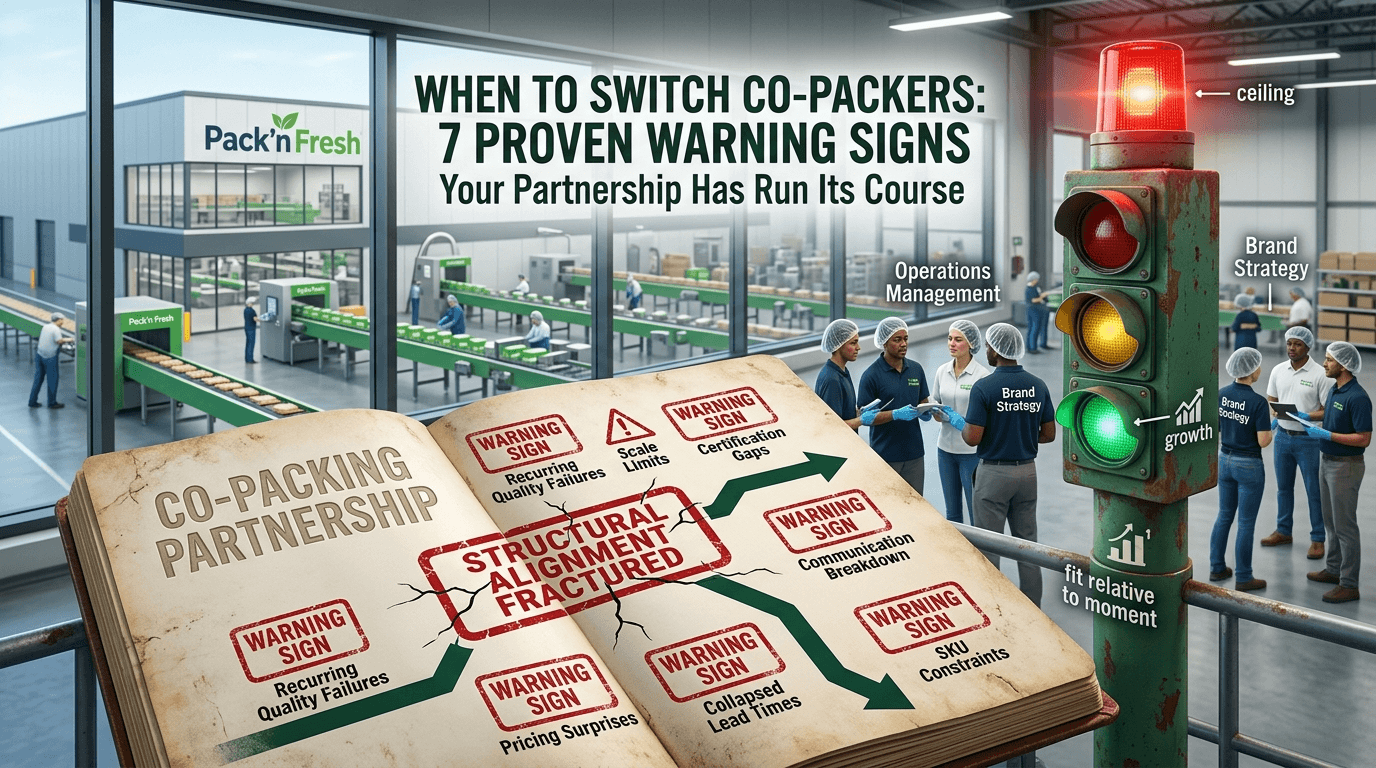
When to Switch Co-Packers: 7 Proven Warning Signs Your Co-Packing Partnership Has Run Its Course
Every co-packing relationship starts with alignment — the right volume minimums, the right certifications, the right lead times for where your brand stands today. But co-packing partnerships are not static. They are built around a specific snapshot of your business, and as your brand scales, diversifies its SKU portfolio, and enters new retail channels, that original alignment can quietly erode into something far more costly: a production relationship that is actively limiting your growth. The failure mode is rarely dramatic at first. It shows up as a quality complaint that gets dismissed, a lead time that stretches by two days, a certification audit that gets delayed. Then it compounds. By the time most brands recognize how badly the relationship has deteriorated, the damage to their operations, retailer relationships, and brand reputation has already been done. Understanding exactly when to switch co-packers — before that damage becomes irreversible — is what separates brands that scale successfully from those that fight fires indefinitely.
Knowing when to switch co-packers is one of the most difficult operational calls a food brand executive can make — not because the warning signs are ambiguous, but because transition risk feels more immediate than the slow, grinding cost of a failing partnership. You know what a transition looks like: onboarding time, documentation transfers, parallel production runs, potential gaps. What is harder to quantify is the accumulating cost of staying: recalled product, lost retail placements, declining fill rates, and the energy your team spends managing a co-packer that has become an operational liability rather than a production partner. Industry operators consistently note that brands which delay the decision to switch after clear warning signs emerge end up spending significantly more on the transition than brands that act proactively. Waiting until a crisis forces the conversation is always the more expensive path.
At Pack’n Fresh, we work with food brands at every stage of their growth — including brands that are transitioning away from a prior co-packing relationship. We understand what a well-executed transition looks like, and we understand the operational signals that make it necessary. This guide is built to give food brand founders and operations executives a clear, evidence-based framework for evaluating their current co-packing partnership and knowing with confidence when the right answer is to move on. We will walk through the seven most reliable warning signs that a co-packing relationship has structurally failed, how to evaluate whether the problem is fixable, and how to execute a clean transition without disrupting your production schedule. If you are just beginning to evaluate co-packing options, our co-packer vetting guide is the right place to start.
Table of Contents
- Why Co-Packer Relationships Have a Natural Lifecycle
- The 7 Warning Signs That Answer When to Switch Co-Packers
- Warning Sign Deep-Dive: Quality Failures and Certification Gaps
- Warning Sign Deep-Dive: Capacity, Flexibility, and Communication Breakdown
- Is the Problem Fixable? How to Evaluate Before You Decide
- The Co-Packer Transition Roadmap: How to Switch Without Stopping Production
- What to Look for in Your Next Co-Packing Partner
- FAQs — When to Switch Co-Packers
1. Why Co-Packer Relationships Have a Natural Lifecycle
A co-packing partnership is not a permanent infrastructure decision — it is a fit decision, and fit is always relative to where your brand is at a specific moment in time. When you signed with your current co-packer, you evaluated them against your volume requirements, your product formats, your certification needs, and your budget at that stage. If that evaluation was done well, you found a genuine fit. But here is what most brands underestimate: the co-packer that was the right partner at 5,000 units per month may be structurally wrong for you at 50,000 units per month. It is not that the co-packer failed — it is that your business evolved past what they were built to deliver.
Co-packing relationships tend to follow a recognizable three-phase lifecycle. The first phase is startup fit: your co-packer’s minimum order quantities match your current volume, their equipment handles your initial product formats, and the relationship feels collaborative because both parties are relatively small-scale. The second phase is growth fit: as your volume increases, your co-packer scales alongside you — adding production capacity, accommodating new SKUs, maintaining certification standards as your retail channel requirements grow more demanding. The third phase — the one most brands fail to recognize until they are already in it — is the ceiling. This is the point at which your growth trajectory has outpaced what the co-packer can deliver. They are running near capacity, lead times are drifting, quality consistency is declining under production pressure, and their certification portfolio has not kept pace with where your retail buyers now require you to be.
The critical failure in most co-packing relationships is not the ceiling phase itself — it is the failure to monitor for early signals that you are approaching it. Most brands do not proactively evaluate fit on a regular cadence. They operate reactively, addressing individual problems as they surface without recognizing the pattern those problems form. A quality deviation here, a delayed production run there, a certification that was supposed to be renewed six months ago — each individual issue gets explained away. It is only when three or four of these signals align simultaneously that brands finally ask the right question: is this relationship still working? By then, the damage is already accumulating. Brands that proactively track fit — and ask when to switch co-packers before the warning signs compound — consistently navigate the decision at lower cost and with more control. Knowing when to switch co-packers begins with a commitment to monitoring fit proactively, not reactively — and recognizing that lifecycle phases are real, predictable, and manageable when you see them early.
2. The 7 Warning Signs It’s Time to Switch Co-Packers
The warning signs that a co-packing relationship has structurally failed are not subtle once you know what to look for. The problem is that most brands encounter these signals individually and address them as isolated incidents rather than reading them as a pattern. What follows is the definitive list of the seven warning signs that indicate a co-packing partnership has run its course — each one meaningful on its own, and collectively representing clear evidence that the relationship needs to end. Read them as a pattern, and they give you a definitive answer to when to switch co-packers.
Warning Sign 1 — Recurring Quality Failures That Don’t Get Fixed
A single quality failure is a data point. It tells you that a process deviated, that a piece of equipment underperformed, or that a procedure was not followed correctly. A capable co-packer treats a quality failure as a trigger for a structured root cause analysis (RCA) and implements a corrective action plan (CAPA) that specifically addresses the mechanism of failure — not just the symptom. The RCA identifies whether the problem was equipment, personnel, process, or raw material. The CAPA defines the specific change being made, who owns it, and what metric proves it is working. This is standard operating procedure for any facility operating under a meaningful food safety management system.
The warning sign is not the first quality failure — it is what happens after the corrective action is supposedly in place. If the same category of defect (seal failures, fill weight deviations, label placement errors, allergen incidents) reappears within 60 to 90 days of a documented corrective action, the system is broken. The co-packer either lacks the operational discipline to implement the corrective action consistently, lacks the equipment capability to prevent the defect mechanically, or lacks the tracking systems to identify that the problem has recurred. Any one of these represents a structural failure, not a one-time miss. Brands that have experienced three or more instances of the same defect category within a 12-month period — despite documented corrective actions — are operating with a co-packer that cannot solve quality problems systematically. When to switch co-packers becomes clear the moment a pattern of unresolved quality failure becomes undeniable.
Warning Sign 2 — They Cannot Scale With You
Capacity is finite, and a co-packer that was a fit at your current volume becomes a constraint when you grow beyond their operational ceiling. The signs of a co-packer that cannot scale are recognizable: lead times that were once 5 to 7 days begin stretching to 12 to 15 days without a clear explanation. Rush order accommodation — once flexible — becomes impossible or prohibitively expensive. New SKU additions get pushed back repeatedly because adding them would disrupt the production schedule for existing runs. Production date commitments begin slipping by days, then by a week, then longer.
What is happening operationally is that the co-packer is running at or near full capacity utilization, and your brand is one of many competing for limited production slots. At high utilization rates, co-packers make prioritization decisions — and brands with longer relationships or higher contract values tend to get protected while newer or smaller brands absorb the schedule disruptions. If your co-packer cannot commit to volume increases that match your growth plan for the next 12 months, they are not a growth partner — they are a production ceiling. This is particularly acute for brands operating in subscription commerce, meal kit fulfillment, or seasonal demand categories where volume variability is a structural feature of the business model, not an exception.
Warning Sign 3 — Certification Gaps That Put Your Brand at Risk
Co-packer certifications are not administrative checkboxes — they are the foundation of your brand’s compliance posture and channel access. If your co-packer’s SQF-certified facility status lapses, if they deprioritize re-certification after a failed audit, or if they have never pursued a GFSI-recognized certification scheme like SQF, BRCGS, or FSSC 22000, you inherit their compliance risk directly. Retail buyers — particularly large grocery chains and natural food retailers — increasingly require third-party food safety certification as a condition of supplier approval. Institutional food service purchasers have the same requirement. Meal kit platforms often mandate it contractually.
A co-packer that is not pursuing or maintaining GFSI-recognized certification is telling you something important about their operational culture: food safety systems are not a priority. That posture has downstream implications for your brand that extend beyond certification paperwork. It affects the rigor of their sanitation protocols, their allergen management systems, their traceability infrastructure, and their corrective action discipline. The certification is a proxy for the operational culture underneath it. Review your co-packer’s current certification status, its expiration date, and the history of their most recent audit cycle. If there are gaps, lapses, or a consistent pattern of delayed re-certification, that is a warning sign that belongs in the same category as a recurring quality failure. Certification gaps of this kind frequently determine when to switch co-packers — because a co-packer deprioritizing certification is deprioritizing the entire food safety infrastructure your brand depends on. You can find an overview of what these certifications require in our GFSI food safety standards guide.
Warning Sign 4 — Communication Breakdown and Accountability Avoidance
The operational maturity of a co-packer is reflected most clearly in how they communicate when something goes wrong. A co-packer with mature systems and an accountable culture surfaces problems proactively, documents them with specificity, and gives you the information you need to make decisions. They can produce a traceability report — from ingredient receipt through finished goods pack-out — within hours of a request. They notify you immediately when a production deviation occurs rather than waiting until a scheduled check-in. They have a designated point of contact who has authority to make decisions and who responds within a defined window.
The warning sign is the opposite pattern: delayed or absent responses to quality complaints, inability to provide lot-level traceability data on demand, vague explanations for production deviations, and a defensive posture when accountability is requested. A co-packer that cannot produce a complete lot trace within a business day does not have the traceability infrastructure that FSMA 204 traceability requirements demand — and that gap is a compliance exposure for your brand, not just an inconvenience. Communication breakdowns and accountability avoidance are not personality problems. They are symptoms of inadequate systems, and inadequate systems do not fix themselves. When these symptoms are persistent, they represent a definitive answer to when to switch co-packers — one that protects your brand’s operational visibility and compliance posture.
Warning Sign 5 — Hidden Fees, Pricing Surprises, and Contract Drift
Transparent, predictable pricing is a baseline expectation in a functional co-packing partnership. Your contract defines the service scope and the cost structure — setup fees, run rates, storage terms, minimum order commitments. When that clarity erodes, the relationship has a fundamental trust problem. The specific pattern to watch for: unexpected setup fees that were not in the original statement of work, unilateral mid-contract price changes with minimal notice, storage fees that accumulate without prior disclosure, or invoice line items that appear without a corresponding conversation. Individual instances can happen in any business relationship — equipment replacements, material cost increases, and operational changes are real. But a pattern of pricing surprises indicates either that the co-packer’s internal cost accounting systems are inadequate, or that they are managing cash flow by expanding invoice scope rather than renegotiating contracts transparently.
Either scenario is a warning sign. Pricing opacity makes it impossible for your finance and operations team to build accurate cost models, which downstream affects your own pricing decisions, margin planning, and retail negotiations. If you cannot trust the invoice, you cannot trust the partnership. Review the last six months of invoices against your original contract terms. If you find consistent discrepancies that were never pre-disclosed, that pattern is a meaningful signal — and for many brands, pricing opacity alone settles the question of when to switch co-packers.
Warning Sign 6 — Lead Times Have Collapsed and Flexibility Is Gone
Lead time is a direct measurement of a co-packer’s operational health. When a co-packer is well-organized, properly staffed, running at appropriate utilization levels, and managing their ingredient procurement effectively, they can deliver on consistent, predictable lead time commitments. When those conditions deteriorate — utilization climbs, staffing becomes inconsistent, ingredient procurement is reactive rather than planned — lead times inflate, and flexibility disappears. What was a 5-day standard lead time becomes 10, then 15, then “we’ll get back to you.” What was a co-packer that could accommodate a 20% volume increase with a week’s notice becomes one that requires six weeks of advance notice for any deviation from the standing order.
For brands operating in subscription commerce, seasonal food categories, or meal kit fulfillment, lead time flexibility is not a convenience — it is a structural production requirement. Subscription brands cannot absorb a two-week lead time extension without missing fulfillment windows and generating customer service failures. Seasonal brands cannot wait six weeks for approval on a volume adjustment. If your co-packer’s lead time performance has degraded significantly from your original agreement, and their ability to accommodate any production flexibility has effectively disappeared, they have become an operational liability regardless of their quality performance. Knowing when to switch co-packers is often as simple as comparing today’s lead time reality to the terms in your original agreement.
Warning Sign 7 — They Cannot Support Your New Product Categories
Brands grow by expanding their product portfolio — new formats, new ingredients, new certifications, new production requirements. A co-packer that was built for your initial product set may be structurally unable to support where your portfolio is going. This is one of the most common structural mismatches we see: a brand that started with a single dry blend SKU in a stand-up pouch, then added organic-certified products, then added a stick pack format, then added a carton format — and their co-packer has neither the organic certification nor the equipment to handle anything beyond the original stand-up pouch.
This is not a failure on either party’s part in isolation — it is a natural consequence of brand growth outpacing a co-packer’s investment in their own capabilities. But the implication for your brand is clear: if adding a new SKU requires you to find a separate co-packer for that product, you have already partially switched. Managing production across multiple co-packers for what should be a unified portfolio creates complexity, increases your audit burden, fragments your traceability, and adds logistics overhead that a single capable partner could eliminate. When your new product development roadmap consistently runs into your co-packer’s capability ceiling, the relationship has reached its structural limit — and you have a clear answer to when to switch co-packers.
3. Warning Sign Deep-Dive: Quality Failures and Certification Gaps
Quality failures in co-packing fall into two categories that operators need to distinguish clearly: execution failures and system failures. An execution failure is a one-time deviation that can be traced to a specific, identifiable cause — a miscalibrated fill head, an operator who was new to the line, a packaging material lot that had a dimensional inconsistency. These happen in every production environment. The differentiating factor is what happens next. A co-packer with mature quality systems runs an RCA within 24 to 48 hours, identifies the precise mechanism of failure, implements a documented CAPA with a measurable success metric, and closes the loop with you in writing. The failure is an input to the quality system, not an exception to it.
A system failure is what happens when the quality management infrastructure itself is inadequate. This shows up in specific ways: seal integrity failures on pouches that recur because the heat seal equipment has never been properly validated for your film specifications. Fill weight deviations on precision-filled sachets that persist because the co-packer lacks the real-time checkweigher monitoring to catch drift before it produces an out-of-spec run. Allergen cross-contact incidents that recur because the co-packer’s cleaning validation protocol is inadequate and never tested with ATP swab verification. In each case, the root problem is not a one-time deviation — it is an infrastructure gap that will continue producing failures until it is fundamentally addressed.
Certification gaps carry the same diagnostic weight. A co-packer that is actively pursuing and maintaining SQF Level 2 certification — or an equivalent GFSI-recognized scheme — has made an organizational commitment to building and maintaining the systems that prevent these failures: documented food safety plans, validated sanitation procedures, allergen control protocols, calibrated equipment maintenance programs, and trained personnel. When a co-packer deprioritizes certification, or loses certification without a credible recovery plan, they are telling you that these systems are not being maintained to an externally verified standard. That matters not just for regulatory compliance but for the practical quality and traceability performance your brand depends on every production cycle. The certification is not the goal — but it is a reliable indicator of whether the operational infrastructure underneath it is real. For brands evaluating when to switch co-packers, this diagnostic distinction between execution failures and system failures is the clearest basis for a defensible, data-driven decision.
4. Warning Sign Deep-Dive: Capacity, Flexibility, and Communication Breakdown
Capacity constraints and communication failures are often two symptoms of the same underlying problem: a co-packer that has grown faster than their operational systems and management infrastructure can support. When a facility moves from 50% to 90% utilization, the impact is not linear — it is exponential. At 50% utilization, there is slack in the schedule to accommodate a rush order, to run a trial batch of a new SKU, to add a production day when a quality hold delays a run. At 90% utilization, every slot is committed. Every deviation from the plan creates a cascade. Lead times inflate because there is no buffer. Communication degrades because operations management is in constant firefighting mode rather than proactive planning mode. The brands that absorb the most disruption at high-utilization co-packers are consistently the ones without the leverage of a high contract value or a long-term relationship — which typically means growth-stage brands at exactly the moment they need production reliability the most. For these brands, capacity failure is among the clearest signals of when to switch co-packers.
The specific capacity signal to monitor is lead time trend over 12 months. Pull the actual production completion dates from your last 12 months of orders and compare them to the originally committed dates. If the gap between committed and actual has grown quarter over quarter, you are watching a capacity problem develop in real time. A co-packer operating with healthy capacity headroom delivers on committed dates consistently and can absorb modest volume changes — a 20% increase or decrease relative to a standing order — without requiring extended lead time or formal approval. This baseline flexibility is not a premium feature; it is what a production partner with appropriate capacity management should deliver as standard practice.
Communication breakdown is the operational visibility problem that makes every other problem worse. When a co-packer fails to proactively notify you of a production hold, a quality deviation, or an ingredient shortage, you lose the time you need to make decisions. If your retailer’s purchase order requires delivery by Thursday and you learn on Wednesday that production is running two days late, you are managing a retailer relationship crisis that should have been manageable at the operational level if you had been notified on Monday. The brands that consistently report the highest satisfaction with their co-packing partnerships describe a communication culture where problems surface early, ownership is clear, and resolution timelines are specific. That communication culture does not exist by accident — it is built on staffing, systems, and accountability standards that a co-packer either prioritizes or does not. When those standards are absent across capacity, lead times, and communication simultaneously, brands have a clear answer to when to switch co-packers.
5. Is the Problem Fixable? How to Evaluate Before You Decide to Switch
Not every co-packing problem justifies a full transition. Switching co-packers has real costs: the time to identify and qualify a new partner, the documentation transfer burden, the risk of a production gap during the transition window, and the onboarding period during which a new co-packer is still learning your product specifications. These costs are real and should be weighed against the severity and fixability of the problems driving the consideration. The right question is not “should I switch?” in the abstract — it is “is the root cause of this problem addressable within this relationship, within a reasonable timeline, with measurable accountability?”
A structured evaluation framework helps answer that question with discipline rather than frustration. Start with the root cause: has the co-packer been able to clearly identify and articulate what is causing the problem, or are the explanations vague and inconsistent? A co-packer that cannot clearly diagnose their own failure cannot reliably fix it. Next, assess acknowledgment: has the co-packer acknowledged the problem formally, in writing, without minimizing or deflecting? Defensive posture at the problem acknowledgment stage is a strong predictor of inadequate corrective action. Finally, evaluate the resolution commitment: has the co-packer committed to a specific, measurable corrective action with a defined completion date and a success metric? “We’re going to look into it” is not a corrective action plan. A 30-day CAPA with a defined metric and a follow-up review is.
Green flags that suggest the problem may be fixable include proactive communication before you raised the complaint, existing RCA documentation that demonstrates a functional quality system, and a willingness to invest in the corrective action — whether that means equipment calibration, additional personnel training, or a process modification. Red flags that indicate structural failure include a pattern of the same failure category recurring after multiple corrective actions, an inability to produce documentation of past corrective actions, a defensive or dismissive response to quality complaints, and a history of delayed certification renewal. When you see the red flags clustering — multiple warning signs present simultaneously, corrective actions that have not held, communication that has become increasingly evasive — the answer is almost always to begin the transition process. The sooner you act, the more control you have over the timeline and the lower the transition risk. When multiple red flags cluster simultaneously and corrective actions have failed to hold, the framework gives you a clear answer to when to switch co-packers: now, and from a position of operational stability.
6. The Co-Packer Transition Roadmap: How to Switch Without Stopping Production
The single most important principle in a co-packer transition is this: never transition under deadline pressure. A transition that is forced by a crisis — a co-packer that abruptly loses certification, a catastrophic quality failure that makes continued production impossible, a contract termination — is a transition that costs more, takes longer, and carries significantly higher production gap risk than a planned transition executed from a position of operational stability. The goal is to begin the qualification process for a new co-packing partner while your current production is still functional, so that the timeline of the transition is driven by your readiness rather than by an emergency.
A well-executed co-packer transition follows a four-phase roadmap over 16 weeks. Phase 1 — weeks one through four — is new partner identification and qualification. This includes facility audits of candidate co-packers, certification verification, reference checks with existing clients at comparable volume and product type, and negotiation of trial run terms. The facility audit should evaluate food safety systems, equipment capability for your specific product formats, capacity headroom, and communication culture. Reference checks should specifically ask about lead time reliability, quality consistency, and how the co-packer handles problems when they arise. Starting this qualification process is the first concrete action after determining when to switch co-packers — and beginning it while current production is still stable is what keeps the transition under your control.
Phase 2 — weeks five through eight — is documentation transfer. This is one of the most underestimated steps in a co-packer transition. The documentation package that a new co-packer needs to produce your product correctly includes: master recipe specifications with tolerance ranges, ingredient supplier lists with approved alternates, SOPs for each production step, finished goods quality specifications with accept/reject criteria, packaging material specifications, label files and approval documentation, and any allergen or certification-specific handling requirements. Review your co-packing contract clauses to confirm documentation ownership and transfer rights before beginning this process — some contracts include IP provisions that affect how and when you can share formulation documentation with a prospective partner.
Phase 3 — weeks nine through twelve — is parallel production. Run your new co-packer on a trial quantity of your product while your existing co-packer continues producing the primary volume. This gives you real production data from the new facility — actual fill weights, seal integrity testing results, label placement accuracy, finished goods visual conformance — without putting your primary supply at risk. Compare the output quality systematically and use the results to identify any gaps in the new co-packer’s setup before they become responsible for your full volume. Phase 4 — weeks thirteen through sixteen — is the full transition. Transfer primary production responsibility to the new co-packer and, where possible, maintain a standby arrangement with your prior co-packer for four additional weeks in case an unexpected production issue requires a backup solution. This buffer period significantly reduces transition risk and gives you the confidence to execute the transfer cleanly. A planned transition executed while knowing exactly when to switch co-packers is categorically different from an emergency pivot — and the 16-week roadmap is what makes the difference.
7. What to Look for in Your Next Co-Packing Partner
The co-packer vetting process after a transition experience tends to be more rigorous than the original selection — brands that have lived through a co-packing failure know exactly what they cannot afford to overlook. Here is the framework for evaluating your next co-packing partner with the diligence the decision deserves — because answering the question of when to switch co-packers is only half the work; choosing the right replacement partner is the other half.
GFSI-recognized certification at the SQF Level 2, BRCGS, or FSSC 22000 level is a non-negotiable baseline. Do not accept a commitment to pursue certification in the future as a substitute for current certification status — you need a partner whose food safety systems are already verified by an independent third-party auditor. Verify the certificate directly, confirm the expiration date, and ask about the most recent audit cycle results. ERP-backed traceability is the second baseline requirement: your co-packer must be able to produce a complete lot trace — ingredient receipt through finished goods pack-out — within hours of a request. This is both a practical operational need and a compliance requirement under FSMA 204 standards.
Capacity headroom is a criterion that most brands underweight in the selection process and regret later. Ask your prospective co-packer what their current utilization rate is and what percentage of their capacity your projected volume would represent. A co-packer that is already running at 80% or above before adding your business has limited flexibility to absorb growth or accommodate production variability. Target partners with enough headroom that your business represents a meaningful portion of their volume — enough to be a priority — without pushing them into the capacity ceiling zone that creates the lead time and flexibility problems described earlier. Communication culture can be assessed in the sales and onboarding process itself: how responsive is their team? How quickly do they answer questions? Do they have a defined account management structure with clear points of contact? These behaviors in the sales process predict their behaviors when production problems arise. Getting this selection right is how you avoid asking when to switch co-packers again in 18 months — the right partner is one your brand can grow into, not one you quickly outgrow. At Pack’n Fresh, our SQF-certified facility, ERP-backed traceability, Digital Ingredient Locking system, and ATP swab sanitation verification represent exactly the operational infrastructure that brands need when they are making a transition to a co-packer built for serious food safety and growth-stage scale. Our choosing a food co-packer guide walks through the full evaluation framework if you want to go deeper on the vetting process.
Conclusion: The Right Time to Switch Is Before the Crisis Forces Your Hand
Knowing exactly when to switch co-packers is one of the most consequential operational decisions a food brand can make — and the brands that get it right are the ones who make it early, with a clear framework, and with enough runway to execute a planned transition rather than an emergency pivot. The seven warning signs in this guide are not judgment calls. They are operational signals with clear implications: recurring quality failures that survive corrective actions, capacity constraints that limit your growth, certification gaps that expose your brand to compliance risk, communication breakdowns that eliminate your ability to manage problems in real time, pricing surprises that undermine financial planning, lead time failures that threaten fulfillment commitments, and capability ceilings that block your product development roadmap. When these signals appear individually, evaluate carefully. When they cluster, the answer is almost always to begin the transition process.
Understanding when to switch co-packers is ultimately about understanding the full cost of inaction versus the manageable cost of a planned transition. Brands that act on clear warning signs within a reasonable window — before a crisis, before a retailer relationship fails, before a compliance event creates a recall — consistently report that the transition was less disruptive than they expected and that the performance improvement in the new relationship was more significant than they anticipated. Brands that wait until they are in crisis consistently report the opposite. The data on this is not ambiguous, and the operational logic is straightforward: a planned 16-week transition executed from a position of stability will always be less expensive and less risky than a reactive switch executed under pressure.
At Pack’n Fresh, we specialize in working with brands that are making the move from a prior co-packing relationship. Our onboarding process is built specifically to make transitions clean: structured documentation intake, a trial production run with full quality reporting, ERP-backed lot traceability from day one, and a dedicated account management team that communicates proactively rather than reactively. If the warning signs in this guide have answered the question of when to switch co-packers for you, the most valuable thing you can do right now is start the qualification conversation — because the sooner you begin, the more control you have over how the transition unfolds. Contact our team to discuss your production requirements and learn how Pack’n Fresh can build the co-packing partnership your brand has been looking for.
FAQs — When to Switch Co-Packers
How long does it take to switch co-packers?
A well-planned co-packer transition typically takes 12 to 16 weeks from the start of the new partner qualification process through the completion of the full production transfer. The timeline breaks down into four phases: new partner identification and qualification (weeks 1–4), documentation transfer (weeks 5–8), parallel production run (weeks 9–12), and full transition with a standby buffer (weeks 13–16). Brands that begin this process while their current production is still functional have the most control over the timeline. Emergency transitions forced by a certification failure or catastrophic quality event can compress this timeline to 4 to 6 weeks, but that compression significantly increases risk and cost at every stage. Planning ahead is always the right approach when the warning signs are visible — and brands that recognize when to switch co-packers early consistently complete transitions with less disruption and lower total cost than those who wait for a crisis to force the decision.
Will I lose production during a co-packer transition?
A properly structured co-packer transition does not require a production gap. The parallel production phase — running your new co-packer on trial volume while your existing co-packer continues primary production — is specifically designed to prevent this outcome. The key is ensuring that you maintain adequate finished goods inventory during the transition window to buffer against any timing variability between when you wind down production at your current facility and when your new co-packer reaches full production cadence. Most brands build a four to six week safety stock buffer as part of their transition planning. Production gaps occur when transitions are executed reactively under deadline pressure — which is the strongest argument for beginning the process while current production is stable. Brands that recognize when to switch co-packers early have the runway to run parallel production and build safety stock; brands that wait for a crisis do not.
What documents do I need to transfer to a new co-packer?
The core documentation package for a co-packer transition includes: master recipe specifications with tolerance ranges for every ingredient and process step; ingredient supplier lists with approved alternates and supplier qualification documentation; finished goods quality specifications with accept/reject criteria for all critical quality attributes; packaging material specifications with supplier information; SOPs for each production process; label files and regulatory approval documentation; allergen management requirements specific to your products; and any certification-specific handling protocols (organic, Kosher, Gluten-Free, Non-GMO). Review your existing co-packing contract before initiating the transfer to confirm documentation ownership and any IP or confidentiality provisions that govern how formulation information can be shared with a new partner during the qualification process. Having this documentation package organized in advance is one of the most effective ways to accelerate a transition once you have determined when to switch co-packers.
How do I know if my co-packer’s certification gap is a real risk?
A co-packer certification gap is a real and immediate risk if any of the following conditions apply: your current or prospective retail buyers require third-party GFSI-recognized certification as a supplier condition; your brand carries organic, Kosher, Non-GMO, or Gluten-Free claims that require certified production environments; your product is subject to FSMA traceability requirements that demand lot-level documentation standards your co-packer cannot meet; or your co-packer’s most recent third-party audit resulted in a major or critical finding that has not been resolved and verified. Even if none of these conditions currently apply, a co-packer that is not pursuing or maintaining GFSI-recognized certification is signaling an organizational culture that does not prioritize the food safety systems that protect your brand — and that culture affects quality and traceability performance in ways that go beyond the certification itself. For many brands, a certification gap is what definitively answers the question of when to switch co-packers.
Can Pack’n Fresh help brands that are transitioning from another co-packer?
Yes — working with brands in transition from a prior co-packing relationship is a core part of how Pack’n Fresh operates. Our onboarding process is specifically structured to handle the documentation intake, trial production, and quality validation steps that a clean transition requires. We are an SQF-certified facility operating under FSMA-compliant food safety standards, with ERP-backed lot traceability, a Digital Ingredient Locking system, and ATP swab sanitation verification — the infrastructure that brands need when they are making a move to a more capable co-packing partner. Our team will work with you to assess your production requirements, review your existing documentation, and develop a transition plan that protects your production schedule and maintains your brand’s quality standards throughout the process. Reach out through our contact page to start the conversation about what a transition to Pack’n Fresh would look like for your brand — and to make sure that once you know when to switch co-packers, you have a capable, SQF-certified partner ready to receive you.