
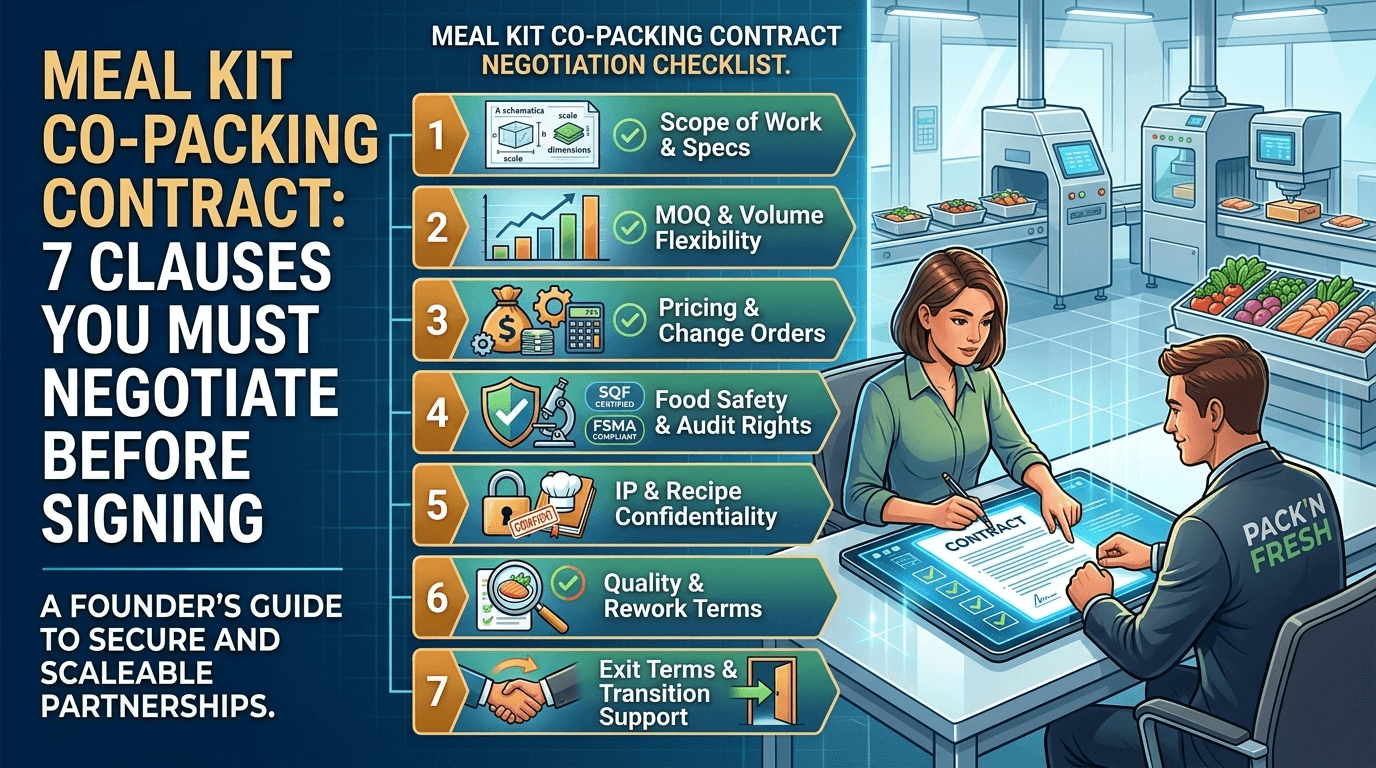
Meal Kit Co-Packing Contract: 7 Clauses You Must Negotiate Before Signing
Signing a meal kit co-packing contract is one of the most consequential decisions a food brand founder will ever make. Done right, your meal kit co-packing contract locks in a partnership that enables predictable scale, cost control, and consistent product quality. Done wrong, it leaves your brand exposed — to hidden fees, quality disputes, IP theft, and supply chain fragility that can derail your business at exactly the wrong moment.
The co-packing industry is largely unregulated in terms of contract standardization. Unlike a lease or employment agreement, there is no universally accepted meal kit co-packing contract template. This means the terms you negotiate — or fail to negotiate — define the entire operational and financial relationship with your manufacturing partner.
At Pack’n Fresh, we believe in transparent, partnership-driven agreements that protect both parties. Based on our experience working with meal kit brands at every stage of growth, here are the 7 most critical clauses every founder must negotiate in their meal kit co-packing contract before a single signature is given.
Table of Contents
- Why Your Meal Kit Co-Packing Contract Is a Strategic Document
- Clause 1 — Scope of Work and Specifications
- Clause 2 — Minimum Order Quantities (MOQs) and Volume Flexibility
- Clause 3 — Pricing Structure, Cost Escalation, and Change Orders
- Clause 4 — Food Safety, Certifications, and Audit Rights
- Clause 5 — Intellectual Property and Recipe Confidentiality
- Clause 6 — Quality Standards, Rejections, and Liability
- Clause 7 — Exit Terms, Termination, and Transition Support
- Red Flags to Watch for in Any Co-Packing Agreement
- Conclusion
- FAQs
1. Why Your Meal Kit Co-Packing Contract Is a Strategic Document — Not Just a Legal Formality
Most founders approach a meal kit co-packing contract as a necessary legal hurdle to get through before production can start. This is a costly mistake. Your meal kit co-packing contract is, in practice, the operational blueprint of your entire supply chain. It governs what your co-packer is obligated to produce, what quality level they are held to, what happens when things go wrong, and how either party can exit the arrangement.
Before entering contract negotiations, educate yourself on what food co-packing involves at a technical level. Our guide on what food co-packing is and how it benefits your business provides a strong foundation. Once you understand what a co-packer does day-to-day, you will be far better positioned to negotiate a meal kit co-packing contract that reflects the real operational complexity of the relationship.
Clause 1 — Scope of Work and Specifications: The Foundation of Any Meal Kit Co-Packing Contract
The scope of work (SOW) is the foundation of your meal kit co-packing contract. It defines precisely what the co-packer is responsible for producing — and what they are not. A vague or incomplete SOW is the single most common source of production disputes and the most preventable weakness in any meal kit co-packing contract.
What to negotiate and include:
- A detailed product specification sheet for every SKU — including ingredients, fill weights with acceptable variance tolerances (e.g., ±1g), pouch dimensions, seal parameters, and labeling requirements
- Explicit process responsibilities — who sources ingredients, who sources packaging film, who manages artwork files and print vendors
- Kitting and assembly instructions for multi-component meal kits — sequence of assembly, orientation of pouches, acceptable appearance standards
- Photography and inspection standards for finished goods — what “acceptable” vs. “rejected” looks like in writing, with images if possible
- Throughput expectations — units per day/week that the co-packer commits to under normal operating conditions
The more precise your spec sheet, the more accountable your co-packer can be — and the easier it becomes to resolve disputes when they arise. Precision specifications also directly support the kind of ERP-enabled traceability that separates professional co-packers from informal facilities.
Clause 2 — MOQs and Volume Flexibility in Your Meal Kit Co-Packing Contract
MOQs are one of the most misunderstood elements of a meal kit co-packing contract. Co-packers set MOQs to ensure production runs are economically viable given setup costs, labor, and material minimums. But for a scaling meal kit brand, rigidly fixed MOQs create dangerous inflexibility in your meal kit co-packing contract.
What to negotiate:
- A tiered MOQ structure that grows with your volume — start lower (e.g., 2,000 units/run) and ramp up as your subscription base grows, without penalty
- Ramp-up provisions — if you commit to reaching a target volume within 90 days, the co-packer holds a lower MOQ for the ramp period
- Seasonal volume flex clauses — meal kit demand fluctuates significantly between Q1 (New Year surge) and Q3 (summer slowdown); your meal kit co-packing contract should allow production calendar adjustments without financial penalty
- Minimum annual commitment vs. per-run MOQ — committing to an annual volume in exchange for lower per-run MOQs gives you operational flexibility while giving the co-packer revenue predictability
- Consequences for falling short of MOQ commitments — are you charged a short-run fee, or is the run rescheduled?
Understanding the full economics of MOQs in your meal kit co-packing contract is tied directly to your unit economics model. We break down how to account for these costs correctly in our post on the hidden costs of food business COGS calculation.
Clause 3 — Pricing Structure, Cost Escalation, and Change Orders
The pricing clause is where many brands get hurt — not through dishonesty, but through insufficient specificity in the meal kit co-packing contract. A co-packing price quote is a snapshot in time. Without a clearly negotiated escalation framework, that price can change significantly within months.
What to negotiate:
- Base tolling fee (cost per unit for labor and overhead) — locked for a defined period, typically 12 months, with a cap on annual increases (e.g., CPI + 2%)
- Material cost pass-through terms — are ingredient and packaging film costs passed through at actual cost, or is there a markup? If a markup exists, what is the maximum percentage?
- Change order pricing — what does it cost when you update a recipe, change a pouch format, or add a new SKU? Get this in writing in your meal kit co-packing contract before your first product iteration
- Setup and changeover fees — is there a charge each time the line is cleaned and reconfigured for your product? For allergen-controlled facilities, these costs can be substantial
- Storage and inventory holding fees — if your packaging film or finished goods sit in their warehouse, what is the daily/weekly charge per pallet?
- Rush order premium — what is the uplift for expedited production runs? Define “rush” in the meal kit co-packing contract (e.g., less than 5 business days’ notice)
Clause 4 — Food Safety, Certifications, and Audit Rights: Non-Negotiable in Any Meal Kit Co-Packing Contract
For a meal kit brand, your co-packer’s food safety posture is your food safety posture. This clause is non-negotiable in any meal kit co-packing contract. Retailers, insurance providers, and consumers will hold your brand responsible for the safety practices of your entire supply chain.
What to negotiate:
- Mandatory certification requirements — your meal kit co-packing contract should specify which certifications the co-packer must maintain at all times (SQF, FSMA compliance, Organic, Kosher, Gluten-Free, Non-GMO) and what happens if they lapse
- Immediate notification obligation — the co-packer must notify you within 24 hours of any FDA inspection, warning letter, or food safety incident involving your products
- Audit rights — your brand has the right to conduct announced and, critically, unannounced facility audits. Without this clause, your meal kit co-packing contract gives you no visibility
- Mock recall participation — your co-packer must support lot-level traceability mock recalls within a defined timeframe (e.g., within 4 hours of request)
- Certificate of Analysis (COA) requirements — finished goods must be accompanied by a COA confirming the product meets specification
- FSMA 204 compliance — under the FDA’s enhanced traceability requirements, your co-packer must maintain digital records traceable to raw ingredient lot level
This is a critical area where co-packer selection matters as much as the contract language itself. Our guide on 5 critical questions for choosing a food co-packer is essential reading before finalizing any meal kit co-packing contract. We also recommend reviewing allergen management and traceability risks in food packaging to understand the operational standards your contract should enforce.
Clause 5 — Intellectual Property and Recipe Confidentiality
Your recipes, formulations, spice blends, and packaging designs are your brand’s competitive moat. Without an explicit IP protection clause in your meal kit co-packing contract, you are sharing your most valuable trade secrets with no legal recourse if they are misused.
What to negotiate:
- Non-disclosure agreement (NDA) — must be bilateral, covering recipe formulations, ingredient ratios, supplier relationships, customer data, and proprietary processes
- IP ownership — all recipes, formulations, and packaging designs provided by your brand remain your exclusive intellectual property, regardless of any modifications the co-packer suggests during production
- Non-compete scope — your co-packer should not produce an identical or substantially similar product for a direct competitor without your written consent. Define “direct competitor” specifically in your meal kit co-packing contract
- Data security obligations — any digital files (formulation specs, artwork, ERP data) shared with the co-packer must be stored securely and deleted or returned upon contract termination
- Employee confidentiality — the co-packer must require all staff who handle your product formulations to sign individual NDAs
Clause 6 — Quality Standards, Rejections, and Liability
What happens when a production run does not meet your quality standards? Without a clearly defined quality clause in your meal kit co-packing contract, this disagreement can become a relationship-ending dispute — often after significant financial damage has already occurred.
What to negotiate:
- Acceptance sampling protocol — define the statistical sampling methodology used to accept or reject a production lot (e.g., AQL Level II sampling, ANSI/ASQ Z1.4)
- Rejection process — how does your brand formally reject a lot? What is the timeline for the co-packer to respond, remediate, or replace the production?
- Cost of rework — if a production run requires rework due to co-packer error (wrong fill weight, labeling error, seal failure), who bears the labor and material cost?
- Liability cap — what is the maximum financial liability the co-packer accepts for a defective run? Push for consequential damages coverage if your brand will suffer downstream losses (subscriber cancellations, retailer chargebacks)
- Product recall cost sharing — in a worst-case scenario, what portion of recall logistics, consumer notification, and disposal costs does the co-packer absorb?
- Insurance requirements — co-packer must carry product liability insurance with a minimum coverage amount (e.g., $2M per occurrence), with your brand named as an additional insured
Avoiding the most common food packaging mistakes starts with a co-packer who is contractually accountable to clear quality standards in your meal kit co-packing contract — not just verbally committed to them.
Clause 7 — Exit Terms, Termination, and Transition Support
No business relationship lasts forever, and your meal kit co-packing contract must plan for a graceful exit even when the relationship is strong. Exit clauses that are unclear or one-sided can trap brands in partnerships that no longer serve them.
What to negotiate:
- Notice period for termination without cause — typically 60–90 days for established brands; shorter (30 days) for early-stage brands with lower production volume
- Termination for cause — define what constitutes “cause” for immediate termination: material food safety breach, loss of a required certification, three or more quality rejections in a 6-month period
- Transition support obligation — upon termination of the meal kit co-packing contract, the co-packer must transfer all formulation records, return proprietary packaging materials and raw ingredient inventory, and assist in onboarding a replacement co-packer for a defined period (e.g., 30 days)
- Finished goods ownership — clarify who owns work-in-progress and finished goods at the moment of termination notice, and define payment obligations for each
- Exclusivity unwinding — if the contract includes exclusivity provisions, define how these unwind upon termination
The best co-packing partnerships are built on transparency and mutual respect — which means both parties should be comfortable with clearly defined exit terms from day one. The qualities of an accessible, responsive co-packer include a genuine willingness to put everything in writing.
9. Red Flags to Watch for in Any Meal Kit Co-Packing Contract
Beyond the 7 critical clauses above, watch for these warning signs in any meal kit co-packing contract you review:
- Unlimited IP use rights — any clause giving the co-packer rights to use your formulations for any purpose other than producing your product
- One-sided termination — only the co-packer can terminate with short notice; you are locked in for 2+ years without cause-based exits
- No audit rights — a co-packer who will not allow facility audits should not be trusted with your brand, regardless of what their meal kit co-packing contract offers on other terms
- Vague quality language — “industry standard quality” is not a quality standard. Demand specificity in every clause
- Unlimited liability exclusions — clauses that fully exempt the co-packer from liability for product recalls, even when caused by their own error
- Missing food safety certification requirements — no mention of SQF, FSMA, or equivalent certifications means you are accepting unknown compliance risk in your meal kit co-packing contract
10. Conclusion: Your Meal Kit Co-Packing Contract Is Your Brand Protection
A well-negotiated meal kit co-packing contract is not about distrust — it is about building a partnership on a foundation of clarity. When both parties understand their obligations, quality expectations, and exit rights from the beginning, the relationship is far more likely to thrive through the inevitable challenges of scaling a food brand.
At Pack’n Fresh, we welcome transparent, detailed contractual discussions because we are confident in what we deliver. Our SQF-certified, ERP-integrated facility gives brands the food safety, traceability, and operational consistency that should be at the heart of any meal kit co-packing contract. If you’re ready to evaluate a co-packing partnership built on integrity and full transparency, reach out to our team today.
FAQs — Meal Kit Co-Packing Contract
Q. What should be included in a meal kit co-packing contract?
A comprehensive meal kit co-packing contract should include: scope of work and product specifications, MOQ and volume flexibility terms, pricing and cost escalation clauses, food safety and certification requirements, IP and recipe confidentiality protections, quality standards and liability terms, and clearly defined exit and termination conditions.
Q. How long should a meal kit co-packing contract term be?
For early-stage meal kit brands (under 10,000 units/week), a 12-month initial term with renewal options is typically appropriate. Larger brands may negotiate 2-year terms in exchange for volume commitments or favorable pricing. Avoid multi-year meal kit co-packing contract terms without clear cause-based exit provisions.
Q. Can I negotiate MOQs in a co-packing agreement?
Yes, and you should. Tiered MOQ structures, ramp-up provisions, and seasonal volume flex clauses are all negotiable in a meal kit co-packing contract, especially with co-packers who value long-term partnerships over rigid short-term commitments.
Q. What food safety requirements should my meal kit co-packing contract include?
At minimum, your meal kit co-packing contract should require a GFSI-recognized certification (SQF, BRC, or FSSC 22000), full FSMA compliance, lot-level traceability through an ERP system, and your brand’s right to conduct unannounced facility audits.
Q. What happens to my recipe if I leave a co-packer?
Your recipe and formulation data should remain your exclusive intellectual property under any meal kit co-packing contract. Ensure your contract includes a clear IP ownership clause, a bilateral NDA, and a data return or deletion obligation upon contract termination.