Category

Founder / Co-Founder

The Meal Kit Executive’s Packaging Solutions: How to Control Costs & Drive Profitability

The Meal Kit Executive's Packaging Solutions

The Meal Kit Executive’s Packaging Solutions: How to Control Costs & Drive Profitability

You lead an established meal kit business that has successfully scaled beyond the startup phase. You have a loyal customer base and a respected brand.

However, growth has introduced massive, complex problems—and they all center on one critical area: Packaging and Logistics.

Your success is no longer about the recipes; it’s about supply chain execution. It’s about how you efficiently and profitably get specialized, shelf-stable components—like high-value spice blends, specialty grains, or finishing sauces—into a single customer box, 1,000 miles away.

If your system is built on outdated, manual, or fragmented logistics, your growth is being capped by runaway costs. This is the definitive guide for operations managers and executives who are ready to transition their current supply chain to a more scalable, professional, and profitable model. We’ll cover the massive drain of the fragmented vendor model, the materials that guarantee margin, and the strategic partnership that unlocks the next phase of profitable growth: Turnkey Meal Kit Co-Packing.

Chapter 1: The Fragmented Supply Chain: Why Juggling Vendors Is Draining Profitability

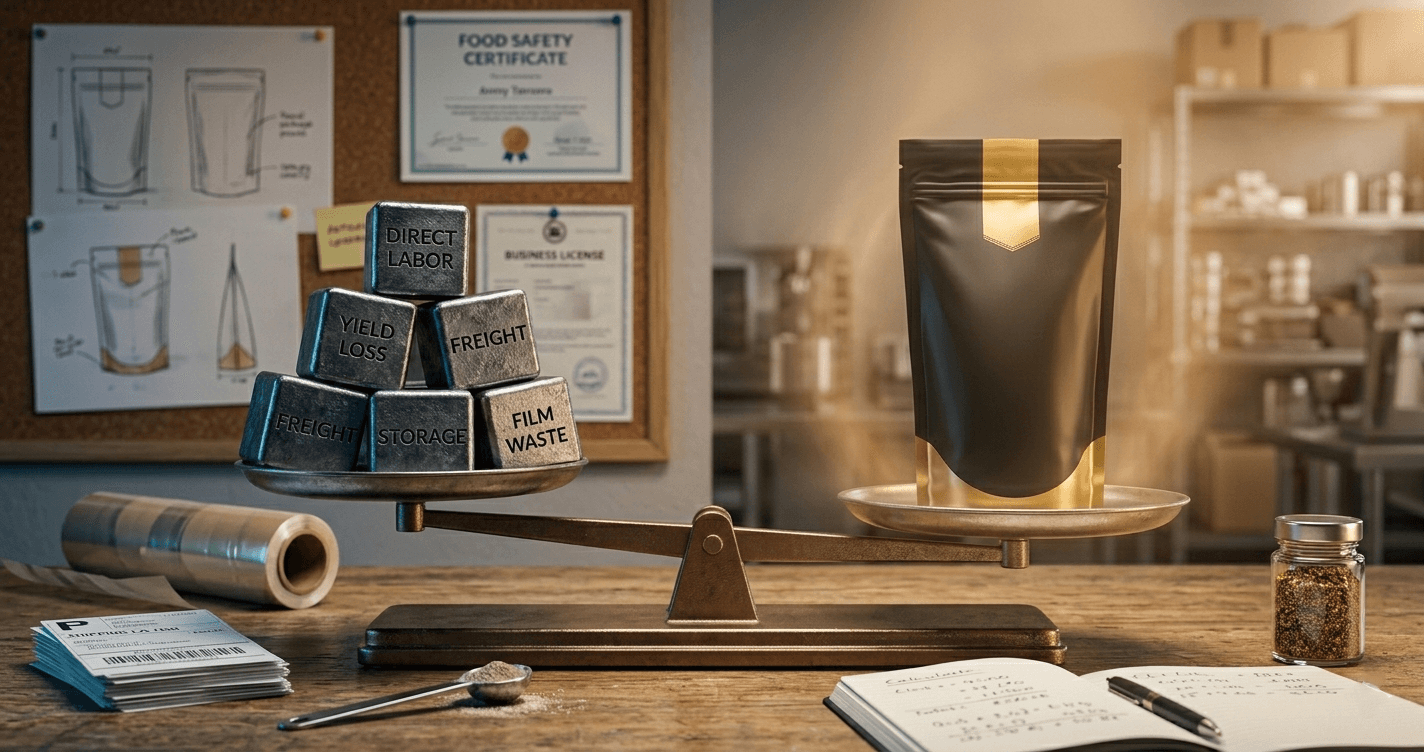
The current system of sourcing components from 10+ different vendors (blending, packaging, labeling, shipping) is a financial and operational liability. This complexity is not a sign of efficiency; it’s a sign of a fragmented supply chain built on risk.

For an established enterprise, the true cost of this “Vendor Juggle” is immense:

  • Massive Inventory Bloat: Forcing an established company to purchase massive Minimum Order Quantities (MOQs) of raw packaging materials (boxes, film, jars) that tie up critical working capital and require vast, expensive warehouse space.
  • Operational Risk: Relying on multiple handoffs means one delay, one quality control failure, or one miscommunication can halt production across your entire enterprise.
  • No Volume Consolidation: The sheer inefficiency of buying 10 small quantities from 10 different people ensures you never achieve the true economy of scale that your enterprise volume should command.
  • Traceability Liability: An outdated, non-integrated system makes lot-level traceability a manual, complex, and potentially company-ending legal risk during an audit or recall.

Chapter 2: The Strategic Solution: How Turnkey Co-Packing Unlocks True Scalability

A turnkey co-packer is a single partner that manages the entire packaging and kitting process for you—from sourcing raw ingredients to blending your proprietary mixes, to packaging them into pouches, and handing them off to your final fulfillment house.

This transition is the most impactful decision an established business can make to simplify its operations and immediately improve its margin.

Operational Function The Old, Fragmented Way The New Turnkey Way
Vendor Management 10+ partners (Blender, Pouch Supplier, Kitter, Shipper) 1 Strategic Partner (Your Co-Packer)
Inventory Risk High. Capital tied up in packaging MOQs and storage. Low. Co-packer manages material sourcing and just-in-time delivery.
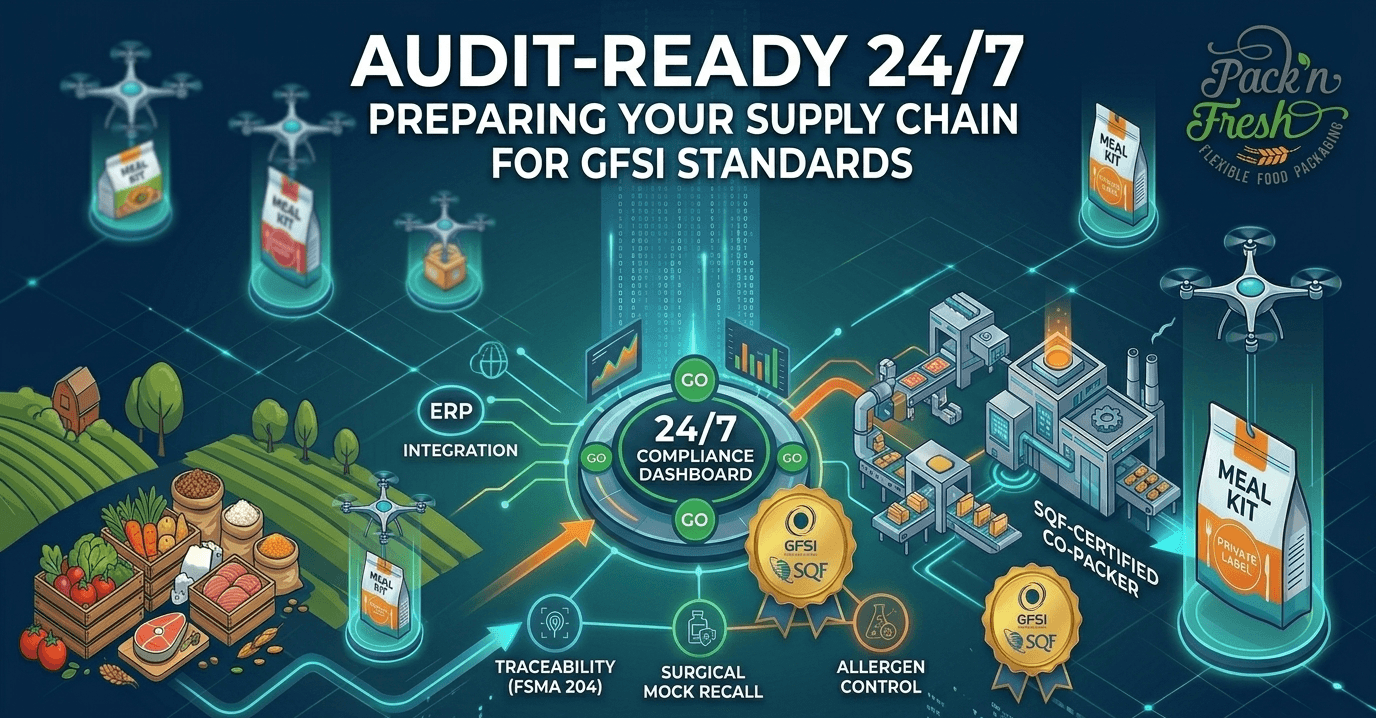
Traceability Messy paper trails, high legal/audit risk. Digital, lot-level tracking (ERP) in a single system.
Executive Focus Managing Logistics and QC Headaches Driving Brand Growth and Marketing Strategy

Chapter 3: The Ultimate Packaging Format: Why Pouches Won

Your packaging is your customer’s first physical experience with your brand. The reliance on rigid plastic tubs and heavy jars is now a significant cost center.

The clear winner for stable, non-perishable ingredients—especially your high-value spice blends, specialty grains, coffee, and finishing sauces—is the flexible, small-format pouch (stand-up, pillow, and stick packs).

The Pouch Advantage for Established Enterprises:

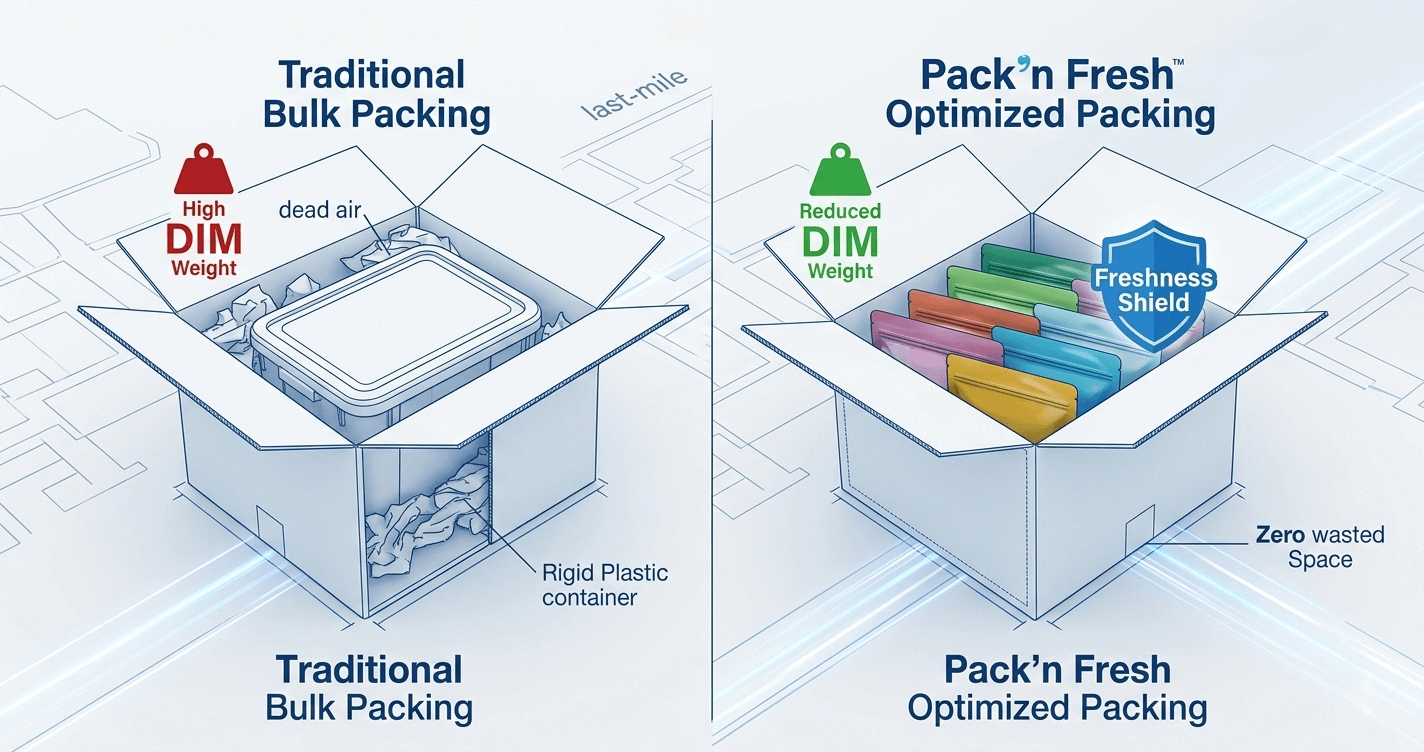
  • It Slashes Your Shipping Costs (DIM Weight):
    • Pouches are lightweight and form-fitting. They allow you to use a significantly smaller final shipping box.
    • This directly and immediately reduces your “Dimensional Weight (DIM)” freight charges—a cost that can make or break the profitability of high-volume shipments.
  • It Elevates Your Premium Brand:
    • The modern, flat, custom-printed pouch is a vibrant, full-color “mini-billboard” that wins at the point of sale (or in the unboxing experience). A small label on an opaque tub cannot compete with the brand presence of a full-surface printed pouch.
  • It Simplifies Kitting:
    • Pouches are easy to handle, stack efficiently, and reduce breakage compared to rigid containers, leading to faster, more accurate kitting and a better customer experience.

Chapter 4: The Professional Edge: Integrated Systems and Compliance

Scaling successfully means adopting best-in-class operational professionalism. This relies on an integrated, modern approach to food safety and logistics.

The ERP System: Your Traceability Insurance

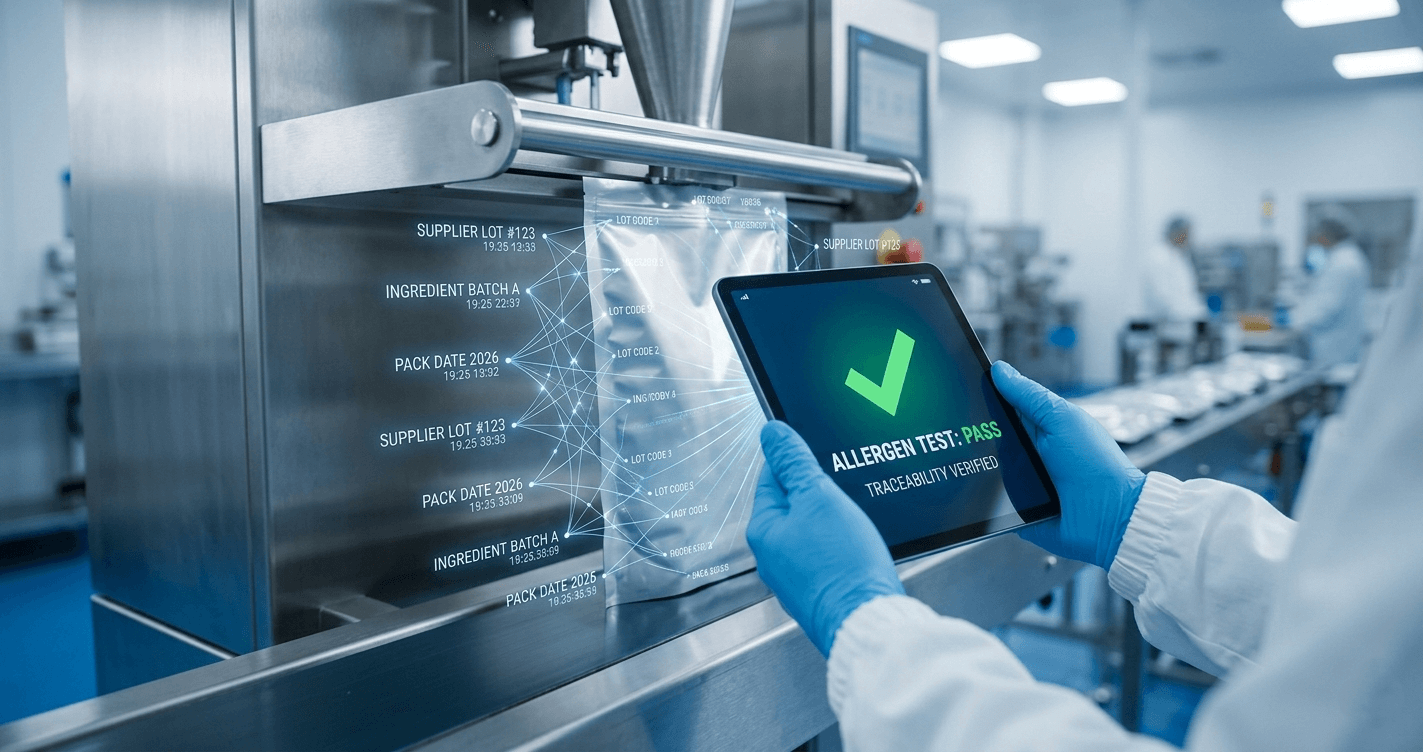
An Enterprise Resource Planning (ERP) system digitally tracks every single ingredient from the moment it enters the facility to the moment it leaves in a customer’s kit.

  • Compliance: This is your best and fastest defense against an FDA audit or a product recall.
  • Efficiency: It ensures accurate, real-time inventory management, which is essential for managing your complex supply chain and preventing out-of-stocks.

A professional co-packer doesn’t just use an ERP system; they integrate their lot codes and inventory reporting directly with your systems, providing a single source of truth for your entire operation.

Chapter 5: How to Choose Your Strategic Meal Kit Co-Packer

When you are already an established brand, the decision is not if you need a co-packer, but which partner is sophisticated enough to handle your scale and complexity.

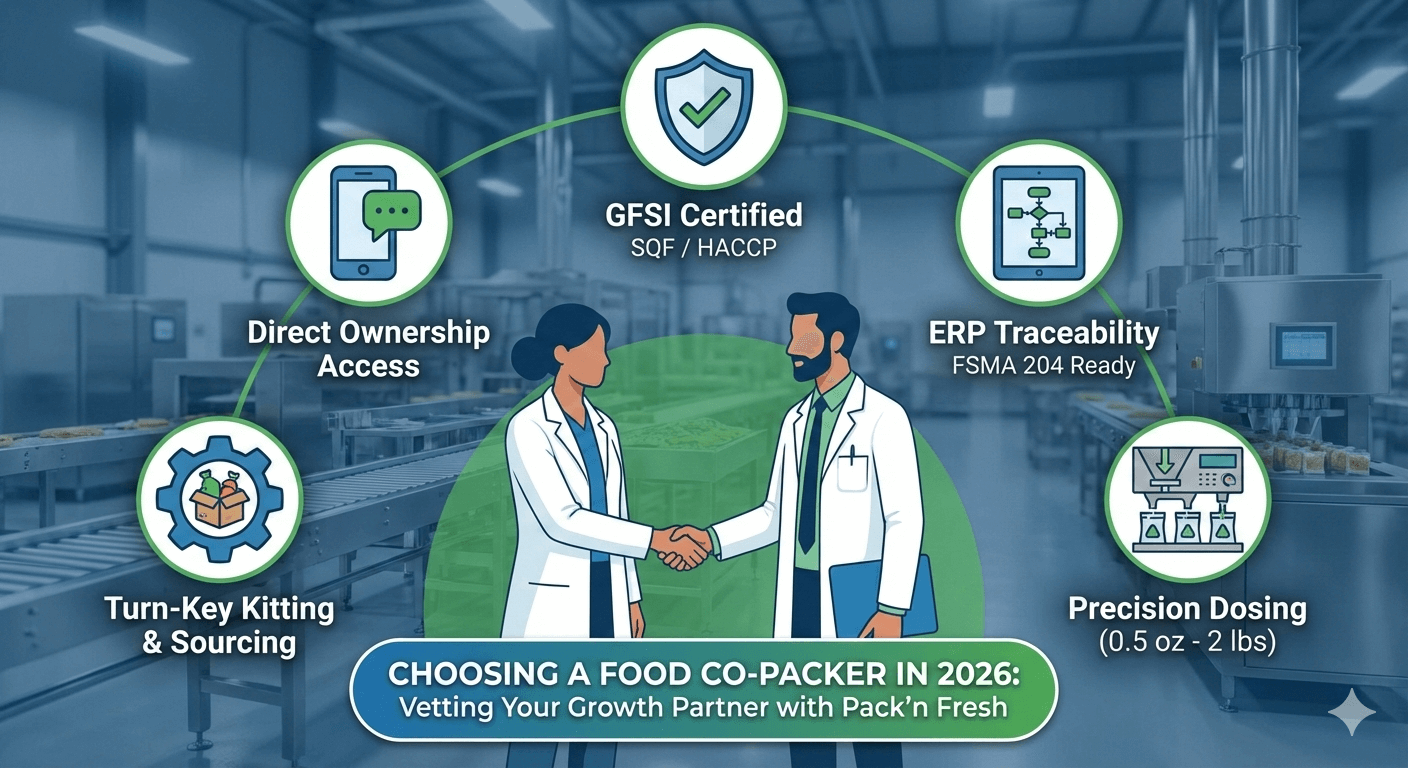
  • Ask About Specialization: Does their facility match your needs? They should specialize in high-SKU meal kit kitting, small-format (< 2lb) pouches and kits of shelf-stable components.
  • Ask About Blending: If you have proprietary spice or powder blends, your co-packer should have in-house blending capabilities. Managing two separate partners (a blender and a packager) re-creates the “DIY Trap.”
  • Ask About Food Science: Are they just machine operators, or are they food scientists and quality control experts? Their team should be able to consult on material integrity and shelf life.
  • Ask About Equipment Flexibility: Do they have a range of equipment that allows them to scale with you, or are they limited to one machine that requires massive MOQs?

Your Next Step: From Complex Operations to Streamlined Profitability

The right turnkey co-packing partner provides the integrated systems, expertise, and operational structure that frees your enterprise from the inefficiencies of the fragmented supply chain. It’s the moment your logistics stop being a bottleneck and start being a competitive advantage.

About Pack’n Fresh, Pack’n Fresh is the expert turnkey co-packing partner for scaling food brands. We specialize in the exact needs of the established meal kit industry: high-SKU, small-format (< 2lb) pouches, in-house blending, and complex kitting, all backed by a food-science-led team and a state-of-the-art ERP system.

Stop managing logistics. Start driving profitability. Contact us today for a strategic consultation.

The Modern Snack & Spice Brand’s Playbook: How to Win at Retail with Pouch Packaging

Packnfresh - Pouch Packaging

The Modern Snack & Spice Brand’s Playbook: How to Win at Retail with Pouch Packaging

You’re a modern food founder. You’ve created a unique snack mix, an artisanal spice blend, or a new superfood granola. Your product is amazing, your branding is on point, and you’re ready to go from the farmer’s market to the retail shelf.

Now you’re facing the single biggest hurdle: “pouch packaging”.

The old-world model of glass jars (for spices) or flimsy bags-in-boxes (for snacks) is dead. It’s expensive, heavy, breaks easily, and has zero “pop” on a crowded shelf.

To win in modern retail, your pouch packaging has to be your *#1 salesperson*. It needs to be premium, cost-effective, and functional. This is why the stand up pouch packaging has become the undisputed champion for snack and spice brands.

This is your playbook for using pouch packaging to scale your brand and win at retail.

Chapter 1: Why Pouches Won: The Retail Shelf Takedown

Walk down the snack or spice aisle. The most successful, fastest-growing brands have all moved to pouches. This is not a coincidence. It’s a strategic takedown of older, inefficient formats.

The Pouch vs. The Glass Jar (for Spices)

  • Shipping: Glass is heavy and fragile. You pay a fortune in freight and shrink (breakage). Pouches are lightweight and unbreakable, slashing shipping costs.
  • Branding: A jar gives you a tiny, 2×3-inch label. A pouch gives you a 360-degree, full-color brand canvas that stands up and acts like a mini-billboard.
  • Freshness: A glass jar doesn’t protect from UV light, which rapidly degrades the color and potency of spices. A high-barrier, opaque pouch is a “vault” that protects your product from light and oxygen.

The Pouch vs. The “Bag-in-Box” (for Snacks/Granola)

  • Customer Experience: The bag-in-box is the most hated format. The inner bag is impossible to reseal, the box gets crushed, and the product goes stale in days. A pouch with a resealable zipper is a premium experience that customers love.
  • Shelf Presence: A box looks dated. A custom-printed pouch looks modern, healthy, and premium, allowing you to justify a higher price point.
  • Cost: A bag-in-box is two packaging components (bag + box), which means more material and more complex assembly. A pouch is a single, efficient, all-in-one solution.

(Deep Dive: How to Package Snacks for Retail: A Startup’s Guide to Pouches)

(Deep Dive: Flexible Food Packaging vs. Rigid: A Cost-Benefit Analysis)

Chapter 2: The Turnkey Co-Packing Advantage

You’re convinced. You need pouches. Now, how do you get them?

  • The DIY Trap: You try to source your nuts from one vendor, your spices from another, your pouch film from a third, and find a “co-packer” to assemble it all. This is a logistical nightmare.
  • The Turnkey Solution: You partner with a turnkey co-packer. This is a single, expert partner who manages the entire process for you.

At Pack’n Fresh, our turnkey model for a snack/spice brand looks like this:

  • Consultation: We start with your recipe. Our food science team recommends the perfect high-barrier film and active packaging (see Chapter 3) to guarantee freshness.
  • Sourcing & Blending: We source all your raw ingredients (nuts, spices, seeds, etc.) and use our in-house, commercial-scale blenders to perfectly create your 5-star recipe, every time.
  • High-Speed Packing: Your blend is moved directly to our state-of-the-art pouching lines, where it is automatically portioned, gas-flushed, and sealed.

You manage one partner. You get one invoice. And you get your time back to focus on sales and marketing.

(Deep Dive: What is Turnkey Co-Packing? A Simple Explanation for Food Brands)

Chapter 3: The Science of “Crunch”: Protecting Your Product

For a snack or spice brand, freshness is everything. “Stale” is a brand-killer. This is where your co-packer’s expertise in food science becomes your critical advantage.

We build a “packaging system” to defend your product’s specific texture and flavor.

For Snacks (Nuts, Granola, Mixes)

  • The Enemy: Oxygen. Oxygen oxidizes the fats in nuts, making them taste rancid and stale in a matter of weeks.
  • The Solution: Oxygen Absorbers. We insert a small “scavenger” packet into each pouch before sealing. It actively absorbs 99.9% of the oxygen, stopping the oxidation process cold. This can extend your snack’s shelf life from 3 months to 12 months.

For Spices (Blends, Rubs)

  • The Enemy: Moisture & UV Light. Moisture makes your blend “clump” into a solid brick. UV light from a store shelf bleaches the color and degrades the flavor.
  • The Solution: **Desiccants & Opaque Film**. We use a high-barrier, opaque pouch to block 100% of UV light. Then, we add a “desiccant” packet to absorb all moisture, keeping your blend powdery and fresh.

This is the science that retailers and customers respect. It’s the difference between an amateur product and a professional one.

(Deep Dive: What is Active Packaging? A Practical Guide to Extending Shelf Life)

Chapter 4: How to Choose Turnkey Snack and Spice Co-Packer

You’re looking for a partner to grow with. The wrong co-packer will trap you with massive MOQs (Minimum Order Quantities) or won’t have the right equipment.

You need a flexible specialist. Ask these questions:

  • What is your specialization? A co-packer who handles giant 50lb bags of flour is the wrong choice. You need to hear: “We specialize in high-SKU, small-format (< 2lb) pouches for high-growth brands.” This is our entire focus at Pack’n Fresh.
  • Do you have in-house blending? This is non-negotiable. If they can’t blend your recipe and pack it in the same facility, they aren’t a true turnkey partner.
  • What is your equipment portfolio? If they only have one giant machine, you’ll face massive MOQs. You want to hear: “We have an extensive equipment portfolio.” This is the key to flexible MOQs. It means they have the right-sized machine for your pilot run and your 500,000-unit retail order.
  • How do you ensure quality? Look for two things: a **food-science background** and an ERP system for digital lot-level traceability. This is your proof of professionalism.

(Deep Dive: 3 Signs You’ve Outgrown Your Commercial Kitchen)

Your Next Step: From Kitchen Table to Retail Shelf

You’ve created an amazing product. Don’t let your pouch packaging be the bottleneck that stops you from scaling.

The move to a turnkey pouch system is the most important investment you can make in your brand’s future. It cuts costs, elevates your brand, and delivers the “wow” experience that gets you off the shelf and into the customer’s cart.

Pack’n Fresh is the expert partner for snack and spice founders. We provide the turnkey sourcing, in-house blending, and food-science expertise to move your brand into the major leagues.

Ready to look like a national brand? Contact us for a consultation today.

The Ultimate Guide to Supplement Co-Packing: From Powders to Pouches

Packnfresh - Supplement Co-Packing

The Ultimate Guide to Supplement Co-Packing: From Powders to Pouches

You’re a supplement brand founder. You’ve spent months, maybe years, perfecting your formulation. You have a product that delivers real results, and you’ve built a brand that customers are starting to trust.

But now you’re facing a problem that has nothing to do with your formula. It’s a logistics and cost problem.

The heavy, rigid plastic tubs you’re using are a bottleneck. They are expensive to buy, expensive to store, and astronomically expensive to ship in an e-commerce and subscription-box world. You’re competing in a crowded market where brand matters, but your “brand” is a small sticker on a generic white tub.

This is the guide for supplement founders who are ready to switch to a smarter, more profitable, and more premium packaging format. We’ll explore why flexible pouches are the future of the industry and how to find a supplement packaging manufacturers to help you make the switch.

Chapter 1: The “Tub Tax”: How Rigid Bottles Are Draining Your Margin

For decades, the rigid plastic tub or “bottle” was the default for protein, collagen, and vitamin powders. In a brick-and-mortar retail world, this made some sense. But in a modern, direct-to-consumer (DTC) model, it’s a financial drain.

We call this the “Tub Tax”—a series of hidden costs you’re paying at every step:

  • You Pay to Ship Air: Tubs are mostly empty air, and they don’t collapse. In an e-commerce world ruled by Dimensional Weight (DIM), you are paying carriers to ship that empty space.
  • You Pay to Store Air: A single pallet of empty tubs takes up a massive amount of expensive warehouse space.
  • You Pay for Inefficiency: Tubs are heavy, prone to cracking, and have high material costs compared to their lightweight counterparts.
  • You Pay with Your Brand: Your branding is limited to a small, applied label. You look like everyone else on the shelf.

This is why you see the most innovative, fastest-growing supplement brands making a universal switch.

Chapter 2: The Pouch Revolution: The #1 Format for Modern Brands

The future of supplement packaging is the flexible, small-format (< 2lb) stand-up pouch.

This isn’t just a trend; it’s a strategic move to a superior format. For a direct-to-consumer brand, pouches solve every problem that tubs create.

  • They Slash Shipping & Storage Costs: A lightweight, form-fitting pouch is the perfect e-commerce package. It’s 70%+ lighter, takes up less space in a subscription box, and drastically cuts your DIM weight shipping costs. One pallet of flat pouches holds the equivalent of 15-20 pallets of empty tubs.
  • They Are a Premium Brand Canvas: The entire pouch is your “billboard.” You get edge-to-edge, stunning, full-color printing. A pouch looks and feels premium, allowing you to stand out in a sea of generic tubs.
  • They Offer a Better Customer Experience: Pouches are portable (gym bags, travel), resealable, and create less plastic waste. This aligns perfectly with the values of a health-conscious consumer.
  • They Unlock New Markets: Pouches allow for two key formats:
    • Bulk Pouches (1-2 lb): The new standard for your core protein/collagen product.
    • Single-Serve “Stick Packs”: The ultimate tool for trial, travel, and subscription box “samplers.”

(Deep Dive: Custom Vitamin Packaging: Why Pouches Beat Bottles)

(Deep Dive: Finding a Low-MOQ Supplement Co-Packer)

Chapter 3: The Science of Supplement Packaging (Protecting Your Formula)

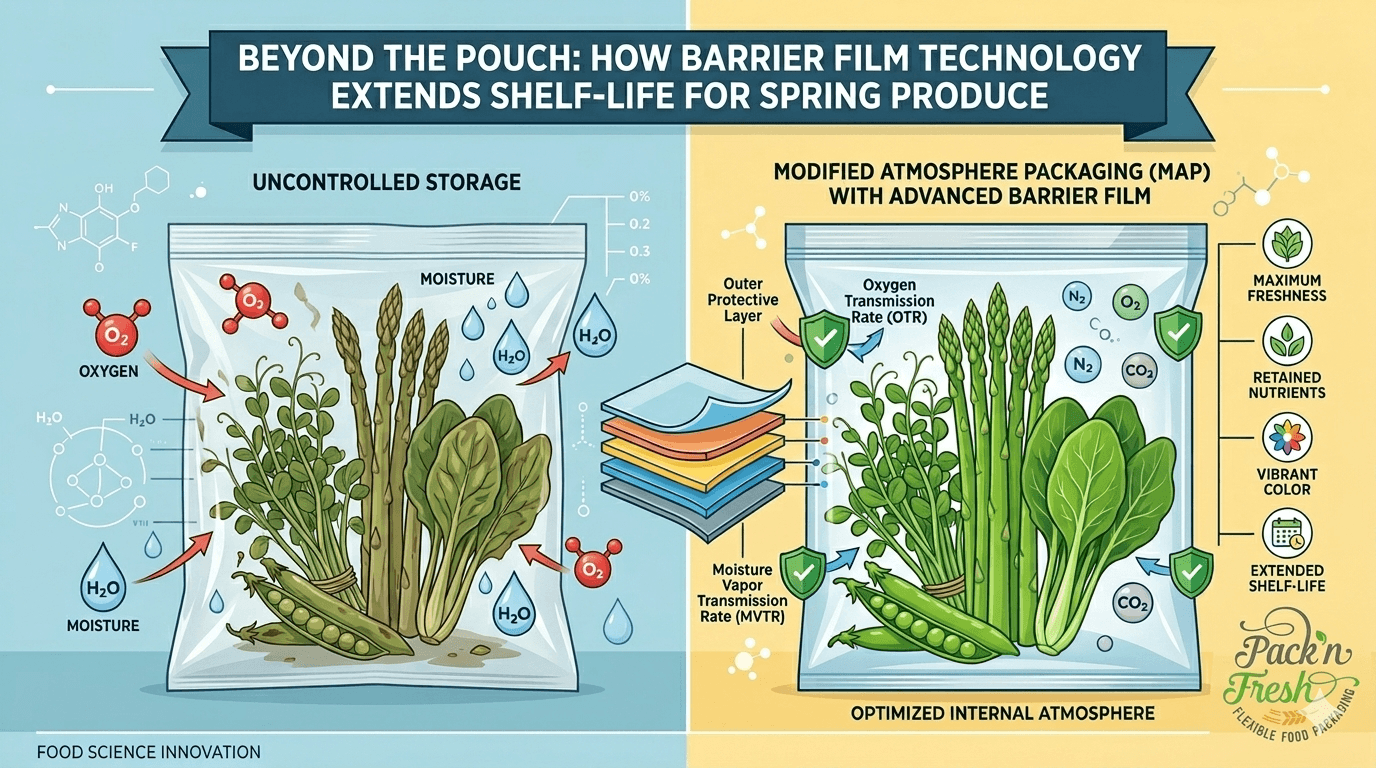
Your #1 asset is your formula. Your packaging’s primary job is to protect its potency and freshness from its two greatest enemies: moisture and oxygen.

This is where your co-packer’s food science expertise is non-negotiable.

1. The Moisture Menace (Clumping)

Powders (especially those with botanicals or vitamins) are hygroscopic—they love to absorb moisture from the air. This causes clumping, ruins mixability, and can degrade the product.

  • The Solution: A high-barrier pouch film is your first defense. The second is a desiccant (a moisture-absorbing packet) inserted into the pouch by your co-packer. This “pulls” all residual moisture from the pouch, keeping your powder perfectly dry.

2. The Oxygen Problem (Degradation)

Oxygen is the enemy of freshness. It oxidizes fats (going rancid) and rapidly degrades the potency of sensitive ingredients like vitamins (Vitamin C, E) and Omega-3s.

  • The Solution: An oxygen scavenger (or “absorber”). This is a small packet that we insert into the pouch, which then absorbs 99.9% of the destructive oxygen, “locking in” freshness and protecting the potency of your formula for its entire shelf life.

(Deep Dive: What is Active Packaging? A Practical Guide)

Chapter 4: The Compliance & Safety Mandate (Your ERP “Defense”)

The supplement industry is governed by strict FDA regulations (cGMP). You are legally responsible for the safety and traceability of your product, and “I don’t know” is not an answer.

This is why your co-packer’s internal software is critical.

  • DIY Risk: Trying to track ingredient lots across your supplier, your blender, and your packager via spreadsheets is a massive compliance risk.
  • The Professional Solution: A true co-packing partner, like Pack’n Fresh, runs on a single ERP (Enterprise Resource Planning) system. This provides a digital, lot-level “chain of custody” from the moment a raw ingredient arrives to the moment your finished pouch ships. In the event of an audit or recall, you have an instant, professional report.

(Deep Dive: Why Your Co-Packer’s ERP System is Your Best Defense)

Chapter 5: How to Choose Your Supplement Co-Packer

You’re ready to move to pouches. Now you must choose a partner. Be careful: the co-packer who fills 50lb bags of flour is the wrong partner for your high-value, 1lb pouch of protein.

You need a specialist. Ask these questions:

  • What is your specialization? You want to hear: “We specialize in small-format (< 2lb) pouches and turnkey co-packing.” This is our exact focus at Pack’n Fresh.
  • What is your background? You want to hear: “Our co-founders come from food science and quality control.” This proves they are experts in product safety, not just machine operators.
  • What is your equipment portfolio? You want to hear: “We have an extensive portfolio of equipment.” This is the key to flexible MOQs. It means they have the right-sized machine for your brand, whether you’re at 5,000 units or 500,000.
  • Do you offer turnkey services? The answer must be “Yes.” A partner who can source your ingredients, blend your formula, and pack your product is the only way to simplify your business and scale.

Your Next Step: From Bottleneck to Breakout Brand

Stop letting rigid tubs and high shipping costs drain your margins. The move to flexible pouches is the single most effective way to cut costs, elevate your brand, and create a better customer experience.

Pack’n Fresh is the expert turnkey supplement co packer for scaling supplement brands. We provide the food-science expertise, the state-of-the-art pouching equipment, and the ERP-backed compliance you need to compete and win.

Stop paying the “Tub Tax.” Contact us today for a consultation.