
Nutraceutical Packaging: 7 Proven Ways to Protect Potency, Ensure FDA Compliance, and Scale Faster
The nutraceutical space — functional foods, dietary supplements, adaptogens, protein formats, probiotic blends — is among the most complex packaging environments in consumer packaged goods. Active ingredients that degrade on contact with oxygen, moisture, or heat; FDA labeling requirements that differ significantly from conventional food; potency claims that can only be supported if the packaging protects ingredient integrity through shelf life.
Getting nutraceutical packaging right is not a design decision — it is an engineering decision with regulatory consequences. The margin for error is narrow, and the downstream cost of getting it wrong can be measured in chargebacks, recall costs, and brand equity erosion that takes years to recover from.
The most common nutraceutical packaging failures are silent. A probiotic CFU count that has dropped 40% by month six because the oxygen barrier was under-specified. An ashwagandha powder that has clumped into a brick because moisture vapor transmission was not accounted for during packaging material selection.
A collagen stick pack that the consumer cannot open cleanly because the tearnotch was positioned incorrectly for the film laminate being used. These failures don’t announce themselves at launch — they accumulate in customer complaints, subscription cancellations, and Amazon reviews that chip away at the brand equity you spent months building through marketing and influencer partnerships.
At Pack’n Fresh, we co-pack functional food and supplement brands using precision micro-dosing equipment, barrier-specified packaging materials, and dry blending capability designed for active ingredient integrity. Our SQF-certified, GMP-compatible facility in Grand Prairie, TX handles the full production chain — from ingredient sourcing and dry blending through precision filling and finished product kitting.
This guide gives you the 7 proven nutraceutical packaging strategies that protect potency, satisfy FDA labeling requirements, and support a co-packing partnership built to scale.
Table of Contents
- Why Nutraceutical Packaging Is More Demanding Than Standard Food Packaging
- FDA Compliance: Structure/Function Claims, Supplement Facts, and What Your Label Cannot Say
- The 7 Nutraceutical Packaging Strategies That Protect Potency and Ensure Compliance
- High-Risk Ingredients That Demand Superior Nutraceutical Packaging: Probiotics, Omega-3s, and Adaptogens
- Nutraceutical Packaging Formats: Stick Packs, Sachets, Pouches, and Cartons
- The Biggest Nutraceutical Packaging Compliance Mistakes — and How to Avoid Them
- How Pack’n Fresh Supports Nutraceutical and Functional Food Brands
- FAQs — Nutraceutical Packaging
1. Why Nutraceutical Packaging Is More Demanding Than Standard Food Packaging
Standard food packaging must protect against contamination and spoilage — preventing microbial growth, preventing physical damage in transit, and maintaining acceptable flavor and texture through the product’s shelf life. That is a demanding set of requirements, but it is a relatively well-understood engineering problem with decades of industry data behind it.
Nutraceutical packaging must do all of that and then go further: it must protect the biological activity of active ingredients that are often more chemically sensitive than the food matrix they are delivered in.
Probiotics are living organisms. Colony-forming unit (CFU) viability declines measurably with any sustained heat exposure, with oxygen exposure, and with elevated relative humidity. A probiotic product that tests at 10 billion CFU at the time of manufacture may reach the consumer at 4 billion CFU if the packaging barrier specification was not sufficient for the distribution environment.
Depending on your label claim, that gap may represent a material inaccuracy — and it certainly represents a consumer experience failure that will surface in reviews and subscription cancellations before the production team realizes there is a problem.
Omega-3 fatty acids, including fish oil and algal oil, oxidize in the presence of oxygen and light through a process called lipid oxidation. Oxidized fish oil does not simply lose efficacy — it produces aldehydes and peroxides that create objectionable flavors and have their own potential health implications. Even small amounts of residual oxygen within a sealed package can accelerate oxidation if the barrier film is inadequate for the product’s target shelf life.
Vitamin C (ascorbic acid) degrades with light, heat, and oxidation. Adaptogens and botanical extracts in dried powder form are relatively stable against microbial risk but highly sensitive to moisture — clumping and caking do not affect safety, but they devastate the consumer experience when a packet of ashwagandha arrives looking like a compressed disc rather than a flowable powder.
Collagen peptides carry higher water activity than many other supplement ingredients, making moisture ingress the primary packaging failure mode across a broad range of distribution environments.
Each ingredient class has different packaging engineering requirements. And when you are producing a multi-ingredient nutraceutical formula — a stick pack combining a probiotic base, vitamin C, and an adaptogen blend, for example — your nutraceutical packaging specification must address the requirements of the most sensitive ingredient in the entire formulation.
You cannot average the sensitivity profiles. You protect at the ceiling of sensitivity, not the mean.
2. FDA Compliance: Structure/Function Claims, Supplement Facts, and What Your Label Cannot Say
FDA regulates dietary supplements under the Dietary Supplement Health and Education Act of 1994 (DSHEA). The foundational regulatory distinction is this: dietary supplements may make claims about their role in supporting normal bodily structure or function, but they cannot make disease claims.
Understanding this distinction is not optional for any brand producing nutraceutical products — it defines what your packaging can legally say to the consumer and what regulatory exposure you carry if you cross the line.
Structure/function claims are permitted. “Supports immune health,” “promotes healthy digestion,” “helps maintain bone density,” “supports mental clarity” — these are allowable claim formats because they describe how a nutrient or ingredient affects the normal structure or function of the human body.
The FDA structure/function claim requirements outline the specific conditions under which these claims can be made, including a requirement to notify FDA within 30 days of first marketing a product bearing a structure/function claim and to include a disclaimer on the label stating the claim has not been evaluated by FDA and the product is not intended to diagnose, treat, cure, or prevent any disease.
Disease claims are prohibited. “Treats arthritis,” “prevents cancer,” “cures COVID,” “reduces blood pressure in hypertensive patients” — these are disease claims and cannot legally appear on a dietary supplement label. The line between a permissible structure/function claim and an impermissible disease claim can be subtle, and brands should work with a regulatory consultant when developing label copy for products with complex health benefit narratives.
A co-packer producing your label is not legally responsible for the compliance of your claim language — but a co-packer with a strong quality culture will flag claims that present obvious compliance risk before they go to print.
The Supplement Facts panel is required on dietary supplements — not the Nutrition Facts panel used on conventional food. The Supplement Facts panel must list serving size, servings per container, and per-serving amounts of each declared active ingredient, including the specific form of the ingredient (calcium as calcium carbonate, vitamin B12 as methylcobalamin, and so on).
The FDA dietary supplement labeling requirements provide the full technical specification for Supplement Facts panel formatting and required content elements.
GMP compliance under 21 CFR Part 111 is required for dietary supplement manufacturers and their co-packers. These regulations govern physical facility standards, equipment qualification, sanitation programs, personnel training, identity testing of incoming ingredients, in-process controls, finished product testing, and record-keeping.
The GMP framework creates the documentation foundation that makes your Supplement Facts panel defensible: you can demonstrate, through batch records and certificates of analysis, that the product you manufactured matches the label you placed on it.
NSF International dietary supplement certification programs, including NSF Certified for Sport, provide third-party verification of GMP compliance and formula accuracy. NSF certification is increasingly expected by retailers, athletic organizations, and sophisticated consumers — and it represents an independent verification that your nutraceutical packaging and production systems meet the standards your label claims require.
3. The 7 Nutraceutical Packaging Strategies That Protect Potency and Ensure Compliance
Strategy 1 — Specify Barrier Film Based on Your Most Sensitive Ingredient
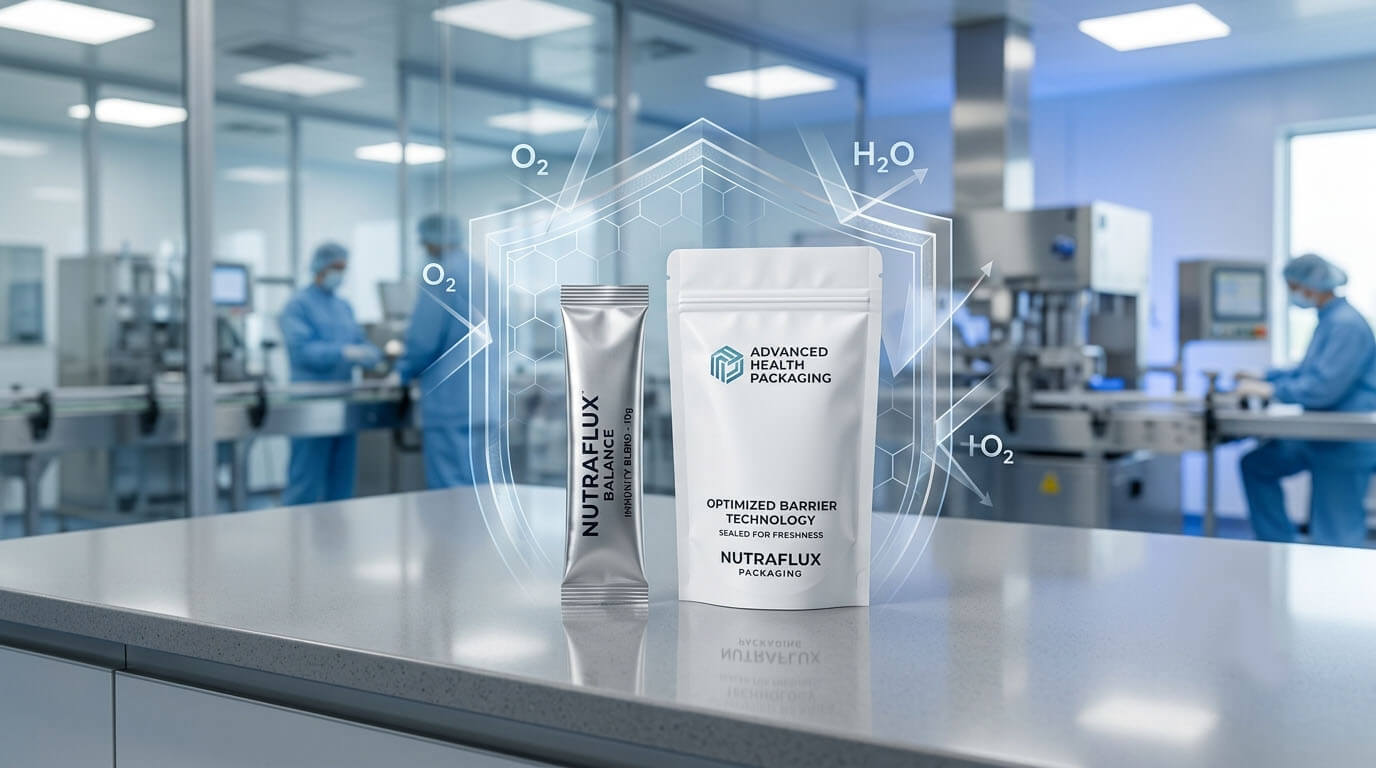
Barrier film specification is the first and most consequential decision in nutraceutical packaging engineering. Three parameters define a packaging material’s barrier performance: oxygen transmission rate (OTR), moisture vapor transmission rate (MVTR), and light transmission.
Each must be specified based on the sensitivity profile of your most sensitive active ingredient — not based on average ingredient sensitivity, cost optimization, or whatever laminate the co-packer happens to have in their existing material inventory.
For a probiotic stick pack, the specification should include a high OTR barrier (typically a metalized laminate or foil laminate structure), a tight MVTR, and a light-blocking outer layer. For a collagen powder sachet, the MVTR barrier is the primary concern — preventing moisture ingress that causes caking — with moderate OTR requirements. For a product containing omega-3 oil in any form, maximum OTR barrier and an opaque outer layer are essential to prevent lipid oxidation during the product’s intended shelf life.
The right barrier structure is determined by your formulation, confirmed by accelerated shelf life testing, and sourced by your co-packer. A co-packer with material sourcing capability — one who works directly with laminate suppliers and understands OTR and MVTR specifications in the context of ingredient sensitivity — can help you identify the right laminate structure and source it to your specification.
But the specification decision must be driven by your formulation science, not by the co-packer’s existing material inventory. If a prospective co-packer cannot discuss OTR and MVTR in the context of your specific ingredients, treat that as a significant qualification gap in their nutraceutical capability.
Strategy 2 — Use Modified Atmosphere Packaging for Oxygen-Sensitive Formulations
Barrier film reduces the rate at which oxygen enters a package from the outside — but if oxygen is already present inside the package at the time of sealing, barrier film alone cannot protect the product. Modified atmosphere packaging for shelf life addresses this by replacing the headspace atmosphere inside the package with an inert gas — typically nitrogen — before the final seal is made.
Nitrogen flushing before seal can reduce in-package oxygen concentration to under 1-2%, dramatically extending the viable shelf life of oxygen-sensitive ingredients including probiotics, omega-3s, and certain vitamin forms. For products targeting a shelf life of 18-24 months, nitrogen flush combined with a high OTR barrier film is often the minimum specification for maintaining potency through the full intended shelf life. Without nitrogen flush, the residual oxygen trapped inside even a high-barrier package may be sufficient to cause meaningful potency degradation before the product reaches the consumer’s hands.
Modified atmosphere packaging does add cost — in equipment investment, nitrogen consumption, and cycle time per unit — but it also provides demonstrable shelf life data that supports premium positioning. For nutraceutical brands positioning on ingredient quality and efficacy, nitrogen-flushed nutraceutical packaging is a quality signal as well as an engineering requirement.
When communicated clearly in product marketing, it becomes a differentiator in a category where consumers are increasingly sophisticated about ingredient integrity.
Strategy 3 — Precision Micro-Dosing for High-Potency Ingredients
Many nutraceutical formulations include active ingredients at very low dose levels — single-digit milligrams, or even microgram-range doses for highly potent compounds. At these fill levels, the fill accuracy tolerance of your co-packer’s equipment determines whether the product that reaches the consumer actually delivers the dose stated on the Supplement Facts panel.
Standard auger fill or volumetric fill equipment is designed for gram-scale fills — spice sachets, protein powder scoops, beverage mixes. Fill weight variance of ±5% on a 10-gram serving of a beverage mix is commercially acceptable and has no meaningful health or compliance implication.
Fill weight variance of ±5% on a 200mg ashwagandha dose represents a 10mg spread — from 190mg to 210mg — which is a clinically meaningful variation in active ingredient delivery, particularly if the published research supporting your structure/function claim was conducted at a specific, defined dose level.
Our precision micro-dosing packaging capability is designed specifically for nutraceutical fill requirements — delivering consistent fill weights at milligram-range targets with in-line check weigher verification across the production run.
When evaluating any co-packer for nutraceutical production, ask specifically: what is your fill accuracy tolerance for fills under 500mg? Under 100mg? What verification method do you use — in-line check weighers that verify every unit, statistical sampling, or end-of-run manual checks? The answer reveals whether the facility is genuinely equipped for nutraceutical work or whether “we can fill small doses” means standard equipment applied to a non-standard problem.
Strategy 4 — Desiccant and Oxygen Absorber Integration
Barrier film and nitrogen flush address the primary moisture and oxygen control requirements for nutraceutical packaging. Desiccants and oxygen absorbers provide a secondary in-package control that works continuously from the moment of sealing through the product’s entire shelf life — absorbing any residual or permeating moisture and oxygen before it can interact with sensitive active ingredients and cause potency degradation or quality failures.
Desiccants — silica gel, molecular sieve, calcium chloride — absorb moisture within the package after sealing. They are a particularly effective secondary control for products with high MVTR sensitivity, including collagen peptides, probiotic blends, and botanical extracts prone to caking.
The practical format matters: desiccant packets are impractical inside a narrow stick pack where there is no physical space, but a desiccant canister inside the finished product carton or a desiccant sachet inside a multi-serve stand-up pouch is entirely workable. Some packaging materials now incorporate desiccant-embedded films or desiccant-integrated canister cap systems that eliminate the separate sachet entirely — a cleaner solution for premium nutraceutical formats where consumer experience inside the package matters.
Oxygen absorbers reduce in-package oxygen to near-zero levels — more aggressive than nitrogen flush alone, and more practical in rigid formats such as canisters and jars than in flexible pouches where the absorber’s activity can cause the pouch to collapse inward. For maximum protection of ultra-sensitive formulations, combining nitrogen flush at the time of sealing with a small oxygen absorber sachet delivers the lowest achievable in-package oxygen environment over time.
The specification of desiccant type, size, and placement should be part of your packaging development protocol — not an afterthought added when a quality complaint surfaces months after launch.
Strategy 5 — Supplement Facts Panel Accuracy and Label-Formulation Alignment
Your Supplement Facts panel is a legal representation of what is in your product. It must accurately reflect your actual formulation — not the formulation you intend to produce, not the formulation your contract lab tested eighteen months ago during feasibility, and not an approximation based on ingredient supplier certificates of analysis that may have been averaged or rounded for convenience.
Nutraceutical packaging compliance depends on the label and the product being provably the same thing at every production run.
At Pack’n Fresh, our Digital Ingredient Locking system automatically halts production if the wrong ingredient lot is scanned during the filling run. This system prevents formulation errors at the production level — a wrong ingredient or an incorrect lot cannot be introduced into a production run without triggering an automatic stop. In a category where Supplement Facts panel accuracy has direct regulatory consequences, this is not a convenience feature — it is a core quality safeguard that protects both the brand and the consumer.
Conduct an identity test on every incoming active ingredient before incorporating it into production. Identity testing — typically HPLC, NIR spectroscopy, or other analytical methods depending on the ingredient — confirms that the material received from your supplier is what the certificate of analysis says it is. Ingredient adulteration and substitution are documented problems in the supplement supply chain, and identity testing is your first line of defense.
Retain certificates of analysis from every ingredient lot used in every production run: these records form the audit defense if your Supplement Facts panel accuracy is ever questioned by FDA, a retail partner, or a third-party testing organization.
Strategy 6 — GMP-Aligned Co-Packing Facility Standards
21 CFR Part 111, the FDA’s current Good Manufacturing Practices for dietary supplements, imposes specific requirements on physical facility design, equipment qualification, sanitation verification, personnel training, batch record documentation, and finished product testing. These requirements apply across the entire supply chain — including co-packers who manufacture dietary supplements on behalf of brand owners.
Not every food co-packer operates under GMP-aligned systems, and the distinction matters significantly for any brand in the nutraceutical category.
When evaluating a co-packer for nutraceutical work, ask directly: have you been audited under 21 CFR Part 111? Do you maintain a formal GMP compliance program? What does your batch record documentation look like, and can I see an example of how you document ingredient lot traceability from receipt through finished product? These are not aggressive questions — they are standard due diligence for a category where the regulatory framework explicitly requires manufacturing controls that many general food co-packers simply do not maintain.
SQF (Safe Quality Food) certification provides a documentation culture and systems infrastructure that is highly compatible with dietary supplement GMP requirements. SQF-certified facilities operate under a food safety management system that includes HACCP-based hazard analysis, prerequisite programs for sanitation and pest control, documented corrective action protocols, and internal audit programs.
An SQF-certified co-packer is not automatically 21 CFR Part 111 compliant — there are GMP-specific requirements that go beyond SQF’s scope — but the organizational discipline that SQF certification requires creates a foundation on which GMP compliance can be built and maintained. Pack’n Fresh’s SQF certification reflects a commitment to exactly this kind of documented, auditable production environment.
Strategy 7 — Packaging Format Selection: Matching the Format to the Formulation and the Consumer
Format selection is the intersection of engineering requirements, consumer experience design, and retail strategy. The right nutraceutical packaging format depends on serving size, target consumer use occasion, distribution channel, barrier requirements, and unit economics.
The decision has downstream implications for everything from fill equipment selection to secondary packaging configuration and retail shelf placement.
Stick packs — the slim, single-serve tubes typically 10-25mm wide — are the dominant format for single-serve powder supplements, hydration products, collagen blends, and functional drink mixes. They deliver single-serving convenience, strong on-shelf visual impact at retail, and excellent portability for the active consumer who drops a few packs in a gym bag.
The stick pack format supports high OTR and MVTR barrier specifications because the laminate selection is independent of the format geometry. Pack’n Fresh produces stick packs as a core capability, with tearnotch positioning and film qualification verified during format setup.
Sachets (flat pillow packs) are versatile for powder and granular products where cost efficiency is the primary driver — sampling programs, single-dose vitamin packs, and high-volume production runs where the per-unit packaging cost is under pressure. Stand-up resealable pouches are the multi-serve format of choice for larger daily-use products — protein powder, pre-workout blends, collagen in bulk quantities — where premium brand visual impact and consumer reuse are both priorities.
Canisters and jars remain the traditional supplement format for protein powder and high-volume supplements where rigid packaging is the established category convention. Each format requires different filling equipment and a different secondary packaging configuration, which is why format selection should happen before co-packer selection — not after the co-packer relationship is already established.
4. High-Risk Ingredients That Demand Superior Nutraceutical Packaging: Probiotics, Omega-3s, and Adaptogens
Not all nutraceutical ingredients carry the same packaging risk. Some active compounds are relatively forgiving — they maintain potency across a wide range of temperature, humidity, and oxygen exposure conditions with standard barrier film protection. Others are genuinely high-risk: they require precise barrier specification, secondary in-package controls, and in some cases, cold-chain distribution to deliver the potency your label claims through the product’s intended shelf life.
Understanding which ingredients in your formulation carry the highest packaging risk — and designing your nutraceutical packaging specification to address those risks specifically — is the difference between a product that performs at month one and a product that performs at month eighteen when it is still sitting on a retailer’s shelf.
Probiotics represent the most demanding packaging challenge in the nutraceutical category. As living organisms, probiotic bacteria — including Lactobacillus, Bifidobacterium, and related strains — are sensitive to heat, oxygen, and moisture in ways that no inert chemical compound is. CFU viability declines with any sustained heat exposure above the organism’s stability threshold, which varies by strain but is generally well below the temperatures that can occur in uncontrolled warehousing or vehicle-based distribution during summer months.
Oxygen exposure degrades viability for oxygen-sensitive strains. Moisture activates metabolic activity in dormant cultures, consuming the energy reserves that keep them viable through shelf life. The ideal packaging for a probiotic powder product is a foil laminate barrier structure with nitrogen flush, sealed under conditions that maintain low relative humidity throughout the fill and seal process.
Refrigerated probiotic products require cold-chain distribution all the way to the consumer — which has significant implications for your retail channel strategy, your logistics cost structure, and your direct-to-consumer fulfillment model.
Omega-3 fatty acids in any delivery format — fish oil-infused powders, algal oil blends, omega-3 fortified stick packs — are subject to lipid oxidation in the presence of oxygen and light. Oxidation is a chain reaction: once initiated, it accelerates. The result is not just efficacy loss but the production of peroxides and aldehydes that create the objectionable “fishy” off-flavor associated with oxidized fish oil products.
For omega-3 containing nutraceuticals, packaging specification should include maximum OTR barrier, an opaque outer layer (light catalyzes oxidation in unsaturated fatty acids), and nitrogen flush to minimize initial in-package oxygen. Finished product testing should include peroxide value and TOTOX score measurements at defined intervals throughout the claimed shelf life — not just at time zero, when the product always looks its best.
Adaptogens — ashwagandha (Withania somnifera), rhodiola rosea, lion’s mane mushroom extract — are generally stable in dried powder form against microbial and oxidative degradation, but they are highly moisture-sensitive. The primary quality failure mode for adaptogen powders is caking and clumping when moisture vapor permeates the package over time. This does not affect safety, but it creates a consumer experience failure that generates the kind of reviews that sink subscription retention: “product arrived as a solid brick, had to break it up with a spoon.”
Standard high-MVTR barrier film prevents most moisture ingress; desiccant sachets in multi-serve pouch formats add a reliable secondary control for distribution environments with temperature cycling that can drive condensation inside packaging during transit.
Vitamin C (ascorbic acid) presents a combined heat, light, and oxidation sensitivity profile. Light-blocking barrier film is important for any vitamin C-containing formulation. During the filling and sealing process, excessive heat at the seal bar should be avoided — some laminate structures that include vitamin C powders perform better with lower-temperature sealing profiles to prevent localized thermal degradation at the seal interface.
Collagen peptides — hydrolyzed collagen in powder form — are relatively stable against oxidation and microbial risk, but their higher water activity compared to other supplement ingredients means moisture barrier specification must be aggressive. Pack’n Fresh’s precision filling equipment handles the fine particle size typical of hydrolyzed collagen without bridging or inconsistent fill weight, which is a practical production consideration that directly affects dose accuracy across the full production run.
5. Nutraceutical Packaging Formats: Stick Packs, Sachets, Pouches, and Cartons
Nutraceutical packaging format selection is a strategic decision that affects consumer behavior, retail shelf performance, logistics cost, and fill equipment requirements simultaneously. The right format for your product depends on your serving size, your target consumer use occasion, your distribution channel, and your unit cost targets — and it should be locked down early in the product development process.
Changing formats after co-packer selection requires revisiting equipment compatibility, material sourcing, barrier specifications, and secondary packaging design — all of which carries cost and timeline implications that compound quickly.
Stick packs are the dominant single-serve format for powder nutraceuticals, and their share within the functional food and supplement category has grown significantly over the past decade as consumers have shifted toward on-the-go supplement formats. The slim tube format is optimized for portability — it fits in a gym bag, a purse, or a jacket pocket in a way that a sachet or a canister does not. For on-the-go hydration products, single-serve collagen blends, and AM/PM supplement stacks, the stick pack format aligns precisely with the consumer use occasion.
The tearnotch position and tearability are critical consumer experience elements — a stick pack that requires scissors to open, or that tears across rather than cleanly at the notch, generates consumer complaints regardless of how good the formulation inside is. Our supplement co-packing guide covers format selection considerations in full detail for brands navigating the supplement production process for the first time.
Sachets (flat pillow packs) are versatile and cost-effective for a range of powder and granular nutraceutical products. The flat pillow format works well for sampling programs, where cost-per-unit efficiency is the primary driver, and for products where portability is less important than per-unit packaging cost. Single-dose vitamin C packets, single-serve fiber supplement sachets, and powdered greens sample packs are common sachet applications. Sachets are generally lower cost per unit than stick packs at equivalent fill weight, making them attractive for high-volume production programs where unit economics are under competitive pressure.
Stand-up resealable pouches are the multi-serve format of choice for protein powders, pre-workout blends, larger daily-use collagen products, and other formulations where the consumer interacts with the product multiple times per purchase. The reclosable zipper provides convenience for repeat use; the stand-up format provides strong shelf presence at retail; the large printable surface area supports detailed Supplement Facts panel display alongside brand graphics and product claims. For premium nutraceutical brands, the stand-up pouch format delivers the visual weight and shelf presence that can justify a premium price point in a competitive category set.
Canisters, jars, and rigid containers remain important formats in the supplement category, particularly for protein powder, creatine, and other high-volume products where rigid packaging is the established category convention. Rigid formats work well with oxygen absorber sachets and desiccant canisters, since there is physical space within the container for secondary moisture and oxygen control that flexible pouches cannot easily accommodate.
Retail-ready cartons and display boxes are secondary packaging formats that matter significantly for brands in traditional retail channels. Individual stick packs or sachets assembled into a branded carton elevate shelf presence and enable clear serving-count communication that drives purchase conversion. Our precision micro-dosing packaging capabilities extend through the full production chain, including kitting and finished product carton assembly for retail-ready configurations.
6. The Biggest Nutraceutical Packaging Compliance Mistakes — and How to Avoid Them
Most nutraceutical packaging failures are preventable. They result not from unavoidable technical challenges but from a predictable set of specification, selection, and testing decisions that brands consistently get wrong — particularly brands launching their first supplement or functional food product without prior co-packing experience.
Understanding these mistakes before launch is substantially less expensive than discovering them after a major retail placement, a third-party potency test, or an FDA inquiry.
The most common mistake is specifying nutraceutical packaging based on cost rather than ingredient sensitivity. A co-packer who quotes a lower price because they are using a lighter-gauge laminate with lower OTR performance is not saving you money — they are transferring potency risk to your brand. The cost difference between an adequate barrier structure and an insufficient barrier structure for a probiotic stick pack may be fractions of a cent per unit at production scale.
The cost of a potency claim failure after retail launch — in returns, chargebacks, retailer margin claims, and brand damage — is orders of magnitude larger. Specify the barrier requirement first based on your formulation, then find cost efficiency within that specification, not by reducing the specification itself.
Using a co-packer without GMP alignment or documentation culture is the second most consequential mistake. If your co-packer cannot provide you with complete batch records showing lot-level ingredient traceability for every active ingredient in every production run, you do not have the documentation foundation to defend your Supplement Facts panel accuracy if it is ever challenged.
Challenges come from multiple directions in the nutraceutical category: FDA inspections, retailer quality audits, third-party testing organizations that publish potency test results publicly, and class action litigation specifically targeting supplement label accuracy.
Skipping accelerated shelf life testing before a major launch is a risk that brands consistently underestimate until it costs them in a very visible way. Accelerated shelf life testing exposes finished product samples to elevated temperature and humidity conditions that simulate an accelerated version of the distribution environment, allowing potency projections at the 18-24 month mark to be generated from a study that takes weeks rather than the real time required for standard shelf life confirmation.
Discovering that your probiotic product drops below label claim CFU count at month eight, after you have already committed to a retail program and produced 50,000 units, is a brand-altering event. Running that discovery in a stability chamber before launch costs a fraction of a percent of the production budget.
Formulation changes made after label design — a new ingredient supplier, a substituted vitamin form, an adjusted blend ratio — that are not reflected in an updated Supplement Facts panel create a direct label inaccuracy. This is both a GMP violation and a consumer protection issue.
Any formulation change, however minor it may seem in the context of day-to-day production management, must trigger a formal label review and update process before the modified formulation goes to market. The same discipline applies to packaging material changes: switching to a different barrier film laminate should trigger a review of whether the new material meets the original barrier specification that was used for shelf life qualification.
Label claims that exceed what the formulation can support at end-of-shelf-life — not at time of manufacture, but at the end of the stated shelf life period when the consumer is actually using the product — are a compliance risk that is easy to miss and expensive to correct. If your probiotic product is labeled at 10 billion CFU, that claim must be supportable at the time of consumption, not just on the day the batch was sealed in the warehouse.
For labile ingredients, label claims should be set at the expected end-of-shelf-life potency level, with manufacturing overage built into the blend specification to ensure the claim is met continuously throughout the product’s shelf life. This is standard pharmaceutical industry practice and is increasingly expected across the supplement category as third-party testing organizations apply pharmaceutical-level scrutiny to consumer supplement products.
7. How Pack’n Fresh Supports Nutraceutical and Functional Food Brands
Pack’n Fresh is a turnkey co-packaging partner for nutraceutical and functional food brands that need precision filling, GMP-compatible documentation, and barrier-specified packaging materials — not just a facility that will run their SKU through a standard food production line and describe the output as supplement manufacturing.
Our capabilities are built around the specific requirements of the nutraceutical category, from the individual ingredient level through the finished, labeled, and retail-kitted product.
Our precision micro-dosing equipment is engineered for the fill accuracy demands of nutraceutical production. Active ingredient doses in the milligram range — ashwagandha at 300mg per serving, vitamin D3 at a defined IU target, lion’s mane at 500mg — require filling equipment with in-line verification capability and the mechanical precision to hold tight tolerances across a production run of tens of thousands of units.
Our in-line check weighing systems verify fill weight continuously during production, not just at the start and end of a run. Fill weight drift — which can occur as equipment warms up, as powder flow characteristics change with environmental humidity, or as blend density varies across lot boundaries — is detected and corrected in real time rather than discovered in a post-run statistical review. For nutraceutical packaging programs, this level of fill accuracy verification is the difference between a production run that consistently meets label claims and one that creates a potency compliance exposure spread across thousands of units in the field.
Our dry blending capability handles multi-ingredient nutraceutical formulations with ingredient-level traceability from receipt of raw materials through finished product. Each ingredient lot is received, identity-tested, COA-verified, and assigned a lot number in our ERP system before it enters any production environment. Our Digital Ingredient Locking system scans each ingredient as it is introduced into the blend — and automatically halts production if an incorrect ingredient lot is detected.
This is not a manual check that depends on operator attention at hour eleven of a twelve-hour shift. It is a system-enforced control that prevents the formulation error class of quality failure that is uniquely damaging in the nutraceutical category, where a wrong ingredient can represent a label inaccuracy, an undeclared allergen, and a regulatory compliance failure simultaneously.
Pack’n Fresh’s SQF certification and GMP-compatible documentation systems provide the audit trail that nutraceutical brands require from their co-packing partners. Every production run generates batch records that capture ingredient lot numbers, fill weights, equipment settings, operator identifiers, in-process check data, and finished product disposition — the complete documentation package that supports both internal quality review and external audit defense.
Our siloed production scheduling prevents cross-contamination between allergen-containing and allergen-free production runs, which is critical for brands producing gluten-free, dairy-free, or other allergen-controlled nutraceuticals in a multi-SKU production facility.
We work with nutraceutical brands from trial production runs through scaled commercial production. Trial runs allow you to qualify your formulation on our equipment, verify fill accuracy at your target weights, and generate finished product samples for accelerated shelf life testing — before committing to a full commercial production volume.
Scaled commercial production builds on the qualified process documentation from the trial run, giving you a production system that is defined, documented, and reproducible across every manufacturing event. Whether your initial production volume is 10,000 units or 500,000 units, the process infrastructure is the same — which means scaling up does not introduce new variables that invalidate your shelf life qualification data or your barrier specification testing.
Conclusion: Nutraceutical Packaging Is an Engineering Problem — Treat It Like One
Nutraceutical packaging is a precision engineering problem disguised as a design decision. The barrier film specification, the fill accuracy tolerance, the modified atmosphere protocol, the desiccant selection, the GMP documentation system — these are not details to finalize after the brand identity is complete and the product has already gone to a first production run.
They are the foundational decisions that determine whether the product your consumer receives in month eighteen delivers the potency, the quality experience, and the label accuracy that your brand has staked its reputation on. Getting them right from the beginning is substantially less expensive than correcting them after a retail launch, a negative third-party potency test, or an FDA inquiry into label accuracy.
The 7 strategies in this guide — barrier specification based on ingredient sensitivity, modified atmosphere packaging for oxygen-sensitive formulations, precision micro-dosing for high-potency active ingredients, desiccant and oxygen absorber integration, Supplement Facts accuracy and label-formulation alignment, GMP-aligned co-packing facility standards, and packaging format selection matched to the formulation and the consumer — represent a complete framework for nutraceutical packaging decisions that protect potency, maintain compliance, and support a co-packing partnership that scales with your brand.
None of these strategies is optional. Each one addresses a specific failure mode that has caused real brands to face real consequences in the nutraceutical market.
Pack’n Fresh brings the precision filling equipment, barrier film specification capability, GMP-compatible documentation systems, Digital Ingredient Locking, and SQF certification that nutraceutical and functional food brands need in a co-packing partner built for this category.
If you are launching a new supplement or functional food product, scaling an existing formulation to a new production volume, or evaluating your current co-packing relationship against the standards your category requires, we would like to be part of that conversation. Contact Pack’n Fresh to discuss your nutraceutical packaging requirements, your fill accuracy needs, and how our co-packing capabilities can support your brand’s long-term growth.
FAQs — Nutraceutical Packaging
What is the difference between a dietary supplement and a nutraceutical for packaging purposes?
The terms overlap significantly in practice but are not legally identical. A dietary supplement is a formally defined regulatory category under DSHEA — a product intended to supplement the diet that contains a dietary ingredient (vitamin, mineral, herb, amino acid, enzyme, or concentrate thereof) and is labeled as a dietary supplement. A nutraceutical is a broader, informal term for food or food-derived products that provide health benefits beyond basic nutrition — it encompasses dietary supplements but also includes functional foods, novel functional beverage formats, and health-oriented food products that do not fit neatly into the DSHEA dietary supplement definition.
For packaging purposes, the regulatory distinction matters primarily at the label level: products regulated as dietary supplements under DSHEA require a Supplement Facts panel; functional food products typically require a standard Nutrition Facts panel. The barrier specification, fill accuracy requirements, and GMP-compatible production standards apply to both categories based on their active ingredient profiles, independent of the specific regulatory classification on the label.
Do I need a co-packer with GMP certification to produce nutraceuticals?
If you are producing a product regulated as a dietary supplement under DSHEA, your co-packer is required to operate under 21 CFR Part 111 Good Manufacturing Practices — this is a regulatory requirement, not an optional quality enhancement. Formal GMP certification from a recognized third-party body (NSF International, UL, NPA) is not legally mandated by FDA, but it provides documented, independently verified evidence that the facility meets GMP requirements. This third-party verification is increasingly expected by major retailers, athletic organizations (for NSF Certified for Sport products), and sophisticated retail buyers who conduct supplier qualification audits.
For functional food products not classified as dietary supplements, 21 CFR Part 111 does not apply directly, but the documentation culture and quality systems that GMP compliance requires are still best practice for any brand making substantive health benefit claims. When evaluating co-packers, ask for documented evidence of GMP alignment — batch record examples, audit results, SOP documentation — rather than accepting an unverified assertion of GMP compliance.
How do I know if my co-packer’s fill accuracy is sufficient for high-potency nutraceutical ingredients?
Ask for documented fill accuracy data at the fill weight relevant to your specific formulation. A credible co-packer should be able to provide you with statistical process control data showing the mean fill weight, standard deviation, and process capability index (Cpk) for fills at your target weight range — not just a general claim that their equipment is accurate. For fills at 500mg or below, a Cpk of at least 1.33 is the industry standard, indicating the process operates well within specification limits with adequate margin.
For fills below 100mg, the fill accuracy requirements become even more demanding, and not all filling equipment is capable of holding acceptable tolerances at these fill levels. Ask specifically how fill weight is verified during a production run: in-line check weighers that verify every individual unit provide substantially stronger assurance than end-of-run statistical samples that may not detect drift that occurred mid-production. Request a qualification trial run with your actual product before committing to a full production volume — this is the most reliable way to verify fill accuracy under real production conditions.
What packaging format is best for a probiotic powder supplement?
For single-serve probiotic powder supplements, the stick pack format is generally the strongest choice from both barrier performance and consumer experience perspectives. The stick pack format readily supports foil laminate barrier structures with the OTR and MVTR performance that probiotic CFU viability requires, and the single-serve format eliminates the consumer’s repeated opening and re-closing of a multi-serve pouch — which re-introduces ambient oxygen and humidity each time the package is accessed.
For multi-serve probiotic products, a stand-up resealable pouch with a nitrogen-flushed interior, foil laminate barrier, and desiccant sachet inside the pouch provides reasonable protection, but the consumer’s repeated opening of the package means that in-package oxygen and humidity will gradually increase over the product’s usage period. This should be factored into your end-of-use CFU label claim, your shelf life testing protocol, and the usage instructions you provide to the consumer to encourage storage in a cool, dry environment after opening.
Can Pack’n Fresh help with both the formulation blending and the packaging of nutraceutical products?
Yes. Pack’n Fresh offers turnkey co-packing services that cover the full production chain from ingredient sourcing and dry blending through precision filling and finished product kitting. Our dry blending capability handles multi-ingredient nutraceutical formulations — protein powder blends, adaptogen stacks, probiotic and prebiotic combinations, vitamin and mineral complexes — with ingredient-level lot traceability throughout the entire production process.
We can source ingredients to your specification or work with your pre-sourced materials, depending on your supply chain structure and preferences. For brands that want a single co-packing partner managing the complete production process rather than coordinating independently between a separate blending operation and a packaging facility, our integrated capability reduces handoff risk, simplifies lot-level traceability, and creates a single point of accountability for finished product quality. Contact us to discuss your specific formulation, target fill weights, and production volume requirements.
What is accelerated shelf life testing and why does it matter for nutraceutical packaging?
Accelerated shelf life testing (ASLT) is a method for projecting how a product will perform over its stated shelf life by exposing finished product samples to elevated temperature and humidity conditions that simulate an accelerated aging process. Exposing samples to 40°C and 75% relative humidity for a defined period can project real-time performance at 18-24 months under ambient storage conditions, depending on the specific ingredient and the applicable degradation kinetics model.
For nutraceutical products, ASLT is essential because the potency claim on your Supplement Facts panel must be supportable at the end of the stated shelf life — not just at time of manufacture when the product is at its freshest and most potent. Without ASLT data generated before launch, you are making a shelf life claim based on assumption rather than evidence.
For labile ingredients like probiotics, vitamin C, and omega-3 fatty acids, the gap between time-zero potency and end-of-shelf-life potency can be substantial if the barrier specification is not adequate for the distribution environment. Generating ASLT data before commercial launch allows you to confirm that your packaging specification is sufficient, set your label claims at appropriate end-of-shelf-life potency levels with appropriate manufacturing overage, and identify any necessary packaging or formulation adjustments before you are committed to a production volume and a retail program.