
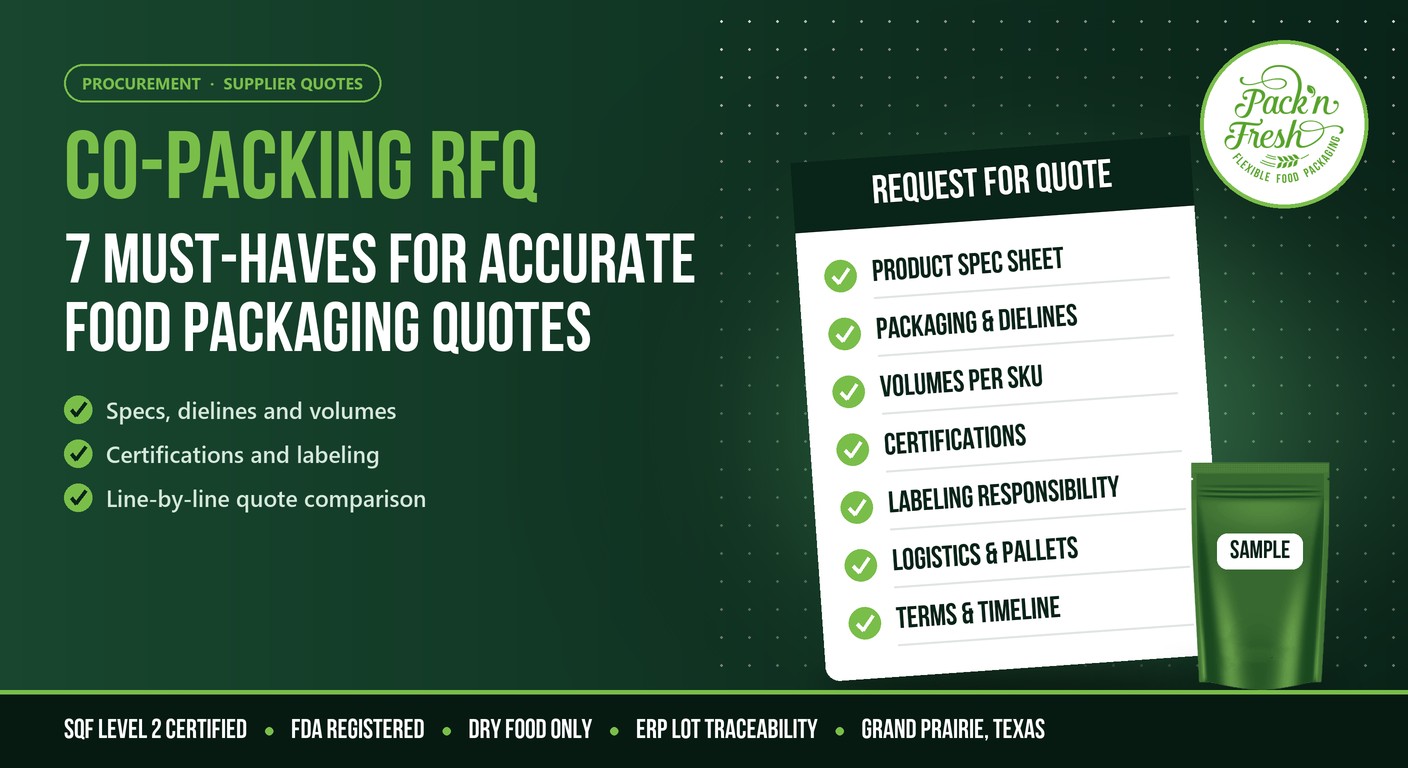
Co-Packing RFQ: 7 Must-Haves for Accurate Food Packaging Quotes
A co-packing RFQ is the document that decides whether the quotes you receive can actually be compared. Outsourcing is now a mainstream strategy: a 2024 PMMI report on brand owners found that 48% use contract packagers to test new products or packaging, and 43% use them to supplement in-house capacity and meet surges in sales volume.
A vague request gets a vague answer or a number padded for every unknown. A clear request gets a feasibility review, a line-item price and a realistic start date.
This guide is written for procurement managers and brand founders sourcing dry-food packaging, such as seasonings, powders, snacks, grains and drink mixes. We cover the seven must-haves of a strong co-packing RFQ, how to compare quotes line by line, the red flags to watch for, and a copy-ready checklist you can use on your next request.
Table of Contents
- What a Co-Packing RFQ Is (and How It Differs From an RFI or RFP)
- Must-Haves 1–2: Product Specs and Packaging Specs
- Must-Haves 3–4: Volumes and Quality Certifications
- Must-Haves 5–6: Labeling Responsibilities and Logistics
- Must-Have 7: Commercial Terms, Timeline, Insurance and NDA
- How to Compare Co-Packing RFQ Responses Line by Line
- Red Flags and a Copy-Ready Co-Packing RFQ Checklist
1. What a Co-Packing RFQ Is (and How It Differs From an RFI or RFP)
An RFQ, or request for quotation, asks a co-packer to price a defined job. You already know the product, the package and the approximate volume. What you need back is cost, lead time and confirmation that the facility can run it.
RFI: Request for Information
An RFI is a screening tool. You use it early, when you are still building a shortlist and want to learn which facilities handle your product type, which certifications they hold and what packaging formats they run.
RFP: Request for Proposal
An RFP is open-ended. You describe a problem, such as “we need a single-serve format for our protein powder,” and ask partners to propose solutions. Proposals vary widely, so they are harder to compare on price alone.
RFQ: Request for Quotation
An RFQ is specific. Every bidder prices the same scope, so the answers line up. University extension guides make the same point in plain terms. The UF/IFAS factsheet on finding and using a co-packer advises entrepreneurs to bring detailed process instructions and a business plan to the first meeting, along with a checklist of questions.
If you have not yet narrowed your list, start with our food co-packer vetting guide, then send your co-packing RFQ only to the facilities that pass.
2. Must-Haves 1–2: Product Specs and Packaging Specs
These two sections drive most of the price. If either is incomplete, the co-packer has to guess.
Must-Have 1: Product Specification Sheet and Ingredient Handling
Describe the product exactly as it will arrive at the filler, including how it behaves on a line.
- Product form: free-flowing powder, granules, flakes, inclusions, nuts or pieces
- Bulk density and particle size, if known
- Flow behavior: dusty, sticky, hygroscopic or prone to caking
- Target net weight per unit and acceptable tolerance
- Shelf-life goal and any moisture or oxygen sensitivity
Next, state who supplies what. Will you ship a finished blend, or should the co-packer source raw ingredients and blend to your formula? Is the formula shared under NDA, or delivered as a pre-blended premix? Each option changes both the quote and the risk.
Finally, list every allergen in the formula. Under the FASTER Act, effective January 1, 2023, sesame joined the original eight as the ninth major food allergen, as Michigan State University Extension explains. A facility needs this information to plan scheduling, cleaning and changeovers before it can price your run.
Must-Have 2: Packaging Specification, Dielines and Artwork
Packaging is the second large cost driver. Name the format and give dimensions, not just a description.
- Format: stand-up pouch, pillow pouch, stick pack, sachet, carton, cup, can or plastic jar
- Dimensions, fill volume and closure type (zipper, tear notch, resealable, scoop)
- Film or material structure, gauge and barrier needs
- Who supplies film, pouches, cartons and labels, and in what form (roll stock vs. premade)
- Dielines and print-ready artwork status, plus lot code and date code placement
- Secondary packaging: display boxes, multipacks, shrink-wrap or inserts
3. Must-Haves 3–4: Volumes and Quality Certifications
Volume decides line and schedule. Certifications decide whether the job is possible at all.
Must-Have 3: Volume Forecasts and Run Sizes per SKU
Give a forecast for each SKU, not one total for the brand. A program with six flavors at modest volume runs very differently from a single SKU at the same total.
- Launch quantity per SKU and expected run size
- Forecasted annual volume, with a low and high scenario
- Expected order frequency (monthly, quarterly, seasonal)
- Planned SKU additions in the next 12 months
Co-packers plan labor, materials and line time around these figures.
Must-Have 4: Quality and Certification Requirements
List every certification your customers or retailers require. Many large retailers ask for a GFSI-benchmarked scheme. The SQF Institute describes SQF as a GFSI-recognized food safety program, and certification level matters, so state which one your buyers expect.
If you plan to sell organic, the co-packer generally must be certified as well. Oregon Tilth’s co-packer guidance explains that operations handling organic-labeled goods for another brand must be certified, and that a private label agreement is needed when the brand owner is not certified. Note any kosher, non-GMO or gluten-free claims too.
Also ask for documents you will need during onboarding: the current audit certificate, a recent audit summary, allergen control procedures and recall program details. Our co-packer audit checklist shows what an audit-ready facility should be able to share.
Ready to Send Your RFQ?
Share your spec sheet, packaging format and volume forecast with our team. Our team reviews dry-food requests for feasibility and follows up with questions and next steps.
4. Must-Haves 5–6: Labeling Responsibilities and Logistics
These sections feel administrative, but gaps here often surface after the contract is signed.
Must-Have 5: Labeling and Regulatory Responsibilities
Your RFQ should say clearly who owns label compliance. Typically, the brand owner owns label content, while the co-packer applies the correct label and prints accurate lot and date codes, but the split should be stated in your contract.
Reference the rules your label must meet. The FDA publishes a Small Entity Compliance Guide for Nutrition and Supplement Facts labels that helps smaller brands understand the current requirements. Ask whether the co-packer will review artwork for obvious errors, and in writing, what that review does and does not cover.
Must-Have 6: Logistics, Receiving, Storage and Shipping
Logistics costs are easy to miss and hard to compare unless you specify them. Include:
- How inbound ingredients and packaging will arrive (pallet, tote, bag size)
- Expected storage time for raw materials and finished goods
- Case pack, case dimensions and case labeling (including GTIN or barcode needs)
- Pallet pattern, pallet height, stretch-wrap and pallet label requirements
- Outbound shipping: to your warehouse, a 3PL, retailer DCs or direct-to-consumer
- Who arranges freight and who pays for it
5. Must-Have 7: Commercial Terms, Timeline, Insurance and NDA
Without this section, quotes may assume different payment terms, validity periods or responsibilities.
Timeline and Milestones
Give your target dates: sample or trial run, first production, and launch. Ask each co-packer to confirm lead times for onboarding, material procurement and the first run. The UF/IFAS co-packer factsheet stresses careful scheduling communication so a product does not get stuck in a production hold, and notes many co-packers ask clients to confirm production a month or more ahead.
Commercial Terms to Request
- Quote validity period and how raw material price changes are handled
- Payment terms and any deposits for setup or materials
- Who owns leftover film, labels and ingredients if a SKU is discontinued
- Yield and waste allowances, and how shortages are charged
Insurance and Confidentiality
Ask for a certificate of insurance (COI) showing product liability coverage, and state whether your brand must be named as an additional insured. Send an NDA before sharing formulas, sales forecasts or unreleased artwork.
Commercial terms in the RFQ will later become contract clauses. Our guide to co-packing contract clauses covers what to negotiate once you pick a partner.
6. How to Compare Co-Packing RFQ Responses Line by Line
When the quotes come in, resist the urge to compare only the per-unit total. Two quotes with similar totals can hide very different assumptions. Build a simple comparison sheet with one row per cost line.
The Main Cost Drivers
- Setup and changeover: line setup, cleaning between SKUs and allergen changeovers
- Labor and line time: driven by fill speed, format and number of people on the line
- Materials: film, pouches, cartons and labels, if the co-packer sources them
- Ingredients and blending: if the co-packer sources and blends to your formula
- Secondary packing: cartoning, kitting, display boxes, shrink-wrap
- Storage and handling: pallet storage, receiving and outbound fees
- Quality testing: any lab testing, retained samples or extra checks
Note that costs vary widely by product, format and volume, so treat any early number as an estimate until a trial run confirms speeds and yields.
What a Good Co-Packer Sends Back
A serious partner does not just return a price. Look for feasibility notes that flag risks in your product or package, a list of assumptions, a line-item breakdown, clear lead times and questions about anything your co-packing RFQ left open. The Oklahoma State University FAPC factsheet on using a co-packer is a useful reference for the topics both sides should settle early.
7. Red Flags and a Copy-Ready Co-Packing RFQ Checklist
Many co-packing problems show up early, at the quote stage. Watch for these warning signs.
Red Flags in Quote Responses
- A single all-in price with no breakdown or stated assumptions
- No questions at all about your product’s flow, allergens or packaging
- Reluctance to share a current certificate or audit results
- Vague answers about allergen scheduling or cleaning validation
- No clear lot traceability or recall procedure
- Pressure to sign before a trial run or sample approval
Copy-Ready Co-Packing RFQ Checklist
Use this list as the outline for your next request. If you cannot fill in a line, say so in the RFQ, as co-packers can usually help with gaps when they know about them.
- Company overview, contact person and decision timeline
- Product spec sheet: form, density, flow, net weight, tolerance, shelf life
- Ingredient supply model: finished blend, premix or co-packer sourced
- Full allergen list and any allergen-free claims
- Packaging format, dimensions, material structure and closure
- Material supply: who provides film, pouches, cartons and labels
- Dielines, artwork status and lot/date code requirements
- Volume forecast per SKU: launch, annual, order frequency
- Required certifications: SQF level, organic, kosher, non-GMO, gluten-free
- Labeling responsibilities and Nutrition Facts or Supplement Facts panel
- Case pack, pallet configuration and barcode needs
- Receiving, storage, shipping destinations and freight ownership
- Target dates for samples, first production and launch
- Commercial terms: quote validity, payment, material ownership
- COI requirements and a signed NDA
How Pack’n Fresh Supports Procurement Teams With Co-Packing RFQ Requests
Pack’n Fresh is an SQF Level 2 certified contract packager for dry food, based in Grand Prairie, Texas, and serving brands nationwide since 2017. Our facility is FDA-registered, FSMA-compliant, and certified Organic, Kosher, Non-GMO and Gluten-Free.
We pack seasonings, dry blends, protein and supplement powders, powdered drink mixes, snacks, grains and other dry foods. Formats range from stick packs and sachets as small as 2 g to pouches, cartons, cups, cans and plastic jars up to 5 lb. We can also handle dry blending, ingredient and packaging sourcing, kitting, display boxes and drop-shipping support.
For procurement teams, our systems make due diligence easier. Our Microsoft Dynamics 365 ERP provides full lot traceability and fast mock recalls. Digital Ingredient Locking halts production if a wrong material is scanned, siloed scheduling supports allergen control, and ATP swabs verify sanitation. Our owners bring food-science and QA backgrounds, and we work with both startups and scaling brands.
Send your request through our RFQ form. We review it for feasibility and follow up with questions and next steps.
Conclusion
An accurate quote starts with an accurate request. When your co-packing RFQ covers product specs, packaging, volumes, certifications, labeling, logistics and commercial terms, every bidder prices the same job, and you can compare answers line by line instead of guessing.
Complete the checklist before you send anything, ask for line-item pricing and value the co-packers who ask good questions. That upfront effort shortens onboarding and reduces change orders.
Frequently Asked Questions About Co-Packing RFQ
What should a co-packing RFQ include?
A complete co-packing RFQ includes a product specification sheet, ingredient supply model and allergen list, packaging specifications and artwork status, volume forecasts per SKU, certification requirements, labeling responsibilities, logistics details such as case and pallet configuration, target timelines, commercial terms, insurance requirements and an NDA. The more complete it is, the more accurate and comparable your quotes will be.
How is an RFQ different from an RFP for co-packing?
An RFQ asks co-packers to price a clearly defined job, so every bidder quotes the same scope. An RFP describes a need and invites partners to propose their own solutions, which makes responses harder to compare on price. Brands usually send an RFI first to screen facilities, then an RFQ once the product and packaging are defined.
How many co-packers should I send my RFQ to?
Most brands send their request to a short list of qualified facilities rather than a long list. University extension guides suggest preparing a checklist for each potential co-packer you meet, and a few comparable quotes are usually enough to judge price, capability and fit. Screen facilities first for product type, packaging format and certifications so every response is relevant.
Why do co-packing quotes vary so much?
Quotes vary because co-packers make different assumptions about fill speed, changeovers, allergen cleaning, material sourcing, waste allowances, storage and freight. Equipment and line setup also differ between facilities. Asking for a line-item breakdown with stated assumptions lets you see where the differences come from and compare quotes fairly rather than by total price alone.
Do I need to share my formula in a co-packing RFQ?
Not always. You can ship a finished blend or a premix so the co-packer only fills and packs. If the co-packer will source ingredients and blend for you, they will need the formula to quote accurately. In that case, sign an NDA before sharing it, and include a full allergen list either way.
Get a Clear, Line-Item Quote for Your Dry Food Product
Pack’n Fresh is an SQF Level 2 certified dry-food co-packer in Grand Prairie, Texas, with full ERP lot traceability, Digital Ingredient Locking and siloed allergen scheduling. Send us your RFQ and our team will review it for feasibility and respond with practical next steps.