
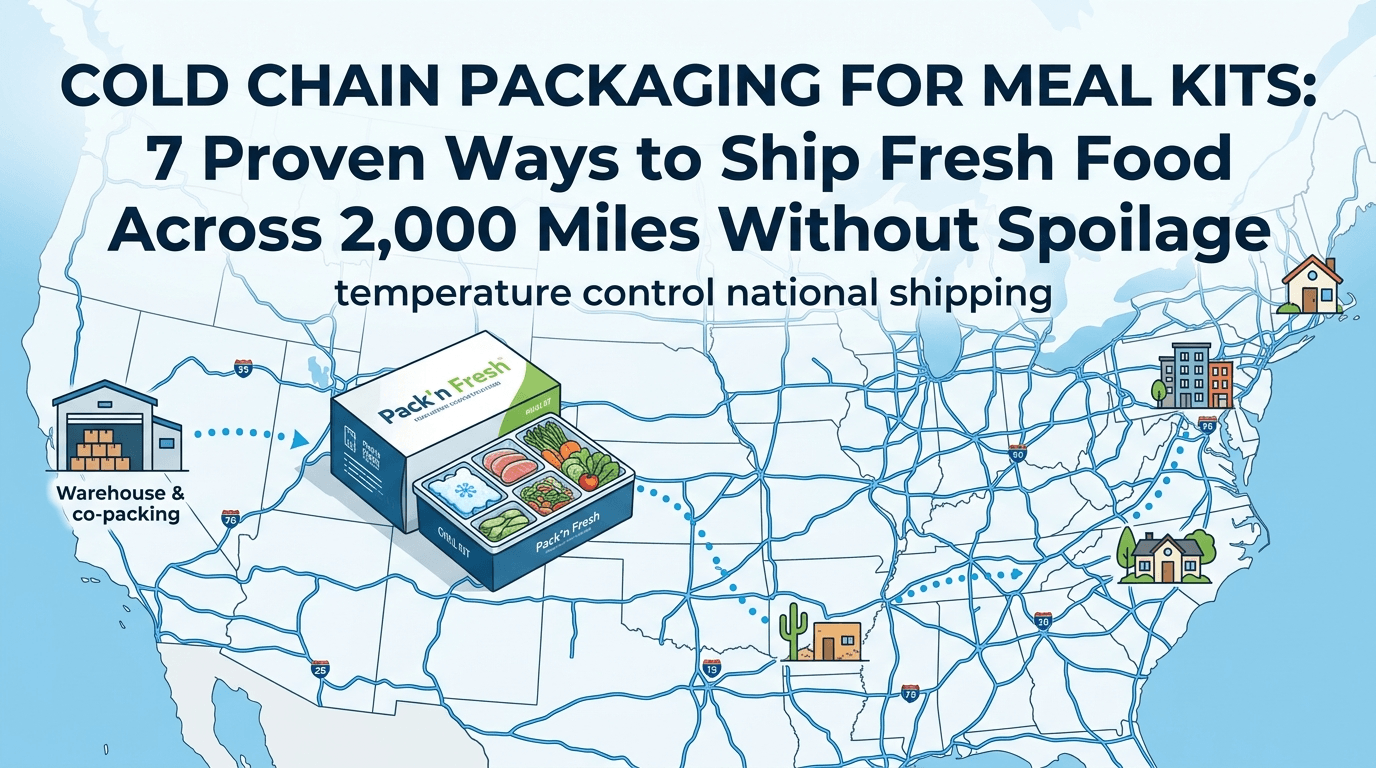
Cold Chain Packaging for Meal Kits: 7 Proven Ways to Ship Fresh Food Across 2,000 Miles Without Spoilage
The promise of a meal kit subscription is simple: fresh ingredients, delivered to your door, ready to cook. But behind that simple promise lies one of the most complex logistics challenges in the food industry — maintaining safe temperatures across a 2,000-mile transit chain that passes through multiple warehouse environments, carrier trucks, sorting facilities, and ultimately a doorstep that may bake in the Texas sun for six hours before a subscriber picks up their box.
Cold chain packaging for meal kits is the engineering discipline that makes this promise possible. Get it right, and you build subscriber trust with every delivery. Get it wrong, and a single spoiled protein component — arriving warm, off-color, or malodorous — can end a subscription relationship that took $120 in CAC to build.
At Pack’n Fresh, we co-pack for meal kit brands that ship nationally, and we understand that cold chain packaging for meal kits is not just a logistics question — it is a brand integrity question. This guide breaks down the 7 proven strategies that high-volume meal kit brands use to ship fresh food reliably across the country.
Table of Contents
- Why Cold Chain Packaging for Meal Kits Is More Complex Than Traditional Food Logistics
- The 3 Temperature Zones Every Meal Kit Brand Must Engineer For
- 7 Cold Chain Packaging Strategies for National Meal Kit Shipping
- How Barrier Film Technology Extends Dry Ingredient Shelf Life Across Long Transit
- The True Cost of Cold Chain Packaging Failure
- How Your Co-Packer Affects Cold Chain Performance
- Conclusion
- FAQs
1. Why Cold Chain Packaging for Meal Kits Is More Complex Than Traditional Food Logistics
Traditional food cold chain logistics — moving palletized product from a manufacturer to a retail distribution center — is a relatively controlled environment. Temperature is maintained in refrigerated trucks, monitored continuously, and managed by trained logistics professionals.
Cold chain packaging for meal kits operates in an entirely different environment. Your meal kit box leaves a temperature-controlled co-packing or fulfillment facility and enters a transit chain with zero active refrigeration. It may spend 3–5 days moving through carrier sorting facilities that range from 55°F in January in Minnesota to 95°F in July in Arizona. It will ultimately be left on a doorstep — in direct sunlight, in a narrow apartment lobby, or behind a gate — for an unknown period before a subscriber retrieves it.
This “last mile” temperature challenge has no parallel in traditional food cold chain. The FDA food safety standard for refrigerated proteins requires maintaining temperatures below 40°F (4°C) continuously. In a meal kit context, maintaining that standard through a 72–120 hour passive transit window — with no active refrigeration — requires precise engineering of every layer of the packaging system.
The financial stakes are high: a national meal kit brand shipping 50,000 boxes per week at an average of $65 per box has $3.25M in weekly product value in transit. Even a 1% spoilage rate — 500 boxes per week — represents $32,500 in direct weekly losses plus the subscriber retention damage that comes with each failed delivery.
2. The 3 Temperature Zones Every Meal Kit Brand Must Engineer For
Effective cold chain packaging for meal kits must address three distinct temperature zones within a single delivery:
Zone 1 — Proteins and Dairy (Below 40°F / 4°C)
Raw proteins (chicken, beef, seafood, eggs) and dairy components require continuous refrigeration below 40°F to prevent bacterial growth. This is the most demanding temperature requirement in any meal kit box and the primary driver of cold chain packaging design.
Zone 2 — Fresh Produce (Between 34°F and 50°F)
Fresh vegetables and herbs have different optimal storage temperatures than proteins — many leafy greens actually experience chilling injury below 35°F. Effective cold chain packaging for meal kits that includes both proteins and produce must manage a temperature range that serves both, typically targeting 36–40°F as the practical sweet spot.
Zone 3 — Dry Ingredients (Ambient, but Protected from Heat and Moisture)
Spice sachets, grain pouches, sauce packets, and dry seasoning blends do not require refrigeration — but they are critically vulnerable to heat and humidity during long transit. A spice sachet that experiences 95°F ambient temperatures for 48 hours will develop clumping, off-aromas, and accelerated oxidation regardless of how perfect the refrigerated components’ cold chain is. This is why cold chain packaging for meal kits must address dry ingredient protection as a parallel engineering challenge.
3. The 7 Cold Chain Packaging Strategies for National Meal Kit Shipping
Strategy 1 — Right-Size Your Insulation for Your Transit Window, Not Your Budget
The single most common cold chain packaging for meal kits failure mode is under-insulating relative to the actual transit window. Many brands design their insulation for a 48-hour transit standard when their actual worst-case transit time (ground shipping to a rural address in a hot climate) is 96–120 hours. The result is a predictable failure pattern: urban deliveries succeed, rural summer deliveries fail.
The correct engineering approach is to identify your worst-case transit scenario — longest ground transit time to your most remote service area, in the highest summer ambient temperature — and design your insulation system to maintain below 40°F for that duration, not your average transit time. Options include: EPS (expanded polystyrene) foam liners, molded pulp insulation, reflective foil bubble insulation, and wool-based insulation for sustainable positioning.
Strategy 2 — Engineer Your Refrigerant for the Full Transit Window
Refrigerant selection is one of the most technically nuanced elements of cold chain packaging for meal kits. The three primary options each have specific performance profiles:
- Dry ice (solid CO₂): Maintains the coldest temperatures and lasts longest, but can freeze delicate produce and creates CO₂ gas that can rupture sealed boxes if improperly managed. Requires IATA/PHMSA shipping compliance documentation.
- Gel packs (frozen water/gel): The most common refrigerant for consumer meal kits. Available in various freeze temperatures (0°F, 20°F, 32°F) — selecting the correct freeze temperature for your transit duration and product mix is critical. Gel packs at 32°F hold cold longer than those at 20°F for ambient-temperature transit.
- Phase-change materials (PCMs): The most sophisticated and expensive option — PCMs are engineered to maintain a specific temperature (e.g., exactly 38°F) as they transition between solid and liquid states. Used by premium brands where cost-per-delivery justifies the investment.
The key principle of effective cold chain packaging for meal kits is placing refrigerant at the top of the box (cold air sinks) and surrounding proteins with direct refrigerant contact, with produce positioned to avoid direct freeze exposure.
Strategy 3 — Separate Temperature Zones Within the Box
A single undivided meal kit box comingles proteins, produce, and dry ingredients in a single temperature environment. This creates a design conflict: gel packs cold enough to maintain protein safety may freeze delicate herbs, and the ambient warmth needed by dry ingredients accelerates ice melt near proteins.
Effective cold chain packaging for meal kits uses internal dividers, dedicated protein bags, or separate thermal sleeves to create micro-zones within the delivery box. Proteins in a sealed thermal bag with direct gel pack contact, produce in a separate compartment buffered from direct freeze exposure, and dry ingredient sachets sealed in high-barrier pouches isolated from moisture.
Strategy 4 — Use High-Barrier Film for All Dry Ingredient Components
Spice sachets, seasoning blends, and dry ingredient pouches in a meal kit box are continuously exposed to the moisture released by melting refrigerant and produce respiration. Without high-barrier packaging film, dry ingredients absorb this ambient moisture — causing caking, clumping, and flavor degradation that arrives at your subscriber’s kitchen as a quality failure.
This is where the science of modified atmosphere packaging for food shelf life intersects directly with cold chain packaging for meal kits — high-barrier film with oxygen and moisture barriers protects dry ingredients through the transit environment that the cold chain creates.
Strategy 5 — Validate Your Packaging System with Transit Temperature Testing
No amount of theoretical engineering replaces empirical validation. Effective cold chain packaging for meal kits requires systematic testing using temperature loggers placed inside representative boxes shipped via your actual carrier routes to your actual service areas — in summer and winter conditions.
ISTA (International Safe Transit Association) Protocol 7E is the standard testing method specifically designed for thermal performance validation of insulated shipping packages. Brands that have completed ISTA 7E testing can make defensible temperature performance claims — those that have not are making unverified assumptions about their cold chain’s performance in the field.
Strategy 6 — Build Carrier Transit Time Into Your Cold Chain Design
The US carrier network has meaningful transit time variability. A box shipped Monday for Tuesday delivery in a major metro area will behave very differently from a box shipped Thursday for Monday delivery to a rural ZIP code. Effective cold chain packaging for meal kits accounts for this variability by: restricting shipments to shorter transit lanes during summer months, using expedited shipping for longer-distance orders, building carrier transit guarantees into your co-packing SLA, and designing your packaging for the maximum likely transit time in each shipping zone.
We discuss this in the context of overall DTC packaging strategy in our post on DTC food packaging solutions: shipping costs and freshness.
Strategy 7 — Design for the “Hot Doorstep” — The Final Cold Chain Failure Point
The single most common point of cold chain packaging for meal kits failure is not transit — it is the doorstep. A box left in direct summer sunlight on a concrete porch can experience internal temperature increases of 10–15°F per hour. A box that arrives safely at 38°F can reach 65°F within 3–4 hours of doorstep exposure — well past food safety thresholds for protein components.
Strategies for addressing the hot doorstep problem include: designing the outer box with reflective exterior materials to reduce solar heat gain, using extended-performance refrigerant formulations that maintain temperatures for 6–8 hours post-delivery, and implementing real-time delivery notifications that prompt subscribers to retrieve their box immediately — an operational choice that significantly reduces temperature failure claims.
4. How Barrier Film Technology Extends Dry Ingredient Shelf Life Across Long Transit
In the context of cold chain packaging for meal kits, the performance of dry ingredient packaging is as critical as the performance of the thermal insulation system. A meal kit where the protein component arrives safely chilled but the cumin sachet has caked into a solid lump due to moisture ingress is still a quality failure — one that erodes subscriber trust and drives cancellations.
High-barrier packaging film for dry ingredient components in meal kits should provide:
- Moisture vapor transmission rate (MVTR) below 1 g/m²/day — preventing the ambient humidity inside a cold, condensing meal kit box from migrating into spice and seasoning pouches
- Oxygen transmission rate (OTR) below 10 cc/m²/day — protecting oxidation-sensitive ingredients (oils, spice volatile compounds, herbs) from the accelerated oxidation that warm and variable transit temperatures promote
- Seal integrity under temperature cycling — pouch seals must maintain integrity through the freeze-thaw cycles that occur as refrigerant depletes and ambient temperature rises during transit
At Pack’n Fresh, our film selection process for each client’s dry ingredient components includes a technical review of the specific moisture and oxygen sensitivity requirements of every ingredient — and film barrier specifications are matched to the most demanding ingredient in each kit component. This is a core element of how we support our clients’ cold chain packaging for meal kits systems.
5. The True Cost of Cold Chain Packaging Failure
The financial impact of cold chain packaging for meal kits failure extends far beyond the direct cost of the spoiled delivery:
- Product credit/refund: Typically $30–$65 per failed box, issued as account credit or refund
- Customer service cost: $8–$15 per contact for a CS agent to handle the spoilage complaint
- Subscriber churn: A subscriber who receives a spoiled delivery is significantly more likely to cancel within 30 days — industry operators consistently report spoilage complaints as among the top three churn triggers, making each failed delivery a direct threat to subscriber LTV
- Brand reputation damage: Social media posts featuring spoiled meal kit components are a disproportionately visible form of negative brand exposure — a single viral post can reach tens of thousands of potential subscribers
- Food safety liability: A temperature excursion that leads to a documented foodborne illness claim creates regulatory, legal, and reputational exposure that can threaten the company’s existence
Against this cost profile, investing in properly engineered cold chain packaging for meal kits — including validated insulation systems, high-barrier dry ingredient pouches, and refrigerant systems sized for worst-case transit — is one of the highest-ROI capital allocations a meal kit brand can make. As we detail in our post on how packaging drives meal kit subscription retention, the financial case for packaging investment is fundamentally a subscriber LTV protection argument.
6. How Your Co-Packer Affects Cold Chain Packaging Performance
Cold chain packaging for meal kits success begins at the co-packing facility — not at the carrier pickup. The final packed temperature of your meal kit box when it exits the co-packing facility determines the thermal budget available for the entire transit chain. A box that leaves the facility at 34°F has a larger thermal buffer than a box that leaves at 42°F — even if both use identical insulation systems.
Co-packing facility requirements that directly impact cold chain packaging for meal kits performance:
- Temperature-controlled packing environment: Kitting of temperature-sensitive meal kit components should occur in a refrigerated packing area (below 45°F) — not at ambient room temperature
- Refrigerant conditioning: Gel packs must be fully frozen (not just chilled) before placement in the box — a co-packer without dedicated gel pack freezing capacity cannot deliver consistent cold chain starts
- Minimized pack-to-pickup time: The time between when a box is packed and when it is picked up by the carrier is critical — packed boxes sitting on a loading dock in summer heat deplete refrigerant before transit even begins
- Ingredient temperature pre-conditioning: Proteins and dairy components should be packed directly from refrigerated storage — warming to ambient temperature during kitting represents a cold chain loss that cannot be recovered
At Pack’n Fresh, our facility protocols for cold chain packaging for meal kits include temperature-controlled kitting environments and carrier pickup scheduling that minimizes dock time for temperature-sensitive orders. Our ERP system tracks pack time and pickup time for every production run, enabling continuous performance monitoring of the pre-transit cold chain window. Learn more about our automated food kitting capabilities and how they support consistent cold chain performance at scale.
7. Conclusion: Cold Chain Packaging for Meal Kits Is a Brand Promise, Engineered
Your meal kit subscription promise — “fresh ingredients, delivered to your door” — is only as strong as the engineering behind your cold chain packaging for meal kits. Every element of that engineering, from the thermal performance of your outer insulation to the barrier specification of your spice sachet film, determines whether your brand’s promise survives a 2,000-mile transit chain in July heat.
The brands that invest in validated, properly engineered cold chain packaging for meal kits — with worst-case transit scenarios, not average scenarios, as the design standard — build subscription retention, reduce CS costs, and protect the subscriber LTV that drives their entire business model.
At Pack’n Fresh, we partner with meal kit brands to engineer the full cold chain packaging system from the facility floor to the subscriber’s doorstep. Our SQF-certified facility, temperature-controlled kitting environment, and precision dry ingredient packaging capabilities make us the ideal co-packing partner for brands serious about cold chain packaging for meal kits. Reach out to our team today to schedule a cold chain packaging consultation.
FAQs — Cold Chain Packaging for Meal Kits
How long can cold chain packaging for meal kits maintain safe temperatures?
With properly engineered insulation and refrigerant systems, cold chain packaging for meal kits can maintain below 40°F for 48–120 hours depending on insulation type, refrigerant quantity, and ambient temperature conditions. Brands shipping to hot-climate destinations or rural areas with 4–5 day transit times require higher-performance systems than brands serving urban areas with 1–2 day delivery windows.
What is the FDA temperature requirement for meal kit proteins?
The FDA Food Safety Modernization Act requires perishable proteins to be maintained below 40°F (4°C) continuously throughout the distribution chain. Effective cold chain packaging for meal kits must maintain this standard not just during carrier transit but through the doorstep period — including potential same-day exposure to outdoor temperatures before subscriber retrieval.
What refrigerant works best for meal kit shipping?
For most national meal kit brands, gel packs frozen to 20–32°F offer the best balance of performance, cost, and consumer safety. Phase-change materials (PCMs) offer superior temperature precision for premium brands. Dry ice provides the longest hold time but adds shipping compliance complexity and can damage freeze-sensitive produce. The right choice depends on your specific transit window, product mix, and cost structure within your cold chain packaging for meal kits system.
How does barrier film protect dry ingredients in a cold chain meal kit?
Inside a meal kit box, melting refrigerant and produce respiration create a high-humidity micro-environment. High-barrier pouch film with low moisture vapor transmission rate (MVTR below 1 g/m²/day) prevents this ambient moisture from migrating into spice sachets, grain pouches, and dry seasoning blends — preventing caking, clumping, and flavor degradation that represents a quality failure in cold chain packaging for meal kits.
What is ISTA 7E testing for meal kit packaging?
ISTA Protocol 7E is the International Safe Transit Association’s standard test method for thermal performance validation of insulated shipping packages for temperature-sensitive products. It simulates real-world transit conditions including temperature cycling, shock, and vibration. Completing ISTA 7E testing is the industry-standard approach for validating that your cold chain packaging for meal kits system performs to spec under worst-case conditions.
How does my co-packer affect my meal kit cold chain performance?
Significantly. The temperature at which your box leaves the co-packing facility, the conditioning of your gel packs, the time between packing and carrier pickup, and the protein pre-conditioning temperature all directly impact your cold chain’s thermal budget. A co-packer with temperature-controlled kitting environments and structured carrier pickup scheduling is a foundational element of any successful cold chain packaging for meal kits strategy.