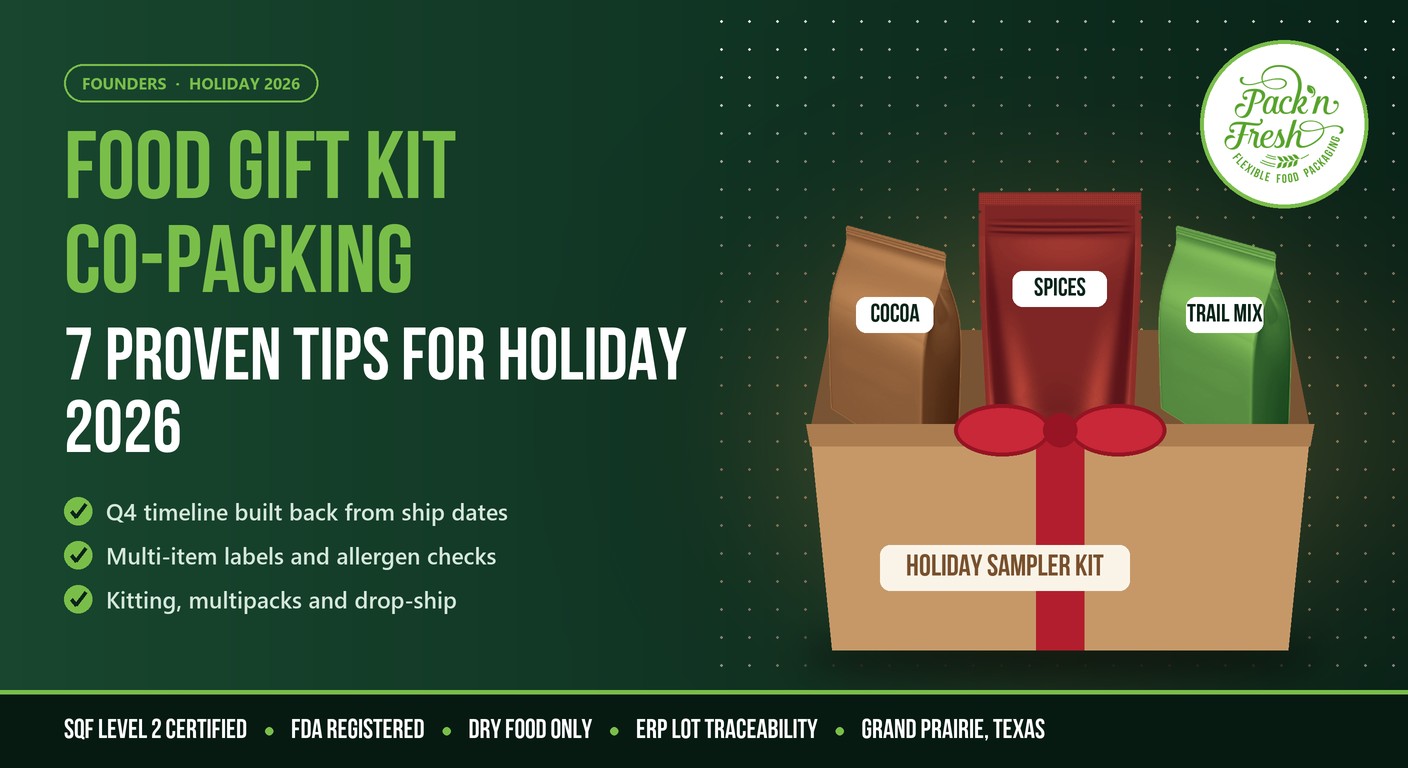
Food Gift Kit Co-Packing: 7 Proven Tips for Holiday 2026
Food gift kit co-packing has become one of the most valuable seasonal levers for dry food brands and corporate gifting programs. The National Retail Federation forecast that 2025 holiday sales would pass $1 trillion for the first time, with shoppers planning to spend an average of $890.49 each on gifts, food, decorations and other seasonal items. That spending window is short, and gift sets that miss it rarely get a second chance.
Packaged Facts, a division of The Freedonia Group, sizes the U.S. consumer and corporate food gifting market at $42 billion, with average growth of 5.2% a year projected through 2028. Spice sets, baking mix kits, snack samplers and cocoa or tea assortments are natural fits for that demand. They travel well, store without refrigeration and look premium inside a well-designed box.
The hard part is execution. A gift kit multiplies every packaging decision: several SKUs, several labels, several allergen profiles and one immovable ship date. This guide walks founders and gifting program managers through seven proven tips for food gift kit co-packing, from Q4 timelines to choosing the right kitting partner.
Table of Contents
- Why Food Gift Kit Co-Packing Matters for Holiday 2026
- Build a Q4 Timeline That Works Backward from Ship Dates
- Design Assortments Around Dry, Shelf-Stable Products
- Choose Gift Boxes, Display Packs and Multipacks That Sell
- Get Labeling and Allergen Declarations Right on Multi-Item Kits
- Align Shelf Life and Protect Kitting Accuracy
- Plan DTC Shipping, Control Costs and Pick Your Partner
1. Why Food Gift Kit Co-Packing Matters for Holiday 2026
Gift kits do something a single pouch cannot. They raise the average order value, introduce shoppers to several products at once and give retailers a seasonal reason to feature your brand on an endcap. For corporate gifting programs, a branded sampler box is a memorable, consumable thank-you that ships easily to remote employees and clients.
Yet the economics of food gift kit co-packing only work when assembly is fast, accurate and compliant. Hand-packing hundreds of boxes in a back room is manageable. Hand-packing thousands across three assortments, with retail labels and drop-ship orders, is where margins and deadlines collapse.
Who Uses Food Gift Kit Co-Packing
- Spice and seasoning brands building three-, four- or six-jar style sets using plastic or metal containers, or pouch trios.
- Snack and trail mix brands creating sampler boxes with single-serve packs of different blends.
- Baking and cocoa brands packaging cookie mix, hot cocoa powder and spice blends as a themed kit.
- Corporate gifting programs that need custom-branded dry food boxes delivered to many addresses.
Each of these buyers needs the same core capabilities: filling, assembly, labeling, boxing and shipping under one food safety system. That is exactly what a kitting co-packer is built to provide.
2. Build a Q4 Timeline That Works Backward from Ship Dates
Holiday programs fail most often on time, not on quality, and food gift kit co-packing is no exception. Packaging components, especially printed gift boxes and custom inserts, frequently carry longer lead times than the food inside them. Start with the date product must land at retail or with the gifting client, then work backward through every step.
A Practical Backward-Planning Sequence
- In-market date: confirm retailer delivery windows or the corporate client’s ship-by date.
- Final assembly and shipping: reserve kitting line time with your co-packer early, because Q4 calendars fill quickly.
- Component filling: fill and seal individual pouches, stick packs or containers before assembly begins.
- Packaging arrival: printed boxes, sleeves, inserts and labels must be received and inspected before filling ends.
- Artwork and label approval: lock artwork only after the final assortment and ingredient statements are confirmed.
- Assortment decision: finalize the products, sizes and pack count for each kit.
Many brands begin this sequence in late spring or summer for a Q4 launch. Exact timing depends on your packaging suppliers, so ask your co-packer for a written production calendar and build buffer into every step.
Order Forecasting for One-Season Products
Gift kits are unforgiving because leftover inventory loses value after December. Forecast by channel, separating retail purchase orders, DTC demand and corporate commitments. A good partner can fill components in bulk and assemble kits in waves, so you can respond to sell-through without overcommitting finished goods.
3. Design Assortments Around Dry, Shelf-Stable Products
The best holiday kits pair a clear theme with products that share similar storage needs. Dry, shelf-stable foods are ideal because they tolerate warehouse and parcel conditions without refrigeration. They also allow components to be produced weeks before assembly.
Proven Dry Gift Kit Concepts
- Global spice set: four or six seasoning blends in matching containers or pouches.
- Holiday baking kit: cookie or brownie mix, a spice blend and decorating sugar.
- Cozy night sampler: hot cocoa powder sticks, loose tea sachets and a cinnamon sugar blend.
- Snack sampler: single-serve trail mix, roasted nuts and popcorn kernels with seasoning packets.
- Pasta night kit: dried pasta, a dry seasoning blend and dried herb blend.
Format Choices Inside the Box
Stand-up pouches give retail shelf presence, while stick packs and sachets make low-cost sampling possible. Our earlier guide to snack and spice pouch packaging covers barrier films and closures in detail. Consistent sizing across components also simplifies tray design and speeds assembly.
Keep the assortment tight. Each added SKU adds a label, a component count, an allergen check and a potential stockout. Three to five well-chosen items usually tell a stronger story than eight loosely related ones.
4. Choose Gift Boxes, Display Packs and Multipacks That Sell
The outer package is the gift. It must protect the products, communicate the brand and survive shipping or shelf handling. Your choice depends heavily on the channel: retail, club, DTC or corporate.
Gift Boxes and Rigid Sets
Printed folding cartons with inserts are a common choice for spice sets and baking kits. Inserts keep items from shifting and make the unboxing moment feel intentional. For branding ideas, see our overview of custom packaging and branding solutions.
Display Boxes, Multipacks and Club Packs
Retail buyers often want shelf-ready display boxes that move straight from case to shelf. Club channels typically prefer larger multipacks or club packs that bundle several units under one barcode. Shrink-wrap and printed sleeves can turn existing pouches into a seasonal bundle without a fully custom carton.
Inserts That Drive Repeat Sales
Recipe cards, coupons and literature inserts turn a one-time gift into a future customer. Placing a reorder code or QR card inside a corporate gift box is a simple way to capture recipients who discover your products for the first time.
Planning a Holiday Gift Set or Sampler Kit?
Pack’n Fresh fills, assembles, labels and ships dry food gift kits under one SQF Level 2 certified roof. Share your assortment and ship dates, and we will map out a production calendar.
5. Get Labeling and Allergen Declarations Right on Multi-Item Kits
Multi-item kits create labeling questions that single products never raise, which makes compliance a core part of food gift kit co-packing. Each item may have its own ingredient statement, allergen profile and nutrition facts. The outer box adds another layer of regulatory responsibility.
Nutrition Labeling for Assortments
FDA rules in 21 CFR 101.9 address products made of two or more separately packaged foods inside an outer container. In those cases, nutrition information is generally required per serving for each food and must be clearly visible at the point of purchase. Confirm the exact approach for your kit with a qualified labeling specialist.
Allergen Declarations Across Components
Spice blends, trail mixes and baking kits frequently contain tree nuts, peanuts, wheat, milk, soy or sesame. Under the FASTER Act, sesame became the ninth major food allergen and has required allergen labeling on packaged foods since January 1, 2023. Every component, and the outer package where applicable, should declare allergens accurately.
Labeling Checklist for Kits
- Individual labels on every component that may be separated from the box.
- Outer label with product identity, net quantity, and manufacturer or distributor information.
- Allergen information that reflects every item in the assortment.
- Lot code and best-by date tied to the shortest-dated component.
6. Align Shelf Life and Protect Kitting Accuracy
A gift kit is only as fresh as its shortest-dated item. If a cocoa mix carries a long shelf life but a nut blend carries a shorter one, the whole kit should be dated to the nut blend. Plan production so that components with shorter shelf lives are filled closest to assembly.
Shelf Life Alignment Tactics
- Group products with similar moisture sensitivity and barrier needs.
- Use high-barrier pouches or nitrogen-flushed packs for oil-rich nuts and seeds.
- Date the outer kit to the earliest best-by date inside.
- Keep components sealed individually so a damaged item does not affect the others.
Kitting Accuracy Is a Food Safety Issue
A missing item frustrates a customer. A wrong item, such as a nut-containing pouch in a nut-free kit, can create a real allergen risk. Accuracy controls include scanned components, check weights on finished kits and documented line clearance between assortments. We explore the margin side of this in our post on automated food kitting.
Ask any prospective partner how they verify that the right components go into each box. Systems that halt production when a wrong material is scanned, plus lot traceability through to the finished kit, are strong signs of a mature operation.
7. Plan DTC Shipping, Control Costs and Pick Your Food Gift Kit Co-Packing Partner
The final tip covers where kits go after assembly, what they cost and who builds them. These three decisions are tightly linked, because a partner that fills, kits and ships can remove handoffs that add cost and delay.
DTC and Drop-Ship Fulfillment
Corporate gifting programs often need hundreds of individual addresses rather than one pallet. DTC brands need kits shipped straight from production to customers’ doors. Drop-ship support from your co-packer avoids moving finished goods to a separate warehouse, which saves a freight leg and a round of handling.
Cost Control Levers
- Standardize component sizes so one insert design fits several assortments.
- Use stock boxes with custom sleeves instead of fully custom cartons for smaller runs.
- Fill components in bulk and assemble kits in waves as orders confirm.
- Consolidate sourcing of ingredients and packaging through one partner where practical.
Actual costs vary widely by assortment, packaging and volume, so request itemized quotes that separate filling, kitting, materials and shipping.
Questions to Ask a Kitting Co-Packer
- Which food safety certification do you hold, and at what level?
- Can you fill the components as well as assemble the kits?
- How do you control allergens between different assortments?
- Can you trace every component lot to each finished kit?
- Do you handle inserts, shrink-wrap, labeling and drop-ship orders?
Clear answers to these questions separate a dependable food gift kit co-packing partner from one that is simply willing to try.
How Pack’n Fresh Supports Food Gift Kit Co-Packing for Holiday Programs
Pack’n Fresh is an SQF Level 2 certified contract packager for dry food, based in Grand Prairie, Texas, and serving brands nationwide since 2017. We handle the full gift kit workflow under one roof, from ingredient and packaging sourcing to filled, assembled and shipped kits.
- Component filling: pillow and stand-up pouches, stick packs, sachets, cartons, cups, cans and plastic or metal containers, single-serve up to 5 lb.
- Kitting and assembly: assortments, combo packs, multipacks, club packs and display boxes.
- Finishing: shrink-wrap, sleeves, labeling and coupon or literature inserting.
- Fulfillment: drop-ship and DTC shipping support from our central U.S. location near DFW airport.
Our Microsoft Dynamics 365 ERP provides full lot traceability and fast mock recalls. Digital Ingredient Locking halts production if a wrong material is scanned, while siloed scheduling and ATP swab verification support allergen control between assortments. Our facility also holds FDA registration and USDA Organic, Kosher, Non-GMO and Gluten-Free certifications.
Conclusion
Holiday gift kits reward brands that plan early and execute precisely, and food gift kit co-packing turns that plan into finished boxes. Lock your assortment, work backward from ship dates, and treat labels, allergens and shelf life as part of the product design rather than an afterthought.
The right partner makes the season manageable. With food gift kit co-packing handled by a certified team that fills, assembles and ships under one system, you can focus on selling while your kits arrive on time and on spec.
Frequently Asked Questions About Food Gift Kit Co-Packing
What is food gift kit co-packing?
It is a contract service where a co-packer fills individual food products, assembles them into gift boxes or sampler kits, applies labels and inserts, and often ships finished kits. For dry, shelf-stable foods such as spices, baking mixes and snacks, it lets brands launch seasonal sets without building their own assembly line or hiring temporary holiday staff.
When should I start planning holiday gift kits?
Start by confirming your in-market or ship-by date, then work backward through assembly, filling, packaging delivery and artwork approval. Printed boxes and inserts often take longest. Many brands begin planning in late spring or summer for Q4, but your packaging suppliers and co-packer calendar should set the exact schedule.
Does each item in a gift kit need its own label?
Generally, yes, especially when items may be separated from the box. FDA rules in 21 CFR 101.9 also address nutrition information for separately packaged foods inside an outer container. Allergen declarations should cover every component. Because kit designs vary, review your final labels with a qualified food labeling specialist before printing.
How do you set the shelf life of a multi-item gift kit?
Date the finished kit to the earliest best-by date among its components. Schedule shorter-life items, such as oil-rich nuts, to be filled closest to assembly, and use barrier packaging suited to each product. Grouping components with similar storage needs keeps the whole kit fresh for the gifting season.
Can a co-packer ship gift kits directly to recipients?
Many kitting co-packers, including Pack’n Fresh, offer drop-ship and DTC shipping support. This is valuable for corporate gifting programs sending kits to many individual addresses. Shipping directly from the production facility avoids an extra freight leg to a separate warehouse and reduces handling of finished, gift-ready packages.
Make Holiday 2026 Your Smoothest Gift Season Yet
Pack’n Fresh combines SQF Level 2 certification, ERP-backed lot traceability and Digital Ingredient Locking with in-house filling, kitting and drop-ship support. From spice sets to snack samplers, we build dry food gift kits that arrive on time, on spec and on budget.