Food Packaging Cost Reduction: 7 Proven Strategies for the 2026 Tariff Economy
Food brands in 2026 are absorbing packaging cost shocks unlike anything the industry has seen in years. Polyethylene and polypropylene resin prices have surged more than 30 percent since late February, Section 232 tariffs on imported steel and aluminum are now enforced at 50 percent of full customs value, and packaging machinery import costs have jumped an average of 21 percent. Every co-packer, every packaging buyer, and every brand manager is being asked the same question: where can we cut without cutting quality? This guide lays out a proven roadmap for food packaging cost reduction that works in this specific environment — not theoretical savings, but actionable strategies grounded in how packaging supply chains actually operate today.
The good news is that real food packaging cost reduction is achievable without sacrificing compliance, shelf appeal, or consumer experience. Most brands have never done a rigorous line-by-line audit of what packaging actually costs them across the full value chain. When you break down materials, converting, storage, changeover, waste, and vendor coordination fees separately, the opportunities become visible. Industry operators consistently report that holistic packaging optimization across material selection, supplier consolidation, and format standardization can reduce total packaging spend by 20 to 30 percent without touching a single product recipe.
At Pack’n Fresh, a SQF Level 2 certified full-service co-packer based in Grand Prairie, Texas, we partner with food brands at exactly this inflection point. We help brands reconfigure their packaging strategy so that food packaging cost reduction becomes a structural advantage rather than a one-time fix. The seven strategies below reflect what actually works for growing CPG brands navigating the 2026 tariff environment.
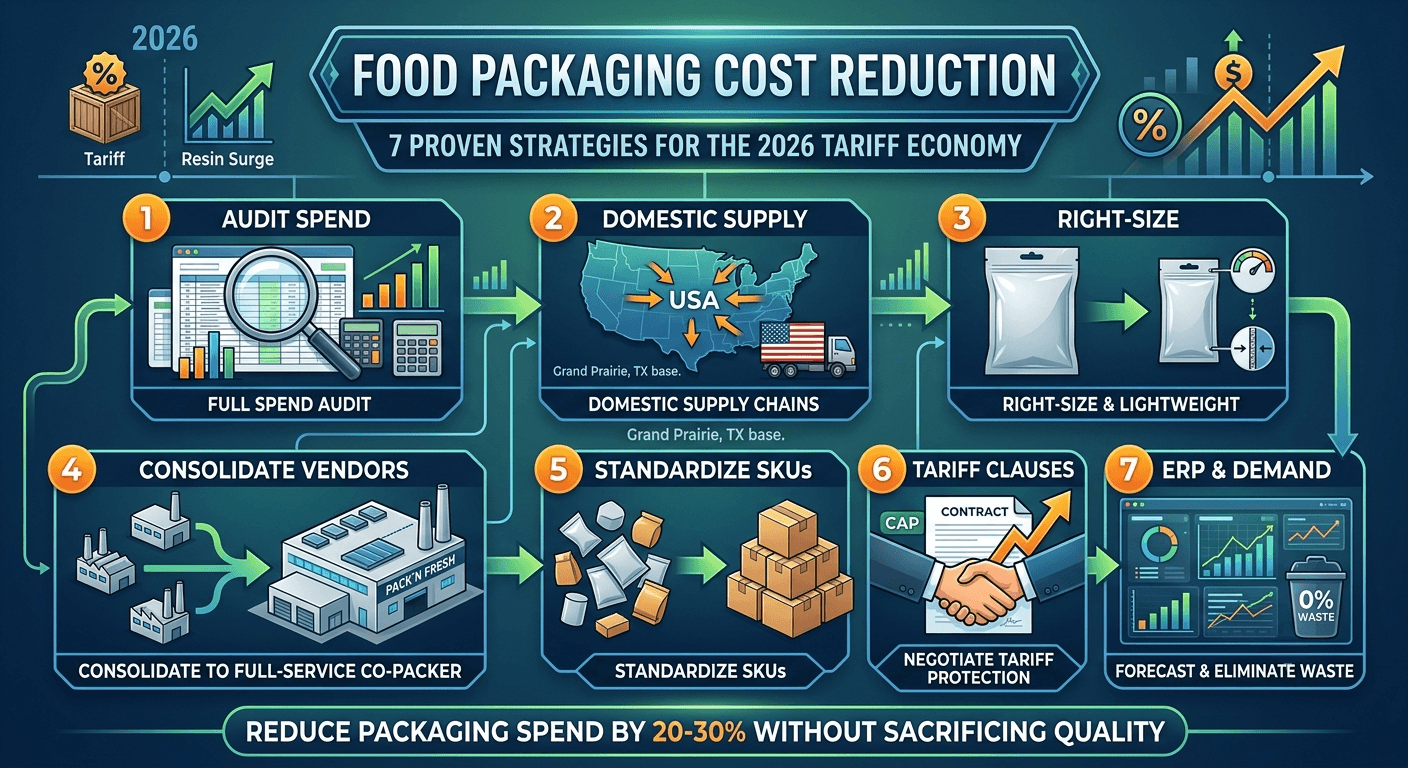
The seven strategies covered in this guide move from diagnostic to structural. We start with a full packaging spend audit — because you cannot cut what you have not measured — and work through domestic sourcing, format right-sizing, vendor consolidation, SKU standardization, contract renegotiation, and ERP-driven demand alignment. Each strategy stands on its own, but the compounding effect of implementing them together is where the most significant food packaging cost reduction opportunities live.
At Pack’n Fresh, a SQF Level 2 certified full-service co-packer based in Grand Prairie, Texas, we work with food brands across the CPG spectrum — from emerging regional brands to established national labels — that are navigating exactly these cost pressures. Our domestic supply relationships, ERP-integrated production environment, and full-service capabilities make food packaging cost reduction a built-in feature of how we co-pack, not an afterthought applied at the end of a project.
Table of Contents
- Audit Your Full Packaging Spend Before You Cut Anything
- Switch to Domestic Suppliers and Co-Packers to Escape Tariff Exposure
- Right-Size and Lightweight Your Packaging Formats
- Consolidate to a Full-Service Co-Packer to Eliminate Vendor Overhead
- Standardize SKUs and Reduce Format Proliferation
- Negotiate Co-Packer Contracts with Tariff Protection Clauses
- Use ERP and Demand Forecasting to Eliminate Overproduction Waste
1. Audit Your Full Packaging Spend Before You Cut Anything
The most common mistake brands make when trying to achieve food packaging cost reduction is going straight to the material cost line and trying to negotiate a cheaper pouch or a thinner film. That approach often leads to compliance failures, quality complaints, or shelf-life problems that cost far more than the savings they generated. Effective food packaging cost reduction starts with knowing exactly where your packaging dollars are going before you change anything.
A complete packaging spend audit has three layers. The first is direct material costs: the price per unit of every substrate, closure, label, insert, and outer carton across every SKU. The second is converting and production costs: what you pay for filling, sealing, labeling, kitting, and inspection per case. The third — and most overlooked — is indirect costs: minimum order quantity penalties from small-volume SKUs, waste from overruns, expediting fees when lead times slip, and the hidden overhead of managing five or six separate packaging suppliers.
Most brands find that indirect costs account for 15 to 25 percent of total packaging spend and are the easiest target for immediate food packaging cost reduction. These costs rarely appear on a packaging invoice — they hide in freight charges, storage fees, changeover downtime, and the labor hours your team spends chasing vendor quotes and coordinating deliveries. A proper audit surfaces them so you can attack them systematically.
When conducting the audit, pull 12 months of purchase orders across every packaging supplier. Calculate your actual cost-per-unit for each SKU including inbound freight, storage, and waste. Compare that fully-loaded cost to your theoretical standard cost. The gap between the two is your food packaging cost reduction opportunity. If you need a deeper framework for mapping packaging into your total COGS picture, our guide on food business COGS calculation walks through how to build that model from scratch.
Brands that complete this audit for the first time typically find their results cluster into three categories. The first is materials that are over-specified relative to their actual channel requirements — a high-barrier film protecting a product that does not need that level of oxygen exclusion, or a premium carton used for a product sold primarily in e-commerce where the outer carton is never seen by the consumer. The second category is suppliers that are underperforming on lead time, quality consistency, or minimum order flexibility, driving hidden costs through expediting fees and inventory write-offs. The third is internal complexity — too many SKUs, too many formats, or too many changeovers per week — that inflate per-unit cost even when individual supplier pricing is reasonable.
Prioritizing which category to attack first depends on your current constraint. If cash flow is tight, reducing inventory carrying cost through MOQ renegotiation delivers results fastest. If margin is the primary pressure, material right-sizing and format consolidation typically offer the largest structural food packaging cost reduction. If operations are the bottleneck, SKU rationalization to reduce changeover frequency will improve throughput and cost simultaneously. In most cases, the audit reveals all three categories of opportunity, and a sequenced roadmap that addresses each in turn delivers compounding improvement over four to six quarters.
2. Switch to Domestic Suppliers and Co-Packers to Escape Tariff Exposure
The single most structurally impactful move for food packaging cost reduction in 2026 is reducing your exposure to imported packaging materials. According to packaging industry analysts, the combination of Section 232 steel and aluminum tariffs at 50 percent, broad reciprocal tariff structures on finished packaging goods, and resin prices driven up by Middle East supply disruptions has made the landed cost of imported packaging both higher and nearly impossible to forecast. Brands still sourcing film, foil, metal closures, or corrugated materials from offshore suppliers are absorbing all of that unpredictability into their COGS.
Domestic material sourcing eliminates the tariff layer entirely. It also removes the currency risk, the 6- to 12-week ocean transit lead time, and the inventory carrying costs that come with needing to buffer against import delays. For brands that have been sourcing packaging from China, Southeast Asia, or Europe, the math in 2026 often shows that domestic materials — even at a nominally higher unit cost — deliver a lower total landed cost once tariffs, freight, and inventory financing are factored in.
The same principle applies to your co-packer. A co-packer operating in the U.S. with domestic material supply chains gives you a tariff-sheltered production environment. This is a meaningful component of food packaging cost reduction that brands often overlook when they focus only on unit-level material pricing. Pack’n Fresh operates from Grand Prairie, Texas, with domestic supplier relationships across film, foil, and flexible packaging substrates. That location in the center of the country also reduces inbound ingredient freight and outbound distribution costs for brands shipping nationally.
Domestic co-packing also delivers lead time advantages that translate into real cost savings. Shorter lead times mean lower safety stock requirements, smaller working capital tied up in packaging inventory, and faster response when demand patterns shift. Every week of safety stock you can take out of your packaging pipeline is a direct contribution to food packaging cost reduction.
The transition from imported to domestic material sourcing does not need to happen all at once. A practical approach is to start with the packaging components that have the highest tariff exposure — typically metal closures, foil laminates, and rigid trays where Section 232 tariffs add the most cost — and substitute those with domestic equivalents first. Flexible film substrates can follow in a second phase as you validate domestic alternatives against your existing barrier and shelf-life requirements. Most co-packers with domestic supplier relationships can facilitate this transition without a production stoppage if migration is planned 60 to 90 days in advance.
Domestic sourcing also improves your quality audit program. When your packaging material supplier is three states away rather than twelve time zones away, a raw material quality issue identified in receiving can be escalated and resolved in days rather than weeks. Faster quality feedback loops reduce the risk of producing a full batch against out-of-spec materials — an event that typically results in complete product write-off and emergency re-sourcing at premium cost. Reducing that risk is an indirect but real component of food packaging cost reduction that does not appear on a material price comparison but shows up clearly in annual waste and write-off totals.
3. Right-Size and Lightweight Your Packaging Formats
Packaging that is heavier, larger, or more structurally complex than the product actually requires is one of the most persistent sources of unnecessary cost in food manufacturing. Food packaging cost reduction through right-sizing means systematically matching your packaging format — its gauge, dimensions, closure type, and barrier specification — to the actual protection requirements of the product inside it.
Many brands inherit packaging specifications that were set during product development and never revisited. A pouch gauge specified for a 24-month shelf life product may be unnecessarily thick if the product is actually turning in 90 days. A rigid box used because it looked premium at launch may be delivering no functional value over a stand-up pouch that costs 40 to 60 percent less per unit. Revisiting these specifications with your co-packer — specifically looking at whether current formats are over-engineered relative to actual channel requirements — is one of the fastest paths to meaningful food packaging cost reduction.
Lightweighting is the complementary tactic: reducing the weight of the packaging material itself without changing the format. Converting from a thicker polyethylene film to a thinner high-barrier alternative, or moving from a full-gauge aluminum foil laminate to a thinner foil/film combination, can reduce material cost per unit by 15 to 25 percent while maintaining or improving oxygen transmission rates. The key is that any lightweighting decision must be validated against shelf-life testing and distribution stress testing before full rollout.
Right-sizing also delivers downstream savings in freight. A product that ships in a package 20 percent smaller in cubic volume pays 20 percent less in dimensional weight freight charges. For brands with significant DTC or national retail distribution, the freight impact of food packaging cost reduction through right-sizing can rival the material cost savings themselves. Analyze your freight spend alongside material cost when evaluating format changes — the full picture is almost always more compelling than the material line alone.
Brands moving from rigid packaging to flexible pouches often find that this single format change delivers the most concentrated food packaging cost reduction available to them. Stand-up pouches require less material per unit, ship flat before filling, and take up less shelf space in retail — which matters for category resets. Our guide on stand-up pouch packaging covers the format decision framework in detail.
One consideration brands sometimes overlook in right-sizing is the retailer approval process. Major retail channels — club stores, natural grocery, mass market — each have packaging dimension and structural requirements that must be met before a product can be ranged in their planograms. Before committing to a new format or gauge specification, confirm that the proposed change meets the requirements of every retail channel the product currently sells through or is targeting. A format change that delivers 20 percent material cost savings but requires a 90-day retail re-approval process may be the right decision — but the timing needs to align with your category reset calendar, not just your cost reduction timeline.
Shelf-life validation is the other gate that right-sizing must pass through. Modified atmosphere packaging, barrier film selection, and seal integrity specifications exist to maintain product safety and quality over the intended shelf life. Any reduction in packaging specification — thinner gauge, lower barrier, narrower seal width — requires accelerated shelf-life testing under the same conditions the product will experience in distribution and storage. Running these tests in parallel with the format change design process, rather than sequentially, is the most time-efficient path to capturing the food packaging cost reduction that right-sizing delivers without slowing the rollout schedule.
4. Consolidate to a Full-Service Co-Packer to Eliminate Vendor Overhead
One of the most underappreciated levers for food packaging cost reduction is the elimination of multi-vendor overhead. A brand working with separate suppliers for film, labels, filling, kitting, and labeling is not just paying each vendor separately — it is absorbing coordination costs, quality control gaps, freight between facilities, and minimum order penalties from each vendor operating on its own schedule and volume tier.
When a brand consolidates to a full-service co-packer that handles materials, filling, labeling, kitting, and warehousing under one roof, those coordination layers disappear. There is one purchase order, one quality audit, one inbound freight lane, and one point of accountability for everything that goes out the door. Industry operators consistently note that this consolidation alone can reduce total packaging operations cost by 18 to 25 percent, even before any material substitution is considered. The food packaging cost reduction comes from elimination of overhead, not from cutting material quality.
Full-service co-packers also offer economies of scale that fragmented multi-vendor relationships cannot match. A full-service operation buying film in volume for multiple customers has supplier negotiating leverage that a small brand buying on its own will never achieve. When that purchasing power translates into material cost, the brand benefits from food packaging cost reduction without doing anything differently on its end. The co-packer’s scale becomes the brand’s cost advantage.
There is also a quality dimension to consolidation. When multiple vendors each handle part of the packaging process, accountability for quality failures fragments. A seal failure, a label misregister, or an off-spec fill weight gets attributed to whoever happens to be the last vendor to touch the product. A full-service co-packer owns the outcome end-to-end — which means problems get identified and fixed earlier, reducing waste-driven cost. Our detailed breakdown of full-service packaging solutions covers each of these advantages in depth.
For brands currently working with three or more packaging vendors, the consolidation analysis almost always shows net positive food packaging cost reduction. The exercise is straightforward: total up what you pay each vendor including freight, minimum order fees, coordination labor, and quality-related rework. Compare that to a fully-loaded quote from a single full-service co-packer. The gap is typically larger than brands expect.
The transition to a full-service co-packer is typically structured in three phases. The first phase — validation and onboarding — involves running trial production to confirm that the co-packer’s equipment, materials, and processes can reproduce the product to spec. This phase typically takes four to eight weeks and should be completed before any existing vendor agreements are terminated. The second phase is parallel production: running a defined volume through both the old vendor network and the new co-packer simultaneously to validate quality consistency and operational cadence. The third phase is full transition: shutting down the fragmented vendor relationships and consolidating all production to the full-service partner.
Brands that try to skip the validation and parallel production phases in order to capture food packaging cost reduction faster often pay a higher price when quality issues surface in full-scale production with no fallback option. A structured transition that adds six to ten weeks to the timeline is consistently the lower-risk path, and the cost savings from consolidation are permanent once the transition is complete. The initial investment in a careful transition pays itself back within the first production cycle at the new consolidated rate.
Ready to cut your packaging costs without cutting corners?
Pack’n Fresh helps food brands achieve measurable food packaging cost reduction through full-service co-packing, domestic material sourcing, and ERP-backed production management. Let’s build your cost reduction roadmap together.
5. Standardize SKUs and Reduce Format Proliferation
Format proliferation is a silent killer of packaging economics. Every unique SKU — different pouch size, different label layout, different fill weight, different closure type — requires its own setup, its own minimum order quantity, its own tooling amortization, and its own changeover time on the production line. Brands that have grown quickly and added SKUs to capture market segments often end up with portfolios where the packaging complexity cost exceeds the revenue contribution of the marginal SKUs driving it.
Food packaging cost reduction through SKU rationalization starts with a volume-weighted analysis of your portfolio. Rank every SKU by annual units sold and by fully-loaded packaging cost per unit. The SKUs in the bottom quartile by volume and the top quartile by cost-per-unit are your primary targets. The question for each is whether the revenue it generates justifies its disproportionate contribution to packaging complexity — and the answer is often no.
The goal of rationalization is not to eliminate product variety — it is to deliver that variety within a standardized packaging architecture. Standardizing on two or three core format configurations (for example, a 4 oz stand-up pouch, an 8 oz stand-up pouch, and a 1 lb flat-bottom bag) lets your co-packer run longer, more efficient production campaigns. Fewer changeovers mean lower per-unit setup cost and better utilization of line time. That efficiency is a direct driver of food packaging cost reduction at the production level.
Standardization also improves your purchasing leverage. Buying larger consolidated volumes of two or three film SKUs instead of small quantities of six or eight different substrates puts you in a better tier with material suppliers. Volume pricing improvements of 8 to 15 percent are common when a brand moves from fragmented small-lot purchasing to consolidated volume purchasing within a standardized format architecture.
Once you have identified your target standard formats, work with your co-packer to build product line extensions within those formats rather than outside them. Flavor variants, seasonal products, and limited editions can almost always be accommodated within an existing format configuration through label changes alone. This approach gives consumers the variety they want while delivering the food packaging cost reduction your margins require.
The SKU rationalization decision is easier when you have a clear framework for what constitutes a non-viable SKU. A useful starting threshold: any SKU that generates less than two production runs per year is a candidate for review. Running a SKU once or twice annually means setup and changeover costs represent a disproportionate share of its fully-loaded unit cost — often exceeding what the margin contribution from that SKU actually delivers. For those products, the choice is either to discontinue the SKU, absorb it into a larger format under the same brand architecture, or accept that it will always carry a cost premium and price it accordingly.
Rationalization does not mean eliminating your lowest-volume products entirely. For some brands, a premium low-volume SKU serves a strategic purpose beyond its direct margin contribution — it demonstrates range, supports a premium price positioning, or qualifies the brand for a retailer category that benefits the whole portfolio. The goal of food packaging cost reduction through SKU management is not to build the smallest possible portfolio, but to ensure that every SKU in the portfolio is either carrying its own packaging cost weight or serving a clear strategic function that justifies the cost it imposes on the rest of the production schedule.
6. Negotiate Co-Packer Contracts with Tariff Protection Clauses
The contract between a food brand and its co-packer determines who absorbs the cost of packaging material volatility — and in 2026, that is not a question to leave to ambiguity. Many brands are currently operating under contracts written in 2023 or 2024 that contain material pass-through clauses with no caps, meaning that every resin price increase or tariff surcharge flows directly into their per-case rate with no protection. Renegotiating these contract terms is a structural lever for food packaging cost reduction that requires no operational changes at all.
The most important clause to add or revise is the material cost adjustment provision. A well-structured version of this clause defines a baseline material cost index (typically a published resin price index or commodity reference), specifies how often adjustments can be made, and caps the maximum year-over-year increase that can be passed through. A cap of 5 to 8 percent per year gives your co-packer reasonable protection against genuine market moves while protecting your brand from absorbing extraordinary spikes caused by tariff policy decisions entirely outside your co-packer’s control.
Volume tier pricing is the second lever. If your co-packer offers per-case pricing that decreases at defined volume thresholds, committing to an annual minimum volume in exchange for a locked rate can deliver 6 to 12 percent food packaging cost reduction relative to spot pricing. The risk is that you commit to volume you need to hit — so this works best for brands with predictable, growing demand where the volume commitment is conservative relative to actual trajectory.
Annual review clauses protect both parties in a volatile material environment. Rather than waiting for contract renewal to discuss pricing, schedule a formal semi-annual review that looks at material index changes, volume actuals versus commitments, and any operational efficiency gains the co-packer has realized. Co-packers who are genuinely partnered with their customers — rather than just transacting with them — will share efficiency gains as they occur. That partnership dynamic is itself a source of sustained food packaging cost reduction over time.
Minimum order quantity terms deserve scrutiny as well. MOQs that were set when material costs were lower may no longer make sense — a brand forced to order 20,000 units of a pouch it sells 8,000 units per quarter is financing 12,000 units of inventory carrying cost per cycle. Revisiting MOQ terms as part of a broader contract negotiation can free up working capital that is effectively a hidden packaging cost.
When renegotiating, come prepared with data rather than requests. Pull your material cost index history for the past 24 months, calculate the cumulative percentage change in your major packaging inputs, and quantify in dollar terms what those changes have cost your business at current volumes. Co-packers negotiate more constructively when presented with a factual cost impact analysis than when approached with a general request for lower pricing. Showing that a 30 percent resin increase has added $X per case to your production cost, and proposing a specific tariff protection clause that limits future exposure to Y percent annually, is a far more productive starting point than asking for a better rate without context.
The goal of contract renegotiation for food packaging cost reduction is not to transfer all cost risk to your co-packer — it is to establish a risk-sharing framework that both parties can plan around. Co-packers face the same material volatility you do, and contracts that leave them fully exposed to cost spikes tend to produce either co-packer relationships that deteriorate under margin pressure or sudden rate increase requests mid-contract that are harder to plan around than a structured annual adjustment mechanism. A fair contract produces a stable, sustainable co-packing relationship that delivers consistent packaging cost performance over time.
7. Use ERP and Demand Forecasting to Eliminate Overproduction Waste
Overproduction is one of the least visible but most significant sources of packaging cost in food manufacturing. When demand forecasts are inaccurate and production runs are set too high, the result is excess finished goods inventory, obsolescence write-offs when products expire, and — critically — packaging material that was purchased, converted, and wasted without generating any revenue. Systematic food packaging cost reduction through demand alignment is only possible when your co-packer is operating from the same real-time data you are.
An ERP-backed co-packer gives brands visibility into production schedules, material inventory levels, and consumption actuals in real time. When a demand signal shifts — a retail order changes, a DTC subscription cohort churns, a seasonal product moves faster or slower than forecast — an ERP-integrated production environment can recalibrate the production schedule before the wrong volume runs. That recalibration prevents the packaging waste that accumulates when production is driven by static schedules rather than live demand data.
The cost impact of demand-aligned production is material. Every case that is produced and then written off as expired or obsolete carries 100 percent of its packaging cost with zero revenue recovery. Reducing overproduction by 10 percent in a brand doing $5 million in annual COGS can represent $400,000 to $600,000 in recovered packaging cost — a scale of food packaging cost reduction that no material substitution or vendor consolidation exercise is likely to match. Our full analysis of why ERP implementation matters in a co-packer covers this in detail.
Demand forecasting integration also enables better purchasing timing. When your co-packer can see your demand plan 8 to 12 weeks forward, it can time material purchases to avoid price spikes, consolidate material buys across customers for volume pricing, and carry less buffer inventory without risking stockouts. That purchasing intelligence is a compounding source of food packaging cost reduction that improves over time as the forecast model becomes more accurate.
Pack’n Fresh’s ERP system connects production scheduling, material inventory, and traceability into a single platform. Brands working with us have real-time visibility into their production status, material consumption, and inventory position — enabling the kind of demand-aligned decision-making that turns overproduction waste from an accepted cost of doing business into an eliminated cost center.
When evaluating a co-packer’s ERP maturity, ask specifically about demand signal integration. A co-packer with a good ERP system can still produce at the wrong volume if it is operating from a demand plan that is 60 days old. The facilities that deliver the best food packaging cost reduction through production accuracy are those that have established a direct connection between the brand’s sales data or DTC subscription platform and the co-packer’s production scheduling system. This integration does not need to be technically complex — a shared planning document refreshed weekly can achieve most of the benefit. But it does need to be a deliberate, structured process rather than an informal conversation at the start of each production month.
Emergency production runs are another cost that ERP-driven demand management eliminates. When forecasts are inaccurate and safety stock runs out unexpectedly, brands often resort to expedited production runs that carry setup premiums, expedited material sourcing fees, and expedited freight costs. These emergency costs can easily exceed 30 to 50 percent above standard run rates for the same production volume. Eliminating even two or three emergency runs per year through better demand visibility is a meaningful contribution to food packaging cost reduction that does not require any change to material specifications, formats, or supplier relationships.
How Pack’n Fresh Delivers Measurable Food Packaging Cost Reduction
Every strategy in this guide maps to a specific operational capability. At Pack’n Fresh, we have built our co-packing model around the capabilities that make food packaging cost reduction achievable at scale — not as a one-time project, but as a structural feature of how we produce for every brand we partner with.
Our SQF Level 2 certification means that quality control is built into the production process, not inspected at the end. Preventing packaging failures — seal defects, fill weight variances, label misregisters — at the point of occurrence eliminates the rework cost and product write-off cost that inflate packaging spend in facilities without robust quality management systems. Quality-driven food packaging cost reduction is the kind that compounds: fewer defects mean less waste, less waste means better line utilization, and better line utilization means lower per-unit cost for every brand on the floor.
Our Digital Ingredient Locking system provides an additional layer of allergen and cross-contamination protection that eliminates the risk of costly product recalls. A single recall event can generate packaging cost exposure that erases years of cost reduction progress. Brands co-packing at a facility with robust allergen management and traceability are protecting their packaging economics from low-probability but high-consequence events that unmanaged facilities leave as an open risk.
Our full-service model — covering material procurement, filling, sealing, labeling, kitting, and warehousing — allows brands to realize the vendor consolidation savings described in Strategy 4 immediately, without a complex transition project. When you move to Pack’n Fresh, you are not managing six supplier relationships down to five; you are moving from fragmented to unified in a single step. That is the fastest path to structural food packaging cost reduction for brands currently operating a multi-vendor model.
Grand Prairie, Texas gives brands a domestic production base that is sheltered from the tariff exposure affecting imported packaging materials and finished goods. Our domestic material supply relationships mean that the resin price volatility described at the top of this guide — PE/PP up 30 percent, PET trending at $1,100 to $1,250 per metric ton — is something we navigate on your behalf rather than something you absorb blindly through import invoices.
Conclusion
The 2026 tariff environment has made food packaging cost reduction an urgent priority for brands that were still operating on pre-tariff cost assumptions. Resin prices at four-year highs, steel and aluminum tariffs restructured to apply at full customs value, and packaging machinery import costs up 21 percent have created a structural cost increase that cannot be managed by simply asking existing suppliers for a better price. The brands that will protect their margins in this environment are the ones that take a systematic approach — auditing actual spend, restructuring supplier relationships, optimizing formats, and building contract terms that provide real tariff protection.
The seven strategies in this guide are not sequential — they work in parallel, and the order in which you pursue them should reflect where your audit identifies the largest opportunities. For most brands, vendor consolidation and domestic sourcing will deliver the fastest and largest impact. Format right-sizing and SKU standardization will deliver sustained compounding savings over subsequent quarters. Contract renegotiation and ERP-driven demand alignment will build the structural foundation that makes those savings permanent rather than temporary.
Effective food packaging cost reduction is not about cutting quality — it is about eliminating waste, consolidating complexity, and building supplier relationships that are structured for shared efficiency rather than one-sided cost pass-through. Pack’n Fresh partners with food brands to make that kind of structural improvement achievable. If you are ready to build a packaging cost reduction roadmap that fits your specific product mix and channel strategy, we are here to help.
Frequently Asked Questions About Food Packaging Cost Reduction
What is the fastest strategy for food packaging cost reduction in 2026?
For most brands, consolidating from a multi-vendor packaging model to a single full-service co-packer delivers the fastest measurable food packaging cost reduction. Vendor consolidation eliminates coordination overhead, minimum order penalties from multiple suppliers, and inter-facility freight costs without requiring any product formula or format changes. Brands with three or more packaging vendors typically see 18 to 25 percent reduction in total packaging operations cost within the first production cycle after consolidation.
How do 2026 tariffs specifically affect food packaging costs?
The 2026 tariff environment affects packaging costs through three channels. Section 232 tariffs on imported steel and aluminum at 50 percent of full customs value increase the cost of metal closures, canned packaging, and foil laminates. Reciprocal tariffs on finished packaging goods imported from affected countries add cost to sourcing film, pouches, and boxes from offshore suppliers. And plastic resin prices — driven by both import tariffs on petrochemical feedstocks and Strait of Hormuz supply disruptions — have pushed polyethylene and polypropylene to four-year highs. Domestic sourcing is the most direct path to food packaging cost reduction under these conditions.
What is lightweighting, and how much can it reduce packaging costs?
Lightweighting is the process of reducing the gauge or weight of packaging material while maintaining its protective performance. For flexible packaging, this typically means switching to a thinner film with equivalent or superior barrier properties — for example, moving from a 3.5 mil polyethylene film to a 2.8 mil high-barrier alternative. Industry operators consistently report that well-executed lightweighting delivers food packaging cost reduction of 15 to 25 percent on direct material cost per unit. Additional freight savings from reduced dimensional weight typically add another 5 to 10 percent to the total benefit. Any lightweighting change must be validated through shelf-life testing and distribution stress testing before deployment at scale.
What ERP capabilities should I look for in a co-packer for packaging cost control?
The ERP capabilities most relevant to food packaging cost reduction are real-time inventory visibility, demand-driven production scheduling, and automated material consumption tracking. Real-time inventory visibility lets you and your co-packer see packaging material levels without manual counts, enabling tighter purchasing cycles and less safety stock. Demand-driven scheduling prevents overproduction by aligning run quantities to actual demand signals rather than static forecasts. And automated material consumption tracking identifies waste points in the production process — fill weight variance, seal rejection rates, label waste — before they accumulate into significant cost. A co-packer with a fully implemented ERP will be able to share this data with you directly, not just report it retrospectively.
How often should I renegotiate my co-packer contract for cost protection?
In a stable material cost environment, annual contract reviews are typically sufficient. In 2026’s volatile tariff environment, semi-annual reviews are a stronger approach to sustained food packaging cost reduction. The review should examine actual material cost index changes against the baseline written into your contract, volume actuals versus commitments, and any efficiency improvements your co-packer has realized that should flow back to your per-case rate. Co-packers who are genuinely partnered with their customers will welcome semi-annual reviews as an opportunity to demonstrate value and strengthen the relationship. Those who resist them are typically absorbing margin on material volatility at your expense.
Can I achieve food packaging cost reduction without changing my packaging format?
Yes — and for brands where format changes require retail buyer approval or significant tooling investment, format-neutral food packaging cost reduction strategies should be prioritized first. Switching to domestic material suppliers, consolidating to a full-service co-packer, renegotiating contract terms, and implementing ERP-driven demand alignment all deliver meaningful cost reduction without touching the packaging format the consumer sees on shelf. Once those structural changes are in place, format optimization through right-sizing and lightweighting can be pursued as a second phase with the savings from phase one funding the validation and transition costs of phase two.
Stop absorbing tariff costs. Start building a smarter packaging model.
Pack’n Fresh offers food brands a domestic, full-service co-packing partnership built for food packaging cost reduction in today’s environment — SQF Level 2 certified, ERP-backed, and located in Grand Prairie, Texas for central U.S. distribution. Tell us about your current packaging model and we will identify your biggest cost reduction opportunities at no charge.