How to Launch a Food Brand: 7 Proven Steps from Concept to Retail Shelf in 2026
Every year, thousands of food entrepreneurs ask themselves the same foundational question: what does it actually take to turn a great recipe into a commercially manufactured product that reaches retail shelves and generates consistent, scalable revenue? The journey from a home kitchen idea to a product that consumers can buy at their local grocery store is longer, more technically complex, and more capital-intensive than most first-time founders anticipate — but it is absolutely achievable with the right roadmap and the right partners. Understanding how to launch a food brand in today’s competitive market means building competency across multiple disciplines simultaneously: food science, regulatory compliance, brand strategy, manufacturing logistics, and multi-channel distribution — all before your product ever reaches a store shelf.
The food brands that reach meaningful commercial scale are rarely those with the best recipes. They are the ones whose founders understood how to launch a food brand as a complete business system — not simply a culinary passion project. That distinction matters enormously: it is the difference between a product that sells out at one farmers market weekend and a brand that earns a purchase order from a regional grocery chain with 200 locations. This guide was written specifically to help you make that transition with clarity and confidence, so you can move from concept to retail shelf in 2026 without wasting capital on avoidable mistakes that derail far too many promising food startups before they reach their potential.
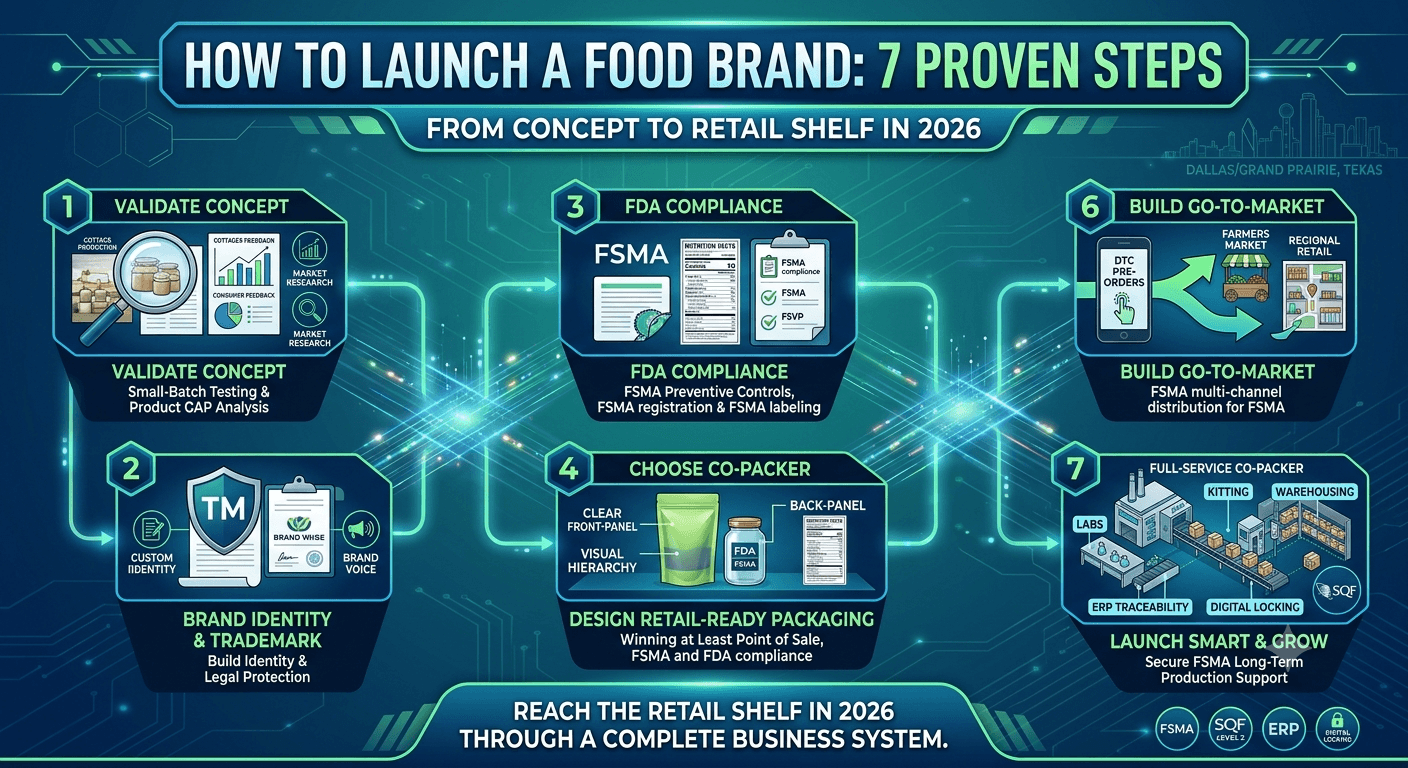
What follows is a practical, step-by-step framework covering everything a first-time or early-stage food founder needs to know about how to launch a food brand in the current market: from validating your concept before spending a dollar on manufacturing, to navigating FDA compliance under FSMA, selecting and vetting the right co-packer, designing retail-ready packaging, and executing a multi-channel go-to-market strategy that generates real, sustainable revenue. Whether you are launching a clean-label sauce, a functional snack, a specialty beverage, a premium pantry staple, or a private-label retail product, the seven steps in this article apply directly to your product, your market, and your launch timeline.
This guide walks you through all seven of those steps in sequence: concept validation, brand identity and trademark protection, FDA compliance under FSMA, co-packer selection and vetting, retail-ready packaging design, go-to-market channel strategy, and long-term growth through a strategic co-packing partnership. Each step builds directly on the one before it, and understanding how to launch a food brand through this complete framework is what separates founders who reach the retail shelf from those who stall at the product development stage.
At Pack’n Fresh, a SQF Level 2 certified full-service co-packer based in Grand Prairie, Texas, we have partnered with food entrepreneurs at the earliest stages of their brands — from first product development conversation to first retail purchase order. Our fully integrated production capabilities — including dry blending, pouching, labeling, kitting, and ERP-backed lot traceability — give brand founders the operational foundation they need when they are learning how to launch a food brand without the coordination complexity of managing multiple independent vendors. For the emerging food brands we work with, that end-to-end operational support at launch is not a convenience — it is a competitive advantage that shapes the entire trajectory of their first year in market.
Table of Contents
- Step 1 — Validate Your Concept Before Spending a Dollar on Manufacturing
- Step 2 — Build Your Brand Identity and File for Trademark Protection
- Step 3 — Navigate FDA Compliance: Registration, Labeling, and FSMA
- Step 4 — Choose and Vet the Right Co-Packer for Your Product Category
- Step 5 — Design Retail-Ready Packaging That Wins at Point of Sale
- Step 6 — Build Your Go-to-Market: DTC, Farmers Market, and Retail Strategy
- Step 7 — Launch Smart and Use Your Co-Packer as a Long-Term Growth Partner
Step 1 — Validate Your Concept Before Spending a Dollar on Manufacturing
The single most expensive mistake founders make when learning how to launch a food brand is falling in love with their product before the market has validated demand for it. Product development costs, custom packaging design fees, regulatory consulting, co-packer minimum order quantities, and initial inventory can easily total tens of thousands of dollars before you have sold a single unit at retail — and every dollar of that investment carries real financial risk if you have not first confirmed that real consumers actually want what you are making at the price you need to charge. The best founders in the food industry treat concept validation like a scientific hypothesis test: they design small, low-cost experiments specifically designed to confirm or challenge their core assumptions before committing capital to commercial-scale production.
Begin by building a thorough, objective picture of your target product category and its competitive landscape. Professional industry tools like SPINS and Mintel offer detailed category analysis and purchase data, but low-cost alternatives — walking your target retail section and photographing every competitor on shelf, reading consumer reviews on Amazon for competing products, monitoring category conversations in food-focused online communities — can reveal significant insight without a subscription fee. Your goal at this stage is to identify a defensible gap that your product authentically fills and that your target consumer actually cares about — not simply to find confirmation for assumptions you already hold. If five competitors are already competing effectively at your exact positioning and price point, that is critical market intelligence you need before you commit to manufacturing, not after.
Sell before you manufacture — this is one of the most important principles in how to launch a food brand without catastrophic early losses. Before booking co-packer production time or ordering custom packaging components, produce small cottage-law-compliant batches where your state’s regulations permit, and sell at local farmers markets, community pop-up events, or through a small DTC pre-order campaign to test real consumer purchasing behavior. Farmers market sales conversations are among the highest-quality market research available to an early-stage food brand: consumers will tell you directly which flavors move fastest, which label descriptions create confusion, what price point feels right for your product, and how your brand compares in their minds to competing products they already buy. Set yourself a concrete validation target: aim to sell at least 500 units at local events and direct channels before you schedule a co-packer discovery call.
Analyze your pricing and margin structure rigorously before you commit to a manufacturing partner or a packaging format. Calculate your estimated cost of goods sold (COGS) at realistic co-packer scale and work backward from a realistic retail selling price — taking into account the typical retail margin (30–50%), distributor margin (15–25%), freight costs, and promotional allowances — to confirm that your unit economics actually work at your target price point. Our detailed guide on food business COGS calculation walks through exactly how to structure this math before you commit capital to a production run. Founders consistently report that discovering at this stage that their target retail price is insufficient to support their actual cost structure is far less painful than discovering it after 5,000 units of finished goods are sitting in a warehouse.
Distill your product’s core differentiation into a single, clear sentence before you take your concept any further. This is sometimes called your shelf pitch — the one claim that makes a buyer or a first-time consumer choose your product over a direct competitor sitting immediately beside it. Knowing how to launch a food brand with genuine retail traction almost always traces back to founders who could articulate this sentence with precision and confidence from the earliest stage of their planning. If you cannot state your differentiation that concisely and convincingly right now, treat it as a signal that your concept needs additional refinement before you invest in co-packing, packaging design, or distribution outreach.
Document everything systematically during your validation phase — disciplined founders who understand how to launch a food brand with lasting co-packer credibility treat this step as non-negotiable. Keep organized records of your sales volumes by event and channel, your consumer feedback conversations, your price sensitivity testing results, and the questions that buyers and consumers ask most frequently about your product. This documentation becomes the raw material for your brand story, your investor narrative, your retail sell sheet, and your buyer conversations later in the launch process. A co-packer with genuine experience working with early-stage food brands will want to understand your validation story before they invest time in a discovery conversation — it demonstrates that you are a disciplined brand founder, not someone exploring a manufacturing hobby.
Step 2 — Build Your Brand Identity and File for Trademark Protection
Every strategic decision in how to launch a food brand with lasting recognition flows from the strength of your brand identity. Brand identity is not simply a logo and a color palette — it is the complete, integrated system of visual and verbal signals that communicate your product’s value, personality, and promise to a consumer in the three to five seconds they spend evaluating your product at shelf. Before you invest substantially in packaging design, website development, or social media content, you need to make the foundational brand decisions that will govern every downstream design and communication choice for years: your brand name, your complete visual identity system, your brand voice and tone, and your core founding story. Brand operators note that these foundational decisions become exponentially more expensive to revise once commercial packaging has been printed and distributed to retail accounts, so investing the time to make them strategically right from the beginning creates significant compounding returns.
Conduct a thorough trademark search before committing to any brand name or logo system — and do it before you fall in love with a name that may already be legally protected. The USPTO (United States Patent and Trademark Office) maintains a publicly searchable database called TESS (Trademark Electronic Search System) where you can check for existing federal trademark registrations in your product category before you invest in naming, design, or brand registration. Filing a federal trademark with the USPTO is the standard mechanism for protecting food brand names, logos, and slogans in U.S. commerce; the application process requires submitting your mark, its classification under the appropriate International Class of goods, and a specimen demonstrating the mark in active commercial use. Working with a qualified trademark attorney is strongly advisable throughout this process, because incorrect goods classification, likelihood-of-confusion conflicts with existing marks, and procedural errors are among the most common reasons USPTO applications are rejected or significantly delayed.
Protect your formula and proprietary processes before you share them with any external party — this is one of the highest-leverage legal steps in how to launch a food brand without surrendering your core intellectual property to a competitor. When you begin working with co-packers, ingredient suppliers, flavor development houses, or any third-party involved in your production process, you will necessarily be sharing formulation information that represents a core competitive asset — the precise combination of ingredients, ratios, and processes that makes your product distinctive. Always execute a Non-Disclosure Agreement (NDA) before sharing any formulation details, process specifications, ingredient sourcing information, or proprietary flavor profiles with any external organization. Most reputable co-packers are fully accustomed to executing NDAs as a standard element of their client onboarding process — but review every NDA carefully with qualified legal counsel to confirm it adequately covers the specific intellectual property you are disclosing and provides meaningful enforcement rights.
Your brand voice and complete visual identity system should be built precisely around your specific target consumer, not a generalized food-purchasing audience. A functional electrolyte drink targeting competitive endurance athletes communicates very differently from a premium artisan hot sauce targeting adventurous home chefs — even if both products are packaged in similar-sized bottles occupying adjacent positions on the same retail shelf. Define your target consumer persona with operational specificity: demographic profile, household income bracket, purchase motivations, dietary philosophy, shopping channel preferences, and media consumption patterns. Let that persona drive every brand decision you make, from the copy hierarchy on your front label to your Instagram content strategy to the trade events you choose to invest booth space at. This discipline in consumer focus is one of the most consistent predictors of early launch success that co-packers experienced in new product launches observe across their growing client roster.
Understanding how to launch a food brand with lasting market position also means recognizing that brand equity is actively constructed before your product ships — not passively accumulated after it does. Begin building your email subscriber list, your social media following, and your brand narrative during the product development phase, not after your first commercial production run arrives. Document your development journey authentically, share the story of why you are building this brand and what gap in the market motivated you, and start capturing genuine consumer testimonials and feedback even from your earliest cottage-production batches. By the time your co-packer delivers your first commercial run, you should already have a warm, engaged audience that has followed your journey and is ready and eager to make a purchase.
Step 3 — Navigate FDA Compliance: Registration, Labeling, and FSMA
FDA compliance is non-negotiable for any food brand selling products to U.S. consumers, and the regulatory requirements are more specific, more technical, and more actively enforced than most first-time founders realize when they begin their launch planning. The Food Safety Modernization Act (FSMA) fundamentally reoriented FDA’s regulatory posture from responding to foodborne illness outbreaks after they occur to actively preventing them before they can happen — placing significant new preventive control obligations on food facilities and manufacturers at every stage of the supply chain. Understanding your specific obligations under FSMA, and building a manufacturing relationship with a co-packer who already operates in full documented compliance with those requirements, is one of the most critical components of knowing how to launch a food brand that survives its first regulatory review or retail buyer compliance audit.
Founders who understand how to launch a food brand in full FDA compliance know that facility registration is a mandatory pre-production step, not a post-launch formality. Food facilities that manufacture, process, pack, or hold food intended for consumption in the United States are required to register with the FDA before producing food for U.S. commerce — this is a FSMA requirement, not simply a best practice. FDA food facility registration is completed online through the FDA’s Unified Registration and Listing System (FURLS) at fda.gov/food and must be renewed biennially during the October through December registration window. If you are working with a co-packer — which most emerging food brands should be — that co-packer’s facility is the registered food facility for regulatory purposes. Confirm this arrangement explicitly in your co-packing agreement, request a copy of your co-packer’s current FDA registration number and registration status documentation, and retain those records as part of your compliance file.
FDA food labeling requirements are detailed, technically specific, and enforced by both FDA and state-level regulatory agencies. Federal law requires that any packaged food product sold in U.S. commerce include the following mandatory elements: a Nutrition Facts panel formatted precisely to current FDA specifications (including the updated panel format that has been mandatory since 2020 for most manufacturers), a complete ingredient list declared in descending order of predominance by weight using standardized ingredient names, a major food allergen declaration compliant with both FALCPA and the FASTER Act of 2021, the net quantity of contents expressed in both metric and U.S. customary units, and the name and place of business of the manufacturer, packer, or distributor. The full technical requirements for each of these mandatory label elements — including type size requirements, panel placement rules, and permitted format variations — are available at FDA’s food labeling and nutrition resource page.
For any founder mapping out how to launch a food brand with allergen-containing ingredients, allergen labeling deserves particular attention from both a regulatory compliance and consumer safety standpoint. The FASTER Act of 2021 added sesame as the ninth major food allergen in the United States, effective January 1, 2023 — joining the previously established eight: milk, eggs, fish, shellfish, tree nuts, peanuts, wheat, and soybeans. Your ingredient list and any applicable may-contain or processed-in-the-same-facility statements must accurately reflect every major allergen present in your formulation. Where cross-contact in the manufacturing environment is a realistic operational possibility, that risk should be disclosed to consumers through appropriate precautionary labeling. A qualified co-packer will have documented, audited allergen control procedures that protect your specific product and their other client products simultaneously — including allergen scheduling protocols and verified sanitation standards designed specifically to manage cross-contact risk between production runs.
FSMA also requires that facilities producing food subject to the Preventive Controls for Human Food rule maintain comprehensive written food safety plans, conduct documented hazard analyses for each product they manufacture, and implement preventive controls with monitoring, corrective action, and verification procedures that are documented and available for regulatory review. Founders consistently report that partnering with an SQF-certified co-packer dramatically simplifies their own compliance burden, because a certified co-packer’s food safety management system already meets or exceeds FSMA’s preventive controls requirements at the facility level. Knowing how to launch a food brand without becoming entangled in costly regulatory non-compliance issues frequently comes down to choosing a manufacturing partner whose existing certifications and documented food safety systems effectively carry a substantial portion of your compliance responsibility on your behalf.
Step 4 — Choose and Vet the Right Co-Packer for Your Product Category
Founders who know how to launch a food brand that scales without operational crisis will tell you that choosing the right co-packer is the single most consequential decision of the entire launch process, and the stakes justify treating it as a multi-week strategic evaluation rather than a casual vendor comparison. A strong co-packing partner is far more than a contract manufacturer — they are an operational partner who protects your proprietary formula, delivers consistent product quality across every production run regardless of volume, scales their service capacity alongside your brand’s growth trajectory, and actively helps you navigate the technical and regulatory challenges of commercial food production. A poor co-packer choice, by contrast, can derail your launch timeline by months, generate quality inconsistencies that cost you early retail placements, and expose your brand to significant regulatory liability you may not discover until a buyer audit reveals the problem.
Begin your co-packer evaluation by clearly defining the complete scope of production services your brand requires, then systematically match those requirements to co-packer capabilities. How to launch a food brand efficiently almost always involves working with a full-service co-packer rather than piecing together a supply chain from multiple independent vendors. Full-service co-packers — like Pack’n Fresh in Grand Prairie, Texas — provide end-to-end manufacturing solutions that include sourcing and managing inbound raw materials, filling, sealing, labeling, kitting, and warehousing under a single, integrated operational roof. This integrated capability means you as the brand owner do not need to coordinate multiple independent vendors, manage inbound ingredient shipment logistics, or troubleshoot handoffs between separate suppliers and manufacturers. Specialty co-packers may focus on specific product formats (liquid-only, dry blends, flexible pouches) or specific product categories — match your product’s format and category to the co-packer’s demonstrated operational expertise before you invest time scheduling a facility visit.
Third-party food safety certification is the absolute minimum qualification bar for any co-packer you seriously evaluate. A co-packer operating without a recognized independent certification — such as SQF (Safe Quality Food) certification from the Safe Quality Food Institute — represents an unnecessary and potentially brand-threatening risk to your product’s integrity and your consumers’ safety. Pack’n Fresh holds SQF Level 2 certification, meaning an independent auditor from a SQFI-approved certification body has comprehensively evaluated our food safety management system against the SQF Code standards and formally confirmed compliance. For brand founders, this certification provides documented, third-party-verified evidence of your manufacturing partner’s food safety practices — the kind of documentation that retail buyers, grocery chain compliance teams, national distributors, and institutional purchasers may require before approving your brand for their program.
Ask every co-packer candidate to explain their allergen management system in specific operational detail — not just in general terms or with reference to a written policy document. Brands whose products contain any of the nine major food allergens, or whose products must be kept free of cross-contact with allergens present elsewhere in the facility, need a co-packer who can demonstrate documented allergen control with real operational specificity about how cross-contact risk is managed run-to-run. Pack’n Fresh uses siloed allergen scheduling, which means allergen-containing production runs are methodically sequenced and scheduled to prevent cross-contact exposure with non-allergen or allergen-sensitive products. We combine this scheduling system with ATP swab sanitation verification — an objective, measurement-based microbiological test that provides documented confirmation that all equipment contact surfaces are free of biological residue following every cleaning event between production runs. Request ATP testing records and allergen scheduling documentation from every co-packer candidate before making a selection commitment.
Founders learning how to launch a food brand at a retail-ready level quickly discover that traceability infrastructure has become operationally non-negotiable for food brands seeking placement with retail chains, regional and national distributors, and institutional buyers — and the regulatory trend toward mandatory supply chain traceability under FSMA’s Food Traceability Rule makes this a forward-looking investment regardless of your current channel profile. In the event of a product recall — whether voluntary or FDA-mandated — your ability to trace every ingredient from its origin through your co-packer’s production process to the specific lot of finished goods currently in the distribution channel determines how quickly and precisely you can limit consumer exposure and protect your brand’s long-term reputation. Pack’n Fresh’s ERP-backed production management system maintains comprehensive production records linking every lot of finished product to its source ingredients, production batch parameters, in-process quality control data, and finished goods disposition. Our Digital Ingredient Locking system provides an additional safeguard by ensuring that production runs cannot deviate from an approved, brand-owner-authorized formulation without documented authorization — protecting your formula integrity, your label compliance, and your product consistency simultaneously.
For a more comprehensive operational framework covering the full co-packer vetting process, read our detailed guide on choosing a food co-packer: 5 critical questions every brand should ask, which covers minimum order quantity negotiation, lead time management, contract term structures, and ongoing quality control requirement setting. If you are earlier in the process and want to understand what co-packing actually involves before beginning vetting conversations, our foundational overview of what food co-packing is and how it can benefit your business is the right starting point. How to launch a food brand the right way means treating co-packer selection as a multi-week strategic investment, not a two-hour vendor comparison.
Ready to Work With a Co-Packer Purpose-Built for New Food Brand Launches?
Pack’n Fresh is a SQF Level 2 certified full-service co-packer in Grand Prairie, Texas. We offer ERP-backed traceability, Digital Ingredient Locking, siloed allergen scheduling, and fully integrated production services — from inbound materials through labeling, kitting, and warehousing. Whether you are planning your first production run or scaling an established SKU, we would love to discuss your product and timeline.
Step 5 — Design Retail-Ready Packaging That Wins at Point of Sale
Your packaging is your product’s most powerful sales tool at the retail shelf level — and it performs that function entirely without you present to explain, demonstrate, or advocate. The design decisions you make about label layout, color palette, typography, front-panel visual hierarchy, and back-panel copy will determine whether your product attracts consumer attention and earns a purchase or disappears behind a more visually compelling competitor. Brand operators note that packaging design is consistently one of the highest-leverage investments an early-stage food brand can make, yet it is also one of the most frequently rushed steps in how to launch a food brand at retail scale, with founders cutting corners that later cost them placements, reorder opportunities, and the kind of brand recognition that drives long-term consumer loyalty.
Structure your front panel around a deliberate visual hierarchy that communicates your product’s core value proposition within one second of shelf exposure — because that is realistically all the time you will have. Your brand name should function as the dominant visual element that creates recognition and recall. Directly adjacent to it, your product name or flavor descriptor should immediately answer the consumer’s first question: what is this? The hero claim — your single most compelling benefit, whether “No Added Sugar,” “USDA Organic,” “Gluten-Free,” “20g Protein,” “Non-GMO,” or another category-relevant attribute — should be the third element the consumer’s eye encounters, reinforcing the primary purchase motivation. Consumers making purchase decisions in a retail aisle spend very limited time reading label copy; your packaging must communicate its entire value proposition without requiring careful reading.
Understanding how to launch a food brand through the right packaging format requires an early co-packer conversation, because your physical packaging format has direct structural implications for your production relationship that must be resolved before your label design is finalized — not after packaging components have been ordered. Different fill formats — glass jars, flexible stand-up pouches, rigid plastic containers, aseptic cartons, aluminum cans, foil-sealed cups, metal tins — require fundamentally different filling equipment, sealing systems, and labeling approaches. Discuss your preferred format with your co-packer before committing to a design, because equipment tolerances, minimum fill volumes, and label application specifications vary significantly across formats and must be fully compatible with your co-packer’s existing production capabilities. Pack’n Fresh’s precision micro-dosing capability enables accurate, consistent filling of small-volume servings that require tight fill-weight control — a differentiating operational asset for brands producing hot sauces, concentrated flavor drops, premium oils, or high-value supplement-grade functional ingredients where fill accuracy directly affects both product quality and regulatory compliance.
Your mandatory FDA labeling elements — Nutrition Facts panel, complete ingredient list, allergen declarations, net quantity statement, and manufacturer contact information — must be integrated into your label design from the very beginning of the design process. It is a common and costly mistake for first-time founders to invest substantially in label artwork only to discover during the prepress review that mandatory FDA label elements cannot be accommodated within the available panel space at the required minimum type sizes. Work with a label designer who has specific, demonstrated experience with FDA food labeling requirements, or use FDA’s published label format templates as structural constraints from your first design draft. Regulatory compliance is not a design afterthought you address before sending files to the printer — it is a fundamental design constraint that must govern your label layout from the first concept sketch.
Knowing how to launch a food brand that earns repeat retail placement also means approaching your packaging from the buyer’s operational perspective, not just from the consumer’s visual perspective. Retail buyers evaluate packaging submissions for shelf-fit (does the package fit within the standard shelf depth and height allowed by their planogram?), planogram compatibility (does it stack, hang, or stand in a format their shelving system supports?), and case efficiency (what are the case pack quantity and master case dimensions?). Request standard case pack configurations and pallet layout specifications from your co-packer during initial production planning, and confirm that your packaging format is fully compatible with their case sealing, pallet building, and warehouse storage systems before you finalize component procurement.
Step 6 — Build Your Go-to-Market: DTC, Farmers Market, and Retail Strategy
Your go-to-market strategy determines not just where your product will be sold, but in what sequence, at what investment level, and through what channel architecture — and channel sequencing is one of the most consistently misunderstood dimensions of how to launch a food brand effectively. The industry-validated channel progression for most emerging food brands follows a deliberate escalation of both opportunity and barrier-to-entry: farmers markets and local community events → direct-to-consumer (DTC) e-commerce → regional specialty retail → natural and organic grocery chains → national mass retail. Each channel in this sequence builds the specific proof points — documented sales velocity, verified consumer reviews, retailer references, and brand story depth — that the next, higher-barrier channel requires before their buyers will take your call.
For founders learning how to launch a food brand with real consumer validation baked in from day one, farmers markets are dramatically undervalued as a launch vehicle and deserve far more strategic investment than most founders give them. A farmers market booth puts you in direct, unmediated contact with your target consumers — no distributor margin, no retail listing fee, no slotting allowance, and no buyer gatekeeper standing between you and your customer. More importantly, the live sales environment at a farmers market creates real-time consumer feedback loops that no focus group can replicate: you will learn which flavors move fastest, which label language generates the most confusion or the most enthusiasm, what price point your specific target consumer considers genuinely reasonable, and how your product compares in their experience to competing products they already purchase regularly. Founders consistently report that their first season of farmers market sales was the most valuable market research investment they made across their entire launch — and they generated real revenue while conducting it.
Launch your DTC e-commerce channel concurrently with your farmers market presence, and use your early farmers market customers as your first online buyers, reviewers, and brand advocates. Shopify is the most widely used e-commerce platform among early-stage food brands because of its native inventory management, payment processing, and subscription app integrations. Subscription purchase models work particularly well for consumable food products — hot sauces, coffee blends, snack bars, supplements, shelf-stable meal components — because they generate predictable recurring revenue that enables more accurate production volume forecasting and eventually provides the leverage to negotiate improved minimum order quantities and longer planning horizons with your co-packer. Understanding how to launch a food brand with operational efficiency means building the revenue predictability that allows your manufacturing relationships to mature alongside your volume.
For founders who understand how to launch a food brand through a disciplined channel sequence, regional specialty retail is typically the first brick-and-mortar channel where early-stage brands find meaningful velocity, and it is the channel most worth prioritizing aggressively before you approach larger regional or national chains. Independent natural food retailers, regional specialty grocery chains, local food co-ops, and premium specialty markets are significantly more open to emerging brands than national chains, feature meaningfully shorter buyer decision timelines, and are genuinely motivated to carry compelling local and regional brand stories that their core customer base actively responds to. To secure initial placement with regional specialty retailers, you typically need: a professionally designed sell sheet with verifiable sales history, retail-ready packaging that fully complies with FDA labeling requirements, a reliable ability to service accounts on their required replenishment schedule, and a promotional support plan that demonstrates to the buyer that you are personally invested in making their shelf placement commercially successful.
National retail is a long-term objective that requires a substantial, documented foundation of channel velocity before it becomes a realistic near-term conversation. The category buyers at Whole Foods Market, Target, Kroger, Albertsons, Wegmans, and comparable national chains are evaluating tens of thousands of product submissions simultaneously and making placement decisions based on verifiable consumer velocity data, promotional budget commitment levels, proven retail execution capability, and precise category fit with their existing planogram architecture. Brand operators note that most food brands that ultimately achieve meaningful national retail placement spent two to four years building their velocity foundation in smaller, more accessible channels before earning that shelf space. Knowing how to launch a food brand for long-term national retail success means being strategically patient about the national opportunity while executing with real urgency in the direct and regional channels where you can build verifiable momentum right now.
Industry trade events — Natural Products Expo West, the Specialty Food Association’s Summer and Winter Fancy Food Shows, and category-specific industry conferences — are important relationship-building venues for food brands that are genuinely ready to begin accelerating the retail conversation at a broader level. These events provide direct, concentrated access to national and regional distributors, food brokers, category buyers, and industry trade media who can meaningfully accelerate your retail expansion if the relationship is established at the right stage of your brand’s development. Most experienced food industry advisors consistently recommend that you should arrive at trade shows fully equipped — confirmed co-packing partnership, retail-compliant packaging, verified sales history, and a compelling data-backed sell sheet — before investing in booth space. Trade events are most effective as acceleration tools for brands that already have proven channel momentum, not as substitutes for building that momentum through direct sales channel execution first.
Step 7 — Launch Smart and Use Your Co-Packer as a Long-Term Growth Partner
Your first commercial production run is a milestone worth celebrating — and then immediately treating as the baseline from which you will systematically improve. The food brands that achieve lasting market presence are those whose founders approached their initial launch not as the finish line of their launch process, but as the starting point of a disciplined operational learning cycle: measuring consumer response across channels, tracking sell-through velocity at each retail account, testing new SKU variants and product formats as data supports, and continuously improving product and brand execution based on real market feedback. How to launch a food brand that compounds value over time means building operational systems and co-packing relationships capable of scaling with genuine consistency — not just executing a single successful launch event and hoping the momentum carries.
Founders who truly understand how to launch a food brand with operational discipline use co-packer production documentation as an active management tool from the very first run — not as archival paperwork. Request complete batch records, production yield data, fill-weight audit results, and quality control testing documentation from every production run and review them carefully. Understand your standard production yield percentage — the ratio of saleable finished product to total raw material input — because this number is the bedrock foundation of your COGS model and drives your pricing architecture at every future volume tier. A co-packing partner genuinely committed to your brand’s long-term success will provide complete, transparent production documentation and proactively communicate any process deviations, raw material substitutions, or out-of-specification events that could affect your product’s consistency, label compliance, or shelf life performance.
As your production volume grows over time, your relationship with your co-packer should evolve from a transactional vendor arrangement to a genuine strategic manufacturing partnership. Pack’n Fresh works with emerging food brands at every stage of their growth trajectory, from initial first-run production commitments to high-volume recurring commercial production at full retail scale. Our ERP-backed production management system ensures that every production run — whether your first 500-unit introductory batch or your hundredth 50,000-unit recurring order — is tracked with the same rigorous level of documented traceability, quality control verification, and production data integrity. This operational consistency is what enables growing food brands to maintain the product quality standards that earned their retail placements as they scale to volumes that would strain a less systematized manufacturing partner.
As experienced founders who know how to launch a food brand at scale will confirm, new product development is one of the most powerful commercial growth levers available once a loyal consumer base is established — and your co-packing partner should be actively engaged in that process as a capabilities consultant, not just a passive executor. When you are ready to extend your product line with a new flavor variant, a new packaging format, a new serving size tier, or an entirely new product category, engage your co-packer early in the planning process to evaluate whether your proposed new SKU is compatible with their existing filling equipment, allergen scheduling protocols, and labeling systems before you invest in new packaging component artwork or procurement. Pack’n Fresh’s precision micro-dosing capability and fully integrated full-service production infrastructure give growing food brands the operational flexibility to explore multiple formats, serving sizes, and product configurations without requiring the significant capital investment in dedicated proprietary equipment that in-house production would demand.
Distribution partnerships represent a major commercial growth inflection point for food brands that have established solid, documented velocity in their direct and regional retail channels. National food distributors like UNFI and KeHE serve as the logistics backbone for natural, specialty, and conventional grocery retail — managing the warehousing, order fulfillment, invoicing, and last-mile delivery to individual retail accounts that independently servicing hundreds of store locations would otherwise require you to execute yourself. Founders consistently report that securing a meaningful distributor partnership requires demonstrated retail velocity with verifiable sell-through data, a retail-ready product with complete regulatory compliance documentation, and a manufacturing partner who can reliably meet the distributor’s required delivery timelines, lot coding standards, and inbound shipment documentation requirements. Confirm with your co-packer early that they are operationally configured to ship directly to distributor warehouse receiving facilities and to provide the case labels, lot codes, Certificates of Analysis, and shipping documentation that major distributors require before accepting inbound product.
Ultimately, how to launch a food brand that achieves its full commercial potential requires thinking in multi-year horizons, not in monthly sprint cycles driven by launch-week excitement. Plan your first 24 months as a structured sequence of concrete, achievable milestones: market validation and brand development → first co-packer production run → DTC channel launch → farmers market season → first regional retail placement → first retail reorder → first line extension → first distributor partnership. Each milestone creates the operational and commercial foundation that makes the next milestone achievable. The discipline to complete each milestone thoroughly before aggressively pursuing the next is what consistently distinguishes food brands with durable, compounding growth from brands that generate promising early momentum but stall before reaching meaningful scale. Co-packers experienced in working with early-stage food brands regularly observe that the founders most likely to build lasting market presence are the ones who maintain rigorous strategic discipline at each stage rather than attempting to compress timelines or skip the foundational steps that experienced brands have learned are non-negotiable.
How Pack’n Fresh Helps New Brands Launch Successfully
For food entrepreneurs navigating the real-world complexity of how to launch a food brand from scratch, Pack’n Fresh offers the specific combination of verified food safety certification, comprehensive full-service manufacturing capabilities, and production infrastructure that early-stage food brands need — without the coordination complexity of managing multiple independent vendors or the regulatory burden of facility registration and food safety plan development from a standing start. Located in Grand Prairie, Texas — a strategically central U.S. hub with cost-efficient shipping access to both major coastal markets and key regional distribution centers throughout the Sunbelt — Pack’n Fresh serves emerging and growth-stage food brands across a wide range of product categories and packaging formats.
Our SQF Level 2 certification means that your brand’s products are manufactured in a facility independently evaluated and formally verified by an accredited SQFI certification body against the rigorous food safety management standards of the Safe Quality Food Institute. For food brand founders, this certification is not simply a compliance checkbox to present during a buyer audit — it is a documented operational credential you can actively leverage in conversations with retail buyers, regional grocery chain compliance departments, and national distributors who are increasingly requiring verified, third-party-audited food safety practices from the brands they commit shelf space to. Our Digital Ingredient Locking system ensures your proprietary formula is protected across every production run, and our ERP-backed traceability infrastructure maintains comprehensive production records from your first batch through every subsequent commercial run as your volume scales.
Pack’n Fresh is a true full-service co-packer in the most operationally meaningful sense of the term: we manage inbound raw material sourcing and receiving verification, filling and sealing operations, labeling and date coding, kitting and retail assembly, and warehousing and outbound logistics under a single integrated production facility. For founders navigating how to launch a food brand while simultaneously managing brand development, regulatory compliance, sales channel outreach, and financial relationships, this integrated production capability dramatically reduces the coordination complexity and execution risk associated with your first commercial production run. Our siloed allergen scheduling protocols and ATP swab sanitation verification system provide the scientifically documented, objectively measured allergen control that brand founders with allergen-containing or allergen-sensitive products require — and can demonstrate with confidence to retail buyers who request your manufacturing documentation as part of their vendor approval process.
When you are ready to begin the co-packer evaluation conversation in earnest, the Pack’n Fresh team is available for a no-commitment free consultation to discuss your product category, production volume requirements, target launch timeline, and packaging format needs. We have supported many emerging food brands through exactly the steps outlined in this guide — from initial discovery conversations through first commercial production runs and into growing retail distribution relationships — and we would welcome the opportunity to discuss how to launch a food brand with the right co-packing partner — starting with your specific product, target timeline, and production requirements.
Conclusion
Knowing how to launch a food brand in 2026 means understanding that you are not launching a product in isolation — you are building a complete, integrated business system with a manufacturing supply chain, a regulatory compliance infrastructure, a carefully developed brand identity, and a deliberate multi-channel distribution architecture. Each of the seven steps in this framework represents a distinct operational and strategic discipline that successful food founders have had to develop and execute before they reached meaningful commercial scale. The encouraging, well-documented reality is that the framework itself is proven: thousands of food brands have navigated this exact sequence of decisions, found strong co-packing partners, built retail-ready brands, and are now generating consistent revenue on retail shelves across the country.
The most consistent differentiator between food brands that build lasting market presence and those that stall after a promising early launch is the quality of the foundational decisions made in the first 12 to 18 months — particularly the co-packer selection and the go-to-market channel sequencing. A manufacturing partner who delivers consistent product quality, documented regulatory compliance, scalable production capacity, and genuine operational transparency gives you a foundation that actively supports every growth decision you make downstream. If you are genuinely serious about how to launch a food brand that builds durable commercial value, treat those foundational decisions with the time, rigor, and strategic discipline they deserve — because every major milestone that follows depends on getting them right.
Whether you are still in the concept validation stage, actively evaluating co-packing partners, finalizing your retail-ready packaging design, or preparing your first formal buyer pitch, the seven steps in this guide — and the full-service team at Pack’n Fresh in Grand Prairie, Texas — are available to support your progress. How to launch a food brand is ultimately a question that gets answered one well-executed, strategically disciplined step at a time. The food founders who reach the retail shelf — and build thriving brands that stay there — are the ones who commit to moving decisively and methodically toward the next milestone on their roadmap, every single day.
Frequently Asked Questions About How to Launch a Food Brand
How long does it typically take to launch a food brand from concept to retail shelf?
The realistic timeline for how to launch a food brand from initial concept through your first retail placement typically ranges from 12 to 24 months, with most founders reaching their first co-packer commercial production run within six to nine months of beginning the process in earnest. The most time-intensive phases are typically concept validation and market testing (two to four months), FDA compliance review and label development (one to three months), co-packer vetting and contract negotiation (four to eight weeks), and retail-ready packaging design and component production (six to twelve weeks). Founders who attempt to rush any of these phases — particularly the co-packer vetting process and the FDA label compliance review — consistently report rework costs, compliance corrections, and launch delays that a more methodical, sequenced approach would have avoided entirely.
How much does it cost to launch a food brand?
The total capital required for how to launch a food brand varies significantly by product category, packaging format, and target distribution channel, but brand operators note that a realistic initial launch budget — covering packaging design and first print run, co-packer first-production-run minimum order quantity, FDA registration and compliance review, initial inventory carrying costs, and basic digital marketing and sales assets — typically ranges from $25,000 to $75,000 for most emerging food brand categories. Products requiring custom packaging components, specialty or imported ingredients, or co-packers with higher minimum order requirements may require substantially more launch capital. Our guide on food business COGS calculation provides a structured financial framework for building an accurate cost model before you commit your launch capital.
Do I need FDA registration to launch a food brand?
Yes — food facilities that manufacture, process, pack, or hold food intended for human consumption in the United States are legally required to register with the FDA under the Food Safety Modernization Act before producing food for U.S. commerce. If you are working with a co-packer, the co-packer’s facility typically fulfills the FDA facility registration requirement for your production runs — but confirm this explicitly in your co-packing agreement and retain your co-packer’s registration documentation. Brand founders also need to be aware of their labeling compliance obligations, their allergen declaration requirements, and — depending on their product category and facility type — the FSMA Preventive Controls for Human Food requirements. Consulting with a qualified food regulatory attorney early in your planning is advisable for any founder who wants a complete understanding of how to launch a food brand in full regulatory compliance before committing to a co-packer and production schedule.
What is the minimum order quantity I should expect from a co-packer?
Minimum order quantities (MOQs) vary considerably across co-packers depending on product format, facility operational scale, and production complexity. When evaluating co-packing partners as part of how to launch a food brand at your current development stage, ask directly about the minimum commitment for a first production run, the minimum for ongoing recurring runs, and whether the co-packer offers staged scaling arrangements that allow your volume commitments to grow proportionally as your verified retail sales grow. Understanding MOQ terms before you select a co-packing partner is essential because MOQ requirements directly determine your initial capital commitment, your inventory carrying costs, and your cash flow profile in the months following your first production run. Early-stage founders consistently find that full-service co-packers with genuine experience in emerging brand launches are more flexible on initial MOQ terms than large-scale commodity manufacturers whose primary client base consists of established national brands with high-volume recurring programs.
What certifications should I look for when vetting a co-packer?
At a minimum, any co-packer you seriously evaluate for how to launch a food brand should hold a recognized, independently audited third-party food safety certification — with SQF (Safe Quality Food) certification from the Safe Quality Food Institute being among the most widely recognized and respected in the industry. SQF certification at Level 2 or higher means an independent auditor from an SQFI-accredited certification body has evaluated the facility’s food safety management system against the comprehensive SQF Code standards. Additional certifications to evaluate depending on your product category and target market include USDA Organic facility certification, Kosher or Halal certification, Non-GMO Project verification capability, and allergen-free facility certification for products making allergen-free label claims. Always request current certification documents directly from the co-packer, and consider verifying active certification status directly with the certifying body before making a significant production commitment.
How do I protect my food formula when working with a co-packer?
Protecting your proprietary formulation is one of the most important practical steps in how to launch a food brand through an external co-packing relationship. The primary legal mechanism is a Non-Disclosure Agreement (NDA) executed with every external party — co-packer, ingredient supplier, flavor development house, contract laboratory, or third-party consultant — before you share any formulation details, ingredient specifications, process parameters, or proprietary flavor profiles. Most established, reputable co-packers are fully accustomed to executing NDAs as a standard element of their client onboarding process and will have a standard form available; however, always have any NDA reviewed by a qualified attorney before signing to confirm it adequately covers the specific intellectual property you are disclosing and provides meaningful, enforceable legal protection. Additionally, maintain your proprietary formulas and ingredient ratios in secure internal systems with strict access controls, file federal trademark protections with the USPTO for your brand name and logo, and consider trade secret protections for your most commercially sensitive formulation elements.
Ready to Take the Next Step in Launching Your Food Brand?
Pack’n Fresh is a SQF Level 2 certified full-service co-packer based in Grand Prairie, Texas, offering ERP-backed traceability, Digital Ingredient Locking, siloed allergen scheduling, ATP swab sanitation verification, precision micro-dosing, and complete production management from inbound materials through labeling, kitting, and warehousing. Our team has helped emerging food brands navigate every step of the commercial launch process — and we are ready to support yours.