Pet Food Co-Packing: 7 Proven Strategies to Scale Your Pet Treat Brand Without Compromise
The pet food and treat market is one of the most resilient and consistently growing categories in consumer goods. According to the American Pet Products Association (APPA), Americans spend tens of billions of dollars annually on pet food and treats, with the treat and supplement category growing consistently faster than core food. Even through economic downturns, pet owners maintain their spending on companion animals — and the premiumization of pet food, driven by the humanization of pets, a sharp increase in ingredient-consciousness, and the growth of functional treat formats, has created a robust market for innovative brands.
But scaling pet treat production from small-batch kitchen runs to national retail distribution requires a pet food co-packing partner who understands both the regulatory environment and the production precision that premium pet food demands. The gap between artisan production and commercial co-packing is significant, and choosing the wrong partner at that transition point creates quality, compliance, and supply chain risk that can stall a brand’s growth or cause lasting reputational damage.
Pet food co-packing is not simply food co-packing with different labels. AAFCO-compliant labeling requirements, FDA safety oversight under the Federal Food, Drug, and Cosmetic Act, specific ingredient declaration rules, and the production discipline required for consistent treat quality all create obligations that not every food co-packer is equipped to fulfill.
A co-packer who handles human food snacks may have excellent equipment and a strong safety culture — but if they have never navigated the guaranteed analysis panel requirements, the nutritional adequacy statement, or the ingredient declaration order rules that govern pet food labels, they will create compliance exposure for your brand regardless of how well-intentioned they are. Regulatory sophistication must be part of your co-packer evaluation, not an afterthought.
At Pack’n Fresh, we co-pack for food and supplement brands with the same production discipline that premium pet treat brands require — SQF certification, ERP-backed traceability, precision fill control, and a flexible format capability that spans dry blending, seasoning, and packaging across pouches, sachets, stand-up bags, jars, and beyond. Our infrastructure maps directly to the production requirements of dry pet treats, training treats, dental chews, and powdered pet supplement formats.
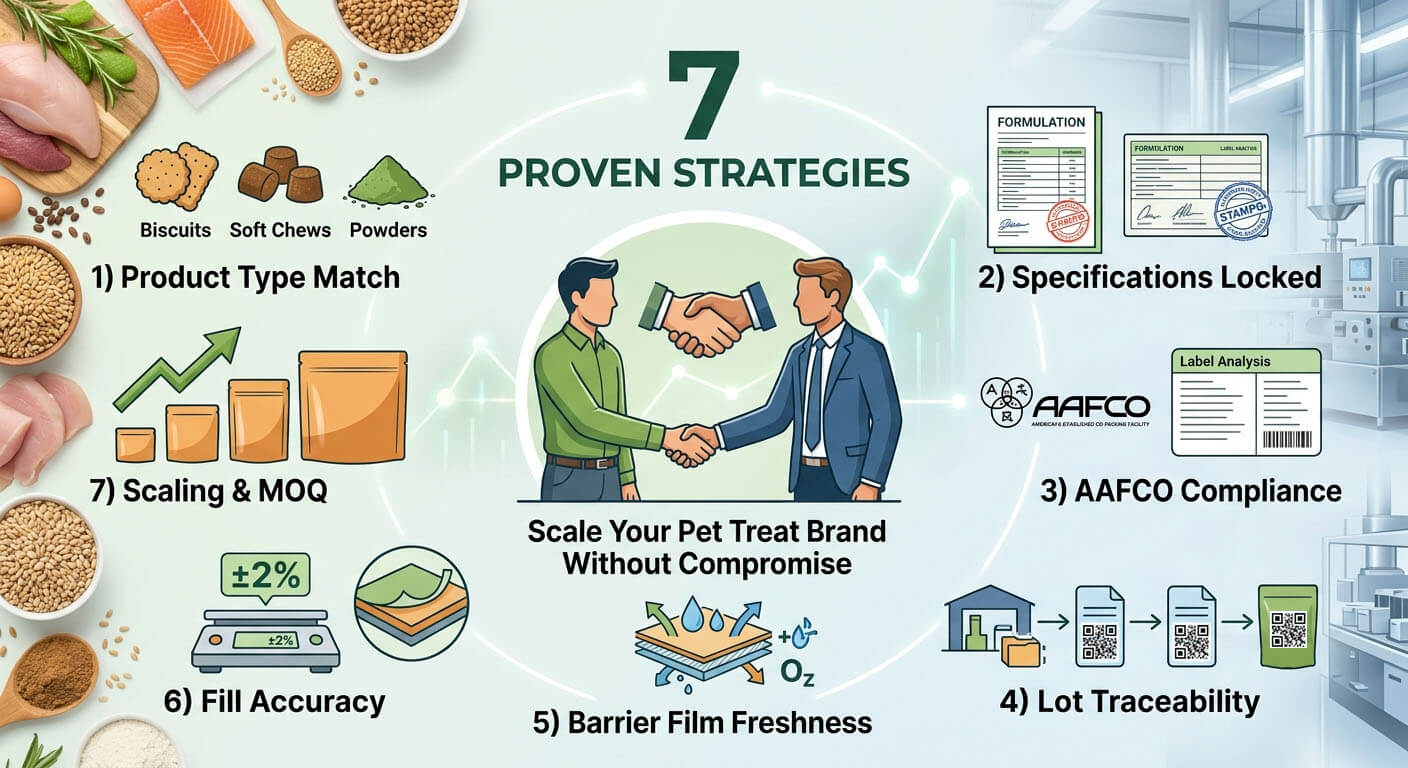
This guide walks through the 7 proven strategies for scaling a pet treat brand with a pet food co-packing partner — without cutting corners on compliance, quality, or the brand integrity you have built.
Table of Contents
- Why Pet Food Co-Packing Demands a Different Level of Compliance Discipline
- AAFCO and FDA: The Two Regulatory Bodies That Govern Pet Food Co-Packing
- The 7 Pet Food Co-Packing Strategies for Scaling Without Compromise
- Dry Treat vs. Freeze-Dried vs. Soft Chew vs. Powder Supplement: Matching Format to Co-Packer
- Packaging Formats for Pet Treats: Pouches, Stand-Up Bags, Sachets, and Beyond
- How to Evaluate a Co-Packing Partner for Pet Food Production
- How Pack’n Fresh Supports Pet Food and Pet Treat Brands
- FAQs — Pet Food Co-Packing
1. Why Pet Food Co-Packing Demands a Different Level of Compliance Discipline
Pet food occupies a unique regulatory position in the United States — it is regulated as food for animals under the Federal Food, Drug, and Cosmetic Act, which means the FDA has direct authority over safety, adulteration, and misbranding. According to FDA pet food labeling and safety requirements, pet food must meet the same general standards applied to human food with respect to cleanliness, contamination prevention, and truthful labeling.
FSMA’s Preventive Controls for Animal Food rule extends formal food safety planning requirements to pet food manufacturers and co-packers, creating infrastructure obligations — hazard analysis, preventive controls, supplier verification, recall procedures — that parallel the FSMA requirements for human food.
Consumer expectations in the pet food space have risen sharply over the past decade. Premium pet brands now face a level of ingredient scrutiny comparable to what human food brands have navigated since the clean label movement took hold. Pet owners read ingredient panels. They research sourcing. They evaluate whether the first five ingredients align with the animal protein claims on the front of the package.
The 2007 melamine contamination crisis, which killed thousands of pets and resulted in one of the largest pet food recalls in history, permanently elevated consumer awareness of ingredient safety. Subsequent investigations into potential links between grain-free diets and canine dilated cardiomyopathy generated years of regulatory scrutiny that reinforced the importance of formulation transparency and documentation. These episodes created a consumer base that does not give pet brands the benefit of the doubt on ingredient or production quality.
For a pet food co-packing operation, this consumer environment translates into a set of non-negotiable production requirements: lot-level ingredient traceability from supplier certificate of analysis through finished product, consistent fill accuracy that matches the net weight stated on the label, allergen controls that account for the specific allergen profile of pet food ingredients, and the sanitation verification discipline that protects against cross-contamination.
A co-packer who lacks any of these capabilities introduces risk that will eventually surface — either as a quality failure, a regulatory action, or a consumer complaint that damages the brand’s standing in a market where reputation is built slowly and lost quickly.
2. AAFCO and FDA: The Two Regulatory Bodies That Govern Pet Food Co-Packing
AAFCO (Association of American Feed Control Officials) is the primary standard-setting body for pet food labeling in the United States. AAFCO does not have direct regulatory authority — it is a membership organization of state and federal regulatory officials — but it publishes model regulations for pet food ingredient definitions, ingredient declaration order, guaranteed analysis panel requirements, nutritional adequacy statements, and feeding directions that individual states adopt into law.
As a result, AAFCO compliance is effectively mandatory for any pet food or treat brand selling through retail channels, because states that have adopted AAFCO’s model regulations can take enforcement action against products that do not comply. The vast majority of U.S. states have adopted AAFCO’s model language, making AAFCO compliance the de facto national standard.
The specific AAFCO requirements that most directly affect pet food co-packing operations include: ingredient definitions (AAFCO defines what qualifies as “chicken,” “chicken meal,” “chicken by-product meal,” and hundreds of other ingredients — only approved defined ingredients may be listed on a pet food label); and ingredient declaration order (ingredients must be listed in descending order by weight before moisture processing, which can differ significantly from post-processing weight if moisture-heavy ingredients like fresh meat are included).
Also required are the guaranteed analysis panel (crude protein, crude fat, crude fiber, and moisture must be stated at minimum, with additional parameters required for certain claim categories); and the nutritional adequacy statement (which must assert either that the product is “complete and balanced” based on AAFCO nutrient profiles or feeding trials, or that the product is “intended for supplemental or intermittent feeding” — the standard designation for most treat formats).
FDA’s role in pet food regulation is distinct from AAFCO’s. The FDA enforces the Federal Food, Drug, and Cosmetic Act with respect to pet food, which means the FDA has authority over adulteration (contamination with harmful substances), misbranding (false or misleading labeling), and manufacturing practices.
Under FSMA’s Preventive Controls for Animal Food (PCAF) rule, facilities that manufacture, process, pack, or hold animal food for domestic or export consumption must implement documented food safety plans with hazard analysis and risk-based preventive controls. This includes your co-packer. A co-packer who is not operating under a documented FSMA food safety plan is creating regulatory exposure for both themselves and for the brands whose products they produce. When evaluating any pet food co-packing partner, FSMA PCAF compliance should be a baseline requirement, not a differentiating feature.
3. The 7 Pet Food Co-Packing Strategies for Scaling Without Compromise
Scaling a pet treat brand through a co-packing partner is a high-stakes transition. The following seven strategies represent the framework for doing it correctly — protecting your compliance posture, your product quality, and your brand’s long-term viability in an increasingly competitive and regulatory-scrutinized category.
Strategy 1 — Match Your Co-Packer to Your Specific Pet Food Product Type
The most fundamental error in pet food co-packing is selecting a co-packer based on general food production capability without verifying that their specific equipment, processes, and experience match your specific product format. Pet treats span a wide range of production requirements, and the equipment that produces excellent dry biscuits is not the same equipment that produces freeze-dried meat strips or soft chew functional treats.
Mismatching product format to co-packer capability is one of the most common and costly mistakes in the pet treat industry — brands discover the mismatch after they have committed to a co-packer, signed a contract, and transferred their formulation documentation, leaving them with poor alternatives and significant time pressure.
Dry treats — biscuits, training treats, jerky-style strips in shelf-stable dry format, dental chews in dry form — are the most broadly compatible format with general dry food co-packers. Low moisture content provides inherent shelf stability, packaging barrier requirements are manageable relative to higher-moisture formats, and the equipment required (filling, sealing, check weighing) is within the capability range of established dry food packaging facilities. This is the format category most directly compatible with Pack’n Fresh’s production capabilities.
Freeze-dried treats require specialized freeze-dryer equipment — a significant capital investment that limits the co-packer universe considerably. Brands targeting freeze-dried formats need to identify co-packers who have made this specific equipment investment and have demonstrated production experience with freeze-dried protein products.
Soft chews, which require extrusion, molding, or depositing equipment and often careful moisture management during production to achieve consistent texture, are limited to co-packers with appropriate manufacturing capability and often require refrigerated storage. Powdered pet supplements — joint support powders, probiotic meal toppers, digestive health powders — require precision powder filling equipment and dry blending capability, which is a core Pack’n Fresh strength. Start every co-packer evaluation by confirming that your specific product format is within their demonstrated equipment and production capability — not just their theoretical range.
Strategy 2 — Lock In Your Formulation and Specification Documents Before Co-Packer Onboarding
A co-packer can only produce a consistent product if they have complete, precise, written specifications to produce against. Formulations that exist primarily in the founder’s memory, in informal recipe cards, or in rough notes from early development batches will produce inconsistent output at commercial co-packing scale — and inconsistency in pet food production is both a quality problem and a regulatory problem.
If your label declares “chicken is the first ingredient” and your formulation specifies chicken at a weight percentage that makes it the first ingredient before moisture processing, but your production specification is ambiguous, a co-packer making an unintentional substitution or modification can inadvertently create a violation of AAFCO ingredient declaration requirements without anyone catching it until a label audit or consumer complaint surfaces it.
Complete specification documentation for pet food co-packing onboarding includes: the master formulation with exact ingredient weights and percentages (not approximations), identified suppliers for each ingredient with certificate of analysis requirements, acceptable substitute ingredients (if any) and the label implications of each substitution, and in-process quality specifications (moisture content parameters, particle size for powder formats, fill weight tolerance ranges).
Also required are finished product quality specifications (appearance standards, texture, color, odor), packaging specifications (material structure, seal strength requirements, barrier specifications), and label artwork in its final approved form before production begins. The discipline of building this documentation before you approach a co-packer pays dividends throughout the production relationship — it reduces production errors, speeds the onboarding process, and creates the authoritative reference that resolves disputes when production output does not match expectations.
Strategy 3 — Understand AAFCO Labeling Requirements Before Designing Your Package
Your pet food co-packing partner does not design your label and is not responsible for its regulatory compliance — but they are responsible for producing the product that your label represents. This means that any disconnect between your formulation and your label creates liability that sits with your brand, and that a co-packer who makes an unauthorized substitution or modification to your formulation creates misbranding liability for you.
Understanding AAFCO labeling requirements before you finalize your packaging design — and before you onboard a co-packer — prevents both categories of error.
The core AAFCO labeling requirements for pet treats and supplements include: the product name (which triggers specific ingredient content requirements if it references a specific protein — a product named “Chicken Treats” must contain chicken as a specified percentage of the formula); the ingredient list in descending order by pre-processing weight (heavier ingredients listed first, with AAFCO-defined names for each ingredient); and the guaranteed analysis panel stating crude protein minimum, crude fat minimum, crude fiber maximum, and moisture maximum (plus additional parameters required for specific claim categories or formats).
Also required are the nutritional adequacy statement (typically “intended for intermittent or supplemental feeding only” for treats), the manufacturer or distributor name and address, and the net weight statement. Work with a pet food regulatory consultant or label designer experienced in AAFCO requirements to confirm all required elements are present and accurate before your first production run. It is significantly less expensive to correct a label before printing than to recall and relabel finished inventory sitting in a distribution center.
Strategy 4 — Require Lot-Level Traceability from Your Co-Packer from Day One
In the pet food space, recalls are a documented reality — and when a recall occurs, the speed and completeness of traceability response determines both the scope of the recall and your brand’s regulatory standing with the FDA. A co-packer with ERP-backed lot traceability can typically produce a complete trace document — from supplier lot numbers for every ingredient through every production run through every finished product lot distributed to every customer — within hours.
A co-packer operating on manual records, paper receiving logs, and spreadsheet production tracking may take days to produce the same documentation, during which time the product continues to move through the distribution chain and the scope of the recall expands.
Per FDA pet food labeling and safety requirements, manufacturers and co-packers are expected to maintain records that support rapid traceability in the event of a recall or safety investigation. The specific record-keeping requirements under FSMA’s PCAF rule include receiving records for every ingredient lot, production records linking ingredient lots to finished product lots, and distribution records linking finished lots to customers.
Pack’n Fresh’s ERP system maintains all three categories of record at the lot level, which means any brand whose products we co-pack can trace any finished product lot back to every ingredient lot that went into it — and forward to every customer who received it. For a pet treat brand, this infrastructure is not a feature. It is a baseline requirement that protects your business in a category where recalls are possible and traceability speed matters.
Strategy 5 — Specify Barrier Film Requirements for Shelf Life and Freshness
Pet treats present a range of packaging barrier challenges that depend on the specific ingredient profile of the product. Treats that contain real animal protein — chicken, beef, salmon — have moisture and fat content that accelerates degradation without adequate barrier protection. Treats with fish oil as a functional ingredient are vulnerable to oxidation. Probiotic-enhanced treats require moisture barrier protection to maintain viable organism counts through shelf life.
A standard polyethylene bag is inadequate for most premium pet treat formats that target shelf life beyond three to four months. The barrier film specification for your product must match your product’s specific water activity, oil content, and target shelf life — and your pet food co-packing partner must have the sealing equipment compatible with the laminate structure your product requires.
For moisture-sensitive pet treats and powdered pet supplements, modified atmosphere packaging for shelf life — specifically nitrogen flushing before final seal — can dramatically extend shelf life by displacing the oxygen that drives oxidation and mold growth. This technique is widely used in premium human food snack applications and applies equally well to premium pet treat formats targeting extended shelf life. A co-packer capable of nitrogen flushing as part of their sealing process provides a meaningful shelf life advantage for premium pet brands.
Your packaging specification for co-packing purposes should include: material structure (specify each laminate layer by material and thickness), the oxygen transmission rate (OTR) target, the moisture vapor transmission rate (MVTR) target, and the minimum seal strength requirement. These specifications give your co-packer the information needed to source compliant materials and to identify non-conforming packaging before it goes into production.
Strategy 6 — Verify Fill Weight Accuracy and Consistency Standards
Fill weight accuracy in pet food co-packing is simultaneously a legal compliance requirement, a cost control factor, and a consumer experience issue. The net weight stated on a pet food label is a legal representation under NIST Handbook 133, which governs package quantity — consistent under-fill creates regulatory liability (state weights and measures inspectors periodically test retail products for net content compliance), while consistent over-fill erodes your ingredient cost margin on every unit produced.
For premium treats with high-cost ingredients — salmon, organic proteins, specific nutraceutical components — an over-fill of even two or three percent can have a material impact on the economics of a production run.
A precision co-packing partner uses calibrated automated filling equipment with in-line check weighers that weigh every package and reject any package outside the defined tolerance band. The industry standard tolerance for dry fills is typically plus or minus two to three percent of target weight, but premium brands with expensive ingredients may specify tighter tolerances.
Request fill accuracy data from any co-packer you evaluate — a co-packer who cannot provide documented fill accuracy statistics from recent production runs is operating without the measurement discipline that commercial pet food production requires. Pack’n Fresh’s precision filling equipment maintains consistent fill accuracy with documented in-process monitoring, and our ERP system records fill performance at the production run level, giving brand clients a complete record for every lot produced.
Strategy 7 — Plan Your MOQ Structure and Production Scalability from the Start
Minimum order quantity mismatches are among the most common pain points in pet food co-packing relationships. A co-packer optimized for high-volume production will have an MOQ that reflects the economics of their equipment and changeover costs — and if your current volume does not justify that MOQ, you will be forced either to over-produce (creating inventory financing and storage costs) or to accept unfavorable per-unit pricing that undermines your margin structure.
The right co-packing partner for your current stage is not necessarily the right partner for your two-year growth projection — and vice versa.
For pet brands in the early scaling phase — roughly $500K to $3M in annual revenue with corresponding production volumes — a co-packer with flexible MOQ structures and experience working with growing brands will be a better fit than a high-minimum facility designed for established CPG volumes. As the brand scales and production volumes increase proportionately, the economics of higher-minimum, higher-throughput co-packers become attractive.
The key is to work with a co-packer who understands your growth trajectory and builds the production relationship with volume growth in mind — setting MOQ expectations that match your current reality while defining the volume thresholds that will trigger pricing adjustments as you scale. Pack’n Fresh works with brands at multiple volume levels and structures production relationships designed to grow with the brand rather than force premature scaling decisions that strain working capital.
4. Dry Treat vs. Freeze-Dried vs. Soft Chew vs. Powder Supplement: Matching Format to Co-Packer
One of the most consequential decisions a pet treat brand makes before approaching a pet food co-packing partner is product format selection. Format determines production equipment requirements, packaging requirements, shelf life parameters, cost of goods structure, and the universe of co-packers capable of producing the product.
Understanding the production requirements of each major pet treat format helps brands evaluate co-packer fit accurately and avoid the costly experience of discovering a format-equipment mismatch after the co-packing relationship is already underway and production commitments have been made.
Dry treats — biscuits, training treats, jerky-style strips in shelf-stable dry format, dental chews in dry form — are the most broadly compatible format with general dry food co-packers. Low moisture content provides inherent shelf stability, packaging barrier requirements are manageable relative to higher-moisture formats, and the filling and sealing equipment required is within the capability range of established dry food packaging facilities. This is the format category most directly compatible with Pack’n Fresh’s production capabilities.
Freeze-dried treats represent a premium positioning with a capital-intensive production process — freeze-drying requires dedicated freeze-dryer equipment that a limited number of co-packers have invested in. Brands targeting this format must identify those specific co-packers and evaluate them on freeze-dry cycle capacity, protein handling experience, and post-freeze-dry packaging capability.
Soft chews — functional chews with a pliable texture, dental chews with soft composition — require extrusion, molding, or depositing equipment and careful moisture management during production to achieve consistent texture. This format is limited to co-packers with the appropriate manufacturing capability, and often requires refrigerated storage or high-barrier packaging to maintain texture through shelf life.
Powdered pet supplements represent one of the highest-growth segments within the pet treat and health category. Joint support powders, digestive health formulas with probiotic strains, coat and skin health supplements, and meal toppers in powder form are all experiencing strong consumer adoption as pet owners extend the supplement mindset they apply to their own health to their companion animals.
This format requires precision powder filling capability, dry blending for multi-ingredient formulations, and the ability to maintain consistent fill weights in powder form — which presents more variability challenges than hard particulate formats due to particle size variation, static, and density inconsistency between ingredient components. Pack’n Fresh’s precision powder filling and dry blending capabilities make powdered pet supplement pet food co-packing a direct application of our core infrastructure.
Understanding which format your product requires — and confirming that your target co-packer has specific, demonstrated capability in that format — is the first and most important step in building a viable production partnership.
5. Packaging Formats for Pet Treats: Pouches, Stand-Up Bags, Sachets, and Beyond
Packaging format is both a production decision and a brand strategy decision. The format a pet treat is packaged in communicates positioning, determines shelf presence, affects consumer repurchase behavior (resealable vs. non-resealable, portion-controlled vs. bulk), and must be matched to the retail or e-commerce channel where the product will be sold.
Choosing a packaging format without considering all three of these dimensions — production capability, brand positioning, and channel fit — creates problems that are expensive to correct after production tooling and packaging inventory commitments have been made.
Stand-up pouches (SUPs) are the dominant packaging format for premium pet treat brands in specialty retail and direct-to-consumer channels. A stand-up pouch packaging format offers excellent shelf presence, a large billboard surface for branding and claims communication, resealable zipper options that support consumer convenience and maintain treat freshness between uses, and barrier laminate structures that protect sensitive ingredients from moisture and oxygen. SUPs are available in clear, opaque, and window-front formats, which allows brands to make deliberate choices about ingredient visibility.
Flat-bottom bags provide an even more premium retail presentation with a wide, stable base that maximizes billboard surface area and stands independently on shelf without support. Pillow bags (flow wrap) represent a lower-cost packaging format appropriate for value-positioned products or brands with e-commerce-first distribution where shipping efficiency and cost of goods take priority over shelf presentation.
Sachets and single-serve pouches are a growing format for portion-controlled training treats, travel packs, and single-serve supplement portions — the convenience positioning resonates with active pet owners and works well in subscription box and gifting contexts. Canisters and tubs serve larger-format treat products and powdered supplements, where the consumer expects a format that allows repeated access over weeks of use. For powdered supplement brands, the canister format communicates supplement category positioning and accommodates scoop inclusion.
The channel fit dimension of packaging format selection deserves particular attention: boutique pet specialty retail generally expects premium SUP or flat-bottom bag formats; national big-box retail typically expects canisters or larger bag formats; e-commerce channels reward packaging that ships efficiently and protects product integrity in transit. Work through the channel implications of your packaging format selection before finalizing your pet food co-packing specification — and confirm that your target co-packer has the sealing and filling equipment compatible with your specific format before committing to the partnership.
6. How to Evaluate a Co-Packing Partner for Pet Food Production
Evaluating a co-packing partner for pet food production requires a structured assessment that goes beyond standard food co-packer criteria. The regulatory complexity of the pet food category, the consumer sensitivity around ingredient safety and traceability, and the production precision requirements of premium pet treat formats all create evaluation criteria that must be verified through documentation and direct inquiry — not assumed based on general food production credentials or a co-packer’s self-description of their capabilities.
Food safety certification is the baseline entry requirement. SQF (Safe Quality Food) or an equivalent GFSI-recognized scheme — BRC, FSSC 22000 — provides independent third-party verification that a facility meets defined food safety management standards. The same certification standard that applies to premium human food co-packers applies equally to pet food co-packing, and SQF-certified facilities have demonstrated the documentation discipline, sanitation programs, and management systems that the pet food category requires.
For a deeper look at the regulatory and certification standards that underpin food production facility compliance, see Pack’n Fresh’s resource on food packaging safety and regulatory standards. FSMA PCAF compliance must be confirmed directly — ask the prospective co-packer whether they operate under a documented PCAF food safety plan and request to review the plan’s scope statement or their last third-party audit report.
Equipment fit for your specific product format must be verified directly rather than inferred from general capability claims. Ask the co-packer to identify the specific equipment they would use to produce your product, their documented fill accuracy tolerance for your format, and whether they have produced similar products for other pet brand clients. Request a facility tour before committing to a production run — physical observation reveals operational discipline, sanitation culture, and equipment condition more reliably than any written questionnaire.
Allergen control is a critical evaluation point specifically for pet food: many premium pet treats contain ingredients that are also common human allergens (peanut butter, wheat, fish, tree nuts) — the co-packer’s allergen management program must explicitly cover the allergens present in pet food ingredients, including documented allergen cleaning validation between production runs.
Finally, reference checks from current pet brand clients at a similar volume level are the most reliable signal of day-to-day operational performance — ask specifically about fill accuracy history, label accuracy, quality issue response time, and communication quality during production runs.
7. How Pack’n Fresh Supports Pet Food and Pet Treat Brands
Pack’n Fresh’s production capabilities are directly applicable to the dry pet treat and powdered pet supplement categories — two of the highest-growth segments within the broader pet food market. Our dry blending, seasoning, and precision filling infrastructure supports the specific production requirements of biscuit-style training treats, dry jerky formats, meal topper powders, joint support supplement blends, probiotic pet supplements, and other dry and powder pet treat formats.
We bring to pet food co-packing the same production discipline that premium human food and supplement brands rely on: SQF certification, FSMA compliance infrastructure, ERP-backed lot-level traceability, and precision filling equipment with documented accuracy controls.
Our Digital Ingredient Locking system is a particularly relevant capability for pet food co-packing. In the pet food category, unauthorized substitution of an ingredient — even with a functionally similar alternative — creates a label misrepresentation that constitutes misbranding under AAFCO model regulations and FDA oversight. Digital Ingredient Locking prevents formulation substitutions by requiring explicit approval for any deviation from the approved specification, creating a documented record of every production run that confirms adherence to the approved formulation.
For pet brands whose label claims depend on specific ingredient inclusion — real chicken, wild-caught salmon, organic sweet potato — this protection against inadvertent substitution is material to regulatory compliance and consumer trust. Our allergen control systems and ATP swab-based sanitation verification provide the cross-contamination protection that pet treat production involving protein-rich ingredients demands.
We work with brands across multiple growth stages — from emerging brands establishing their initial co-packing relationship to established brands scaling production to meet retail distribution requirements. Our approach is to build production relationships designed to grow with the brand: starting at a volume level that matches the brand’s current scale, documenting specifications with the rigor that supports consistent quality at higher volumes, and building the institutional knowledge of your product and requirements that makes scaling production efficient rather than disruptive.
If you are launching a pet treat or pet supplement line, transitioning away from an existing co-packer, or evaluating production options for a new pet product format, Pack’n Fresh welcomes the conversation to assess whether our capabilities and your production requirements are a fit.
Conclusion: Building a Pet Treat Brand That Scales Without Compromise
The pet food market rewards brands that take quality and compliance seriously — and delivers swift consequences to those that do not. Ingredient safety concerns, labeling violations, and fill accuracy failures each carry consequences that extend beyond regulatory action: consumer trust, once lost, is difficult to rebuild in a category where pet owners make purchasing decisions based on a belief that the brand is protecting their animal’s health.
The seven strategies outlined in this guide provide a framework for building a pet food co-packing relationship that supports your brand’s quality standards rather than undermining them.
The common thread across all seven strategies is preparation and verification. Preparation means arriving at a co-packing relationship with complete formulation documentation, confirmed packaging specifications, AAFCO-compliant label artwork, and a clear understanding of the regulatory requirements that govern your product format. Verification means evaluating co-packers against the specific capabilities your product format requires — not against general food production credentials — and confirming that their food safety infrastructure, traceability systems, fill accuracy performance, and allergen management programs meet the standards the pet food category demands.
Brands that do this work upfront scale successfully. Brands that rush the co-packer selection process discover the gaps at the worst possible time — during a quality failure or a regulatory inquiry when options are limited and consequences are significant.
Pack’n Fresh brings SQF certification, ERP-backed traceability, Digital Ingredient Locking, and precision filling capability to pet treat and pet supplement co-packing from our facility in Grand Prairie, TX. We support dry pet treat formats, powdered pet supplement formats, and the full range of packaging formats that premium pet brands require — from stand-up pouches to sachets to canisters.
If you are evaluating co-packing options for a pet treat or pet supplement line, we invite you to contact Pack’n Fresh to discuss whether our capabilities match your production requirements. The right conversation, at the right stage of your brand’s development, is the starting point for a co-packing relationship that scales without compromise.
FAQs — Pet Food Co-Packing
Does a pet food co-packer need to be registered differently than a human food co-packer?
Yes, with an important qualification. Facilities that manufacture, process, pack, or hold animal food for sale in the United States must register with the FDA under the same facility registration framework as human food facilities. However, the specific regulatory rule governing their food safety plan is FSMA’s Preventive Controls for Animal Food (PCAF) rule rather than the Preventive Controls for Human Food (PCHF) rule.
While the structural requirements are similar — hazard analysis, preventive controls, monitoring, corrective actions, verification, and recall procedures — the PCAF rule is tailored to the specific hazards and production practices of animal food manufacturing. When evaluating a co-packing partner for pet food production, confirm that they have a documented FSMA PCAF-compliant food safety plan, not merely a human food FSMA plan applied to animal food production. Some co-packers handle both human food and animal food under the same facility registration, with separate food safety plans covering each product category.
What is AAFCO and why does it matter for pet food co-packing?
AAFCO — the Association of American Feed Control Officials — is the organization of state and federal regulatory officials that publishes model regulations for pet food labeling, ingredient definitions, and nutritional standards in the United States. AAFCO does not have direct enforcement authority, but the model regulations it publishes are adopted by individual states into their feed control statutes, making AAFCO compliance the effective national standard for pet food sold through U.S. retail channels.
For pet food co-packing purposes, AAFCO’s requirements govern the ingredient list (which ingredients may be used and how they must be named), the ingredient declaration order (descending by pre-processing weight), the guaranteed analysis panel (required nutrient parameters and their stated form — minimum or maximum), and the nutritional adequacy statement (which must accurately represent whether the product is complete and balanced or intended for supplemental or intermittent feeding).
A co-packing partner needs to understand AAFCO basics — specifically, that any modification to a formula that changes ingredient order or guaranteed analysis values requires corresponding label revisions — to avoid inadvertently putting your brand in violation during production.
Can the same co-packer produce both human food and pet food products?
Yes — many food co-packers produce both human food and animal food products in the same facility, with appropriate controls to manage any cross-category risks. The key requirements are that the facility maintains separate documented food safety plans for human food and animal food production categories (FSMA PCHF and PCAF respectively), that allergen management protocols cover the ingredients present in both product categories, and that sanitation procedures between production runs address any cross-contact risks specific to the combination of products being produced in the facility.
For pet treat brands specifically, using a co-packer with deep human food production experience is often an advantage — the food safety culture, documentation discipline, and quality management systems that premium human food and supplement brands require are directly applicable to premium pet food production. Pack’n Fresh’s SQF certification and food safety infrastructure, developed for human food and supplement co-packing, provides the same compliance foundation that regulated pet food production demands.
What is the typical minimum order quantity for pet treat co-packing?
Minimum order quantities for pet treat co-packing vary significantly depending on the co-packer’s scale, equipment, and target client profile. Smaller co-packers or those specifically positioned to serve emerging brands may work with MOQs in the range of 500 to 2,000 units per SKU for dry treat formats. Mid-size co-packers typically work in the range of 2,000 to 10,000 units per production run. Large co-packers with high-throughput equipment may require MOQs of 20,000 units or more.
The MOQ discussion with any prospective co-packing partner should include not just the minimum unit quantity but also the minimum production run time and the associated setup and changeover costs — some co-packers express MOQ in terms of minimum production hours rather than finished units.
For emerging pet brands, MOQ fit is a critical selection criterion — a co-packer with a very high MOQ forces over-production that creates working capital strain and inventory risk before the brand has established the velocity to support it. Match your co-packer selection to your current volume reality, with a clear understanding of the volume growth path that the relationship can accommodate over time.
How do I find out if a co-packer has experience with pet food production?
Direct inquiry is the most reliable method. Ask prospective co-packers explicitly whether they have produced pet food or pet treat products, which formats they have produced, and whether they can provide references from pet brand clients at a production volume similar to your own. Request documentation of their FSMA PCAF food safety plan or ask them to confirm that their existing food safety infrastructure covers animal food production under PCAF.
Ask specifically about their familiarity with AAFCO labeling requirements and their process for handling formulation changes that may affect ingredient declaration order or guaranteed analysis values on the label. If possible, visit the facility in person before committing — a facility tour reveals the operational realities of their production environment, sanitation culture, and equipment condition more reliably than any written questionnaire.
Additionally, review the co-packer’s SQF or equivalent food safety audit reports, which are typically available to prospective clients under a non-disclosure agreement. An audited co-packer with a strong food safety score and no major nonconformances has demonstrated the operational discipline that premium pet food production requires, regardless of whether their audit was specific to animal food or human food production.