
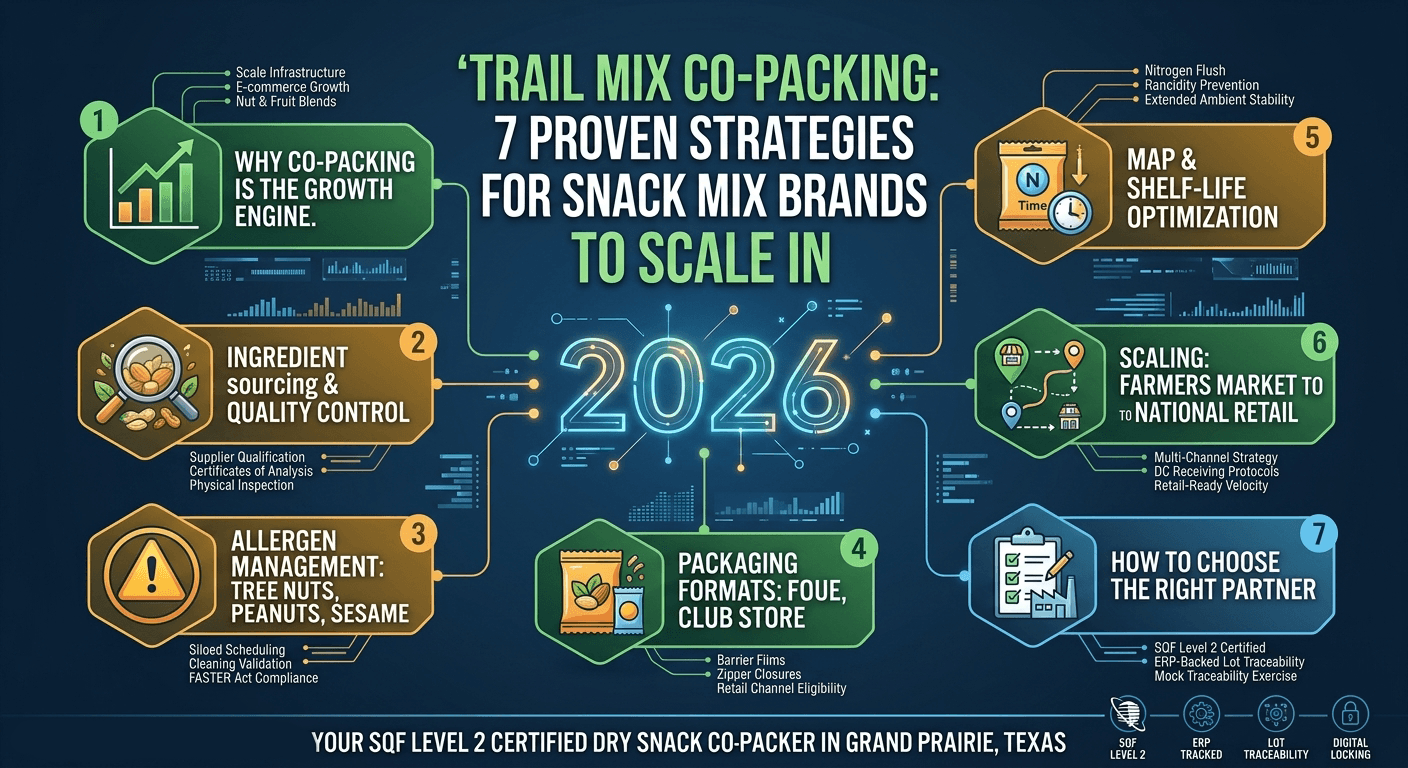
Trail Mix Co-Packing: 7 Proven Strategies for Snack Mix Brands to Scale in 2026
The global trail mix market is on a sustained growth trajectory that creates real commercial opportunity for snack brands at every development stage. Industry research values the market at USD 10.91 billion in 2026 and projects it will reach USD 14.77 billion by 2031 at a 6.24% compound annual growth rate. Verified Market Reports attributes this growth to a structural consumer shift toward nutrient-dense, portable, whole-food snack formats that serve both active-lifestyle and everyday-convenience occasions.
Capturing that opportunity demands far more than a differentiated formula and compelling brand identity. A trail mix product is an orchestrated assembly of dry components — tree nuts, peanuts, seeds, dried fruits, granola clusters, and increasingly, functional inclusions such as collagen peptides and fortified fiber powders — each with its own moisture activity profile, allergen classification, and particle density. Blending these components in precise ratios, portioning accurately, and packaging them in barrier formats that maintain shelf stability at commercial volumes while meeting certified food safety standards is a manufacturing challenge most brands cannot handle without an experienced production partner.
This is precisely where trail mix co-packing becomes the defining strategic lever for brands ready to scale. A professional co-packer brings not only the blending, portioning, and packaging equipment required at commercial volumes, but also the certified food safety infrastructure — SQF Level 2 certification, HACCP-based allergen controls, ERP-backed lot traceability, and documented cleaning validation records — that major grocery retailers and food service distributors require before they will approve a supplier. Understanding what separates a genuinely capable partner from one that is willing but operationally underprepared is the foundation of this guide.
The seven strategies that follow address every critical dimension of trail mix manufacturing: ingredient quality controls, allergen management, modified atmosphere packaging, retail compliance documentation, and co-packing partner evaluation criteria. Each strategy reflects the operational realities of commercial dry snack manufacturing and provides actionable frameworks for brand founders and procurement managers evaluating co-manufacturing partnerships. Whether you are sourcing your first commercial production run or assessing whether your current arrangement can support a national retail launch, these strategies apply directly.
Table of Contents
- Why Trail Mix Co-Packing Is the Growth Engine for Snack Brands in 2026
- Ingredient Sourcing and Quality Control: What Your Trail Mix Co-Packer Must Guarantee
- Allergen Management in Trail Mix Co-Packing: Tree Nuts, Peanuts, and Sesame Controls
- Packaging Formats for Trail Mix Brands: Pouches, Single-Serve Packs, and Club Store Formats
- Modified Atmosphere Packaging and Shelf-Life Optimization for Dry Snack Mixes
- Scaling Your Trail Mix Brand: From Farmers Market to National Retail and Online
- How to Choose the Right Trail Mix Co-Packing Partner: Certifications, ERP, and Traceability
1. Why Trail Mix Co-Packing Is the Growth Engine for Snack Brands in 2026
The market data behind the trail mix category in 2026 reflects a durable structural shift in consumer snacking, not a short-cycle trend. The global trail mix market, valued at USD 10.91 billion this year and projected at USD 14.77 billion by 2031, is advancing at a 6.24% CAGR that outpaces the broader snack food category average. Growth spans active-lifestyle shoppers, health-and-wellness buyers, and workday snackers replacing processed options with nut-and-fruit blends delivering sustained energy without refined sugar spikes.
Online retail is emerging as the single fastest-growing distribution channel in the category, with e-commerce projected to expand at 7.15% CAGR through 2031. Trail mix co-packing with a certified production partner is the operational foundation that makes consistent online fulfillment possible at scale. Brands that produce reliably, maintain shelf stability through parcel supply chains, and carry third-party food safety certifications are positioned to capture a disproportionate share of this digital commerce growth.
Ingredient innovation is reshaping trail mix formulations and opening premium segment opportunities at two to three times the price point of conventional nut-and-fruit blends. Functional inclusions — collagen peptides for protein density, fortified dietary fibers for gut-health marketing, adaptogenic mushroom powders for wellness branding — create new technical requirements at the co-packing level: homogeneous distribution of fine-particle powders across coarser matrices, moisture activity management across components with different hygroscopic properties, and lot-level documentation supporting functional ingredient label claims.
Retail channel dynamics are raising the production quality and compliance bar at every distribution tier simultaneously. Club stores continue expanding trail mix floor and shelf space, natural grocers are tightening supplier qualification requirements, and mass retailers are building premium snack sets with trail mix as a high-margin centerpiece. Across all of these channels, the common denominator for supplier approval is a certified, audit-ready manufacturing partner — precisely what a qualified trail mix co-packing facility provides to its brand clients.
Trail mix brands consistently find that production capacity, not marketing effectiveness, becomes the binding growth constraint as consumer demand accelerates. A brand that secures a regional Sprouts or Whole Foods placement but cannot reliably produce 25,000 units monthly at consistent quality will lose that placement to a competing brand that can. Engaging a professional trail mix co-packing partner is fundamentally a decision to remove manufacturing capacity as the limiting factor and replace it with scalable infrastructure designed to grow with your retail footprint.
2. Ingredient Sourcing and Quality Control: What Your Trail Mix Co-Packer Must Guarantee
The quality ceiling for any trail mix product is set at the ingredient intake stage, and a professional trail mix co-packing operation must maintain documented ingredient qualification processes for every raw material your formula requires. This means reviewing supplier food safety certifications — SQF, FSSC 22000, BRC, or equivalent GFSI credentials — along with Certificate of Analysis documentation for each incoming lot, allergen status verification, and physical inspection upon receipt. Ingredient qualification is a continuous program ensuring every lot of almonds, cashews, dried cranberries, granola clusters, or functional dry inclusions meets your formula’s quality specification before blending begins.
Moisture activity (aw) management is one of the most technically critical and frequently underestimated quality parameters in dry snack mix production. Each component carries a different equilibrium moisture activity: almonds typically stabilize around 0.55–0.65 aw, while dried cranberries can range from 0.60 to 0.75 aw depending on processing method. When components with different aw values are blended, moisture migration occurs as the system moves toward equilibrium — progressively softening nuts, hardening dried fruits, promoting clumping, and compromising both sensory quality and microbial stability over the product’s shelf life.
ATP swab sanitation verification provides rapid, quantified evidence of equipment hygiene that visual inspection alone cannot deliver. Pack’n Fresh uses ATP swab testing between production runs, testing blending chambers, fill heads, weigh systems, and sealing surfaces to confirm equipment is hygienically clean before your trail mix production begins. These swab results are logged as part of the sanitation record, creating documentation that supports food safety audits and customer quality assurance reviews — a meaningful differentiator between trail mix co-packing facilities that operate with verified sanitation systems and those that rely solely on operator judgment.
ERP-backed traceability converts ingredient management from a paper-intensive exercise into a real-time digital system with full audit capability. Pack’n Fresh’s ERP-integrated production platform assigns lot identifiers to every incoming ingredient, links those lots to specific production orders, tracks component consumption through blending and portioning, and traces finished goods to shipment records. In a supplier recall or internal quality deviation, this system identifies exactly which production runs and finished lot codes incorporated the affected ingredient within minutes — enabling targeted product holds rather than broad market withdrawals.
Digital Ingredient Locking addresses one of the most persistent root causes of quality and safety incidents in multi-ingredient dry snack manufacturing: human error in formula assembly. Pack’n Fresh’s Digital Ingredient Locking system requires each ingredient to be digitally verified against the approved formula specification before it enters the blending process, cross-referencing scanned ingredient identity against the production order and flagging any discrepancy. For trail mix formulas with ten to fifteen components — many sharing similar visual characteristics — this systematic verification layer provides protection that relying solely on employee attentiveness cannot replicate.
3. Allergen Management in Trail Mix Co-Packing: Tree Nuts, Peanuts, and Sesame Controls
Trail mix is inherently one of the highest-allergen food categories in the snack industry, and the regulatory framework governing its production is comprehensive. A single trail mix formula can simultaneously contain tree nuts — almonds, cashews, walnuts, pecans — peanuts, sesame seeds, and wheat-containing granola components, covering four of the nine major allergens recognized under FALCPA and the FASTER Act of 2021, which added sesame as a major allergen effective January 1, 2023. For any brand in this category, allergen management is the central operational discipline that must be embedded in every stage of the trail mix co-packing process.
Siloed allergen scheduling is Pack’n Fresh’s structural approach to allergen conflict prevention at the production planning level, operating upstream of equipment cleaning entirely. Rather than relying solely on cleaning procedures to manage allergen transitions, Pack’n Fresh organizes its production schedule to segregate allergen classes by dedicated time blocks — scheduling peanut-containing formulas in production windows physically and temporally separated from tree-nut-containing and sesame-containing formulas. This architecture reduces allergen changeover frequency, minimizes cross-contact risk at the most fundamental operational level, and provides a documented scheduling framework that supports FSMA Preventive Controls compliance and retailer allergen questionnaires.
Cleaning validation for allergen changeovers is a documented, systematic process that any GFSI-certified trail mix co-packing facility must maintain with verifiable records. Following a production run containing a defined allergen, the line undergoes a structured cleaning sequence — dry cleaning to remove gross residue, wet cleaning with food-grade detergents, rinse, and drying — followed by ATP swab verification of all product-contact surfaces, and for high-risk transitions, allergen-specific swab testing using ELISA-based kits to confirm removal below the action threshold. Pack’n Fresh documents all changeover cleaning records as part of its sanitation program, creating an auditable data trail for customer allergen management questionnaires and retail supplier audits.
Ingredient storage segregation is the physical infrastructure dimension of allergen management — and it is where many smaller co-packing operations fall short. In a facility handling peanuts, tree nuts, and sesame as concurrent raw materials, physical storage must enforce complete separation with designated allergen-specific zones, clear identification, physical barriers between allergen classes, and documented receiving and staging procedures that maintain allergen integrity from the dock through the production floor. Pack’n Fresh maintains allergen-designated storage areas with access controls preventing co-mingling of allergen-class ingredients at the warehouse level, where cross-contact is operationally simplest to prevent and most damaging when it occurs undetected.
For a comprehensive examination of allergen risk management within a broader food safety management system, Pack’n Fresh’s in-depth resource on allergen management in food packaging and traceability risk mitigation covers supplier allergen documentation, facility allergen zoning, FALCPA label compliance, and FSMA Preventive Controls requirements in practical detail. Trail mix brands entering the category for the first time will find this guide essential for evaluating whether a prospective co-packing partner’s allergen program is adequate for their specific formula risk profile.
4. Packaging Formats for Trail Mix Brands: Pouches, Single-Serve Packs, and Club Store Formats
Packaging format selection is one of the most commercially consequential decisions a trail mix brand makes, simultaneously determining retail channel eligibility, consumer occasion fit, shelf presentation, unit economics, and the specific production capabilities your trail mix co-packing partner must provide. The category spans a wide range of formats — from 1-ounce single-serve sachets for vending and convenience to 48-ounce resealable stand-up pouches engineered for club store velocity — and the production requirements for each format differ substantially in film material selection, fill system configuration, and sealing technology. Matching your packaging format to your target retail channel is a strategic decision that must precede co-packing partner selection.
The pouch and sachet segment is the fastest-growing format in the trail mix category, advancing at 6.5% CAGR driven by e-commerce growth, on-the-go consumption occasions, and retailer demand for shelf-ready pouch presentations. Stand-up pouches with reclosable zipper closures have become the dominant branded format in natural and specialty grocery, providing superior graphic space for brand differentiation, consumer-valued resealability, and the barrier film properties needed to protect nut oils and dried fruit quality through extended ambient shelf life. Pack’n Fresh’s pouching capabilities span the stand-up pouch dimensions and closure configurations the trail mix co-packing category requires, from small-format single-serve to large-format club and e-commerce SKUs.
Club store and mass retail formats introduce the most demanding specification set in trail mix packaging, with tight fill-weight tolerances — often ±3 grams on large fills — retail-ready label requirements, defined case-pack configurations, and consistent visual presentation that survives weeks of open-display shelf time. Pack’n Fresh’s ERP-backed production management system coordinates formula specifications, fill-weight parameters, label version requirements, and case-pack configurations for each customer SKU and retail destination, ensuring the correct product ships with the documentation the retailer’s compliance team requires at receiving.
For a detailed examination of film materials, barrier specifications, zipper formats, and print considerations for snack pouch applications, Pack’n Fresh’s guide to snack and spice pouch packaging is a practical resource for trail mix brands evaluating their packaging strategy. Selecting the right film barrier for your trail mix formula — balancing moisture vapor transmission rate against oxygen transmission rate based on your specific ingredient mix, moisture activity profile, and target shelf life — is a technical decision your co-packing partner should actively support with documented material recommendations and comparable formula shelf-life validation data.
Ready to Scale Your Trail Mix Brand? Talk to Pack’n Fresh.
Pack’n Fresh is a SQF Level 2 certified dry product co-packer in Grand Prairie, Texas, specializing in trail mix co-packing for snack brands ready to move from small-batch to retail-ready scale. Our full-service capabilities include dry blending, stand-up pouching, MAP nitrogen flush, kitting, labeling, warehousing, Digital Ingredient Locking, and siloed allergen scheduling for nut-intensive formulas.
5. Modified Atmosphere Packaging and Shelf-Life Optimization for Dry Snack Mixes
Shelf life is not simply a technical specification printed on the package — it is a commercial threshold that determines whether your trail mix reaches consumers in optimal condition through a retail supply chain. Major retail distribution center receiving protocols require trail mix SKUs to arrive with 60% to 80% of remaining shelf life to accommodate DC storage, store delivery cycles, and consumer purchase time. For trail mix products targeting 12 to 18 months of ambient shelf stability, ingredient aw management, packaging material barrier selection, and gas atmosphere technology must all be optimized together — and trail mix co-packing with a partner who integrates these variables into a coherent shelf-life management system is the practical route to meeting retail requirements consistently.
Modified Atmosphere Packaging (MAP) is the industry-standard technology for extending shelf life in nut-containing trail mix formulations. Nuts and seeds contain significant concentrations of polyunsaturated and monounsaturated fatty acids — oleic acid in almonds, linoleic acid in walnuts and sunflower seeds — that oxidize readily when exposed to atmospheric oxygen, producing the aldehyde and ketone compounds responsible for rancid off-flavors and off-aromas. MAP directly addresses this mechanism by displacing or replacing oxygen in the package headspace with inert gas before sealing, dramatically slowing the lipid oxidation that degrades both sensory quality and the nutritional value of fat-soluble vitamins in fortified formulas.
Nitrogen flush is the most widely applied MAP technique in trail mix co-packing and dry snack production. In a nitrogen flush system, the package is filled with product, flooded with food-grade nitrogen gas displacing the oxygen-laden headspace air, and sealed in rapid sequence, maintaining internal headspace oxygen concentration typically below 1 to 2% compared to approximately 21% in ambient air. At this reduced oxygen level, the rate of lipid oxidation in nut-containing formulas slows by an order of magnitude, extending sensory shelf life by weeks to months depending on the formula’s total oil content and the initial quality of incoming nut ingredients.
Carbon dioxide is sometimes incorporated into the MAP gas blend for trail mix formulas that include granola clusters or oat-based components where yeast-and-mold suppression is a secondary shelf-life concern alongside oxidation control. CO₂ exhibits antimicrobial properties at headspace concentrations above approximately 20%, and a nitrogen/CO₂ blend — typically 70 to 80% N₂ and 20 to 30% CO₂ — simultaneously addresses lipid oxidation in nut-containing components and microbial stability in cereal-based ones. Pack’n Fresh documents MAP parameters for each customer formula as a permanent element of the production specification record, ensuring gas blend ratios are consistently applied across every production run.
For a comprehensive technical guide to MAP applications in dry snack manufacturing — covering gas selection rationale, aw considerations, film barrier specifications, and shelf-life validation approaches — Pack’n Fresh’s resource on modified atmosphere packaging and shelf life optimization covers the full technical picture in one place. Shelf-life validation — storing finished product under defined conditions and conducting sensory, microbiological, and physicochemical testing at defined intervals — is both a regulatory expectation under FSMA and a commercial expectation from retail buyers who require documented evidence that your product maintains declared quality through their distribution supply chain.
6. Scaling Your Trail Mix Brand: From Farmers Market to National Retail and Online
The transition from small-batch trail mix to commercially manufactured product positioned for national retail is not a single step — it is a sequence of production capability thresholds, each requiring different co-packing arrangements, documentation standards, and volume commitments. What works for a 500-unit farmers market run does not work for a 40,000-unit natural grocery regional launch, and regional natural channel production does not meet the specification depth required for a national club store program. Understanding the scale milestones and the trail mix co-packing capabilities required at each stage prepares brand teams to structure co-manufacturing partnerships that support, rather than constrain, their growth trajectory.
Minimum order quantity negotiation is the first practical production conversation a growing trail mix brand has with a commercial co-packer, and understanding the drivers helps brands negotiate effectively. Co-packer MOQs are determined by equipment changeover costs, packaging material minimums from film and label suppliers, and production scheduling efficiency — factors that vary by facility and formula complexity. Regional brands in the 5,000 to 15,000 unit per run range need co-packers willing to accommodate shorter runs with efficient changeovers, and Pack’n Fresh discusses MOQ structures directly with brand partners during onboarding, establishing run sizes that reflect actual production economics and scale as retail velocity supports larger volumes.
Retail compliance documentation is the scaling requirement that consistently surprises trail mix brand founders who underestimate the bureaucratic depth of major retail supplier approval. Before Whole Foods Market, Sprouts Farmers Market, Target, or Costco will process a purchase order, their supplier compliance teams typically require: a current SQF or GFSI certification certificate, documented lot traceability records and a written mock-recall procedure, allergen management documentation, nutrition facts panel validation against laboratory analysis, and in some programs a third-party facility audit report. A trail mix co-packing partner holding SQF Level 2 certification substantially reduces the time required to assemble this package because the most demanding elements are already in place and audited annually.
E-commerce scaling introduces fulfillment requirements fundamentally different from retail store replenishment, and trail mix brands building both channels simultaneously must confirm their co-packing partner supports both without operational compromise. Online channels — Amazon, direct-to-consumer Shopify storefronts, Thrive Market — require unit labeling formatted for warehouse pick-and-pack, platform-specific labeling for marketplace fulfillment programs, and packaging robust enough to protect product integrity through parcel shipping variability. Pack’n Fresh’s kitting and warehousing capabilities allow trail mix brands to consolidate production and e-commerce-ready fulfillment at a single co-packing location, reducing the logistics complexity of managing a separate third-party logistics relationship.
7. How to Choose the Right Trail Mix Co-Packing Partner: Certifications, ERP, and Traceability
The decision to entrust your trail mix brand’s manufacturing to a co-packing partner is a commitment that affects every downstream element of your business — product quality, food safety compliance, retail eligibility, cost structure, and growth velocity. It deserves the same rigor and structured evaluation you apply to selecting a major retail customer or a strategic investor, because a co-packing partner lacking the right certifications, allergen management infrastructure, or production documentation systems creates not just operational friction but regulatory and reputational risk. Evaluating candidates against a consistent, criteria-based framework identifies the facilities genuinely capable of supporting your brand.
SQF Level 2 certification is the non-negotiable baseline credential for any trail mix co-packing facility worthy of serious consideration. SQF is recognized by the Global Food Safety Initiative (GFSI) and audited annually by independent, SQFI-accredited certification bodies. The Safe Quality Food Institute maintains a searchable database of certified facilities, allowing you to verify a co-packer’s SQF status and certification scope before requesting a facility visit. SQF Level 2 certification confirms the facility has implemented a documented food safety management system including HACCP-based hazard analysis, prerequisite programs covering allergen management, sanitation, pest control, and supplier qualification — all verified annually by a third party.
FSMA Preventive Controls compliance is the regulatory foundation that every commercial trail mix co-packing operation in the United States must satisfy. The FDA’s Food Safety Modernization Act requires food manufacturing facilities to maintain documented Preventive Controls Plans addressing allergen controls, sanitation controls, and supply chain program controls, along with monitoring procedures, corrective action protocols, and verification activities. When evaluating a co-packing partner, request a summary of their Preventive Controls Plan and ask specifically about their allergen Preventive Controls — the documented controls for tree nuts, peanuts, and sesame are the most critical elements for a trail mix co-packer to have correctly designed and consistently executed.
ERP-backed traceability capability separates professional trail mix co-packing operations from facilities managing production on spreadsheets and paper lot cards, and the simplest evaluation method is a mock traceability exercise. Provide a hypothetical ingredient lot number and ask the facility to demonstrate how quickly and completely they can trace that ingredient through all associated production runs and finished lot codes. A facility operating on a robust ERP system should complete this exercise in under four hours with fully documented records; a facility requiring multiple days represents a traceability risk that is incompatible with retail supplier agreements where four-hour recall response is increasingly a contractual requirement.
Pack’n Fresh: SQF Level 2 Certified Trail Mix Co-Packing in Grand Prairie, Texas
Pack’n Fresh is a full-service, SQF Level 2 certified co-packer in Grand Prairie, Texas, specializing exclusively in dry product manufacturing for snack, spice, and specialty food brands. As a dedicated dry-only facility, Pack’n Fresh produces trail mix formulas — tree nuts, peanuts, seeds, dried fruits, granola clusters, and functional dry inclusions — without any liquid filling, beverage production, or liquid sauce operations on site. This dry-product-only focus means every system in the facility is calibrated for the precision demands of complex dry snack formulas, undiluted by competing operational requirements from wet-process or liquid product lines.
Pack’n Fresh’s core capabilities for trail mix co-packing include precision dry blending with documented weigh-to-blend accuracy; stand-up pouch filling and sealing across single-serve, multi-serve, and club store formats; modified atmosphere packaging with nitrogen flush for nut-containing formulas requiring extended shelf life; kitting and variety pack assembly for e-commerce and retail display applications; custom labeling with ERP-managed label version control; and finished goods warehousing with lot-level inventory management. Every production run is executed within a SQF Level 2 certified food safety management system audited annually by an independent third-party certifier.
The Digital Ingredient Locking system at Pack’n Fresh provides systematic, documented verification that every ingredient entering a production blend matches the approved formula specification before blending begins — particularly valuable for trail mix formulas with complex component lists and critical allergen implications. Combined with siloed allergen scheduling that segregates peanut-class, tree-nut-class, and sesame-class production windows at the planning stage, and ATP swab verification confirming equipment hygiene between every run, Pack’n Fresh’s allergen management infrastructure is designed to meet the documentation expectations of the most rigorous retail compliance programs in natural, specialty, and mass grocery markets.
Conclusion
The trail mix category in 2026 represents a genuine and growing commercial opportunity — a USD 10.91 billion global market advancing at 6.24% CAGR, with e-commerce outpacing that rate and premium functional formulations commanding price points that reward quality investment. Capturing that opportunity at scale requires a production infrastructure capable of delivering consistent quality, certified food safety compliance, allergen management discipline, and the packaging technology that maintains product integrity from the production line through the consumer’s hands. Trail mix co-packing with the right certified partner is the strategic foundation that transforms a differentiated formula into a retail-ready, audit-compliant, scalable brand.
The seven strategies in this guide — ingredient quality control through ATP swab verification and Digital Ingredient Locking, allergen management through siloed scheduling and cleaning validation, MAP-based shelf-life optimization, retail compliance documentation, and structured co-packing partner evaluation using SQF certification and ERP traceability as core criteria — address the operational checkpoints that separate trail mix brands built for sustainable national scale from those that plateau at regional or artisan production. Each strategy provides both a technical framework and the evaluation questions that reveal whether a prospective co-packing partner has genuinely implemented the system or merely represents that they have.
Frequently Asked Questions About Trail Mix Co-Packing
What certifications should I require from a trail mix co-packing facility?
At minimum, require SQF Level 2 or equivalent GFSI certification — FSSC 22000 or BRC are also accepted by major retailers. SQF Level 2 means the facility has been independently audited against food safety management standards covering HACCP, allergen controls, sanitation programs, and supplier qualification. For brands targeting Whole Foods, Target, Sprouts, or club stores, SQF certification is a formal supplier prerequisite. Verify a facility’s current certification status directly through the SQFI database before initiating any co-packing discussions.
How do trail mix co-packers manage allergens like tree nuts, peanuts, and sesame?
Qualified trail mix co-packing facilities manage allergens through siloed production scheduling that segregates allergen classes by dedicated time blocks, physical ingredient storage segregation, allergen changeover cleaning validation with ATP swab verification, and allergen-specific swab testing for high-risk transitions. The FASTER Act, effective January 1, 2023, added sesame as a major allergen under FALCPA — making sesame controls as rigorous as peanut and tree-nut controls. Ask any prospective co-packer to describe their allergen changeover procedure step by step; the specificity of the answer reveals program maturity.
What is modified atmosphere packaging and why does it matter for trail mix shelf life?
Modified Atmosphere Packaging (MAP) displaces oxygen in the sealed package headspace with inert gas — most commonly nitrogen, or a nitrogen/CO₂ blend — to dramatically slow the lipid oxidation that causes nuts and seeds to develop rancid off-flavors. Nuts contain polyunsaturated fatty acids that oxidize rapidly under ambient oxygen, degrading quality within weeks to months. MAP extends trail mix sensory shelf life to support the 12 to 18 month windows that major grocery retailers and club stores require from any professional trail mix co-packing operation.
What is Digital Ingredient Locking and why does it matter for trail mix production?
Digital Ingredient Locking digitally verifies each ingredient against the approved formula specification before it enters the blending process. For trail mix formulas with ten or more components — many sharing similar visual characteristics, such as raw almonds and cashews, or sesame and hemp seeds — this system prevents formula assembly errors including wrong ingredient selection, allergen-class substitution, and incorrect lot usage. Without it, multi-ingredient blending relies solely on employee attentiveness to prevent errors that can result in allergen incidents, label violations, or product non-conformance.
How does ERP traceability support trail mix brands during a product recall?
ERP-backed traceability in a professional trail mix co-packing operation links every ingredient lot at receipt to every production run that consumed it, and every production run to every finished lot code shipped. In a recall scenario, this system identifies exactly which finished lot codes contain the affected ingredient within hours — enabling a targeted product hold rather than a broad market withdrawal. Most major retail supplier agreements now include a contractual four-hour mock recall response requirement, making ERP traceability infrastructure a commercial necessity for brands in national retail distribution.
What is a typical minimum order quantity for trail mix co-packing?
Minimum order quantities vary by facility, formula complexity, and packaging format, but regional and emerging brands typically encounter MOQs in the range of 5,000 to 20,000 units per SKU for standard stand-up pouch formats. MOQs are driven by equipment changeover costs, packaging material minimums from film and label suppliers, and production scheduling efficiency. As retail velocity grows and run sizes increase, per-unit costs improve as setup costs are amortized across larger volumes, making MOQ an evolving conversation as your brand scales.
Schedule Your Trail Mix Co-Packing Consultation with Pack’n Fresh
Pack’n Fresh is a SQF Level 2 certified dry product co-packer in Grand Prairie, Texas, ready to support your trail mix brand from first commercial production run through national retail scale. Our full-service trail mix co-packing capabilities — dry blending, stand-up pouching, MAP nitrogen flush, kitting, ERP traceability, Digital Ingredient Locking, and siloed allergen scheduling — are available for snack brands at every stage of growth. Reach out today to discuss your formula, your volume targets, and your retail timeline.