GLP-1 & Ozempic Are Changing What America Eats: 7 Ways Food Brands Must Respond
A quiet revolution is reshaping the American food market — and it is not driven by a new diet trend, a celebrity influencer, or a government nutrition guideline. It is driven by a class of drugs. GLP-1 receptor agonists — including semaglutide (Ozempic, Wegovy), tirzepatide (Mounjaro, Zepbound), and a growing pipeline of new entrants — are being prescribed to tens of millions of Americans for weight loss and diabetes management, and they are fundamentally altering how, when, and how much people eat.
For food brand founders, meal kit executives, and co-packing clients, this is not a background trend to monitor from a distance. A strong GLP-1 food brand strategy is now a competitive necessity. The brands that adapt their product formats, portion sizes, nutritional profiles, and packaging to serve GLP-1 users will capture a rapidly growing, high-value consumer segment. The brands that ignore it will find their core products quietly losing relevance.
At Pack’n Fresh, we co-pack for food brands and meal kit companies across the country. We are seeing firsthand how GLP-1 adoption is reshaping order patterns, portion preferences, and packaging requirements — and this guide gives you the actionable GLP-1 food brand strategy framework your brand needs right now.
Table of Contents
- The Scale of the GLP-1 Revolution — Why This Changes Everything for Food Brands
- How GLP-1 Drugs Change Eating Behavior: What the Data Shows
- 7 GLP-1 Food Brand Strategies to Adapt and Win
- The Packaging Opportunity: Small Format Is Now a Growth Category
- Protein Density — The Nutrient GLP-1 Users Need Most
- What GLP-1 Means for Meal Kit Brands Specifically
- How Pack’n Fresh Supports Your GLP-1 Food Brand Strategy
- Conclusion
- FAQs
1. The Scale of the GLP-1 Revolution — Why This Changes Everything for Food Brands
The numbers are significant. As of mid-2025, approximately 10–12 million Americans are actively filling GLP-1 prescriptions for weight management or diabetes treatment, according to IQVIA patient data — with Gallup and RAND surveys suggesting as many as 11–12% of US adults report current or recent use. That number is projected to reach approximately 25 million by 2030, according to JP Morgan and industry consensus forecasts. GLP-1 prescriptions have more than tripled since 2020, and spending on GLP-1 drugs already exceeded $50 billion annually in the US by 2025.
Research from Morgan Stanley and major investment banks documents this as one of the most significant structural shifts in food consumption behavior in decades — pharmacologically driven, meaning it is more persistent, more consistent, and more measurable than a consumer diet trend. Unlike low-fat or low-carb cycles, GLP-1-driven behavior change does not require willpower — it is physiological, and it compounds as adoption grows.
For any brand building a GLP-1 food brand strategy, the critical insight is this: GLP-1 users do not stop eating — they eat differently. They eat less volume, eat more slowly, prioritize nutrient density over caloric density, and experience significant changes in food preferences and cravings. Understanding exactly how those behavioral changes manifest in real purchasing decisions is the foundation of an effective GLP-1 food brand strategy.
2. How GLP-1 Drugs Change Eating Behavior: What the Data Shows
GLP-1 receptor agonists work by mimicking the naturally occurring glucagon-like peptide-1 hormone, which signals satiety to the brain and slows gastric emptying. The behavioral effects on eating are well-documented in clinical literature:
- Dramatically reduced portion sizes: Clinical trials show semaglutide users lose an average of 13–15% of body weight and tirzepatide users 17–22%, driven largely by significant reductions in portion size and overall food intake. A subscriber who previously consumed a full 600-calorie meal kit serving may now comfortably eat 350–400 calories in a sitting.
- Reduced appetite for ultra-processed and high-fat foods: Multiple studies show GLP-1 users report decreased cravings for sweets, fried foods, and alcohol — a phenomenon researchers call the “food noise” reduction effect.
- Increased preference for protein and vegetables: GLP-1 users who are actively losing weight prioritize protein to preserve lean muscle mass, creating strong demand for high-protein, nutrient-dense formats.
- More frequent, smaller eating occasions: Instead of 3 full meals, many GLP-1 users shift to 4–6 small eating occasions per day — snacks, half-portions, and “mini meals” become their primary format.
- Heightened sensitivity to food quality: With reduced quantity of food consumed, the quality of each bite matters more — GLP-1 users become more discerning about ingredient quality, freshness, and taste.
Each of these behavioral shifts has direct implications for packaging format, portion size, product formulation, and the overall GLP-1 food brand strategy your brand needs to develop.
3. The 7 GLP-1 Food Brand Strategies to Adapt and Win
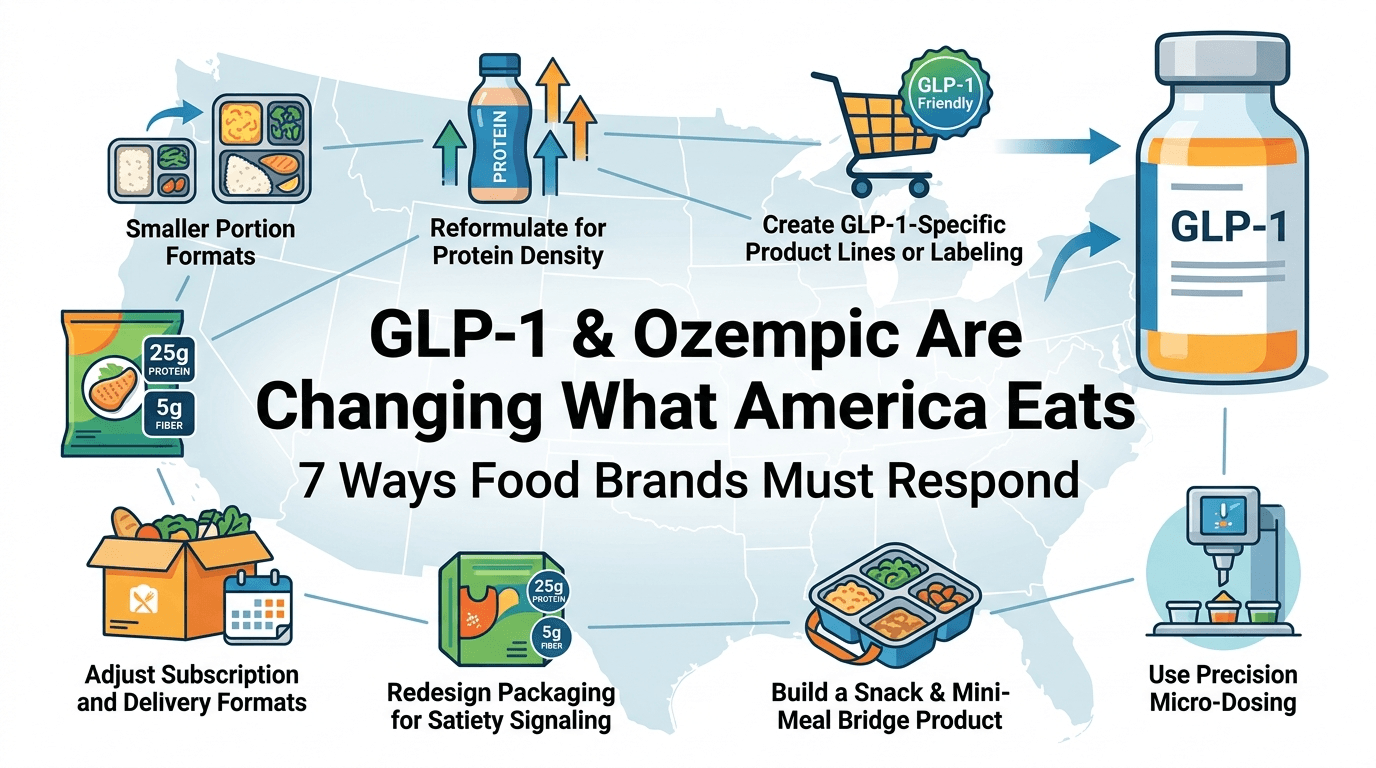
Strategy 1 — Launch Smaller Portion Formats Across Your Existing SKU Line
The single highest-impact GLP-1 food brand strategy available to most brands right now is not creating new products — it is offering existing products in smaller, GLP-1-appropriate portion sizes. A meal kit that serves 2 full portions can be repackaged as a 3-portion kit where each component is proportionally downsized. A snack pack previously sized at 2 oz becomes a 1 oz single-serve format.
This is not simply a size reduction — it is a complete packaging and portioning exercise. Each ingredient component in a meal kit must be re-portioned, the pouches resized, and the kitting assembly reconfigured. This requires the kind of precision portioning infrastructure and flexible production capabilities that a full-service co-packer provides. See our guide on 5 powerful single-serve food packaging trends dominating 2026 for the full market context behind this shift.
Strategy 2 — Reformulate for Protein Density
GLP-1 users eating less volume need more protein per calorie consumed. The clinical recommendation for GLP-1 users is 1.2–1.5g of protein per kilogram of body weight daily — a target that becomes challenging when total caloric intake drops to 1,200–1,600 calories per day. This creates enormous demand for high-protein, nutrient-dense food products that maximize protein content per ounce.
For meal kit and snack brands, this means reformulating toward protein-forward ingredient ratios — more legumes, seeds, lean proteins, and functional protein additions in every kit component. This is a GLP-1 food brand strategy that simultaneously serves GLP-1 users and the broader high-protein trend that has dominated food retail for the past 3 years. We cover the demand drivers behind this in our post on bold and high protein snacks.
Strategy 3 — Create GLP-1-Specific Product Lines or Labeling
Some brands are beginning to explicitly market products as “GLP-1 friendly” or “GLP-1 supportive” — a label that resonates immediately with the approximately 10–12 million Americans currently on these medications. While the FDA does not have a specific “GLP-1 friendly” claim standard yet, brands are using language like “high protein, small portions,” “nutrient-dense snack,” and “designed for mindful eating” to signal relevance to this consumer segment.
This is a first-mover GLP-1 food brand strategy opportunity — the brands that establish positioning in this space now will own the search rankings, the retail shelf placement, and the consumer associations that latecomers will struggle to match.
Strategy 4 — Redesign Your Packaging for Satiety Signaling
GLP-1 users are highly attuned to satiety cues. Packaging that prominently features protein content, fiber content, and ingredient quality signals directly addresses their primary nutritional concerns. Front-of-pack callouts like “25g Protein,” “5g Fiber,” or “Only 6 Ingredients” are more persuasive to GLP-1 users than traditional marketing claims.
Your co-packing partner should support the flexibility to produce multiple packaging variants with different front-of-pack callouts, enabling your brand to A/B test messaging and respond quickly to consumer feedback. This packaging agility is a core component of an effective GLP-1 food brand strategy.
Strategy 5 — Adjust Your Subscription Cadence and Delivery Formats
Meal kit brands built around 3 meals × 2 portions = 6 full-meal deliveries per week will see GLP-1 subscribers either over-ordering (and cancelling due to food waste guilt) or requesting smaller delivery options. Building flexibility into your subscription tiers — offering a “light” or “mini” meal kit plan with smaller components and fewer calories — is a GLP-1 food brand strategy that directly protects meal kit subscription retention among this fast-growing demographic. We cover the retention mechanics in our guide on how packaging drives meal kit subscription retention.
Strategy 6 — Build a Snack & Mini-Meal Bridge Product
GLP-1 users’ shift toward 4–6 small eating occasions per day creates strong demand for a product category that most meal kit brands do not currently serve: the “bridge snack” or “mini meal.” These are single-serve, 150–300 calorie items designed to fit between meals — high in protein, satisfying, and nutritionally complete. For brands that can execute this format, it is an adjacent product category that serves GLP-1 users’ new eating pattern while deepening their subscription relationship with your brand.
Strategy 7 — Use Precision Micro-Dosing to Control Ingredient Costs at Smaller Portions
Smaller portions at the same per-serving price means tighter ingredient cost management. A GLP-1 food brand strategy that moves toward smaller formats must be supported by precision portioning technology that maintains COGS targets at lower fill weights. Without automated micro-dosing equipment, the labor and material cost per unit at smaller portion sizes can actually be higher than at full-size portions. Our guide on 5 massive benefits of precision micro-dosing packaging explains exactly how this technology enables profitable small-format production.
4. The Packaging Opportunity: Small Format Is Now a Growth Category
The GLP-1 trend is accelerating a packaging shift that was already underway: the move toward small-format, single-serve, and mini-portion packaging. For co-packers and food brands, this creates a specific set of packaging infrastructure requirements that not all facilities can meet.
Effective small-format packaging for a GLP-1 food brand strategy requires:
- Precision fill accuracy at low weights: Filling a 15g spice sachet accurately requires different equipment calibration than filling a 100g pouch. At Pack’n Fresh, our precision micro-dosing equipment is calibrated for fill weights as low as 2g with ±0.5g accuracy.
- High-barrier film for smaller pouches: A smaller pouch has a higher surface-area-to-volume ratio, meaning the contents are more exposed to oxygen and moisture per gram of product. High-barrier film is even more critical at small formats to maintain freshness and shelf life.
- Efficient kitting at smaller component sizes: A GLP-1-adapted meal kit with 6 mini-components instead of 3 full-size components increases kitting complexity. Automated kitting systems handle this efficiently; manual kitting becomes exponentially more error-prone.
- Flexible MOQ structures: Launching a new small-format SKU alongside an existing full-size product requires a co-packer who supports lower MOQs for new product introductions without penalizing your overall cost structure.
5. Protein Density — The Nutrient GLP-1 Users Need Most
No element of a GLP-1 food brand strategy is more commercially important than protein. GLP-1 users losing significant weight face the clinically documented risk of muscle mass loss alongside fat loss — a condition that has driven widespread adoption of high-protein diets among this population. The result is a consumer segment that actively prioritizes protein content above almost every other nutritional factor when making food purchase decisions.
For meal kit brands, this means every kit component should be evaluated for its protein contribution per 100 calories. For snack brands, it means protein content per ounce is now a primary purchase driver — not an added benefit. Packaging that leads with protein content (“20g Protein Per Serving”), uses protein-signaling ingredient language (“quinoa,” “lentils,” “pea protein”), and presents clean, minimal ingredient lists will consistently outperform traditional packaging with GLP-1 consumers.
The precision required to consistently deliver exactly the protein content claimed on your label is a co-packing quality issue. A ±5% fill weight variance on a protein-rich ingredient sachet can mean a consumer receives 19g or 21g of protein instead of the 20g your label promises — a discrepancy that health-conscious GLP-1 users are likely to notice and react to.
6. What the GLP-1 Trend Means for Meal Kit Brands Specifically
Meal kit brands face both a significant threat and a significant opportunity from GLP-1 adoption. The threat: GLP-1 users who are eating 30% fewer calories may find that standard meal kit portions create consistent food waste — cooked food they cannot finish becomes a guilt-driven cancellation trigger. The opportunity: a brand that proactively offers a “GLP-1 Adapted” plan — smaller components, higher protein ratios, and 350–400 calorie per-serving targets — captures a subscriber segment with strong long-term retention incentives. GLP-1 users are typically on these medications for 1–3+ years, meaning a retained subscriber in this cohort has exceptional lifetime value.
The critical enabler of this opportunity is co-packing infrastructure that supports flexible portion sizes across the same SKU range. Your GLP-1 food brand strategy for meal kits should include: a tiered subscription plan with a “mini meals” option, reformulated high-protein recipe components, and smaller-format pouch sizes for every ingredient category — from the protein component down to the seasoning sachets.
Understanding the cost implications of different meal kit packaging formats is essential before launching a GLP-1-adapted product line, as smaller components can shift your cost structure meaningfully if not managed carefully.
7. How Pack’n Fresh Supports Your GLP-1 Food Brand Strategy
At Pack’n Fresh, our facility is purpose-built for the precision, flexibility, and quality management that an effective GLP-1 food brand strategy demands:
- Micro-dosing precision equipment: Fill weights from 2g up to 5 lb with industry-leading accuracy — supporting the small-format product lines GLP-1-adapted brands need
- High-barrier pouch formats: Pillow pouches, stand-up pouches, sachets, and stick packs — all available in sizes optimized for GLP-1-appropriate single-serve portions
- Flexible MOQs for new SKU launches: Launch your GLP-1-adapted product line without committing to full-scale production volumes before market validation
- ERP-driven label accuracy: Our digital ingredient locking system ensures every pouch contains exactly the protein content, ingredient quantities, and fill weight your label declares — critical for health-conscious GLP-1 consumers
- Full-service formulation support: Our food science team can work with your brand to reformulate existing recipes toward higher protein density without compromising flavor or consumer experience
8. Conclusion: GLP-1 Is Not a Fad — It Is a Structural Shift in American Food Consumption
A GLP-1 food brand strategy is no longer optional for brands that want to remain relevant through 2026 and beyond. With approximately 25 million projected GLP-1 users by 2030 — up from roughly 11 million in 2025 — and the behavioral evidence showing consistent, durable changes in eating patterns, the brands that adapt their packaging, portions, and nutritional profiles now will build a competitive advantage that compounds over time.
The core elements of an effective GLP-1 food brand strategy are: smaller portion formats, higher protein density, precision packaging accuracy, flexible subscription options, and a co-packing partner with the small-format production infrastructure to bring these changes to market efficiently.
At Pack’n Fresh, we are ready to help your brand lead this shift. Schedule a consultation with our team today — let’s build the packaging and production foundation your GLP-1 food brand strategy needs to win.
FAQs — GLP-1 Food Brand Strategy
How are GLP-1 drugs like Ozempic affecting food brand sales?
GLP-1 receptor agonists produce substantial and sustained reductions in food intake — clinical trials show average body weight reductions of 13–22% depending on the drug, driven by smaller portions, reduced appetite for high-fat and ultra-processed foods, and a shift toward more frequent but smaller eating occasions. A Cornell University study (2025) found GLP-1 users reduce grocery spending by 5–8%, with the sharpest declines in savory snacks, sweets, and baked goods. A proactive GLP-1 food brand strategy adapts to these shifts before they become a revenue problem.
What packaging formats work best for GLP-1 users?
GLP-1 users benefit most from single-serve, portion-controlled formats that eliminate food waste from over-serving. Sachets, mini pouches (15–50g), and individually portioned meal kit components are the highest-fit packaging formats for a GLP-1 food brand strategy. High-barrier films are especially important at small formats due to the higher surface-area-to-volume ratio.
Should meal kit brands create a specific GLP-1 subscription plan?
Yes. A dedicated “mini meal” or “GLP-1 adapted” subscription tier — with smaller component sizes, higher protein ratios, and 350–400 calorie per-serving targets — directly serves the 15–20 million current GLP-1 users and their documented eating behavior changes. This is one of the highest-ROI elements of a GLP-1 food brand strategy for meal kit brands.
How much protein should GLP-1-adapted food products contain?
Clinical guidelines for GLP-1 users recommend 1.2–1.5g of protein per kilogram of body weight daily. For a 150 lb (68 kg) person, that means 82–102g of protein per day on a reduced-calorie diet. Products that deliver 20–30g of protein per serving are well-positioned for GLP-1 users — making high-protein content a central pillar of any effective GLP-1 food brand strategy.
How can a co-packer help brands implement a GLP-1 food brand strategy?
A co-packer with precision micro-dosing equipment, flexible MOQ structures, and high-barrier small-format pouching capabilities enables brands to launch GLP-1-adapted SKUs efficiently and at scale. Pack’n Fresh supports fill weights from 2g up with ±0.5g accuracy — exactly the production precision that a GLP-1 food brand strategy built around small, nutrient-dense portions requires.
Is the GLP-1 food trend permanent or a passing phase?
The evidence strongly suggests it is structural, not cyclical. GLP-1 receptor agonist prescriptions are growing at over 50% annually, and clinical evidence shows sustained behavioral changes in users. A GLP-1 food brand strategy built today will compound in relevance as adoption continues to grow through 2030 and beyond