How to Scale Your Meal Kit Business from 500 to 50,000 Subscribers: A 7-Stage Road Map
The meal kit industry has proven something that was once debatable: people will pay a meaningful premium for the combination of convenience, fresh ingredients, and culinary discovery — delivered to their door. What the industry has also proven, in a long list of high-profile failures and near-collapses, is that getting subscribers is only half the challenge. Building an operation that can serve those subscribers profitably at 10x, 50x, or 100x your current volume without imploding on food safety, cost, or delivery reliability — that is the other half.
Scale your meal kit business too fast without the right operational infrastructure, and you will face a predictable sequence of failures: packaging inconsistencies, spoilage complaints, co-packing capacity gaps, supplier stockouts, and a cost-per-box that rises instead of falls as you grow. Too slow, and a well-funded competitor locks up your subscriber acquisition channels before you can establish a defensible market position.
This guide is built for meal kit founders and operators who are somewhere in the growth zone — past the hand-assembled proof-of-concept stage, but not yet at the industrial scale where every system is automated and optimized. We have worked with brands at every stage of this journey at Pack’n Fresh, and we have built this 7-stage roadmap to help you scale your meal kit business in a sequence that protects your margins, your food safety record, and your subscriber relationships at every inflection point.
Table of Contents
- Why Most Meal Kit Businesses Fail to Scale — And How to Avoid the Same Traps
- The 4 Operational Pillars Required to Scale a Meal Kit Business
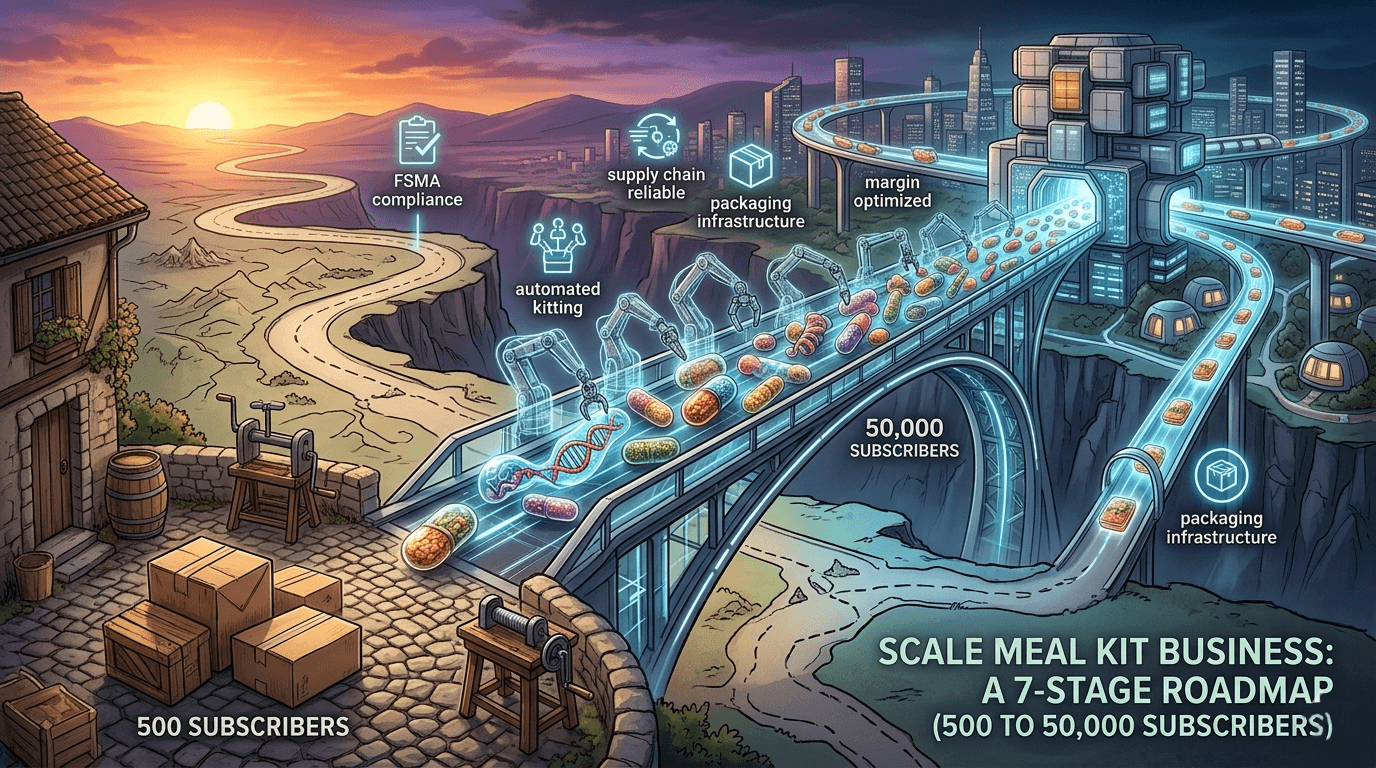
- The 7-Stage Roadmap to Scale Your Meal Kit Business from 500 to 50,000 Subscribers
- How Packaging Infrastructure Determines Your Scaling Ceiling
- The Co-Packer Transition: When and How to Make the Move
- Unit Economics at Each Scale Stage
- Conclusion
- FAQs
1. Why Most Meal Kit Businesses Fail to Scale — And How to Avoid the Same Traps
The graveyard of meal kit companies that grew fast and collapsed faster is well-documented. The pattern is almost always the same: a brand achieves strong early subscriber traction on the strength of a compelling concept and founder-driven quality control, then attempts to replicate that quality at 5x or 10x volume using the same informal systems that worked at small scale.
At 500 subscribers, a founder can personally oversee every pack-out, personally approve every ingredient shipment, and personally respond to every customer complaint. Those founder-level quality controls create an excellent early product experience. But they do not scale. When the same brand reaches 5,000 subscribers and the founder is no longer physically present in the pack-out facility, the informal systems collapse — and the product experience collapses with them.
The meal kit brands that successfully scale their meal kit business to 50,000 subscribers share a common discipline: they build systems, not heroics. They document every process, codify every quality standard, transition every informal founder judgment call into a written SOP that any trained team member can execute consistently. And critically, they make the transition from in-house assembly to professional co-packing at the right moment — neither so early that they cede control before the product is fully defined, nor so late that they are already in crisis.
2. The 4 Operational Pillars Required to Scale a Meal Kit Business
Before we walk through the 7-stage roadmap, it is important to understand the four operational pillars that underpin every successful meal kit scale-up. Every challenge you will face as you scale your meal kit business can be traced back to one or more of these pillars being underdeveloped relative to your subscriber volume.
Pillar 1 — Packaging Infrastructure
Your box, your insulation system, your protein pouches, your produce wrapping, your sauce packets — collectively, these are not just your product delivery vehicle. They are your food safety system, your cold chain management system, your brand expression vehicle, and your cost structure all in one. Packaging that is appropriate at 500 subscribers will typically be too expensive, too inconsistent, or both at 10,000 subscribers.
Pillar 2 — Supply Chain Reliability
At 500 subscribers, a supplier shortfall means you make a few phone calls and substitute ingredients for one week. At 50,000 subscribers, a supplier shortfall means 50,000 boxes need a recipe modification, 50,000 customers need a notification, and your co-packer’s pack schedule needs to be restructured — all within 48 hours. Supply chain reliability must be engineered for the scale you are targeting, not the scale you are operating at today.
Pillar 3 — Food Safety Compliance
FSMA compliance, allergen management, cold chain documentation, and traceability records that may have been managed informally at small scale must become formal, auditable systems as you grow. Retail buyers, institutional customers, and co-packing partners will all require documented food safety systems before they will do business with you at volume. The brands that scale their meal kit business successfully treat food safety as a growth enabler, not a regulatory burden.
Pillar 4 — Fulfillment and Co-Packing Capacity
Your assembly and fulfillment operation — whether in-house or outsourced — must be able to handle not just your current weekly volume, but your peak weekly volume (holiday gifting, promotional periods, post-resolution subscriber surges) with no reduction in quality or throughput. Capacity constraints at peak periods are the most common scaling bottleneck meal kit brands face.
3. The 7-Stage Roadmap to Scale Your Meal Kit Business from 500 to 50,000 Subscribers
Stage 1 — Founder-Assembled Proof of Concept (Under 500 Subscribers)
At this stage, you are assembling kits manually — likely with a small team in a commercial kitchen or small leased production space. Your primary goal is product-market fit: validating that subscribers love the recipes, the packaging, and the delivery experience enough to retain and refer. Every operational decision at this stage should prioritize learning speed over efficiency.
Document everything you do, even informally. Photograph every box configuration. Note which ingredients cause the most prep-time complaints, which proteins generate the most spoilage reports, which packaging materials fail most often in transit. This observational data becomes the foundation for your operational systems as you scale your meal kit business.
Stage 2 — Systematize Before You Grow (500–1,500 Subscribers)
This is the most critical stage in the roadmap, and the one most brands rush past in pursuit of growth. Before you invest in subscriber acquisition to push past 1,500 subscribers, you must systematize your operations so they can run without you.
Write formal SOPs for every pack-out step. Implement a recipe management system that locks ingredient specifications and portion weights. Build a supplier roster with at least two approved sources for every key ingredient. Establish formal quality check points — incoming ingredient inspection, in-process weight and portion checks, outgoing box inspection before seal. When you can scale your meal kit business reliably to 1,500 subscribers on your current system without your personal daily oversight, you are ready for Stage 3.
Stage 3 — Co-Packer Transition Planning (1,500–3,000 Subscribers)
At 1,500–3,000 subscribers, most meal kit brands are approaching the ceiling of what a small in-house operation can handle efficiently. Labor costs are rising, the pack-out floor is cramped, and the operational complexity of managing a growing ingredient list, multiple recipes, and increasing pack volume is consuming founder bandwidth that should be going into subscriber acquisition and retention.
This is the stage to begin evaluating co-packing partners seriously — not because you must make the transition immediately, but because finding the right meal kit co-packing partner takes time. You need to evaluate facilities for SQF or equivalent certification, cold chain capability, minimum order quantities, pricing at your current and target volumes, and cultural fit. Rushing this evaluation because you are already in operational crisis at Stage 4 or 5 is one of the most common and costly mistakes meal kit founders make.
Review the meal kit co-packing contract clauses you will need to negotiate before signing — particularly the SOW scope, minimum order flexibility, and exit provisions that protect you if the partnership does not work out.
Stage 4 — Co-Packer Onboarding and Transition (3,000–7,000 Subscribers)
The co-packer transition is operationally complex and requires more runway than most brands anticipate. Plan for a 60–90 day onboarding period that includes: recipe and specification documentation transfer, ingredient supplier introduction and approval, trial production runs at increasing volumes, packaging qualification testing, cold chain validation, and quality standard alignment.
As you scale your meal kit business through the transition, run your in-house and co-packing operations in parallel for at least 4–6 weeks before fully transferring production. This parallel period lets you identify gaps between your co-packer’s output and your quality standard while you still have a fallback. The brands that transition cleanly are the ones that invest in this parallel period; the ones that skip it to save cost typically pay the price in subscriber complaints during the transition window.
Stage 5 — Subscriber Growth Acceleration (7,000–20,000 Subscribers)
With a capable co-packing partner managing assembly and fulfillment, your internal team can refocus on what drives revenue: subscriber acquisition, retention optimization, recipe development, and brand building. This is typically the stage where meal kit brands activate their paid acquisition channels at meaningful scale — Meta and Google ads, influencer partnerships, corporate gifting programs, and retail pilot programs.
Two operational priorities are critical at this stage. First, establish formal demand forecasting so your co-packer has 4–6 weeks of forward visibility into expected pack volumes. The ability to scale your meal kit business efficiently at this stage depends on your co-packer’s ability to plan labor, ingredient procurement, and packaging inventory in advance — which requires accurate forecasts from you. Second, invest in automated kitting infrastructure at your co-packer to reduce per-box labor cost as volumes grow.
Stage 6 — National Expansion and Multi-Region Fulfillment (20,000–35,000 Subscribers)
At 20,000+ subscribers, most meal kit brands begin to feel the friction of a single fulfillment point serving a national subscriber base. Transit times lengthen for the most distant service areas. Cold chain costs rise as insulation must support longer transit windows. And carrier reliability becomes a meaningful variable in subscriber satisfaction scores.
The solution for most brands at this stage is multi-region fulfillment: either a second co-packing location in a different region (East/West, or South/North depending on your subscriber concentration), or a hybrid model using a primary co-packer for assembly and regional third-party cold storage hubs for last-mile staging. Understand the meal kit packaging cost implications of each model before committing — the right answer depends heavily on your subscriber geography and your box economics at scale.
Stage 7 — Full-Scale Operations and Margin Optimization (35,000–50,000+ Subscribers)
At 50,000 subscribers, a meal kit brand is a meaningful mid-market consumer food company — generating $50M–$100M+ in annual revenue depending on box price and meal count. At this scale, the operational priorities shift from growth to optimization: reducing per-box cost, improving ingredient yield, minimizing spoilage and shrinkage, and building the proprietary operational advantages that make you difficult to replicate.
The key leverage points to scale your meal kit business profitably at this stage are: direct ingredient sourcing relationships that bypass distributors, proprietary packaging formats developed with your co-packer that improve packing speed and reduce material cost, automated quality systems that reduce manual inspection labor, and data-driven recipe engineering that optimizes ingredient costs without degrading subscriber satisfaction.
4. How Packaging Infrastructure Determines Your Scale Meal Kit Business Ceiling
Packaging is not a branding decision — it is an operational architecture decision that will either enable or constrain your ability to scale your meal kit business. Brands that treat packaging as a cosmetic afterthought consistently hit the same scaling wall: their in-house packaging configurations cannot be replicated efficiently at co-packing scale, their cold chain insulation fails at longer transit windows as they add new service areas, and their per-box packaging cost does not decrease meaningfully as volume grows because they have not transitioned to standardized bulk-purchased formats.
The packaging decisions that determine your scaling ceiling include:
- Box standardization: A standardized outer box configuration that can be assembled and sealed at automated line speeds (versus a custom, hand-folded format that requires individual manual assembly) is worth 30–50% labor savings on the pack-out floor at scale. Standardize your outer box format at Stage 2, not Stage 5.
- Protein packaging format: Heat-sealed barrier pouches for proteins (rather than tray-and-film configurations) are faster to pack, more consistent in seal integrity, and more reliable in cold chain performance. If you are still using hand-wrapped protein formats at 3,000+ subscribers, transition before your co-packer transition — not after.
- Insulation system scalability: Pre-formed EPS or molded pulp insulation liners that drop into the outer box in a single step are dramatically faster to assemble than multi-piece foil bubble insulation that requires folding and fitting. The time difference per box — typically 20–40 seconds — multiplies to significant labor cost savings at volume.
- Sauce and spice packet format: Pillow-style heat-sealed sachets produced in bulk are significantly less expensive and more consistent than hand-portioned containers at scale. A professional co-packer like Pack’n Fresh can produce and fill these sachets as part of the pack-out process.
Review how your meal kit subscription retention data correlates with specific packaging failures — that data is your prioritization guide for packaging infrastructure investment.
5. The Co-Packer Transition: When and How to Make the Move to Scale Your Meal Kit Business
The co-packer transition is the single highest-leverage operational decision most meal kit brands will make. A great co-packing partner does not just assemble your kits — they bring food safety infrastructure, cold chain capability, regulatory compliance systems, ingredient procurement leverage, and operational expertise that would cost millions of dollars to build in-house.
When Is the Right Time to Transition?
The clearest signal that you are ready to transition to a co-packer is when your in-house operation is running at or near capacity for two or more consecutive weeks, and adding capacity in-house would require capital investment in equipment, space, or labor that is comparable to co-packing fees at your target volume. Most meal kit brands hit this inflection point between 1,500 and 3,000 subscribers, though the exact threshold varies with box format complexity and the size of your in-house facility.
A secondary signal is food safety complexity. If your ingredient list has expanded to include allergen-sensitive items, raw proteins from multiple suppliers, or organic/certified ingredients that require chain-of-custody documentation, the food safety management infrastructure required to handle these ingredients professionally typically exceeds what a small in-house operation can maintain.
What to Look for in a Co-Packing Partner to Scale Your Meal Kit Business
When evaluating co-packers to help you scale your meal kit business, prioritize the following criteria:
- SQF or GFSI certification: SQF Level 2 or equivalent GFSI scheme certification (BRCGS, FSSC 22000) indicates that the facility’s food safety management system has been independently audited and meets nationally recognized standards. This is non-negotiable for a meal kit co-packer handling raw proteins.
- Cold chain capability: The facility must have temperature-controlled receiving, storage, and production areas appropriate for the temperature requirements of your ingredient mix — typically refrigerated production space for protein handling and separate ambient storage for dry goods.
- Minimum order flexibility: Some co-packers have minimum weekly volume requirements that exceed your current subscriber count. Evaluate whether the co-packer’s minimums match your current volume, not just your target volume, and negotiate a ramp-up schedule in the contract.
- FSMA traceability compliance: FSMA 204 traceability requirements are increasingly affecting the entire supply chain. Your co-packer must maintain lot-level traceability records for all ingredients from receiving through pack-out — this is required for rapid recall response and is becoming a baseline expectation from retail and institutional buyers.
- Capacity headroom: Your co-packing partner should have meaningful capacity above your current volume so that your growth does not immediately constrain their schedule. A co-packer that is already at 90% capacity when you sign has limited ability to support your scaling trajectory.
6. Unit Economics at Each Scale Stage: How Costs Change as You Scale Your Meal Kit Business
Understanding how your unit economics evolve as you scale your meal kit business is essential for making good investment decisions at each stage. The general trajectory is favorable — per-box costs decline as volume grows — but the path is not linear, and there are transition points where costs temporarily rise before falling.
Packaging Cost per Box
Packaging represents 15–25% of total COGS for most meal kit brands. At 500 subscribers ordering weekly, you are likely purchasing packaging at retail or small-lot prices — covering all packaging components combined (outer box, insulation, protein pouches, sauce sachets, produce wrapping). As volume grows, bulk purchasing from packaging suppliers meaningfully reduces this per-box cost. At 50,000 subscribers with a co-packing partner who consolidates purchasing across multiple clients, packaging costs can decline significantly compared to small-lot pricing. Exact figures vary by volume, packaging format, insulation type, and facility — request itemized packaging quotes at each scale stage to benchmark your specific configuration.
Review the full meal kit packaging cost breakdown to understand which components offer the greatest optimization opportunity at your current scale.
Labor Cost per Box
In-house manual assembly labor cost per box varies significantly by kit complexity, local labor rates, and facility layout. Co-packing with semi-automated kitting typically reduces this per-box labor cost meaningfully compared to manual in-house assembly. Fully automated kitting at high volume can reduce labor cost further — often dramatically relative to small-scale manual assembly. Exact figures depend on kit complexity, region, and equipment configuration; industry estimates vary widely by operation. The transition to co-packing and the investment in automation together represent the largest single per-box cost reduction opportunity for most meal kit brands.
Ingredient Cost per Box
Ingredient cost typically represents 35–45% of meal kit COGS and is the largest single cost component. At small scale, you are purchasing ingredients through distributors or food service broadliners at standard pricing. As volume grows and you develop direct supplier relationships, ingredient costs typically decline 10–20% relative to distributor pricing. At 50,000 subscribers, direct sourcing relationships with farms, protein processors, and specialty ingredient suppliers are worth pursuing actively.
The COGS Crossover Point
Most meal kit brands experience a COGS crossover point when they transition to co-packing — a temporary increase in total per-box cost as co-packing fees replace the (often undercosted) in-house labor and overhead that was previously absorbed informally. This crossover is normal and expected. The correct response is not to delay the co-packing transition to preserve the appearance of lower costs, but to forecast the full co-packing cost accurately and build it into your subscriber acquisition economics from the beginning. Understanding your true meal kit COGS calculation at each scale stage is foundational to making good decisions about pricing, co-packing, and growth investment.
Conclusion: Building the Operational Foundation to Scale Your Meal Kit Business
The meal kit brands that reach 50,000 subscribers do not succeed by growing faster than their competitors. They succeed by building operational infrastructure that can support growth without degrading quality, food safety, or subscriber experience. That infrastructure — systematized SOPs, a capable co-packing partner, engineered packaging, a reliable supply chain, and strong unit economics — is what turns subscriber acquisition investment into durable revenue.
The 7-stage roadmap in this guide is designed to help you build that infrastructure in the right sequence: systematize before you grow, find your co-packer before you need them urgently, transition your packaging before your current format becomes a constraint, and optimize your unit economics before you scale your acquisition spending.
Pack’n Fresh works with meal kit brands at every stage of this journey — from the 1,500-subscriber brands beginning their first co-packer evaluation to the 20,000-subscriber brands building multi-region fulfillment models. If you are ready to scale your meal kit business with an SQF-certified co-packing partner who specializes in meal kit and fresh food assembly, we would like to talk.
FAQs — How to Scale a Meal Kit Business
At what subscriber count should I move from in-house assembly to a co-packer to scale my meal kit business?
Most meal kit brands make the co-packer transition between 1,500 and 3,000 weekly subscribers, though the right timing depends on your current production capacity, your kit complexity, and your local labor costs. The key signal is when your in-house operation is regularly running at or near capacity, and adding capacity in-house would require capital investment comparable to co-packing fees. Begin evaluating co-packing partners at 1,000 subscribers so you have time to make a thoughtful decision rather than a reactive one.
How much does it cost to co-pack meal kits at different subscriber volumes?
Co-packing fees for meal kits decline meaningfully as weekly box volume grows, as volume discounts and automation reduce per-unit costs. The exact pricing depends on kit complexity, ingredient count, packaging format, the degree of automation at the facility, and the specific co-packer. Published benchmarks vary widely and can be misleading if applied outside their original context. The most reliable approach: request itemized quotes from multiple co-packers and compare total landed cost — co-packing fee plus ingredient procurement, packaging, and fulfillment — not just the assembly fee in isolation. Pack’n Fresh provides transparent, itemized pricing for meal kit co-packing based on your specific kit specs and target volume.
What certifications does a meal kit co-packer need to help me scale my meal kit business?
At minimum, your co-packing partner should hold SQF Level 2 certification (or an equivalent GFSI scheme such as BRCGS or FSSC 22000) and operate under a documented HACCP plan. For brands serving subscribers with dietary restrictions, look for additional certifications relevant to your product: Organic handler certification, Kosher or Halal certification, Gluten-Free facility certification, or Non-GMO Project verification. These certifications are not just regulatory compliance — they are quality signals that help you scale your meal kit business into channels like natural grocery retail and corporate gifting that require documented third-party verification.
How do I maintain food safety as I scale my meal kit business?
Food safety scales with systems, not headcount. The transition from informal founder oversight to formal documented food safety management is the most important operational step you will take as you grow. This means written SOPs for every food handling step, documented temperature logs for all refrigerated storage and transit, allergen control procedures, supplier approval programs with documented qualification criteria, and lot-level traceability records for every ingredient from receiving to pack-out. A co-packing partner with SQF certification brings all of these systems as part of their standard operations — which is one of the most compelling reasons to transition to co-packing before your subscriber count forces a reactive food safety upgrade.
What is the biggest mistake brands make when trying to scale a meal kit business?
The most common and costly mistake is accelerating subscriber acquisition before systematizing operations. Rapid subscriber growth on an informal operational foundation creates an almost certain recipe for delivery failures, subscriber complaints, and churn that erodes the CAC investment that drove the growth in the first place. The brands that successfully scale their meal kit business to 50,000 subscribers consistently share one practice: they build the operational infrastructure one stage ahead of their current subscriber volume, not one stage behind it.
Can a small meal kit brand negotiate co-packing contracts with favorable terms?
Yes — particularly if you approach the negotiation with a clear growth trajectory and a professional presentation of your brand, your recipes, and your current operations. Co-packers evaluate potential clients not just on current volume but on growth potential. A 2,000-subscriber brand with a strong retention rate, a differentiated positioning, and a credible 12-month growth plan to 10,000+ subscribers is an attractive client for a co-packer looking to fill capacity and build long-term partnership