Category

Packaging Solutions

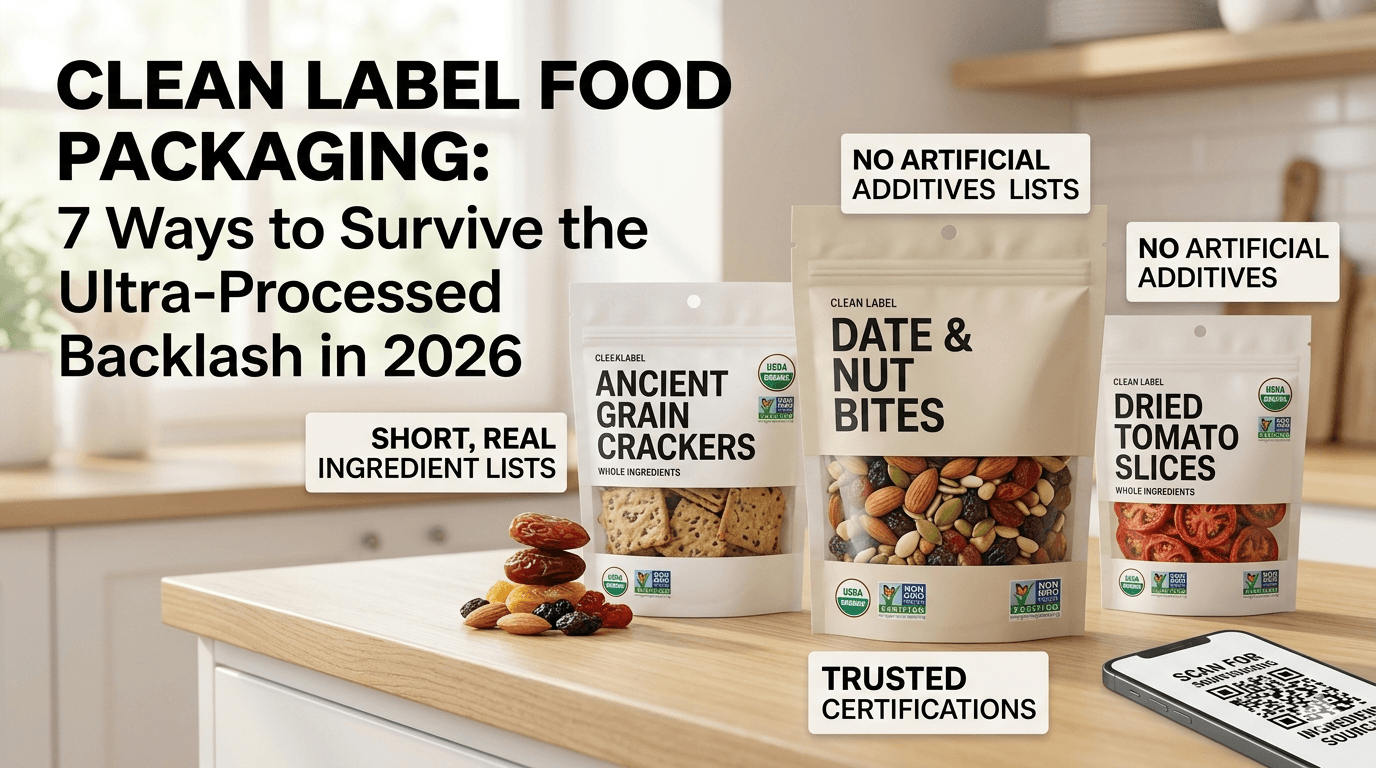
Clean Label Food Packaging: 7 Ways to Survive the Ultra-Processed Food Backlash in 2026

Clean Label Food Packaging

Clean Label Food Packaging: 7 Ways to Survive the Ultra-Processed Food Backlash in 2026

Something significant has shifted in the American food market. Consumers are reading ingredient labels more carefully than ever before. They are photographing ingredient lists and posting them on social media. They are downloading apps that score their food products on “processing level.” And increasingly, they are abandoning brands whose ingredient lists fail the “grandmother test” — if your grandmother wouldn’t recognize it as food, it does not belong in the product.

The ultra-processed food backlash is real, it is data-backed, and it is accelerating. For food brand founders and co-packing clients, the strategic response is not a complete product reformulation overnight — it starts with how your clean label food packaging communicates ingredient integrity and manufacturing transparency to a consumer base that is more skeptical than ever before.

At Pack’n Fresh, we co-pack for food brands navigating this exact shift. This post breaks down what the ultra-processed food backlash actually means, why clean label food packaging is now a front-line brand defense strategy, and the 7 specific ways your brand can adapt its packaging approach to win consumer trust in 2026.


Table of Contents

  1. What the Ultra-Processed Food Backlash Actually Is — And Why It’s Not Going Away
  2. What “Clean Label” Means in 2026 (And What It Doesn’t)
  3. 7 Clean Label Food Packaging Strategies That Protect Your Brand
  4. How Certifications Support Your Clean Label Food Packaging Story
  5. The Role of Your Co-Packer in Clean Label Compliance
  6. Common Clean Label Mistakes That Backfire
  7. Conclusion
  8. FAQs

1. What the Ultra-Processed Food Backlash Actually Is — And Why It Is Not Going Away

The term “ultra-processed food” comes from the NOVA food classification system, developed by researchers at the University of São Paulo, which categorizes foods into 4 groups based on the extent of industrial processing. NOVA Group 4 — ultra-processed foods — includes products containing ingredients not typically found in home kitchens: emulsifiers, artificial colorings, flavor enhancers, modified starches, hydrogenated oils, and high-fructose corn syrup.

In 2024, a series of high-profile peer-reviewed studies linked ultra-processed food consumption to increased risk of cardiovascular disease, type 2 diabetes, depression, and even certain cancers. These studies were covered in mainstream media with a frequency and prominence that previous nutrition research rarely achieved. The result: a significant portion of the American consumer base — particularly the health-conscious, educated demographic that drives premium food brand growth — actively began avoiding products they perceived as ultra-processed.

The data is compelling. According to the 2025 IFIC Food & Health Survey, 80% of American consumers now say they consider whether a food was processed before buying it — up from 76% in 2023 — and 40% report being familiar with the specific term “ultra-processed food,” a 12-percentage-point jump from just two years prior. Awareness is translating into behavior: a separate IFIC analysis found consumer confusion and concern about ultra-processed foods growing faster than any other food-safety issue tracked in 2025. For food brands, this is not a niche concern. It is a mainstream market force that requires a proactive clean label food packaging response.


2. What “Clean Label” Means in 2026 — And What It Doesn’t

“Clean label” is not an FDA-defined term. There is no legal standard, no certification authority, and no universal definition. This ambiguity creates both an opportunity and a risk for food brands. The opportunity: brands can authentically define and communicate what “clean” means for their specific product category. The risk: vague or unsubstantiated “clean” claims invite consumer and regulatory backlash.

In practice, clean label food packaging in 2026 is defined by what consumers expect to see — and not see — on your ingredient list and package:

What clean label consumers expect TO SEE:

  • Short ingredient lists — typically 8 ingredients or fewer for snacks and simple products, 12–15 for meal kit components
  • Ingredients they recognize and can pronounce — whole food names, not chemical-sounding derivatives
  • Real food descriptors — “sea salt” not “sodium chloride,” “cane sugar” not “sucrose,” “dried tomatoes” not “tomato powder”
  • Transparent sourcing claims — “domestic ingredients,” “family farm,” “non-GMO corn”
  • Third-party certifications — Organic, Non-GMO, Gluten-Free, Kosher — as independent verification

What clean label consumers expect NOT TO SEE:

  • Artificial colors, flavors, or preservatives (Red 40, Yellow 5, sodium benzoate)
  • High-fructose corn syrup in any form
  • Partially hydrogenated oils
  • Carrageenan, carboxymethylcellulose, or other industrial emulsifiers
  • Ingredient names that require a chemistry degree to interpret
  • Very long ingredient lists regardless of the individual ingredients’ natural status

Effective clean label food packaging does not just remove problematic ingredients — it actively communicates their absence and celebrates the ingredients that remain.


3. The 7 Clean Label Food Packaging Strategies That Protect Your Brand in 2026

Strategy 1 — Lead with Your Ingredient List as a Marketing Asset

The most powerful clean label food packaging strategy is also the simplest: make your ingredient list a headline feature, not a footnote. Brands like RxBar built entire identities on ingredient-forward packaging (“3 Egg Whites. 6 Almonds. 4 Cashews. 2 Dates. No B.S.”). This approach works precisely because it demonstrates confidence in the product’s ingredient integrity.

If your product has a short, recognizable ingredient list, your packaging should showcase it prominently on the front of pack. This transforms what is typically a compliance requirement (ingredient disclosure) into a purchase driver — the embodiment of effective clean label food packaging.

Strategy 2 — Replace Ambiguous Claims with Specific, Verifiable Statements

Generic claims like “natural,” “wholesome,” or “real ingredients” have lost consumer credibility through overuse and misuse. Effective clean label food packaging replaces vague language with specific, verifiable statements: “No artificial preservatives,” “Made with 100% whole grain oats,” “Sweetened only with dates,” “Contains 5 ingredients you can see in the photo.”

Specificity builds trust. Vagueness invites skepticism. In 2026’s environment of heightened ingredient scrutiny, every generic “natural” claim is a missed opportunity to make a specific, credible statement that resonates with clean label consumers.

Strategy 3 — Use Transparency Windows and Visible Ingredient Photography

Physical packaging transparency — literal windows that let consumers see the actual product inside — is one of the most powerful clean label food packaging tools available. A transparent window in a pouch that shows whole spices, real nuts, or visible grain pieces communicates ingredient quality more convincingly than any text claim.

Where a physical window is not practical (for light-sensitive or humidity-sensitive ingredients), high-quality ingredient photography on pack that accurately represents the actual contents performs the same trust-building function. The key is authenticity — stylized photography that bears no resemblance to the actual product contents actively backfires with clean label consumers.

Strategy 4 — Audit and Simplify Your Ingredient List Before Redesigning Your Packaging

The most effective clean label food packaging strategy starts before the design table — it starts in the formulation kitchen and the ingredient sourcing process. Work through every ingredient in your current formulation and ask: can this be replaced with a recognizable whole food equivalent without compromising product performance?

Common clean label substitutions include: replacing modified food starch with arrowroot powder or tapioca starch, replacing sodium benzoate with rosemary extract, replacing artificial flavor with real spice concentrates, and replacing refined sugars with dates, honey, or coconut sugar. Many of these substitutions are possible without significant cost increases when managed through a co-packer with strong ingredient sourcing relationships.

At Pack’n Fresh, our hybrid sourcing model gives brands access to domestic and global clean ingredient suppliers at competitive pricing — making the reformulation process economically viable for brands at every scale.

Strategy 5 — Leverage Third-Party Certifications as Clean Label Proof Points

In the absence of a legal “clean label” standard, third-party certifications serve as the most credible clean label signal on your packaging. For clean label consumers, certifications like Non-GMO Project Verified, USDA Organic, and Gluten-Free (GFCO) function as independent confirmation that your “clean” claims are externally audited, not self-declared.

We explore the revenue impact of these certifications in depth in our post on food brand certifications ROI — Organic, Kosher, and Non-GMO. From a clean label food packaging perspective, the key is not to collect certifications indiscriminately, but to display the specific certifications that are most meaningful to your target consumer’s clean label definition.

Strategy 6 — Address Allergens with Proactive Transparency, Not Just Compliance

Clean label consumers view allergen labeling not just as a safety requirement but as a transparency signal. Brands that clearly, prominently, and proactively communicate allergen information — beyond the minimum FDA requirement — signal that they have “nothing to hide” in their production process. This is an underutilized element of clean label food packaging that builds specific trust with the growing population of consumers managing food sensitivities.

This is also an area where your co-packer’s allergen management capabilities directly impact your ability to make credible claims. Our guide on allergen management in food packaging explains the operational systems — siloed production scheduling, validated sanitation protocols, ATP swab testing — that make “free-from” claims defensible.

Strategy 7 — Build a “Behind the Label” Digital Experience

QR codes on packaging have evolved from novelty to expectation. Clean label food packaging in 2026 uses QR codes to extend the ingredient story beyond what fits on the physical package — linking to ingredient sourcing videos, facility tours, third-party lab test results, and farmer profiles. This “behind the label” transparency is especially powerful for brands whose ingredients have compelling sourcing stories (single-origin spices, small-farm proteins, regeneratively grown grains).

Under FSMA Section 204 traceability requirements, your supply chain must maintain digital lot-level records anyway — repurposing that traceability data into consumer-facing transparency content is a no-cost upgrade to your clean label food packaging strategy.


Is your current packaging telling a clean label story your consumers will trust? Talk to Pack’n Fresh — our SQF-certified, Organic and Non-GMO certified facility is built for brands that take ingredient integrity seriously.

4. How Certifications Support Your Clean Label Food Packaging Story

Clean label food packaging claims are most credible when they are independently verified. The certification landscape in 2026 offers several meaningful options for brands building a clean label identity:

  • USDA Organic: The gold standard for ingredient integrity — verifies no synthetic pesticides, GMOs, or artificial additives were used in production. The strongest clean label signal for natural channel brands.
  • Non-GMO Project Verified: Specifically addresses the GMO concern that is one of the top clean label triggers for consumers. Highly visible, instantly recognized.
  • Gluten-Free (GFCO): For naturally gluten-free products, this certification serves double duty — allergen safety signal and production process transparency signal.
  • No Artificial Ingredients (self-declared with ingredient list support): While not a third-party certification, a clearly supported “no artificial flavors, colors, or preservatives” callout backed by a clean ingredient list is a high-performing clean label food packaging element.

Pack’n Fresh holds Organic, Non-GMO, Kosher, and Gluten-Free facility certifications — giving brands we co-pack a credible certification foundation for their clean label food packaging strategy from day one.


5. The Role of Your Co-Packer in Clean Label Compliance

Your co-packer is the physical environment where your clean label promise is either kept or broken. A co-packer that uses shared equipment without validated sanitation protocols, cannot provide ingredient lot-level traceability, or sources packaging materials that contain BPA or other chemical migrants directly undermines your clean label food packaging claims — regardless of how excellent your package design is.

The questions to ask your co-packer about clean label compliance:

  • Can you provide Certificate of Analysis documentation for every ingredient lot used in my production run?
  • What is your validated cleaning procedure between runs — specifically for allergen residue and cross-contact risk?
  • Are your packaging films food-contact safe per FDA 21 CFR regulations, and are migration test results available?
  • Do you hold Organic or Non-GMO facility certification that would support my product-level certification?
  • What is your FSMA 204 digital traceability system, and can you provide lot-level ingredient traceability on demand?

At Pack’n Fresh, all of these questions have affirmative answers — built into our standard operating procedures, not available only as premium add-ons. This is the operational foundation that makes credible clean label food packaging possible for every brand we serve. Explore our full-service capabilities in our guide on 7 powerful reasons to choose a full-service packaging solution.


6. Common Clean Label Packaging Mistakes That Backfire

Not all clean label food packaging attempts succeed. Here are the most common mistakes that damage rather than build consumer trust:

  • Greenwashing ingredient names: Renaming “high-fructose corn syrup” as “corn sugar” or “maltodextrin” as “tapioca fiber” fools no one in 2026. Informed consumers and food journalists will identify and publicize these rebranding attempts immediately.
  • “Natural” without specificity: Claiming “all natural ingredients” while including carrageenan, maltodextrin, or natural flavor (which can contain hundreds of chemical components) invites well-deserved skepticism.
  • Front-of-pack clean claims contradicted by the ingredient list: Leading with “No Preservatives” while the ingredient list contains citric acid as a preservative is a consistency failure that destroys trust.
  • Certifications that don’t match your claims: Displaying a “Certified Gluten-Free” seal on a product that also contains wheat starch is both a regulatory violation and a clean label food packaging integrity failure.
  • Over-claiming on behalf of your co-packer’s certifications: Your product is only as certified as your specific production run — co-packer facility certifications must be verified as current and applicable to your specific product to be legitimately displayed.

7. Conclusion: Clean Label Food Packaging Is Your Brand’s Most Durable Defense

The ultra-processed food backlash is not a trend that will peak and subside. The scientific evidence base is growing, the media coverage is intensifying, and consumer behavior is shifting in ways that compound over time as new information reaches new demographics. For food brand founders, the question is not whether to develop a clean label food packaging strategy — it is how quickly and how authentically.

The most durable clean label food packaging strategy is not one built on marketing language. It is one built on genuine ingredient integrity, production transparency, and third-party verification — all of which begin with choosing a co-packing partner whose facility certifications, traceability systems, and allergen management protocols make clean label claims defensible.

At Pack’n Fresh, our Organic, Non-GMO, Kosher, and Gluten-Free certifications, combined with our ERP-driven traceability and rigorous sanitation standards, make us the co-packing partner of choice for brands that are serious about clean label integrity. If you are ready to build a clean label food packaging strategy that consumers will trust and competitors will struggle to match, reach out to our team today.


FAQs — Clean Label Food Packaging

What is clean label food packaging?

Clean label food packaging refers to packaging that communicates ingredient transparency, minimal processing, and recognizable ingredients to health-conscious consumers. It includes short ingredient lists, absence of artificial additives, prominent display of third-party certifications, and design elements that actively signal ingredient integrity rather than obscuring it.

Is “clean label” an FDA-regulated term?

No. “Clean label” has no official FDA definition or regulatory standard. This means brands have flexibility in how they define and communicate their clean label positioning — but it also means unsubstantiated or misleading clean label claims can attract FTC scrutiny and consumer backlash. The safest clean label food packaging approach is to anchor claims in specific, verifiable facts supported by third-party certifications.

How many ingredients should a clean label product have?

There is no universal rule, but consumer research consistently shows that products with 8 or fewer ingredients score highest on clean label perception tests. For more complex meal kit components, 12–15 recognizable ingredients can still qualify as clean label if every ingredient is familiar and functional. Effective clean label food packaging makes the ingredient count a visible feature rather than hiding it.

How does my co-packer affect my clean label claims?

Significantly. Your co-packer’s ingredient sourcing practices, allergen management protocols, facility certifications, and packaging material standards all directly affect whether your clean label food packaging claims are operationally defensible. A co-packer who cannot provide ingredient lot-level traceability or whose facility lacks Organic/Non-GMO certification cannot support many clean label claims regardless of your product formulation.

What certifications best support a clean label food packaging strategy?

The most valuable certifications for clean label food packaging are: USDA Organic (strongest overall signal), Non-GMO Project Verified (most recognized consumer-facing seal), and Gluten-Free GFCO (for naturally gluten-free products). Together, these three certifications address the top clean label concerns of the health-conscious consumer segment that drives premium food brand growth.

What is the difference between “natural” and “clean label” on food packaging?

“Natural” is an FDA-recognized but loosely defined claim that has been significantly devalued through misuse. “Clean label” is a broader consumer-defined concept that goes beyond the natural claim to include minimal processing, recognizable ingredients, supply chain transparency, and production integrity. Effective clean label food packaging goes far beyond simply claiming “natural” — it substantiates ingredient quality through specific claims, certifications, and design elements that make the product’s integrity immediately visible.

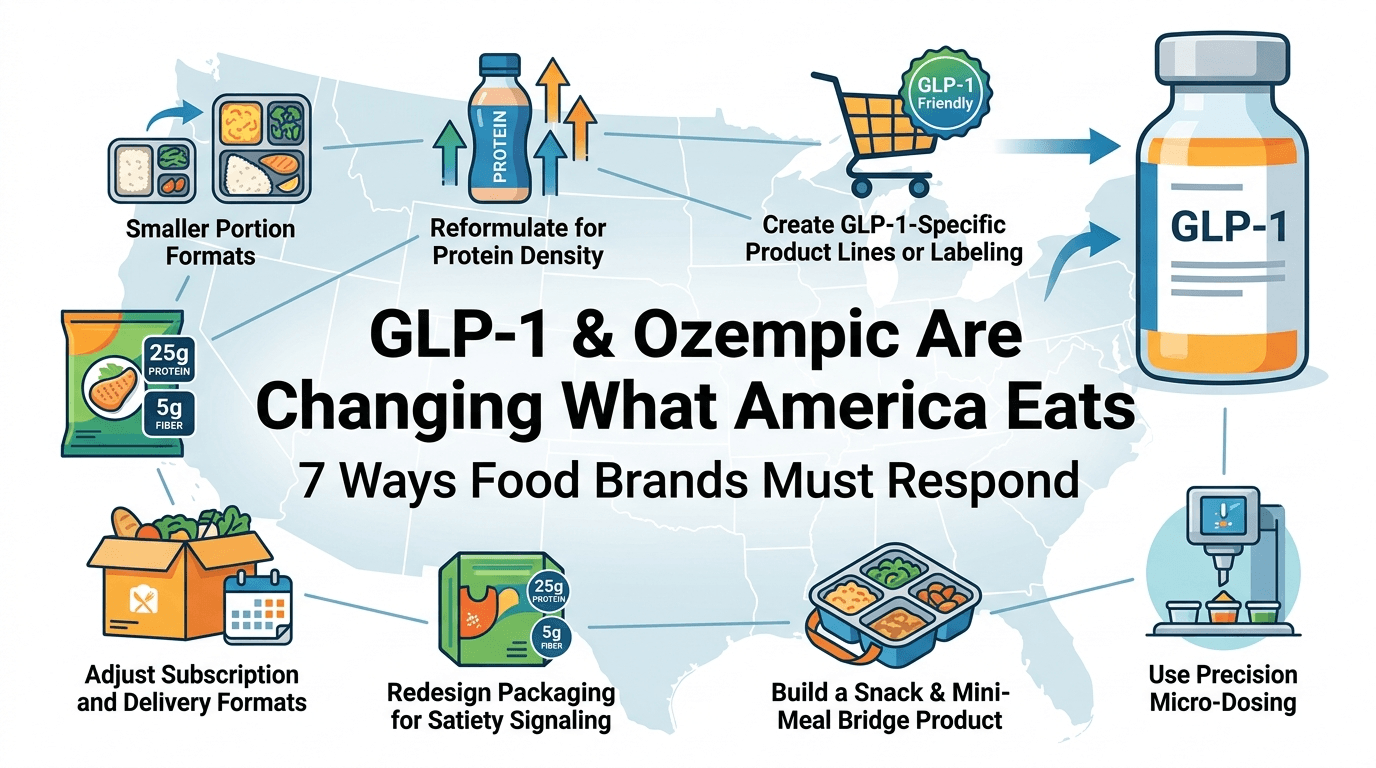
GLP-1 & Ozempic Are Changing What America Eats: 7 Ways Food Brands Must Respond

GLP-1 food brand strategy

GLP-1 & Ozempic Are Changing What America Eats: 7 Ways Food Brands Must Respond

A quiet revolution is reshaping the American food market — and it is not driven by a new diet trend, a celebrity influencer, or a government nutrition guideline. It is driven by a class of drugs. GLP-1 receptor agonists — including semaglutide (Ozempic, Wegovy), tirzepatide (Mounjaro, Zepbound), and a growing pipeline of new entrants — are being prescribed to tens of millions of Americans for weight loss and diabetes management, and they are fundamentally altering how, when, and how much people eat.

For food brand founders, meal kit executives, and co-packing clients, this is not a background trend to monitor from a distance. A strong GLP-1 food brand strategy is now a competitive necessity. The brands that adapt their product formats, portion sizes, nutritional profiles, and packaging to serve GLP-1 users will capture a rapidly growing, high-value consumer segment. The brands that ignore it will find their core products quietly losing relevance.

At Pack’n Fresh, we co-pack for food brands and meal kit companies across the country. We are seeing firsthand how GLP-1 adoption is reshaping order patterns, portion preferences, and packaging requirements — and this guide gives you the actionable GLP-1 food brand strategy framework your brand needs right now.


Table of Contents

  1. The Scale of the GLP-1 Revolution — Why This Changes Everything for Food Brands
  2. How GLP-1 Drugs Change Eating Behavior: What the Data Shows
  3. 7 GLP-1 Food Brand Strategies to Adapt and Win
  4. The Packaging Opportunity: Small Format Is Now a Growth Category
  5. Protein Density — The Nutrient GLP-1 Users Need Most
  6. What GLP-1 Means for Meal Kit Brands Specifically
  7. How Pack’n Fresh Supports Your GLP-1 Food Brand Strategy
  8. Conclusion
  9. FAQs

1. The Scale of the GLP-1 Revolution — Why This Changes Everything for Food Brands

The numbers are significant. As of mid-2025, approximately 10–12 million Americans are actively filling GLP-1 prescriptions for weight management or diabetes treatment, according to IQVIA patient data — with Gallup and RAND surveys suggesting as many as 11–12% of US adults report current or recent use. That number is projected to reach approximately 25 million by 2030, according to JP Morgan and industry consensus forecasts. GLP-1 prescriptions have more than tripled since 2020, and spending on GLP-1 drugs already exceeded $50 billion annually in the US by 2025.

Research from Morgan Stanley and major investment banks documents this as one of the most significant structural shifts in food consumption behavior in decades — pharmacologically driven, meaning it is more persistent, more consistent, and more measurable than a consumer diet trend. Unlike low-fat or low-carb cycles, GLP-1-driven behavior change does not require willpower — it is physiological, and it compounds as adoption grows.

For any brand building a GLP-1 food brand strategy, the critical insight is this: GLP-1 users do not stop eating — they eat differently. They eat less volume, eat more slowly, prioritize nutrient density over caloric density, and experience significant changes in food preferences and cravings. Understanding exactly how those behavioral changes manifest in real purchasing decisions is the foundation of an effective GLP-1 food brand strategy.


2. How GLP-1 Drugs Change Eating Behavior: What the Data Shows

GLP-1 receptor agonists work by mimicking the naturally occurring glucagon-like peptide-1 hormone, which signals satiety to the brain and slows gastric emptying. The behavioral effects on eating are well-documented in clinical literature:

  • Dramatically reduced portion sizes: Clinical trials show semaglutide users lose an average of 13–15% of body weight and tirzepatide users 17–22%, driven largely by significant reductions in portion size and overall food intake. A subscriber who previously consumed a full 600-calorie meal kit serving may now comfortably eat 350–400 calories in a sitting.
  • Reduced appetite for ultra-processed and high-fat foods: Multiple studies show GLP-1 users report decreased cravings for sweets, fried foods, and alcohol — a phenomenon researchers call the “food noise” reduction effect.
  • Increased preference for protein and vegetables: GLP-1 users who are actively losing weight prioritize protein to preserve lean muscle mass, creating strong demand for high-protein, nutrient-dense formats.
  • More frequent, smaller eating occasions: Instead of 3 full meals, many GLP-1 users shift to 4–6 small eating occasions per day — snacks, half-portions, and “mini meals” become their primary format.
  • Heightened sensitivity to food quality: With reduced quantity of food consumed, the quality of each bite matters more — GLP-1 users become more discerning about ingredient quality, freshness, and taste.

Each of these behavioral shifts has direct implications for packaging format, portion size, product formulation, and the overall GLP-1 food brand strategy your brand needs to develop.


3. The 7 GLP-1 Food Brand Strategies to Adapt and Win

Strategy 1 — Launch Smaller Portion Formats Across Your Existing SKU Line

The single highest-impact GLP-1 food brand strategy available to most brands right now is not creating new products — it is offering existing products in smaller, GLP-1-appropriate portion sizes. A meal kit that serves 2 full portions can be repackaged as a 3-portion kit where each component is proportionally downsized. A snack pack previously sized at 2 oz becomes a 1 oz single-serve format.

This is not simply a size reduction — it is a complete packaging and portioning exercise. Each ingredient component in a meal kit must be re-portioned, the pouches resized, and the kitting assembly reconfigured. This requires the kind of precision portioning infrastructure and flexible production capabilities that a full-service co-packer provides. See our guide on 5 powerful single-serve food packaging trends dominating 2026 for the full market context behind this shift.

Strategy 2 — Reformulate for Protein Density

GLP-1 users eating less volume need more protein per calorie consumed. The clinical recommendation for GLP-1 users is 1.2–1.5g of protein per kilogram of body weight daily — a target that becomes challenging when total caloric intake drops to 1,200–1,600 calories per day. This creates enormous demand for high-protein, nutrient-dense food products that maximize protein content per ounce.

For meal kit and snack brands, this means reformulating toward protein-forward ingredient ratios — more legumes, seeds, lean proteins, and functional protein additions in every kit component. This is a GLP-1 food brand strategy that simultaneously serves GLP-1 users and the broader high-protein trend that has dominated food retail for the past 3 years. We cover the demand drivers behind this in our post on bold and high protein snacks.

Strategy 3 — Create GLP-1-Specific Product Lines or Labeling

Some brands are beginning to explicitly market products as “GLP-1 friendly” or “GLP-1 supportive” — a label that resonates immediately with the approximately 10–12 million Americans currently on these medications. While the FDA does not have a specific “GLP-1 friendly” claim standard yet, brands are using language like “high protein, small portions,” “nutrient-dense snack,” and “designed for mindful eating” to signal relevance to this consumer segment.

This is a first-mover GLP-1 food brand strategy opportunity — the brands that establish positioning in this space now will own the search rankings, the retail shelf placement, and the consumer associations that latecomers will struggle to match.

Strategy 4 — Redesign Your Packaging for Satiety Signaling

GLP-1 users are highly attuned to satiety cues. Packaging that prominently features protein content, fiber content, and ingredient quality signals directly addresses their primary nutritional concerns. Front-of-pack callouts like “25g Protein,” “5g Fiber,” or “Only 6 Ingredients” are more persuasive to GLP-1 users than traditional marketing claims.

Your co-packing partner should support the flexibility to produce multiple packaging variants with different front-of-pack callouts, enabling your brand to A/B test messaging and respond quickly to consumer feedback. This packaging agility is a core component of an effective GLP-1 food brand strategy.

Strategy 5 — Adjust Your Subscription Cadence and Delivery Formats

Meal kit brands built around 3 meals × 2 portions = 6 full-meal deliveries per week will see GLP-1 subscribers either over-ordering (and cancelling due to food waste guilt) or requesting smaller delivery options. Building flexibility into your subscription tiers — offering a “light” or “mini” meal kit plan with smaller components and fewer calories — is a GLP-1 food brand strategy that directly protects meal kit subscription retention among this fast-growing demographic. We cover the retention mechanics in our guide on how packaging drives meal kit subscription retention.

Strategy 6 — Build a Snack & Mini-Meal Bridge Product

GLP-1 users’ shift toward 4–6 small eating occasions per day creates strong demand for a product category that most meal kit brands do not currently serve: the “bridge snack” or “mini meal.” These are single-serve, 150–300 calorie items designed to fit between meals — high in protein, satisfying, and nutritionally complete. For brands that can execute this format, it is an adjacent product category that serves GLP-1 users’ new eating pattern while deepening their subscription relationship with your brand.

Strategy 7 — Use Precision Micro-Dosing to Control Ingredient Costs at Smaller Portions

Smaller portions at the same per-serving price means tighter ingredient cost management. A GLP-1 food brand strategy that moves toward smaller formats must be supported by precision portioning technology that maintains COGS targets at lower fill weights. Without automated micro-dosing equipment, the labor and material cost per unit at smaller portion sizes can actually be higher than at full-size portions. Our guide on 5 massive benefits of precision micro-dosing packaging explains exactly how this technology enables profitable small-format production.


Is your brand ready for the GLP-1 food brand strategy shift? Pack’n Fresh specializes in precision small-format portioning and high-protein packaging solutions. Schedule a free consultation today.

4. The Packaging Opportunity: Small Format Is Now a Growth Category

The GLP-1 trend is accelerating a packaging shift that was already underway: the move toward small-format, single-serve, and mini-portion packaging. For co-packers and food brands, this creates a specific set of packaging infrastructure requirements that not all facilities can meet.

Effective small-format packaging for a GLP-1 food brand strategy requires:

  • Precision fill accuracy at low weights: Filling a 15g spice sachet accurately requires different equipment calibration than filling a 100g pouch. At Pack’n Fresh, our precision micro-dosing equipment is calibrated for fill weights as low as 2g with ±0.5g accuracy.
  • High-barrier film for smaller pouches: A smaller pouch has a higher surface-area-to-volume ratio, meaning the contents are more exposed to oxygen and moisture per gram of product. High-barrier film is even more critical at small formats to maintain freshness and shelf life.
  • Efficient kitting at smaller component sizes: A GLP-1-adapted meal kit with 6 mini-components instead of 3 full-size components increases kitting complexity. Automated kitting systems handle this efficiently; manual kitting becomes exponentially more error-prone.
  • Flexible MOQ structures: Launching a new small-format SKU alongside an existing full-size product requires a co-packer who supports lower MOQs for new product introductions without penalizing your overall cost structure.

5. Protein Density — The Nutrient GLP-1 Users Need Most

No element of a GLP-1 food brand strategy is more commercially important than protein. GLP-1 users losing significant weight face the clinically documented risk of muscle mass loss alongside fat loss — a condition that has driven widespread adoption of high-protein diets among this population. The result is a consumer segment that actively prioritizes protein content above almost every other nutritional factor when making food purchase decisions.

For meal kit brands, this means every kit component should be evaluated for its protein contribution per 100 calories. For snack brands, it means protein content per ounce is now a primary purchase driver — not an added benefit. Packaging that leads with protein content (“20g Protein Per Serving”), uses protein-signaling ingredient language (“quinoa,” “lentils,” “pea protein”), and presents clean, minimal ingredient lists will consistently outperform traditional packaging with GLP-1 consumers.

The precision required to consistently deliver exactly the protein content claimed on your label is a co-packing quality issue. A ±5% fill weight variance on a protein-rich ingredient sachet can mean a consumer receives 19g or 21g of protein instead of the 20g your label promises — a discrepancy that health-conscious GLP-1 users are likely to notice and react to.


6. What the GLP-1 Trend Means for Meal Kit Brands Specifically

Meal kit brands face both a significant threat and a significant opportunity from GLP-1 adoption. The threat: GLP-1 users who are eating 30% fewer calories may find that standard meal kit portions create consistent food waste — cooked food they cannot finish becomes a guilt-driven cancellation trigger. The opportunity: a brand that proactively offers a “GLP-1 Adapted” plan — smaller components, higher protein ratios, and 350–400 calorie per-serving targets — captures a subscriber segment with strong long-term retention incentives. GLP-1 users are typically on these medications for 1–3+ years, meaning a retained subscriber in this cohort has exceptional lifetime value.

The critical enabler of this opportunity is co-packing infrastructure that supports flexible portion sizes across the same SKU range. Your GLP-1 food brand strategy for meal kits should include: a tiered subscription plan with a “mini meals” option, reformulated high-protein recipe components, and smaller-format pouch sizes for every ingredient category — from the protein component down to the seasoning sachets.

Understanding the cost implications of different meal kit packaging formats is essential before launching a GLP-1-adapted product line, as smaller components can shift your cost structure meaningfully if not managed carefully.


7. How Pack’n Fresh Supports Your GLP-1 Food Brand Strategy

At Pack’n Fresh, our facility is purpose-built for the precision, flexibility, and quality management that an effective GLP-1 food brand strategy demands:

  • Micro-dosing precision equipment: Fill weights from 2g up to 5 lb with industry-leading accuracy — supporting the small-format product lines GLP-1-adapted brands need
  • High-barrier pouch formats: Pillow pouches, stand-up pouches, sachets, and stick packs — all available in sizes optimized for GLP-1-appropriate single-serve portions
  • Flexible MOQs for new SKU launches: Launch your GLP-1-adapted product line without committing to full-scale production volumes before market validation
  • ERP-driven label accuracy: Our digital ingredient locking system ensures every pouch contains exactly the protein content, ingredient quantities, and fill weight your label declares — critical for health-conscious GLP-1 consumers
  • Full-service formulation support: Our food science team can work with your brand to reformulate existing recipes toward higher protein density without compromising flavor or consumer experience

8. Conclusion: GLP-1 Is Not a Fad — It Is a Structural Shift in American Food Consumption

A GLP-1 food brand strategy is no longer optional for brands that want to remain relevant through 2026 and beyond. With approximately 25 million projected GLP-1 users by 2030 — up from roughly 11 million in 2025 — and the behavioral evidence showing consistent, durable changes in eating patterns, the brands that adapt their packaging, portions, and nutritional profiles now will build a competitive advantage that compounds over time.

The core elements of an effective GLP-1 food brand strategy are: smaller portion formats, higher protein density, precision packaging accuracy, flexible subscription options, and a co-packing partner with the small-format production infrastructure to bring these changes to market efficiently.

At Pack’n Fresh, we are ready to help your brand lead this shift. Schedule a consultation with our team today — let’s build the packaging and production foundation your GLP-1 food brand strategy needs to win.


FAQs — GLP-1 Food Brand Strategy

How are GLP-1 drugs like Ozempic affecting food brand sales?

GLP-1 receptor agonists produce substantial and sustained reductions in food intake — clinical trials show average body weight reductions of 13–22% depending on the drug, driven by smaller portions, reduced appetite for high-fat and ultra-processed foods, and a shift toward more frequent but smaller eating occasions. A Cornell University study (2025) found GLP-1 users reduce grocery spending by 5–8%, with the sharpest declines in savory snacks, sweets, and baked goods. A proactive GLP-1 food brand strategy adapts to these shifts before they become a revenue problem.

What packaging formats work best for GLP-1 users?

GLP-1 users benefit most from single-serve, portion-controlled formats that eliminate food waste from over-serving. Sachets, mini pouches (15–50g), and individually portioned meal kit components are the highest-fit packaging formats for a GLP-1 food brand strategy. High-barrier films are especially important at small formats due to the higher surface-area-to-volume ratio.

Should meal kit brands create a specific GLP-1 subscription plan?

Yes. A dedicated “mini meal” or “GLP-1 adapted” subscription tier — with smaller component sizes, higher protein ratios, and 350–400 calorie per-serving targets — directly serves the 15–20 million current GLP-1 users and their documented eating behavior changes. This is one of the highest-ROI elements of a GLP-1 food brand strategy for meal kit brands.

How much protein should GLP-1-adapted food products contain?

Clinical guidelines for GLP-1 users recommend 1.2–1.5g of protein per kilogram of body weight daily. For a 150 lb (68 kg) person, that means 82–102g of protein per day on a reduced-calorie diet. Products that deliver 20–30g of protein per serving are well-positioned for GLP-1 users — making high-protein content a central pillar of any effective GLP-1 food brand strategy.

How can a co-packer help brands implement a GLP-1 food brand strategy?

A co-packer with precision micro-dosing equipment, flexible MOQ structures, and high-barrier small-format pouching capabilities enables brands to launch GLP-1-adapted SKUs efficiently and at scale. Pack’n Fresh supports fill weights from 2g up with ±0.5g accuracy — exactly the production precision that a GLP-1 food brand strategy built around small, nutrient-dense portions requires.

Is the GLP-1 food trend permanent or a passing phase?

The evidence strongly suggests it is structural, not cyclical. GLP-1 receptor agonist prescriptions are growing at over 50% annually, and clinical evidence shows sustained behavioral changes in users. A GLP-1 food brand strategy built today will compound in relevance as adoption continues to grow through 2030 and beyond

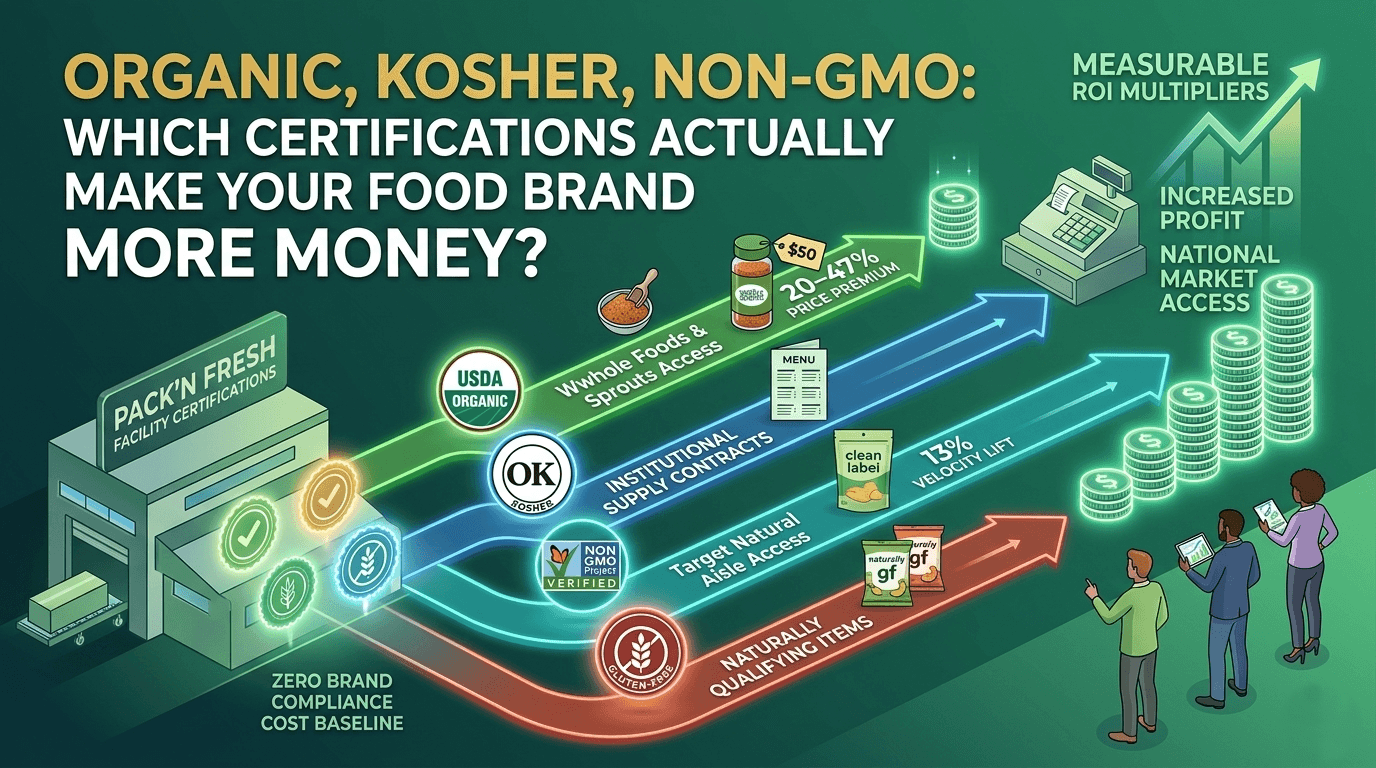
Organic, Kosher, Non-GMO: Which Certifications Actually Make Your Food Brand More Money?

food brand certifications ROI

Food Brand Certifications ROI: Organic, Kosher & Non-GMO — Which 5 Labels Actually Make You More Money?

You’ve probably heard it at every food industry trade show: “Get certified. Retailers demand it. Consumers pay a premium for it.” But which certifications actually deliver a measurable food brand certifications — and which ones are expensive compliance exercises with limited commercial upside?

The answer depends heavily on your product category, target retail channel, customer demographic, and stage of growth. Understanding food brand certifications ROI is not a one-size-fits-all exercise. A Kosher certification might be transformative for a spice brand targeting national grocery chains and institutional buyers — and entirely irrelevant for a DTC functional beverage startup targeting 25-year-olds on Instagram.

At Pack’n Fresh, our facility holds SQF, Organic, Kosher, Non-GMO, and Gluten-Free certifications. Over years of co-packing for brands across categories, we’ve observed firsthand which certifications deliver genuine ROI — and which ones simply add compliance overhead. This data-driven guide gives you the framework to make the right certification investment for your brand’s growth.


Table of Contents

  1. Why Food Brand Certifications ROI Is a Revenue Strategy, Not Just Compliance
  2. Organic Certification: The Premium Price Driver
  3. Kosher Certification: The Market Access Multiplier
  4. Non-GMO Project Verified: The Consumer Trust Signal
  5. Gluten-Free Certification: The Allergy-Safe Premium
  6. SQF Certification: The Retail and Institutional Gateway
  7. Head-to-Head Comparison: Which Certification Delivers the Best ROI?
  8. How to Sequence Your Certifications for Maximum ROI
  9. The Role of Your Co-Packer in Certification Strategy
  10. Conclusion
  11. FAQs

1. Why Food Brand Certifications ROI Is a Revenue Strategy — Not Just Compliance

Food brand certifications ROI operates on three commercial levels simultaneously. First, certifications are a retail access tool — many national grocery chains, club retailers, and institutional buyers require specific certifications before a product can even be considered for shelf space. Second, they are a pricing justification — certified products command measurable price premiums that more than offset certification costs at volume. Third, they are a consumer trust signal — in an era of ingredient label scrutiny and supply chain skepticism, third-party certifications provide the independent verification that drives purchase conversion.

The mistake most founders make is pursuing certifications reactively — applying for Organic after a retailer requests it, or adding Non-GMO after a competitor launch. The brands that extract the most ROI build certifications into their growth roadmap proactively, treating them as market access infrastructure rather than compliance checkboxes.

Before evaluating specific certifications, understand what certifications your co-packing partner already holds. As we detail in our guide on the 7 powerful reasons to choose a full-service packaging solution, a co-packer with the full certification stack dramatically lowers your cost and complexity of achieving food brand certifications ROI from day one.


2. Organic Certification: The Highest-ROI Food Brand Certification for Premium Channels

What It Is

USDA Organic certification verifies that a product’s ingredients were produced without synthetic pesticides, artificial fertilizers, GMOs, or irradiation. For processed food products, at least 95% of ingredients must be certified organic to carry the USDA Organic seal.

The Financial Case for Organic Food Brand Certifications ROI

Organic food sales in the United States reached $67.6 billion in 2023 (Organic Trade Association), growing at approximately 4.5% annually. More importantly for brand founders, organic-labeled products command an average price premium of 20–47% over conventional equivalents in the same category (USDA Economic Research Service, 2024).

For a spice blend retailing at $6.99 conventional, an organic equivalent can justify $9.99–$10.99 — a 43–57% price lift. At scale, this premium directly expands gross margin per unit, making Organic one of the most compelling food brand certifications ROI plays in the natural channel. Understanding how to manage ingredient cost increases through the hybrid sourcing model for balancing domestic and global costs is essential for maximizing Organic food brand certifications ROI.

Best Fit For

  • Spice, seasoning, and dry ingredient brands targeting Whole Foods, Sprouts, or natural grocery channels
  • Meal kit brands whose core customer segment is health-conscious, ages 28–45, household income $75K+
  • Supplement brands using plant-based active ingredients (adaptogenic mushrooms, herbal blends)
  • Private label brands for natural and specialty retailers

Cost Considerations

USDA Organic certification costs range from $700 to $2,500+ annually depending on your certifying agent and operation scale. The real cost driver is ingredient sourcing — organic raw materials typically cost 25–40% more than conventional equivalents. Your co-packer’s facility must also be Organic-certified for your finished product to qualify. Pack’n Fresh holds Organic facility certification, which means brands co-packing with us pursue Organic product-level food brand certifications ROI without needing to separately qualify a facility.

ROI Verdict: HIGHEST Food Brand Certifications ROI

The 20–47% price premium consistently outpaces certification and ingredient cost increases at meaningful volume, making Organic the top food brand certifications ROI play for natural channel and premium meal kit brands.


3. Kosher Certification: The Market Access Multiplier

What It Is

Kosher certification verifies that a product’s ingredients, production processes, and facility comply with Jewish dietary laws. The most recognized certifying bodies in the US include the Orthodox Union (OU), OK Kosher, Star-K, and KOF-K. The OU symbol is recognized globally and is one of the most trusted food seals in the world — and one of the most underrated drivers of  ROI.

The Commercial Case — Beyond the Jewish Market

Here is the insight most food founders miss: the primary commercial value of Kosher certification is not access to Jewish consumers. According to Mintel, only 15–20% of Kosher-certified product purchases are made by observant Jewish consumers. The remaining 80–85% are purchased by:

  • Muslims who use Kosher as a halal proxy
  • Vegetarians and vegans who rely on Kosher meat/dairy designations as an animal product indicator
  • Health-conscious consumers who associate Kosher with higher quality and stricter oversight
  • Institutional buyers (hospitals, airlines, government programs) that require Kosher certification for menu inclusion

Market Access Food Brand Certifications ROI

Kosher certification is a gateway to institutional and government food supply contracts — including military commissary, hospital systems, school nutrition programs, and airline catering. For brands pursuing these channels, Kosher certification is frequently a mandatory requirement, delivering substantial food brand certifications ROI well beyond what most founders anticipate. We cover this strategic opportunity in full in our post on emerging trends in government food packaging contracts.

ROI Verdict: Exceptional Food Brand Certifications ROI

Exceptional market access multiplier at relatively low certification cost — and one of the most commercially underappreciated certifications in the food industry.


4. Non-GMO Project Verified: The Consumer Trust Signal for Food Brand Certifications ROI

What It Is

The Non-GMO Project Verified seal is issued by the Non-GMO Project, a nonprofit organization that verifies products meet rigorous standards for GMO avoidance and control. As of 2024, it is the most recognized non-GMO certification in North America, with over 60,000 verified products and $13 billion in annual verified product sales.

The Financial Food Brand Certifications ROI Case

Non-GMO Project Verified products command an average price premium of 12–24% in natural and conventional grocery channels. More importantly, the seal functions as a powerful shelf conversion tool — Non-GMO Project data shows Verified products achieve 13% higher unit velocity (units sold per store per week) than non-verified equivalents in the same category.

The consumer demand signal supporting this food brand certifications ROI is clear: in a 2023 Consumer Reports survey, 72% of American consumers said they would prefer to buy non-GMO food when given the choice — making this one of the broadest purchasing preference signals in the food industry.

Best Fit For

  • Snack brands using corn, soy, canola, or sugar — the most commonly GMO crops — as ingredients
  • Brands targeting Whole Foods, Target’s Good & Gather, and conventional grocery’s natural aisle
  • Meal kit brands whose subscriber base skews health-conscious or “clean label” oriented
  • Supplement brands using plant-derived ingredients

ROI Verdict: HIGH Food Brand Certifications ROI

The 12–24% price premium and 13% velocity improvement deliver strong ROI for conventional and natural grocery brands. Less impactful for DTC-only brands whose customers already trust the brand narrative without third-party verification.


5. Gluten-Free Certification: The Allergy-Safe Premium

What It Is

Gluten-Free certification (GFCO, NSF Gluten-Free, or BRCGS Gluten-Free) verifies that a product contains less than 10–20 ppm of gluten and that the production facility has validated allergen control procedures preventing cross-contact. The allergen management rigor required for this certification is the operational backbone of Gluten-Free food brand certifications.

The Financial and Market Case

The global gluten-free food market reached $8.3 billion in 2024 and is projected to reach $14.8 billion by 2032 (Grand View Research). Critically, only approximately 1% of the US population has celiac disease — yet 26% of Americans actively seek to reduce or eliminate gluten (NPD Group, 2023). This “lifestyle gluten-free” segment is the primary driver of food brand certifications ROI for Gluten-Free certified products.

For brands whose products are naturally gluten-free (spice blends, nut mixes, grain-free snacks), achieving Gluten-Free certification at a certified facility requires minimal reformulation and delivers immediate retail access to this growing market — making it one of the fastest-path food brand certifications ROI options available.

ROI Verdict: HIGH Food Brand Certifications ROI for Qualifying Products

Highest food brand certifications ROI for naturally gluten-free products (spices, nut-based snacks, grain-free items). Medium ROI for products requiring significant facility investment or reformulation.


6. SQF Certification: The Retail and Institutional Gateway — Your Most Powerful Food Brand Certifications ROI Tool

What It Is

Safe Quality Food (SQF) certification is a GFSI-recognized food safety management standard that verifies a facility’s food safety systems, quality management practices, and product traceability. SQF is one of the most respected certifications in the global food industry and a foundational driver of food brand certifications ROI.

Why SQF Delivers the Best Food Brand Certifications ROI at Zero Cost to Your Brand

SQF is primarily a facility-level certification — your co-packer’s certification, not your product’s directly. However, its commercial impact on your brand’s food brand certifications ROI is enormous. National retailers including Walmart, Costco, Kroger, and Target increasingly require that co-manufacturing facilities hold GFSI-recognized certifications as a supplier qualification standard.

Co-packing at an SQF-certified facility like Pack’n Fresh means your brand inherits the credibility and retail access that comes with the certification — without bearing the direct cost of achieving or maintaining it yourself. This is one of the most underappreciated financial advantages of choosing the right food co-packer and the single highest-leverage food brand certifications ROI move available to most scaling brands.

ROI Verdict: HIGHEST Food Brand Certifications ROI (Zero Cost to Your Brand)

When achieved through your co-packer, SQF delivers the highest food brand certifications ROI of any certification — at zero direct cost to your brand while unlocking national retail, club, and institutional channel access. This should be a non-negotiable baseline requirement in your co-packer selection process.


7. Head-to-Head: Which Certification Delivers the Best Food Brand Certifications ROI?

Certification Annual Cost Price Premium / Benefit Food Brand Certifications ROI Rating Best For
Organic (USDA) $700–$2,500+ (+ ingredient cost) 20–47% price premium ⭐⭐⭐⭐⭐ Highest Natural channel, premium meal kits, supplements
Kosher (OU/OK/Star-K) $500–$10,000+ Institutional & multi-faith market access ⭐⭐⭐⭐⭐ Highest Govt/institutional buyers, spice brands, multi-faith markets
Non-GMO Verified $1,000–$5,000+ 12–24% premium + 13% velocity lift ⭐⭐⭐⭐ High Conventional grocery, clean-label snacks, meal kits
Gluten-Free $500–$3,000+ 8–15% premium for qualifying products ⭐⭐⭐⭐ High Spices, nut snacks, grain-free brands
SQF (via co-packer) Zero — borne by co-packer Retail & institutional access gateway ⭐⭐⭐⭐⭐ Highest ALL brands — non-negotiable baseline for food brand certifications ROI

8. How to Sequence Your Certifications for Maximum ROI

For a scaling food brand with a limited certification budget, here is the recommended sequencing logic to maximize ROI at each growth stage:

  • Step 1 — Pre-Launch: Choose an SQF-certified co-packer. This is your foundation for food brand certifications ROI. It costs you nothing but unlocks retail access that would otherwise require years of compliance work.
  • Step 2 — Launch to 12 Months: Prioritize the certification most aligned with your primary retail channel. Natural channel entry? Organic first. Institutional/government? Kosher first. Conventional grocery? Non-GMO first. Each delivers its own form of food brand certifications ROI.
  • Step 3 — 12 to 24 Months: Layer in Gluten-Free if your product is naturally qualifying — typically your lowest-effort, highest-velocity secondary food brand certifications ROI gain.
  • Step 4 — 24+ Months: Stack certifications for compound market access. An Organic + Kosher + Non-GMO + Gluten-Free stack creates a product that qualifies for virtually every US retail and institutional channel — a defensible competitive moat built on food brand certifications ROI.

9. The Role of Your Co-Packer in Maximizing ROI

Your co-packer’s facility certifications are the infrastructure that makes your brand’s  ROI possible — and affordable. A co-packer who holds Organic, Kosher, Non-GMO, and Gluten-Free facility certifications does not just simplify your compliance journey; they fundamentally lower your cost of certification by removing the facility qualification requirement from your application.

This is precisely why co-packer selection should include a detailed review of existing facility certifications as part of your analysis. Ask for current certificates with expiration dates. Ask about their certification renewal track record. And ask about their process for maintaining certification continuity during audits — because a lapsed facility certification can put your product certification at risk mid-cycle.

At Pack’n Fresh, we hold and actively maintain SQF, Organic, Kosher, Non-GMO, and Gluten-Free certifications. Our packaging solutions for small-batch food production are designed specifically to help early-stage brands access this certification advantage and start generating ROI without large-volume commitments.


10. Conclusion: Food Brand Certifications ROI Is a Revenue Investment, Not a Cost

ROI is not theoretical — it is measurable in price premiums, unit velocity, retail access unlocked, and customer trust conversion rates. The brands that treat ROI as a strategic growth tool, sequenced deliberately to match channel strategy and customer demographics, consistently outperform competitors who pursue certifications reactively or not at all.

The highest-leverage move most founders can make today is selecting a co-packing partner with the full certification stack already in place — and immediately beginning to benefit from food brand certifications ROI that would otherwise take years of solo compliance work to access. At Pack’n Fresh, our SQF, Organic, Kosher, Non-GMO, and Gluten-Free certifications are active and maintained, giving your brand immediate access to the markets and channels that drive real, measurable ROI.


FAQs — Food Brand Certifications ROI

Q. Which food certification delivers the highest food brand certifications ROI for small brands?

For most scaling food brands, SQF certification (through your co-packer) delivers the highest food brand certifications ROI at zero cost to your brand — unlocking national retail and institutional channel access. For product-level certifications, Organic typically delivers the highest price premium (20–47%), while Kosher provides the broadest market access multiplier across consumer and institutional segments.

Q. Is Organic certification worth the cost for a food startup?

Yes, for brands targeting natural or premium grocery channels. The 20–47% price premium on Organic-certified products delivers strong food brand certifications ROI that more than offsets annual certification costs at meaningful production volume. The key is working with an Organic-certified co-packer to minimize facility qualification complexity.

Q. Who actually buys Kosher-certified food products?

Approximately 80–85% of Kosher-certified product purchases are made by non-Jewish consumers, including Muslim consumers, vegetarians, vegans, and health-conscious shoppers — making Kosher one of the broadest food brand certifications ROI drivers for brands targeting diverse consumer markets and institutional buyers.

Q. Can my co-packer’s certifications improve my food brand certifications ROI?

Yes, significantly. A co-packer holding Organic, Kosher, Non-GMO, and Gluten-Free facility certifications removes the facility qualification barrier from your product certification applications, dramatically reducing cost and timeline — and delivering faster than pursuing certifications independently.

Q. In what order should a food brand pursue certifications for maximum ROI?

Recommended sequencing for maximum food brand certifications ROI: (1) Select an SQF-certified co-packer as your foundation; (2) Pursue the product certification most aligned with your primary retail channel at launch; (3) Add Gluten-Free within 12 months if naturally qualifying; (4) Stack additional certifications at 24+ months for compound market access and brand defensibility.

Q. Does Non-GMO certification increase retail sales?

Yes. Non-GMO Project Verified products achieve 13% higher unit velocity than non-verified equivalents, in addition to a 12–24% price premium — making it one of the most ROI-positive food brand certifications ROI plays for brands in conventional and natural grocery channels.

Ready to build your food brand certifications ROI on a fully certified foundation? Schedule a consultation with Pack’n Fresh — SQF, Organic, Kosher, Non-GMO, and Gluten-Free certified, all active and audit-ready.

How Bad Packaging Is Killing Your Meal Kit Subscription Retention Rate

meal kit subscription retention packaging solution

Meal Kit Subscription Retention: 5 Ways Your Packaging Is Silently Driving Churn

Your recipes are excellent. Your ingredients are fresh. Your branding is sharp. Yet month after month, your meal kit subscription retention rate keeps declining — and the cause may be sitting right in your customer’s recycling bin.

Poor packaging is one of the most silent, most damaging forces behind meal kit churn, and the majority of founders don’t see it until they’ve already lost hundreds of subscribers. According to McKinsey & Company, meal kit services face an average annual churn rate of 45–60%. While pricing and recipe fatigue are often blamed, a significant but underreported driver of poor meal kit subscription retention is the unboxing experience itself — specifically, how packaging performs on freshness, convenience, and perceived quality.

At Pack’n Fresh, we partner with meal kit brands at every stage of growth, and we’ve seen firsthand how a packaging overhaul directly translates into improved meal kit subscription retention. In this post, we break down exactly how packaging drives churn — and the 5 proven fixes that stop it.

Table of Contents

  1. The Real Reason Customers Cancel Meal Kit Subscriptions
  2. 5 Packaging Failures That Destroy Meal Kit Subscription Retention
  3. How Packaging Directly Affects Customer Lifetime Value (LTV)
  4. The Pack’n Fresh Retention-First Packaging Model
  5. Real-World Impact: What Better Packaging Looks Like
  6. How to Audit Your Packaging for Meal Kit Subscription Retention Risk
  7. Conclusion
  8. FAQs

1. The Real Reason Customers Cancel — And Why It Starts With Packaging

When a subscriber cancels, your cancellation survey might say “too expensive” or “not enough variety.” But dig deeper into behavioral data, and a different story emerges. Research from the Food Marketing Institute shows that 35% of food subscription cancellations are linked to a negative product experience — wilted greens, leaking sauces, clumped spice pouches, or a box that arrives looking like it survived a shipping war.

Your packaging is not just a box. It is the physical manifestation of your brand promise. Every time a customer opens a delivery, they are subconsciously asking: “Do I trust this brand with my family’s dinner?” A warm protein pack, a broken spice sachet, or damp cardboard answers that question with a hard no — and kills meal kit subscription retention on the spot.

This is why meal kit subscription retention must be viewed through a packaging lens — not just a marketing or pricing lens. The moment of unboxing is the single most critical quality touchpoint your brand owns. Understanding the true hidden costs behind your food business COGS — including packaging-related credits and returns — is the first step to fixing this.


2. 5 Packaging Failures That Destroy Meal Kit Subscription Retention

Failure #1: Inadequate Thermal Protection Breaks Subscriber Trust

If your temperature-sensitive proteins or dairy components arrive above safe holding temperatures (above 40°F / 4°C), you are not just risking a bad review — you are risking a food safety incident. A single spoiled delivery can permanently end a customer’s trust in your brand. According to Nielsen, one negative experience reaches an average of 9–15 people through word of mouth and social media — turning one packaging failure into a compounding meal kit subscription retention problem.

Failure #2: Non-Resealable or Difficult-to-Open Pouches Create Friction

Convenience is the entire value proposition of a meal kit. If a subscriber struggles to open a spice sachet, tears a pouch incorrectly and loses half the contents, or cannot reseal an ingredient bag for next-day use, they experience friction at the one moment your brand should be creating delight. Poorly designed pouches signal a lack of care — and subscribers notice. This friction is one of the most underrated drivers of poor meal kit subscription retention.

Failure #3: Low-Barrier Films Cause Premature Spoilage

Using generic, low-barrier packaging film for dry ingredients like spice blends, seasoning packets, or grain pouches accelerates oxidation and moisture ingress. The result: clumped powders, stale aromas, and off-flavors by the time the kit reaches the kitchen. This is why the science of modified atmosphere packaging for food shelf life is critical — a compromised seal destroys the entire freshness strategy your meal kit subscription retention model depends on.

Failure #4: Over-Packaging Triggers Sustainability-Driven Churn

Today’s subscriber is environmentally conscious. A box stuffed with excessive plastic, non-recyclable ice packs, and layers of foam inserts communicates environmental irresponsibility — a value mismatch that quietly erodes loyalty and destroys meal kit subscription retention among eco-aware demographics. In a 2023 IBM survey, 62% of consumers said they would change purchasing habits to reduce environmental impact. Over-packaging accelerates guilt-driven churn, particularly among subscribers aged 25–40.

Failure #5: Inconsistent Portioning Destroys Brand Trust

If a meal kit promises “2 servings” but packaging inconsistency means one delivery has noticeably more or less food than the last, subscribers lose trust in the brand’s precision. This is a co-packing and packaging operations issue, not just a recipe issue. Without precision portioning equipment and an ERP system to monitor fill weights, portion consistency becomes a manual — and therefore unreliable — process that silently erodes meal kit subscription retention. See how automated food kitting eliminates manual scaling problems killing your Q2 margins.


3. How Packaging Directly Affects Meal Kit Subscription Retention and LTV

Meal kit subscription retention is ultimately a financial equation. The cost of acquiring a new subscriber (CAC) in the meal kit industry averages $94–$145 per customer (Statista, 2024). If that customer churns after two deliveries because of a bad packaging experience, you have not only lost revenue — you have lost the entire CAC investment with zero return.

Consider this: a subscriber retained for 12 months at $60/week generates $3,120 in annual revenue. A subscriber who cancels after 6 weeks generates just $360. The LTV gap is nearly $2,760 — per customer. Multiply this across hundreds of churned subscribers per quarter, and poor packaging is quite literally destroying your company’s financial health and long-term meal kit subscription retention curve.

The inverse is equally powerful. Brands that invest in retention-focused packaging — proper thermal barriers, clean pouch formats, precise portioning — report 20–30% improvements in 6-month meal kit subscription retention rates. This translates directly to lower effective CAC, higher LTV, and a more predictable revenue model that investors and retail partners respond to with confidence.


4. The Pack’n Fresh Retention-First Packaging Model

At Pack’n Fresh, we design every packaging solution with one goal: making sure your customer’s unboxing experience earns their next order and supports long-term meal kit subscription retention. Our retention-first approach includes:

  • High-barrier film selection for spice pouches, protein powders, and seasoning blends — protecting against moisture, oxygen, and UV degradation throughout the entire last-mile journey
  • Precision fill-weight portioning using automated equipment calibrated to ±0.5g accuracy — so every “1 tbsp of seasoning” is exactly that, every single time
  • ERP-driven traceability that ensures lot-level consistency — if a film supplier changes spec, we catch it before it reaches your subscriber’s kitchen
  • Right-sized packaging design consultation — eliminating unnecessary void fill and over-packaging that drives sustainability-related churn
  • Reseal-friendly pouch formats that maintain freshness between meal prep sessions, adding perceived value that reinforces subscription renewal decisions

We also work closely with brands on their DTC food packaging solutions to ensure the outer shipping format protects every inner component across a 3–5 day transit window. Our on-the-go meal kit packaging optimization guide is a strong companion resource for the full design philosophy behind meal kit subscription retention-focused packaging.


5. Real-World Impact: What Packaging-Driven Meal Kit Subscription Retention Looks Like

Consider a meal kit brand scaling from 5,000 to 20,000 weekly subscribers. At 5,000 subscribers, informal quality checks and manual kitting may be sufficient. But as volume scales, manual processes introduce inconsistency — and meal kit subscription retention begins to suffer. When this brand transitions to Pack’n Fresh’s automated kitting line with precision portioning and high-barrier spice pouches, the results are measurable: complaint tickets related to “bad smell,” “leaking sachets,” or “warm proteins” drop significantly. Customer support costs decrease. And 6-month meal kit subscription retention metrics improve because the physical product consistently meets the promise made at the point of sale.

Better packaging doesn’t just prevent cancellations — it generates referrals. When subscribers consistently experience clean, precise, beautifully presented meal components, they share. That organic word-of-mouth reduces your effective CAC and compounds your meal kit subscription retention growth.


6. How to Audit Your Packaging for Meal Kit Subscription Retention Risk

Before your next delivery cycle, run this quick packaging audit specifically designed to identify meal kit subscription retention threats:

  • Temperature integrity: Are all cold components arriving below 40°F? Are you testing with thermochromic indicators or temperature loggers?
  • Seal integrity: Pull a random sample from each production run. Are all pouches sealed with zero micro-leaks? Even a 0.5% failure rate at 10,000 units/week = 50 bad deliveries per week.
  • Portioning accuracy: Weigh 20 random spice/ingredient pouches from each production run. Is variance within ±2g? If not, investigate your filling equipment calibration.
  • Recyclability audit: What percentage of your packaging components are curbside recyclable? If below 60%, you are at risk with sustainability-conscious subscribers.
  • Open-and-use friction test: Have someone unfamiliar with your kits open and use every pouch format cold. Count friction points — every single one is a meal kit subscription retention risk.
  • Supplier consistency check: Have your film or sachet specs changed in the last 90 days? Supplier changes without QA verification introduce invisible freshness risks.

If you identify two or more failure points in this audit, it is time to have a packaging operations review with your co-packing partner. Learn more about the 5 most common food packaging mistakes that brands make when scaling.


7. Conclusion: Packaging Is Your #1 Meal Kit Subscription Retention Strategy

Meal kit subscription retention is not solved by discounts, loyalty programs, or more recipe variety alone. The physical experience your packaging creates at the moment of unboxing is a foundational meal kit subscription retention driver — one that most brands dramatically underinvest in.

Every dollar invested in better barrier films, tighter portioning tolerances, and smarter thermal protection is a dollar invested in lower churn, higher LTV, and a more defensible brand. Packaging is not a cost center. It is your most consistent customer touchpoint — and it should be engineered specifically to protect meal kit subscription retention.

At Pack’n Fresh, we help scaling meal kit brands build packaging systems that protect product quality from our production line to your subscriber’s kitchen. We are an SQF-certified, ERP-integrated contract packaging facility — built specifically to help brands like yours scale without sacrificing the quality your subscribers subscribed for.


FAQs — Meal Kit Subscription Retention & Packaging

Q. How does packaging affect meal kit subscription retention?

Packaging directly impacts the unboxing experience — the primary quality touchpoint between your brand and subscribers. Poor thermal protection, leaking pouches, and inconsistent portioning destroy meal kit subscription retention by creating negative product experiences that erode customer trust and trigger cancellations.

Q. What is the average churn rate for meal kit companies?

According to McKinsey & Company, meal kit services face an average annual churn rate of 45–60%. A significant contributor to poor meal kit subscription retention is negative product experience at delivery, which is directly influenced by packaging quality and consistency.

Q. How can a co-packer help improve meal kit subscription retention?

A qualified co-packer like Pack’n Fresh offers precision portioning (±0.5g), high-barrier pouch films, ERP-based lot-level traceability, and automated kitting — all of which eliminate the inconsistencies that drive packaging-related cancellations and support stronger meal kit subscription retention over time.

Q. What packaging improvements most directly improve meal kit subscription retention?

The highest-impact improvements are: (1) upgrading to high-barrier film for spice and ingredient pouches, (2) implementing precision fill-weight automation, (3) right-sizing thermal packaging for your transit window, and (4) switching to resealable, frustration-free pouch formats. Together, these 4 changes are the most proven drivers of improved meal kit subscription retention.

Q. Is sustainable packaging important for meal kit subscription retention?

Yes. Over 62% of consumers actively consider environmental impact in purchasing decisions (IBM, 2023). Excessive or non-recyclable packaging is a measurable churn driver, especially among subscribers aged 25–40 — the core meal kit demographic — making eco-friendly packaging design a direct meal kit subscription retention investment.

Ready to turn packaging into your most powerful meal kit subscription retention tool? Schedule a free consultation with Pack’n Fresh — let’s build a packaging system your subscribers will renew for.

7 Essential Ways to Meet GFSI Food Safety Standards for Growth

Pack'n Fresh - GFSI Food Safety Standards

Audit-Ready 24/7: Preparing Your Supply Chain for GFSI Food Safety Standards

Adhering to GFSI food safety standards is now a 24/7 requirement for modern brands. As a Food Safety and Regulatory Compliance Officer, I often see companies navigate shifting thresholds while still viewing audits as an annual stress test. Today, food safety is a continuous, verifiable state of operations.

If you are scaling a meal kit or private label brand, your supply chain must be audit-ready. Achieving this level of continuous compliance requires moving beyond spreadsheets and partnering with an SQF-certified co-packer. Here are the 7 essential ways we maintain these rigorous standards:


1. Navigating the Regulatory Landscape (FSMA 204)

The demands of GFSI food safety standards are evolving. A major driver is the FDA’s FSMA Section 204, which mandates enhanced traceability. Without a fully integrated partner, meeting emerging trends in food packaging contracts is nearly impossible.

2. ERP System Implementation

To navigate this complex environment, an Enterprise Resource Planning (ERP) system is no longer a luxury. At Pack’n Fresh, our system tracks every single touchpoint. This is why it is important to choose a copacker with an ERP implemented; it eliminates the “blind spots” during production.

3. The “Surgical” Mock Recall

With a fully implemented ERP, we execute “surgical” recalls. We identify exactly which lot of raw ingredients went into which specific final pouch. This digital precision protects your brand from widespread market panic and the 5 common food packaging mistakes that lead to financial loss.

4. Universal Trust with National Retailers

Adhering to GFSI food safety standards provides a gold standard that builds immediate trust with retailers. For meal kit founders, this certification is the ‘passport’ required to enter premium markets, ensuring raw material intake to final kitting is scrutinized under a global framework.

The value of GFSI food safety standards extends beyond just passing an audit; it is a critical component of your brand’s financial health. When you align with these global benchmarks, you significantly reduce the ‘risk premium’ associated with scaling a food business. Insurance providers and investors often look for GFSI-recognized certifications as a sign of operational maturity. By maintaining these standards, you are essentially future-proofing your supply chain against the volatility of the modern market and ensuring that your growth is built on a foundation of verifiable data

5. Siloed Production Scheduling (Allergen Control)

To mitigate allergen and traceability risks, we implement strict operational controls. This includes running allergen-free products prior to allergen-containing products, all monitored meticulously by our ERP system.

6. Validated Sanitation SOPs

Strict adherence to GFSI food safety standards is central to our sanitation protocols. We utilize state-of-the-art equipment designed for deep sanitation, coupled with ATP swab testing to verify that every surface is biologically clean before production begins.

7. Digital Ingredient Locking & Expert Oversight

Our co-owners’ backgrounds in food science ensure that safety plans are strictly enforced. Furthermore, our Digital Ingredient Locking system automatically halts the production line if an incorrect raw material is scanned, preventing costly errors before they happen.

Maintaining a state of 24/7 readiness means that every shift, every batch, and every sanitation cycle must be performed as if an auditor is standing on the production floor. This level of discipline is what separates a world-class SQF-certified co-packer from a standard facility. By utilizing real-time monitoring and digital logs, we remove the ‘human error’ variable that often leads to compliance gaps. Ultimately, this proactive approach to GFSI food safety standards saves your brand time and money, allowing you to focus on innovation and market expansion while we handle the complexities of regulatory rigor


Summary: Secure Your Supply Chain Today

The transition to a digital-first compliance model is the most significant shift in modern manufacturing. By aligning your brand with GFSI food safety standards through a technology-enabled partner, you are building a resilient brand. This proactive approach allows you to focus on marketing while we handle the technical rigors of compliance.

Do not wait for a compliance deadline to upgrade. Partner with an expert who can help you get your food co-packing partner based on actual data and safety protocols.

Schedule a consultation with our quality control team to review your HACCP plan and align your operations with GFSI food safety standards today

7 Critical Benefits of Modified Atmosphere Packaging for Freshness

Pack'n Fresh - Modified Atmosphere Packaging

Beyond the Pouch: How Barrier Film Technology Extends Shelf-Life for Spring Produce

Modified atmosphere packaging is the definitive solution for meal kit founders and food brands as they transition into the spring season and face the recurring biological challenge of produce respiration. Fresh spring produce—from delicate pea shoots to crisp asparagus—remains biologically active after harvest. Without the right technical intervention, these ingredients can lose their nutritional value, texture, and flavor within days.

For the modern food brand, “packaging” can no longer be a passive envelope. It must be a high-performance atmospheric shield. Achieving true food shelf life extension requires a sophisticated marriage of material science and gas dynamics.

1. The Science of Barrier Films: Your First Line of Defense

At the heart of any high-quality food pouch is the barrier film. Unlike standard plastics, food-safe barrier films are engineered with multiple layers of specialized polymers (such as EVOH or Nylon) designed to control the migration of molecules.

Moisture and Oxygen Transmission Rates (MVTR & OTR): In food science, we measure the efficacy of a film by its transmission rates. If your film has a high Oxygen Transmission Rate (OTR), your ingredients will oxidize, leading to browning and “off” flavors. If the Moisture Vapor Transmission Rate (MVTR) is poorly calibrated, your ingredients may dehydrate or clump. By selecting the correct gauge, we create a micro-environment that effectively “slows down” the aging process—a core component of efficient packaging solutions design.


Why Modified Atmosphere Packaging (MAP) is a Growth Game-Changer

While the film acts as the shield, Modified Atmosphere Packaging (MAP) is the active strategy. MAP involves flushing the package with a precise mixture of gases—typically Nitrogen ($N_2$) and Carbon Dioxide ($CO_2$)—to displace Oxygen ($O_2$).

The “Spring” Challenge: Spring brings unpredictable logistics. A delivery truck might be 50°F in the morning and 80°F by the afternoon. According to the USDA Food Safety and Inspection Service, maintaining control during these temperature shifts is vital for safety.

MAP acts as a stabilizer during these transitions. By significantly reducing oxygen levels (common targets are $<1\%–2\%$), we inhibit the growth of aerobic spoilage organisms. This is essential for DTC food packaging solutions, where consumers expect a “farm-to-table” experience despite the product spending 48 hours in transit.

The role of modified atmosphere packaging extends beyond mere protection; it is about active preservation. By utilizing multi-layer films with specific OTR and MVTR ratings, we can manipulate the internal environment to match the biological needs of each ingredient. This precision ensures that even the most volatile organic compounds—those responsible for the ‘fresh’ scent of spring greens—remain trapped within the pouch until the consumer opens it.


2. Quality Control Standards at Pack’n Fresh

At Pack’n Fresh, we apply rigorous food science to every pouch. Our commitment to food packaging safety and regulatory standards is backed by a team with deep backgrounds in quality control.

  • Precision Gas Flushing: Utilizing our equipment portfolio to ensure every pouch receives the exact atmospheric mix required for its specific pH and moisture content.
  • Hermetic Seal Integrity: We use high-precision sealing bars to ensure zero “micro-leaks” that could compromise the modified atmosphere, a common issue highlighted in 5 common food packaging mistakes.
  • Shelf-Life Testing: We help brands understand how specific recipes react over time, offering consultation to maximize freshness. This is key to how smart and active packaging is changing the industry.

Summary: Future-Proof Your Freshness

Implementation of modified atmosphere packaging also allows for a wider geographical reach. Brands that were previously restricted to local shipping can now confidently ship across state lines, knowing their barrier film technology will maintain internal stability. This scalability is a primary reason why MAP has transitioned from a high-end luxury to a standard operational requirement for any serious food brand.

In the competitive meal kit landscape, the difference between a one-time buyer and a loyal subscriber is the state of the produce when the box is opened. Investing in advanced barrier technology isn’t just a safety measure—it’s a marketing strategy. Whether you are looking for packaging solutions for small-batch food production or national scaling, we provide the technical expertise to keep your products fresh.

Contact Pack’n Fresh today for a Technical Packaging Consultation.

5 Massive Benefits of Precision Micro-Dosing Packaging for Growth

Pack'n Fresh- Precision Micro-Dosing Packaging

Small Format, Big Impact: The Rise of Micro-Dosing in Functional Foods

The functional food market is shifting rapidly, making precision micro-dosing packaging the new standard for brands dealing with high-potency ingredients. Consumers are no longer just buying “food”—they are buying performance, focus, and recovery. From adaptogenic mushroom powders and nootropic coffee blends to high-potency probiotics, the active ingredients driving this industry are incredibly potent, highly sensitive, and remarkably expensive.

This shift has created a critical operational bottleneck for scaling brands: the technical challenge of precision dosing. When your product serving size is measured in fractional ounces rather than pounds, standard packaging solutions simply cannot keep up. This is where advanced micro-dosing packaging transitions from a luxury to an absolute necessity.

1. Why Precision Matters for High-Value Ingredients

When dealing with premium functional ingredients or high-end culinary blends, the margin for error is effectively zero. In the world of precision snack and spice pouch packaging and custom pouch packaging for supplements, weight variance is the enemy of profitability and compliance.

The Cost of Variance: If a co-packer overfills a 1 oz pouch of a rare functional mushroom extract by just 5%, you are bleeding top-line revenue with every unit shipped. Conversely, underfilling leads to regulatory non-compliance and destroyed consumer trust. At Pack’n Fresh, we specifically cater to companies that require packaging for smaller than 2 lb pouches of food ingredients. This specialized focus ensures every single dose is perfectly calibrated to meet FDA labeling requirements.

In the competitive landscape of this year, precision micro-dosing packaging acts as a safeguard against the rising costs of raw materials. When every gram of a specialized adaptogen or probiotic costs a premium, losing even a fraction to inefficient machinery can derail your quarterly projections. By investing in high-accuracy filling systems, brands can ensure that their ‘cost of goods sold’ remains stable even as production scales


Why Precision Micro-Dosing Packaging is Engineered for the Sub-2lb Market

A common and costly mistake made by scaling functional food brands is partnering with massive, legacy co-packers built to push tonnage. Their machinery is designed for 5 lb to 50 lb fills; when you attempt to run a 0.5 oz or 2 oz pouch on that equipment, the result is massive yield loss and poor seal integrity.

Many brands realize too late that choosing a food co-packer requires a strict vetting guide to ensure equipment compatibility. Our technical moat is built on an extensive equipment portfolio designed specifically for high-velocity, low-weight production.

Our turn-key packaging solutions provide:


2. Precision Engineered for the Sub-2lb Market

Whether you are producing bold high-protein snacks or concentrated wellness powders, the machinery must be fit-for-purpose. Pack’n Fresh has invested in state-of-the-art equipment that eliminates the “macro-facility” errors that plague the functional food industry. By focusing exclusively on the sub-2lb market, we protect your margins and your brand’s functional efficacy.

Summary: Future-Proof Your Functional Brand

Furthermore, the consumer experience relies heavily on the accuracy of these small-format doses. If a customer buys a functional coffee blend for focus, they expect the exact milligram count promised on the label. Precision micro-dosing packaging guarantees that potency, building long-term brand loyalty that macro-scale facilities simply cannot provide. This technical precision is what separates market leaders from those hitting the growth wall

Stop letting inaccurate fills and wasted ingredients eat into your functional food margins. Don’t force your high-value micro-doses onto machinery built for bulk commodities. Partner with a specialized expert that understands the ultimate guide to supplement co-packing.

Contact Pack’n Fresh today to request a sample run for your functional food brand.

7 Proven Benefits of the Hybrid Sourcing Model for Massive Growth

Hybrid Sourcing Model - Pack'n Fresh

The Hybrid Sourcing Model: Balancing Domestic Speed with Global Costs

In today’s volatile trade environment, the traditional “lowest-cost-at-all-costs” sourcing model has officially retired. For meal kit founders and food brand executives, the challenge is no longer just finding the cheapest ingredient—it is ensuring that the ingredient actually arrives at the production line on time, within spec, and without a surprise tariff invoice.

To survive the current economic climate, brands must transition to a hybrid food sourcing strategy. This model balances the cost efficiencies of global trade with the unmatched speed and security of domestic supply chains. At Pack’n Fresh, we provide the infrastructure to manage this balance, acting as a strategic procurement partner. Understanding what is food co-packing and how can it benefit your business is the first step in mastering this hybrid approach.

1. Navigating the 2026 Tariff-Focused Economy

The shift toward a more protectionist global trade environment has fundamentally altered the domestic vs. global food supply chain debate. According to U.S. Customs and Border Protection, trade remedies and duties can fluctuate significantly based on current policy, making long-term forecasting difficult for international-only brands.

For many brands, the perceived savings of overseas sourcing are being erased by:

  • Increased Duties: Surprise tariffs that can swing margins by 10–25% overnight.
  • Port Congestion: Administrative hurdles and customs inspections that add weeks to lead times.
  • Inventory Carrying Costs: The need to sit on six months of safety stock to hedge against shipping delays.

In this environment, local food sourcing wins in a tariff-focused economy. By shifting a portion of your raw material procurement to domestic partners, you gain “supply chain elasticity”—the ability to react to market trends without waiting for an ocean freighter. This elasticity is a core benefit for any brand adopting a hybrid sourcing model.


Pillar Strategy: Eliminating Vendor Finger-Pointing

One of the greatest “hidden costs” in the food industry is the fragmented supply chain. When a brand uses a broker for spices, a separate blender for dry mixes, and a third-party co-packer, they create a “responsibility gap.” When a quality issue arises, the result is inevitable: vendor finger-pointing.

Pack’n Fresh eliminates this friction through a turn-key blending and packing model. There are 7 full-service packaging solution powerful reasons to consolidate your supply chain, but the most important is control.

This integration provides:

  • Single-Point Accountability: We own the quality and the timeline from the raw seed to the sealed pouch.
  • Resource Management: We ensure ingredients meet strict food packaging safety and regulatory standards before they ever enter our equipment.
  • Simplified Logistics: No more paying for freight to move semi-finished goods between facilities.

2. Significantly Reducing Lead Times

In the meal kit industry, speed to market is a competitive advantage. By utilizing our turn-key solutions, brands can effectively reduce lead times in food production by 15% or more, which is a critical advantage of the hybrid sourcing model. This efficiency is driven by our efficient packaging solutions design and our specialization in snack and spice pouch packaging (under 2 lbs).

Summary: Future-Proof Your Procurement

The “Growth Wall” of 2026 is built from logistical delays and rising trade costs. To scale, you need a partner that doesn’t just pack bags, but understands the strategic math of procurement. This is why many brands are choosing a copacker with an ERP implemented to manage these complex data points.

At Pack’n Fresh, our co-owners’ backgrounds in food science and quality control ensure that your hybrid sourcing model is built on a foundation of safety and excellence. Stop managing a dozen vendors and start managing one result.

By choosing a partner that integrates these complex global and domestic variables, your brand can maintain a hybrid sourcing model that is both resilient and highly profitable. This strategic shift ensures long-term sustainability in an ever-changing international trade landscape

Consult with our sourcing experts at Pack’n Fresh today to audit your supply chain.

Automated Food Kitting: Why Manual Scaling Kills Your Q2 Margins

Pack'n Fresh - Automated Food Kitting

The “Growth Wall”: Why Manual Kitting cost is Killing Your Q2 Margins

Implementing automated food kitting is the most critical move for meal kit executives as they transition from Q1 to Q2—a ‘make or break’ period where operational cracks begin to show. While Q1 brings a surge of New Year health resolutions, by Q2, the limitations of manual labor often hit a ‘Growth Wall’ that can kill your margins.. Q1 often brings a surge of New Year health resolutions and customer acquisitions, but by Q2, the operational cracks begin to show.

If your team is still hand-scooping spices, manually counting sachets, and assembling kits on stainless steel tables, you have likely hit the “Growth Wall.” This is the point where increasing your order volume no longer increases your profit—it only increases your overhead. To keep scaling a meal kit brand, you must move past the limitations of manual labor and embrace automated food kitting.

1. The Hidden Costs of Manual Labor: A Drain on Q2 Margins

When you are small, manual kitting feels like “sweat equity.” But as you scale, the math changes. DIY food packaging hidden costs are not just the hourly wage of your staff; they include a waterfall of inefficiencies that erode your bottom line. This erosion is exactly what automated food kitting prevents by stabilizing production costs.

  • The Variance Trap: Manual portioning is inherently inconsistent. If a staff member overfills a 50g spice pouch by just 3 grams, you are “giving away” 30kg of high-value product every month. Automated systems, like the ones in Pack’n Fresh’s extensive equipment portfolio for snack and spice pouch packaging, ensure precision to the milligram, which is the primary financial advantage of switching to automated food kitting.
  • The Human Error Factor: In the meal kit world, a missing ingredient isn’t just a minor inconvenience—it’s a failed dinner. According to industry research from the Association for Packaging and Processing Technologies, automation significantly reduces the “human error” variable. High churn rates are often fueled by 5 common food packaging mistakes.
  • The Management Overhead: Managing a team of manual packers requires supervisors, HR, and training. This “hidden” overhead often stays off the food business COGS calculation spreadsheet but eats your Q2 profits from the inside out. Shifting these resources toward automated food kitting allows your team to focus on brand growth instead of labor management.

The Pack’n Fresh “Turn-Key” Advantage

The solution to the Growth Wall isn’t just buying a machine; it’s finding a turn-key manufacturing partner. Fragmented supply chains create “traceability gaps” and massive logistics costs. At Pack’n Fresh, we offer a unified solution that keeps your production under one roof:

  • Sourcing & Blending: We leverage our industry expertise to source high-quality ingredients and blend them to your exact specifications.
  • Precision Pouching: Specialization in smaller than 2 lb pouches ensures secondary ingredients (sauces, grains, spices) are packed with retail-grade precision.
  • Automated Kitting: Our automated food kitting lines assemble final kits faster, cleaner, and more accurate than any manual team.

By consolidating these steps, you simplify your food packaging safety and regulatory compliance, which is critical under current FDA FSMA guidelines.


2. Scaling for Q2: From Variable Costs to Fixed Margins

As a B2B supply chain consultant, my advice to meal kit executives is simple: Stop managing people and start managing your brand. When you move to a food co-packing model, your kitting costs shift from a fluctuating variable (labor) to a predictable fixed price per unit.

This is why it is vital to choose a copacker with an ERP implemented for scalability; it allows you to forecast spend with 100% confidence. Whether you are launching a high-protein snack line or scaling a national dinner kit, automated packaging is the only way to climb over the Growth Wall.

Summary: Audit Your Production with Pack’n Fresh

Are your manual processes quietly killing your margins? Don’t wait for a high-churn month to find out. Pack’n Fresh offers specialized consultations to help you identify inefficiencies in your current kitting workflow. Let our team of food science and quality control experts help you transition to a scalable future powered by automated food kitting.

Contact Pack’n Fresh today for a Turn-Key Production Audit.

Allergen Management in Food Packaging: Mitigating Traceability Risks

Pack'n Fresh - Allergen management in food packaging

Allergen Management in Food Packaging & Traceability: The Silent Risk in Contract Packaging

In the modern food industry, a single misstep in allergen management in food packaging is not just a logistical error—it is a catastrophic business event. For emerging meal-kit and supplement brands, the transition to contract packaging is often driven by a need for scale. However, without rigorous oversight, this transition can lead to the “silent risk” of undeclared allergens, which remains the leading cause of safety-related market withdrawals.

1. The Terrifying Reality: The True Cost of a Recall

An undeclared allergen is the leading cause of food recalls globally. According to the FDA Recall Database, labeling errors and cross-contact account for nearly 40% of all food-related enforcement actions.

For a growing brand, a recall is more than a line item for food recall insurance; it is a potential bankruptcy event. Beyond the immediate costs of retrieving and destroying product, the long-term damage to brand equity and consumer trust is often irreparable. When you outsource to a partner like Pack’n Fresh, you are investing in a GFSI food safety committed team capable of preventing these high-stakes failures.

2. The ‘Invisible’ Risk: Cross-Contamination Prevention

The most significant threat to food safety often lies in the machinery itself. In lower-tier facilities, an extensive equipment portfolio can be a double-edged sword if sanitation protocols are not world-class. Cross-contamination prevention becomes exponentially more complex when the same machinery used for a peanut-based satay sauce is used an hour later for a “nut-free” spice blend.

Pack’n Fresh mitigates this “invisible” risk through:

  • Sanitary Design: State-of-the-art equipment designed for complete teardown and validated sanitation.
  • Small Format Control: Specialization in small-format pouching (under 2 lbs), which allows for tighter environmental swabbing and ingredient isolation.
  • Safe Recipe Consultation: Our experts help clients develop recipes with allergen management in food packaging and ingredient segregation in mind.

Pillar Strategy: The Turnkey Safety Net

Fragmented supply chains are where food safety traceability goes to die. If your ingredients come from one vendor, your blending happens at another, and your kitting at a third, your risk of an allergen “blind spot” triples.

At Pack’n Fresh, our Full-Service Packaging Solution eliminates these gaps. By utilizing a turn-key model, we maintain total chain-of-custody. From the moment a raw allergen enters our dock to the moment the final kit is sealed, it is tracked under one roof. This integrated approach is why we are considered a premier SQF certified co-packer for high-risk categories.

3. The ERP Difference: Digital Food Safety Traceability

In a crisis, speed is the only metric that matters. This is where an ERP-implemented co-packer provides an untouchable advantage. If a supplier notifies you of a contaminated raw ingredient, can you identify every affected finished pouch in 30 minutes?

Digital food safety traceability ensures:

  • Automated Tracking: Every ingredient is scanned and married to a specific lot code during blending and packing.
  • Precision Mock Recalls: As an SQF certified co-packer, we perform “one-up, one-back” traceability in minutes, meeting and exceeding GFSI standards.
  • Regulatory Readiness: Digital records provide immediate proof of compliance during surprise FSMA 204 traceability audits.

2026 Technical Sidebar: The Science of Changeovers

In 2026, allergen management in food packaging requires more than just soap and water. High-growth brands should demand ATP bioluminescence testing and lateral flow allergen-specific swabs after every changeover. These GFSI food safety protocols provide scientific “Proof of Clean” before the next production run begins, ensuring that cross-contamination prevention is a data-driven reality, not a guess.

4. Vetting Your Partner: The Technical Checklist

Before signing a contract, use this contract packaging checklist to audit your partner’s allergen management in food packaging:

  • Do you perform allergen-specific lateral flow tests after a changeover?
  • Is your lot-level food safety traceability managed through a digital ERP?
  • How do you prevent airborne cross-contamination in the blending areas?
  • Can you provide your last SQF audit score and allergen control plan?

Summary: Quality is Not Negotiable

In the world of food manufacturing, what you don’t see can hurt you. Pack’n Fresh positions itself as a reliable partner because we prioritize our co-owners’ backgrounds in food science. By offering turn-key food co-packing, we shield your brand from the silent risks of the industry.

Protect your brand—Audit your allergen safety with Pack’n Fresh.