
Category

Procurement Manager

Co-Packer Audit Checklist: 7 Proven Steps to Prepare Your Facility for Any Food Safety Inspection

co-packer audit checklist

Co-Packer Audit Checklist: 7 Proven Steps to Prepare Your Facility for Any Food Safety Inspection

The food safety audit landscape has fundamentally changed over the past decade. SQF, GFSI, FDA, and retailer-mandated audits have raised the bar to a level where a facility that would have passed a third-party certification review ten years ago routinely fails today. Documentation requirements are more granular, verification testing is now expected rather than optional, and auditors are trained to look beyond the binder on the shelf and examine whether systems are actually functioning on the production floor.

For food brands evaluating co-packers, and for co-packers preparing for third-party audits, the preparation gap — the distance between what a facility does and what it can prove it does — is the most common cause of audit failures. This co-packer audit checklist gives you the framework for closing that gap — and keeping it closed every production day, not just before an auditor arrives.

The stakes are real. A failed audit can trigger consequences that cascade far beyond the facility itself: losing a retail buyer relationship that took years to build, triggering a voluntary recall, or facing FDA corrective action demands — all of which cost substantially more, in both dollars and brand equity, than the investment in proper year-round preparation.

For brands that co-pack their products, a co-packer’s failed audit is their supply chain disruption. Production halts, shipments stop, and retailer shelves go empty — regardless of whether the failure originated in the brand’s operations or their co-packing partner’s facility. For brands evaluating co-packing partners, a structured co-packer audit checklist is the most reliable tool for verifying that a prospective partner’s food safety systems will protect your supply chain rather than disrupt it.

At Pack’n Fresh, we maintain continuous SQF certification, and our co-owners bring food science and quality assurance expertise to every aspect of our operations. Audit readiness is not something we activate before an auditor calls — it is how we operate every production day.

The result is a facility that performs every item on the co-packer audit checklist not on a pre-inspection schedule but as standard daily operating procedure. This guide gives you the complete co-packer audit checklist — the 7-step framework we and other leading co-packers use to stay audit-ready year-round, not just when an auditor calls. Whether you are a food brand evaluating a new co-packing partner or a co-packer preparing for your next certification audit, this checklist covers what auditors actually look for and where most facilities fall short.


Table of Contents

  1. Why Co-Packer Audits Are More Rigorous Than Ever — And What’s at Stake
  2. Understanding SQF, GFSI, BRCGS, and FSSC 22000: What Each Auditor Looks For
  3. The 7-Step Co-Packer Audit Checklist
  4. The Most Common Reasons Co-Packers Fail Food Safety Audits
  5. How to Conduct a Pre-Audit Internal Review
  6. What Happens After a Non-Conformance: Corrective Action Plans
  7. How Pack’n Fresh Maintains Audit-Ready Operations Year-Round
  8. FAQs — Co-Packer Audit Checklist

1. Why Co-Packer Audits Are More Rigorous Than Ever — And What’s at Stake

Third-party food safety certification has moved from a competitive differentiator to table stakes for co-packers serving retail, e-commerce, institutional, and food service buyers. A decade ago, many buyers would accept a co-packer’s internal quality program or a basic GMP audit. Today, the standard has shifted dramatically: major retailers and food service operators routinely require co-packers to hold a current, active certificate from a GFSI-recognized scheme — SQF, BRCGS, or FSSC 22000 — as a non-negotiable condition of vendor approval.

Without that certificate, a co-packer cannot be listed as an approved supplier regardless of how good their facility or their product actually is. Applying a co-packer audit checklist to verify current certification status before signing any production agreement is the most direct protection against this supply chain risk.

The audit cadence itself has become more demanding. GFSI-recognized schemes require annual full audits, and many schemes now include unannounced verification visits — auditors who arrive without advance notice to verify that what they saw during the scheduled audit is what actually happens every day. This shift toward unannounced verification is specifically designed to identify facilities that perform well under scheduled audit conditions but do not maintain those standards continuously.

A facility that passes a scheduled audit by doing intensive preparation in the two weeks beforehand, then relaxes its documentation and verification practices afterward, is increasingly likely to be caught in an unannounced visit. A genuine co-packer audit checklist is what distinguishes facilities that are continuously compliant from those that perform compliance only when an auditor is watching.

Layered on top of third-party certification requirements is FDA FSMA, which has added regulatory audit risk that operates independently of whether a facility holds a GFSI certificate. Under FSMA, FDA can inspect co-packing facilities on a risk-based schedule — and a facility that is not maintaining HACCP documentation, lot-level traceability, and supplier verification records consistent with FSMA requirements can face FDA warning letters, import alerts, or mandatory corrective action even if its SQF certificate is current.

For food brands evaluating co-packing partners, the critical insight is this: a co-packer’s failed audit doesn’t just affect that co-packer. Every brand whose products are made in that facility absorbs the downstream impact — supply disruption, potential recall, and in some cases loss of channel access while corrective actions are resolved. A rigorous co-packer audit checklist applied during partner evaluation directly reduces this downstream exposure before a production relationship is ever established.


2. Understanding SQF, GFSI, BRCGS, and FSSC 22000: What Each Auditor Looks For

For food brands selecting a co-packing partner and for co-packers choosing which certification scheme to pursue, understanding the differences between the major GFSI-recognized schemes matters — but so does understanding what they have in common. SQF, BRCGS, and FSSC 22000 all audit the same fundamental food safety systems: HACCP, allergen control, traceability, sanitation, personnel training, and mock recall capability.

The differences lie primarily in the structure of the audit, the documentation requirements at each level, and the regional prevalence of each scheme. All three evaluate the same seven system areas covered in the co-packer audit checklist below — which is why strong performance in one scheme transfers directly to readiness in the others.

SQF (Safe Quality Food) is the most widely recognized GFSI scheme in North America and is the scheme Pack’n Fresh is certified under. The SQF certification standard operates on a leveled system: SQF Level 2 is the standard for food manufacturers and co-packers, covering both food safety fundamentals and a quality management system. SQF Level 3 adds advanced quality systems requirements.

Most US retail buyers, particularly in the grocery and natural food channels, recognize and accept SQF certification as evidence of robust food safety management. SQF audits are conducted by licensed SQF auditors through approved certification bodies, and the resulting certificate is posted in the SQFI database — any buyer can verify a facility’s current certification status in real time. Verifying this status is item one of any co-packer audit checklist for brand due diligence — it takes under two minutes and tells you more than any co-packer’s marketing materials ever will.

BRCGS (British Retail Consortium Global Standards) is more prevalent in European supply chains and UK-connected retail buyers, though it is recognized by most US major retailers as well. FSSC 22000 integrates ISO 22000 with sector-specific prerequisite program (PRP) requirements and appeals particularly to manufacturers already operating within ISO management system frameworks. All three schemes are recognized under the GFSI umbrella, which means meeting the requirements of one scheme generally satisfies the buyer requirements for all of them.

For food brands evaluating co-packers, the most important question is not which scheme a co-packer uses, but whether their certification is current, at what level, and whether any non-conformances from the most recent audit remain open. A current certificate with zero open major non-conformances is what responsible brand managers ask to see before signing a co-packing agreement. You can learn more about GFSI food safety standards and how they apply to co-packing relationships in our dedicated guide.


3. The 7-Step Co-Packer Audit Checklist

This co-packer audit checklist reflects what GFSI-recognized auditors consistently evaluate across SQF, BRCGS, and FSSC 22000 certification reviews. Each step corresponds to a system that auditors will review through document review, records inspection, and physical facility walkthrough.

Facilities that fail audits almost always fail because one or more of these systems has a documentation gap, a verification gap, or an implementation gap — meaning the policy exists on paper but is not being followed on the production floor. Each of the seven steps in this co-packer audit checklist corresponds to one of these systems — following it systematically identifies every type of gap before an external auditor does.

Step 1 — HACCP Plan: Documentation, Validation, and Verification Records

The Hazard Analysis and Critical Control Points (HACCP) plan is the foundational document of any food safety management system, and it is always the first thing an auditor reviews. A compliant HACCP plan must identify all biological, chemical, and physical hazards associated with every product category manufactured at the facility; define each Critical Control Point (CCP) with specific, measurable critical limits; document monitoring procedures for each CCP including who monitors, how, and at what frequency; specify corrective actions for any CCP deviation; and define verification activities that confirm the overall HACCP system is working as intended. The FDA HACCP principles and application guidelines provide the regulatory framework that underpins what auditors expect to see.

What auditors specifically check extends well beyond whether the HACCP plan document exists. They verify whether the plan is dated and version-controlled — an undated HACCP plan or one that lacks a revision history raises immediate questions about whether it has been maintained. They check whether the plan was reviewed within the last 12 months and whether that review is documented with a signature and date.

They pull CCP monitoring records and verify that monitoring was actually performed at the required frequency, that the results are recorded in real time (not filled in at the end of the day), and that any CCP deviation triggered the required corrective action record. Perhaps most commonly, auditors find HACCP plans that are technically compliant on paper but are supported by monitoring records that are incomplete, have unexplained gaps, or have corrective action records that are missing for periods when monitoring data shows a deviation occurred.

The most common HACCP failure pattern is what auditors describe as a “plan-practice gap”: the written HACCP plan is detailed and well-structured, but the daily monitoring records are inconsistent, incomplete, or clearly filled in retrospectively rather than at the time of monitoring. Closing this gap requires not just having a good HACCP plan but building the record-keeping discipline into daily production workflow so that CCP monitoring records are generated in real time as a natural byproduct of production — not as a documentation exercise performed separately. HACCP documentation discipline is item one on this co-packer audit checklist and the area auditors examine first — the system most frequently found to have a plan-practice gap.

Step 2 — Allergen Control: Segregation, Scheduling, and Verification

Allergen control is among the most heavily scrutinized areas in any food safety audit and among the highest-consequence failure categories. An allergen cross-contact event — the unintended presence of an allergenic ingredient in a product that does not declare it — can trigger a Class I recall, which the FDA considers the most serious category, involving products where there is a reasonable probability that consumption will cause serious adverse health consequences or death for sensitized individuals. Auditors approach allergen control with this consequence in mind, and they look hard for gaps.

A compliant allergen control program requires several interconnected elements. First, a written allergen control policy that identifies all allergenic ingredients handled in the facility (from the FDA’s list of major food allergens, now expanded to nine). Second, a documented allergen risk assessment for every raw material received — identifying whether each ingredient contains or may contain an allergen due to shared supplier equipment or supply chain cross-contact. Third, physical segregation of allergenic ingredients in storage — clearly labeled, physically separated from non-allergenic ingredients, stored in sealed containers that prevent cross-contact during receiving and storage.

Fourth, production scheduling controls that ensure allergen-containing and allergen-free products do not share production windows without a complete, documented cleaning cycle between them. At Pack’n Fresh, siloed production scheduling is standard practice — allergen-containing product lines and allergen-free product lines are scheduled in dedicated blocks with verified cleaning separation, never interleaved in a way that creates cross-contact risk.

Fifth and critically: post-cleaning allergen verification. Auditors increasingly expect to see not just cleaning records but verification results — ATP swab test results and, where the risk assessment warrants it, ELISA allergen swab results confirming that the cleaning cycle successfully removed allergenic residues before the next production run begins. A cleaning record signed by a team member is evidence that cleaning was performed; a passing ATP or ELISA result is evidence that it was effective. The distinction matters to auditors — and to the brands whose allergen-free products are produced on shared equipment. Our dedicated guide on allergen management in food packaging covers these requirements in depth. Allergen control is the highest-consequence item on the co-packer audit checklist — and the gap between cleaning records and verified ATP/ELISA results is where auditors and brands should look hardest.

Step 3 — Traceability: Lot-Level Documentation from Receiving to Finished Product

Every GFSI-recognized certification scheme requires full, bidirectional lot-level traceability — the documented ability to identify the origin of any ingredient used in a finished product (backward traceability) and the destination of any finished product that contained a given ingredient lot (forward traceability). SQF requires that a facility can complete a full mock recall trace within four hours. For a facility producing multiple SKUs using shared ingredient lots across multiple production runs, meeting a four-hour traceability window with manual, spreadsheet-based records is extremely difficult — and auditors who have seen facilities fail mock recalls understand exactly why.

The regulatory traceability requirements have also expanded significantly with FDA’s FSMA 204 rule. The FSMA 204 traceability requirements apply to foods on the FDA’s Food Traceability List and require Key Data Elements (KDEs) to be recorded at each Critical Tracking Event (CTE) — from receiving through transformation (processing/packaging) through shipping. For co-packers handling foods on the FTL, this means the traceability documentation requirements are now defined in federal regulation, not just certification scheme guidelines.

What auditors check in the traceability system is highly specific: Is there a unique lot code on every incoming ingredient receiving record, tied to the supplier’s lot number and the date of receipt? Are production records complete — linking the specific ingredient lot codes used to the finished product lot code produced, with quantities and production date? Can the facility demonstrate a complete trace of a finished product lot back to every ingredient lot it contained, and forward from an ingredient lot to every finished product lot that used it, within the required time window?

Facilities that rely on a co-packer with ERP-backed traceability — where ingredient receiving, production, and shipping records are linked in a single system — can consistently meet four-hour traceability requirements. Facilities relying on disconnected paper records or spreadsheets routinely cannot. Traceability is step three of this co-packer audit checklist, and ERP-backed systems that link ingredient receipt to finished product dispatch in real time are the only infrastructure that consistently meets the four-hour SQF mock recall requirement.

Step 4 — Sanitation: SOPs, Frequency Records, and ATP Verification

Sanitation verification is the area where many otherwise well-prepared facilities fail — not because they do not clean their equipment and facility, but because they cannot demonstrate with quantifiable evidence that they cleaned effectively. The distinction between cleaning (the activity) and sanitation verification (the proof that cleaning achieved its intended result) is one that auditors draw carefully, and facilities that provide only the former routinely receive non-conformances.

A compliant sanitation program requires a Master Sanitation Schedule (MSS) that specifies every surface, piece of equipment, and facility area that must be cleaned, the cleaning frequency for each, the cleaning method and chemistry, and the responsibility assignment for each task. The MSS must be current — listing equipment that is actually in use — and the associated sanitation completion records must demonstrate that the schedule is being followed: dated, signed, and specific to the equipment cleaned.

Auditors pull a sample of the last several months of sanitation records and look for consistency — a schedule that shows perfect compliance every day for six months with no missed or delayed cleanings raises questions just as one with obvious gaps does.

Beyond completion records, auditors increasingly expect to see environmental monitoring results. ATP (adenosine triphosphate) swab testing provides a rapid, quantifiable measure of organic residue on a surface — a proxy for sanitation effectiveness that requires no lab and produces a result in seconds. A facility that conducts ATP swab testing after every cleaning cycle, documents the results by surface and date, has established acceptable RLU (relative light unit) thresholds, and maintains corrective action records for any out-of-spec result is demonstrating sanitation verification at the level most GFSI auditors are looking for.

At Pack’n Fresh, ATP swab testing after every cleaning cycle is standard practice — not a pre-audit preparation measure. For allergen-sensitive production lines, we supplement ATP verification with allergen swab testing at the frequency our allergen risk assessment specifies. Sanitation verification with documented ATP results is step four of the co-packer audit checklist — and the difference between facilities that can prove their cleaning worked and those that can only prove they cleaned.

Step 5 — Incoming Ingredient Inspection and Supplier Approval Program

Ingredient quality and safety begins before raw materials enter the production floor — at the receiving dock, where every incoming ingredient should be inspected against an approved specification before it is accepted into inventory. Auditors evaluate both the receiving inspection process and the upstream Supplier Approval Program that determines which suppliers are authorized to supply ingredients in the first place.

A compliant receiving inspection process requires that each incoming ingredient delivery is checked against a documented specification: weight verification, visual inspection for packaging integrity and absence of damage or contamination, temperature confirmation for any refrigerated or frozen materials, and Certificate of Analysis (COA) review against established acceptance criteria before the lot is approved for use in production. Receiving records must capture all of this: the date of receipt, the supplier, the supplier’s lot number, the quantity received, the inspection results, and the acceptance or rejection decision with the inspector’s signature.

An accepted lot that was not inspected or whose receiving record is incomplete is a gap that auditors will flag as a major non-conformance.

The Supplier Approval Program sits behind the receiving process and is equally important. Auditors expect to see a documented roster of approved suppliers for every ingredient used in production, along with the criteria used to qualify suppliers — whether through a supplier questionnaire, a supplier audit, third-party certification review, or some combination. The program should include a periodic supplier performance review process, documentation of how new suppliers are evaluated and approved before their ingredients are used in production, and a process for addressing supplier-related quality issues.

A facility that sources from unapproved or unqualified suppliers — even occasionally — is creating a supply chain risk that auditors treat as a significant system weakness, not just a paperwork gap. The Supplier Approval Program is step five of this co-packer audit checklist — it controls supply chain risk before it can reach the production floor.

Step 6 — Personnel Training Records and Food Handler Certification

All food handlers and production personnel must have documented food safety training — and the documentation requirement is not flexible. Auditors consistently apply the principle that undocumented training is treated as no training, regardless of how experienced or well-trained a facility’s workforce actually is. A facility with veteran production staff who deeply understand allergen control, GMP rules, and temperature management but whose training records are incomplete or missing will receive the same non-conformance as a facility with genuinely untrained personnel.

At a minimum, every food handler must have documented training covering: a basic food handler certification (state-issued food handler card or equivalent); facility-specific training on the allergen control program, including the allergen risk of the products produced and the employee’s role in preventing cross-contact; personal hygiene requirements, including handwashing procedures, illness reporting protocols, and prohibited items on the production floor; Good Manufacturing Practice (GMP) rules specific to the facility; and emergency contact and reporting procedures.

Auditors will ask to see training records by employee name — the ability to pull a training file for any individual on the production floor and show their complete training history, with dates and signatures, is what a compliant training program looks like.

Two specific training documentation gaps auditors find frequently: new employees who begin food handling work before their initial training is completed and documented, and temporary or seasonal workers whose training records either never existed or were not retained after their assignment ended. Both represent the same underlying system failure — training completion was not built into the pre-production authorization process as a hard requirement.

The fix is straightforward: no employee, full-time or temporary, handles food before their training checklist is completed and signed, and training records are retained for the duration required by the applicable certification scheme, typically a minimum of 12 months post-employment. Personnel training documentation is step six of the co-packer audit checklist — and one of the most consistently flagged areas in facilities with genuine training programs that simply failed to maintain the paper trail.

Step 7 — Mock Recall Readiness: Speed, Accuracy, and Corrective Action

The mock recall is the acid test of the traceability system — and it is the one exercise that most clearly reveals whether a facility’s food safety documentation functions as an integrated system or as a collection of disconnected records. SQF requires documented mock recalls to be conducted at least annually, and auditors review mock recall records as part of every certification audit.

Increasingly, leading co-packers conduct mock recalls on a semi-annual or quarterly basis, recognizing that a once-per-year exercise is insufficient to keep the recall response muscle sharp and to identify traceability gaps before an actual recall event forces them to surface.

A compliant mock recall must test both directions of traceability. A forward trace starts with a specific incoming ingredient lot code and requires the facility to identify every finished product lot that contained that ingredient and every customer who received those finished product lots — the scenario that mirrors an actual ingredient recall notification from a supplier. A backward trace starts with a finished product lot code and requires the facility to identify every ingredient lot that went into that product — the scenario that mirrors an actual customer complaint or FDA inquiry about a specific production lot. Both directions should be tested, documented, and timed.

Auditors reviewing mock recall records evaluate four things: Did the mock recall test the right scenarios (both forward and backward traceability)? Was it completed within the required time window (four hours under SQF)? Was the result accurate — did the facility identify all affected lots, with no product unaccounted for? And were any gaps or failures identified during the mock recall addressed through documented corrective actions?

A mock recall that completes within four hours with a 100% accuracy rate and no corrective actions needed is strong evidence of a functioning traceability system. A mock recall that took six hours, missed two finished product lots, and has no corrective action record is strong evidence that the traceability system needs significant remediation — which is exactly why finding this in an internal mock recall, rather than in a real recall event, is the point of the exercise. This complete co-packer audit checklist is designed to surface those gaps before an auditor or a real event does.


Evaluating a co-packer for your next product launch? Request a quote from Pack’n Fresh — SQF-certified, audit-ready, and built to protect your brand.

4. The Most Common Reasons Co-Packers Fail Food Safety Audits

After years of operating under continuous SQF certification and watching the food safety audit landscape evolve, the patterns behind audit failures are consistent and largely preventable. Facilities that fail GFSI audits rarely fail because they lack food safety knowledge or because their production environment is genuinely unsafe. They fail because one or more critical systems has a documentation gap, a verification gap, or a gap between written policy and actual practice — and those gaps are exposed under the systematic scrutiny of a trained third-party auditor.

The most frequently cited reasons for audit non-conformances, across SQF, BRCGS, and similar schemes, fall into recognizable categories. Incomplete HACCP monitoring records — CCP monitoring forms with unexplained blank periods, corrective action fields left empty when monitoring data shows a deviation, or records that appear to have been completed retrospectively rather than in real time. Allergen cleaning records without supporting verification test results — facilities that can show a cleaning was performed but cannot show that it was effective through ATP or ELISA swab data.

Traceability gaps — ingredient receiving records that capture supplier name but not lot code, or production records that link finished product to a blend batch but not to the specific incoming ingredient lots that made up that blend — are another frequently cited failure area.

Sanitation records that are signed but not dated, or signed by personnel who were not present during the cleaning, represent another persistent failure category. Training records for seasonal, temporary, or contract workers that were never created, or were not retained after the worker’s assignment ended, consistently generate non-conformances. HACCP plans that have not been formally reviewed within the last 12 months — even if the underlying hazard analysis is still accurate — fail on documentation grounds.

And failed mock recalls, where a facility cannot complete a full bidirectional trace within the four-hour SQF requirement, expose the fundamental weakness of manual, disconnected traceability systems. Every one of these is a preventable failure — the root cause in each case is a system that is not consistently maintained, not a facility that is fundamentally incapable of compliance. The co-packer audit checklist in this guide is specifically designed to surface each of these documented failure patterns during an internal review — before an external auditor identifies them during a scheduled or unannounced certification visit.


5. How to Conduct a Pre-Audit Internal Review

The most effective preparation for a third-party food safety audit is a rigorous internal audit conducted using the same evaluation framework the certifying body will use. SQF publishes its audit question sets through its certification body network, and BRCGS makes its audit checklist available through its licensing structure. Requesting or accessing the current audit question set for your certification scheme and using it as the basis for your internal review is the single most direct way to identify gaps before an external auditor does.

A thorough internal audit should physically walk every area that the external auditor will access: the receiving dock (reviewing recent receiving records and the physical organization of incoming ingredient storage); the ingredient storage area (checking label integrity, allergen segregation, FIFO rotation, and lot code visibility); the production floor (reviewing CCP monitoring records against the HACCP plan, checking that equipment is in the state described in sanitation records, and verifying that production scheduling aligns with the allergen control program).

The walkthrough should also cover the packaging lines (checking label accuracy, finished product lot coding, and rework handling procedures); the finished goods storage and shipping dock (verifying lot code integrity on outbound shipments and reviewing shipping records); sanitation storage (confirming that chemicals are properly labeled, stored separately from food contact areas, and that the SDS binder is current); and employee hygiene areas (checking that handwashing stations are stocked and accessible and that posted GMP requirements are current).

Beyond the facility walkthrough, pull traceability records for three to five recent production lots and walk through a complete mock trace — both forward from an ingredient lot and backward from a finished product lot — while timing the exercise. If you cannot complete it in under four hours using your current records and systems, that gap must be closed before your audit date.

Review the last 12 months of CAPA (corrective action and preventive action) records: auditors will ask what changed in your operations as a result of your last non-conformances, and a CAPA record that shows a documented root cause analysis, a specific corrective action taken, and evidence of effectiveness monitoring is what they want to see.

Assign a single pre-audit owner — a specific person who is accountable for documenting every gap identified in the internal review, assigning a responsible party and target closure date for each, and tracking closure before the external audit date. Pre-audit preparation that produces a punch list without an owner and a timeline rarely results in all gaps being closed. The co-packer audit checklist framework — covering HACCP, allergen, traceability, sanitation, receiving, training, and mock recall — gives the pre-audit owner a structured punch list that covers every system an external auditor will assess.


6. What Happens After a Non-Conformance: Corrective Action Plans

Receiving a non-conformance during a food safety audit is not unusual — most audits, including audits of well-run facilities, produce at least some findings. What matters is how non-conformances are classified, how the facility responds, and whether the corrective action plan demonstrates genuine root cause resolution or superficial remediation. Auditors are experienced at distinguishing between a substantive corrective action and a paper response designed to close a finding without actually fixing the underlying system.

Non-conformances under GFSI schemes are typically classified into three categories. Critical non-conformances involve an immediate, direct threat to food safety — conditions where product may have been or could be adulterated, mislabeled, or otherwise unsafe. A critical non-conformance can result in immediate certification suspension, and depending on the scheme, may require the facility to halt production of affected products until the condition is remediated and verified.

Major non-conformances represent significant gaps in the food safety management system — a broken system rather than an isolated documentation lapse. Major findings typically require a corrective action plan submitted within 28 days, with closure verified either through documentary evidence or a follow-up visit. Minor non-conformances represent isolated documentation gaps or process deviations that do not indicate a systemic failure — typically closed through documentary evidence within 28 to 60 days.

The quality of a corrective action plan (CAP) determines whether a non-conformance closes. Auditors review CAPs for three elements: root cause analysis (what actually caused this gap, not just what the gap was), corrective action taken (what specific change was made to address the root cause — not just “retrained staff,” which is a surface-level response that rarely addresses root cause), and effectiveness verification (how the facility will confirm that the corrective action worked, and over what time horizon).

A CAP that states “employees were retrained on the allergen control procedure” without identifying why the allergen control procedure was not being followed in the first place, and without specifying how compliance will be monitored going forward, will typically be rejected by the certification body as insufficient. The investment in a substantive CAP process — one that actually identifies and fixes the root cause — is also the investment that prevents the same finding from recurring in the next audit cycle. Understanding corrective action requirements is a critical component of the co-packer audit checklist framework — both for co-packers managing their own compliance posture and for brands evaluating whether a prospective partner’s response to past findings reflects genuine system improvement.


7. How Pack’n Fresh Maintains Audit-Ready Operations Year-Round

At Pack’n Fresh, audit readiness is not a mode we enter when we receive an audit notification — it is the operational standard we maintain every production day. This distinction matters for the food brands that co-pack with us: when your co-packer’s food safety systems are functioning continuously at audit-ready standards, your supply chain does not carry the risk of an audit failure disrupting production or triggering a recall. Here is how we maintain that standard.

Our ERP system maintains lot-level traceability from the moment an ingredient is received through every stage of production and into finished product shipping records. Every incoming ingredient receiving record captures the supplier, the supplier’s lot code, the quantity received, the inspection result, and the date — linked automatically to the production records for any batch that uses that ingredient. Production records link every ingredient lot code to the finished product lot code and batch quantity. Shipping records link finished product lot codes to specific customer orders and shipment dates.

The result is a fully connected traceability chain that allows us to complete a bidirectional mock recall trace in well under the SQF four-hour requirement — without the manual effort of reconciling disconnected paper records.

Our Digital Ingredient Locking system adds an additional layer of allergen protection that goes beyond scheduling controls. Before each production run, the system verifies that the ingredient lots scanned for use match the approved formulation for the product being produced. If an incorrect ingredient — including an allergen-containing ingredient not specified in the formula — is scanned for a production run, the system halts and requires resolution before production can proceed. This prevents allergen cross-contact at the source, before product is made, rather than relying solely on post-production verification to catch errors.

Combined with siloed production scheduling that dedicates separate production windows to allergen-containing and allergen-free products, and ATP swab verification after every cleaning cycle before production resumes, our allergen control system operates with multiple independent verification layers. Our co-owners’ food science and quality assurance backgrounds are embedded in how every one of these systems was designed — audit readiness is a reflection of how we believe food safety operations should be run, every day, not just when an auditor is present. Every element of the co-packer audit checklist — HACCP documentation, allergen verification, traceability speed, sanitation evidence, personnel records — is a daily operating standard at Pack’n Fresh, not a pre-inspection preparation mode.


Conclusion: Audit Readiness Is an Operational Discipline, Not a Preparation Event

The co-packer audit checklist in this guide — seven steps covering HACCP documentation, allergen control, lot-level traceability, sanitation verification, incoming ingredient inspection, personnel training, and mock recall readiness — represents the baseline that GFSI auditors expect to find in any certified co-packing facility. None of these seven systems is technically complicated. All of them require consistent, disciplined execution and documentation every production day, not just in the weeks before an audit.

The facilities that consistently pass audits — and that pass unannounced verification visits — are those that have built audit-ready operations into their daily workflow, not those that have the most intensive pre-audit preparation process.

For food brands evaluating co-packing partners, this checklist is also a due diligence framework. Ask prospective co-packers to walk you through their HACCP plan and their last mock recall results. Ask to see their current SQF or BRCGS certificate and whether any major non-conformances from the last audit are still open. Ask how they manage allergen scheduling and what verification testing they conduct between allergen-containing and allergen-free production runs. Ask how their traceability system works and how quickly they could complete a full trace in a real recall scenario.

The answers — and the ease and specificity with which a co-packer answers them — tell you a great deal about whether audit readiness is embedded in their operations or performed for the purposes of certification. This line of inquiry is an informal co-packer audit checklist in practice — and a co-packer who cannot answer these questions with specificity and confidence has already answered the most important one.

At Pack’n Fresh, we maintain SQF certification continuously because we believe it reflects how food safety operations should be run — not as a credential, but as a discipline. If you are a food brand looking for a co-packing partner whose food safety systems protect your brand, your customers, and your supply chain, we welcome the conversation. Request a quote or reach out through our contact page to discuss your product and co-packing needs. If you would like to evaluate Pack’n Fresh against the co-packer audit checklist in this guide, a facility review is the fastest and most reliable way to get that answer.


FAQs — Co-Packer Audit Checklist

How often do co-packers need to be audited under SQF certification?

SQF-certified co-packers are required to undergo a full third-party certification audit at least once per calendar year. In addition, SQF Level 2 and Level 3 certified facilities may be subject to unannounced verification visits conducted between scheduled audits. These unannounced visits are designed to verify that the food safety practices observed during the scheduled audit represent the facility’s normal daily operations — not a heightened pre-audit performance.

Some certification bodies conduct unannounced visits on a risk-based frequency, targeting facilities that received non-conformances in their most recent scheduled audit or that operate in higher-risk product categories. For brands using a co-packer audit checklist to evaluate prospective partners, auditing cadence and unannounced visit history are important qualification data points alongside current certification status.

What is the difference between an SQF audit and an FDA inspection?

An SQF audit is a voluntary third-party certification assessment conducted by a licensed SQF auditor on behalf of a certification body. Its purpose is to verify that a facility meets the SQF code requirements, and the result is a certification that a facility can present to buyers as evidence of its food safety management system. An FDA inspection is a government regulatory inspection conducted by FDA-commissioned inspectors under the authority of federal food safety law, including FSMA.

FDA inspections can be routine (scheduled on a risk-based frequency) or for-cause (triggered by a complaint, outbreak investigation, or import alert). Failing an SQF audit may result in loss of certification; an FDA inspection that identifies significant violations can result in warning letters, consent decrees, product seizures, or mandatory facility closure. A facility can hold a current SQF certificate and still receive FDA findings if its practices do not meet FSMA regulatory requirements — the two systems are complementary but independent. This distinction matters when using a co-packer audit checklist for vendor evaluation — a current SQF certificate does not guarantee FDA FSMA compliance, and brands should verify both independently.

How long does it take to become SQF certified for the first time?

The timeline for initial SQF certification varies based on a facility’s starting point, but most facilities that undertake a serious gap assessment and remediation process are audit-ready within six to twelve months. The process involves conducting a gap assessment against the SQF code, developing or updating the HACCP plan and prerequisite programs, implementing required documentation and record-keeping systems, training all relevant personnel, conducting internal audits, and completing at least one mock recall exercise before scheduling the certification audit.

Facilities that have strong foundational food safety practices — existing HACCP plans, active sanitation programs, and some form of traceability documentation — typically move through the process faster than facilities building food safety systems from scratch. Engaging a qualified SQF consultant or working with an experienced co-packer who holds current SQF certification can significantly accelerate the readiness timeline. Brands applying a co-packer audit checklist to evaluate a prospective partner’s first-time certification readiness should factor this timeline into their production launch planning to avoid supply chain gaps during the certification process.

What should a food brand ask to see before choosing a co-packer to verify food safety?

Before signing a co-packing agreement, food brands should request several specific items to verify a co-packer’s food safety posture. First, the co-packer’s current third-party food safety certificate — SQF, BRCGS, or FSSC 22000 — and confirmation that it is active with no suspended status. Second, a summary of the most recent audit’s non-conformances and the corrective action plans for any open findings. Third, a description of the facility’s allergen control program, including how allergen scheduling works and what verification testing is conducted between allergen-containing and allergen-free production runs.

Fourth, a demonstration or description of the traceability system — specifically, how quickly a full mock recall trace can be completed and what records are used. Fifth, the facility’s food safety certifications and regulatory compliance history, including whether any FDA warning letters or Form 483 observations have been issued in the past three years. A co-packer who is confident in their food safety systems will provide this information readily; significant reluctance or inability to produce it is informative in its own right. This five-question sequence is effectively an applied co-packer audit checklist for brand due diligence — one that can be deployed in any vendor evaluation conversation without conducting a formal facility audit.

Can a co-packer lose their SQF certification after a failed audit?

Yes. A co-packer can have their SQF certification suspended or withdrawn following a failed audit, depending on the severity and nature of the non-conformances identified. A single critical non-conformance — one that involves an immediate threat to food safety — can trigger certification suspension even if the facility has held certification for many years. Multiple major non-conformances that are not remediated within the required timeframe, or a pattern of recurring major non-conformances across audit cycles, can result in certificate withdrawal.

When a certificate is suspended, the facility cannot represent itself as SQF-certified, and any buyers requiring active SQF certification as a vendor approval condition may suspend the co-packing relationship. Certification suspension is publicly visible in the SQFI database, which means buyers can verify a facility’s status in real time. This is why continuous, year-round audit readiness — not periodic pre-audit preparation — is the only reliable approach to protecting certification status. Year-round execution against the co-packer audit checklist framework is what actually sustains certification across audit cycles — not the intensity of the sprint that happens before the auditor arrives.

Does Pack’n Fresh allow client-initiated audits of their facility?

Yes. Pack’n Fresh welcomes client-initiated facility reviews and audits as part of our commitment to transparency and partnership with the brands we co-pack for. We understand that food brands have a direct responsibility to their customers for the safety and quality of the products bearing their labels — and that a thoughtful brand will want to verify that their co-packing partner’s food safety practices meet their own standards, not just certification body standards.

During a client facility review, we can walk you through our HACCP documentation, our allergen control program and production scheduling practices, our lot-level traceability system, our sanitation records and ATP verification results, and our mock recall process. If you are evaluating Pack’n Fresh as a co-packing partner and want to conduct a facility review as part of your due diligence, we encourage you to reach out through our contact page to schedule a visit. A client facility review is the most direct application of a co-packer audit checklist — it evaluates the seven systems covered in this guide in real time against what you observe on the production floor.

Ready to work with an SQF-certified co-packer who is audit-ready every day — not just before inspection season? Contact Pack’n Fresh to get started.

When to Switch Co-Packers: 7 Proven Warning Signs Your Co-Packing Partnership Has Run Its Course

when to switch co-packers

When to Switch Co-Packers: 7 Proven Warning Signs Your Co-Packing Partnership Has Run Its Course

Every co-packing relationship starts with alignment — the right volume minimums, the right certifications, the right lead times for where your brand stands today. But co-packing partnerships are not static. They are built around a specific snapshot of your business, and as your brand scales, diversifies its SKU portfolio, and enters new retail channels, that original alignment can quietly erode into something far more costly: a production relationship that is actively limiting your growth. The failure mode is rarely dramatic at first. It shows up as a quality complaint that gets dismissed, a lead time that stretches by two days, a certification audit that gets delayed. Then it compounds. By the time most brands recognize how badly the relationship has deteriorated, the damage to their operations, retailer relationships, and brand reputation has already been done. Understanding exactly when to switch co-packers — before that damage becomes irreversible — is what separates brands that scale successfully from those that fight fires indefinitely.

Knowing when to switch co-packers is one of the most difficult operational calls a food brand executive can make — not because the warning signs are ambiguous, but because transition risk feels more immediate than the slow, grinding cost of a failing partnership. You know what a transition looks like: onboarding time, documentation transfers, parallel production runs, potential gaps. What is harder to quantify is the accumulating cost of staying: recalled product, lost retail placements, declining fill rates, and the energy your team spends managing a co-packer that has become an operational liability rather than a production partner. Industry operators consistently note that brands which delay the decision to switch after clear warning signs emerge end up spending significantly more on the transition than brands that act proactively. Waiting until a crisis forces the conversation is always the more expensive path.

At Pack’n Fresh, we work with food brands at every stage of their growth — including brands that are transitioning away from a prior co-packing relationship. We understand what a well-executed transition looks like, and we understand the operational signals that make it necessary. This guide is built to give food brand founders and operations executives a clear, evidence-based framework for evaluating their current co-packing partnership and knowing with confidence when the right answer is to move on. We will walk through the seven most reliable warning signs that a co-packing relationship has structurally failed, how to evaluate whether the problem is fixable, and how to execute a clean transition without disrupting your production schedule. If you are just beginning to evaluate co-packing options, our co-packer vetting guide is the right place to start.


Table of Contents

  1. Why Co-Packer Relationships Have a Natural Lifecycle
  2. The 7 Warning Signs That Answer When to Switch Co-Packers
  3. Warning Sign Deep-Dive: Quality Failures and Certification Gaps
  4. Warning Sign Deep-Dive: Capacity, Flexibility, and Communication Breakdown
  5. Is the Problem Fixable? How to Evaluate Before You Decide
  6. The Co-Packer Transition Roadmap: How to Switch Without Stopping Production
  7. What to Look for in Your Next Co-Packing Partner
  8. FAQs — When to Switch Co-Packers

1. Why Co-Packer Relationships Have a Natural Lifecycle

A co-packing partnership is not a permanent infrastructure decision — it is a fit decision, and fit is always relative to where your brand is at a specific moment in time. When you signed with your current co-packer, you evaluated them against your volume requirements, your product formats, your certification needs, and your budget at that stage. If that evaluation was done well, you found a genuine fit. But here is what most brands underestimate: the co-packer that was the right partner at 5,000 units per month may be structurally wrong for you at 50,000 units per month. It is not that the co-packer failed — it is that your business evolved past what they were built to deliver.

Co-packing relationships tend to follow a recognizable three-phase lifecycle. The first phase is startup fit: your co-packer’s minimum order quantities match your current volume, their equipment handles your initial product formats, and the relationship feels collaborative because both parties are relatively small-scale. The second phase is growth fit: as your volume increases, your co-packer scales alongside you — adding production capacity, accommodating new SKUs, maintaining certification standards as your retail channel requirements grow more demanding. The third phase — the one most brands fail to recognize until they are already in it — is the ceiling. This is the point at which your growth trajectory has outpaced what the co-packer can deliver. They are running near capacity, lead times are drifting, quality consistency is declining under production pressure, and their certification portfolio has not kept pace with where your retail buyers now require you to be.

The critical failure in most co-packing relationships is not the ceiling phase itself — it is the failure to monitor for early signals that you are approaching it. Most brands do not proactively evaluate fit on a regular cadence. They operate reactively, addressing individual problems as they surface without recognizing the pattern those problems form. A quality deviation here, a delayed production run there, a certification that was supposed to be renewed six months ago — each individual issue gets explained away. It is only when three or four of these signals align simultaneously that brands finally ask the right question: is this relationship still working? By then, the damage is already accumulating. Brands that proactively track fit — and ask when to switch co-packers before the warning signs compound — consistently navigate the decision at lower cost and with more control. Knowing when to switch co-packers begins with a commitment to monitoring fit proactively, not reactively — and recognizing that lifecycle phases are real, predictable, and manageable when you see them early.


2. The 7 Warning Signs It’s Time to Switch Co-Packers

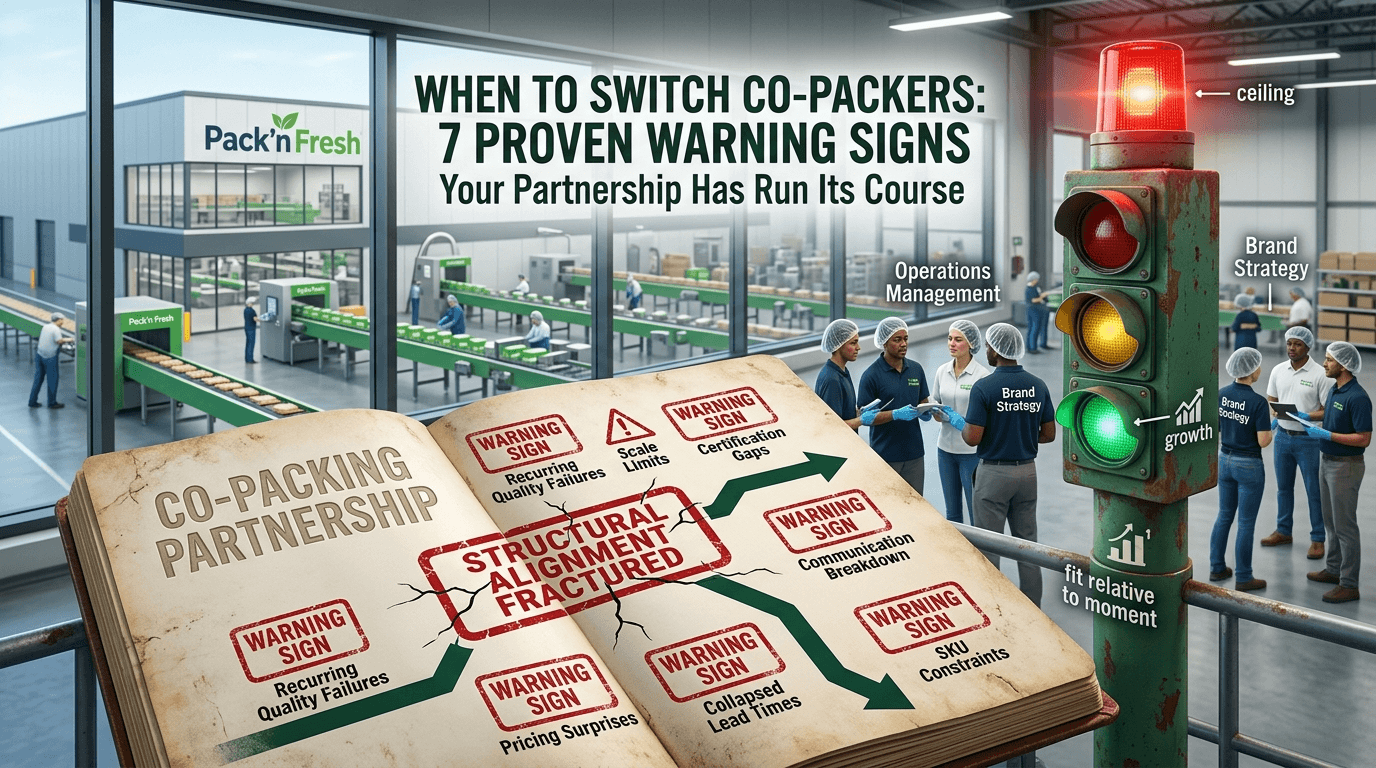
The warning signs that a co-packing relationship has structurally failed are not subtle once you know what to look for. The problem is that most brands encounter these signals individually and address them as isolated incidents rather than reading them as a pattern. What follows is the definitive list of the seven warning signs that indicate a co-packing partnership has run its course — each one meaningful on its own, and collectively representing clear evidence that the relationship needs to end. Read them as a pattern, and they give you a definitive answer to when to switch co-packers.

Warning Sign 1 — Recurring Quality Failures That Don’t Get Fixed

A single quality failure is a data point. It tells you that a process deviated, that a piece of equipment underperformed, or that a procedure was not followed correctly. A capable co-packer treats a quality failure as a trigger for a structured root cause analysis (RCA) and implements a corrective action plan (CAPA) that specifically addresses the mechanism of failure — not just the symptom. The RCA identifies whether the problem was equipment, personnel, process, or raw material. The CAPA defines the specific change being made, who owns it, and what metric proves it is working. This is standard operating procedure for any facility operating under a meaningful food safety management system.

The warning sign is not the first quality failure — it is what happens after the corrective action is supposedly in place. If the same category of defect (seal failures, fill weight deviations, label placement errors, allergen incidents) reappears within 60 to 90 days of a documented corrective action, the system is broken. The co-packer either lacks the operational discipline to implement the corrective action consistently, lacks the equipment capability to prevent the defect mechanically, or lacks the tracking systems to identify that the problem has recurred. Any one of these represents a structural failure, not a one-time miss. Brands that have experienced three or more instances of the same defect category within a 12-month period — despite documented corrective actions — are operating with a co-packer that cannot solve quality problems systematically. When to switch co-packers becomes clear the moment a pattern of unresolved quality failure becomes undeniable.

Warning Sign 2 — They Cannot Scale With You

Capacity is finite, and a co-packer that was a fit at your current volume becomes a constraint when you grow beyond their operational ceiling. The signs of a co-packer that cannot scale are recognizable: lead times that were once 5 to 7 days begin stretching to 12 to 15 days without a clear explanation. Rush order accommodation — once flexible — becomes impossible or prohibitively expensive. New SKU additions get pushed back repeatedly because adding them would disrupt the production schedule for existing runs. Production date commitments begin slipping by days, then by a week, then longer.

What is happening operationally is that the co-packer is running at or near full capacity utilization, and your brand is one of many competing for limited production slots. At high utilization rates, co-packers make prioritization decisions — and brands with longer relationships or higher contract values tend to get protected while newer or smaller brands absorb the schedule disruptions. If your co-packer cannot commit to volume increases that match your growth plan for the next 12 months, they are not a growth partner — they are a production ceiling. This is particularly acute for brands operating in subscription commerce, meal kit fulfillment, or seasonal demand categories where volume variability is a structural feature of the business model, not an exception.

Warning Sign 3 — Certification Gaps That Put Your Brand at Risk

Co-packer certifications are not administrative checkboxes — they are the foundation of your brand’s compliance posture and channel access. If your co-packer’s SQF-certified facility status lapses, if they deprioritize re-certification after a failed audit, or if they have never pursued a GFSI-recognized certification scheme like SQF, BRCGS, or FSSC 22000, you inherit their compliance risk directly. Retail buyers — particularly large grocery chains and natural food retailers — increasingly require third-party food safety certification as a condition of supplier approval. Institutional food service purchasers have the same requirement. Meal kit platforms often mandate it contractually.

A co-packer that is not pursuing or maintaining GFSI-recognized certification is telling you something important about their operational culture: food safety systems are not a priority. That posture has downstream implications for your brand that extend beyond certification paperwork. It affects the rigor of their sanitation protocols, their allergen management systems, their traceability infrastructure, and their corrective action discipline. The certification is a proxy for the operational culture underneath it. Review your co-packer’s current certification status, its expiration date, and the history of their most recent audit cycle. If there are gaps, lapses, or a consistent pattern of delayed re-certification, that is a warning sign that belongs in the same category as a recurring quality failure. Certification gaps of this kind frequently determine when to switch co-packers — because a co-packer deprioritizing certification is deprioritizing the entire food safety infrastructure your brand depends on. You can find an overview of what these certifications require in our GFSI food safety standards guide.

Warning Sign 4 — Communication Breakdown and Accountability Avoidance

The operational maturity of a co-packer is reflected most clearly in how they communicate when something goes wrong. A co-packer with mature systems and an accountable culture surfaces problems proactively, documents them with specificity, and gives you the information you need to make decisions. They can produce a traceability report — from ingredient receipt through finished goods pack-out — within hours of a request. They notify you immediately when a production deviation occurs rather than waiting until a scheduled check-in. They have a designated point of contact who has authority to make decisions and who responds within a defined window.

The warning sign is the opposite pattern: delayed or absent responses to quality complaints, inability to provide lot-level traceability data on demand, vague explanations for production deviations, and a defensive posture when accountability is requested. A co-packer that cannot produce a complete lot trace within a business day does not have the traceability infrastructure that FSMA 204 traceability requirements demand — and that gap is a compliance exposure for your brand, not just an inconvenience. Communication breakdowns and accountability avoidance are not personality problems. They are symptoms of inadequate systems, and inadequate systems do not fix themselves. When these symptoms are persistent, they represent a definitive answer to when to switch co-packers — one that protects your brand’s operational visibility and compliance posture.

Warning Sign 5 — Hidden Fees, Pricing Surprises, and Contract Drift

Transparent, predictable pricing is a baseline expectation in a functional co-packing partnership. Your contract defines the service scope and the cost structure — setup fees, run rates, storage terms, minimum order commitments. When that clarity erodes, the relationship has a fundamental trust problem. The specific pattern to watch for: unexpected setup fees that were not in the original statement of work, unilateral mid-contract price changes with minimal notice, storage fees that accumulate without prior disclosure, or invoice line items that appear without a corresponding conversation. Individual instances can happen in any business relationship — equipment replacements, material cost increases, and operational changes are real. But a pattern of pricing surprises indicates either that the co-packer’s internal cost accounting systems are inadequate, or that they are managing cash flow by expanding invoice scope rather than renegotiating contracts transparently.

Either scenario is a warning sign. Pricing opacity makes it impossible for your finance and operations team to build accurate cost models, which downstream affects your own pricing decisions, margin planning, and retail negotiations. If you cannot trust the invoice, you cannot trust the partnership. Review the last six months of invoices against your original contract terms. If you find consistent discrepancies that were never pre-disclosed, that pattern is a meaningful signal — and for many brands, pricing opacity alone settles the question of when to switch co-packers.

Warning Sign 6 — Lead Times Have Collapsed and Flexibility Is Gone

Lead time is a direct measurement of a co-packer’s operational health. When a co-packer is well-organized, properly staffed, running at appropriate utilization levels, and managing their ingredient procurement effectively, they can deliver on consistent, predictable lead time commitments. When those conditions deteriorate — utilization climbs, staffing becomes inconsistent, ingredient procurement is reactive rather than planned — lead times inflate, and flexibility disappears. What was a 5-day standard lead time becomes 10, then 15, then “we’ll get back to you.” What was a co-packer that could accommodate a 20% volume increase with a week’s notice becomes one that requires six weeks of advance notice for any deviation from the standing order.

For brands operating in subscription commerce, seasonal food categories, or meal kit fulfillment, lead time flexibility is not a convenience — it is a structural production requirement. Subscription brands cannot absorb a two-week lead time extension without missing fulfillment windows and generating customer service failures. Seasonal brands cannot wait six weeks for approval on a volume adjustment. If your co-packer’s lead time performance has degraded significantly from your original agreement, and their ability to accommodate any production flexibility has effectively disappeared, they have become an operational liability regardless of their quality performance. Knowing when to switch co-packers is often as simple as comparing today’s lead time reality to the terms in your original agreement.

Warning Sign 7 — They Cannot Support Your New Product Categories

Brands grow by expanding their product portfolio — new formats, new ingredients, new certifications, new production requirements. A co-packer that was built for your initial product set may be structurally unable to support where your portfolio is going. This is one of the most common structural mismatches we see: a brand that started with a single dry blend SKU in a stand-up pouch, then added organic-certified products, then added a stick pack format, then added a carton format — and their co-packer has neither the organic certification nor the equipment to handle anything beyond the original stand-up pouch.

This is not a failure on either party’s part in isolation — it is a natural consequence of brand growth outpacing a co-packer’s investment in their own capabilities. But the implication for your brand is clear: if adding a new SKU requires you to find a separate co-packer for that product, you have already partially switched. Managing production across multiple co-packers for what should be a unified portfolio creates complexity, increases your audit burden, fragments your traceability, and adds logistics overhead that a single capable partner could eliminate. When your new product development roadmap consistently runs into your co-packer’s capability ceiling, the relationship has reached its structural limit — and you have a clear answer to when to switch co-packers.


Experiencing any of these warning signs? Talk to Pack’n Fresh about a smooth co-packer transition — we specialize in onboarding brands from prior partnerships without production gaps.

3. Warning Sign Deep-Dive: Quality Failures and Certification Gaps

Quality failures in co-packing fall into two categories that operators need to distinguish clearly: execution failures and system failures. An execution failure is a one-time deviation that can be traced to a specific, identifiable cause — a miscalibrated fill head, an operator who was new to the line, a packaging material lot that had a dimensional inconsistency. These happen in every production environment. The differentiating factor is what happens next. A co-packer with mature quality systems runs an RCA within 24 to 48 hours, identifies the precise mechanism of failure, implements a documented CAPA with a measurable success metric, and closes the loop with you in writing. The failure is an input to the quality system, not an exception to it.

A system failure is what happens when the quality management infrastructure itself is inadequate. This shows up in specific ways: seal integrity failures on pouches that recur because the heat seal equipment has never been properly validated for your film specifications. Fill weight deviations on precision-filled sachets that persist because the co-packer lacks the real-time checkweigher monitoring to catch drift before it produces an out-of-spec run. Allergen cross-contact incidents that recur because the co-packer’s cleaning validation protocol is inadequate and never tested with ATP swab verification. In each case, the root problem is not a one-time deviation — it is an infrastructure gap that will continue producing failures until it is fundamentally addressed.

Certification gaps carry the same diagnostic weight. A co-packer that is actively pursuing and maintaining SQF Level 2 certification — or an equivalent GFSI-recognized scheme — has made an organizational commitment to building and maintaining the systems that prevent these failures: documented food safety plans, validated sanitation procedures, allergen control protocols, calibrated equipment maintenance programs, and trained personnel. When a co-packer deprioritizes certification, or loses certification without a credible recovery plan, they are telling you that these systems are not being maintained to an externally verified standard. That matters not just for regulatory compliance but for the practical quality and traceability performance your brand depends on every production cycle. The certification is not the goal — but it is a reliable indicator of whether the operational infrastructure underneath it is real. For brands evaluating when to switch co-packers, this diagnostic distinction between execution failures and system failures is the clearest basis for a defensible, data-driven decision.


4. Warning Sign Deep-Dive: Capacity, Flexibility, and Communication Breakdown

Capacity constraints and communication failures are often two symptoms of the same underlying problem: a co-packer that has grown faster than their operational systems and management infrastructure can support. When a facility moves from 50% to 90% utilization, the impact is not linear — it is exponential. At 50% utilization, there is slack in the schedule to accommodate a rush order, to run a trial batch of a new SKU, to add a production day when a quality hold delays a run. At 90% utilization, every slot is committed. Every deviation from the plan creates a cascade. Lead times inflate because there is no buffer. Communication degrades because operations management is in constant firefighting mode rather than proactive planning mode. The brands that absorb the most disruption at high-utilization co-packers are consistently the ones without the leverage of a high contract value or a long-term relationship — which typically means growth-stage brands at exactly the moment they need production reliability the most. For these brands, capacity failure is among the clearest signals of when to switch co-packers.

The specific capacity signal to monitor is lead time trend over 12 months. Pull the actual production completion dates from your last 12 months of orders and compare them to the originally committed dates. If the gap between committed and actual has grown quarter over quarter, you are watching a capacity problem develop in real time. A co-packer operating with healthy capacity headroom delivers on committed dates consistently and can absorb modest volume changes — a 20% increase or decrease relative to a standing order — without requiring extended lead time or formal approval. This baseline flexibility is not a premium feature; it is what a production partner with appropriate capacity management should deliver as standard practice.

Communication breakdown is the operational visibility problem that makes every other problem worse. When a co-packer fails to proactively notify you of a production hold, a quality deviation, or an ingredient shortage, you lose the time you need to make decisions. If your retailer’s purchase order requires delivery by Thursday and you learn on Wednesday that production is running two days late, you are managing a retailer relationship crisis that should have been manageable at the operational level if you had been notified on Monday. The brands that consistently report the highest satisfaction with their co-packing partnerships describe a communication culture where problems surface early, ownership is clear, and resolution timelines are specific. That communication culture does not exist by accident — it is built on staffing, systems, and accountability standards that a co-packer either prioritizes or does not. When those standards are absent across capacity, lead times, and communication simultaneously, brands have a clear answer to when to switch co-packers.


5. Is the Problem Fixable? How to Evaluate Before You Decide to Switch

Not every co-packing problem justifies a full transition. Switching co-packers has real costs: the time to identify and qualify a new partner, the documentation transfer burden, the risk of a production gap during the transition window, and the onboarding period during which a new co-packer is still learning your product specifications. These costs are real and should be weighed against the severity and fixability of the problems driving the consideration. The right question is not “should I switch?” in the abstract — it is “is the root cause of this problem addressable within this relationship, within a reasonable timeline, with measurable accountability?”

A structured evaluation framework helps answer that question with discipline rather than frustration. Start with the root cause: has the co-packer been able to clearly identify and articulate what is causing the problem, or are the explanations vague and inconsistent? A co-packer that cannot clearly diagnose their own failure cannot reliably fix it. Next, assess acknowledgment: has the co-packer acknowledged the problem formally, in writing, without minimizing or deflecting? Defensive posture at the problem acknowledgment stage is a strong predictor of inadequate corrective action. Finally, evaluate the resolution commitment: has the co-packer committed to a specific, measurable corrective action with a defined completion date and a success metric? “We’re going to look into it” is not a corrective action plan. A 30-day CAPA with a defined metric and a follow-up review is.

Green flags that suggest the problem may be fixable include proactive communication before you raised the complaint, existing RCA documentation that demonstrates a functional quality system, and a willingness to invest in the corrective action — whether that means equipment calibration, additional personnel training, or a process modification. Red flags that indicate structural failure include a pattern of the same failure category recurring after multiple corrective actions, an inability to produce documentation of past corrective actions, a defensive or dismissive response to quality complaints, and a history of delayed certification renewal. When you see the red flags clustering — multiple warning signs present simultaneously, corrective actions that have not held, communication that has become increasingly evasive — the answer is almost always to begin the transition process. The sooner you act, the more control you have over the timeline and the lower the transition risk. When multiple red flags cluster simultaneously and corrective actions have failed to hold, the framework gives you a clear answer to when to switch co-packers: now, and from a position of operational stability.


6. The Co-Packer Transition Roadmap: How to Switch Without Stopping Production

The single most important principle in a co-packer transition is this: never transition under deadline pressure. A transition that is forced by a crisis — a co-packer that abruptly loses certification, a catastrophic quality failure that makes continued production impossible, a contract termination — is a transition that costs more, takes longer, and carries significantly higher production gap risk than a planned transition executed from a position of operational stability. The goal is to begin the qualification process for a new co-packing partner while your current production is still functional, so that the timeline of the transition is driven by your readiness rather than by an emergency.

A well-executed co-packer transition follows a four-phase roadmap over 16 weeks. Phase 1 — weeks one through four — is new partner identification and qualification. This includes facility audits of candidate co-packers, certification verification, reference checks with existing clients at comparable volume and product type, and negotiation of trial run terms. The facility audit should evaluate food safety systems, equipment capability for your specific product formats, capacity headroom, and communication culture. Reference checks should specifically ask about lead time reliability, quality consistency, and how the co-packer handles problems when they arise. Starting this qualification process is the first concrete action after determining when to switch co-packers — and beginning it while current production is still stable is what keeps the transition under your control.

Phase 2 — weeks five through eight — is documentation transfer. This is one of the most underestimated steps in a co-packer transition. The documentation package that a new co-packer needs to produce your product correctly includes: master recipe specifications with tolerance ranges, ingredient supplier lists with approved alternates, SOPs for each production step, finished goods quality specifications with accept/reject criteria, packaging material specifications, label files and approval documentation, and any allergen or certification-specific handling requirements. Review your co-packing contract clauses to confirm documentation ownership and transfer rights before beginning this process — some contracts include IP provisions that affect how and when you can share formulation documentation with a prospective partner.

Phase 3 — weeks nine through twelve — is parallel production. Run your new co-packer on a trial quantity of your product while your existing co-packer continues producing the primary volume. This gives you real production data from the new facility — actual fill weights, seal integrity testing results, label placement accuracy, finished goods visual conformance — without putting your primary supply at risk. Compare the output quality systematically and use the results to identify any gaps in the new co-packer’s setup before they become responsible for your full volume. Phase 4 — weeks thirteen through sixteen — is the full transition. Transfer primary production responsibility to the new co-packer and, where possible, maintain a standby arrangement with your prior co-packer for four additional weeks in case an unexpected production issue requires a backup solution. This buffer period significantly reduces transition risk and gives you the confidence to execute the transfer cleanly. A planned transition executed while knowing exactly when to switch co-packers is categorically different from an emergency pivot — and the 16-week roadmap is what makes the difference.


7. What to Look for in Your Next Co-Packing Partner

The co-packer vetting process after a transition experience tends to be more rigorous than the original selection — brands that have lived through a co-packing failure know exactly what they cannot afford to overlook. Here is the framework for evaluating your next co-packing partner with the diligence the decision deserves — because answering the question of when to switch co-packers is only half the work; choosing the right replacement partner is the other half.

GFSI-recognized certification at the SQF Level 2, BRCGS, or FSSC 22000 level is a non-negotiable baseline. Do not accept a commitment to pursue certification in the future as a substitute for current certification status — you need a partner whose food safety systems are already verified by an independent third-party auditor. Verify the certificate directly, confirm the expiration date, and ask about the most recent audit cycle results. ERP-backed traceability is the second baseline requirement: your co-packer must be able to produce a complete lot trace — ingredient receipt through finished goods pack-out — within hours of a request. This is both a practical operational need and a compliance requirement under FSMA 204 standards.

Capacity headroom is a criterion that most brands underweight in the selection process and regret later. Ask your prospective co-packer what their current utilization rate is and what percentage of their capacity your projected volume would represent. A co-packer that is already running at 80% or above before adding your business has limited flexibility to absorb growth or accommodate production variability. Target partners with enough headroom that your business represents a meaningful portion of their volume — enough to be a priority — without pushing them into the capacity ceiling zone that creates the lead time and flexibility problems described earlier. Communication culture can be assessed in the sales and onboarding process itself: how responsive is their team? How quickly do they answer questions? Do they have a defined account management structure with clear points of contact? These behaviors in the sales process predict their behaviors when production problems arise. Getting this selection right is how you avoid asking when to switch co-packers again in 18 months — the right partner is one your brand can grow into, not one you quickly outgrow. At Pack’n Fresh, our SQF-certified facility, ERP-backed traceability, Digital Ingredient Locking system, and ATP swab sanitation verification represent exactly the operational infrastructure that brands need when they are making a transition to a co-packer built for serious food safety and growth-stage scale. Our choosing a food co-packer guide walks through the full evaluation framework if you want to go deeper on the vetting process.


Conclusion: The Right Time to Switch Is Before the Crisis Forces Your Hand

Knowing exactly when to switch co-packers is one of the most consequential operational decisions a food brand can make — and the brands that get it right are the ones who make it early, with a clear framework, and with enough runway to execute a planned transition rather than an emergency pivot. The seven warning signs in this guide are not judgment calls. They are operational signals with clear implications: recurring quality failures that survive corrective actions, capacity constraints that limit your growth, certification gaps that expose your brand to compliance risk, communication breakdowns that eliminate your ability to manage problems in real time, pricing surprises that undermine financial planning, lead time failures that threaten fulfillment commitments, and capability ceilings that block your product development roadmap. When these signals appear individually, evaluate carefully. When they cluster, the answer is almost always to begin the transition process.

Understanding when to switch co-packers is ultimately about understanding the full cost of inaction versus the manageable cost of a planned transition. Brands that act on clear warning signs within a reasonable window — before a crisis, before a retailer relationship fails, before a compliance event creates a recall — consistently report that the transition was less disruptive than they expected and that the performance improvement in the new relationship was more significant than they anticipated. Brands that wait until they are in crisis consistently report the opposite. The data on this is not ambiguous, and the operational logic is straightforward: a planned 16-week transition executed from a position of stability will always be less expensive and less risky than a reactive switch executed under pressure.

At Pack’n Fresh, we specialize in working with brands that are making the move from a prior co-packing relationship. Our onboarding process is built specifically to make transitions clean: structured documentation intake, a trial production run with full quality reporting, ERP-backed lot traceability from day one, and a dedicated account management team that communicates proactively rather than reactively. If the warning signs in this guide have answered the question of when to switch co-packers for you, the most valuable thing you can do right now is start the qualification conversation — because the sooner you begin, the more control you have over how the transition unfolds. Contact our team to discuss your production requirements and learn how Pack’n Fresh can build the co-packing partnership your brand has been looking for.


FAQs — When to Switch Co-Packers

How long does it take to switch co-packers?

A well-planned co-packer transition typically takes 12 to 16 weeks from the start of the new partner qualification process through the completion of the full production transfer. The timeline breaks down into four phases: new partner identification and qualification (weeks 1–4), documentation transfer (weeks 5–8), parallel production run (weeks 9–12), and full transition with a standby buffer (weeks 13–16). Brands that begin this process while their current production is still functional have the most control over the timeline. Emergency transitions forced by a certification failure or catastrophic quality event can compress this timeline to 4 to 6 weeks, but that compression significantly increases risk and cost at every stage. Planning ahead is always the right approach when the warning signs are visible — and brands that recognize when to switch co-packers early consistently complete transitions with less disruption and lower total cost than those who wait for a crisis to force the decision.

Will I lose production during a co-packer transition?

A properly structured co-packer transition does not require a production gap. The parallel production phase — running your new co-packer on trial volume while your existing co-packer continues primary production — is specifically designed to prevent this outcome. The key is ensuring that you maintain adequate finished goods inventory during the transition window to buffer against any timing variability between when you wind down production at your current facility and when your new co-packer reaches full production cadence. Most brands build a four to six week safety stock buffer as part of their transition planning. Production gaps occur when transitions are executed reactively under deadline pressure — which is the strongest argument for beginning the process while current production is stable. Brands that recognize when to switch co-packers early have the runway to run parallel production and build safety stock; brands that wait for a crisis do not.

What documents do I need to transfer to a new co-packer?

The core documentation package for a co-packer transition includes: master recipe specifications with tolerance ranges for every ingredient and process step; ingredient supplier lists with approved alternates and supplier qualification documentation; finished goods quality specifications with accept/reject criteria for all critical quality attributes; packaging material specifications with supplier information; SOPs for each production process; label files and regulatory approval documentation; allergen management requirements specific to your products; and any certification-specific handling protocols (organic, Kosher, Gluten-Free, Non-GMO). Review your existing co-packing contract before initiating the transfer to confirm documentation ownership and any IP or confidentiality provisions that govern how formulation information can be shared with a new partner during the qualification process. Having this documentation package organized in advance is one of the most effective ways to accelerate a transition once you have determined when to switch co-packers.

How do I know if my co-packer’s certification gap is a real risk?

A co-packer certification gap is a real and immediate risk if any of the following conditions apply: your current or prospective retail buyers require third-party GFSI-recognized certification as a supplier condition; your brand carries organic, Kosher, Non-GMO, or Gluten-Free claims that require certified production environments; your product is subject to FSMA traceability requirements that demand lot-level documentation standards your co-packer cannot meet; or your co-packer’s most recent third-party audit resulted in a major or critical finding that has not been resolved and verified. Even if none of these conditions currently apply, a co-packer that is not pursuing or maintaining GFSI-recognized certification is signaling an organizational culture that does not prioritize the food safety systems that protect your brand — and that culture affects quality and traceability performance in ways that go beyond the certification itself. For many brands, a certification gap is what definitively answers the question of when to switch co-packers.

Can Pack’n Fresh help brands that are transitioning from another co-packer?

Yes — working with brands in transition from a prior co-packing relationship is a core part of how Pack’n Fresh operates. Our onboarding process is specifically structured to handle the documentation intake, trial production, and quality validation steps that a clean transition requires. We are an SQF-certified facility operating under FSMA-compliant food safety standards, with ERP-backed lot traceability, a Digital Ingredient Locking system, and ATP swab sanitation verification — the infrastructure that brands need when they are making a move to a more capable co-packing partner. Our team will work with you to assess your production requirements, review your existing documentation, and develop a transition plan that protects your production schedule and maintains your brand’s quality standards throughout the process. Reach out through our contact page to start the conversation about what a transition to Pack’n Fresh would look like for your brand — and to make sure that once you know when to switch co-packers, you have a capable, SQF-certified partner ready to receive you.

Ready to leave your underperforming co-packer behind? Contact Pack’n Fresh today — our structured transition process gets you to SQF-certified, ERP-tracked production without stopping the line.

Scale Meal Kit Business: 7 Proven Strategies from 500 to 50,000 Subscribers

Scale Meal Kit Business

How to Scale Your Meal Kit Business from 500 to 50,000 Subscribers: A 7-Stage Road Map

The meal kit industry has proven something that was once debatable: people will pay a meaningful premium for the combination of convenience, fresh ingredients, and culinary discovery — delivered to their door. What the industry has also proven, in a long list of high-profile failures and near-collapses, is that getting subscribers is only half the challenge. Building an operation that can serve those subscribers profitably at 10x, 50x, or 100x your current volume without imploding on food safety, cost, or delivery reliability — that is the other half.

Scale your meal kit business too fast without the right operational infrastructure, and you will face a predictable sequence of failures: packaging inconsistencies, spoilage complaints, co-packing capacity gaps, supplier stockouts, and a cost-per-box that rises instead of falls as you grow. Too slow, and a well-funded competitor locks up your subscriber acquisition channels before you can establish a defensible market position.

This guide is built for meal kit founders and operators who are somewhere in the growth zone — past the hand-assembled proof-of-concept stage, but not yet at the industrial scale where every system is automated and optimized. We have worked with brands at every stage of this journey at Pack’n Fresh, and we have built this 7-stage roadmap to help you scale your meal kit business in a sequence that protects your margins, your food safety record, and your subscriber relationships at every inflection point.


Table of Contents

  1. Why Most Meal Kit Businesses Fail to Scale — And How to Avoid the Same Traps
  2. The 4 Operational Pillars Required to Scale a Meal Kit Business
  3. The 7-Stage Roadmap to Scale Your Meal Kit Business from 500 to 50,000 Subscribers
  4. How Packaging Infrastructure Determines Your Scaling Ceiling
  5. The Co-Packer Transition: When and How to Make the Move
  6. Unit Economics at Each Scale Stage
  7. Conclusion
  8. FAQs

1. Why Most Meal Kit Businesses Fail to Scale — And How to Avoid the Same Traps

The graveyard of meal kit companies that grew fast and collapsed faster is well-documented. The pattern is almost always the same: a brand achieves strong early subscriber traction on the strength of a compelling concept and founder-driven quality control, then attempts to replicate that quality at 5x or 10x volume using the same informal systems that worked at small scale.

At 500 subscribers, a founder can personally oversee every pack-out, personally approve every ingredient shipment, and personally respond to every customer complaint. Those founder-level quality controls create an excellent early product experience. But they do not scale. When the same brand reaches 5,000 subscribers and the founder is no longer physically present in the pack-out facility, the informal systems collapse — and the product experience collapses with them.

The meal kit brands that successfully scale their meal kit business to 50,000 subscribers share a common discipline: they build systems, not heroics. They document every process, codify every quality standard, transition every informal founder judgment call into a written SOP that any trained team member can execute consistently. And critically, they make the transition from in-house assembly to professional co-packing at the right moment — neither so early that they cede control before the product is fully defined, nor so late that they are already in crisis.


2. The 4 Operational Pillars Required to Scale a Meal Kit Business

Before we walk through the 7-stage roadmap, it is important to understand the four operational pillars that underpin every successful meal kit scale-up. Every challenge you will face as you scale your meal kit business can be traced back to one or more of these pillars being underdeveloped relative to your subscriber volume.

Pillar 1 — Packaging Infrastructure

Your box, your insulation system, your protein pouches, your produce wrapping, your sauce packets — collectively, these are not just your product delivery vehicle. They are your food safety system, your cold chain management system, your brand expression vehicle, and your cost structure all in one. Packaging that is appropriate at 500 subscribers will typically be too expensive, too inconsistent, or both at 10,000 subscribers.

Pillar 2 — Supply Chain Reliability

At 500 subscribers, a supplier shortfall means you make a few phone calls and substitute ingredients for one week. At 50,000 subscribers, a supplier shortfall means 50,000 boxes need a recipe modification, 50,000 customers need a notification, and your co-packer’s pack schedule needs to be restructured — all within 48 hours. Supply chain reliability must be engineered for the scale you are targeting, not the scale you are operating at today.

Pillar 3 — Food Safety Compliance

FSMA compliance, allergen management, cold chain documentation, and traceability records that may have been managed informally at small scale must become formal, auditable systems as you grow. Retail buyers, institutional customers, and co-packing partners will all require documented food safety systems before they will do business with you at volume. The brands that scale their meal kit business successfully treat food safety as a growth enabler, not a regulatory burden.

Pillar 4 — Fulfillment and Co-Packing Capacity

Your assembly and fulfillment operation — whether in-house or outsourced — must be able to handle not just your current weekly volume, but your peak weekly volume (holiday gifting, promotional periods, post-resolution subscriber surges) with no reduction in quality or throughput. Capacity constraints at peak periods are the most common scaling bottleneck meal kit brands face.


3. The 7-Stage Roadmap to Scale Your Meal Kit Business from 500 to 50,000 Subscribers

Stage 1 — Founder-Assembled Proof of Concept (Under 500 Subscribers)

At this stage, you are assembling kits manually — likely with a small team in a commercial kitchen or small leased production space. Your primary goal is product-market fit: validating that subscribers love the recipes, the packaging, and the delivery experience enough to retain and refer. Every operational decision at this stage should prioritize learning speed over efficiency.

Document everything you do, even informally. Photograph every box configuration. Note which ingredients cause the most prep-time complaints, which proteins generate the most spoilage reports, which packaging materials fail most often in transit. This observational data becomes the foundation for your operational systems as you scale your meal kit business.

Stage 2 — Systematize Before You Grow (500–1,500 Subscribers)

This is the most critical stage in the roadmap, and the one most brands rush past in pursuit of growth. Before you invest in subscriber acquisition to push past 1,500 subscribers, you must systematize your operations so they can run without you.

Write formal SOPs for every pack-out step. Implement a recipe management system that locks ingredient specifications and portion weights. Build a supplier roster with at least two approved sources for every key ingredient. Establish formal quality check points — incoming ingredient inspection, in-process weight and portion checks, outgoing box inspection before seal. When you can scale your meal kit business reliably to 1,500 subscribers on your current system without your personal daily oversight, you are ready for Stage 3.

Stage 3 — Co-Packer Transition Planning (1,500–3,000 Subscribers)

At 1,500–3,000 subscribers, most meal kit brands are approaching the ceiling of what a small in-house operation can handle efficiently. Labor costs are rising, the pack-out floor is cramped, and the operational complexity of managing a growing ingredient list, multiple recipes, and increasing pack volume is consuming founder bandwidth that should be going into subscriber acquisition and retention.

This is the stage to begin evaluating co-packing partners seriously — not because you must make the transition immediately, but because finding the right meal kit co-packing partner takes time. You need to evaluate facilities for SQF or equivalent certification, cold chain capability, minimum order quantities, pricing at your current and target volumes, and cultural fit. Rushing this evaluation because you are already in operational crisis at Stage 4 or 5 is one of the most common and costly mistakes meal kit founders make.

Review the meal kit co-packing contract clauses you will need to negotiate before signing — particularly the SOW scope, minimum order flexibility, and exit provisions that protect you if the partnership does not work out.

Stage 4 — Co-Packer Onboarding and Transition (3,000–7,000 Subscribers)

The co-packer transition is operationally complex and requires more runway than most brands anticipate. Plan for a 60–90 day onboarding period that includes: recipe and specification documentation transfer, ingredient supplier introduction and approval, trial production runs at increasing volumes, packaging qualification testing, cold chain validation, and quality standard alignment.

As you scale your meal kit business through the transition, run your in-house and co-packing operations in parallel for at least 4–6 weeks before fully transferring production. This parallel period lets you identify gaps between your co-packer’s output and your quality standard while you still have a fallback. The brands that transition cleanly are the ones that invest in this parallel period; the ones that skip it to save cost typically pay the price in subscriber complaints during the transition window.

Stage 5 — Subscriber Growth Acceleration (7,000–20,000 Subscribers)

With a capable co-packing partner managing assembly and fulfillment, your internal team can refocus on what drives revenue: subscriber acquisition, retention optimization, recipe development, and brand building. This is typically the stage where meal kit brands activate their paid acquisition channels at meaningful scale — Meta and Google ads, influencer partnerships, corporate gifting programs, and retail pilot programs.

Two operational priorities are critical at this stage. First, establish formal demand forecasting so your co-packer has 4–6 weeks of forward visibility into expected pack volumes. The ability to scale your meal kit business efficiently at this stage depends on your co-packer’s ability to plan labor, ingredient procurement, and packaging inventory in advance — which requires accurate forecasts from you. Second, invest in automated kitting infrastructure at your co-packer to reduce per-box labor cost as volumes grow.

Stage 6 — National Expansion and Multi-Region Fulfillment (20,000–35,000 Subscribers)

At 20,000+ subscribers, most meal kit brands begin to feel the friction of a single fulfillment point serving a national subscriber base. Transit times lengthen for the most distant service areas. Cold chain costs rise as insulation must support longer transit windows. And carrier reliability becomes a meaningful variable in subscriber satisfaction scores.

The solution for most brands at this stage is multi-region fulfillment: either a second co-packing location in a different region (East/West, or South/North depending on your subscriber concentration), or a hybrid model using a primary co-packer for assembly and regional third-party cold storage hubs for last-mile staging. Understand the meal kit packaging cost implications of each model before committing — the right answer depends heavily on your subscriber geography and your box economics at scale.

Stage 7 — Full-Scale Operations and Margin Optimization (35,000–50,000+ Subscribers)

At 50,000 subscribers, a meal kit brand is a meaningful mid-market consumer food company — generating $50M–$100M+ in annual revenue depending on box price and meal count. At this scale, the operational priorities shift from growth to optimization: reducing per-box cost, improving ingredient yield, minimizing spoilage and shrinkage, and building the proprietary operational advantages that make you difficult to replicate.

The key leverage points to scale your meal kit business profitably at this stage are: direct ingredient sourcing relationships that bypass distributors, proprietary packaging formats developed with your co-packer that improve packing speed and reduce material cost, automated quality systems that reduce manual inspection labor, and data-driven recipe engineering that optimizes ingredient costs without degrading subscriber satisfaction.


Ready to scale your meal kit business with a certified co-packing partner? Get a free quote from Pack’n Fresh →

4. How Packaging Infrastructure Determines Your Scale Meal Kit Business Ceiling

Packaging is not a branding decision — it is an operational architecture decision that will either enable or constrain your ability to scale your meal kit business. Brands that treat packaging as a cosmetic afterthought consistently hit the same scaling wall: their in-house packaging configurations cannot be replicated efficiently at co-packing scale, their cold chain insulation fails at longer transit windows as they add new service areas, and their per-box packaging cost does not decrease meaningfully as volume grows because they have not transitioned to standardized bulk-purchased formats.

The packaging decisions that determine your scaling ceiling include:

  • Box standardization: A standardized outer box configuration that can be assembled and sealed at automated line speeds (versus a custom, hand-folded format that requires individual manual assembly) is worth 30–50% labor savings on the pack-out floor at scale. Standardize your outer box format at Stage 2, not Stage 5.
  • Protein packaging format: Heat-sealed barrier pouches for proteins (rather than tray-and-film configurations) are faster to pack, more consistent in seal integrity, and more reliable in cold chain performance. If you are still using hand-wrapped protein formats at 3,000+ subscribers, transition before your co-packer transition — not after.
  • Insulation system scalability: Pre-formed EPS or molded pulp insulation liners that drop into the outer box in a single step are dramatically faster to assemble than multi-piece foil bubble insulation that requires folding and fitting. The time difference per box — typically 20–40 seconds — multiplies to significant labor cost savings at volume.
  • Sauce and spice packet format: Pillow-style heat-sealed sachets produced in bulk are significantly less expensive and more consistent than hand-portioned containers at scale. A professional co-packer like Pack’n Fresh can produce and fill these sachets as part of the pack-out process.

Review how your meal kit subscription retention data correlates with specific packaging failures — that data is your prioritization guide for packaging infrastructure investment.


5. The Co-Packer Transition: When and How to Make the Move to Scale Your Meal Kit Business

The co-packer transition is the single highest-leverage operational decision most meal kit brands will make. A great co-packing partner does not just assemble your kits — they bring food safety infrastructure, cold chain capability, regulatory compliance systems, ingredient procurement leverage, and operational expertise that would cost millions of dollars to build in-house.

When Is the Right Time to Transition?

The clearest signal that you are ready to transition to a co-packer is when your in-house operation is running at or near capacity for two or more consecutive weeks, and adding capacity in-house would require capital investment in equipment, space, or labor that is comparable to co-packing fees at your target volume. Most meal kit brands hit this inflection point between 1,500 and 3,000 subscribers, though the exact threshold varies with box format complexity and the size of your in-house facility.

A secondary signal is food safety complexity. If your ingredient list has expanded to include allergen-sensitive items, raw proteins from multiple suppliers, or organic/certified ingredients that require chain-of-custody documentation, the food safety management infrastructure required to handle these ingredients professionally typically exceeds what a small in-house operation can maintain.

What to Look for in a Co-Packing Partner to Scale Your Meal Kit Business

When evaluating co-packers to help you scale your meal kit business, prioritize the following criteria:

  • SQF or GFSI certification: SQF Level 2 or equivalent GFSI scheme certification (BRCGS, FSSC 22000) indicates that the facility’s food safety management system has been independently audited and meets nationally recognized standards. This is non-negotiable for a meal kit co-packer handling raw proteins.
  • Cold chain capability: The facility must have temperature-controlled receiving, storage, and production areas appropriate for the temperature requirements of your ingredient mix — typically refrigerated production space for protein handling and separate ambient storage for dry goods.
  • Minimum order flexibility: Some co-packers have minimum weekly volume requirements that exceed your current subscriber count. Evaluate whether the co-packer’s minimums match your current volume, not just your target volume, and negotiate a ramp-up schedule in the contract.
  • FSMA traceability compliance: FSMA 204 traceability requirements are increasingly affecting the entire supply chain. Your co-packer must maintain lot-level traceability records for all ingredients from receiving through pack-out — this is required for rapid recall response and is becoming a baseline expectation from retail and institutional buyers.
  • Capacity headroom: Your co-packing partner should have meaningful capacity above your current volume so that your growth does not immediately constrain their schedule. A co-packer that is already at 90% capacity when you sign has limited ability to support your scaling trajectory.

6. Unit Economics at Each Scale Stage: How Costs Change as You Scale Your Meal Kit Business

Understanding how your unit economics evolve as you scale your meal kit business is essential for making good investment decisions at each stage. The general trajectory is favorable — per-box costs decline as volume grows — but the path is not linear, and there are transition points where costs temporarily rise before falling.

Packaging Cost per Box

Packaging represents 15–25% of total COGS for most meal kit brands. At 500 subscribers ordering weekly, you are likely purchasing packaging at retail or small-lot prices — covering all packaging components combined (outer box, insulation, protein pouches, sauce sachets, produce wrapping). As volume grows, bulk purchasing from packaging suppliers meaningfully reduces this per-box cost. At 50,000 subscribers with a co-packing partner who consolidates purchasing across multiple clients, packaging costs can decline significantly compared to small-lot pricing. Exact figures vary by volume, packaging format, insulation type, and facility — request itemized packaging quotes at each scale stage to benchmark your specific configuration.

Review the full meal kit packaging cost breakdown to understand which components offer the greatest optimization opportunity at your current scale.

Labor Cost per Box

In-house manual assembly labor cost per box varies significantly by kit complexity, local labor rates, and facility layout. Co-packing with semi-automated kitting typically reduces this per-box labor cost meaningfully compared to manual in-house assembly. Fully automated kitting at high volume can reduce labor cost further — often dramatically relative to small-scale manual assembly. Exact figures depend on kit complexity, region, and equipment configuration; industry estimates vary widely by operation. The transition to co-packing and the investment in automation together represent the largest single per-box cost reduction opportunity for most meal kit brands.

Ingredient Cost per Box

Ingredient cost typically represents 35–45% of meal kit COGS and is the largest single cost component. At small scale, you are purchasing ingredients through distributors or food service broadliners at standard pricing. As volume grows and you develop direct supplier relationships, ingredient costs typically decline 10–20% relative to distributor pricing. At 50,000 subscribers, direct sourcing relationships with farms, protein processors, and specialty ingredient suppliers are worth pursuing actively.

The COGS Crossover Point

Most meal kit brands experience a COGS crossover point when they transition to co-packing — a temporary increase in total per-box cost as co-packing fees replace the (often undercosted) in-house labor and overhead that was previously absorbed informally. This crossover is normal and expected. The correct response is not to delay the co-packing transition to preserve the appearance of lower costs, but to forecast the full co-packing cost accurately and build it into your subscriber acquisition economics from the beginning. Understanding your true meal kit COGS calculation at each scale stage is foundational to making good decisions about pricing, co-packing, and growth investment.


Conclusion: Building the Operational Foundation to Scale Your Meal Kit Business

The meal kit brands that reach 50,000 subscribers do not succeed by growing faster than their competitors. They succeed by building operational infrastructure that can support growth without degrading quality, food safety, or subscriber experience. That infrastructure — systematized SOPs, a capable co-packing partner, engineered packaging, a reliable supply chain, and strong unit economics — is what turns subscriber acquisition investment into durable revenue.

The 7-stage roadmap in this guide is designed to help you build that infrastructure in the right sequence: systematize before you grow, find your co-packer before you need them urgently, transition your packaging before your current format becomes a constraint, and optimize your unit economics before you scale your acquisition spending.

Pack’n Fresh works with meal kit brands at every stage of this journey — from the 1,500-subscriber brands beginning their first co-packer evaluation to the 20,000-subscriber brands building multi-region fulfillment models. If you are ready to scale your meal kit business with an SQF-certified co-packing partner who specializes in meal kit and fresh food assembly, we would like to talk.


FAQs — How to Scale a Meal Kit Business

At what subscriber count should I move from in-house assembly to a co-packer to scale my meal kit business?

Most meal kit brands make the co-packer transition between 1,500 and 3,000 weekly subscribers, though the right timing depends on your current production capacity, your kit complexity, and your local labor costs. The key signal is when your in-house operation is regularly running at or near capacity, and adding capacity in-house would require capital investment comparable to co-packing fees. Begin evaluating co-packing partners at 1,000 subscribers so you have time to make a thoughtful decision rather than a reactive one.

How much does it cost to co-pack meal kits at different subscriber volumes?

Co-packing fees for meal kits decline meaningfully as weekly box volume grows, as volume discounts and automation reduce per-unit costs. The exact pricing depends on kit complexity, ingredient count, packaging format, the degree of automation at the facility, and the specific co-packer. Published benchmarks vary widely and can be misleading if applied outside their original context. The most reliable approach: request itemized quotes from multiple co-packers and compare total landed cost — co-packing fee plus ingredient procurement, packaging, and fulfillment — not just the assembly fee in isolation. Pack’n Fresh provides transparent, itemized pricing for meal kit co-packing based on your specific kit specs and target volume.

What certifications does a meal kit co-packer need to help me scale my meal kit business?

At minimum, your co-packing partner should hold SQF Level 2 certification (or an equivalent GFSI scheme such as BRCGS or FSSC 22000) and operate under a documented HACCP plan. For brands serving subscribers with dietary restrictions, look for additional certifications relevant to your product: Organic handler certification, Kosher or Halal certification, Gluten-Free facility certification, or Non-GMO Project verification. These certifications are not just regulatory compliance — they are quality signals that help you scale your meal kit business into channels like natural grocery retail and corporate gifting that require documented third-party verification.

How do I maintain food safety as I scale my meal kit business?

Food safety scales with systems, not headcount. The transition from informal founder oversight to formal documented food safety management is the most important operational step you will take as you grow. This means written SOPs for every food handling step, documented temperature logs for all refrigerated storage and transit, allergen control procedures, supplier approval programs with documented qualification criteria, and lot-level traceability records for every ingredient from receiving to pack-out. A co-packing partner with SQF certification brings all of these systems as part of their standard operations — which is one of the most compelling reasons to transition to co-packing before your subscriber count forces a reactive food safety upgrade.

What is the biggest mistake brands make when trying to scale a meal kit business?

The most common and costly mistake is accelerating subscriber acquisition before systematizing operations. Rapid subscriber growth on an informal operational foundation creates an almost certain recipe for delivery failures, subscriber complaints, and churn that erodes the CAC investment that drove the growth in the first place. The brands that successfully scale their meal kit business to 50,000 subscribers consistently share one practice: they build the operational infrastructure one stage ahead of their current subscriber volume, not one stage behind it.

Can a small meal kit brand negotiate co-packing contracts with favorable terms?

Yes — particularly if you approach the negotiation with a clear growth trajectory and a professional presentation of your brand, your recipes, and your current operations. Co-packers evaluate potential clients not just on current volume but on growth potential. A 2,000-subscriber brand with a strong retention rate, a differentiated positioning, and a credible 12-month growth plan to 10,000+ subscribers is an attractive client for a co-packer looking to fill capacity and build long-term partnership

Cold Chain Packaging for Meal Kits: 7 Proven Ways to Ship Fresh Food Across 2,000 Miles Without Spoilage

Cold Chain Packaging For Meal Kits

Cold Chain Packaging for Meal Kits: 7 Proven Ways to Ship Fresh Food Across 2,000 Miles Without Spoilage

The promise of a meal kit subscription is simple: fresh ingredients, delivered to your door, ready to cook. But behind that simple promise lies one of the most complex logistics challenges in the food industry — maintaining safe temperatures across a 2,000-mile transit chain that passes through multiple warehouse environments, carrier trucks, sorting facilities, and ultimately a doorstep that may bake in the Texas sun for six hours before a subscriber picks up their box.

Cold chain packaging for meal kits is the engineering discipline that makes this promise possible. Get it right, and you build subscriber trust with every delivery. Get it wrong, and a single spoiled protein component — arriving warm, off-color, or malodorous — can end a subscription relationship that took $120 in CAC to build.

At Pack’n Fresh, we co-pack for meal kit brands that ship nationally, and we understand that cold chain packaging for meal kits is not just a logistics question — it is a brand integrity question. This guide breaks down the 7 proven strategies that high-volume meal kit brands use to ship fresh food reliably across the country.


Table of Contents

  1. Why Cold Chain Packaging for Meal Kits Is More Complex Than Traditional Food Logistics
  2. The 3 Temperature Zones Every Meal Kit Brand Must Engineer For
  3. 7 Cold Chain Packaging Strategies for National Meal Kit Shipping
  4. How Barrier Film Technology Extends Dry Ingredient Shelf Life Across Long Transit
  5. The True Cost of Cold Chain Packaging Failure
  6. How Your Co-Packer Affects Cold Chain Performance
  7. Conclusion
  8. FAQs

1. Why Cold Chain Packaging for Meal Kits Is More Complex Than Traditional Food Logistics

Traditional food cold chain logistics — moving palletized product from a manufacturer to a retail distribution center — is a relatively controlled environment. Temperature is maintained in refrigerated trucks, monitored continuously, and managed by trained logistics professionals.

Cold chain packaging for meal kits operates in an entirely different environment. Your meal kit box leaves a temperature-controlled co-packing or fulfillment facility and enters a transit chain with zero active refrigeration. It may spend 3–5 days moving through carrier sorting facilities that range from 55°F in January in Minnesota to 95°F in July in Arizona. It will ultimately be left on a doorstep — in direct sunlight, in a narrow apartment lobby, or behind a gate — for an unknown period before a subscriber retrieves it.

This “last mile” temperature challenge has no parallel in traditional food cold chain. The FDA food safety standard for refrigerated proteins requires maintaining temperatures below 40°F (4°C) continuously. In a meal kit context, maintaining that standard through a 72–120 hour passive transit window — with no active refrigeration — requires precise engineering of every layer of the packaging system.

The financial stakes are high: a national meal kit brand shipping 50,000 boxes per week at an average of $65 per box has $3.25M in weekly product value in transit. Even a 1% spoilage rate — 500 boxes per week — represents $32,500 in direct weekly losses plus the subscriber retention damage that comes with each failed delivery.


2. The 3 Temperature Zones Every Meal Kit Brand Must Engineer For

Effective cold chain packaging for meal kits must address three distinct temperature zones within a single delivery:

Zone 1 — Proteins and Dairy (Below 40°F / 4°C)

Raw proteins (chicken, beef, seafood, eggs) and dairy components require continuous refrigeration below 40°F to prevent bacterial growth. This is the most demanding temperature requirement in any meal kit box and the primary driver of cold chain packaging design.

Zone 2 — Fresh Produce (Between 34°F and 50°F)

Fresh vegetables and herbs have different optimal storage temperatures than proteins — many leafy greens actually experience chilling injury below 35°F. Effective cold chain packaging for meal kits that includes both proteins and produce must manage a temperature range that serves both, typically targeting 36–40°F as the practical sweet spot.

Zone 3 — Dry Ingredients (Ambient, but Protected from Heat and Moisture)

Spice sachets, grain pouches, sauce packets, and dry seasoning blends do not require refrigeration — but they are critically vulnerable to heat and humidity during long transit. A spice sachet that experiences 95°F ambient temperatures for 48 hours will develop clumping, off-aromas, and accelerated oxidation regardless of how perfect the refrigerated components’ cold chain is. This is why cold chain packaging for meal kits must address dry ingredient protection as a parallel engineering challenge.


3. The 7 Cold Chain Packaging Strategies for National Meal Kit Shipping

Strategy 1 — Right-Size Your Insulation for Your Transit Window, Not Your Budget

The single most common cold chain packaging for meal kits failure mode is under-insulating relative to the actual transit window. Many brands design their insulation for a 48-hour transit standard when their actual worst-case transit time (ground shipping to a rural address in a hot climate) is 96–120 hours. The result is a predictable failure pattern: urban deliveries succeed, rural summer deliveries fail.

The correct engineering approach is to identify your worst-case transit scenario — longest ground transit time to your most remote service area, in the highest summer ambient temperature — and design your insulation system to maintain below 40°F for that duration, not your average transit time. Options include: EPS (expanded polystyrene) foam liners, molded pulp insulation, reflective foil bubble insulation, and wool-based insulation for sustainable positioning.

Strategy 2 — Engineer Your Refrigerant for the Full Transit Window

Refrigerant selection is one of the most technically nuanced elements of cold chain packaging for meal kits. The three primary options each have specific performance profiles:

  • Dry ice (solid CO₂): Maintains the coldest temperatures and lasts longest, but can freeze delicate produce and creates CO₂ gas that can rupture sealed boxes if improperly managed. Requires IATA/PHMSA shipping compliance documentation.
  • Gel packs (frozen water/gel): The most common refrigerant for consumer meal kits. Available in various freeze temperatures (0°F, 20°F, 32°F) — selecting the correct freeze temperature for your transit duration and product mix is critical. Gel packs at 32°F hold cold longer than those at 20°F for ambient-temperature transit.
  • Phase-change materials (PCMs): The most sophisticated and expensive option — PCMs are engineered to maintain a specific temperature (e.g., exactly 38°F) as they transition between solid and liquid states. Used by premium brands where cost-per-delivery justifies the investment.

The key principle of effective cold chain packaging for meal kits is placing refrigerant at the top of the box (cold air sinks) and surrounding proteins with direct refrigerant contact, with produce positioned to avoid direct freeze exposure.

Strategy 3 — Separate Temperature Zones Within the Box

A single undivided meal kit box comingles proteins, produce, and dry ingredients in a single temperature environment. This creates a design conflict: gel packs cold enough to maintain protein safety may freeze delicate herbs, and the ambient warmth needed by dry ingredients accelerates ice melt near proteins.

Effective cold chain packaging for meal kits uses internal dividers, dedicated protein bags, or separate thermal sleeves to create micro-zones within the delivery box. Proteins in a sealed thermal bag with direct gel pack contact, produce in a separate compartment buffered from direct freeze exposure, and dry ingredient sachets sealed in high-barrier pouches isolated from moisture.

Strategy 4 — Use High-Barrier Film for All Dry Ingredient Components

Spice sachets, seasoning blends, and dry ingredient pouches in a meal kit box are continuously exposed to the moisture released by melting refrigerant and produce respiration. Without high-barrier packaging film, dry ingredients absorb this ambient moisture — causing caking, clumping, and flavor degradation that arrives at your subscriber’s kitchen as a quality failure.

This is where the science of modified atmosphere packaging for food shelf life intersects directly with cold chain packaging for meal kits — high-barrier film with oxygen and moisture barriers protects dry ingredients through the transit environment that the cold chain creates.

Strategy 5 — Validate Your Packaging System with Transit Temperature Testing

No amount of theoretical engineering replaces empirical validation. Effective cold chain packaging for meal kits requires systematic testing using temperature loggers placed inside representative boxes shipped via your actual carrier routes to your actual service areas — in summer and winter conditions.

ISTA (International Safe Transit Association) Protocol 7E is the standard testing method specifically designed for thermal performance validation of insulated shipping packages. Brands that have completed ISTA 7E testing can make defensible temperature performance claims — those that have not are making unverified assumptions about their cold chain’s performance in the field.

Strategy 6 — Build Carrier Transit Time Into Your Cold Chain Design

The US carrier network has meaningful transit time variability. A box shipped Monday for Tuesday delivery in a major metro area will behave very differently from a box shipped Thursday for Monday delivery to a rural ZIP code. Effective cold chain packaging for meal kits accounts for this variability by: restricting shipments to shorter transit lanes during summer months, using expedited shipping for longer-distance orders, building carrier transit guarantees into your co-packing SLA, and designing your packaging for the maximum likely transit time in each shipping zone.

We discuss this in the context of overall DTC packaging strategy in our post on DTC food packaging solutions: shipping costs and freshness.

Strategy 7 — Design for the “Hot Doorstep” — The Final Cold Chain Failure Point

The single most common point of cold chain packaging for meal kits failure is not transit — it is the doorstep. A box left in direct summer sunlight on a concrete porch can experience internal temperature increases of 10–15°F per hour. A box that arrives safely at 38°F can reach 65°F within 3–4 hours of doorstep exposure — well past food safety thresholds for protein components.

Strategies for addressing the hot doorstep problem include: designing the outer box with reflective exterior materials to reduce solar heat gain, using extended-performance refrigerant formulations that maintain temperatures for 6–8 hours post-delivery, and implementing real-time delivery notifications that prompt subscribers to retrieve their box immediately — an operational choice that significantly reduces temperature failure claims.


Is your cold chain packaging for meal kits engineered for your worst-case transit scenario? Talk to Pack’n Fresh — we’ll help you build a packaging system that delivers fresh, every time. Free consultation available.

4. How Barrier Film Technology Extends Dry Ingredient Shelf Life Across Long Transit

In the context of cold chain packaging for meal kits, the performance of dry ingredient packaging is as critical as the performance of the thermal insulation system. A meal kit where the protein component arrives safely chilled but the cumin sachet has caked into a solid lump due to moisture ingress is still a quality failure — one that erodes subscriber trust and drives cancellations.

High-barrier packaging film for dry ingredient components in meal kits should provide:

  • Moisture vapor transmission rate (MVTR) below 1 g/m²/day — preventing the ambient humidity inside a cold, condensing meal kit box from migrating into spice and seasoning pouches
  • Oxygen transmission rate (OTR) below 10 cc/m²/day — protecting oxidation-sensitive ingredients (oils, spice volatile compounds, herbs) from the accelerated oxidation that warm and variable transit temperatures promote
  • Seal integrity under temperature cycling — pouch seals must maintain integrity through the freeze-thaw cycles that occur as refrigerant depletes and ambient temperature rises during transit

At Pack’n Fresh, our film selection process for each client’s dry ingredient components includes a technical review of the specific moisture and oxygen sensitivity requirements of every ingredient — and film barrier specifications are matched to the most demanding ingredient in each kit component. This is a core element of how we support our clients’ cold chain packaging for meal kits systems.


5. The True Cost of Cold Chain Packaging Failure

The financial impact of cold chain packaging for meal kits failure extends far beyond the direct cost of the spoiled delivery:

  • Product credit/refund: Typically $30–$65 per failed box, issued as account credit or refund
  • Customer service cost: $8–$15 per contact for a CS agent to handle the spoilage complaint
  • Subscriber churn: A subscriber who receives a spoiled delivery is significantly more likely to cancel within 30 days — industry operators consistently report spoilage complaints as among the top three churn triggers, making each failed delivery a direct threat to subscriber LTV
  • Brand reputation damage: Social media posts featuring spoiled meal kit components are a disproportionately visible form of negative brand exposure — a single viral post can reach tens of thousands of potential subscribers
  • Food safety liability: A temperature excursion that leads to a documented foodborne illness claim creates regulatory, legal, and reputational exposure that can threaten the company’s existence

Against this cost profile, investing in properly engineered cold chain packaging for meal kits — including validated insulation systems, high-barrier dry ingredient pouches, and refrigerant systems sized for worst-case transit — is one of the highest-ROI capital allocations a meal kit brand can make. As we detail in our post on how packaging drives meal kit subscription retention, the financial case for packaging investment is fundamentally a subscriber LTV protection argument.


6. How Your Co-Packer Affects Cold Chain Packaging Performance

Cold chain packaging for meal kits success begins at the co-packing facility — not at the carrier pickup. The final packed temperature of your meal kit box when it exits the co-packing facility determines the thermal budget available for the entire transit chain. A box that leaves the facility at 34°F has a larger thermal buffer than a box that leaves at 42°F — even if both use identical insulation systems.

Co-packing facility requirements that directly impact cold chain packaging for meal kits performance:

  • Temperature-controlled packing environment: Kitting of temperature-sensitive meal kit components should occur in a refrigerated packing area (below 45°F) — not at ambient room temperature
  • Refrigerant conditioning: Gel packs must be fully frozen (not just chilled) before placement in the box — a co-packer without dedicated gel pack freezing capacity cannot deliver consistent cold chain starts
  • Minimized pack-to-pickup time: The time between when a box is packed and when it is picked up by the carrier is critical — packed boxes sitting on a loading dock in summer heat deplete refrigerant before transit even begins
  • Ingredient temperature pre-conditioning: Proteins and dairy components should be packed directly from refrigerated storage — warming to ambient temperature during kitting represents a cold chain loss that cannot be recovered

At Pack’n Fresh, our facility protocols for cold chain packaging for meal kits include temperature-controlled kitting environments and carrier pickup scheduling that minimizes dock time for temperature-sensitive orders. Our ERP system tracks pack time and pickup time for every production run, enabling continuous performance monitoring of the pre-transit cold chain window. Learn more about our automated food kitting capabilities and how they support consistent cold chain performance at scale.


7. Conclusion: Cold Chain Packaging for Meal Kits Is a Brand Promise, Engineered

Your meal kit subscription promise — “fresh ingredients, delivered to your door” — is only as strong as the engineering behind your cold chain packaging for meal kits. Every element of that engineering, from the thermal performance of your outer insulation to the barrier specification of your spice sachet film, determines whether your brand’s promise survives a 2,000-mile transit chain in July heat.

The brands that invest in validated, properly engineered cold chain packaging for meal kits — with worst-case transit scenarios, not average scenarios, as the design standard — build subscription retention, reduce CS costs, and protect the subscriber LTV that drives their entire business model.

At Pack’n Fresh, we partner with meal kit brands to engineer the full cold chain packaging system from the facility floor to the subscriber’s doorstep. Our SQF-certified facility, temperature-controlled kitting environment, and precision dry ingredient packaging capabilities make us the ideal co-packing partner for brands serious about cold chain packaging for meal kits. Reach out to our team today to schedule a cold chain packaging consultation.


FAQs — Cold Chain Packaging for Meal Kits

How long can cold chain packaging for meal kits maintain safe temperatures?

With properly engineered insulation and refrigerant systems, cold chain packaging for meal kits can maintain below 40°F for 48–120 hours depending on insulation type, refrigerant quantity, and ambient temperature conditions. Brands shipping to hot-climate destinations or rural areas with 4–5 day transit times require higher-performance systems than brands serving urban areas with 1–2 day delivery windows.

What is the FDA temperature requirement for meal kit proteins?

The FDA Food Safety Modernization Act requires perishable proteins to be maintained below 40°F (4°C) continuously throughout the distribution chain. Effective cold chain packaging for meal kits must maintain this standard not just during carrier transit but through the doorstep period — including potential same-day exposure to outdoor temperatures before subscriber retrieval.

What refrigerant works best for meal kit shipping?

For most national meal kit brands, gel packs frozen to 20–32°F offer the best balance of performance, cost, and consumer safety. Phase-change materials (PCMs) offer superior temperature precision for premium brands. Dry ice provides the longest hold time but adds shipping compliance complexity and can damage freeze-sensitive produce. The right choice depends on your specific transit window, product mix, and cost structure within your cold chain packaging for meal kits system.

How does barrier film protect dry ingredients in a cold chain meal kit?

Inside a meal kit box, melting refrigerant and produce respiration create a high-humidity micro-environment. High-barrier pouch film with low moisture vapor transmission rate (MVTR below 1 g/m²/day) prevents this ambient moisture from migrating into spice sachets, grain pouches, and dry seasoning blends — preventing caking, clumping, and flavor degradation that represents a quality failure in cold chain packaging for meal kits.

What is ISTA 7E testing for meal kit packaging?

ISTA Protocol 7E is the International Safe Transit Association’s standard test method for thermal performance validation of insulated shipping packages for temperature-sensitive products. It simulates real-world transit conditions including temperature cycling, shock, and vibration. Completing ISTA 7E testing is the industry-standard approach for validating that your cold chain packaging for meal kits system performs to spec under worst-case conditions.

How does my co-packer affect my meal kit cold chain performance?

Significantly. The temperature at which your box leaves the co-packing facility, the conditioning of your gel packs, the time between packing and carrier pickup, and the protein pre-conditioning temperature all directly impact your cold chain’s thermal budget. A co-packer with temperature-controlled kitting environments and structured carrier pickup scheduling is a foundational element of any successful cold chain packaging for meal kits strategy.

Ready to engineer a cold chain packaging system that keeps your meal kit promi

Clean Label Food Packaging: 7 Ways to Survive the Ultra-Processed Food Backlash in 2026

Clean Label Food Packaging

Clean Label Food Packaging: 7 Ways to Survive the Ultra-Processed Food Backlash in 2026

Something significant has shifted in the American food market. Consumers are reading ingredient labels more carefully than ever before. They are photographing ingredient lists and posting them on social media. They are downloading apps that score their food products on “processing level.” And increasingly, they are abandoning brands whose ingredient lists fail the “grandmother test” — if your grandmother wouldn’t recognize it as food, it does not belong in the product.

The ultra-processed food backlash is real, it is data-backed, and it is accelerating. For food brand founders and co-packing clients, the strategic response is not a complete product reformulation overnight — it starts with how your clean label food packaging communicates ingredient integrity and manufacturing transparency to a consumer base that is more skeptical than ever before.

At Pack’n Fresh, we co-pack for food brands navigating this exact shift. This post breaks down what the ultra-processed food backlash actually means, why clean label food packaging is now a front-line brand defense strategy, and the 7 specific ways your brand can adapt its packaging approach to win consumer trust in 2026.


Table of Contents

  1. What the Ultra-Processed Food Backlash Actually Is — And Why It’s Not Going Away
  2. What “Clean Label” Means in 2026 (And What It Doesn’t)
  3. 7 Clean Label Food Packaging Strategies That Protect Your Brand
  4. How Certifications Support Your Clean Label Food Packaging Story
  5. The Role of Your Co-Packer in Clean Label Compliance
  6. Common Clean Label Mistakes That Backfire
  7. Conclusion
  8. FAQs

1. What the Ultra-Processed Food Backlash Actually Is — And Why It Is Not Going Away

The term “ultra-processed food” comes from the NOVA food classification system, developed by researchers at the University of São Paulo, which categorizes foods into 4 groups based on the extent of industrial processing. NOVA Group 4 — ultra-processed foods — includes products containing ingredients not typically found in home kitchens: emulsifiers, artificial colorings, flavor enhancers, modified starches, hydrogenated oils, and high-fructose corn syrup.

In 2024, a series of high-profile peer-reviewed studies linked ultra-processed food consumption to increased risk of cardiovascular disease, type 2 diabetes, depression, and even certain cancers. These studies were covered in mainstream media with a frequency and prominence that previous nutrition research rarely achieved. The result: a significant portion of the American consumer base — particularly the health-conscious, educated demographic that drives premium food brand growth — actively began avoiding products they perceived as ultra-processed.

The data is compelling. According to the 2025 IFIC Food & Health Survey, 80% of American consumers now say they consider whether a food was processed before buying it — up from 76% in 2023 — and 40% report being familiar with the specific term “ultra-processed food,” a 12-percentage-point jump from just two years prior. Awareness is translating into behavior: a separate IFIC analysis found consumer confusion and concern about ultra-processed foods growing faster than any other food-safety issue tracked in 2025. For food brands, this is not a niche concern. It is a mainstream market force that requires a proactive clean label food packaging response.


2. What “Clean Label” Means in 2026 — And What It Doesn’t

“Clean label” is not an FDA-defined term. There is no legal standard, no certification authority, and no universal definition. This ambiguity creates both an opportunity and a risk for food brands. The opportunity: brands can authentically define and communicate what “clean” means for their specific product category. The risk: vague or unsubstantiated “clean” claims invite consumer and regulatory backlash.

In practice, clean label food packaging in 2026 is defined by what consumers expect to see — and not see — on your ingredient list and package:

What clean label consumers expect TO SEE:

  • Short ingredient lists — typically 8 ingredients or fewer for snacks and simple products, 12–15 for meal kit components
  • Ingredients they recognize and can pronounce — whole food names, not chemical-sounding derivatives
  • Real food descriptors — “sea salt” not “sodium chloride,” “cane sugar” not “sucrose,” “dried tomatoes” not “tomato powder”
  • Transparent sourcing claims — “domestic ingredients,” “family farm,” “non-GMO corn”
  • Third-party certifications — Organic, Non-GMO, Gluten-Free, Kosher — as independent verification

What clean label consumers expect NOT TO SEE:

  • Artificial colors, flavors, or preservatives (Red 40, Yellow 5, sodium benzoate)
  • High-fructose corn syrup in any form
  • Partially hydrogenated oils
  • Carrageenan, carboxymethylcellulose, or other industrial emulsifiers
  • Ingredient names that require a chemistry degree to interpret
  • Very long ingredient lists regardless of the individual ingredients’ natural status

Effective clean label food packaging does not just remove problematic ingredients — it actively communicates their absence and celebrates the ingredients that remain.


3. The 7 Clean Label Food Packaging Strategies That Protect Your Brand in 2026

Strategy 1 — Lead with Your Ingredient List as a Marketing Asset

The most powerful clean label food packaging strategy is also the simplest: make your ingredient list a headline feature, not a footnote. Brands like RxBar built entire identities on ingredient-forward packaging (“3 Egg Whites. 6 Almonds. 4 Cashews. 2 Dates. No B.S.”). This approach works precisely because it demonstrates confidence in the product’s ingredient integrity.

If your product has a short, recognizable ingredient list, your packaging should showcase it prominently on the front of pack. This transforms what is typically a compliance requirement (ingredient disclosure) into a purchase driver — the embodiment of effective clean label food packaging.

Strategy 2 — Replace Ambiguous Claims with Specific, Verifiable Statements

Generic claims like “natural,” “wholesome,” or “real ingredients” have lost consumer credibility through overuse and misuse. Effective clean label food packaging replaces vague language with specific, verifiable statements: “No artificial preservatives,” “Made with 100% whole grain oats,” “Sweetened only with dates,” “Contains 5 ingredients you can see in the photo.”

Specificity builds trust. Vagueness invites skepticism. In 2026’s environment of heightened ingredient scrutiny, every generic “natural” claim is a missed opportunity to make a specific, credible statement that resonates with clean label consumers.

Strategy 3 — Use Transparency Windows and Visible Ingredient Photography

Physical packaging transparency — literal windows that let consumers see the actual product inside — is one of the most powerful clean label food packaging tools available. A transparent window in a pouch that shows whole spices, real nuts, or visible grain pieces communicates ingredient quality more convincingly than any text claim.

Where a physical window is not practical (for light-sensitive or humidity-sensitive ingredients), high-quality ingredient photography on pack that accurately represents the actual contents performs the same trust-building function. The key is authenticity — stylized photography that bears no resemblance to the actual product contents actively backfires with clean label consumers.

Strategy 4 — Audit and Simplify Your Ingredient List Before Redesigning Your Packaging

The most effective clean label food packaging strategy starts before the design table — it starts in the formulation kitchen and the ingredient sourcing process. Work through every ingredient in your current formulation and ask: can this be replaced with a recognizable whole food equivalent without compromising product performance?

Common clean label substitutions include: replacing modified food starch with arrowroot powder or tapioca starch, replacing sodium benzoate with rosemary extract, replacing artificial flavor with real spice concentrates, and replacing refined sugars with dates, honey, or coconut sugar. Many of these substitutions are possible without significant cost increases when managed through a co-packer with strong ingredient sourcing relationships.

At Pack’n Fresh, our hybrid sourcing model gives brands access to domestic and global clean ingredient suppliers at competitive pricing — making the reformulation process economically viable for brands at every scale.

Strategy 5 — Leverage Third-Party Certifications as Clean Label Proof Points

In the absence of a legal “clean label” standard, third-party certifications serve as the most credible clean label signal on your packaging. For clean label consumers, certifications like Non-GMO Project Verified, USDA Organic, and Gluten-Free (GFCO) function as independent confirmation that your “clean” claims are externally audited, not self-declared.

We explore the revenue impact of these certifications in depth in our post on food brand certifications ROI — Organic, Kosher, and Non-GMO. From a clean label food packaging perspective, the key is not to collect certifications indiscriminately, but to display the specific certifications that are most meaningful to your target consumer’s clean label definition.

Strategy 6 — Address Allergens with Proactive Transparency, Not Just Compliance

Clean label consumers view allergen labeling not just as a safety requirement but as a transparency signal. Brands that clearly, prominently, and proactively communicate allergen information — beyond the minimum FDA requirement — signal that they have “nothing to hide” in their production process. This is an underutilized element of clean label food packaging that builds specific trust with the growing population of consumers managing food sensitivities.

This is also an area where your co-packer’s allergen management capabilities directly impact your ability to make credible claims. Our guide on allergen management in food packaging explains the operational systems — siloed production scheduling, validated sanitation protocols, ATP swab testing — that make “free-from” claims defensible.

Strategy 7 — Build a “Behind the Label” Digital Experience

QR codes on packaging have evolved from novelty to expectation. Clean label food packaging in 2026 uses QR codes to extend the ingredient story beyond what fits on the physical package — linking to ingredient sourcing videos, facility tours, third-party lab test results, and farmer profiles. This “behind the label” transparency is especially powerful for brands whose ingredients have compelling sourcing stories (single-origin spices, small-farm proteins, regeneratively grown grains).

Under FSMA Section 204 traceability requirements, your supply chain must maintain digital lot-level records anyway — repurposing that traceability data into consumer-facing transparency content is a no-cost upgrade to your clean label food packaging strategy.


Is your current packaging telling a clean label story your consumers will trust? Talk to Pack’n Fresh — our SQF-certified, Organic and Non-GMO certified facility is built for brands that take ingredient integrity seriously.

4. How Certifications Support Your Clean Label Food Packaging Story

Clean label food packaging claims are most credible when they are independently verified. The certification landscape in 2026 offers several meaningful options for brands building a clean label identity:

  • USDA Organic: The gold standard for ingredient integrity — verifies no synthetic pesticides, GMOs, or artificial additives were used in production. The strongest clean label signal for natural channel brands.
  • Non-GMO Project Verified: Specifically addresses the GMO concern that is one of the top clean label triggers for consumers. Highly visible, instantly recognized.
  • Gluten-Free (GFCO): For naturally gluten-free products, this certification serves double duty — allergen safety signal and production process transparency signal.
  • No Artificial Ingredients (self-declared with ingredient list support): While not a third-party certification, a clearly supported “no artificial flavors, colors, or preservatives” callout backed by a clean ingredient list is a high-performing clean label food packaging element.

Pack’n Fresh holds Organic, Non-GMO, Kosher, and Gluten-Free facility certifications — giving brands we co-pack a credible certification foundation for their clean label food packaging strategy from day one.


5. The Role of Your Co-Packer in Clean Label Compliance

Your co-packer is the physical environment where your clean label promise is either kept or broken. A co-packer that uses shared equipment without validated sanitation protocols, cannot provide ingredient lot-level traceability, or sources packaging materials that contain BPA or other chemical migrants directly undermines your clean label food packaging claims — regardless of how excellent your package design is.

The questions to ask your co-packer about clean label compliance:

  • Can you provide Certificate of Analysis documentation for every ingredient lot used in my production run?
  • What is your validated cleaning procedure between runs — specifically for allergen residue and cross-contact risk?
  • Are your packaging films food-contact safe per FDA 21 CFR regulations, and are migration test results available?
  • Do you hold Organic or Non-GMO facility certification that would support my product-level certification?
  • What is your FSMA 204 digital traceability system, and can you provide lot-level ingredient traceability on demand?

At Pack’n Fresh, all of these questions have affirmative answers — built into our standard operating procedures, not available only as premium add-ons. This is the operational foundation that makes credible clean label food packaging possible for every brand we serve. Explore our full-service capabilities in our guide on 7 powerful reasons to choose a full-service packaging solution.


6. Common Clean Label Packaging Mistakes That Backfire

Not all clean label food packaging attempts succeed. Here are the most common mistakes that damage rather than build consumer trust:

  • Greenwashing ingredient names: Renaming “high-fructose corn syrup” as “corn sugar” or “maltodextrin” as “tapioca fiber” fools no one in 2026. Informed consumers and food journalists will identify and publicize these rebranding attempts immediately.
  • “Natural” without specificity: Claiming “all natural ingredients” while including carrageenan, maltodextrin, or natural flavor (which can contain hundreds of chemical components) invites well-deserved skepticism.
  • Front-of-pack clean claims contradicted by the ingredient list: Leading with “No Preservatives” while the ingredient list contains citric acid as a preservative is a consistency failure that destroys trust.
  • Certifications that don’t match your claims: Displaying a “Certified Gluten-Free” seal on a product that also contains wheat starch is both a regulatory violation and a clean label food packaging integrity failure.
  • Over-claiming on behalf of your co-packer’s certifications: Your product is only as certified as your specific production run — co-packer facility certifications must be verified as current and applicable to your specific product to be legitimately displayed.

7. Conclusion: Clean Label Food Packaging Is Your Brand’s Most Durable Defense

The ultra-processed food backlash is not a trend that will peak and subside. The scientific evidence base is growing, the media coverage is intensifying, and consumer behavior is shifting in ways that compound over time as new information reaches new demographics. For food brand founders, the question is not whether to develop a clean label food packaging strategy — it is how quickly and how authentically.

The most durable clean label food packaging strategy is not one built on marketing language. It is one built on genuine ingredient integrity, production transparency, and third-party verification — all of which begin with choosing a co-packing partner whose facility certifications, traceability systems, and allergen management protocols make clean label claims defensible.

At Pack’n Fresh, our Organic, Non-GMO, Kosher, and Gluten-Free certifications, combined with our ERP-driven traceability and rigorous sanitation standards, make us the co-packing partner of choice for brands that are serious about clean label integrity. If you are ready to build a clean label food packaging strategy that consumers will trust and competitors will struggle to match, reach out to our team today.


FAQs — Clean Label Food Packaging

What is clean label food packaging?

Clean label food packaging refers to packaging that communicates ingredient transparency, minimal processing, and recognizable ingredients to health-conscious consumers. It includes short ingredient lists, absence of artificial additives, prominent display of third-party certifications, and design elements that actively signal ingredient integrity rather than obscuring it.

Is “clean label” an FDA-regulated term?

No. “Clean label” has no official FDA definition or regulatory standard. This means brands have flexibility in how they define and communicate their clean label positioning — but it also means unsubstantiated or misleading clean label claims can attract FTC scrutiny and consumer backlash. The safest clean label food packaging approach is to anchor claims in specific, verifiable facts supported by third-party certifications.

How many ingredients should a clean label product have?

There is no universal rule, but consumer research consistently shows that products with 8 or fewer ingredients score highest on clean label perception tests. For more complex meal kit components, 12–15 recognizable ingredients can still qualify as clean label if every ingredient is familiar and functional. Effective clean label food packaging makes the ingredient count a visible feature rather than hiding it.

How does my co-packer affect my clean label claims?

Significantly. Your co-packer’s ingredient sourcing practices, allergen management protocols, facility certifications, and packaging material standards all directly affect whether your clean label food packaging claims are operationally defensible. A co-packer who cannot provide ingredient lot-level traceability or whose facility lacks Organic/Non-GMO certification cannot support many clean label claims regardless of your product formulation.

What certifications best support a clean label food packaging strategy?

The most valuable certifications for clean label food packaging are: USDA Organic (strongest overall signal), Non-GMO Project Verified (most recognized consumer-facing seal), and Gluten-Free GFCO (for naturally gluten-free products). Together, these three certifications address the top clean label concerns of the health-conscious consumer segment that drives premium food brand growth.

What is the difference between “natural” and “clean label” on food packaging?

“Natural” is an FDA-recognized but loosely defined claim that has been significantly devalued through misuse. “Clean label” is a broader consumer-defined concept that goes beyond the natural claim to include minimal processing, recognizable ingredients, supply chain transparency, and production integrity. Effective clean label food packaging goes far beyond simply claiming “natural” — it substantiates ingredient quality through specific claims, certifications, and design elements that make the product’s integrity immediately visible.

GLP-1 & Ozempic Are Changing What America Eats: 7 Ways Food Brands Must Respond

GLP-1 food brand strategy

GLP-1 & Ozempic Are Changing What America Eats: 7 Ways Food Brands Must Respond

A quiet revolution is reshaping the American food market — and it is not driven by a new diet trend, a celebrity influencer, or a government nutrition guideline. It is driven by a class of drugs. GLP-1 receptor agonists — including semaglutide (Ozempic, Wegovy), tirzepatide (Mounjaro, Zepbound), and a growing pipeline of new entrants — are being prescribed to tens of millions of Americans for weight loss and diabetes management, and they are fundamentally altering how, when, and how much people eat.

For food brand founders, meal kit executives, and co-packing clients, this is not a background trend to monitor from a distance. A strong GLP-1 food brand strategy is now a competitive necessity. The brands that adapt their product formats, portion sizes, nutritional profiles, and packaging to serve GLP-1 users will capture a rapidly growing, high-value consumer segment. The brands that ignore it will find their core products quietly losing relevance.

At Pack’n Fresh, we co-pack for food brands and meal kit companies across the country. We are seeing firsthand how GLP-1 adoption is reshaping order patterns, portion preferences, and packaging requirements — and this guide gives you the actionable GLP-1 food brand strategy framework your brand needs right now.


Table of Contents

  1. The Scale of the GLP-1 Revolution — Why This Changes Everything for Food Brands
  2. How GLP-1 Drugs Change Eating Behavior: What the Data Shows
  3. 7 GLP-1 Food Brand Strategies to Adapt and Win
  4. The Packaging Opportunity: Small Format Is Now a Growth Category
  5. Protein Density — The Nutrient GLP-1 Users Need Most
  6. What GLP-1 Means for Meal Kit Brands Specifically
  7. How Pack’n Fresh Supports Your GLP-1 Food Brand Strategy
  8. Conclusion
  9. FAQs

1. The Scale of the GLP-1 Revolution — Why This Changes Everything for Food Brands

The numbers are significant. As of mid-2025, approximately 10–12 million Americans are actively filling GLP-1 prescriptions for weight management or diabetes treatment, according to IQVIA patient data — with Gallup and RAND surveys suggesting as many as 11–12% of US adults report current or recent use. That number is projected to reach approximately 25 million by 2030, according to JP Morgan and industry consensus forecasts. GLP-1 prescriptions have more than tripled since 2020, and spending on GLP-1 drugs already exceeded $50 billion annually in the US by 2025.

Research from Morgan Stanley and major investment banks documents this as one of the most significant structural shifts in food consumption behavior in decades — pharmacologically driven, meaning it is more persistent, more consistent, and more measurable than a consumer diet trend. Unlike low-fat or low-carb cycles, GLP-1-driven behavior change does not require willpower — it is physiological, and it compounds as adoption grows.

For any brand building a GLP-1 food brand strategy, the critical insight is this: GLP-1 users do not stop eating — they eat differently. They eat less volume, eat more slowly, prioritize nutrient density over caloric density, and experience significant changes in food preferences and cravings. Understanding exactly how those behavioral changes manifest in real purchasing decisions is the foundation of an effective GLP-1 food brand strategy.


2. How GLP-1 Drugs Change Eating Behavior: What the Data Shows

GLP-1 receptor agonists work by mimicking the naturally occurring glucagon-like peptide-1 hormone, which signals satiety to the brain and slows gastric emptying. The behavioral effects on eating are well-documented in clinical literature:

  • Dramatically reduced portion sizes: Clinical trials show semaglutide users lose an average of 13–15% of body weight and tirzepatide users 17–22%, driven largely by significant reductions in portion size and overall food intake. A subscriber who previously consumed a full 600-calorie meal kit serving may now comfortably eat 350–400 calories in a sitting.
  • Reduced appetite for ultra-processed and high-fat foods: Multiple studies show GLP-1 users report decreased cravings for sweets, fried foods, and alcohol — a phenomenon researchers call the “food noise” reduction effect.
  • Increased preference for protein and vegetables: GLP-1 users who are actively losing weight prioritize protein to preserve lean muscle mass, creating strong demand for high-protein, nutrient-dense formats.
  • More frequent, smaller eating occasions: Instead of 3 full meals, many GLP-1 users shift to 4–6 small eating occasions per day — snacks, half-portions, and “mini meals” become their primary format.
  • Heightened sensitivity to food quality: With reduced quantity of food consumed, the quality of each bite matters more — GLP-1 users become more discerning about ingredient quality, freshness, and taste.

Each of these behavioral shifts has direct implications for packaging format, portion size, product formulation, and the overall GLP-1 food brand strategy your brand needs to develop.


3. The 7 GLP-1 Food Brand Strategies to Adapt and Win

Strategy 1 — Launch Smaller Portion Formats Across Your Existing SKU Line

The single highest-impact GLP-1 food brand strategy available to most brands right now is not creating new products — it is offering existing products in smaller, GLP-1-appropriate portion sizes. A meal kit that serves 2 full portions can be repackaged as a 3-portion kit where each component is proportionally downsized. A snack pack previously sized at 2 oz becomes a 1 oz single-serve format.

This is not simply a size reduction — it is a complete packaging and portioning exercise. Each ingredient component in a meal kit must be re-portioned, the pouches resized, and the kitting assembly reconfigured. This requires the kind of precision portioning infrastructure and flexible production capabilities that a full-service co-packer provides. See our guide on 5 powerful single-serve food packaging trends dominating 2026 for the full market context behind this shift.

Strategy 2 — Reformulate for Protein Density

GLP-1 users eating less volume need more protein per calorie consumed. The clinical recommendation for GLP-1 users is 1.2–1.5g of protein per kilogram of body weight daily — a target that becomes challenging when total caloric intake drops to 1,200–1,600 calories per day. This creates enormous demand for high-protein, nutrient-dense food products that maximize protein content per ounce.

For meal kit and snack brands, this means reformulating toward protein-forward ingredient ratios — more legumes, seeds, lean proteins, and functional protein additions in every kit component. This is a GLP-1 food brand strategy that simultaneously serves GLP-1 users and the broader high-protein trend that has dominated food retail for the past 3 years. We cover the demand drivers behind this in our post on bold and high protein snacks.

Strategy 3 — Create GLP-1-Specific Product Lines or Labeling

Some brands are beginning to explicitly market products as “GLP-1 friendly” or “GLP-1 supportive” — a label that resonates immediately with the approximately 10–12 million Americans currently on these medications. While the FDA does not have a specific “GLP-1 friendly” claim standard yet, brands are using language like “high protein, small portions,” “nutrient-dense snack,” and “designed for mindful eating” to signal relevance to this consumer segment.

This is a first-mover GLP-1 food brand strategy opportunity — the brands that establish positioning in this space now will own the search rankings, the retail shelf placement, and the consumer associations that latecomers will struggle to match.

Strategy 4 — Redesign Your Packaging for Satiety Signaling

GLP-1 users are highly attuned to satiety cues. Packaging that prominently features protein content, fiber content, and ingredient quality signals directly addresses their primary nutritional concerns. Front-of-pack callouts like “25g Protein,” “5g Fiber,” or “Only 6 Ingredients” are more persuasive to GLP-1 users than traditional marketing claims.

Your co-packing partner should support the flexibility to produce multiple packaging variants with different front-of-pack callouts, enabling your brand to A/B test messaging and respond quickly to consumer feedback. This packaging agility is a core component of an effective GLP-1 food brand strategy.

Strategy 5 — Adjust Your Subscription Cadence and Delivery Formats

Meal kit brands built around 3 meals × 2 portions = 6 full-meal deliveries per week will see GLP-1 subscribers either over-ordering (and cancelling due to food waste guilt) or requesting smaller delivery options. Building flexibility into your subscription tiers — offering a “light” or “mini” meal kit plan with smaller components and fewer calories — is a GLP-1 food brand strategy that directly protects meal kit subscription retention among this fast-growing demographic. We cover the retention mechanics in our guide on how packaging drives meal kit subscription retention.

Strategy 6 — Build a Snack & Mini-Meal Bridge Product

GLP-1 users’ shift toward 4–6 small eating occasions per day creates strong demand for a product category that most meal kit brands do not currently serve: the “bridge snack” or “mini meal.” These are single-serve, 150–300 calorie items designed to fit between meals — high in protein, satisfying, and nutritionally complete. For brands that can execute this format, it is an adjacent product category that serves GLP-1 users’ new eating pattern while deepening their subscription relationship with your brand.

Strategy 7 — Use Precision Micro-Dosing to Control Ingredient Costs at Smaller Portions

Smaller portions at the same per-serving price means tighter ingredient cost management. A GLP-1 food brand strategy that moves toward smaller formats must be supported by precision portioning technology that maintains COGS targets at lower fill weights. Without automated micro-dosing equipment, the labor and material cost per unit at smaller portion sizes can actually be higher than at full-size portions. Our guide on 5 massive benefits of precision micro-dosing packaging explains exactly how this technology enables profitable small-format production.


Is your brand ready for the GLP-1 food brand strategy shift? Pack’n Fresh specializes in precision small-format portioning and high-protein packaging solutions. Schedule a free consultation today.

4. The Packaging Opportunity: Small Format Is Now a Growth Category

The GLP-1 trend is accelerating a packaging shift that was already underway: the move toward small-format, single-serve, and mini-portion packaging. For co-packers and food brands, this creates a specific set of packaging infrastructure requirements that not all facilities can meet.

Effective small-format packaging for a GLP-1 food brand strategy requires:

  • Precision fill accuracy at low weights: Filling a 15g spice sachet accurately requires different equipment calibration than filling a 100g pouch. At Pack’n Fresh, our precision micro-dosing equipment is calibrated for fill weights as low as 2g with ±0.5g accuracy.
  • High-barrier film for smaller pouches: A smaller pouch has a higher surface-area-to-volume ratio, meaning the contents are more exposed to oxygen and moisture per gram of product. High-barrier film is even more critical at small formats to maintain freshness and shelf life.
  • Efficient kitting at smaller component sizes: A GLP-1-adapted meal kit with 6 mini-components instead of 3 full-size components increases kitting complexity. Automated kitting systems handle this efficiently; manual kitting becomes exponentially more error-prone.
  • Flexible MOQ structures: Launching a new small-format SKU alongside an existing full-size product requires a co-packer who supports lower MOQs for new product introductions without penalizing your overall cost structure.

5. Protein Density — The Nutrient GLP-1 Users Need Most

No element of a GLP-1 food brand strategy is more commercially important than protein. GLP-1 users losing significant weight face the clinically documented risk of muscle mass loss alongside fat loss — a condition that has driven widespread adoption of high-protein diets among this population. The result is a consumer segment that actively prioritizes protein content above almost every other nutritional factor when making food purchase decisions.

For meal kit brands, this means every kit component should be evaluated for its protein contribution per 100 calories. For snack brands, it means protein content per ounce is now a primary purchase driver — not an added benefit. Packaging that leads with protein content (“20g Protein Per Serving”), uses protein-signaling ingredient language (“quinoa,” “lentils,” “pea protein”), and presents clean, minimal ingredient lists will consistently outperform traditional packaging with GLP-1 consumers.

The precision required to consistently deliver exactly the protein content claimed on your label is a co-packing quality issue. A ±5% fill weight variance on a protein-rich ingredient sachet can mean a consumer receives 19g or 21g of protein instead of the 20g your label promises — a discrepancy that health-conscious GLP-1 users are likely to notice and react to.


6. What the GLP-1 Trend Means for Meal Kit Brands Specifically

Meal kit brands face both a significant threat and a significant opportunity from GLP-1 adoption. The threat: GLP-1 users who are eating 30% fewer calories may find that standard meal kit portions create consistent food waste — cooked food they cannot finish becomes a guilt-driven cancellation trigger. The opportunity: a brand that proactively offers a “GLP-1 Adapted” plan — smaller components, higher protein ratios, and 350–400 calorie per-serving targets — captures a subscriber segment with strong long-term retention incentives. GLP-1 users are typically on these medications for 1–3+ years, meaning a retained subscriber in this cohort has exceptional lifetime value.

The critical enabler of this opportunity is co-packing infrastructure that supports flexible portion sizes across the same SKU range. Your GLP-1 food brand strategy for meal kits should include: a tiered subscription plan with a “mini meals” option, reformulated high-protein recipe components, and smaller-format pouch sizes for every ingredient category — from the protein component down to the seasoning sachets.

Understanding the cost implications of different meal kit packaging formats is essential before launching a GLP-1-adapted product line, as smaller components can shift your cost structure meaningfully if not managed carefully.


7. How Pack’n Fresh Supports Your GLP-1 Food Brand Strategy

At Pack’n Fresh, our facility is purpose-built for the precision, flexibility, and quality management that an effective GLP-1 food brand strategy demands:

  • Micro-dosing precision equipment: Fill weights from 2g up to 5 lb with industry-leading accuracy — supporting the small-format product lines GLP-1-adapted brands need
  • High-barrier pouch formats: Pillow pouches, stand-up pouches, sachets, and stick packs — all available in sizes optimized for GLP-1-appropriate single-serve portions
  • Flexible MOQs for new SKU launches: Launch your GLP-1-adapted product line without committing to full-scale production volumes before market validation
  • ERP-driven label accuracy: Our digital ingredient locking system ensures every pouch contains exactly the protein content, ingredient quantities, and fill weight your label declares — critical for health-conscious GLP-1 consumers
  • Full-service formulation support: Our food science team can work with your brand to reformulate existing recipes toward higher protein density without compromising flavor or consumer experience

8. Conclusion: GLP-1 Is Not a Fad — It Is a Structural Shift in American Food Consumption

A GLP-1 food brand strategy is no longer optional for brands that want to remain relevant through 2026 and beyond. With approximately 25 million projected GLP-1 users by 2030 — up from roughly 11 million in 2025 — and the behavioral evidence showing consistent, durable changes in eating patterns, the brands that adapt their packaging, portions, and nutritional profiles now will build a competitive advantage that compounds over time.

The core elements of an effective GLP-1 food brand strategy are: smaller portion formats, higher protein density, precision packaging accuracy, flexible subscription options, and a co-packing partner with the small-format production infrastructure to bring these changes to market efficiently.

At Pack’n Fresh, we are ready to help your brand lead this shift. Schedule a consultation with our team today — let’s build the packaging and production foundation your GLP-1 food brand strategy needs to win.


FAQs — GLP-1 Food Brand Strategy

How are GLP-1 drugs like Ozempic affecting food brand sales?

GLP-1 receptor agonists produce substantial and sustained reductions in food intake — clinical trials show average body weight reductions of 13–22% depending on the drug, driven by smaller portions, reduced appetite for high-fat and ultra-processed foods, and a shift toward more frequent but smaller eating occasions. A Cornell University study (2025) found GLP-1 users reduce grocery spending by 5–8%, with the sharpest declines in savory snacks, sweets, and baked goods. A proactive GLP-1 food brand strategy adapts to these shifts before they become a revenue problem.

What packaging formats work best for GLP-1 users?

GLP-1 users benefit most from single-serve, portion-controlled formats that eliminate food waste from over-serving. Sachets, mini pouches (15–50g), and individually portioned meal kit components are the highest-fit packaging formats for a GLP-1 food brand strategy. High-barrier films are especially important at small formats due to the higher surface-area-to-volume ratio.

Should meal kit brands create a specific GLP-1 subscription plan?

Yes. A dedicated “mini meal” or “GLP-1 adapted” subscription tier — with smaller component sizes, higher protein ratios, and 350–400 calorie per-serving targets — directly serves the 15–20 million current GLP-1 users and their documented eating behavior changes. This is one of the highest-ROI elements of a GLP-1 food brand strategy for meal kit brands.

How much protein should GLP-1-adapted food products contain?

Clinical guidelines for GLP-1 users recommend 1.2–1.5g of protein per kilogram of body weight daily. For a 150 lb (68 kg) person, that means 82–102g of protein per day on a reduced-calorie diet. Products that deliver 20–30g of protein per serving are well-positioned for GLP-1 users — making high-protein content a central pillar of any effective GLP-1 food brand strategy.

How can a co-packer help brands implement a GLP-1 food brand strategy?

A co-packer with precision micro-dosing equipment, flexible MOQ structures, and high-barrier small-format pouching capabilities enables brands to launch GLP-1-adapted SKUs efficiently and at scale. Pack’n Fresh supports fill weights from 2g up with ±0.5g accuracy — exactly the production precision that a GLP-1 food brand strategy built around small, nutrient-dense portions requires.

Is the GLP-1 food trend permanent or a passing phase?

The evidence strongly suggests it is structural, not cyclical. GLP-1 receptor agonist prescriptions are growing at over 50% annually, and clinical evidence shows sustained behavioral changes in users. A GLP-1 food brand strategy built today will compound in relevance as adoption continues to grow through 2030 and beyond

Organic, Kosher, Non-GMO: Which Certifications Actually Make Your Food Brand More Money?

food brand certifications ROI

Food Brand Certifications ROI: Organic, Kosher & Non-GMO — Which 5 Labels Actually Make You More Money?

You’ve probably heard it at every food industry trade show: “Get certified. Retailers demand it. Consumers pay a premium for it.” But which certifications actually deliver a measurable food brand certifications — and which ones are expensive compliance exercises with limited commercial upside?

The answer depends heavily on your product category, target retail channel, customer demographic, and stage of growth. Understanding food brand certifications ROI is not a one-size-fits-all exercise. A Kosher certification might be transformative for a spice brand targeting national grocery chains and institutional buyers — and entirely irrelevant for a DTC functional beverage startup targeting 25-year-olds on Instagram.

At Pack’n Fresh, our facility holds SQF, Organic, Kosher, Non-GMO, and Gluten-Free certifications. Over years of co-packing for brands across categories, we’ve observed firsthand which certifications deliver genuine ROI — and which ones simply add compliance overhead. This data-driven guide gives you the framework to make the right certification investment for your brand’s growth.


Table of Contents

  1. Why Food Brand Certifications ROI Is a Revenue Strategy, Not Just Compliance
  2. Organic Certification: The Premium Price Driver
  3. Kosher Certification: The Market Access Multiplier
  4. Non-GMO Project Verified: The Consumer Trust Signal
  5. Gluten-Free Certification: The Allergy-Safe Premium
  6. SQF Certification: The Retail and Institutional Gateway
  7. Head-to-Head Comparison: Which Certification Delivers the Best ROI?
  8. How to Sequence Your Certifications for Maximum ROI
  9. The Role of Your Co-Packer in Certification Strategy
  10. Conclusion
  11. FAQs

1. Why Food Brand Certifications ROI Is a Revenue Strategy — Not Just Compliance

Food brand certifications ROI operates on three commercial levels simultaneously. First, certifications are a retail access tool — many national grocery chains, club retailers, and institutional buyers require specific certifications before a product can even be considered for shelf space. Second, they are a pricing justification — certified products command measurable price premiums that more than offset certification costs at volume. Third, they are a consumer trust signal — in an era of ingredient label scrutiny and supply chain skepticism, third-party certifications provide the independent verification that drives purchase conversion.

The mistake most founders make is pursuing certifications reactively — applying for Organic after a retailer requests it, or adding Non-GMO after a competitor launch. The brands that extract the most ROI build certifications into their growth roadmap proactively, treating them as market access infrastructure rather than compliance checkboxes.

Before evaluating specific certifications, understand what certifications your co-packing partner already holds. As we detail in our guide on the 7 powerful reasons to choose a full-service packaging solution, a co-packer with the full certification stack dramatically lowers your cost and complexity of achieving food brand certifications ROI from day one.


2. Organic Certification: The Highest-ROI Food Brand Certification for Premium Channels

What It Is

USDA Organic certification verifies that a product’s ingredients were produced without synthetic pesticides, artificial fertilizers, GMOs, or irradiation. For processed food products, at least 95% of ingredients must be certified organic to carry the USDA Organic seal.

The Financial Case for Organic Food Brand Certifications ROI

Organic food sales in the United States reached $67.6 billion in 2023 (Organic Trade Association), growing at approximately 4.5% annually. More importantly for brand founders, organic-labeled products command an average price premium of 20–47% over conventional equivalents in the same category (USDA Economic Research Service, 2024).

For a spice blend retailing at $6.99 conventional, an organic equivalent can justify $9.99–$10.99 — a 43–57% price lift. At scale, this premium directly expands gross margin per unit, making Organic one of the most compelling food brand certifications ROI plays in the natural channel. Understanding how to manage ingredient cost increases through the hybrid sourcing model for balancing domestic and global costs is essential for maximizing Organic food brand certifications ROI.

Best Fit For

  • Spice, seasoning, and dry ingredient brands targeting Whole Foods, Sprouts, or natural grocery channels
  • Meal kit brands whose core customer segment is health-conscious, ages 28–45, household income $75K+
  • Supplement brands using plant-based active ingredients (adaptogenic mushrooms, herbal blends)
  • Private label brands for natural and specialty retailers

Cost Considerations

USDA Organic certification costs range from $700 to $2,500+ annually depending on your certifying agent and operation scale. The real cost driver is ingredient sourcing — organic raw materials typically cost 25–40% more than conventional equivalents. Your co-packer’s facility must also be Organic-certified for your finished product to qualify. Pack’n Fresh holds Organic facility certification, which means brands co-packing with us pursue Organic product-level food brand certifications ROI without needing to separately qualify a facility.

ROI Verdict: HIGHEST Food Brand Certifications ROI

The 20–47% price premium consistently outpaces certification and ingredient cost increases at meaningful volume, making Organic the top food brand certifications ROI play for natural channel and premium meal kit brands.


3. Kosher Certification: The Market Access Multiplier

What It Is

Kosher certification verifies that a product’s ingredients, production processes, and facility comply with Jewish dietary laws. The most recognized certifying bodies in the US include the Orthodox Union (OU), OK Kosher, Star-K, and KOF-K. The OU symbol is recognized globally and is one of the most trusted food seals in the world — and one of the most underrated drivers of  ROI.

The Commercial Case — Beyond the Jewish Market

Here is the insight most food founders miss: the primary commercial value of Kosher certification is not access to Jewish consumers. According to Mintel, only 15–20% of Kosher-certified product purchases are made by observant Jewish consumers. The remaining 80–85% are purchased by:

  • Muslims who use Kosher as a halal proxy
  • Vegetarians and vegans who rely on Kosher meat/dairy designations as an animal product indicator
  • Health-conscious consumers who associate Kosher with higher quality and stricter oversight
  • Institutional buyers (hospitals, airlines, government programs) that require Kosher certification for menu inclusion

Market Access Food Brand Certifications ROI

Kosher certification is a gateway to institutional and government food supply contracts — including military commissary, hospital systems, school nutrition programs, and airline catering. For brands pursuing these channels, Kosher certification is frequently a mandatory requirement, delivering substantial food brand certifications ROI well beyond what most founders anticipate. We cover this strategic opportunity in full in our post on emerging trends in government food packaging contracts.

ROI Verdict: Exceptional Food Brand Certifications ROI

Exceptional market access multiplier at relatively low certification cost — and one of the most commercially underappreciated certifications in the food industry.


4. Non-GMO Project Verified: The Consumer Trust Signal for Food Brand Certifications ROI

What It Is

The Non-GMO Project Verified seal is issued by the Non-GMO Project, a nonprofit organization that verifies products meet rigorous standards for GMO avoidance and control. As of 2024, it is the most recognized non-GMO certification in North America, with over 60,000 verified products and $13 billion in annual verified product sales.

The Financial Food Brand Certifications ROI Case

Non-GMO Project Verified products command an average price premium of 12–24% in natural and conventional grocery channels. More importantly, the seal functions as a powerful shelf conversion tool — Non-GMO Project data shows Verified products achieve 13% higher unit velocity (units sold per store per week) than non-verified equivalents in the same category.

The consumer demand signal supporting this food brand certifications ROI is clear: in a 2023 Consumer Reports survey, 72% of American consumers said they would prefer to buy non-GMO food when given the choice — making this one of the broadest purchasing preference signals in the food industry.

Best Fit For

  • Snack brands using corn, soy, canola, or sugar — the most commonly GMO crops — as ingredients
  • Brands targeting Whole Foods, Target’s Good & Gather, and conventional grocery’s natural aisle
  • Meal kit brands whose subscriber base skews health-conscious or “clean label” oriented
  • Supplement brands using plant-derived ingredients

ROI Verdict: HIGH Food Brand Certifications ROI

The 12–24% price premium and 13% velocity improvement deliver strong ROI for conventional and natural grocery brands. Less impactful for DTC-only brands whose customers already trust the brand narrative without third-party verification.


5. Gluten-Free Certification: The Allergy-Safe Premium

What It Is

Gluten-Free certification (GFCO, NSF Gluten-Free, or BRCGS Gluten-Free) verifies that a product contains less than 10–20 ppm of gluten and that the production facility has validated allergen control procedures preventing cross-contact. The allergen management rigor required for this certification is the operational backbone of Gluten-Free food brand certifications.

The Financial and Market Case

The global gluten-free food market reached $8.3 billion in 2024 and is projected to reach $14.8 billion by 2032 (Grand View Research). Critically, only approximately 1% of the US population has celiac disease — yet 26% of Americans actively seek to reduce or eliminate gluten (NPD Group, 2023). This “lifestyle gluten-free” segment is the primary driver of food brand certifications ROI for Gluten-Free certified products.

For brands whose products are naturally gluten-free (spice blends, nut mixes, grain-free snacks), achieving Gluten-Free certification at a certified facility requires minimal reformulation and delivers immediate retail access to this growing market — making it one of the fastest-path food brand certifications ROI options available.

ROI Verdict: HIGH Food Brand Certifications ROI for Qualifying Products

Highest food brand certifications ROI for naturally gluten-free products (spices, nut-based snacks, grain-free items). Medium ROI for products requiring significant facility investment or reformulation.


6. SQF Certification: The Retail and Institutional Gateway — Your Most Powerful Food Brand Certifications ROI Tool

What It Is

Safe Quality Food (SQF) certification is a GFSI-recognized food safety management standard that verifies a facility’s food safety systems, quality management practices, and product traceability. SQF is one of the most respected certifications in the global food industry and a foundational driver of food brand certifications ROI.

Why SQF Delivers the Best Food Brand Certifications ROI at Zero Cost to Your Brand

SQF is primarily a facility-level certification — your co-packer’s certification, not your product’s directly. However, its commercial impact on your brand’s food brand certifications ROI is enormous. National retailers including Walmart, Costco, Kroger, and Target increasingly require that co-manufacturing facilities hold GFSI-recognized certifications as a supplier qualification standard.

Co-packing at an SQF-certified facility like Pack’n Fresh means your brand inherits the credibility and retail access that comes with the certification — without bearing the direct cost of achieving or maintaining it yourself. This is one of the most underappreciated financial advantages of choosing the right food co-packer and the single highest-leverage food brand certifications ROI move available to most scaling brands.

ROI Verdict: HIGHEST Food Brand Certifications ROI (Zero Cost to Your Brand)

When achieved through your co-packer, SQF delivers the highest food brand certifications ROI of any certification — at zero direct cost to your brand while unlocking national retail, club, and institutional channel access. This should be a non-negotiable baseline requirement in your co-packer selection process.


7. Head-to-Head: Which Certification Delivers the Best Food Brand Certifications ROI?

Certification Annual Cost Price Premium / Benefit Food Brand Certifications ROI Rating Best For
Organic (USDA) $700–$2,500+ (+ ingredient cost) 20–47% price premium ⭐⭐⭐⭐⭐ Highest Natural channel, premium meal kits, supplements
Kosher (OU/OK/Star-K) $500–$10,000+ Institutional & multi-faith market access ⭐⭐⭐⭐⭐ Highest Govt/institutional buyers, spice brands, multi-faith markets
Non-GMO Verified $1,000–$5,000+ 12–24% premium + 13% velocity lift ⭐⭐⭐⭐ High Conventional grocery, clean-label snacks, meal kits
Gluten-Free $500–$3,000+ 8–15% premium for qualifying products ⭐⭐⭐⭐ High Spices, nut snacks, grain-free brands
SQF (via co-packer) Zero — borne by co-packer Retail & institutional access gateway ⭐⭐⭐⭐⭐ Highest ALL brands — non-negotiable baseline for food brand certifications ROI

8. How to Sequence Your Certifications for Maximum ROI

For a scaling food brand with a limited certification budget, here is the recommended sequencing logic to maximize ROI at each growth stage:

  • Step 1 — Pre-Launch: Choose an SQF-certified co-packer. This is your foundation for food brand certifications ROI. It costs you nothing but unlocks retail access that would otherwise require years of compliance work.
  • Step 2 — Launch to 12 Months: Prioritize the certification most aligned with your primary retail channel. Natural channel entry? Organic first. Institutional/government? Kosher first. Conventional grocery? Non-GMO first. Each delivers its own form of food brand certifications ROI.
  • Step 3 — 12 to 24 Months: Layer in Gluten-Free if your product is naturally qualifying — typically your lowest-effort, highest-velocity secondary food brand certifications ROI gain.
  • Step 4 — 24+ Months: Stack certifications for compound market access. An Organic + Kosher + Non-GMO + Gluten-Free stack creates a product that qualifies for virtually every US retail and institutional channel — a defensible competitive moat built on food brand certifications ROI.

9. The Role of Your Co-Packer in Maximizing ROI

Your co-packer’s facility certifications are the infrastructure that makes your brand’s  ROI possible — and affordable. A co-packer who holds Organic, Kosher, Non-GMO, and Gluten-Free facility certifications does not just simplify your compliance journey; they fundamentally lower your cost of certification by removing the facility qualification requirement from your application.

This is precisely why co-packer selection should include a detailed review of existing facility certifications as part of your analysis. Ask for current certificates with expiration dates. Ask about their certification renewal track record. And ask about their process for maintaining certification continuity during audits — because a lapsed facility certification can put your product certification at risk mid-cycle.

At Pack’n Fresh, we hold and actively maintain SQF, Organic, Kosher, Non-GMO, and Gluten-Free certifications. Our packaging solutions for small-batch food production are designed specifically to help early-stage brands access this certification advantage and start generating ROI without large-volume commitments.


10. Conclusion: Food Brand Certifications ROI Is a Revenue Investment, Not a Cost

ROI is not theoretical — it is measurable in price premiums, unit velocity, retail access unlocked, and customer trust conversion rates. The brands that treat ROI as a strategic growth tool, sequenced deliberately to match channel strategy and customer demographics, consistently outperform competitors who pursue certifications reactively or not at all.

The highest-leverage move most founders can make today is selecting a co-packing partner with the full certification stack already in place — and immediately beginning to benefit from food brand certifications ROI that would otherwise take years of solo compliance work to access. At Pack’n Fresh, our SQF, Organic, Kosher, Non-GMO, and Gluten-Free certifications are active and maintained, giving your brand immediate access to the markets and channels that drive real, measurable ROI.


FAQs — Food Brand Certifications ROI

Q. Which food certification delivers the highest food brand certifications ROI for small brands?

For most scaling food brands, SQF certification (through your co-packer) delivers the highest food brand certifications ROI at zero cost to your brand — unlocking national retail and institutional channel access. For product-level certifications, Organic typically delivers the highest price premium (20–47%), while Kosher provides the broadest market access multiplier across consumer and institutional segments.

Q. Is Organic certification worth the cost for a food startup?

Yes, for brands targeting natural or premium grocery channels. The 20–47% price premium on Organic-certified products delivers strong food brand certifications ROI that more than offsets annual certification costs at meaningful production volume. The key is working with an Organic-certified co-packer to minimize facility qualification complexity.

Q. Who actually buys Kosher-certified food products?

Approximately 80–85% of Kosher-certified product purchases are made by non-Jewish consumers, including Muslim consumers, vegetarians, vegans, and health-conscious shoppers — making Kosher one of the broadest food brand certifications ROI drivers for brands targeting diverse consumer markets and institutional buyers.

Q. Can my co-packer’s certifications improve my food brand certifications ROI?

Yes, significantly. A co-packer holding Organic, Kosher, Non-GMO, and Gluten-Free facility certifications removes the facility qualification barrier from your product certification applications, dramatically reducing cost and timeline — and delivering faster than pursuing certifications independently.

Q. In what order should a food brand pursue certifications for maximum ROI?

Recommended sequencing for maximum food brand certifications ROI: (1) Select an SQF-certified co-packer as your foundation; (2) Pursue the product certification most aligned with your primary retail channel at launch; (3) Add Gluten-Free within 12 months if naturally qualifying; (4) Stack additional certifications at 24+ months for compound market access and brand defensibility.

Q. Does Non-GMO certification increase retail sales?

Yes. Non-GMO Project Verified products achieve 13% higher unit velocity than non-verified equivalents, in addition to a 12–24% price premium — making it one of the most ROI-positive food brand certifications ROI plays for brands in conventional and natural grocery channels.

Ready to build your food brand certifications ROI on a fully certified foundation? Schedule a consultation with Pack’n Fresh — SQF, Organic, Kosher, Non-GMO, and Gluten-Free certified, all active and audit-ready.

How Bad Packaging Is Killing Your Meal Kit Subscription Retention Rate

meal kit subscription retention packaging solution

Meal Kit Subscription Retention: 5 Ways Your Packaging Is Silently Driving Churn

Your recipes are excellent. Your ingredients are fresh. Your branding is sharp. Yet month after month, your meal kit subscription retention rate keeps declining — and the cause may be sitting right in your customer’s recycling bin.

Poor packaging is one of the most silent, most damaging forces behind meal kit churn, and the majority of founders don’t see it until they’ve already lost hundreds of subscribers. According to McKinsey & Company, meal kit services face an average annual churn rate of 45–60%. While pricing and recipe fatigue are often blamed, a significant but underreported driver of poor meal kit subscription retention is the unboxing experience itself — specifically, how packaging performs on freshness, convenience, and perceived quality.

At Pack’n Fresh, we partner with meal kit brands at every stage of growth, and we’ve seen firsthand how a packaging overhaul directly translates into improved meal kit subscription retention. In this post, we break down exactly how packaging drives churn — and the 5 proven fixes that stop it.

Table of Contents

  1. The Real Reason Customers Cancel Meal Kit Subscriptions
  2. 5 Packaging Failures That Destroy Meal Kit Subscription Retention
  3. How Packaging Directly Affects Customer Lifetime Value (LTV)
  4. The Pack’n Fresh Retention-First Packaging Model
  5. Real-World Impact: What Better Packaging Looks Like
  6. How to Audit Your Packaging for Meal Kit Subscription Retention Risk
  7. Conclusion
  8. FAQs

1. The Real Reason Customers Cancel — And Why It Starts With Packaging

When a subscriber cancels, your cancellation survey might say “too expensive” or “not enough variety.” But dig deeper into behavioral data, and a different story emerges. Research from the Food Marketing Institute shows that 35% of food subscription cancellations are linked to a negative product experience — wilted greens, leaking sauces, clumped spice pouches, or a box that arrives looking like it survived a shipping war.

Your packaging is not just a box. It is the physical manifestation of your brand promise. Every time a customer opens a delivery, they are subconsciously asking: “Do I trust this brand with my family’s dinner?” A warm protein pack, a broken spice sachet, or damp cardboard answers that question with a hard no — and kills meal kit subscription retention on the spot.

This is why meal kit subscription retention must be viewed through a packaging lens — not just a marketing or pricing lens. The moment of unboxing is the single most critical quality touchpoint your brand owns. Understanding the true hidden costs behind your food business COGS — including packaging-related credits and returns — is the first step to fixing this.


2. 5 Packaging Failures That Destroy Meal Kit Subscription Retention

Failure #1: Inadequate Thermal Protection Breaks Subscriber Trust

If your temperature-sensitive proteins or dairy components arrive above safe holding temperatures (above 40°F / 4°C), you are not just risking a bad review — you are risking a food safety incident. A single spoiled delivery can permanently end a customer’s trust in your brand. According to Nielsen, one negative experience reaches an average of 9–15 people through word of mouth and social media — turning one packaging failure into a compounding meal kit subscription retention problem.

Failure #2: Non-Resealable or Difficult-to-Open Pouches Create Friction

Convenience is the entire value proposition of a meal kit. If a subscriber struggles to open a spice sachet, tears a pouch incorrectly and loses half the contents, or cannot reseal an ingredient bag for next-day use, they experience friction at the one moment your brand should be creating delight. Poorly designed pouches signal a lack of care — and subscribers notice. This friction is one of the most underrated drivers of poor meal kit subscription retention.

Failure #3: Low-Barrier Films Cause Premature Spoilage

Using generic, low-barrier packaging film for dry ingredients like spice blends, seasoning packets, or grain pouches accelerates oxidation and moisture ingress. The result: clumped powders, stale aromas, and off-flavors by the time the kit reaches the kitchen. This is why the science of modified atmosphere packaging for food shelf life is critical — a compromised seal destroys the entire freshness strategy your meal kit subscription retention model depends on.

Failure #4: Over-Packaging Triggers Sustainability-Driven Churn

Today’s subscriber is environmentally conscious. A box stuffed with excessive plastic, non-recyclable ice packs, and layers of foam inserts communicates environmental irresponsibility — a value mismatch that quietly erodes loyalty and destroys meal kit subscription retention among eco-aware demographics. In a 2023 IBM survey, 62% of consumers said they would change purchasing habits to reduce environmental impact. Over-packaging accelerates guilt-driven churn, particularly among subscribers aged 25–40.

Failure #5: Inconsistent Portioning Destroys Brand Trust

If a meal kit promises “2 servings” but packaging inconsistency means one delivery has noticeably more or less food than the last, subscribers lose trust in the brand’s precision. This is a co-packing and packaging operations issue, not just a recipe issue. Without precision portioning equipment and an ERP system to monitor fill weights, portion consistency becomes a manual — and therefore unreliable — process that silently erodes meal kit subscription retention. See how automated food kitting eliminates manual scaling problems killing your Q2 margins.


3. How Packaging Directly Affects Meal Kit Subscription Retention and LTV

Meal kit subscription retention is ultimately a financial equation. The cost of acquiring a new subscriber (CAC) in the meal kit industry averages $94–$145 per customer (Statista, 2024). If that customer churns after two deliveries because of a bad packaging experience, you have not only lost revenue — you have lost the entire CAC investment with zero return.

Consider this: a subscriber retained for 12 months at $60/week generates $3,120 in annual revenue. A subscriber who cancels after 6 weeks generates just $360. The LTV gap is nearly $2,760 — per customer. Multiply this across hundreds of churned subscribers per quarter, and poor packaging is quite literally destroying your company’s financial health and long-term meal kit subscription retention curve.

The inverse is equally powerful. Brands that invest in retention-focused packaging — proper thermal barriers, clean pouch formats, precise portioning — report 20–30% improvements in 6-month meal kit subscription retention rates. This translates directly to lower effective CAC, higher LTV, and a more predictable revenue model that investors and retail partners respond to with confidence.


4. The Pack’n Fresh Retention-First Packaging Model

At Pack’n Fresh, we design every packaging solution with one goal: making sure your customer’s unboxing experience earns their next order and supports long-term meal kit subscription retention. Our retention-first approach includes:

  • High-barrier film selection for spice pouches, protein powders, and seasoning blends — protecting against moisture, oxygen, and UV degradation throughout the entire last-mile journey
  • Precision fill-weight portioning using automated equipment calibrated to ±0.5g accuracy — so every “1 tbsp of seasoning” is exactly that, every single time
  • ERP-driven traceability that ensures lot-level consistency — if a film supplier changes spec, we catch it before it reaches your subscriber’s kitchen
  • Right-sized packaging design consultation — eliminating unnecessary void fill and over-packaging that drives sustainability-related churn
  • Reseal-friendly pouch formats that maintain freshness between meal prep sessions, adding perceived value that reinforces subscription renewal decisions

We also work closely with brands on their DTC food packaging solutions to ensure the outer shipping format protects every inner component across a 3–5 day transit window. Our on-the-go meal kit packaging optimization guide is a strong companion resource for the full design philosophy behind meal kit subscription retention-focused packaging.


5. Real-World Impact: What Packaging-Driven Meal Kit Subscription Retention Looks Like

Consider a meal kit brand scaling from 5,000 to 20,000 weekly subscribers. At 5,000 subscribers, informal quality checks and manual kitting may be sufficient. But as volume scales, manual processes introduce inconsistency — and meal kit subscription retention begins to suffer. When this brand transitions to Pack’n Fresh’s automated kitting line with precision portioning and high-barrier spice pouches, the results are measurable: complaint tickets related to “bad smell,” “leaking sachets,” or “warm proteins” drop significantly. Customer support costs decrease. And 6-month meal kit subscription retention metrics improve because the physical product consistently meets the promise made at the point of sale.

Better packaging doesn’t just prevent cancellations — it generates referrals. When subscribers consistently experience clean, precise, beautifully presented meal components, they share. That organic word-of-mouth reduces your effective CAC and compounds your meal kit subscription retention growth.


6. How to Audit Your Packaging for Meal Kit Subscription Retention Risk

Before your next delivery cycle, run this quick packaging audit specifically designed to identify meal kit subscription retention threats:

  • Temperature integrity: Are all cold components arriving below 40°F? Are you testing with thermochromic indicators or temperature loggers?
  • Seal integrity: Pull a random sample from each production run. Are all pouches sealed with zero micro-leaks? Even a 0.5% failure rate at 10,000 units/week = 50 bad deliveries per week.
  • Portioning accuracy: Weigh 20 random spice/ingredient pouches from each production run. Is variance within ±2g? If not, investigate your filling equipment calibration.
  • Recyclability audit: What percentage of your packaging components are curbside recyclable? If below 60%, you are at risk with sustainability-conscious subscribers.
  • Open-and-use friction test: Have someone unfamiliar with your kits open and use every pouch format cold. Count friction points — every single one is a meal kit subscription retention risk.
  • Supplier consistency check: Have your film or sachet specs changed in the last 90 days? Supplier changes without QA verification introduce invisible freshness risks.

If you identify two or more failure points in this audit, it is time to have a packaging operations review with your co-packing partner. Learn more about the 5 most common food packaging mistakes that brands make when scaling.


7. Conclusion: Packaging Is Your #1 Meal Kit Subscription Retention Strategy

Meal kit subscription retention is not solved by discounts, loyalty programs, or more recipe variety alone. The physical experience your packaging creates at the moment of unboxing is a foundational meal kit subscription retention driver — one that most brands dramatically underinvest in.

Every dollar invested in better barrier films, tighter portioning tolerances, and smarter thermal protection is a dollar invested in lower churn, higher LTV, and a more defensible brand. Packaging is not a cost center. It is your most consistent customer touchpoint — and it should be engineered specifically to protect meal kit subscription retention.

At Pack’n Fresh, we help scaling meal kit brands build packaging systems that protect product quality from our production line to your subscriber’s kitchen. We are an SQF-certified, ERP-integrated contract packaging facility — built specifically to help brands like yours scale without sacrificing the quality your subscribers subscribed for.


FAQs — Meal Kit Subscription Retention & Packaging

Q. How does packaging affect meal kit subscription retention?

Packaging directly impacts the unboxing experience — the primary quality touchpoint between your brand and subscribers. Poor thermal protection, leaking pouches, and inconsistent portioning destroy meal kit subscription retention by creating negative product experiences that erode customer trust and trigger cancellations.

Q. What is the average churn rate for meal kit companies?

According to McKinsey & Company, meal kit services face an average annual churn rate of 45–60%. A significant contributor to poor meal kit subscription retention is negative product experience at delivery, which is directly influenced by packaging quality and consistency.

Q. How can a co-packer help improve meal kit subscription retention?

A qualified co-packer like Pack’n Fresh offers precision portioning (±0.5g), high-barrier pouch films, ERP-based lot-level traceability, and automated kitting — all of which eliminate the inconsistencies that drive packaging-related cancellations and support stronger meal kit subscription retention over time.

Q. What packaging improvements most directly improve meal kit subscription retention?

The highest-impact improvements are: (1) upgrading to high-barrier film for spice and ingredient pouches, (2) implementing precision fill-weight automation, (3) right-sizing thermal packaging for your transit window, and (4) switching to resealable, frustration-free pouch formats. Together, these 4 changes are the most proven drivers of improved meal kit subscription retention.

Q. Is sustainable packaging important for meal kit subscription retention?

Yes. Over 62% of consumers actively consider environmental impact in purchasing decisions (IBM, 2023). Excessive or non-recyclable packaging is a measurable churn driver, especially among subscribers aged 25–40 — the core meal kit demographic — making eco-friendly packaging design a direct meal kit subscription retention investment.

Ready to turn packaging into your most powerful meal kit subscription retention tool? Schedule a free consultation with Pack’n Fresh — let’s build a packaging system your subscribers will renew for.

7 Essential Ways to Meet GFSI Food Safety Standards for Growth

Pack'n Fresh - GFSI Food Safety Standards

Audit-Ready 24/7: Preparing Your Supply Chain for GFSI Food Safety Standards

Adhering to GFSI food safety standards is now a 24/7 requirement for modern brands. As a Food Safety and Regulatory Compliance Officer, I often see companies navigate shifting thresholds while still viewing audits as an annual stress test. Today, food safety is a continuous, verifiable state of operations.

If you are scaling a meal kit or private label brand, your supply chain must be audit-ready. Achieving this level of continuous compliance requires moving beyond spreadsheets and partnering with an SQF-certified co-packer. Here are the 7 essential ways we maintain these rigorous standards:


1. Navigating the Regulatory Landscape (FSMA 204)

The demands of GFSI food safety standards are evolving. A major driver is the FDA’s FSMA Section 204, which mandates enhanced traceability. Without a fully integrated partner, meeting emerging trends in food packaging contracts is nearly impossible.

2. ERP System Implementation

To navigate this complex environment, an Enterprise Resource Planning (ERP) system is no longer a luxury. At Pack’n Fresh, our system tracks every single touchpoint. This is why it is important to choose a copacker with an ERP implemented; it eliminates the “blind spots” during production.

3. The “Surgical” Mock Recall

With a fully implemented ERP, we execute “surgical” recalls. We identify exactly which lot of raw ingredients went into which specific final pouch. This digital precision protects your brand from widespread market panic and the 5 common food packaging mistakes that lead to financial loss.

4. Universal Trust with National Retailers

Adhering to GFSI food safety standards provides a gold standard that builds immediate trust with retailers. For meal kit founders, this certification is the ‘passport’ required to enter premium markets, ensuring raw material intake to final kitting is scrutinized under a global framework.

The value of GFSI food safety standards extends beyond just passing an audit; it is a critical component of your brand’s financial health. When you align with these global benchmarks, you significantly reduce the ‘risk premium’ associated with scaling a food business. Insurance providers and investors often look for GFSI-recognized certifications as a sign of operational maturity. By maintaining these standards, you are essentially future-proofing your supply chain against the volatility of the modern market and ensuring that your growth is built on a foundation of verifiable data

5. Siloed Production Scheduling (Allergen Control)

To mitigate allergen and traceability risks, we implement strict operational controls. This includes running allergen-free products prior to allergen-containing products, all monitored meticulously by our ERP system.

6. Validated Sanitation SOPs

Strict adherence to GFSI food safety standards is central to our sanitation protocols. We utilize state-of-the-art equipment designed for deep sanitation, coupled with ATP swab testing to verify that every surface is biologically clean before production begins.

7. Digital Ingredient Locking & Expert Oversight

Our co-owners’ backgrounds in food science ensure that safety plans are strictly enforced. Furthermore, our Digital Ingredient Locking system automatically halts the production line if an incorrect raw material is scanned, preventing costly errors before they happen.

Maintaining a state of 24/7 readiness means that every shift, every batch, and every sanitation cycle must be performed as if an auditor is standing on the production floor. This level of discipline is what separates a world-class SQF-certified co-packer from a standard facility. By utilizing real-time monitoring and digital logs, we remove the ‘human error’ variable that often leads to compliance gaps. Ultimately, this proactive approach to GFSI food safety standards saves your brand time and money, allowing you to focus on innovation and market expansion while we handle the complexities of regulatory rigor


Summary: Secure Your Supply Chain Today

The transition to a digital-first compliance model is the most significant shift in modern manufacturing. By aligning your brand with GFSI food safety standards through a technology-enabled partner, you are building a resilient brand. This proactive approach allows you to focus on marketing while we handle the technical rigors of compliance.

Do not wait for a compliance deadline to upgrade. Partner with an expert who can help you get your food co-packing partner based on actual data and safety protocols.

Schedule a consultation with our quality control team to review your HACCP plan and align your operations with GFSI food safety standards today

7 Critical Benefits of Modified Atmosphere Packaging for Freshness

Pack'n Fresh - Modified Atmosphere Packaging

Beyond the Pouch: How Barrier Film Technology Extends Shelf-Life for Spring Produce

Modified atmosphere packaging is the definitive solution for meal kit founders and food brands as they transition into the spring season and face the recurring biological challenge of produce respiration. Fresh spring produce—from delicate pea shoots to crisp asparagus—remains biologically active after harvest. Without the right technical intervention, these ingredients can lose their nutritional value, texture, and flavor within days.

For the modern food brand, “packaging” can no longer be a passive envelope. It must be a high-performance atmospheric shield. Achieving true food shelf life extension requires a sophisticated marriage of material science and gas dynamics.

1. The Science of Barrier Films: Your First Line of Defense

At the heart of any high-quality food pouch is the barrier film. Unlike standard plastics, food-safe barrier films are engineered with multiple layers of specialized polymers (such as EVOH or Nylon) designed to control the migration of molecules.

Moisture and Oxygen Transmission Rates (MVTR & OTR): In food science, we measure the efficacy of a film by its transmission rates. If your film has a high Oxygen Transmission Rate (OTR), your ingredients will oxidize, leading to browning and “off” flavors. If the Moisture Vapor Transmission Rate (MVTR) is poorly calibrated, your ingredients may dehydrate or clump. By selecting the correct gauge, we create a micro-environment that effectively “slows down” the aging process—a core component of efficient packaging solutions design.


Why Modified Atmosphere Packaging (MAP) is a Growth Game-Changer

While the film acts as the shield, Modified Atmosphere Packaging (MAP) is the active strategy. MAP involves flushing the package with a precise mixture of gases—typically Nitrogen ($N_2$) and Carbon Dioxide ($CO_2$)—to displace Oxygen ($O_2$).

The “Spring” Challenge: Spring brings unpredictable logistics. A delivery truck might be 50°F in the morning and 80°F by the afternoon. According to the USDA Food Safety and Inspection Service, maintaining control during these temperature shifts is vital for safety.

MAP acts as a stabilizer during these transitions. By significantly reducing oxygen levels (common targets are $<1\%–2\%$), we inhibit the growth of aerobic spoilage organisms. This is essential for DTC food packaging solutions, where consumers expect a “farm-to-table” experience despite the product spending 48 hours in transit.

The role of modified atmosphere packaging extends beyond mere protection; it is about active preservation. By utilizing multi-layer films with specific OTR and MVTR ratings, we can manipulate the internal environment to match the biological needs of each ingredient. This precision ensures that even the most volatile organic compounds—those responsible for the ‘fresh’ scent of spring greens—remain trapped within the pouch until the consumer opens it.


2. Quality Control Standards at Pack’n Fresh

At Pack’n Fresh, we apply rigorous food science to every pouch. Our commitment to food packaging safety and regulatory standards is backed by a team with deep backgrounds in quality control.

  • Precision Gas Flushing: Utilizing our equipment portfolio to ensure every pouch receives the exact atmospheric mix required for its specific pH and moisture content.
  • Hermetic Seal Integrity: We use high-precision sealing bars to ensure zero “micro-leaks” that could compromise the modified atmosphere, a common issue highlighted in 5 common food packaging mistakes.
  • Shelf-Life Testing: We help brands understand how specific recipes react over time, offering consultation to maximize freshness. This is key to how smart and active packaging is changing the industry.

Summary: Future-Proof Your Freshness

Implementation of modified atmosphere packaging also allows for a wider geographical reach. Brands that were previously restricted to local shipping can now confidently ship across state lines, knowing their barrier film technology will maintain internal stability. This scalability is a primary reason why MAP has transitioned from a high-end luxury to a standard operational requirement for any serious food brand.

In the competitive meal kit landscape, the difference between a one-time buyer and a loyal subscriber is the state of the produce when the box is opened. Investing in advanced barrier technology isn’t just a safety measure—it’s a marketing strategy. Whether you are looking for packaging solutions for small-batch food production or national scaling, we provide the technical expertise to keep your products fresh.

Contact Pack’n Fresh today for a Technical Packaging Consultation.